REVIEW 4 major objections 4 minor 54 references
C-VCE generates visual counterfactuals that stay closer to the input than external-classifier guidance, by building a human-interpretable concept layer directly into the diffusion model.
Reviewed by Pith at T0; open to challenge. T0 means a machine referee read the full paper against a public rubric. the ladder, T0–T4 →
T0 review · deepseek-v4-flash
2026-08-02 14:52 UTC pith:XE3T5JBQ
load-bearing objection Promising but under-specified: the mask provenance is ambiguous and the main regularizer has a derivation slip; the empirical results are plausible but not yet sufficient to cite. the 4 major comments →
Concept-based Visual Counterfactual Explanations with Diffusion Models
The pith
A machine-rendered reading of the paper's core claim, the machinery that carries it, and where it could break.
Core claim
C-VCE claims to be the first method to embed a concept bottleneck model inside the U-Net of a latent diffusion model, so the same generative network simultaneously predicts human-interpretable concepts and generates images. At sampling time, the user intervenes by toggling concept attributes, and the paper's central claim is that this bottleneck-level conditioning, together with a product-of-experts proximity regularizer and a dynamic gradient-based mask, yields counterfactuals that remain closer to the original and less distorted than those produced by latent-optimization baselines that rely on external classifiers. The paper operationalizes this through a composite noise prediction: validi
What carries the argument
The central object is a denoising U-Net whose internal bottleneck is a concept bottleneck: an encoder produces a pre-concept embedding, a classifier head predicts concept probabilities, an embedding constructor fuses target concepts, and a decoder predicts noise. Two mechanisms carry the argument: the product-of-experts regularizer treats validity and proximity as two competing experts, softly anchoring the reverse diffusion trajectory to the original latent, and a gradient-derived binary mask M computed from ∇ p(c|z_t) on a denoised estimate confines modifications to relevant regions. The combined noise prediction (Eq. 22) uses the mask to apply validity guidance where M=1 and the proximity
Load-bearing premise
The load-bearing premise is that the binarized gradient mask M, computed from ∇ p(c|z_t) on a denoised latent estimate, identifies exactly the regions that must change, and that the proximity anchor keeps everything else pinned to the original; if that mask is miscalibrated or the threshold κ is poorly chosen, the method either over-edits and breaks identity or suppresses the edit entirely—and the paper gives no independent verification of the mask's quality.
What would settle it
Sweep the mask threshold κ from 0 to 0.5 on a fixed CelebA sample set and record l1, flip rate, and sFID; if increasing κ does not shrink the edited region or lower the flip rate roughly monotonically, the mask is not the controlling mechanism. Equivalently, compute the agreement between the mask M and the actual changed pixels across the synthetic counterfactuals; if edits land mostly outside the mask, the localization premise fails.
If this is right
- If correct, C-VCE removes the need for a separately trained noise-robust classifier for diffusion-based counterfactuals, since the concept model is internal and operates on the model's own latent representations.
- Users can steer explanations at the level of human-understandable concepts, toggling attributes on or off during sampling, which makes the counterfactual itself interpretable rather than merely a pixel-level perturbation.
- The single-pass dynamic mask could make visual counterfactual generation faster and more practical than multi-pass approaches that reconstruct clean images or extract masks separately.
- The observed "semantic refusal" on statistically rare attribute combinations suggests the method can respect learned data correlations, which may be desirable for plausibility but also limits the ability to generate genuinely novel counterfactuals.
- The improved proximity and lower failure rate on CelebA indicate that concept-guided diffusion may be better suited than classifier-guided latent optimization for high-stakes domains where image distortion is unacceptable.
Where Pith is reading between the lines
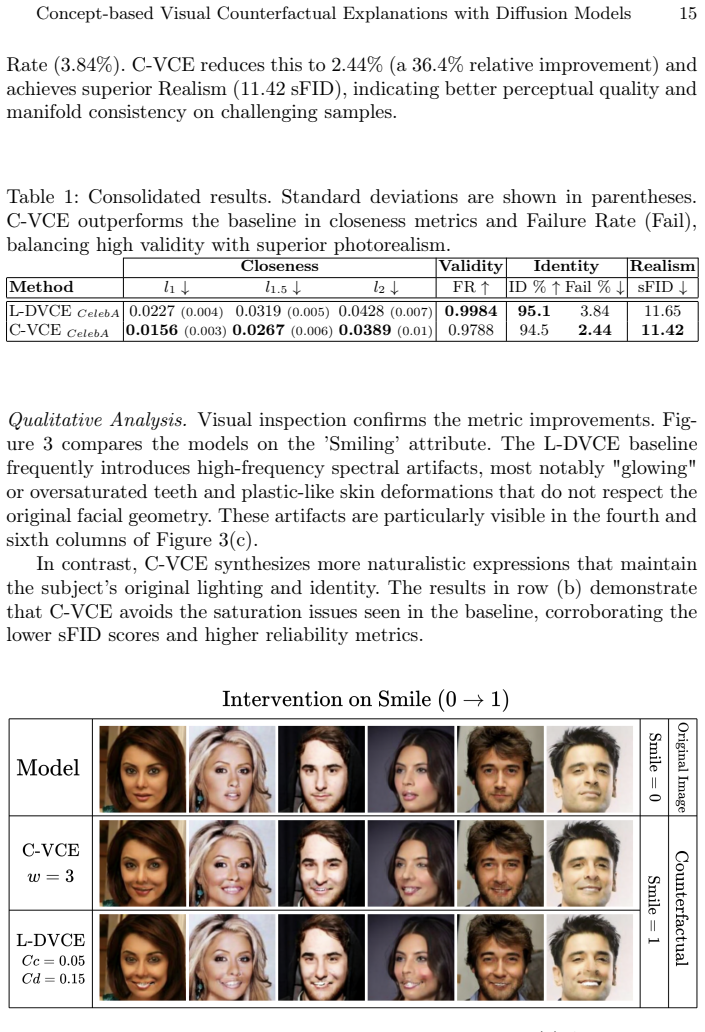
- Editorial inference: the paper's abstract says C-VCE "matches or improves flip rates," but its own Table 1 shows a strictly lower flip rate (0.9788 vs 0.9984); the honest reading is that C-VCE trades a small amount of validity for substantially better proximity and realism, rather than dominating the baseline on both axes.
- Editorial inference: the localization claim rests entirely on the gradient-derived mask and threshold κ, yet the paper provides no ablation of κ, no mask-quality metric, and no ablation removing the regularizer; a fair reader should treat the mask's role as a stated premise, not a demonstrated result.
- Editorial inference: the "semantic refusal" behavior on rare combinations could be reframed as a safety property for medical or other sensitive domains, but it also implies the method may fail to produce valid explanations when the requested counterfactual is statistically unlikely; testable extensions include adaptive concept weighting or explicit uncertainty over concept correlations.
- Editorial inference: because the mask is computed from the denoised estimate z_t and the internal concept head, the method's behavior at small timesteps—when the proximity term dominates—should be analyzed explicitly; the paper does not characterize how the mask changes across t.
Editorial analysis
A structured set of objections, weighed in public.
Referee Report
Summary. The paper proposes C-VCE, a diffusion-based visual counterfactual explanation method that embeds a Concept Bottleneck Model (CBM) directly into the U-Net bottleneck, allowing users to intervene on interpretable concept attributes during reverse diffusion. A product-of-experts regularizer balances validity against proximity to the original image, and a gradient-derived binary mask is computed on the fly to localize edits to relevant regions. The method is evaluated on CelebA against L-DVCE, reporting lower l1/l1.5/l2 distances, lower sFID, fewer face-detection failures, and a slightly lower flip rate, with an additional qualitative claim of smoother latent traversals and semantic refusal for statistically rare attribute combinations.
Significance. If the method works as described, it is a meaningful step toward interpretable counterfactual generation: the CBM layer provides a human-aligned steering mechanism, the single-pass mask avoids multi-pass editing, and the reliance on an external noise-robust classifier is supposedly removed. The paper also ships a code repository, which is a strength for reproducibility. However, the central mechanism — the product-of-experts proximity term and its mask — contains a formal inconsistency in the noise-space translation, and the provenance of the classifier used for the mask is ambiguous and unablated. These issues must be resolved before the empirical claims can be accepted as supporting the paper's thesis.
major comments (4)
- [§3.2, Eqs. (17), (18), (22)] The noise-space translation of the proximity score is inconsistent. Starting from Eq. (17), the proximity score contribution is −(x_t − √ᾱ_t x̂)/(1−ᾱ_t). Using the score-to-noise relation in Eq. (6), this should become ε_prox = (x_t − √ᾱ_t x̂)/√(1−ᾱ_t), i.e., division by √(1−ᾱ_t), not multiplication. Eq. (18) and Eq. (22) write the opposite scaling. Moreover, the text's justification that “as t→0, since √(1−ᾱ_t)→0, the proximity term can dominate” is consistent only with the division form; with the printed multiplication form the term shrinks to zero. As written, the sampling algorithm is not reproducible, and the reported results imply an unstated variant. Please correct the equations and state precisely which scaling is implemented.
- [Fig. 1 caption vs. §3.2, Algorithm 1 line 7] The source of p(c|z_t) in Eq. (20) is ambiguous. §3.2 and Algorithm 1 refer only to “the classifier,” while the Fig. 1 caption explicitly says the gradient mask is computed “via an external classifier.” If an external classifier is used, the paper's central claim of not depending on a separate noise-robust classifier is undermined. If the internal CBM head is used, the localization signal is generated by the same network that produces the counterfactual, and there is no validation that this signal aligns with the external evaluation classifier's decision regions. State unambiguously which classifier is used and justify the choice.
- [§3.2, Eqs. (20)–(22); Table 2] The load-bearing mask mechanism is not ablated or validated in isolation. There is no sensitivity analysis for the mask threshold κ, no ablation that removes the mask or the proximity regularizer, and no quantitative measure of mask quality (e.g., IoU with human annotations or with the external classifier's attribution map). Consequently, the claimed “minimal localized edit” property is not empirically established. Table 2's edit suppression for “Beard on Female” could stem from the mask, from the proximity term, or from the learned data distribution; without ablations, these causes cannot be separated. Please add ablations and report mask sensitivity.
- [Abstract; Table 1] The abstract states that C-VCE “matches or improves flip rates,” but Table 1 reports Flip Rate 0.9788 for C-VCE versus 0.9984 for L-DVCE — strictly lower. The claim should be revised to describe the trade-off accurately, e.g., competitive flip rates with better closeness and lower failure rate.
minor comments (4)
- [§5] The limitation section does not discuss the mask mechanism's dependence on κ or the lack of evaluation on non-face datasets, although these are relevant to practical deployment. Consider adding them to the limitations.
- [Acknowledgments] Typo: “proejct” should be “project.”
- [Throughout] There are minor grammatical issues, e.g., “lets users to toggle” should be “lets users toggle,” and “on/off” is used in a somewhat informal way. A careful language edit is recommended.
- [§4.2] The evaluation reports standard deviations but no significance tests for the differences in l1, sFID, or failure rate. Given the small margins (e.g., sFID 11.42 vs. 11.65), a statistical comparison would strengthen the claims.
Circularity Check
No demonstrable circularity; main derivation is self-contained, with an ambiguous mask classifier and an apparent scaling error as correctness concerns.
full rationale
The paper's central derivation is not circular. The method is trained to denoise images conditioned on concept vectors (Eq. 24); the counterfactual intervention replaces c with c' in the CBM bottleneck (Eq. 15). The reported flip rate, however, is measured by an external classifier (§4.1), not by the conditioning signal itself, so the headline validity result is an independent empirical check rather than a tautology. The proximity regularizer (Eqs. 17-18, 22) is derived from a product-of-experts combination and is not a restatement of an input. The gradient mask (Eqs. 20-21) is a localization mechanism, not a predicted quantity; its provenance is unspecified (Fig. 1 says 'external classifier' while §3.2 could be read as the internal CBM head), and if the same external classifier were both guiding the mask and scoring the flip rate, that would create circularity. But the paper does not state this identity, so the reduction cannot be exhibited. The self-citations [8,9,26] are contextual and non-load-bearing. Eq. 18's proximity term appears to have an incorrect scaling (multiplying rather than dividing by sqrt(1-alpha_bar_t)), but that is a correctness/reproducibility issue, not a circular equivalence.
Axiom & Free-Parameter Ledger
free parameters (6)
- Guidance weight w =
3 (sweep over 1-5)
- Mask threshold κ =
0.1
- Noise start timestep τ =
200
- Loss weights λ_mse, λ_cbm =
not reported
- Intervention strength α =
1.0
- Baseline strengths C_c, C_d =
C_c=0.04, C_d=0.15
axioms (8)
- standard math ε_θ(x_t,t) = -√(1-ᾱ_t) ∇ log p(x_t) (score-noise relationship, Eq. 6)
- standard math Forward noising q(x_t|x̂) = N(x̂√ᾱ_t, (1-ᾱ_t)I) defines the proximity expert's score as -(x_t-√ᾱ_t x̂)/(1-ᾱ_t)
- domain assumption The validity and proximity objectives factorize as independent experts whose product is a valid guided distribution
- domain assumption Gradient of p(c|z_t) on the denoised estimate localizes the minimal semantic region to edit
- domain assumption Classifier providing p(c|z_t) is accurate on denoised estimates
- domain assumption Ground-truth concept labels exist and the 40 CelebA attributes are sufficient concepts
- domain assumption Injecting target concept vector c' during sampling produces the intended attribute change
- domain assumption DDPM/VAE latent diffusion reconstruction preserves identity when anchored
read the original abstract
Visual counterfactual explanations aim to answer "what minimal change to this image would flip the model's prediction?", and are increasingly important as vision models are deployed in safety-critical domains (e.g., medicine). Existing diffusion-based methods can produce realistic edits, but they rely on external classifiers that must work reliably on noisy images, which makes them fragile and hard to deploy for robust explanations. We introduce C-VCE, a new diffusion framework that builds the classifier directly into the generative model via a concept bottleneck layer, so that counterfactuals are guided by human-interpretable features (concepts) instead of a separate noise robust classifier that works with pixel-level edits. Our model lets users to toggle on/off semantic concepts during sampling, then minimally adjusts relevant image regions, while preserving the rest of the image, respecting feature correlations. To keep edits small and controlled, we add a simple probabilistic regularizer that balances "change the prediction" against "stay close to the original", plus a gradient-based mask that confines modifications to the most relevant regions. On benchmarks such as CelebA, C-VCE matches or improves flip rates while producing counterfactuals that are visually closer to the input and less distorted than baselines that depend on separate noisy-image classifiers. These properties make C-VCE a practical tool for vision systems where users need concrete "what-if" images without having to trust an additional, noise-robust classifier. More broadly, our results suggest that exposing and controlling an internal concept layer is a promising way to make powerful generative models easier to understand and safer to use.
Figures




Reference graph
Works this paper leans on
-
[1]
Advances in neural information processing systems31 (2018)
Adebayo, J., Gilmer, J., Muelly, M., Goodfellow, I., Hardt, M., Kim, B.: Sanity checks for saliency maps. Advances in neural information processing systems31 (2018)
2018
-
[2]
IEEE Access (2024)
Atakishiyev, S., Salameh, M., Yao, H., Goebel, R.: Explainable artificial intelli- gence for autonomous driving: A comprehensive overview and field guide for future research directions. IEEE Access (2024)
2024
-
[3]
Augustin, M., Boreiko, V., Croce, F., Hein, M.: Diffusion visual counterfactual explanations (2022), https://arxiv.org/abs/2210.11841
Pith/arXiv arXiv 2022
-
[4]
Augustin, M., Meinke, A., Hein, M.: Adversarial robustness on in- and out- distribution improves explainability (2020), https://arxiv.org/abs/2003.09461
Pith/arXiv arXiv 2020
-
[5]
Chang, C.H., Adam, G.A., Goldenberg, A.: Towards robust classification model by counterfactual and invariant data generation (2021), https://arxiv.org/abs/2106. 01127
2021
-
[6]
Das, A., Rad, P.: Opportunities and challenges in explainable artificial intelligence (xai): A survey (2020), https://arxiv.org/abs/2006.11371
Pith/arXiv arXiv 2020
-
[7]
Dhariwal, P., Nichol, A.: Diffusion models beat gans on image synthesis (2021), https://arxiv.org/abs/2105.05233
Pith/arXiv arXiv 2021
-
[8]
Dominici, G., Barbiero, P., Giannini, F., Gjoreski, M., Marra, G., Langheinrich, M.: Counterfactual concept bottleneck models (2025), https://arxiv.org/abs/2402. 01408
2025
-
[9]
Dominici, G., Barbiero, P., Zarlenga, M.E., Termine, A., Gjoreski, M., Marra, G., Langheinrich, M.: Causal concept graph models: Beyond causal opacity in deep learning. arXiv preprint arXiv:2405.16507 (2024) Concept-based Visual Counterfactual Explanations with Diffusion Models 21
Pith/arXiv arXiv 2024
-
[10]
ACM computing surveys55(9), 1–33 (2023)
Dwivedi, R., Dave, D., Naik, H., Singhal, S., Omer, R., Patel, P., Qian, B., Wen, Z., Shah, T., Morgan, G., et al.: Explainable ai (xai): Core ideas, techniques, and solutions. ACM computing surveys55(9), 1–33 (2023)
2023
-
[11]
Esser, P., Kulal, S., Blattmann, A., Entezari, R., Müller, J., Saini, H., Levi, Y., Lorenz, D., Sauer, A., Boesel, F., Podell, D., Dockhorn, T., English, Z., Lacey, K., Goodwin, A., Marek, Y., Rombach, R.: Scaling rectified flow transformers for high-resolution image synthesis (2024), https://arxiv.org/abs/2403.03206
Pith/arXiv arXiv 2024
-
[12]
Minds and Machines32(1), 77–109 (2022)
Freiesleben, T.: The intriguing relation between counterfactual explanations and adversarial examples. Minds and Machines32(1), 77–109 (2022)
2022
-
[13]
Ghandeharioun, A., Kim, B., Li, C.L., Jou, B., Eoff, B., Picard, R.W.: Dis- sect: Disentangled simultaneous explanations via concept traversals (2022), https: //arxiv.org/abs/2105.15164
Pith/arXiv arXiv 2022
-
[14]
Goodfellow, I.J., Pouget-Abadie, J., Mirza, M., Xu, B., Warde-Farley, D., Ozair, S., Courville, A., Bengio, Y.: Generative adversarial networks (2014), https://arxiv. org/abs/1406.2661
Pith/arXiv arXiv 2014
-
[15]
Goodfellow, I.J., Shlens, J., Szegedy, C.: Explaining and harnessing adversarial examples (2015), https://arxiv.org/abs/1412.6572
Pith/arXiv arXiv 2015
-
[16]
Goodman, B., Flaxman, S.: European union regulations on algorithmic decision making and a “right to explanation”. AI Magazine38(3), 50–57 (Sep 2017). https: //doi.org/10.1609/aimag.v38i3.2741, http://dx.doi.org/10.1609/aimag.v38i3.2741
-
[17]
In: International Conference on Machine Learning
Goyal, Y., Wu, Z., Ernst, J., Batra, D., Parikh, D., Lee, S.: Counterfactual visual explanations. In: International Conference on Machine Learning. pp. 2376–2384. PMLR (2019)
2019
-
[18]
Guidotti, R.: Counterfactual explanations and how to find them: literature review and benchmarking. Data Min. Knowl. Discov.38(5), 2770–2824 (September 2024), https://doi.org/10.1007/s10618-022-00831-6
-
[19]
Ho, J., Jain, A., Abbeel, P.: Denoising diffusion probabilistic models (2020), https: //arxiv.org/abs/2006.11239
Pith/arXiv arXiv 2020
-
[20]
Ho, J., Salimans, T.: Classifier-free diffusion guidance (2022), https://arxiv.org/ abs/2207.12598
Pith/arXiv arXiv 2022
-
[21]
In: The Twelfth International Conference on Learning Representations (2024), https://openreview.net/forum?id=L9U5MJJleF
Ismail, A.A., Adebayo, J., Bravo, H.C., Ra, S., Cho, K.: Concept bottleneck genera- tive models. In: The Twelfth International Conference on Learning Representations (2024), https://openreview.net/forum?id=L9U5MJJleF
2024
-
[22]
Jacob, P., Éloi Zablocki, Ben-Younes, H., Chen, M., Pérez, P., Cord, M.: Steex: Steeringcounterfactualexplanationswithsemantics(2022),https://arxiv.org/abs/ 2111.09094
Pith/arXiv arXiv 2022
-
[23]
In: Proceedings of the Asian conference on computer vision
Jeanneret, G., Simon, L., Jurie, F.: Diffusion models for counterfactual explana- tions. In: Proceedings of the Asian conference on computer vision. pp. 858–876 (2022)
2022
-
[24]
In: Proceedings of the IEEE/CVF Conference on Computer Vision and Pattern Recognition (CVPR)
Jeanneret, G., Simon, L., Jurie, F.: Adversarial counterfactual visual explanations. In: Proceedings of the IEEE/CVF Conference on Computer Vision and Pattern Recognition (CVPR). pp. 16425–16435 (June 2023)
2023
-
[25]
Khorram, S., Fuxin, L.: Cycle-consistent counterfactuals by latent transformations (2022), https://arxiv.org/abs/2203.15064
Pith/arXiv arXiv 2022
-
[26]
View Article (2024)
Kirilenko,D.,Barbiero,P.,Gjoreski,M.,Luštrek,M.,Langheinrich,M.:Generative models for counterfactual explanations. View Article (2024)
2024
-
[27]
Koh, P.W., Nguyen, T., Tang, Y.S., Mussmann, S., Pierson, E., Kim, B., Liang, P.: Concept bottleneck models (2020), https://arxiv.org/abs/2007.04612
Pith/arXiv arXiv 2020
-
[28]
Nature Biomedical Engineering6(12), 1346–1352 (2022) 22 Y
Krishnan, R., Rajpurkar, P., Topol, E.J.: Self-supervised learning in medicine and healthcare. Nature Biomedical Engineering6(12), 1346–1352 (2022) 22 Y. Oueslati
2022
-
[29]
IEEE Trans- actions on Intelligent Transportation Systems (2024)
Kuznietsov, A., Gyevnar, B., Wang, C., Peters, S., Albrecht, S.V.: Explainable ai for safe and trustworthy autonomous driving: A systematic review. IEEE Trans- actions on Intelligent Transportation Systems (2024)
2024
-
[30]
Lang, O., Gandelsman, Y., Yarom, M., Wald, Y., Elidan, G., Hassidim, A., Free- man, W.T., Isola, P., Globerson, A., Irani, M., Mosseri, I.: Explaining in style: Training a gan to explain a classifier in stylespace (2021), https://arxiv.org/abs/ 2104.13369
Pith/arXiv arXiv 2021
-
[31]
Le, T., Lal, V., Howard, P.: Coco-counterfactuals: Automatically constructed coun- terfactual examples for image-text pairs (2023), https://arxiv.org/abs/2309.14356
Pith/arXiv arXiv 2023
-
[32]
In: Proceedings of International Conference on Computer Vision (ICCV) (December 2015)
Liu, Z., Luo, P., Wang, X., Tang, X.: Deep learning face attributes in the wild. In: Proceedings of International Conference on Computer Vision (ICCV) (December 2015)
2015
-
[33]
Loshchilov, I., Hutter, F.: Sgdr: Stochastic gradient descent with warm restarts (2017), https://arxiv.org/abs/1608.03983
Pith/arXiv arXiv 2017
-
[34]
Loshchilov, I., Hutter, F.: Decoupled weight decay regularization (2019), https: //arxiv.org/abs/1711.05101
Pith/arXiv arXiv 2019
-
[35]
In: 2025 IEEE/CVF Winter Conference on Applications of Computer Vision (WACV)
Luu, T., Le, N., Le, D., Le, B.: From visual explanations to counterfactual explana- tions with latent diffusion. In: 2025 IEEE/CVF Winter Conference on Applications of Computer Vision (WACV). p. 420–429. IEEE (Feb 2025). https://doi.org/10. 1109/wacv61041.2025.00051, http://dx.doi.org/10.1109/WACV61041.2025.00051
arXiv 2025
-
[36]
Frontiers in artificial intelligence5, 825565 (2022)
Mertes, S., Huber, T., Weitz, K., Heimerl, A., André, E.: Ganterfac- tual—counterfactual explanations for medical non-experts using generative adver- sarial learning. Frontiers in artificial intelligence5, 825565 (2022)
2022
-
[37]
Molnar, C.: Interpretable machine learning. Lulu. com (2020)
2020
-
[38]
IEEE Access (2025)
Panagiotakopoulos,T.,Kotsiantis,S.,Gkillas,A.,Lalos,A.S.:Conditionaldiffusion models: A survey of techniques, applications and challenges. IEEE Access (2025)
2025
-
[39]
Prach, B., Lampert, C.H.: Intriguing properties of robust classification (2025), https://arxiv.org/abs/2412.04245
Pith/arXiv arXiv 2025
-
[40]
Journal of the academy of marketing science48(1), 137–141 (2020)
Rai, A.: Explainable ai: From black box to glass box. Journal of the academy of marketing science48(1), 137–141 (2020)
2020
-
[41]
Ronneberger, O., Fischer, P., Brox, T.: U-net: Convolutional networks for biomed- ical image segmentation (2015), https://arxiv.org/abs/1505.04597
Pith/arXiv arXiv 2015
-
[42]
Samadi, A., Shirian, A., Koufos, K., Debattista, K., Dianati, M.: Safe: Saliency- aware counterfactual explanations for dnn-based automated driving systems (2023), https://arxiv.org/abs/2307.15786
Pith/arXiv arXiv 2023
-
[43]
In: Proceedings of the European Conference on Computer Vision (ECCV) (September 2018)
Samangouei, P., Saeedi, A., Nakagawa, L., Silberman, N.: Explaingan: Model ex- planation via decision boundary crossing transformations. In: Proceedings of the European Conference on Computer Vision (ECCV) (September 2018)
2018
-
[44]
Santurkar, S., Tsipras, D., Tran, B., Ilyas, A., Engstrom, L., Madry, A.: Image synthesis with a single (robust) classifier (2019), https://arxiv.org/abs/1906.09453
Pith/arXiv arXiv 2019
-
[45]
IEEe Access10, 84486–84517 (2022)
Saraswat, D., Bhattacharya, P., Verma, A., Prasad, V.K., Tanwar, S., Sharma, G., Bokoro, P.N., Sharma, R.: Explainable ai for healthcare 5.0: opportunities and challenges. IEEe Access10, 84486–84517 (2022)
2022
-
[46]
Sauer, A., Geiger, A.: Counterfactual generative networks (2021), https://arxiv. org/abs/2101.06046
Pith/arXiv arXiv 2021
-
[47]
In- ternational Journal of Computer Vision128(2), 336–359 (Oct 2019)
Selvaraju, R.R., Cogswell, M., Das, A., Vedantam, R., Parikh, D., Batra, D.: Grad- cam: Visual explanations from deep networks via gradient-based localization. In- ternational Journal of Computer Vision128(2), 336–359 (Oct 2019). https://doi. org/10.1007/s11263-019-01228-7, http://dx.doi.org/10.1007/s11263-019-01228-7 Concept-based Visual Counterfactual E...
-
[48]
Journal of Information Technologies17(2), 95–107 (2024)
Serengil, S., Ozpinar, A.: A benchmark of facial recognition pipelines and co- usability performances of modules. Journal of Information Technologies17(2), 95–107 (2024). https://doi.org/10.17671/gazibtd.1399077, https://dergipark.org. tr/en/pub/gazibtd/issue/84331/1399077
-
[49]
arXiv preprint arXiv:2011.13456 (2020)
Song, Y., Sohl-Dickstein, J., Kingma, D.P., Kumar, A., Ermon, S., Poole, B.: Score- based generative modeling through stochastic differential equations. arXiv preprint arXiv:2011.13456 (2020)
Pith/arXiv arXiv 2011
-
[50]
Szegedy, C., Zaremba, W., Sutskever, I., Bruna, J., Erhan, D., Goodfellow, I., Fergus, R.: Intriguing properties of neural networks (2014), https://arxiv.org/abs/ 1312.6199
Pith/arXiv arXiv 2014
-
[51]
IEEE transactions on neural networks and learning systems32(11), 4793–4813 (2020)
Tjoa, E., Guan, C.: A survey on explainable artificial intelligence (xai): Toward medical xai. IEEE transactions on neural networks and learning systems32(11), 4793–4813 (2020)
2020
-
[52]
Wachter, S., Mittelstadt, B., Russell, C.: Counterfactual explanations without opening the black box: Automated decisions and the gdpr (2018), https://arxiv. org/abs/1711.00399
Pith/arXiv arXiv 2018
-
[53]
Weng, N., Pegios, P., Petersen, E., Feragen, A., Bigdeli, S.: Fast diffusion-based counterfactuals for shortcut removal and generation (2024), https://arxiv.org/abs/ 2312.14223
Pith/arXiv arXiv 2024
-
[54]
arXiv preprint arXiv:1702.08658 (2017)
Zhao, S., Song, J., Ermon, S.: Towards deeper understanding of variational au- toencoding models. arXiv preprint arXiv:1702.08658 (2017)
Pith/arXiv arXiv 2017
discussion (0)
Sign in with ORCID, Apple, or X to comment. Anyone can read and Pith papers without signing in.