REVIEW 3 major objections 5 minor 41 references
Visible-Light Imaging Diagnosis of Neutral Particle Emission Tomography in the Tokamak Divertor: An Efficient Transformer-based Surrogate Model
T0 review · 3 major / 5 minor · reviewed 2026-08-01 · deepseek-v4-flash
Pith's one-line read This paper claims that a video-input Transformer surrogate, Delta-InvFormer, reconstructs tokamak divertor neutral-emission distributions about 200 times faster than iterative tomography, with accuracy matching or exceeding it.
desk verdict The speedup is real, but the accuracy claim does not survive the one non-circular comparison: Delta-InvFormer is worse than SAART on MRE, and the paper's own limitation section concedes the label dependence. read the letter →
The pith
A machine-rendered reading of the paper's core claim, the machinery that carries it, and where it could break.
The reading
What carries the argument
The load-bearing object is Delta-InvFormer, a surrogate network built on the Mix Transformer (MiT) backbone from SegFormer. Its key mechanism is differential self-attention: the query and key are each split into two groups, two softmax attention matrices are computed, and the network learns a scalar λ to subtract one from the other, cancelling common-mode attention noise (the same idea as differential amplifiers). The S-DiffFormer applies this within each frame to refine spatial features; the T-DiffFormer applies a cross-attention variant across three consecutive frames, using the previous frame's output as query for the next, to capture temporal dependencies and suppress the static tokamak
What would settle it
Generate synthetic ground-truth emission distributions on the 75x98 grid, forward-project them through the fixed EAST weight matrix W to create synthetic camera images, and test whether Delta-InvFormer recovers the known distributions. If its MRE on such phantoms is substantially worse than on the EAST reference labels, the reported accuracy reflects imitation of the teacher, not physical reconstruction quality.
Extended reading notes
Core claim
The central discovery is that the ill-posed inverse mapping from tangential D-alpha camera images to the 2D poloidal neutral emission distribution can be learned end-to-end by a Transformer-based surrogate with accuracy comparable to classical iterative inversion. The network, Delta-InvFormer, combines a pre-trained Mix Transformer backbone with two novel modules: a Spatial Differential Transformer (S-DiffFormer) that subtracts two softmax attention maps to cancel attention noise, and a Temporal Differential Transformer (T-DiffFormer) that uses cross-attention between consecutive frames to exploit plasma motion while treating the static device background as common-mode noise to be removed. T
Load-bearing premise
The reported accuracy is measured against reference emission maps produced by the same traditional inversion algorithms (SAART/Phillips-Tikhonov) that the network is meant to replace, and the paper concedes the results are partly constrained by the accuracy and uncertainty of those references.
Editorial extensions
If this is right
- Real-time divertor tomography: at roughly 20 FPS, the model can track fast transient events in D-alpha emission, such as the drop around 5.8–6.0 s, and could be used in feedback control loops.
- Ablation results show both spatial and temporal differential attention contribute independently—removing either raises average MRE from 5.36% to 6.26–6.88%—indicating the noise-suppression mechanism is what buys accuracy under noisy conditions.
- The approach can be transferred to other line-integral diagnostics (bolometry, interferometry) where the forward model is known and real-time reconstruction is needed.
- The model retains MRE near 5–6% under 3–5% Gaussian and uniform noise, suggesting tolerance to realistic camera and transmission noise without retraining.
Reading between the lines
- Extension: because the training labels come from the traditional inversion algorithms being replaced, the reported accuracy should be read as a measure of imitation fidelity; confirming physical correctness would require validation on independent data or forward-projected synthetic phantoms.
- Extension: the differential-attention mechanism is architecture-agnostic and could be lifted into other video-regression settings with a static background and moving foreground signal, where common-mode noise cancelation would play the same role.
- Extension: adding a forward-model consistency term (minimizing the difference between the observed camera image and the forward projection of the predicted emission) is a natural next test; it would let the model train on unlabeled camera frames and could push accuracy beyond the teacher's.
Editorial analysis
A structured set of objections, weighed in public.
Referee Report
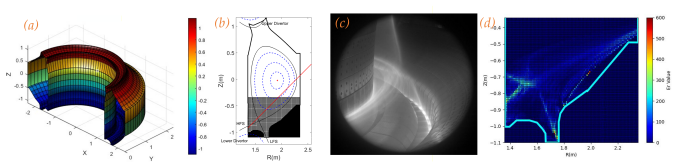
Summary. The paper proposes Delta-InvFormer, an end-to-end transformer-based surrogate model that maps consecutive visible-light D-alpha camera frames from the EAST tokamak to a masked 75×98 poloidal neutral-emission distribution. The model combines a SegFormer MiT backbone with spatial and temporal differential-attention blocks (S-DiffFormer and T-DiffFormer), followed by a fusion module and decoder. The paper reports that Delta-InvFormer achieves the best average MRE, MSE, MAE, and SSIM among the compared deep models, while running at about 20 FPS versus 0.1 FPS for the SAART iterative method, i.e., roughly a 200× speed-up. The central claim is a favorable accuracy-efficiency trade-off: competitive reconstruction accuracy with large efficiency gains. Training labels are obtained from traditional reconstruction methods (Sec. 5.1), and the authors acknowledge in Sec. 5.13 that reconstruction accuracy is partly constrained by these reference results.
Significance. If the accuracy claim were independently established, the paper would make a useful practical contribution to real-time tokamak divertor diagnostics. The efficiency result is credible: Table 10 shows a large inference-speed advantage over SAART, and the paper includes extensive comparisons with recent vision backbones, robustness tests, uncertainty analysis, and ablations. The differential attention modules are a reasonable architectural contribution. However, the central accuracy claim is not established by the present evaluation. The supervised labels are themselves outputs of traditional inversion methods, so the E-metric comparisons are measures of how well the model imitates a teacher, not of physical reconstruction quality. The only non-circular comparison that includes SAART—MRE in the camera-image space, Eq. (21), Table 10—shows that Delta-InvFormer has higher MRE than SAART on both test shots. Thus the paper's headline 'competitive reconstruction accuracy' is currently unsupported.
major comments (3)
- [§3, Eq. (3); §5.1; Tables 2 and 10] The supervised labels E in Eq. (3) are generated by traditional reconstruction methods, as stated in Sec. 5.1. Consequently, the MSE/MAE/SSIM metrics in Table 2 compare predictions against these same traditional-inversion outputs, and the label-generating method is excluded from that table. If the reference E is SAART's output, then SAART would score MSE=0, MAE=0, SSIM=1 on those metrics by construction. The only comparison that includes SAART is the MRE metric defined in Eq. (21) and reported in Table 10: SAART achieves 3.139% and 5.562% on shots #131082 and #131083, while Delta-InvFormer achieves 4.638% and 6.601%. On this non-circular metric, the surrogate is less data-consistent than the traditional method it is intended to replace. Therefore the claim of 'competitive reconstruction accuracy' is not supported by the evidence presented.
- [§5.12 and §5.13] Section 5.13 concedes that 'the reconstruction accuracy of Delta-InvFormer is also partly constrained by the accuracy and uncertainty of these reference results.' This concession directly undermines the paper's accuracy claim. The Filterscope verification in Sec. 5.12 and Table 11 establishes temporal correlation (Pearson r in the 0.82–0.86 range) between line-integrated reconstructed signals and measured Filterscope signals; it does not validate spatial accuracy of the 2D distribution. To support the accuracy claim, the authors need an independent benchmark, for example synthetic phantom cases with known E and fixed W, or comparison against measurements not used to generate training labels. Absent such evidence, the paper should be reframed as a fast surrogate for an existing inversion pipeline, not as a more accurate reconstruction method.
- [§5.6 and §5.9; Tables 5 and 8] Several modeling choices are selected using the test shots. Section 5.6 compares normalization statistics computed from different shots and chooses shot#131076 because it 'achieves the lowest MRE on shot#131082' and is 'more competitive' overall. Section 5.9 selects the 1-2-3 block-insertion positions based on MRE on the test shots. No validation split or nested selection procedure is described. This test-set-based hyperparameter selection makes the reported test metrics optimistic and weakens the generalization claims. Please introduce a held-out validation set for model selection and report test metrics obtained after final selection.
minor comments (5)
- [Abstract and §6] The abstract says source code will be released at https://github.com/Event-AHU/OpenFusion, while the full text says 'upon acceptance' and the repository name is OpenFusion rather than Delta-InvFormer. Please harmonize the availability statement and repository name.
- [Eq. (21)] The MRE formula divides by S_i. Please state how pixels with S_i=0 or near-zero values are handled; otherwise the metric is undefined or unstable in masked regions.
- [§5.8 and §5.9] The layer study in Sec. 5.8 says all S-DiffFormer/T-DiffFormer blocks are inserted into the 2nd, 3rd, and 4th backbone layers, but the default configuration adopted in Sec. 5.9 is positions 1-2-3. Please clarify whether the layer-count conclusion depends on insertion position, and report which test shot(s) are used for Tables 7 and 8.
- [Table 10] The row for P-T regularization contains '->100(CPU)' and the FPS/GFLOPs entries for some deep models appear misaligned (e.g., ViT-B row). Please reformat the table so all columns are legible and consistent.
- [Eqs. (13)–(15) and §4.3] The notation for T-DiffFormer is ambiguous: T_{i+1} is described as N×D, but X_T in Eq. (15) is T×N×D. Please define the concatenation axis and the shapes of the intermediate tensors explicitly.
Circularity Check
Accuracy claim reduces to imitation of teacher-generated labels; non-circular MRE shows SAART is more data-consistent than Delta-InvFormer.
-
fitted input called prediction
[Section 3, Eq. (3); Section 5.1; Figure 7 caption]
"Each sample consists of (i) a measured tangential-view Dα camera image, (ii) the corresponding two-dimensional poloidal cross-section distribution on a 75×98 grid obtained from traditional reconstruction methods ... where Ground Truth is the real two-dimensional distribution, MAE is the difference between Ground Truth and our method."
The reference E optimized in Eq. (3) is not an independent physical measurement; Sec. 5.1 says it is 'obtained from traditional reconstruction methods' — the same family of SAART/P-T/MaxEnt inversions used as baselines. The network is therefore fitted to imitate those reconstructions, and Figure 7 re-labels them 'Ground Truth ... real two-dimensional distribution.' MSE/MAE/SSIM computed against those labels measure imitation fidelity, not physical reconstruction accuracy; the prediction target is the fitted reference by construction.
-
fitted input called prediction
[Section 5.1 Eq. (21); Table 2; Table 10]
"Table 10: ... SAART [40] 0.1 - - 5.6003.139 5.562 ... Delta-InvFormer 2086.787 229.2126.968 4.638 6.601. ... where S_i denotes the ground-truth value of the i-th pixel in the camera image S, and Ŝ_i denotes the corresponding reconstructed value in the reconstructed image Ŝ."
The E-domain tables where Delta-InvFormer is best compare against the teacher-generated labels and omit the traditional reconstruction methods. The only metric in the paper that uses measured camera images, MRE in Eq. (21), is reported in Table 10 and shows SAART beating Delta-InvFormer on both test shots (3.139 vs 4.638; 5.562 vs 6.601). Thus the non-circular comparison contradicts the claimed 'competitive reconstruction accuracy'; the apparent advantage comes from the circular train/evaluate-on-the-same-reference design.
1 more flagged steps
-
self definitional
[Section 5.13 (Limitation Analysis)]
"since the supervised labels are generated based on traditional inversion methods, the reconstruction accuracy of Delta-InvFormer is also partly constrained by the accuracy and uncertainty of these reference results."
The authors explicitly concede that the labels are algorithm outputs whose own accuracy is unquantified. With Eq. (3) minimizing loss against those labels, the reported 'reconstruction accuracy' is accuracy relative to the teacher inversion. The paper's own limitation statement confirms that the headline accuracy claim is partly definitional rather than validated against independent physical ground truth.
full rationale
Delta-InvFormer's speed advantage (20 FPS vs 0.1 FPS, Table 10) is self-contained and not circular. The circularity lies in the accuracy claim. Eq. (3) trains the network to minimize L(f_θ(S),E), and Sec. 5.1 defines the supervised E as 'the corresponding two-dimensional poloidal cross-section distribution on a 75×98 grid obtained from traditional reconstruction methods.' Figure 7's caption then calls these teacher reconstructions 'Ground Truth ... the real two-dimensional distribution.' Tables 2 and 4-9 report MSE/MAE/SSIM/MRE against these same teacher labels, so the best-in-table E-domain scores show imitation fidelity, not physical reconstruction accuracy. Table 2 excludes the traditional inversion methods; when SAART is included in Table 10, it beats Delta-InvFormer on both test shots in the measured-image MRE (3.139 vs 4.638; 5.562 vs 6.601). Section 5.13 concedes the labels constrain accuracy. The Filterscope check (Sec. 5.12) is external but validates only temporal trends (Pearson >0.82), not spatial distribution accuracy. Hence the accuracy half of the 'favorable accuracy-efficiency trade-off' is partly circular; the efficiency half is credible.
Assumptions & free parameters
free parameters (4)
- Z-score normalization statistics (mean/std from shot#131076) =
not reported numerically; selected shot #131076
- Output clamp range =
[0, 600]
- Input frame count T =
3
- S/T-DiffFormer depth and insertion positions =
3 layers at stages 1-2-3
assumptions (4)
- domain assumption Eq. (1), S=Reshape(WE), with the precomputed geometric weight matrix W, is an adequate forward model (no reflections/scattering).
- domain assumption Traditional inversion outputs are valid enough to serve as ground truth for training and evaluation.
- domain assumption The masked 75x98 poloidal grid fully captures observable divertor emission; unobservable regions can be zeroed.
- domain assumption ADE20K-pretrained MiT features transfer to D-alpha emission images.
Cite this review
Pith. "Pith review of Visible-Light Imaging Diagnosis of Neutral Particle Emission Tomography in the Tokamak Divertor: An Efficient Transformer-based Surrogate Model." pith.science (2026). https://pith.science/paper/WGW754RF
@misc{pith2026260722704,
  author       = {Pith},
  title        = {Pith review of: Visible-Light Imaging Diagnosis of Neutral Particle Emission Tomography in the Tokamak Divertor: An Efficient Transformer-based Surrogate Model},
  year         = {2026},
  howpublished = {\url{https://pith.science/paper/WGW754RF}},
  note         = {Machine review of arXiv:2607.22704}
}
read the original abstract
Nuclear fusion has made significant progress in recent years and is expected to become one of the most important pathways to addressing global energy challenges. This paper focuses on observing plasma using visible-light cameras, analyzing its spatio-temporal motion cues, and predicting the two-dimensional spatial distribution of light intensity, aiming to provide a foundational basis for future scientific experiments using deep neural networks. Specifically, we propose Delta-InvFormer, a novel backbone network centered on a differential Transformer. The key insight is that by taking consecutive video frames as input, we can better capture the dynamics of the plasma. Moreover, spatial and temporal differential self-attention effectively mitigates interference from noisy signals, ensuring high-quality feature extraction. These features are then fused into a compact and informative representation, which is fed into a decoder network to predict the distribution. Based on real experimental data collected from the Experimental Advanced Superconducting Tokamak (EAST) large-scale scientific facility, our results demonstrate that the proposed model not only significantly accelerates traditional methods for distribution prediction but also achieves competitive reconstruction accuracy. The source code of this paper will be released on https://github.com/Event-AHU/OpenFusion
Figures


Figures from the paper (5 more)


Reference graph
Works this paper leans on
-
[1]
Alkin, B., Beck, M., Pöppel, K., Hochreiter, S., and Brandstetter, J. (2025). Vision- lstm: xlstm as generic vision backbone. InInternational Conference on Learning Representations, volume 2025, pages 23804–23826. 33
2025
-
[2]
Barbarino, M. (2020). A brief history of nuclear fusion.Nature Physics, 16(9):890–893
2020
-
[3]
Dao, T., Fu, D., Ermon, S., Rudra, A., and Ré, C. (2022). Flashattention: Fast and memory-efficient exact attention with io-awareness.Advances in neural information processing systems, 35:16344–16359
2022
-
[4]
Denisova, N. (1998). Maximum-entropy-based tomography for gas and plasma diagnostics.Journal of Physics D: Applied Physics, 31(15):1888–1895
1998
-
[5]
Ding, X., Zhang, Y ., Ge, Y ., Zhao, S., Song, L., Yue, X., and Shan, Y . (2024). Unireplknet: A universal perception large-kernel convnet for audio video point cloud time-series and image recognition. InProceedings of the IEEE/CVF con- ference on computer vision and pattern recognition, pages 5513–5524
2024
-
[6]
Dong, Q., Chen, Z., Li, R., Yang, Z., Gao, F., Chen, Y ., Xia, F., Zhong, W., and Zhao, Z. (2025). Adapted swin transformer-based real-time plasma shape detection and control in hl-3.Nuclear Fusion, 65(2):026031
2025
-
[7]
Dong, X., Zhang, L., Qian, L., Wu, C., Tang, Z., and Li, A. (2024). Acoustic tomography temperature reconstruction based on improved sparse reconstruction model and multi-scale feature fusion network.Engineering Applications of Artificial Intelligence, 133:108168
2024
-
[8]
Dosovitskiy, A., Beyer, L., Kolesnikov, A., Weissenborn, D., Zhai, X., Unterthiner, T., Dehghani, M., Minderer, M., Heigold, G., Gelly, S., et al. (2020). An image is worth 16x16 words: Transformers for image recognition at scale.arXiv preprint arXiv:2010.11929
arXiv 2020
Show all 41 references
-
[9]
R., Carvalho, P
Ferreira, D. R., Carvalho, P. J., and Fernandes, H. (2019). Deep learning for plasma tomography and disruption prediction from bolometer data.IEEE Transactions on Plasma Science, 48(1):36–45
2019
-
[10]
and Ghahramani, Z
Gal, Y . and Ghahramani, Z. (2016). Dropout as a bayesian approximation: Repre- senting model uncertainty in deep learning. Ininternational conference on machine learning, pages 1050–1059. PMLR. 34
2016
-
[11]
Gill, K., Smith, D., Joung, S., Geiger, B., McKee, G., Zimmerman, J., Coffee, R., Jalalvand, A., and Kolemen, E. (2024). Real-time confinement regime detection in fusion plasmas with convolutional neural networks and high-bandwidth edge fluc- tuation measurements.Machine Learn...
2024
-
[12]
He, K., Zhang, X., Ren, S., and Sun, J. (2016). Deep residual learning for image recognition. InProceedings of the IEEE conference on computer vision and pattern recognition, pages 770–778
2016
-
[13]
He, M., Yang, Z., Liu, S., Xia, F., and Zhong, W. (2024). Identifying lh tran- sition in hl-2a through deep learning.Plasma Physics and Controlled Fusion, 66(10):105019
2024
-
[14]
R., Lomanowski, B., Balboa, I., Carvalho, P., Groth, M., Huber, A., Matthews, G
Karhunen, J., Carr, M., Harrison, J. R., Lomanowski, B., Balboa, I., Carvalho, P., Groth, M., Huber, A., Matthews, G. F., Meakins, A., Silburn, S., and Contributors, J. (2019). Effect of reflections on 2d tomographic reconstructions of filtered cameras and on interpreting spec...
2019
-
[15]
Lakshminarayanan, B., Pritzel, A., and Blundell, C. (2017). Simple and scal- able predictive uncertainty estimation using deep ensembles.Advances in neural information processing systems, 30
2017
-
[16]
A., Cravey, R., Dunleavy, L
Laplante, P. A., Cravey, R., Dunleavy, L. P., Antonakos, J. L., LeRoy, R., East, J., Buris, N. E., Conant, C. J., Fryda, L., Boyd, R. W., et al. (2018).Comprehensive dictionary of electrical engineering. CRC Press
2018
-
[17]
H., Kim, J., Lee, J., and Choe, W
Lee, S. H., Kim, J., Lee, J., and Choe, W. (2010). Modified phillips–tikhonov regularization for plasma tomography.Current Applied Physics, 10(3):893–899
2010
-
[18]
Lei, J., Liu, Q., and Wang, X. (2022). Physics-informed multi-fidelity learning- driven imaging method for electrical capacitance tomography.Engineering Appli- cations of Artificial Intelligence, 116:105467. 35
2022
-
[19]
Lei, J., Liu, Q., and Wang, X. (2024). Deep nested algorithm unrolling learn- ing for inverse problems with its application in electrical capacitance tomography. Engineering Applications of Artificial Intelligence, 133:108617
2024
-
[20]
Liu, Y ., Tian, Y ., Zhao, Y ., Yu, H., Xie, L., Wang, Y ., Ye, Q., Jiao, J., and Liu, Y . (2024). Vmamba: Visual state space model.Advances in neural information processing systems, 37:103031–103063
2024
-
[21]
Liu, Z., Lin, Y ., Cao, Y ., Hu, H., Wei, Y ., Zhang, Z., Lin, S., and Guo, B. (2021). Swin transformer: Hierarchical vision transformer using shifted windows. InProceedings of the IEEE/CVF international conference on computer vision, pages 10012–10022
2021
-
[22]
and Hutter, F
Loshchilov, I. and Hutter, F. (2017). Decoupled weight decay regularization. arXiv preprint arXiv:1711.05101
2017 arXiv
-
[23]
and Yu, Y
Lou, M. and Yu, Y . (2025). Overlock: An overview-first-look-closely-next con- vnet with context-mixing dynamic kernels. InProceedings of the IEEE/CVF Con- ference on Computer Vision and Pattern Recognition, pages 128–138
2025
-
[24]
and Yin, F.-F
Lu, W. and Yin, F.-F. (2004). Adaptive algebraic reconstruction technique: Adap- tive algebraic reconstruction technique.Medical physics, 31(12):3222–3230
2004
-
[25]
Lu, Z., Mao, S., Yang, J., Ming, T., Xiang, J., Xu, G., and Ye, M. (2021). Tomo- graphic reconstruction of emissive profile in the divertor region for the visible light imaging diagnostic on experimental advanced superconducting tokamak.Fusion Engineering and Design, 163:112149
2021
-
[26]
Pavone, A., Merlo, A., Kwak, S., and Svensson, J. (2023). Machine learning and bayesian inference in nuclear fusion research: an overview.Plasma Physics and Controlled Fusion, 65(5):053001
2023
-
[27]
Ronneberger, O., Fischer, P., and Brox, T. (2015). U-net: Convolutional networks for biomedical image segmentation. InInternational Conference on Medical image computing and computer-assisted intervention, pages 234–241. Springer. 36
2015
-
[28]
Shin, G., Juhn, J.-W., Kwon, G., and Hahn, S.-H. (2020). Real-time classification of lh transition and elm in kstar.Fusion Engineering and Design, 157:111634
2020
-
[29]
van Leeuwen, L., Schoukens, M., Citrin, J., van Berkel, M., Duval, B., Perek, A., Team, T., et al. (2025). Machine learning enhanced tomographic reconstruction for multispectral imaging on tcv.Plasma Physics and Controlled Fusion, 67(2):025024
2025
-
[30]
N., Kaiser, Ł., and Polosukhin, I
Vaswani, A., Shazeer, N., Parmar, N., Uszkoreit, J., Jones, L., Gomez, A. N., Kaiser, Ł., and Polosukhin, I. (2017). Attention is all you need.Advances in neural information processing systems, 30
2017
-
[31]
Wai, J., Boyer, M., and Kolemen, E. (2022). Neural net modeling of equilibria in nstx-u.Nuclear Fusion, 62(8):086042
2022
-
[32]
Wang, C., Yang, W., Wang, H., Yang, R., Li, J., Wang, Z., Wei, Y ., Huang, X., Hu, C., Liu, Z., et al. (2025a). Physics-informed deep learning model for line-integral diagnostics across fusion devices.Nuclear Fusion, 65(7):076022
-
[33]
Wang, S., Wang, Y ., Ma, Q., Wang, X., Yan, N., Yang, Q., Xu, G., and Tang, J. (2024). Multi-modal fusion based q-distribution prediction for controlled nuclear fusion. InInternational Conference on Brain Inspired Cognitive Systems, pages 115–125. Springer
2024
-
[34]
Wang, X., Yang, Q., Wang, F., Chen, Q., Wu, W., Jin, Y ., Jiang, J., Jin, L., Jiang, B., Sun, D., et al. (2025b). Xihefusion: Harnessing large language models for science communication in nuclear fusion.arXiv preprint arXiv:2502.05615
-
[35]
Wu, N., Yang, Z., Li, R., Wei, N., Chen, Y ., Dong, Q., Li, J., Zheng, G., Gong, X., Gao, F., et al. (2024). High-fidelity data-driven dynamics model for reinforcement learning-based magnetic control in hl-3 tokamak.arXiv preprint arXiv:2409.09238
2024 arXiv
-
[36]
M., and Luo, P
Xie, E., Wang, W., Yu, Z., Anandkumar, A., Alvarez, J. M., and Luo, P. (2021). Segformer: Simple and efficient design for semantic segmentation with transform- ers.Advances in neural information processing systems, 34:12077–12090. 37
2021
-
[37]
Yang, Z., Yang, Z., Tian, W., Li, J., Sun, X., Zheng, G., Liu, S., Wu, N., Li, R., Xu, Z., et al. (2025a). Fusionmae: large-scale pretrained model to optimize and simplify diagnostic and control of fusion plasma.arXiv preprint arXiv:2509.12945
-
[38]
Yang, Z., Zhong, W., Xia, F., Gao, Z., Zhu, X., Li, J., Hu, L., Xu, Z., Li, D., Zheng, G., et al. (2025b). Implementing deep learning-based disruption pre- diction in a drifting data environment of new tokamak: Hl-3.Nuclear Fusion, 65(2):026030
-
[39]
Ye, T., Dong, L., Xia, Y ., Sun, Y ., Zhu, Y ., Huang, G., and Wei, F. (2024). Differ- ential transformer.arXiv preprint arXiv:2410.05258
2024 arXiv
-
[40]
Zhang, B., Yang, Q., Wang, B., Yang, J., Lin, X., Zhang, C., Du, H., Gao, W., Yu, Y ., Zhang, W., et al. (2025). Tomography of divertor neutral particle emission using visible ccd imaging under metal-wall condition in east.Plasma Physics and Controlled Fusion, 67(7):075021
2025
-
[41]
Zheng, G., Yang, Z., Liu, S., Ma, R., Gong, X., Wang, A., Wang, S., and Zhong, W. (2024). Real-time equilibrium reconstruction by multi-task learning neural net- work based on hl-3 tokamak.Nuclear Fusion, 64(12):126041. 38
2024
Reviewed August 1, 2026 · model on record in the stance chip above.
Discussion (0). Sign in to comment.