REVIEW 4 major objections 4 minor 1 cited by
BOSS-CLAM infers Teff, logg, [Fe/H], and [α/M] from low-resolution BOSS spectra via a generative forward model, producing a clean catalog of 915,514 stars.
Reviewed by Pith at T0; open to challenge. T0 means a machine referee read the full paper against a public rubric. the ladder, T0–T4 →
T0 review · deepseek-v4-flash
2026-08-01 04:23 UTC pith:Y6BX2BNN
load-bearing objection Solid, useful generative pipeline with a large public catalog, but the headline precision and low-metallicity accuracy rest on partly in-sample validation and an untested scale extrapolation. the 4 major comments →
BOSS-CLAM: Utilizing a Constrained Linear Absorption Model to Infer Stellar Parameters from BOSS Spectra
The pith
A machine-rendered reading of the paper's core claim, the machinery that carries it, and where it could break.
Core claim
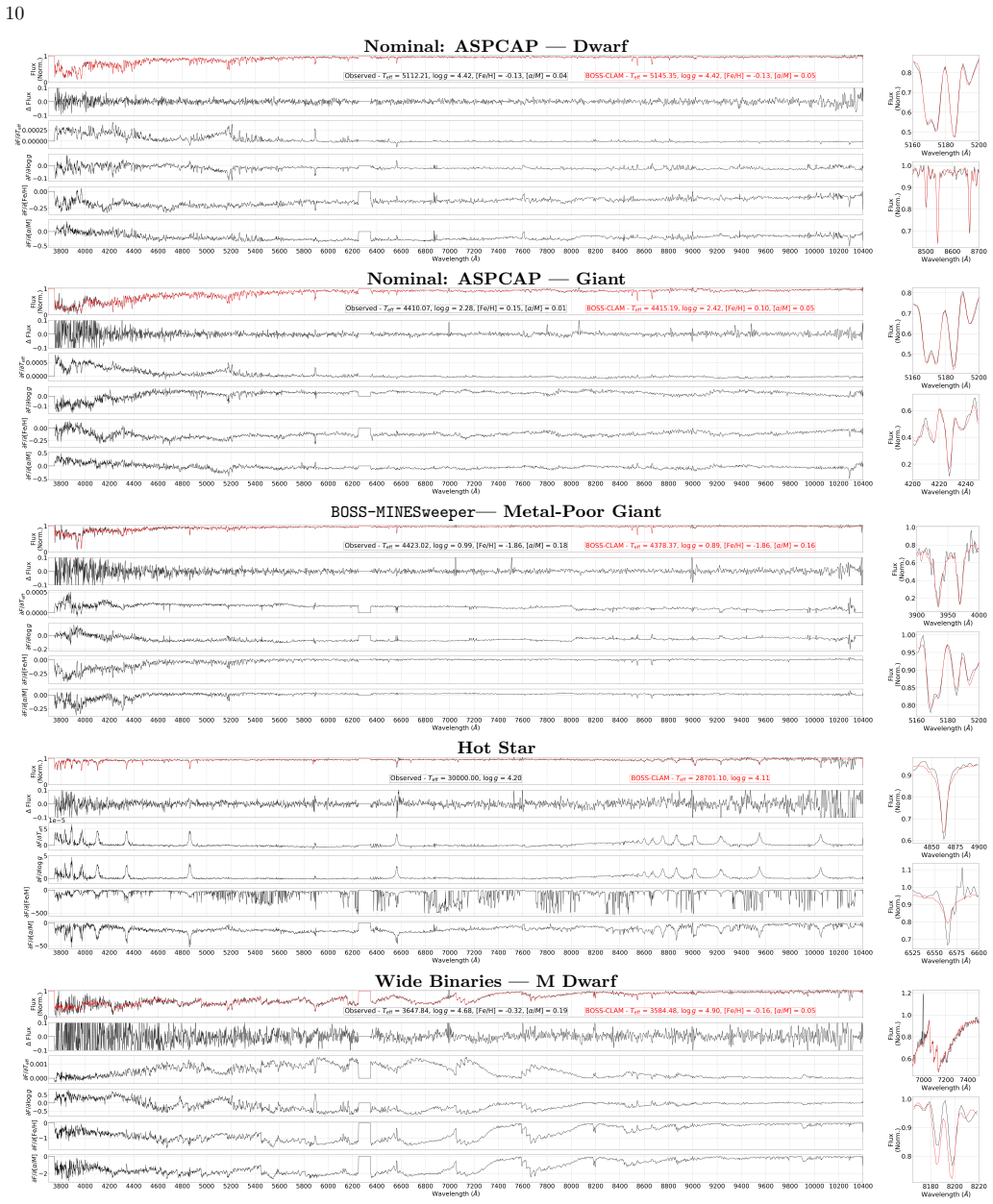
The paper's central claim is that stellar labels can be inferred from BOSS spectra by forward modeling rather than classification: learned NMF basis vectors encode absorption features, and a quadratic polynomial maps Teff, logg, [Fe/H], and [α/M] to non-negative weights, with the mapping and basis optimized jointly on a multi-source label set. Because the model generates spectra from labels rather than regressing labels from spectra, the noise in the low-resolution spectrum enters only the variance, not the bias, of inferred parameters. The paper further claims that this yields homogeneous abundances from cool M dwarfs through hot OB stars, recovers cluster abundances across a wide metallici
What carries the argument
Non-negative Matrix Factorization (NMF): spectra are decomposed as 1 − WH, where H are non-negative basis absorption spectra and W are non-negative weights. The weights are generated from standardized labels through a quadratic feature map with a learned coefficient matrix and a softplus nonlinearity. The same objective optimizes the basis, the mapping, a per-pixel scatter term, and the labels themselves, with a label-regularization term that allows imperfect or partially missing labels (hot stars have no [Fe/H] or [α/M] labels). This joint optimization is what lets the method adapt to lower resolution and imperfect continuum normalization.
Load-bearing premise
The catalog's abundance scale is stitched by empirical corrections onto an infrared-derived label scale, and for [Fe/H] < −1.5 the correction is an untested constant extrapolation; if that scale transfer fails, the low-metallicity and alpha-abundance results are biased without any flag being triggered.
What would settle it
Compare BOSS-CLAM [Fe/H] and [α/M] with high-resolution optical abundances for a sample of metal-poor giants with [Fe/H] < −1.5. If the constant offset used below −1.5 is wrong, the difference should trend with [Fe/H] and exceed the claimed ~0.15 dex scatter; the paper reports no such external check in that regime.
If this is right
- If the scale transfer holds, BOSS-CLAM delivers roughly 915k stars with trustworthy Teff, logg, [Fe/H], and [α/M] in a single homogeneous catalog, an order-of-magnitude expansion for optical SDSS-V stellar parameters.
- The claimed abundance precision at SNR 10—σ[Fe/H] ≈ 0.15 dex and σ[α/M] ≈ 0.06 dex—means faint, low-SNR BOSS targets become usable for population studies, extending Galactic archaeology to fainter stars.
- Cluster validation indicates the pipeline avoids the systematic metallicity biases seen in a discriminative neural-net baseline, particularly at the metal-poor end.
- The trained generative model can synthesize BOSS-like spectra for arbitrary stellar labels, enabling construction of mock surveys and testing of selection functions.
- Recovery of known thin/thick disk chemical sequences and Magellanic Cloud chemistry supports use of the catalog for chemical tagging and disk-structure studies.
Where Pith is reading between the lines
- Extension: because the model generates spectra from labels, the same architecture could be retrained on other R≈2000 surveys, turning heterogeneous label sets into a homogeneous catalog without waiting for a single high-resolution survey to cover the whole HR diagram.
- Extension: the constant extrapolation below [Fe/H] = −1.5 is the point most worth stress-testing; a dedicated high-resolution optical sample of metal-poor giants would either confirm the extrapolation or reveal a low-metallicity bias that the current flagging system would not catch.
- Extension: the reported [α/M]–[Fe/H] degeneracy for alpha-rich stars suggests that adding carbon and nitrogen labels, as the paper notes in passing, might also tighten the alpha-abundance estimates, and this is a concrete testable improvement.
Editorial analysis
A structured set of objections, weighed in public.
Referee Report
Summary. The paper presents BOSS-CLAM, a generative forward-modeling pipeline that infers Teff, logg, [Fe/H], and [α/M] from continuum-normalized SDSS-V BOSS spectra. The model maps stellar labels to NMF basis weights through a quadratic polynomial (P=15) and jointly optimizes the spectral decomposition, the label-to-weight mapping, and a per-pixel scatter term during training; at inference the labels are optimized with fixed spectral model. Training labels are drawn from four sources: ASPCAP, BOSS-MINESweeper, wide binaries, and a hot-star validation sample. The pipeline is applied to 1,708,214 DR20 spectra, with a recommended clean catalog of 915,514 sources. Validation includes open and globular clusters, wide binaries, APO/LCO repeatability, and comparisons against eight external catalogs. The paper claims accurate abundances across a wide HR range and wide metallicity range, with σ[Fe/H]≈0.15 dex and σ[α/M]≈0.06 dex at SNR=10.
Significance. If the accuracy claims hold, BOSS-CLAM is a major community resource: it provides a public, validated, order-of-magnitude larger stellar-parameter catalog for the SDSS-V BOSS sample, with release of the pipeline, trained model, and catalog. The methodological core is sound and unusually well specified: Eq. (6) gives the full training objective, the generative formulation mitigates attenuation bias relative to discriminative models, and the validation design includes genuinely external benchmarks (wide binaries, APO/LCO repeatability, cross-survey comparisons). The explicit flagging system based on covariance correlations and targeting information is a useful contribution. The main weakness is that the absolute abundance scale at low metallicity — a load-bearing part of the abstract's 'wide range of metallicity' claim — rests on an extrapolated correction.
major comments (4)
- [§2.2 and §5.1 / Eq. (1)] The low-metallicity abundance scale is set by an extrapolation that is not independently validated. The ASPCAP 'Nominal' training sample deliberately removes [Fe/H]<-1.5 and logg<3.5 (§2.1), so the quadratic correction in Eq. (1) is fitted only for [Fe/H]>-1.5; below -1.5 the correction is frozen at Δ[Fe/H](-1.5). The M92 validation (§5.1 and Fig. 10) is not fully external because the BOSS-MINESweeper VAC (Chandra et al. 2026) supplies both the corrected training labels and the literature cluster abundances used in Fig. 11. Agreement with M92 therefore demonstrates internal consistency with the training scale, not absolute accuracy at [Fe/H]≈-2.3. Please add an external high-resolution low-metallicity comparison (e.g., GALAH or other optical high-res samples) or explicitly restrict the abstract's accuracy claim in the low-metallicity regime.
- [§4.1] The DESI comparison shows a metallicity offset that the authors attribute to 'a difference in abundance measurements in the optical and infrared' or to model differences. This bears directly on the choice to train BOSS-CLAM on infrared-derived ASPCAP labels for optical BOSS spectra. If optical and infrared abundance scales differ, the ASPCAP-based zero point is not automatically transferable to BOSS spectra. The paper should quantify this risk, for example by reporting the DESI offset in [Fe/H] and [α/M] as a function of SNR and stellar type, and by checking whether an independent optical high-resolution sample (GALAH) shows the same offset pattern in the same regime.
- [§5.1 / Fig. 11] The cluster validation does not quantify the [α/M] systematics that the text acknowledges ('BOSS-CLAM can under- or over-estimate the value relative to the literature for all clusters'). Since [α/M] is a primary product and the wide-binary test quotes σ≈0.06 dex at SNR=10, the cluster comparison should report per-cluster mean offsets and RMS for both [Fe/H] and [α/M]. Without a numerical summary, the claim of 'homogeneous, accurate abundances' is not fully supported for [α/M].
- [§3.1/3.2 and Fig. 3] The train/test split is not clearly specified. The text says seven stars per bin are selected into the training set, but then states 'we run this inference step on all of the data from our four groups' when describing the comparison in Fig. 3. If Fig. 3 includes stars used in training, the quoted scatter and MAD are optimistic. Please state explicitly which stars were held out and report held-out-only metrics.
minor comments (4)
- [§2.1] The prose says 'removing stars where the spectrum fit and [Fe/H] were flagged as bad' but the filter list includes `flag_bad = False` and `fe_h_flags = 0`. Clarify what `flag_bad` refers to (ASPCAP fit vs. spectrum-level flag).
- [Eq. (6)] The per-pixel scatter is denoted s_m in the equation but s_λ in the text. Use a single notation for clarity.
- [Fig. 9 caption] The bottom panel's bar heights are described as counts of stars with each flag bit set, but the caption should state explicitly that a star can contribute to multiple bars if it has multiple flags.
- [Abstract / §5.1] The abstract's 'accurate abundances across a wide range of metallicity' is stronger than what the cluster test demonstrates, given the [α/M] systematics acknowledged in §5.1. Consider softening to 'precise and internally homogeneous' or adding a quantitative statement.
Circularity Check
Wide-binary precision headline is in-sample: the same binaries that define the low-mass training labels yield the quoted sigma[Fe/H] and sigma[alpha/M].
specific steps
-
fitted input called prediction
[Section 2.3 (training labels) and Section 5.2 / Figure 13 (wide-binary validation)]
"To add data for the low-mass dwarfs in the training set, we utilize the wide binaries from K. El-Badry et al. (2021). ... With this, we then transfer the [Fe/H] and [alpha/M] from the ASPCAP parameters of the primary to the BOSS spectrum of the secondary. ... To probe this, we use the wide binaries from K. El-Badry et al. (2021) that meet the same quality cuts as in Section 2.3. ... implying that sigma[Fe/H] ~ 0.15 dex and sigma[alpha/M] ~ 0.06 at SNR = 10."
The exact wide-binary catalog used to construct low-mass dwarf training labels (secondary [Fe/H]/[alpha/M] defined as the primary's ASPCAP values) is then used as the validation sample for the quoted precision. No holdout or exclusion is described, so the scatter in Figure 13 measures the model's ability to reproduce label assignments it was trained on, not an independent external accuracy estimate. The abstract's headline precision is therefore partly in-sample.
-
fitted input called prediction
[Section 5.1, Figure 10 (M67 cluster validation)]
"The APOGEE training set, including M67, recovers the effects from diffusion processes near the turn-off, resulting in a shift of <= -0.1 dex (D. Souto et al. 2019), similar to what is seen here."
M67 is acknowledged to be inside the APOGEE/ASPCAP training set that supplies the Nominal BOSS-CLAM labels. Using M67 as a validation cluster therefore partly checks in-sample reproduction of the training label scale rather than purely external accuracy. The intra-cluster scatter test retains some value, but the cluster's absolute metallicity agreement is not fully independent of the training data.
full rationale
The core BOSS-CLAM derivation is not definitionally circular: the NMF mapping Theta, basis H, and labels are jointly optimized against continuum-normalized BOSS spectra through the spectrum likelihood plus label regularization (Eq. 6), and the catalog is additionally compared with genuinely external surveys (GALAH, DESI, Gaia, LAMOST) and with APO/LCO repeatability. However, the headline precision claim in the abstract comes from the Section 5.2 wide-binary test, and that test uses the same El-Badry et al. (2021) binaries that supplied the low-mass dwarf training labels in Section 2.3, with secondary abundances defined by transfer from the primary. Because no holdout is described, the quoted sigma[Fe/H] ~ 0.15 dex and sigma[alpha/M] ~ 0.06 dex are in-sample scatter estimates. The M67 check is a milder version of the same issue, since the paper itself notes M67 is in the APOGEE training set. The low-metallicity extrapolation in Eq. (1) is a genuine accuracy risk rather than a circularity: the constant correction below [Fe/H] = -1.5 is untested, but the M92 comparison uses an external literature value (J.-W. Lee 2023), so that concern belongs to correctness risk, not to definitional reduction. Overall, the central precision claim is partially circular, while independent content remains in the cross-survey and repeatability checks.
Axiom & Free-Parameter Ledger
free parameters (5)
- MINESweeper→ASPCAP [Fe/H] scale polynomial =
-0.0204·[Fe/H]² - 0.0937·[Fe/H] - 0.119; constant below -1.5
- MINESweeper→ASPCAP [α/M] offset =
0.106
- SNR-scaling fit for abundance scatter =
A=0.479, B=0.486 ([Fe/H]); A=0.157, B=0.411 ([α/M])
- NMF basis count K and label weight λ_ℓ =
K=160; λ_ℓ=1
- Training-set sampling scheme =
40 bins per axis; 7 stars per bin; 80% of hot stars
axioms (7)
- domain assumption Continuum-normalized stellar spectra are representable as F̂ = 1 − WH with non-negative absorption basis H and non-negative weights W (Eq. 5).
- domain assumption ASPCAP labels measured in near-infrared APOGEE spectra remain valid labels for the same stars observed in optical BOSS spectra.
- domain assumption A quadratic polynomial in four standardized labels (P=15 features) maps labels to NMF weights smoothly over the full HR diagram.
- domain assumption Wide binary components share identical [Fe/H] and [α/M], allowing primary-to-secondary label transfer after astrometric and photometric quality cuts.
- domain assumption Mann et al. (2015, 2019) photometric relations provide unbiased Teff and logg for the M dwarf training labels.
- domain assumption Residual continuum-normalization errors are absorbed by the NMF latent representation rather than biasing inferred labels.
- standard math The per-pixel Gaussian likelihood with learned scatter s_m (Eq. 6) is a valid noise model for BOSS spectra.
read the original abstract
Large spectroscopic surveys require robust pipelines capable of inferring stellar parameters over a wide range of the Hertzsprung-Russell (HR) diagram from data of varying quality. SDSS-V is one such survey, where the data from the lower-resolution, optical BOSS spectrograph will provide a large dataset covering a wide range of Galactic stellar populations. To better analyze these data, we present BOSS-CLAM, a generative, forward modeling pipeline for inferring effective temperature ($T_\mathrm{eff}$), surface gravity ($\log g$), metallicity ($[\mathrm{Fe/H}]$), and $\alpha-$abundance ($[\alpha/\mathrm{M}]$) from continuum-normalized BOSS spectra. BOSS-CLAM maps stellar labels to Non-negative Matrix Factorization (NMF) basis vector weights via a polynomial mapping jointly optimized with the spectral decomposition, which provides a more flexible framework for working with the lower-resolution BOSS data. Additionally, training labels are drawn from four complementary sources (ASPCAP, BOSS-MINESweeper, wide binaries, and a hot star validation sample), which enables coverage from cool M dwarfs through hot OB stars, and across a wide range of metallicity. We infer parameters for 1,708,214 BOSS spectra, with a recommended clean catalog of 915,514 sources. Validation against open and globular clusters demonstrates homogeneous, accurate abundances across a wide range of metallicity. Wide binary tests yield abundance uncertainties of $\sigma_{[\mathrm{Fe/H}]} \approx 0.15$ dex and $\sigma_{[\alpha/\mathrm{M}]} \approx 0.06$ dex at SNR = 10. Finally, we demonstrate that the BOSS-CLAM catalog recovers known chemical structure of the Milky Way disk and is well-suited for Galactic archaeology, chemical tagging, and stellar population modeling. The pipeline, trained model, and catalog are publicly released as part of SDSS-V DR20.
Figures




Forward citations
Cited by 1 Pith paper
-
The Twentieth Data Release of the Sloan Digital Sky Survey: First All-Sky BOSS Spectra, eROSITA-SDSS-V Mapper Coordinated Observations, and a Preview of the Local Volume Mapper
DR20 releases over three million BOSS spectra (first southern-hemisphere SDSS-V optical data), 169 LVM integral-field tiles over six targets, and eighteen value-added catalogs.
Reference graph
Works this paper leans on
-
[1]
Abdurro'uf , Accetta , K., Aerts , C., et al. 2022, title The Seventeenth Data Release of the Sloan Digital Sky Surveys: Complete Release of MaNGA, MaStar, and APOGEE-2 Data , , 259, 35, 10.3847/1538-4365/ac4414
-
[2]
Allende Prieto , C., Beers , T. C., Wilhelm , R., et al. 2006, title A Spectroscopic Study of the Ancient Milky Way: F- and G-Type Stars in the Third Data Release of the Sloan Digital Sky Survey , , 636, 804, 10.1086/498131
doi:10.1086/498131 2006
-
[3]
Andrae , R., Rix , H.-W., & Chandra , V. 2023, title Robust Data-driven Metallicities for 175 Million Stars from Gaia XP Spectra , , 267, 8, 10.3847/1538-4365/acd53e
-
[4]
Astropy Collaboration , Robitaille , T. P., Tollerud , E. J., et al. 2013, title Astropy: A community Python package for astronomy , , 558, A33, 10.1051/0004-6361/201322068
-
[5]
Astropy Collaboration , Price-Whelan , A. M., Sip o cz , B. M., et al. 2018, title The Astropy Project: Building an Open-science Project and Status of the v2.0 Core Package , , 156, 123, 10.3847/1538-3881/aabc4f
-
[6]
Astropy Collaboration , Price-Whelan , A. M., Lim , P. L., et al. 2022, title The Astropy Project: Sustaining and Growing a Community-oriented Open-source Project and the Latest Major Release (v5.0) of the Core Package , , 935, 167, 10.3847/1538-4357/ac7c74
-
[7]
Badenes , C., Mazzola , C., Thompson , T. A., et al. 2018, title Stellar Multiplicity Meets Stellar Evolution and Metallicity: The APOGEE View , , 854, 147, 10.3847/1538-4357/aaa765
-
[8]
Bailer-Jones , C. A. L., Rybizki , J., Fouesneau , M., Demleitner , M., & Andrae , R. 2021, title Estimating Distances from Parallaxes. V. Geometric and Photogeometric Distances to 1.47 Billion Stars in Gaia Early Data Release 3 , , 161, 147, 10.3847/1538-3881/abd806
-
[9]
Behmard , A., Ness , M. K., Casey , A. R., et al. 2025, title A Data-driven M Dwarf Model and Detailed Abundances for 17,000 M Dwarfs in SDSS-V , , 982, 13, 10.3847/1538-4357/adaf1f
-
[10]
Bensby , T., Feltzing , S., & Oey , M. S. 2014, title Exploring the Milky Way stellar disk. A detailed elemental abundance study of 714 F and G dwarf stars in the solar neighbourhood , , 562, A71, 10.1051/0004-6361/201322631
-
[11]
2024, title Searching for chemo-kinematic structures in the Milky Way halo with deep clustering algorithms, arXiv e-prints
Berni, L. 2024, title Searching for chemo-kinematic structures in the Milky Way halo with deep clustering algorithms, arXiv e-prints
2024
-
[13]
Bochanski , J. J., Hawley , S. L., Covey , K. R., et al. 2010, title The Luminosity and Mass Functions of Low-mass Stars in the Galactic Disk. II. The Field , , 139, 2679, 10.1088/0004-6256/139/6/2679
-
[14]
Bovy , J., Hogg , D. W., & Roweis , S. T. 2011, title Extreme deconvolution: Inferring complete distribution functions from noisy, heterogeneous and incomplete observations , Annals of Applied Statistics, 5, 1657, 10.1214/10-AOAS439
-
[16]
2018, JAX : composable transformations of P ython+ N um P y programs, 0.3.13 http://github.com/jax-ml/jax
Bradbury, J., Frostig, R., Hawkins, P., et al. 2018, JAX : composable transformations of P ython+ N um P y programs, 0.3.13 http://github.com/jax-ml/jax
2018
-
[17]
Buder , S., Kos , J., Wang , X. E., et al. 2025, title The GALAH survey: Data release 4 , , 42, e051, 10.1017/pasa.2025.26
-
[18]
H., Lu, P., Nocedal, J., & Zhu, C
Byrd, R. H., Lu, P., Nocedal, J., & Zhu, C. 1995, title A Limited Memory Algorithm for Bound Constrained Optimization, SIAM Journal on Scientific Computing, 16, 1190, 10.1137/0916069
doi:10.1137/0916069 1995
-
[19]
Cargile , P. A., Conroy , C., Johnson , B. D., et al. 2020, title MINESweeper: Spectrophotometric Modeling of Stars in the Gaia Era , ApJ, 900, 28, 10.3847/1538-4357/aba43b
-
[20]
2019, title Open clusters in APOGEE and GALAH
Carrera , R., Bragaglia , A., Cantat-Gaudin , T., et al. 2019, title Open clusters in APOGEE and GALAH. Combining Gaia and ground-based spectroscopic surveys , , 623, A80, 10.1051/0004-6361/201834546
-
[21]
Carretta , E., Bragaglia , A., Gratton , R. G., et al. 2015, title The normal chemistry of multiple stellar populations in the dense globular cluster NGC 6093 (M 80) , , 578, A116, 10.1051/0004-6361/201525951
-
[23]
R., Wheeler , A., Bedell , M., et al
Casey , A. R., Wheeler , A., Bedell , M., et al. 2026, title A Constrained Linear Model for Continuum Normalization of Stellar Spectra , , 998, 192, 10.3847/1538-4357/ae3bd6
-
[24]
Chandra, V., Cargile, P. A., Ji, A. P., et al. 2026, title Mapping the Distant and Metal-poor Milky Way with SDSS-V, The Astrophysical Journal, 1000, 283, 10.3847/1538-4357/ae448a
-
[25]
Chiappini, C., Matteucci, F., & Gratton, R. 1997, title The chemical evolution of the Galaxy, The Astrophysical Journal, 477, 765, 10.1086/303726
doi:10.1086/303726 1997
-
[26]
Cooper , A. P., Koposov , S. E., Allende Prieto , C., et al. 2023, title Overview of the DESI Milky Way Survey , , 947, 37, 10.3847/1538-4357/acb3c0
-
[27]
2020, The D eep M ind JAX E cosystem, http://github.com/google-deepmind
DeepMind, Babuschkin, I., Baumli, K., et al. 2020, The D eep M ind JAX E cosystem, http://github.com/google-deepmind
2020
-
[28]
Donor , J., Frinchaboy , P. M., Cunha , K., et al. 2018, title The Open Cluster Chemical Abundances and Mapping Survey. II. Precision Cluster Abundances for APOGEE Using SDSS DR14 , , 156, 142, 10.3847/1538-3881/aad635
-
[29]
El-Badry , K., & Rix , H.-W. 2018, title Imprints of white dwarf recoil in the separation distribution of Gaia wide binaries , , 480, 4884, 10.1093/mnras/sty2186
-
[30]
El-Badry , K., Rix , H.-W., & Heintz , T. M. 2021, title A million binaries from Gaia eDR3: sample selection and validation of Gaia parallax uncertainties , , 506, 2269, 10.1093/mnras/stab323
-
[31]
Freeman, K., & Bland-Hawthorn, J. 2002, title The New Galaxy: Signatures of Its Formation, Annual Review of Astronomy and Astrophysics, 40, 487, 10.1146/annurev.astro.40.060401.093840
arXiv 2002
-
[32]
Gunn , J. E., Siegmund , W. A., Mannery , E. J., et al. 2006, title The 2.5 m Telescope of the Sloan Digital Sky Survey , , 131, 2332, 10.1086/500975
doi:10.1086/500975 2006
-
[34]
Hasselquist , S., Hayes , C. R., Lian , J., et al. 2021, title APOGEE Chemical Abundance Patterns of the Massive Milky Way Satellites , , 923, 172, 10.3847/1538-4357/ac25f9
-
[35]
Hayden, M. R., Bovy, J., Holtzman, J. A., & et al. 2015, title Chemical Cartography with APOGEE, The Astrophysical Journal, 808, 132, 10.1088/0004-637X/808/2/132
-
[36]
2014, title On the metallicity of open clusters
Heiter , U., Soubiran , C., Netopil , M., & Paunzen , E. 2014, title On the metallicity of open clusters. II. Spectroscopy , , 561, A93, 10.1051/0004-6361/201322559
-
[37]
Helmi , A., Babusiaux , C., Koppelman , H. H., et al. 2018, title The merger that led to the formation of the Milky Way's inner stellar halo and thick disk , , 563, 85, 10.1038/s41586-018-0625-x
-
[38]
Hinton, G. E. 1989, title Connectionist Learning Procedures, Artif. Intell., 40, 185. https://api.semanticscholar.org/CorpusID:7840452
1989
-
[40]
Hunter, J. D. 2007, title Matplotlib: A 2D graphics environment, Computing in Science & Engineering, 9, 90, 10.1109/MCSE.2007.55
-
[41]
Husser , T.-O., Wende-von Berg , S., Dreizler , S., et al. 2013, title A new extensive library of PHOENIX stellar atmospheres and synthetic spectra , , 553, A6, 10.1051/0004-6361/201219058
-
[42]
Ivans , I. I., Sneden , C., Kraft , R. P., et al. 1999, title Star-to-Star Abundance Variations among Bright Giants in the Mildly Metal-poor Globular Cluster M4 , , 118, 1273, 10.1086/301017
-
[45]
A., Rix , H.-W., Aerts , C., et al
Kollmeier , J. A., Rix , H.-W., Aerts , C., et al. 2026, title Sloan Digital Sky Survey. V. Pioneering Panoptic Spectroscopy , , 171, 52, 10.3847/1538-3881/ae0576
-
[46]
Lee, D., & Seung, H. S. 2000, title Algorithms for Non-negative Matrix Factorization, in Advances in Neural Information Processing Systems, ed. T. Leen, T. Dietterich, & V. Tresp, Vol. 13 (MIT Press). https://proceedings.neurips.cc/paper_files/paper/2000/file/f9d1152547c0bde01830b7e8bd60024c-Paper.pdf
2000
-
[47]
D., & Seung, H
Lee, D. D., & Seung, H. S. 2000, title Algorithms for non-negative matrix factorization, Advances in Neural Information Processing Systems, 13
2000
-
[48]
Lee , J.-W. 2023, title M92 (NGC 6341) Is a Metal-complex Globular Cluster with an Atypical Primordial Population , , 948, L16, 10.3847/2041-8213/acd05a
-
[49]
Li , J., Liu , C., Zhang , Z.-Y., et al. 2023, title Stellar initial mass function varies with metallicity and time , , 613, 460, 10.1038/s41586-022-05488-1
-
[50]
Li , J., Rix , H.-W., Ting , Y.-S., et al. 2026, title Variations in the Milky Way's Stellar Mass Function at [Fe/H] < - 1 , , 998, L33, 10.3847/2041-8213/ae3d39
-
[51]
2026, VizieR Online Data Catalog: LAMOST DR11 catalogs (Luo+, 2026) ,, VizieR On-line Data Catalog: V/162
Luo , A.-L., Zhao , Y.-H., Zhao , G., & et al. 2026, VizieR Online Data Catalog: LAMOST DR11 catalogs (Luo+, 2026) ,, VizieR On-line Data Catalog: V/162. Originally published in: 2026RAA..in.prep..L
2026
-
[52]
Mann , A. W., Feiden , G. A., Gaidos , E., Boyajian , T., & von Braun , K. 2015, title How to Constrain Your M Dwarf: Measuring Effective Temperature, Bolometric Luminosity, Mass, and Radius , , 804, 64, 10.1088/0004-637X/804/1/64
-
[53]
Mann , A. W., Dupuy , T., Kraus , A. L., et al. 2019, title How to Constrain Your M Dwarf. II. The Mass-Luminosity-Metallicity Relation from 0.075 to 0.70 Solar Masses , , 871, 63, 10.3847/1538-4357/aaf3bc
-
[54]
Medan , I., Way , Z., Rojas-Ayala , B., et al. 2025, title The Importance of Standardizing Spectra in the Era of Large Spectroscopic Surveys: A Case Study of M Dwarfs in SDSS-V , , 170, 302, 10.3847/1538-3881/ae0a12
-
[55]
M \'e sz \'a ros , S., Martell , S. L., Shetrone , M., et al. 2015, title Exploring Anticorrelations and Light Element Variations in Northern Globular Clusters Observed by the APOGEE Survey , , 149, 153, 10.1088/0004-6256/149/5/153
-
[56]
M \'e sz \'a ros , S., Jofr \'e , P., Johnson , J. A., et al. 2025, title SDSS-V Milky Way Mapper (MWM): ASPCAP Stellar Parameters and Abundances in SDSS-V Data Release 19 , , 170, 96, 10.3847/1538-3881/ade4b9
-
[57]
Minchev, I., Chiappini, C., & Martig, M. 2013, title Chemodynamical evolution of the Milky Way disk, Astronomy & Astrophysics, 558, A9, 10.1051/0004-6361/201220386
-
[58]
Ness, M., Hogg, D. W., Rix, H.-W., Ho, A. Y. Q., & Zasowski, G. 2015, title The Cannon: A data-driven approach to stellar label determination, The Astrophysical Journal, 808, 16, 10.1088/0004-637X/808/1/16
-
[59]
Nidever, D. L., Bovy, J., Bird, J. C., & et al. 2014, title Tracing chemical evolution with APOGEE, The Astrophysical Journal, 796, 38, 10.1088/0004-637X/796/1/38
-
[60]
L., Hasselquist , S., Hayes , C
Nidever , D. L., Hasselquist , S., Hayes , C. R., et al. 2020, title The Lazy Giants: APOGEE Abundances Reveal Low Star Formation Efficiencies in the Magellanic Clouds , , 895, 88, 10.3847/1538-4357/ab7305
-
[61]
\"O nehag , A., Gustafsson , B., & Korn , A. 2014, title Abundances and possible diffusion of elements in M 67 stars , , 562, A102, 10.1051/0004-6361/201322663
-
[62]
Otto , J. M., Frinchaboy , P. M., Myers , N. R., et al. 2026, title The Open Cluster Chemical Abundances and Mapping Survey. VIII. Galactic Chemical Gradient and Azimuthal Analysis from SDSS/MWM DR19 , , 171, 91, 10.3847/1538-3881/ae28d8
-
[63]
2011, title Scikit-learn: Machine Learning in P ython, Journal of Machine Learning Research, 12, 2825
Pedregosa, F., Varoquaux, G., Gramfort, A., et al. 2011, title Scikit-learn: Machine Learning in P ython, Journal of Machine Learning Research, 12, 2825
2011
-
[65]
Ratcliffe , B., Minchev , I., Anders , F., et al. 2023, title Unveiling the time evolution of chemical abundances across the Milky Way disc with APOGEE , , 525, 2208, 10.1093/mnras/stad1573
-
[66]
Recio-Blanco , A., de Laverny , P., Palicio , P. A., et al. 2023, title Gaia Data Release 3. Analysis of RVS spectra using the General Stellar Parametriser from spectroscopy , , 674, A29, 10.1051/0004-6361/202243750
-
[67]
C., Courteau , S., Graves , G., & Schiavon , R
Roediger , J. C., Courteau , S., Graves , G., & Schiavon , R. P. 2014, title Constraining Stellar Population Models. I. Age, Metallicity and Abundance Pattern Compilation for Galactic Globular Clusters , , 210, 10, 10.1088/0067-0049/210/1/10
-
[68]
Schiavon , R. P., Phillips , S. G., Myers , N., et al. 2024, title The APOGEE value-added catalogue of Galactic globular cluster stars , , 528, 1393, 10.1093/mnras/stad3020
-
[70]
Sizemore , L., Llanes , D., Kounkel , M., et al. 2024, title A Self-consistent Data-driven Model for Determining Stellar Parameters from Optical and Near-infrared Spectra , , 167, 173, 10.3847/1538-3881/ad291d
-
[71]
A., Gunn, J
Smee, S. A., Gunn, J. E., Uomoto, A., et al. 2013, title The Multi-object, Fiber-fed Spectrographs for the Sloan Digital Sky Survey and the Baryon Oscillation Spectroscopic Survey , The Astronomical Journal, 146, 32
2013
-
[72]
Souto , D., Cunha , K., Smith , V. V., et al. 2018, title Chemical Abundances of Main-sequence, Turnoff, Subgiant, and Red Giant Stars from APOGEE Spectra. I. Signatures of Diffusion in the Open Cluster M67 , , 857, 14, 10.3847/1538-4357/aab612
-
[73]
Souto , D., Allende Prieto , C., Cunha , K., et al. 2019, title Chemical Abundances of Main-sequence, Turnoff, Subgiant, and Red Giant Stars from APOGEE Spectra. II. Atomic Diffusion in M67 Stars , , 874, 97, 10.3847/1538-4357/ab0b43
-
[74]
ten Brummelaar , T. A., McAlister , H. A., Ridgway , S. T., et al. 2005, title First Results from the CHARA Array. II. A Description of the Instrument , , 628, 453, 10.1086/430729
doi:10.1086/430729 2005
-
[75]
Ting , Y.-S. 2025, title Why Machine Learning Models Systematically Underestimate Extreme Values , The Open Journal of Astrophysics, 8, 95, 10.33232/001c.142224
-
[76]
Ting, Y.-S., Conroy, C., Rix, H.-W., & Cargile, P. 2019, title The Payne: Self-consistent abundance fitting of stellar spectra, The Astrophysical Journal, 879, 69, 10.3847/1538-4357/ab2331
-
[77]
Tkachenko , A., et al. in prep
-
[78]
VandenBerg , D. A., & Denissenkov , P. A. 2018, title Constraints on the Distance Moduli, Helium and Metal Abundances, and Ages of Globular Clusters from their RR Lyrae and Non-variable Horizontal-branch Stars. III. M55 and NGC 6362 , , 862, 72, 10.3847/1538-4357/aaca9b
-
[79]
2021, title Gaia EDR3 view on galactic globular clusters , , 505, 5978, 10.1093/mnras/stab1475
Vasiliev , E., & Baumgardt , H. 2021, title Gaia EDR3 view on galactic globular clusters , , 505, 5978, 10.1093/mnras/stab1475
-
[81]
Wilson , J. C., Hearty , F. R., Skrutskie , M. F., et al. 2019, title The Apache Point Observatory Galactic Evolution Experiment (APOGEE) Spectrographs , , 131, 055001, 10.1088/1538-3873/ab0075
-
[83]
Zhang , X., Green , G. M., & Rix , H.-W. 2023, title Parameters of 220 million stars from Gaia BP/RP spectra , , 524, 1855, 10.1093/mnras/stad1941
-
[84]
Zhu, C., Byrd, R. H., Lu, P., & Nocedal, J. 1997, title Algorithm 778: L-BFGS-B : Fortran Subroutines for Large-Scale Bound-Constrained Optimization, ACM Transactions on Mathematical Software, 23, 550, 10.1145/279232.279236
arXiv 1997
-
[85]
The Nineteenth Data Release of the Sloan Digital Sky Survey. arXiv e-prints , keywords =. doi:10.48550/arXiv.2507.07093 , archivePrefix =. 2507.07093 , primaryClass =
-
[86]
SDSS-V Milky Way Mapper (MWM): ASPCAP Stellar Parameters and Abundances in SDSS-V Data Release 19. , keywords =. doi:10.3847/1538-3881/ade4b9 , archivePrefix =. 2506.07845 , primaryClass =
-
[87]
and Ji, Alexander P
Chandra, Vedant and Cargile, Phillip A. and Ji, Alexander P. and Conroy, Charlie and Rix, Hans-Walter and Cunningham, Emily and Dias, Bruno and Laporte, Chervin and Cerny, William and Limberg, Guilherme and Bandyopadhyay, Avrajit and Bonaca, Ana and Casey, Andrew R. and Donor, John and Fernández-Trincado, José G. and Frinchaboy, Peter M. and Gupta, Pramod...
2026
-
[88]
MINESweeper: Spectrophotometric Modeling of Stars in the Gaia Era. ApJ , keywords =. doi:10.3847/1538-4357/aba43b , archivePrefix =. 1907.07690 , primaryClass =
Pith/arXiv arXiv 1907
-
[89]
A million binaries from Gaia eDR3: sample selection and validation of Gaia parallax uncertainties. , keywords =. doi:10.1093/mnras/stab323 , archivePrefix =. 2101.05282 , primaryClass =
-
[90]
How to Constrain Your M Dwarf: Measuring Effective Temperature, Bolometric Luminosity, Mass, and Radius. , keywords =. doi:10.1088/0004-637X/804/1/64 , archivePrefix =. 1501.01635 , primaryClass =
-
[91]
How to Constrain Your M Dwarf. II. The Mass-Luminosity-Metallicity Relation from 0.075 to 0.70 Solar Masses. , keywords =. doi:10.3847/1538-4357/aaf3bc , archivePrefix =. 1811.06938 , primaryClass =
discussion (0)
Sign in with ORCID, Apple, or X to comment. Anyone can read and Pith papers without signing in.