REVIEW 3 major objections 6 minor 84 references
Coding agent teams built on Claude Code's Agent Teams can be made to survive session restarts by keeping each agent's working state in files—so a closed terminal or a compaction no longer erases the team's knowledge.
Reviewed by Pith at T0; open to challenge. T0 means a machine referee read the full paper against a public rubric. the ladder, T0–T4 →
T0 review · deepseek-v4-flash
2026-08-01 04:08 UTC pith:XUTNDPHR
load-bearing objection A genuinely useful design manual for a real problem—team-level agent persistence—but the central recovery claim is unmeasured and rests on an untested prompt-following assumption. the 3 major comments →
Agent Team Work Zone: An Automated, Persistent Workspace for Long-Lived Claude Code Agent Teams
The pith
A machine-rendered reading of the paper's core claim, the machinery that carries it, and where it could break.
Core claim
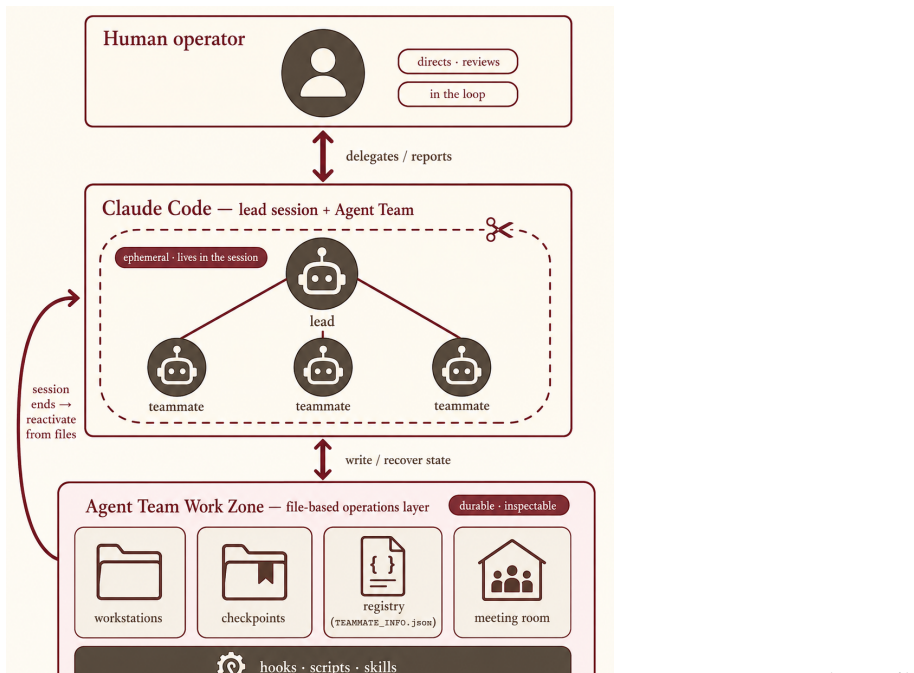
The paper's central claim is that the loss of state when an agent team's session ends—or when compaction thins a long conversation—is not an unavoidable platform limitation but a problem that can be engineered around without changing how the agents run. The design keeps agents ephemeral and reconstructs them from durable artifacts: each teammate owns a workstation holding a role file, working notes, a checkpoint snapshot, and commitments; the lead owns a registry of the team; and an idle hook forces periodic checkpoint writes. On reactivation, a fresh teammate's opening instruction is to read its own workstation and resume from that state. The paper is careful to call this reconstruction, no
What carries the argument
The workstation: a private directory per agent holding role definition, working notes, checkpoint, and commitment files, together with the team registry (TEAMMATE_INFO.json) and the TeammateIdle hook that ages timestamps and forces checkpoints. The workstation is the unit of durability; the registry is the input to reactivation; and the hook makes saving automatic. The whole design reduces to one rule: anything a future agent will need is written to a file outside the session's context window.
Load-bearing premise
The recovery mechanism assumes a freshly spawned agent will faithfully read and adopt the files in its workstation—role, checkpoint, commitments—and that the idle hook fires as documented; if a new teammate ignores its files, reactivation returns a hollow team.
What would settle it
A simple experiment would settle it: run a three-agent team on a small coding task, close the session mid-task, reactivate the team, and check whether the revived teammate's next message reflects the checkpointed task state. If agents frequently ignore their workstation files and restart from scratch, the central claim fails.
If this is right
- Long-lived coding projects can sustain a standing team across multiple sessions; a human is no longer required to be the team's memory and scheduler.
- Compaction stops eroding working detail, since the checkpoint is a separately written, authored snapshot plus an append-only journal of recent turns.
- A team interrupted by a closed terminal, SSH drop, or restart can be rebuilt with a single command, provided the revived teammates read their workstations.
- Agent-to-agent reports become durable, inspectable documents, giving the project an audit trail of decisions and changes that survives closed chats.
- Upgrades are made safe by a strict ownership split: framework files are replaced, user workstations are never touched.
Where Pith is reading between the lines
- Outside the paper's own scope: the same file-first pattern could plausibly be adapted to other coding agents whose subagents are ephemeral, though the paper only notes the similarity without exploring it.
- The load-bearing untested step is whether fresh agents reliably adopt their workstation files; a small empirical study measuring reactivation success under different interruption depths would settle it.
- If the approach holds, the unit of persistence in multi-agent systems shifts from conversation history to something like 'agency'—role plus commitments—which other agent frameworks could adopt as a checkpoint design.
- The paper flags as open work a consistency test between checkpoint writer and reader; automating that contract check would be a concrete next step a maintainer could add.
Editorial analysis
A structured set of objections, weighed in public.
Referee Report
Summary. The paper presents ATWZ (Agent Team Work Zone), a filesystem-based persistence layer for Claude Code's Agent Teams. The design treats each agent as an ephemeral process whose durable state lives in per-agent 'workstation' directories: role files, checkpoints with journals, commitments, a team registry, and file-based meeting rooms and roundtables. The stated contributions are (1) automatic checkpointing so that an agent's knowledge can be recovered after context compaction, (2) one-command team reactivation after a session ends, (3) mitigation of 'agentic technical debt' via durable, inspectable decision records, and (4) reduced prompt-writing overhead through file-based handoffs and reports. The manuscript is explicitly framed as a developer-oriented design manual: it describes the architecture, covers both pre- and post-2.1.178 Claude Code APIs, catalogs failure modes encountered in dogfooding, and explicitly disclaims any benchmarks or user studies (§12). The central recovery mechanism is reconstruction from files: a freshly spawned agent is instructed to read its own workstation and resume from the checkpoint (§6.2).
Significance. If the central claims hold, ATWZ addresses a real and currently unserved gap: the irrecoverability of in-process teammates when a Claude Code session ends and the loss of working detail under compaction. The design is coherent and unusually candid: the file-over-context principle is applied consistently, the failure catalog in §10 is specific and plausible, the version-aware treatment of the Claude Code API change is careful, and the paper ships open-source code. The paper is also honest about its status as a design manual with no empirical evaluation. However, the significance is bounded by the fact that the headline claims—'knowledge can be recovered after compaction' and 'the team can be restored with a single command'—are capability assertions that rest entirely on an untested prompt-following assumption. The design's value is therefore prospective: it is a well-reasoned engineering proposal whose central mechanism has not been demonstrated to work. What would make the contribution credible is a minimal recovery-reliability measurement or a sharpened claim that explicitly labels these as untested design goals.
major comments (3)
- [Abstract and §6.2] The central claims—'knowledge can be recovered after compaction' and 'the team can be restored with a single command'—are capability assertions, yet the only success criterion presented is that the revived teammate 'sends a message back in the current session.' A message receipt does not establish that the agent adopted the checkpoint: a spawned agent that failed to read its workstation could still send a generic acknowledgment, and the manuscript provides no measurement of how often fresh agents actually follow the opening instruction to read their role file, checkpoint, and commitments. Section 12 disclaims evaluation, but the abstract does not carry that hedge. This is load-bearing: the entire reactivation flow reduces to this untested instruction-following reliability. Either run a minimal recovery study (spawn N revived agents from checkpoints and score whether they act on checkpoin
- [§6.4] Automatic checkpointing depends on the TeammateIdle hook firing as documented in the lead session. If the hook silently fails to fire on the target Claude Code versions, the 'periodically back up its working state' feature silently stops, and nothing in the design detects that absence: the release gate and liveness rule cover other failure modes but not hook non-firing. The manuscript should either provide evidence that the hook fires as documented on the versions targeted, or add a watchdog—for example, a checkpoint-freshness check at reactivation or a session-end checkpoint—so that a silent hook failure is observable and recoverable.
- [§4.5 and §10] The hardening narrative is central to the paper's method ('use it on itself, then fix what breaks'), and §10 presents a catalog of failure modes 'learned in use,' including two releases shipped without migration scripts and a Name-2 drift incident. However, no artifact evidence ties this catalog to actual runs: there are no logs, no commit history excerpts, and no incident records in the manuscript, so the claims that these failures occurred and were fixed durably are unfalsifiable from the paper alone. Since the repository is open-source, a short appendix pointing to specific commits or a maintained incident log would substantiate the dogfooding claim and let a reader verify the hardening history.
minor comments (6)
- [§7.1] Message filenames encode a 'minute-precise timestamp.' Two messages from the same author within the same minute would collide; consider second precision or a sequence suffix.
- [§5.2] The upgrade-safety guarantee relies on comment markers delimiting framework-owned blocks in README.md. It would help to state explicitly what happens if a user edits inside a marked block, since the boundary is then no longer mechanically enforceable.
- [§6.2] The sentence 'Disk files cannot confirm a particular reactivation, since a spawn that dies before messaging leaves every file unchanged; the receipt, not the artifact, is the evidence' is honest but highlights the weakness noted in the major comment: the symmetric statement—that a receipt cannot confirm reconstruction—should also appear here or in §12.
- [§11 and references] Several references are the author's own preprints and appear tangential to the persistence question (e.g., [27]–[30] on reasoning modes, [31] on protein language models, [40] on long-term memory probing, [50] on benchmark configuration). Consider trimming to those that directly frame continuity or memory, or adding a sentence explaining each citation's relevance.
- [Throughout] The marginal-footnote style (e.g., '1:In-context memory = the session's live context window...') is unusual and sometimes visually interrupts the narrative; conventional footnotes would improve readability.
- [§8.1] The model-assignment rationale ('mechanical polling on the cheapest capable model... adversarial work on the strongest') is plausible but unsubstantiated; a citation or a short explanation of the cost-quality tradeoff would strengthen it.
Circularity Check
No circularity found: the persistence-layer design is a self-contained construction; the untested prompt-following reliability assumption is an evaluation gap, not a circular reduction.
full rationale
The paper is a developer-oriented design manual rather than an empirical study, and I find no step in its derivation chain that reduces to its own inputs. The central mechanism—state written to per-agent workstation files, automatic checkpointing via the TeammateIdle hook, and reactivation by spawning fresh teammates that read their workstations—is a concrete file/hook/skill construction built on Claude Code's documented Agent Teams limitations. There are no fitted parameters, equations, or renamed empirical patterns. The 'files over context' principle is explicitly acknowledged as the same move Claude Code's subagent memory directory already makes (Section 2.1, note 2: 'the memory directory is, in fact, the same move this manual generalises'), which is an honest statement of lineage rather than a disguised equivalence. The main concern one could raise—that a revived teammate's knowledge is unverified because Section 6.2 defines success as the teammate sending a message back and Section 12 admits 'we have not measured how much [the mechanisms] help'—is an empirical gap and an untested prompt-following assumption, not circularity: nothing about the design defines recovery as message receipt by construction, and the paper explicitly frames recovery as 'reconstruction from durable files' (Section 3). The dogfooding note and the failure catalog in Section 10 are self-referential but are presented as anecdotal hardening history ('not a proof that the design is complete'), not as the evidence for the central claim. Self-citations in Section 11 (e.g., [27]-[30], [40], [50]) and Section A are contextual related-work references and are not load-bearing for the persistence layer. Accordingly the circularity score is 0.
Axiom & Free-Parameter Ledger
axioms (4)
- domain assumption A fresh teammate that reads its workstation files will recover the prior teammate's working state.
- domain assumption Claude Code's hook system fires the TeammateIdle hook as documented and can block an idle to force a checkpoint.
- domain assumption The documented limitations of Agent Teams (teammates not restored on resume) hold for the versions targeted.
- ad hoc to paper Recovery via reconstruction from files is an acceptable substitute for live-process preservation.
invented entities (3)
-
workstation
no independent evidence
-
checkpoint file (with journal)
no independent evidence
-
meeting room / roundtable
no independent evidence
read the original abstract
Large Language Model (LLM) agents have significantly improved coding and programming workflows. Claude Code, in particular, is one of the most powerful LLM coding agents and is capable of conducting complex coding tasks. However, several drawbacks can undermine long-term agentic workflows. (1) Irrecoverable agent teams: The Agent Teams feature is powerful, but the working state accumulated by each teammate is lost and cannot be resumed once the process stops, for example, when a terminal is closed. (2) Compaction erodes working detail: Compaction condenses the conversation into a summary, causing an agent's working details to become vague. (3) Agentic "technical debt": Over time, a user's decisions and the agents' operations become trapped in compacted old chats, making the project increasingly difficult to maintain and review. (4) Heavy prompt writing: Assigning or handing off tasks requires users to repeatedly write long prompts to achieve the expected agentic performance. We propose ATWZ (Agent Team Work Zone), a filesystem-based operations layer built around Claude Code's native Agent Teams that addresses these problems. Its central design principle is to treat each agent and teammate as a human employee and preserve their important working state in files stored in a dedicated directory called a "workstation," together with the skills, hooks, and scripts that use and maintain these files. With ATWZ, an agent team can periodically back up its working state, allowing an agent's knowledge to be recovered after compaction. After a process ends, the team can be restored with a single command. These features also substantially mitigate the agentic "technical debt" described above. Moreover, within ATWZ, agent "employees" can send documents to one another, greatly reducing the effort required to write prompts.
Figures


Reference graph
Works this paper leans on
-
[1]
Claude Code documentation
Agent Teams. Claude Code documentation. Anthropic.url:https: //code.claude.com/docs/en/agent-teams(visitedon07/21/2026)
2026
-
[2]
Subagents.Codexdocumentation;wordingasofJune2026archived at https://web.archive.org/web/20260613202301/https:// developers.openai.com/codex/subagents.OpenAI.url: https: //learn.chatgpt.com/docs/agent-configuration/subagents (visited on 07/22/2026)
arXiv 2026
-
[3]
Claude Code documentation
Subagents. Claude Code documentation. Anthropic.url:https:// code.claude.com/docs/en/sub-agents (visitedon07/22/2026)
2026
-
[4]
Claude Code documentation
Run agents in parallel. Claude Code documentation. Anthropic. url: https : / / code . claude . com / docs / en / agents(visited on 07/22/2026)
2026
-
[5]
com/anthropics/claude-code/issues/7317(visitedon07/21/2026)
Resumable subagent sessions (feature request).url:https://github. com/anthropics/claude-code/issues/7317(visitedon07/21/2026)
2026
-
[6]
Codex documentation
Codex Cloud. Codex documentation. OpenAI.url:https://learn. chatgpt.com/docs/cloud(visited on 07/22/2026)
2026
-
[7]
Claude Code documentation
Settings. Claude Code documentation. Anthropic.url: https : //code.claude.com/docs/en/settings(visited on 07/22/2026)
2026
-
[8]
Claude Code documentation
Memory. Claude Code documentation. Anthropic.url: https : //code.claude.com/docs/en/memory(visited on 07/22/2026)
2026
-
[9]
Anthropic
Introducing Claude Opus 4.8. Anthropic. 2026.url:https://www. anthropic.com/news/claude-opus-4-8
2026
-
[10]
OpenAI.OpenAI GPT-5 System Card. 2025. arXiv: 2601 . 03267 [cs.CL]
2025
-
[11]
Aaron Grattafiori, Abhimanyu Dubey, Abhinav Jauhri, Abhinav Pandey,AbhishekKadian,AhmadAl-Dahle,AieshaLetman,Akhil Mathur, Alan Schelten, Alex Vaughan, et al.The Llama 3 Herd of Models. 2024. arXiv:2407.21783 [cs.AI]
Pith/arXiv arXiv 2024
-
[12]
AutoGen: Enabling Next-Gen LLM Applications via Multi- Agent Conversation
Qingyun Wu, Gagan Bansal, Jieyu Zhang, Yiran Wu, Beibin Li, Erkang Zhu, Li Jiang, Xiaoyun Zhang, Shaokun Zhang, Jiale Liu, et al. “AutoGen: Enabling Next-Gen LLM Applications via Multi- Agent Conversation”. In:Conference on Language Modeling (COLM)
-
[13]
MetaGPT: Meta Programming for a Multi-Agent Collaborative Framework
Sirui Hong, Mingchen Zhuge, Jiaqi Chen, Xiawu Zheng, Yuheng Cheng,CeyaoZhang,JinlinWang,ZiliWang,StevenKaShingYau, Zijuan Lin, et al. “MetaGPT: Meta Programming for a Multi-Agent Collaborative Framework”. In:International Conference on Learning Representations (ICLR). 2024. arXiv:2308.00352 [cs.AI]
Pith/arXiv arXiv 2024
-
[14]
CAMEL: Communicative Agents for “Mind
Guohao Li, Hasan Abed Al Kader Hammoud, Hani Itani, Dmitrii Khizbullin, and Bernard Ghanem. “CAMEL: Communicative Agents for “Mind” Exploration of Large Language Model Society”. In:Advances in Neural Information Processing Systems (NeurIPS)
-
[15]
ChatDev: Communicative Agents for Software Development
Chen Qian, Wei Liu, Hongzhang Liu, Nuo Chen, Yufan Dang, Jiahao Li, Cheng Yang, Weize Chen, Yusheng Su, Xin Cong, et al. “ChatDev: Communicative Agents for Software Development”. In: Proceedings of the Annual Meeting of the Association for Computational Linguistics (ACL). 2024.doi: 10.18653/v1/2024.acl- long.810 . arXiv:2307.07924 [cs.SE]
Pith/arXiv arXiv 2024
-
[16]
AgentVerse: Facilitating Multi-Agent Collaboration and Exploring Emergent Behaviors
WeizeChen,Yusheng Su,JingweiZuo, ChengYang,ChenfeiYuan, Chi-Min Chan, Heyang Yu, Yaxi Lu, Yi-Hsin Hung, Chen Qian, et al. “AgentVerse: Facilitating Multi-Agent Collaboration and Exploring Emergent Behaviors”. In:International Conference on Learning Representations (ICLR). 2024. arXiv:2308.10848 [cs.CL]
Pith/arXiv arXiv 2024
-
[17]
Improving Factuality and Reasoning in Language Models through Multiagent Debate
Yilun Du, ShuangLi, Antonio Torralba,Joshua B.Tenenbaum, and Igor Mordatch. “Improving Factuality and Reasoning in Language Models through Multiagent Debate”. In:International Conference on Machine Learning (ICML). 2024. arXiv:2305.14325 [cs.CL]
Pith/arXiv arXiv 2024
-
[18]
LangGraph documentation
Persistence. LangGraph documentation. LangChain.url:https: //docs.langchain.com/oss/python/langgraph/persistence (visited on 07/21/2026)
2026
-
[19]
AutoGen AgentChat documentation, stable chan- nel
Managing State. AutoGen AgentChat documentation, stable chan- nel. Microsoft.url: https://microsoft.github.io/autogen/ stable/user-guide/agentchat-user-guide/tutorial/state. html(visited on 07/22/2026)
2026
-
[20]
Towards Reasoning in Large Language Models: A Survey
Jie Huang and Kevin Chen-Chuan Chang. “Towards Reasoning in Large Language Models: A Survey”. In:Findings of the Association for Computational Linguistics: ACL 2023. 2023.doi:10.18653/v1/ 2023.findings-acl.67. arXiv:2212.10403 [cs.CL]
Pith/arXiv arXiv 2023
-
[21]
Chain-of- Thought Prompting Elicits Reasoning in Large Language Models
JasonWei,XuezhiWang,DaleSchuurmans,MaartenBosma,Brian Ichter, Fei Xia, Ed Chi, Quoc Le, and Denny Zhou. “Chain-of- Thought Prompting Elicits Reasoning in Large Language Models”. In:Advances in Neural Information Processing Systems (NeurIPS)
-
[22]
Self- Consistency Improves Chain of Thought Reasoning in Language Models
Xuezhi Wang, Jason Wei, Dale Schuurmans, Quoc Le, Ed Chi, Sharan Narang, Aakanksha Chowdhery, and Denny Zhou. “Self- Consistency Improves Chain of Thought Reasoning in Language Models”. In:International Conference on Learning Representations (ICLR). 2023. arXiv:2203.11171 [cs.CL]
Pith/arXiv arXiv 2023
-
[23]
Tree of Thoughts: Deliberate Problem Solving with Large Language Models
Shunyu Yao, Dian Yu, Jeffrey Zhao, Izhak Shafran, Thomas L. Griffiths, Yuan Cao, and Karthik Narasimhan. “Tree of Thoughts: Deliberate Problem Solving with Large Language Models”. In: Advances in Neural Information Processing Systems (NeurIPS). 2023. arXiv:2305.10601 [cs.CL]
Pith/arXiv arXiv 2023
-
[24]
ReAct: Synergizing Reasoning and ActinginLanguageModels
ShunyuYao,JeffreyZhao,DianYu,NanDu,IzhakShafran,Karthik Narasimhan, and Yuan Cao. “ReAct: Synergizing Reasoning and ActinginLanguageModels”.In:InternationalConferenceonLearning Representations (ICLR). 2023. arXiv:2210.03629 [cs.CL]
Pith/arXiv arXiv 2023
-
[25]
Reflexion: Language AgentswithVerbalReinforcementLearning
NoahShinn,FedericoCassano,EdwardBerman,AshwinGopinath, Karthik Narasimhan, and Shunyu Yao. “Reflexion: Language AgentswithVerbalReinforcementLearning”.In:AdvancesinNeural Information Processing Systems (NeurIPS). 2023. arXiv:2303.11366 [cs.AI]
Pith/arXiv arXiv 2023
-
[26]
Self-Refine: Iterative Refinement with Self-Feedback
Aman Madaan, Niket Tandon, Prakhar Gupta, Skyler Hallinan, Luyu Gao, Sarah Wiegreffe, Uri Alon, Nouha Dziri, Shrimai Prab- humoye, Yiming Yang, et al. “Self-Refine: Iterative Refinement with Self-Feedback”. In:Advances in Neural Information Processing Systems (NeurIPS). 2023. arXiv:2303.17651 [cs.CL]
Pith/arXiv arXiv 2023
-
[27]
arXiv:2510
Shouren Wang, Wang Yang, Xianxuan Long, Qifan Wang, Vipin Chaudhary, and Xiaotian Han.Demystifying Hybrid Thinking: Can LLMs Truly Switch Between Think and No-Think?2025. arXiv:2510. 12680 [cs.CL]. 26
2025
-
[28]
Shouren Wang, Wang Yang, Chuang Ma, Debargha Ganguly, Vikash Singh, Chaoda Song, Xinpeng Li, Xianxuan Long, Vipin Chaudhary, and Xiaotian Han.Path-Lock Expert: Separating Reason- ing Mode in Hybrid Thinking via Architecture-Level Separation. 2026. arXiv:2604.27201 [cs.CL]
Pith/arXiv arXiv 2026
-
[29]
Mid- Think: Training-Free Intermediate-Budget Reasoning via Token- Level Triggers
VanYang,ShourenWang,DebarghaGanguly,XinpengLi,Chaoda Song, Vikash Singh, Vipin Chaudhary, and Xiaotian Han. “Mid- Think: Training-Free Intermediate-Budget Reasoning via Token- Level Triggers”. In:Findings of the Association for Computational Linguistics: ACL 2026. Ed. by Maria Liakata, Viviane P. Moreira, Jia- junZhang,andDavidJurgens.SanDiego,California,...
-
[30]
Wang Yang, Shouren Wang, Chaoda Song, Chuang Ma, Xinpeng Li, Nengbo Wang, Kaixiong Zhou, Vipin Chaudhary, and Xiaotian Han.When Domains Interact: Asymmetric and Order-Sensitive Cross- Domain Effects in Reinforcement Learning for Reasoning. 2026. arXiv: 2602.01365 [cs.LG]
arXiv 2026
-
[31]
A Survey on Efficient Protein Language Models
Shouren Wang, Debargha Ganguly, Vinooth Rao Kulkarni, Van Yang, Zhuoran Qiao, Daniel Blankenberg, Vipin Chaudhary, and Xiaotian Han. “A Survey on Efficient Protein Language Models”. In:Transactions on Machine Learning Research(2026). Survey Certi- fication.issn: 2835-8856.url: https://openreview.net/forum? id=PTReuOwsXz
2026
-
[32]
Toolformer: Language Models Can Teach Themselves to Use Tools
Timo Schick, Jane Dwivedi-Yu, Roberto Dessì, Roberta Raileanu, Maria Lomeli, Luke Zettlemoyer, Nicola Cancedda, and Thomas Scialom. “Toolformer: Language Models Can Teach Themselves to Use Tools”. In:Advances in Neural Information Processing Systems (NeurIPS). 2023. arXiv:2302.04761 [cs.CL]
Pith/arXiv arXiv 2023
-
[33]
Gorilla:LargeLanguageModelConnectedwithMassiveAPIs
ShishirG.Patil,TianjunZhang,XinWang,andJosephE.Gonzalez. “Gorilla:LargeLanguageModelConnectedwithMassiveAPIs”.In: Advances in Neural Information Processing Systems (NeurIPS). 2024. arXiv:2305.15334 [cs.CL]
Pith/arXiv arXiv 2024
-
[34]
HuggingGPT: Solving AI Tasks with ChatGPT and its Friends in Hugging Face
Yongliang Shen, Kaitao Song, Xu Tan, Dongsheng Li, Weiming Lu, and Yueting Zhuang. “HuggingGPT: Solving AI Tasks with ChatGPT and its Friends in Hugging Face”. In:Advances in Neural Information Processing Systems (NeurIPS). 2023. arXiv:2303.17580 [cs.CL]
Pith/arXiv arXiv 2023
-
[35]
ToolLLM: Facilitating Large Language Models to Master 16000+ Real-world APIs
Yujia Qin, Shihao Liang, Yining Ye, Kunlun Zhu, Lan Yan, Yaxi Lu, Yankai Lin, Xin Cong, Xiangru Tang, Bill Qian, et al. “ToolLLM: Facilitating Large Language Models to Master 16000+ Real-world APIs”.In:InternationalConferenceonLearningRepresentations(ICLR)
-
[36]
Lost in the Middle: How Language Models Use Long Contexts
Nelson F. Liu, Kevin Lin, John Hewitt, Ashwin Paranjape, Michele Bevilacqua, Fabio Petroni, and Percy Liang. “Lost in the Middle: How Language Models Use Long Contexts”. In:Transactions of the Association for Computational Linguistics (TACL)(2024).doi: 10.1162/tacl_a_00638. arXiv:2307.03172 [cs.CL]
Pith/arXiv arXiv 2024
-
[37]
MemGPT: Towards LLMs as Operating Systems
Charles Packer, Sarah Wooders, Kevin Lin, Vivian Fang, Shishir G. Patil, Ion Stoica, and Joseph E. Gonzalez. “MemGPT: Towards LLMs as Operating Systems”. In:Conference on Language Modeling (COLM). 2024. arXiv:2310.08560 [cs.AI]. 27
Pith/arXiv arXiv 2024
-
[38]
GenerativeAgents: Interactive Simulacra of Human Behavior
Joon Sung Park, Joseph C. O’Brien, Carrie J. Cai, Meredith Ringel Morris,PercyLiang,andMichaelS.Bernstein.“GenerativeAgents: Interactive Simulacra of Human Behavior”. In:ACM Symposium on User Interface Software and Technology (UIST). 2023. arXiv:2304. 03442 [cs.HC]
2023
-
[39]
arXiv:2307.16789 [cs.AI]
-
[40]
Xianxuan Long, Zhikai Chen, Shenglai Zeng, Shouren Wang, Kai Guo, and Jiliang Tang.MemTrace: Probing What Final Accuracy Misses in Long-Term Memory. 2026. arXiv:2606.17328 [cs.CL]
Pith/arXiv arXiv 2026
-
[41]
Voyager: An Open-Ended Embodied Agent with Large Language Models
Guanzhi Wang, Yuqi Xie, Yunfan Jiang, Ajay Mandlekar, Chaowei Xiao, Yuke Zhu, Linxi Fan, and Anima Anandkumar. “Voyager: An Open-Ended Embodied Agent with Large Language Models”. In:Transactions on Machine Learning Research (TMLR)(2024). arXiv: 2305.16291 [cs.AI]
Pith/arXiv arXiv 2024
-
[42]
SSRN preprint 6746498
Van Yang, Chaoda Song, Xinpeng Li, Shouren Wang, Nengbo Wang, Yanyan Zhang, Chuang Ma, Debargha Ganguly, Vikash Singh, Shuai Xu, et al.A Survey on Agent Skills for LLMs: A Lifecycle Perspective from Construction to Ecosystems. SSRN preprint 6746498. 2026.url: https : / / papers . ssrn . com / sol3 / papers . cfm ? abstract_id=6746498
2026
-
[43]
CognitiveArchitecturesforLanguageAgents
Theodore R. Sumers, Shunyu Yao, Karthik Narasimhan, and ThomasL.Griffiths.“CognitiveArchitecturesforLanguageAgents”. In:Transactions on Machine Learning Research (TMLR)(2024). arXiv: 2309.02427 [cs.AI]
Pith/arXiv arXiv 2024
-
[44]
SWE-agent: Agent-Computer Interfaces Enable Automated Software Engineer- ing
John Yang, Carlos E. Jimenez, Alexander Wettig, Kilian Lieret, Shunyu Yao, Karthik Narasimhan, and Ofir Press. “SWE-agent: Agent-Computer Interfaces Enable Automated Software Engineer- ing”.In:AdvancesinNeuralInformationProcessingSystems(NeurIPS)
-
[45]
OpenHands: An Open Platform for AI Software Developers as Generalist Agents
Xingyao Wang, Boxuan Li, Yufan Song, Frank F. Xu, Xiangru Tang, Mingchen Zhuge, et al. “OpenHands: An Open Platform for AI Software Developers as Generalist Agents”. In:International Conference on Learning Representations (ICLR). 2025. arXiv:2407. 16741 [cs.SE]
2025
-
[46]
ExecutableCodeActionsElicitBetterLLM Agents
XingyaoWang,YangyiChen,LifanYuan,YizheZhang,YunzhuLi, HaoPeng,andHengJi.“ExecutableCodeActionsElicitBetterLLM Agents”. In:International Conference on Machine Learning (ICML)
-
[47]
SWE-bench: Can Language Models Resolve Real-World GitHub Issues?
Carlos E. Jimenez, John Yang, Alexander Wettig, Shunyu Yao, Kexin Pei, Ofir Press, and Karthik Narasimhan. “SWE-bench: Can Language Models Resolve Real-World GitHub Issues?” In: International Conference on Learning Representations (ICLR). 2024. arXiv:2310.06770 [cs.SE]
Pith/arXiv arXiv 2024
-
[48]
Agentless: Demystifying LLM-based Software Engineer- ing Agents
Chunqiu Steven Xia, Yinlin Deng, Soren Dunn, and Lingming Zhang. “Agentless: Demystifying LLM-based Software Engineer- ing Agents”. In:Proceedings of the ACM on Software Engineering (FSE)(2025). arXiv:2407.01489 [cs.SE]. 28
Pith/arXiv arXiv 2025
-
[49]
arXiv:2405.15793 [cs.SE]
-
[50]
WangYang,ChaodaSong,XinpengLi,DebarghaGanguly,Chuang Ma, Shouren Wang, Zhihao Dou, Yuli Zhou, Vipin Chaudhary, and Xiaotian Han.AgentCE-Bench: Agent Configurable Evaluation with Scalable Horizons and Controllable Difficulty under Lightweight Environments. 2026. arXiv:2604.06111 [cs.AI]
Pith/arXiv arXiv 2026
-
[51]
AgentBench: Evaluating LLMs as Agents
Xiao Liu, Hao Yu, Hanchen Zhang, Yifan Xu, Xuanyu Lei, Hanyu Lai, Yu Gu, Hangliang Ding, Kaiwen Men, Kejuan Yang, et al. “AgentBench: Evaluating LLMs as Agents”. In:International Confer- ence on Learning Representations (ICLR). 2024. arXiv:2308.03688 [cs.AI]
Pith/arXiv arXiv 2024
-
[52]
arXiv:2402.01030 [cs.CL]
-
[53]
AutoCodeRover: Autonomous Program Improvement
Yuntong Zhang, Haifeng Ruan, Zhiyu Fan, and Abhik Roychoud- hury. “AutoCodeRover: Autonomous Program Improvement”. In: ACM SIGSOFT International Symposium on Software Testing and Analysis (ISSTA). 2024.doi: 10 . 1145 / 3650212 . 3680384. arXiv: 2404.05427 [cs.SE]
Pith/arXiv arXiv 2024
-
[54]
OSWorld: Benchmarking Multimodal Agents for Open-Ended Tasks in Real Computer Environments
Tianbao Xie, Danyang Zhang, Jixuan Chen, Xiaochuan Li, Siheng Zhao, Ruisheng Cao, Jing Hua Toh, Zhoujun Cheng, Dongchan Shin, Fangyu Lei, et al. “OSWorld: Benchmarking Multimodal Agents for Open-Ended Tasks in Real Computer Environments”. In:Advances in Neural Information Processing Systems (NeurIPS)
-
[55]
Large Language Model-Based Agents for Software Engineering: A Survey
JunweiLiu,KaixinWang,YixuanChen,XinPeng,ZhenpengChen, Lingming Zhang, and Yiling Lou. “Large Language Model-Based Agents for Software Engineering: A Survey”. In:ACM Transactions on Software Engineering and Methodology (TOSEM)(2026). arXiv: 2409.02977 [cs.SE]
Pith/arXiv arXiv 2026
-
[56]
Large Language Model based Multi-Agents: A Survey of Progress and Challenges
Taicheng Guo, Xiuying Chen, Yaqi Wang, Ruidi Chang, Shichao Pei, Nitesh V. Chawla, Olaf Wiest, and Xiangliang Zhang. “Large Language Model based Multi-Agents: A Survey of Progress and Challenges”.In:InternationalJointConferenceonArtificialIntelligence (IJCAI). 2024. arXiv:2402.01680 [cs.CL]
Pith/arXiv arXiv 2024
-
[57]
A Survey on Evaluation of Large Language Models
Yupeng Chang, Xu Wang, Jindong Wang, Yuan Wu, Linyi Yang, KaijieZhu,HaoChen,XiaoyuanYi,CunxiangWang,YidongWang, et al. “A Survey on Evaluation of Large Language Models”. In: ACM Transactions on Intelligent Systems and Technology15.3 (2024). doi:10.1145/3641289. arXiv:2307.03109 [cs.CL]
Pith/arXiv arXiv 2024
-
[58]
WebArena: A Realistic Web Environment for Build- ing Autonomous Agents
Shuyan Zhou, Frank F. Xu, Hao Zhu, Xuhui Zhou, Robert Lo, Abishek Sridhar, Xianyi Cheng, Tianyue Ou, Yonatan Bisk, Daniel Fried, et al. “WebArena: A Realistic Web Environment for Build- ing Autonomous Agents”. In:International Conference on Learning Representations (ICLR). 2024. arXiv:2307.13854 [cs.AI]
Pith/arXiv arXiv 2024
-
[59]
GAIA: a benchmark for Gen- eral AI Assistants
Grégoire Mialon, Clémentine Fourrier, Craig Swift, Thomas Wolf, Yann LeCun, and Thomas Scialom. “GAIA: a benchmark for Gen- eral AI Assistants”. In:International Conference on Learning Repre- sentations (ICLR). 2024. arXiv:2311.12983 [cs.CL]
Pith/arXiv arXiv 2024
-
[60]
Emergent Abilities of Large Language Models
Jason Wei, Yi Tay, Rishi Bommasani, Colin Raffel, Barret Zoph, SebastianBorgeaud,DaniYogatama,MaartenBosma,DennyZhou, Donald Metzler, et al. “Emergent Abilities of Large Language Models”. In:Transactions on Machine Learning Research (TMLR) (2022). arXiv:2206.07682 [cs.CL]
Pith/arXiv arXiv 2022
-
[61]
arXiv:2404.07972 [cs.AI]
-
[62]
A Survey on Large Language Model based Autonomous Agents
Lei Wang, Chen Ma, Xueyang Feng, Zeyu Zhang, Hao Yang, et al. “A Survey on Large Language Model based Autonomous Agents”. In:FrontiersofComputerScience(2024).arXiv: 2308.11432 [cs.AI]
Pith/arXiv arXiv 2024
-
[63]
Finetuned Language Models Are Zero-Shot Learners
Jason Wei, Maarten Bosma, Vincent Y. Zhao, Kelvin Guu, Adams Wei Yu, Brian Lester, Nan Du, Andrew M. Dai, and Quoc V. Le. “Finetuned Language Models Are Zero-Shot Learners”. In: International Conference on Learning Representations (ICLR). 2022. arXiv:2109.01652 [cs.CL]
Pith/arXiv arXiv 2022
-
[64]
Deep Reinforcement Learning from Human Preferences
Paul Christiano, Jan Leike, Tom B. Brown, Miljan Martic, Shane Legg, and Dario Amodei. “Deep Reinforcement Learning from Human Preferences”. In:Advances in Neural Information Processing Systems (NeurIPS). 2017. arXiv:1706.03741 [stat.ML]
Pith/arXiv arXiv 2017
-
[65]
Brown, Benjamin Chess, Rewon Child, Scott Gray, Alec Radford, Jeffrey Wu, and Dario Amodei.Scaling Laws for Neural Language Models
Jared Kaplan, Sam McCandlish, Tom Henighan, Tom B. Brown, Benjamin Chess, Rewon Child, Scott Gray, Alec Radford, Jeffrey Wu, and Dario Amodei.Scaling Laws for Neural Language Models
-
[66]
Direct Preference Optimization: Your Language Model is Secretly a Reward Model
Rafael Rafailov, Archit Sharma, Eric Mitchell, Stefano Ermon, Christopher D. Manning, and Chelsea Finn. “Direct Preference Optimization: Your Language Model is Secretly a Reward Model”. In:Advances in Neural Information Processing Systems (NeurIPS)
-
[67]
Training Compute-OptimalLargeLanguageModels
Jordan Hoffmann, Sebastian Borgeaud, Arthur Mensch, Elena Buchatskaya, Trevor Cai, Eliza Rutherford, Diego de Las Casas, LisaAnneHendricks,JohannesWelbl,AidanClark,etal.“Training Compute-OptimalLargeLanguageModels”.In:AdvancesinNeural Information Processing Systems (NeurIPS). 2022. arXiv:2203.15556 [cs.CL]. 29
Pith/arXiv arXiv 2022
-
[68]
FlashAttention: Fast and Memory-Efficient Exact Attention with IO-Awareness
Tri Dao, Daniel Y. Fu, Stefano Ermon, Atri Rudra, and Christopher Ré. “FlashAttention: Fast and Memory-Efficient Exact Attention with IO-Awareness”. In:Advances in Neural Information Processing Systems (NeurIPS). 2022. arXiv:2205.14135 [cs.LG]
Pith/arXiv arXiv 2022
-
[69]
LanguageModelsare Few-Shot Learners
Tom B. Brown, Benjamin Mann, Nick Ryder, Melanie Subbiah, Jared Kaplan, Prafulla Dhariwal, Arvind Neelakantan, Pranav Shyam,GirishSastry,AmandaAskell,etal.“LanguageModelsare Few-Shot Learners”. In:Advances in Neural Information Processing Systems (NeurIPS). 2020. arXiv:2005.14165 [cs.CL]
Pith/arXiv arXiv 2020
-
[70]
ASurvey on In-context Learning
Qingxiu Dong, Lei Li, Damai Dai, Ce Zheng, Jingyuan Ma, Rui Li, HemingXia,JingjingXu,ZhiyongWu,TianyuLiu,etal.“ASurvey on In-context Learning”. In:Proceedings of the 2024 Conference on Empirical Methods in Natural Language Processing (EMNLP). 2024. arXiv:2301.00234 [cs.CL]
Pith/arXiv arXiv 2024
-
[71]
Hudson, Ehsan Adeli, Russ Altman, Simran Arora, Sydney von Arx, Michael S
Rishi Bommasani, Drew A. Hudson, Ehsan Adeli, Russ Altman, Simran Arora, Sydney von Arx, Michael S. Bernstein, Jeannette Bohg,AntoineBosselut,EmmaBrunskill,etal.OntheOpportunities and Risks of Foundation Models. 2021. arXiv:2108.07258 [cs.LG]
Pith/arXiv arXiv 2021
-
[72]
A Survey of Large Language Models
Wayne Xin Zhao, Kun Zhou, Junyi Li, Tianyi Tang, Xiaolei Wang, Yupeng Hou, Yingqian Min, Beichen Zhang, Junjie Zhang, Zican Dong, et al. “A Survey of Large Language Models”. In:Frontiers of Computer Science(2026). arXiv:2303.18223 [cs.CL]
Pith/arXiv arXiv 2026
-
[73]
Training Language Models to Follow Instructions with Human Feedback
Long Ouyang, Jeff Wu, Xu Jiang, Diogo Almeida, Carroll L. Wain- wright, Pamela Mishkin, Chong Zhang, Sandhini Agarwal, Kata- rina Slama, Alex Ray, et al. “Training Language Models to Follow Instructions with Human Feedback”. In:Advances in Neural In- formation Processing Systems (NeurIPS). 2022. arXiv:2203.02155 [cs.CL]
Pith/arXiv arXiv 2022
-
[74]
ToolLearningwithFoundationModels
Yujia Qin, Shengding Hu, Yankai Lin, Weize Chen, Ning Ding, Ganqu Cui, Zheni Zeng, Yufei Huang, Chaojun Xiao, Chi Han, etal.“ToolLearningwithFoundationModels”.In:ACMComputing Surveys(2025). arXiv:2304.08354 [cs.CL]
Pith/arXiv arXiv 2025
-
[75]
arXiv:2305.18290 [cs.LG]
-
[76]
EfficientMemoryManagementforLargeLanguageModel Serving with PagedAttention
Woosuk Kwon, Zhuohan Li, Siyuan Zhuang, Ying Sheng, Lianmin Zheng, Cody Hao Yu, Joseph E. Gonzalez, Hao Zhang, and Ion Stoica.“EfficientMemoryManagementforLargeLanguageModel Serving with PagedAttention”. In:ACM Symposium on Operating Systems Principles (SOSP). 2023. arXiv:2309.06180 [cs.LG]
Pith/arXiv arXiv 2023
-
[78]
GPTQ: Accurate Post-Training Quantization for Generative Pre-trained Transformers
Elias Frantar, Saleh Ashkboos, Torsten Hoefler, and Dan Alis- tarh. “GPTQ: Accurate Post-Training Quantization for Generative Pre-trained Transformers”. In:International Conference on Learning Representations (ICLR). 2023. arXiv:2210.17323 [cs.LG]
Pith/arXiv arXiv 2023
-
[79]
Switch Trans- formers: Scaling to Trillion Parameter Models with Simple and Efficient Sparsity
William Fedus, Barret Zoph, and Noam Shazeer. “Switch Trans- formers: Scaling to Trillion Parameter Models with Simple and Efficient Sparsity”. In:Journal of Machine Learning Research (JMLR) (2022). arXiv:2101.03961 [cs.LG]. 30
Pith/arXiv arXiv 2022
-
[82]
Tula Masterman, Sandi Besen, Mason Sawtell, and Alex Chao.The Landscape of Emerging AI Agent Architectures for Reasoning, Planning, and Tool Calling: A Survey. 2024. arXiv:2404.11584 [cs.AI]
Pith/arXiv arXiv 2024
-
[84]
A Survey on the Memory Mechanism of Large Language Model based Agents
Zeyu Zhang, Xiaohe Bo, Chen Ma, Rui Li, Xu Chen, Quanyu Dai, Jieming Zhu, Zhenhua Dong, and Ji-Rong Wen. “A Survey on the Memory Mechanism of Large Language Model based Agents”. In:ACM Transactions on Information Systems (TOIS)(2025).doi: 10.1145/3748302. arXiv:2404.13501 [cs.AI]. 31
Pith/arXiv arXiv 2025
discussion (0)
Sign in with ORCID, Apple, or X to comment. Anyone can read and Pith papers without signing in.