REVIEW 3 major objections 5 minor 91 references
The paper argues that the quantum-corrected metric f(r)=sqrt(1-a^2/r^2)-2M/r-Λr^2/3 is linearly stable against massless scalar and Dirac perturbations in both de Sitter and anti-de Sitter spacetimes, with the quantum parameter a systematica
Reviewed by Pith at T0; open to challenge. T0 means a machine referee read the full paper against a public rubric. the ladder, T0–T4 →
T0 review · deepseek-v4-flash
2026-08-01 04:01 UTC pith:APVLL5B5
load-bearing objection First QNM tables for the exact Kazakov–Solodukhin metric with Lambda; the AdS Dirac boundary condition is the one thing to check before trusting the isospectrality-breaking result. the 3 major comments →
Quasinormal modes of a quantum inspired black hole in four dimensions with cosmological constant
The pith
A machine-rendered reading of the paper's core claim, the machinery that carries it, and where it could break.
Core claim
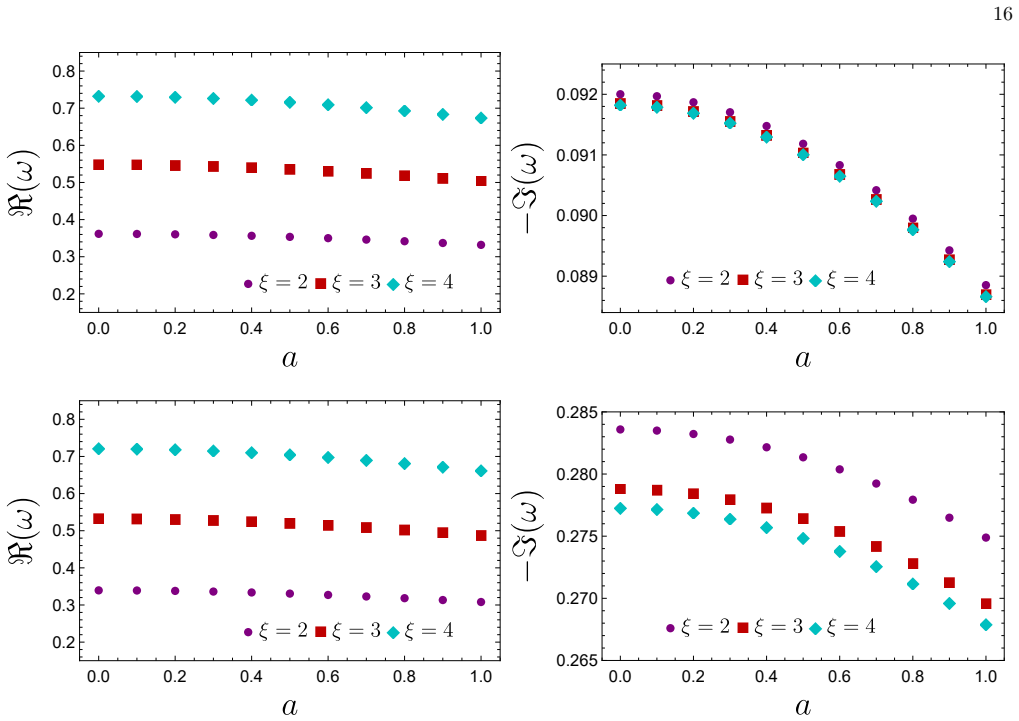
The central finding is that the quantum-corrected lapse function f(r)=sqrt(1-a^2/r^2)-2M/r-Λr^2/3, with 0≤a≤1, is linearly stable against massless scalar and Dirac perturbations in both de Sitter and anti-de Sitter backgrounds: every computed quasinormal frequency has negative imaginary part, so perturbations decay in towers of damped oscillations. The tables show monotonic spectral shifts: in dS both Re ω and -Im ω decrease as a grows (e.g. the fundamental l=2 scalar mode moves from 0.459636-0.092860 i at a=0 to 0.422345-0.089817 i at a=1); in AdS the scalar Re ω increases and |Im ω| decreases; and for AdS Dirac the V+ and V− potentials give distinct spectra, including a near-purely-imagina
What carries the argument
The object doing the work is the quantum-corrected lapse function f(r)=sqrt(1-a^2/r^2)-2M/r-Λr^2/3, which reduces to Schwarzschild-(A)dS when a=0 and introduces a minimum radius r=a. From it the paper builds two effective potentials: the scalar potential V_S=f[ℓ(ℓ+1)/r^2+f'/r] and the Dirac pair V±=W^2 ± dW/dr* with W=ξ sqrt(f)/r. These define one-dimensional Schrödinger equations in the tortoise coordinate; the WKB method and double-null characteristic integration then extract the complex frequencies, whose negative imaginary parts certify stability. The Dirac pair's shared superpotential W makes isospectrality the expected default, so the paper's observed V+ versus V− spectral difference i
Load-bearing premise
The load-bearing premise is that the Dirac spinor's boundary value at the AdS boundary can be fixed to a constant zero, a choice the paper adopts without testing alternatives even though the AdS Dirac spectrum is known to depend on that boundary condition.
What would settle it
Recompute the AdS Dirac quasinormal spectrum with a generic Robin-type boundary condition at infinity (allowing a non-zero constant boundary value) and check whether the V− near-zero purely imaginary mode and the V+ versus V− splitting persist; if either changes, the paper's AdS Dirac isospectrality-breaking result is an artifact of the zero-boundary choice.
If this is right
- If a>0 is real, black-hole ringdown in de Sitter-like spacetimes rings at lower frequency and decays more slowly, making the quantum correction potentially legible in the damping time of the fundamental mode.
- In anti-de Sitter, scalar modes oscillate faster and persist longer as a grows, so the thermalization ringdown of AdS black holes is delayed relative to the general-relativity case.
- AdS Dirac isospectrality breaks: the two spinor channels V+ and V− produce different frequencies, a feature absent for Schwarzschild-AdS with plane-wave boundary conditions.
- The a=0 tables agree with established Schwarzschild-(A)dS values to sub-percent level, certifying the numerical pipeline used for the quantum-corrected cases.
Where Pith is reading between the lines
- If the AdS Dirac boundary condition is relaxed to a generic Robin-type condition instead of a fixed zero boundary value, the near-zero purely imaginary mode found for V− may shift or disappear; boundary-condition sensitivity is a known issue for Dirac fields on AdS, so this part of the spectrum deserves scrutiny before being treated as a prediction.
- The near-linear relation between Re ω and -Im ω as a varies suggests a one-parameter family of ringdown templates; a future gravitational-wave parameter-estimation study could test whether such a template actually fits ringdown data better than the pure Schwarzschild-(A)dS template.
- Because the paper works at small a/r, where the metric looks like a phantom Reissner-Nordström-(A)dS black hole with an artificial charge, the natural next step is to include charged scalar or Dirac fields; the uncharged analysis here cannot see superradiance, which may alter stability in parts of the parameter space.
Editorial analysis
A structured set of objections, weighed in public.
Referee Report
Summary. The paper studies massless scalar and Dirac perturbations of a quantum-corrected Schwarzschild-(A)dS metric with lapse function f(r)=sqrt(1-a^2/r^2)-2M/r-Lambda r^2/3, where a is a quantum/minimal-length parameter. The scalar and Dirac equations are reduced to Schrödinger-like forms with effective potentials (16) and (47). Quasinormal frequencies are computed by sixth-order WKB for de Sitter and by double-null characteristic integration for anti-de Sitter, with GR-limit benchmarks against Horowitz-Hubeny [33] and Zhidenko [84]. The paper reports stable spectra for all computed modes, monotonic dependence of the frequencies on a, and a breaking of the V+ / V- isospectrality for AdS Dirac perturbations. The main claim is that the quantum parameter a stabilizes the perturbations and lengthens the ringdown.
Significance. If the results are correct, this would be a useful first systematic QNM survey of this quantum-inspired metric with cosmological constant, providing concrete falsifiable predictions for the dependence of the spectrum on the quantum parameter a. The paper has clear strengths: the derivation of the effective potentials is standard; the GR-limit validation for the scalar AdS case is excellent (<0.1% against [33]); the tables are extensive and the ×× entries make the limitations of the WKB method transparent; and the numerical recipes are described in enough detail to be reproduced. However, the AdS Dirac sector, which contains two of the paper's headline claims (stability and isospectrality breaking), rests on an insufficiently justified boundary condition. The dS sector also leaves the lowest multipole unexamined, so the 'all perturbations are stable' claim is broader than the evidence presented.
major comments (3)
- [Section III.B and Eq. (48); Section V.A.2 and Tables I-II] The AdS Dirac boundary condition is not justified. The paper writes Ψ|∞ → e^{-i r* sqrt(ω^2 - V∞)} and then, because r*(r→∞)=0, 'the above term reduces to a constant value that we take to be zero.' This is a Dirichlet condition imposed independently on each decoupled second-order component F and G. But the Dirac system is first-order: (40)-(43) relate F and G, so an admissible boundary condition must be imposed on the spinor doublet, not separately on F and G. Setting both F(∞)=0 and G(∞)=0 generally overconstrains the system and can generate spurious modes. The paper itself cites Refs. [73,83], which show that AdS Dirac spectra depend sensitively on boundary conditions and that generic (Robin-type) conditions change the spectrum and alter isospectrality. The near-zero purely imaginary mode in Table II, ω=-0.000089286i at a=0, is exactly the kind of boundary-sensitive object that could b
- [Section V.A, Section V.B, Tables V and VII, Fig. 1] The claim that 'all perturbations are stable' is not supported for the lowest multipole in the de Sitter sector. Fig. 1 shows that the ℓ=0 scalar potential has a negative region, which is precisely the case where instabilities can arise, yet the dS scalar table (Table V) starts at ℓ=1 and the Dirac table (Table VII) starts at ξ=2, with ×× entries for several overtones. The dS sector relies exclusively on WKB, with no independent time-domain or other method to cross-check the lowest multipoles or the missing overtones. For a stability claim as broad as the abstract's, the ℓ=0 modes should be computed (or the claim explicitly restricted to the computed modes and multipoles).
- [Section V.B.2, Table IV] The dS Dirac validation against the literature is not verifiable as presented. Table III shows both the present results and the reference values for the scalar case, with excellent agreement. Table IV, by contrast, reports only the authors' ω(V+) and ω(V-) values and states they are 'consistent with' [84], but no reference numbers are shown. Since [84] is also used for the scalar dS validation, the reader cannot tell whether the comparison is with the same field and boundary conditions. At minimum, the reference values and relative deviations should be given. This is secondary to the AdS Dirac boundary-condition issue, but it affects the credibility of the dS part of the paper.
minor comments (5)
- [Fig. 4 caption] The caption states the Anti-de Sitter case uses Λ=0.01, which is a positive cosmological constant and contradicts the AdS designation. It should be Λ<0, presumably Λ=-0.01, to be consistent with Fig. 2 and the text.
- [Eq. (7) and footnote a] The expansion of sqrt(1-a^2/r^2) is 1 - a^2/(2r^2) - a^4/(8r^4)+..., so the error term should be O(a^4), not O(a^3). The interpretation of -a^2/(2r^2) as a 'phantom charge' is heuristic and should be phrased as an analogy rather than a physical charge.
- [Fig. 5 caption] The caption reads 'M=1 and μ=ℓ=0', but μ is not defined anywhere. If this is meant to be n, the overtone number, it should be stated explicitly.
- [General] No error estimates or convergence measures are reported for any of the frequencies. The text states that the WKB method 'exhibits stable and well-behaved convergence up to the sixth order', but no demonstration or numerical comparison is provided. Adding a short convergence table or error bars would improve the paper.
- [Eq. (57) and surrounding integration formulas] The series for the tortoise coordinate are described in terms of m=M/a and L=Λa^2/3, but the notation for s1, s2, s3, s4 and the matching point is dense. A short worked example or a figure showing the matched r*(r) would help the reader verify the implementation.
Circularity Check
No significant circularity: QNMs are computed from the input metric by standard recipes with external benchmarks; the AdS Dirac boundary condition (Eq. 48) is an assumption posing a correctness risk, not a circular step.
full rationale
The derivation chain starts from the external Kazakov-Solodukhin metric [9,10] and computes QNM frequencies by textbook WKB and characteristic-integration recipes. No parameter is fitted to the target frequencies: the quantum parameter a enters through the metric (Eq. 5), and the a=0 limits are checked against external results (Tables III and IV vs [84]; AdS scalar vs [33]). The paper's own citations ([72,74,75,81]) are used for numerical technique, boundary-condition conventions, or contextual comparisons; they do not supply the uniqueness or derivation of the reported spectra, which come from solving Eqs. (15)/(44-45) with stated boundary conditions. The most vulnerable step is the AdS Dirac boundary condition, Eq. (48), where 'we take to be zero' is an imposed Dirichlet choice rather than a derivation; the near-zero purely imaginary V− modes in Table II and the claimed isospectrality breaking are sensitive to this choice. That is a correctness/robustness concern, not circularity: the boundary condition is an input assumption, and the QNMs follow from it rather than being defined as equivalent to it. The explicit admission that the small-a metric is a phantom Reissner-Nordström form (Eq. 7) also precludes a renaming-as-derivation charge. Overall: no construction-level circularity.
Axiom & Free-Parameter Ledger
free parameters (1)
- a (quantum/minimal-length parameter) =
scanned 0.0-1.0 with M=1; identified with 4*l_P via a=4*sqrt(kappa) (Sec. II)
axioms (6)
- domain assumption Quantum corrections are captured by the Kazakov-Solodukhin U(r)=r/sqrt(r^2-a^2) in the 2D dilaton reduction of the Einstein-Hilbert action (Eqs. 3-4)
- domain assumption Test-field approximation: scalar and Dirac perturbations do not backreact on the geometry (Sec. III)
- standard math WKB formula (Eq. 52) via Gamma-function poles; asymptotic expansion valid for single-barrier potentials (Sec. IV.A)
- domain assumption The two series expansions (58) and (62) for the tortoise coordinate converge and match on an overlap interval (Sec. IV.B, App. C)
- ad hoc to paper AdS Dirac boundary condition: Psi -> 'a constant value that we take to be zero' at r*->0 (Eq. 48 and following)
- domain assumption Small-a approximation Y(r) for horizon roots with phantom-charge interpretation q^2=a^2/2 (Eqs. 7-8, footnote a)
invented entities (1)
-
'Artificial' phantom charge q^2=a^2/2 emerging from the small-a expansion
no independent evidence
read the original abstract
We study the scalar and Dirac perturbations of quantum-corrected black holes with cosmological constant. Using two different methods (WKB and double-null characteristic integration) we compute the quasinormal modes (QNMs) of de Sitter and Anti-de Sitter solutions considering linear field perturbations in the background geometry. In the limit of general relativity black holes our methods demonstrate good convergence with the available results in literature. In the presence of an extra quantum parameter we verify that all perturbations are stable evolving in towers of quasinormal oscillations. We scrutinize the spectra of both dS and AdS solutions studying the influence of that extra parameter in the frequencies.
Figures




Reference graph
Works this paper leans on
-
[1]
The secondary boundary condition comes form the fact that the scalar potential diverges whenr→ ∞
The scalar field The prescription for boundary conditions through the field equation (15) with the potential (16) can be read as ψr→rh →Ae iωr∗ +Be −iωr∗ (66) ψr→∞ →0 (67) where the physical relevant front wave nearr h is that of amplitudeBsince no information emerges from the event horizon (A= 0). The secondary boundary condition comes form the fact that...
-
[2]
The Dirac field The Dirac quasinormal modes follow from the same boundary conditions employed in the scalar case (viz. Eqs. (66) and (67)) and come as a consequence from the stability of the spacetime as well. In such case we apply the usual techniques to obtain the spectra for each value of black hole parameter considering a variety of cosmological const...
-
[3]
Black holes and entropy,
J. D. Bekenstein, “Black holes and entropy,”Phys. Rev. D7(1973) 2333–2346
1973
-
[4]
In these figures,R(ω) andI(ω) denote the real and imaginary parts of the frequency, respectively
The Scalar Field The calculated quasinormal frequencies are listed in Table V and VI, while the overall behavior is illustrated in Figures (7) and (8). In these figures,R(ω) andI(ω) denote the real and imaginary parts of the frequency, respectively. Our numerical findings indicate that all modes remain stable under massless scalar perturbations, as eviden...
-
[5]
Tables VII and VIII list the quasinormal (QN) frequencies computed forM= 1, Λ = 0.01, and different combinations of the parameters {n, a, ξ}
The Dirac field Similar to the massless scalar case, we summarize our main results for massless Dirac perturbations in the pres- ence of a positive cosmological constant through one ta- ble and several illustrative figures. Tables VII and VIII list the quasinormal (QN) frequencies computed forM= 1, Λ = 0.01, and different combinations of the parameters {n...
2023
-
[6]
Black hole explosions,
S. W. Hawking, “Black hole explosions,”Nature248 (1974) 30–31
1974
-
[7]
Particle Creation by Black Holes,
S. W. Hawking, “Particle Creation by Black Holes,” Commun. Math. Phys.43(1975) 199–220. [Erratum: Commun.Math.Phys. 46, 206 (1976)]
1975
-
[8]
Comparison of approaches to quantum correction of black hole thermodynamics,
K. Nozari and A. S. Sefiedgar, “Comparison of approaches to quantum correction of black hole thermodynamics,”Phys. Lett. B635(2006) 156–160, arXiv:gr-qc/0601116
Pith/arXiv arXiv 2006
-
[9]
p f(r) r ξ # G(r) = +ωF(r) (40) f(r) dF(r) dr +
for further details). Since then, new solutions have been discovered in the field and in particular, as e. g. a charged geometry with non-vanishing cosmological con- stant, recently studied in [10], where quantum fluctu- ations in an Reissner-Nordstr¨ om (RN) version of black hole were studied. Afterwards, an AdS spacetime back- ground was included with t...
-
[10]
The quantum mass spectrum of the Kerr black hole,
J. D. Bekenstein, “The quantum mass spectrum of the Kerr black hole,”Lett. Nuovo Cim.11(1974) 467
1974
-
[11]
The thermodynamics of black holes,
R. M. Wald, “The thermodynamics of black holes,” Living Rev. Rel.4(2001) 6,arXiv:gr-qc/9912119
Pith/arXiv arXiv 2001
-
[12]
S. Carlip, “Black Hole Thermodynamics,”Int. J. Mod. Phys. D23(2014) 1430023,arXiv:1410.1486 [gr-qc]
Pith/arXiv arXiv 2014
-
[13]
Quantum gravity: A Progress report,
S. Carlip, “Quantum gravity: A Progress report,”Rept. Prog. Phys.64(2001) 885,arXiv:gr-qc/0108040
Pith/arXiv arXiv 2001
-
[14]
On Quantum deformation of the Schwarzschild solution,
D. I. Kazakov and S. N. Solodukhin, “On Quantum deformation of the Schwarzschild solution,”Nucl. Phys. B429(1994) 153–176,arXiv:hep-th/9310150
Pith/arXiv arXiv 1994
-
[15]
A quantum corrected R–N–AdS black hole and it’s thermodynamics of phase transition,
S. Wu and C. Liu, “A quantum corrected R–N–AdS black hole and it’s thermodynamics of phase transition,” Class. Quant. Grav.39no. 8, (2022) 085009
2022
-
[16]
Quasinormal modes of black holes and black branes,
E. Berti, V. Cardoso, and A. O. Starinets, “Quasinormal modes of black holes and black branes,” Class. Quant. Grav.26(2009) 163001
2009
-
[17]
Quasinormal modes of black holes: From astrophysics to string theory,
R. A. Konoplya and A. Zhidenko, “Quasinormal modes of black holes: From astrophysics to string theory,”Rev. Mod. Phys.83(2011) 793
2011
-
[18]
Observation of gravitational waves from a binary black hole merger,
B. P. A. et al. (LIGO Scientific and V. Collaborations), “Observation of gravitational waves from a binary black hole merger,”Phys. Rev. Lett.116(2016) 061102
2016
-
[19]
Testing the ringdown spectrum of black holes beyond general relativity,
N. Franchini and S. H. V¨ olkel, “Testing the ringdown spectrum of black holes beyond general relativity,” arXiv preprint(2023) ,arXiv:2305.01696 [gr-qc]
Pith/arXiv arXiv 2023
-
[20]
Exact schwarzschild-like solution in a bumblebee gravity model,
R. Casana, A. Cavalcante, F. P. Poulis, and E. B. Santos, “Exact schwarzschild-like solution in a bumblebee gravity model,”Phys. Rev. D97(2018) 104001
2018
-
[21]
Detection of higher derivative corrections to general relativity from black hole quasinormal modes,
R. A. Konoplya and A. Zhidenko, “Detection of higher derivative corrections to general relativity from black hole quasinormal modes,”Phys. Rev. D94(2016) 104024. 22
2016
-
[22]
Quasinormal modes, scattering, and hawking radiation in the vicinity of einstein-dilaton-gauss-bonnet black holes,
R. A. Konoplya, A. F. Zinhailo, and Z. Stuchlik, “Quasinormal modes, scattering, and hawking radiation in the vicinity of einstein-dilaton-gauss-bonnet black holes,”Phys. Rev. D99(2019) 124042
2019
-
[23]
Ringing of rotating black holes in higher-derivative gravity,
P. A. Cano, K. Fransen, and T. Hertog, “Ringing of rotating black holes in higher-derivative gravity,”Phys. Rev. D102(2020) 044047
2020
-
[24]
Eikonal quasinormal modes and shadow of string-correctedd-dimensional black holes,
F. Moura and J. Rodrigues, “Eikonal quasinormal modes and shadow of string-correctedd-dimensional black holes,”Phys. Lett. B819(2021) 136407
2021
-
[25]
Asymptotic quasinormal modes of string-theoreticald-dimensional black holes,
F. Moura and J. Rodrigues, “Asymptotic quasinormal modes of string-theoreticald-dimensional black holes,” JHEP08(2021) 078
2021
-
[26]
Asymptotic quasinormal modes of higher-derivative corrected black holes,
F. Moura and J. Rodrigues, “Asymptotic quasinormal modes of higher-derivative corrected black holes,”Nucl. Phys. B993(2023) 116255
2023
-
[27]
Quasinormal modes in higher-derivative gravity: Testing the black hole parametrization and sensitivity of overtones,
R. A. Konoplya, “Quasinormal modes in higher-derivative gravity: Testing the black hole parametrization and sensitivity of overtones,”Phys. Rev. D107(2023) 064039
2023
-
[28]
A Pedagogical explanation for the non-renormalizability of gravity,
A. Shomer, “A Pedagogical explanation for the non-renormalizability of gravity,”arXiv:0709.3555 [hep-th]
-
[29]
Thermodynamics of phantom Reissner-Nordstrom-AdS black hole,
D. F. Jardim, M. E. Rodrigues, and M. J. S. Houndjo, “Thermodynamics of phantom Reissner-Nordstrom-AdS black hole,”Eur. Phys. J. Plus127(2012) 123, arXiv:1202.2830 [gr-qc]
Pith/arXiv arXiv 2012
-
[30]
Quasinormal modes of phantom Reissner-Nordstr¨ om-de Sitter black holes,
H. Liu, “Quasinormal modes of phantom Reissner-Nordstr¨ om-de Sitter black holes,”Eur. Phys. J. C83no. 10, (2023) 935,arXiv:2306.10498 [gr-qc]
Pith/arXiv arXiv 2023
-
[31]
Greybody factors for nonminimally coupled scalar fields in Schwarzschild–de Sitter spacetime,
L. C. B. Crispino, A. Higuchi, E. S. Oliveira, and J. V. Rocha, “Greybody factors for nonminimally coupled scalar fields in Schwarzschild–de Sitter spacetime,” Phys. Rev. D87(2013) 104034,arXiv:1304.0467 [gr-qc]
Pith/arXiv arXiv 2013
-
[32]
P. Kanti, T. Pappas, and N. Pappas, “Greybody factors for scalar fields emitted by a higher-dimensional Schwarzschild–de Sitter black hole,”Phys. Rev. D90 no. 12, (2014) 124077,arXiv:1409.8664 [hep-th]
Pith/arXiv arXiv 2014
-
[33]
T. Pappas, P. Kanti, and N. Pappas, “Hawking radiation spectra for scalar fields by a higher-dimensional Schwarzschild–de Sitter black hole,” Phys. Rev. D94no. 2, (2016) 024035, arXiv:1604.08617 [hep-th]
Pith/arXiv arXiv 2016
-
[34]
Quasinormal modes of five-dimensional black holes in non-commutative geometry,
G. Panotopoulos and A. Rinc´ on, “Quasinormal modes of five-dimensional black holes in non-commutative geometry,”Eur. Phys. J. Plus135no. 1, (2020) 33, arXiv:1910.08538 [gr-qc]
Pith/arXiv arXiv 2020
-
[35]
R. Avalos, P. Bargue˜ no, and E. Contreras, “A Static and Spherically Symmetric Hairy Black Hole in the Framework of the Gravitational Decoupling,”Fortsch. Phys.71no. 4-5, (2023) 2200171,arXiv:2303.04119 [gr-qc]
Pith/arXiv arXiv 2023
-
[36]
Quasinormal modes of massive scalar fields in four-dimensional wormholes: Anomalous decay rate,
P. A. Gonz´ alez, E. Papantonopoulos, A. Rinc´ on, and Y. V´ asquez, “Quasinormal modes of massive scalar fields in four-dimensional wormholes: Anomalous decay rate,”Phys. Rev. D106no. 2, (2022) 024050, arXiv:2205.06079 [gr-qc]
Pith/arXiv arXiv 2022
-
[37]
Greybody factor and quasinormal modes of Regular Black Holes,
A. Rinc´ on and V. Santos, “Greybody factor and quasinormal modes of Regular Black Holes,”Eur. Phys. J. C80no. 10, (2020) 910,arXiv:2009.04386 [gr-qc]
Pith/arXiv arXiv 2020
-
[38]
Quasinormal modes of ads black holes and the approach to thermal equilibrium,
G. T. Horowitz and V. E. Hubeny, “Quasinormal modes of ads black holes and the approach to thermal equilibrium,”Physical Review D62no. 2, (June, 2000) .http://dx.doi.org/10.1103/PhysRevD.62.024027
-
[39]
Split fermion quasi-normal modes,
H. T. Cho, A. S. Cornell, J. Doukas, and W. Naylor, “Split fermion quasi-normal modes,”Phys. Rev. D75 (2007) 104005,arXiv:hep-th/0701193
Pith/arXiv arXiv 2007
-
[40]
Universality of low-energy absorption cross-sections for black holes,
S. R. Das, G. W. Gibbons, and S. D. Mathur, “Universality of low-energy absorption cross-sections for black holes,”Phys. Rev. Lett.78(1997) 417–419, arXiv:hep-th/9609052
Pith/arXiv arXiv 1997
-
[41]
Anomalous fermion production in gravitational collapse,
G. W. Gibbons and A. R. Steif, “Anomalous fermion production in gravitational collapse,”Phys. Lett. B314 (1993) 13–20,arXiv:gr-qc/9305018
Pith/arXiv arXiv 1993
-
[42]
On the Eigen functions of the Dirac operator on spheres and real hyperbolic spaces,
R. Camporesi and A. Higuchi, “On the Eigen functions of the Dirac operator on spheres and real hyperbolic spaces,”J. Geom. Phys.20(1996) 1–18, arXiv:gr-qc/9505009
Pith/arXiv arXiv 1996
-
[43]
Supersymmetry and quantum mechanics,
F. Cooper, A. Khare, and U. Sukhatme, “Supersymmetry and quantum mechanics,”Phys. Rept. 251(1995) 267–385,arXiv:hep-th/9405029
Pith/arXiv arXiv 1995
-
[44]
BLACK HOLE NORMAL MODES: A SEMIANALYTIC APPROACH,
B. F. Schutz and C. M. Will, “BLACK HOLE NORMAL MODES: A SEMIANALYTIC APPROACH,”Astrophys. J. Lett.291(1985) L33–L36
1985
-
[45]
BLACK HOLE NORMAL MODES: A SEMIANALYTIC APPROACH. 1. FOUNDATIONS,
S. Iyer and C. M. Will, “BLACK HOLE NORMAL MODES: A SEMIANALYTIC APPROACH. 1. FOUNDATIONS,”
-
[46]
Quasinormal behavior of the d-dimensional Schwarzschild black hole and higher order WKB approach,
R. A. Konoplya, “Quasinormal behavior of the d-dimensional Schwarzschild black hole and higher order WKB approach,”Phys. Rev. D68(2003) 024018, arXiv:gr-qc/0303052
Pith/arXiv arXiv 2003
-
[47]
Gravitational quasinormal radiation of higher dimensional black holes,
R. A. Konoplya, “Gravitational quasinormal radiation of higher dimensional black holes,”Phys. Rev. D68 (2003) 124017,arXiv:hep-th/0309030
Pith/arXiv arXiv 2003
-
[48]
Quasinormal modes of black holes. The improved semianalytic approach,
J. Matyjasek and M. Opala, “Quasinormal modes of black holes. The improved semianalytic approach,” Phys. Rev. D96no. 2, (2017) 024011, arXiv:1704.00361 [gr-qc]
Pith/arXiv arXiv 2017
-
[49]
R. A. Konoplya, A. Zhidenko, and A. F. Zinhailo, “Higher order WKB formula for quasinormal modes and grey-body factors: recipes for quick and accurate calculations,”Class. Quant. Grav.36(2019) 155002, arXiv:1904.10333 [gr-qc]
Pith/arXiv arXiv 2019
-
[50]
Decay of charged scalar field around a black hole: Quasinormal modes of R-N, R-N-AdS black hole,
R. A. Konoplya, “Decay of charged scalar field around a black hole: Quasinormal modes of R-N, R-N-AdS black hole,”Phys. Rev. D66(2002) 084007, arXiv:gr-qc/0207028
Pith/arXiv arXiv 2002
-
[51]
Late-time behavior of stellar collapse and explosions. i. linearized perturbations,
C. Gundlach, R. H. Price, and J. Pullin, “Late-time behavior of stellar collapse and explosions. i. linearized perturbations,”Physical Review D49no. 2, (Jan, 1994) 883–889. https://doi.org/10.1103%2Fphysrevd.49.883
1994
-
[52]
Quasinormal modes of black holes: From astrophysics to string theory,
R. A. Konoplya and A. Zhidenko, “Quasinormal modes of black holes: From astrophysics to string theory,”Rev. Mod. Phys.83no. 3, (Jul, 2011) 793–836. http://dx.doi.org/10.1103/RevModPhys.83.793
-
[53]
Scalar field propagation in braneworld black hole scenario obtained from nash theorem,
R. D. B. Fontana, C. A. S. Maia, M. D. Maia, and S. S. A. Silva, “Scalar field propagation in braneworld black hole scenario obtained from nash theorem,” International Journal of Modern Physics D30no. 03, (Jan., 2021) 2150020. http://dx.doi.org/10.1142/S0218271821500206
-
[54]
Quasinormal modes of charged black holes in higher-dimensional Einstein-power-Maxwell theory,
G. Panotopoulos, “Quasinormal modes of charged black holes in higher-dimensional Einstein-power-Maxwell theory,”Axioms9no. 1, (2020) 33,arXiv:2005.08338 [gr-qc]. 23
Pith/arXiv arXiv 2020
-
[55]
A General Framework for the Spontaneous Scalarization of Regular Black Holes,
E. Contreras, M. Carrasco-Hidalgo, P. Bargue˜ no, and A. G. Suvorov, “A General Framework for the Spontaneous Scalarization of Regular Black Holes,” arXiv:2511.01544 [gr-qc]
-
[56]
Ringdown of a black hole embedded in a Burkert dark matter halo,
Y. Yang, G. Lambiase, A. Ovgun, D. Liu, and Z.-W. Long, “Ringdown of a black hole embedded in a Burkert dark matter halo,”arXiv:2511.07858 [gr-qc]
-
[57]
Quasinormal modes and greybody factors of charged symmergent black hole,
D. J. Gogoi, B. Puli¸ ce, and A. ¨Ovg¨ un, “Quasinormal modes and greybody factors of charged symmergent black hole,”Eur. Phys. J. C85no. 11, (2025) 1243, arXiv:2410.00691 [gr-qc]
arXiv 2025
-
[58]
G. Lambiase, R. C. Pantig, D. J. Gogoi, and A. ¨Ovg¨ un, “Investigating the connection between generalized uncertainty principle and asymptotically safe gravity in black hole signatures through shadow and quasinormal modes,”Eur. Phys. J. C83no. 7, (2023) 679, arXiv:2304.00183 [gr-qc]
Pith/arXiv arXiv 2023
-
[59]
Shadow and quasinormal modes of the rotating Einstein–Euler–Heisenberg black holes,
G. Lambiase, D. J. Gogoi, R. C. Pantig, and A. ¨Ovg¨ un, “Shadow and quasinormal modes of the rotating Einstein–Euler–Heisenberg black holes,”Phys. Dark Univ.48(2025) 101886,arXiv:2406.18300 [gr-qc]
Pith/arXiv arXiv 2025
-
[60]
A. Rinc´ on and G. Panotopoulos, “Quasinormal modes of scale dependent black holes in ( 1+2 )-dimensional Einstein-power-Maxwell theory,”Phys. Rev. D97 no. 2, (2018) 024027,arXiv:1801.03248 [hep-th]
Pith/arXiv arXiv 2018
-
[61]
Quasinormal spectra of scale-dependent Schwarzschild–de Sitter black holes,
G. Panotopoulos and ´A. Rinc´ on, “Quasinormal spectra of scale-dependent Schwarzschild–de Sitter black holes,” Phys. Dark Univ.31(2021) 100743,arXiv:2011.02860 [gr-qc]
Pith/arXiv arXiv 2021
-
[62]
Quasi-normal modes and shadows of scale-dependent regular black holes,
B. Koch, G. J. Olmo, A. Riahinia, ´A. Rinc´ on, and D. Rubiera-Garcia, “Quasi-normal modes and shadows of scale-dependent regular black holes,” arXiv:2506.15944 [gr-qc]
-
[63]
R. C. Pantig, A. ¨Ovg¨ un, and´A. Rinc´ on, “Charged black holes in KR gravity: Weak deflection angle, shadow cast, quasinormal modes and neutrino annihilation,”Phys. Dark Univ.49(2025) 102029, arXiv:2505.17947 [gr-qc]
Pith/arXiv arXiv 2025
-
[64]
´A. Rinc´ on, S. Fernando, G. Panotopoulos, and L. Balart, “Quasinormal modes and absorption cross-section of a Bardeen black hole surrounded by perfect fluid dark matter in four dimensions,”JCAP08 (2025) 035,arXiv:2504.05215 [gr-qc]
Pith/arXiv arXiv 2025
-
[65]
´A. Rinc´ on, A.¨Ovg¨ un, and R. C. Pantig, “An effective model for the quantum Schwarzschild black hole: Weak deflection angle, quasinormal modes and bounding of greybody factor,”Phys. Dark Univ.46(2024) 101623, arXiv:2409.10930 [gr-qc]
Pith/arXiv arXiv 2024
-
[66]
Non-singular black hole by gravitational decoupling and some thermodynamic properties,
M. Misyura, A. Rincon, and V. Vertogradov, “Non-singular black hole by gravitational decoupling and some thermodynamic properties,”Phys. Dark Univ.46(2024) 101717,arXiv:2405.05370 [gr-qc]
Pith/arXiv arXiv 2024
-
[67]
Regular Charged Black Holes, Energy Conditions, and Quasinormal Modes,
L. Balart, G. Panotopoulos, and ´A. Rinc´ on, “Regular Charged Black Holes, Energy Conditions, and Quasinormal Modes,”Fortsch. Phys.71no. 12, (2023) 2300075,arXiv:2309.01910 [gr-qc]
Pith/arXiv arXiv 2023
-
[68]
Quasinormal modes and shadow in Einstein Maxwell power-Yang–Mills black hole,
A. Rincon and G. G´ omez, “Quasinormal modes and shadow in Einstein Maxwell power-Yang–Mills black hole,”Phys. Dark Univ.46(2024) 101576, arXiv:2308.11756 [gr-qc]
Pith/arXiv arXiv 2024
-
[69]
A. Rincon, P. A. Gonzalez, G. Panotopoulos, J. Saavedra, and Y. Vasquez, “Quasinormal modes for a non-minimally coupled scalar field in a five-dimensional Einstein–Power–Maxwell background,”Eur. Phys. J. Plus137no. 11, (2022) 1278,arXiv:2112.04793 [gr-qc]
Pith/arXiv arXiv 2022
-
[70]
Long-lived quasinormal modes in the Euler-Heisenberg electrodynamics,
B. C. L¨ utf¨ uo˘ glu, “Long-lived quasinormal modes in the Euler-Heisenberg electrodynamics,”Phys. Lett. B871 (2025) 140026,arXiv:2508.13361 [gr-qc]
arXiv 2025
-
[71]
B. C. L¨ utf¨ uo˘ glu, “Long-lived quasinormal modes and gray-body factors of black holes and wormholes in dark matter inspired Weyl gravity,”Eur. Phys. J. C85 no. 5, (2025) 486,arXiv:2503.16087 [gr-qc]
Pith/arXiv arXiv 2025
-
[72]
B. C. L¨ utf¨ uo˘ glu, “Long-lived quasinormal modes around regular black holes and wormholes in Covariant Effective Quantum Gravity,”JCAP06(2025) 057, arXiv:2504.09323 [gr-qc]
Pith/arXiv arXiv 2025
-
[73]
B. C. L¨ utf¨ uo˘ glu, “Non-minimal Einstein–Yang–Mills black holes: fundamental quasinormal mode and grey-body factors versus outburst of overtones,”Eur. Phys. J. C85no. 6, (2025) 630,arXiv:2504.18482 [gr-qc]
Pith/arXiv arXiv 2025
-
[74]
Long-lived quasinormal modes and echoes in the Einstein–Gauss–Bonnet–Proca theory,
B. C. L¨ utf¨ uo˘ glu, “Long-lived quasinormal modes and echoes in the Einstein–Gauss–Bonnet–Proca theory,” Eur. Phys. J. C85no. 9, (2025) 1076, arXiv:2508.19194 [gr-qc]
arXiv 2025
-
[75]
Proper-time approach in asymptotic safety via black hole quasinormal modes and grey-body factors,
B. C. L¨ utf¨ uo˘ glu, E. U. Saka, A. Shermatov, J. Rayimbaev, I. Ibragimov, and S. Muminov, “Proper-time approach in asymptotic safety via black hole quasinormal modes and grey-body factors,”Eur. Phys. J. C85no. 10, (2025) 1190,arXiv:2509.15923 [gr-qc]
arXiv 2025
-
[76]
Strong cosmic censorship for the massless charged scalar field in the reissner-nordstrom–de sitter spacetime,
Y. Mo, Y. Tian, B. Wang, H. Zhang, and Z. Zhong, “Strong cosmic censorship for the massless charged scalar field in the reissner-nordstrom–de sitter spacetime,”Physical Review D98no. 12, (Dec, 2018) . https://doi.org/10.1103%2Fphysrevd.98.124025
2018
-
[77]
Quasinormal modes of charged btz black holes,
R. D. B. Fontana, “Quasinormal modes of charged btz black holes,”Classical and Quantum Gravity41no. 14, (June, 2024) 145010. http://dx.doi.org/10.1088/1361-6382/ad5782
-
[78]
Superradiance in the BTZ black hole with robin boundary conditions,
C. Dappiaggi, H. R. Ferreira, and C. A. Herdeiro, “Superradiance in the BTZ black hole with robin boundary conditions,”Physics Letters B778(Mar,
-
[79]
Dirac quasinormal modes in schwarzschild black hole spacetimes,
H. T. Cho, “Dirac quasinormal modes in schwarzschild black hole spacetimes,”Phys. Rev. D68(Jul, 2003) 024003.https: //link.aps.org/doi/10.1103/PhysRevD.68.024003. 24
-
[80]
Lower dimensional black holes in nonlinear electrodynamics: Causal structure and scalar perturbations,
R. D. B. Fontana, “Lower dimensional black holes in nonlinear electrodynamics: Causal structure and scalar perturbations,”Universe11no. 6, (2025) . https://www.mdpi.com/2218-1997/11/6/197
2025
discussion (0)
Sign in with ORCID, Apple, or X to comment. Anyone can read and Pith papers without signing in.