REVIEW 4 major objections 5 minor 57 references
Metasurface neural net estimates signal direction from power alone
Reviewed by Pith at T0; open to challenge. T0 means a machine referee read the full paper against a public rubric. the ladder, T0–T4 →
T0 review · deepseek-v4-flash
2026-08-01 03:51 UTC pith:UNPRA4B6
load-bearing objection The EMNN architecture is a plausible low-power DOA idea and the CRB derivation is solid, but the 0.01° accuracy claim is a classification-error artifact, not RMSE, and the all-simulated validation is too self-referential. the 4 major comments →
Electromagnetic Neural Network for Direction-of-Arrival Estimation
The pith
A machine-rendered reading of the paper's core claim, the machinery that carries it, and where it could break.
Core claim
The central claim is that an EMNN — a stacked intelligent metasurface acting as analog hidden layers plus a fully connected digital output — can map incident signals to an angular spectrum using amplitude measurements only. The SIM converts angle-dependent phase structure into a power pattern across the antenna array; the digital layer then learns to turn that pattern into a spectrum. With hierarchical estimation (a coarse global spectrum, then fine spectra on promising subregions), the reported DOA error is about 0.01 degrees, and in a two-signal test the method cuts classification error by roughly 13 dB relative to conventional beamforming, while using only simple envelope detectors and fe
What carries the argument
The load-bearing object is the SIM transfer function B(Phi) = W_L Lambda_L W_{L-1} ... Lambda_2 W_1 Lambda_1, where each Lambda is a diagonal phase-shift matrix of the reconfigurable meta-atoms and each W is a Rayleigh-Sommerfeld propagation matrix between layers. Time-division multiplexing over Q phase configurations expands the receptive field of the analog layers. A fully connected layer with a noise-power bias then produces the angular spectrum, and a two-stage coarse-fine grid search keeps the output dimension small. A derived amplitude-only Fisher information matrix and Cramér-Rao bound quantify how much angle information survives the power measurement.
Load-bearing premise
The whole scheme leans on exact knowledge of the noise power and of the number of arriving signals, plus perfectly calibrated inter-layer propagation coefficients; if any of those is wrong, the angular spectrum's peaks can shift or be masked.
What would settle it
Take a trained EMNN and feed it received powers with the noise-power estimate deliberately off by +3 dB at SNR=10 dB; if the peak location of the angular spectrum shifts by more than the claimed 0.01 degrees in the fine stage, the noise-bias subtraction is load-bearing and fragile. Alternatively, run the algorithm with K=2 on two well-separated signals while using a network trained only for single-signal coarse estimation — missing or merged peaks would show that the K prior is essential.
If this is right
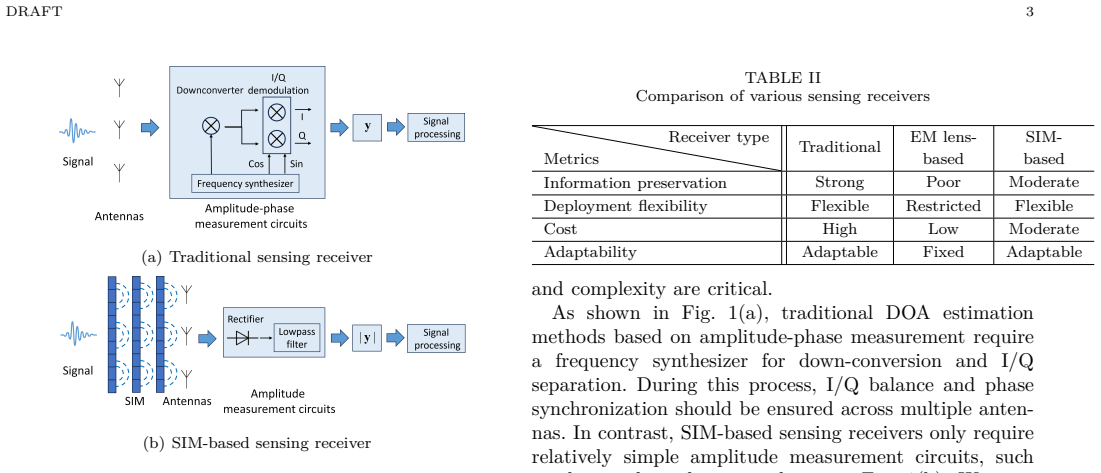
- A UAV receiver can replace power-hungry I/Q and phase-synchronized RF chains with envelope detectors, since the SIM does the angle-to-power encoding in the electromagnetic domain.
- High-resolution DOA becomes feasible with fewer snapshots, because the SIM acts as a large-aperture preprocessor rather than requiring many digital samples.
- The hierarchical coarse-fine search cuts spectrum-generation complexity whenever (G-9)(V-1)>9, i.e., for fine enough grids.
- The derived CRB gives a principled way to compare SIM designs: better-trained SIMs lower the amplitude-only bound, meaning angle information is better preserved.
- In dual-signal regimes at high SNR, the EMNN's large metasurface aperture separates sources that conventional beamforming cannot.
Where Pith is reading between the lines
- Editorial inference: because noise power and the number of incident signals K are assumed known, a practical deployment would need an online noise-estimation or calibration stage; the paper does not analyze how sensitive the 0.01-degree figure is to noise-power mismatch.
- Editorial inference: the same hierarchical spectrum-subregion idea could be applied to other electromagnetic-domain computing tasks, such as localization or imaging, where a coarse global map is refined locally.
- Editorial inference: a natural testable extension is to train with an unknown-K setting (e.g., predicting a confidence threshold for peaks) to remove the K prior.
- Editorial inference: the phase-aware CRB being lower than the amplitude-only CRB quantifies the information cost of dropping phase; a comparable gap for real hardware would motivate hybrid amplitude-plus-coarse-phase designs.
Editorial analysis
A structured set of objections, weighed in public.
Referee Report
Summary. The paper proposes an electromagnetic neural network (EMNN) for direction-of-arrival (DOA) estimation. The EMNN consists of a stacked intelligent metasurface (SIM) front end that transforms the incident wavefront into a received power distribution, followed by a fully connected digital layer that maps the measured amplitudes to an angular spectrum. A hierarchical two-stage estimator (coarse then fine) is introduced to reduce computational load and snapshot requirements. The paper also derives a Cramér–Rao bound for amplitude-only single-snapshot observations through a SIM. The main claimed contributions are: amplitude-only spectrum generation, a hierarchical DOA protocol with approximately 0.01° error, and about 13 dB classification-error gain over conventional beamforming (CBF) in dual-signal scenarios.
Significance. If substantiated, the proposal would be a genuinely interesting step toward low-power, low-latency DOA estimation for UAV platforms, because it replaces phase-coherent RF chains with amplitude detectors and pushes most computation into passive/analog metasurface layers. The CRB derivation in Appendix A is internally consistent under the stated model, and the simulation pipeline is coherent. The paper also makes a useful architectural point: the SIM provides a learned analog preprocessing front end, and the fully connected layer adds nonlinear representational capacity. However, the current evidence does not support the headline numerical claims: the reported 0.01° accuracy is not measured with an appropriate localization metric, the CBF comparison is made in classification-error space rather than estimation-error space, and the method requires precise knowledge of K, σ_n², and the inter-layer propagation coefficients, with no sensitivity analysis. The idea is defensible, but the evaluation needs to be reworked before the central claims can be accepted.
major comments (4)
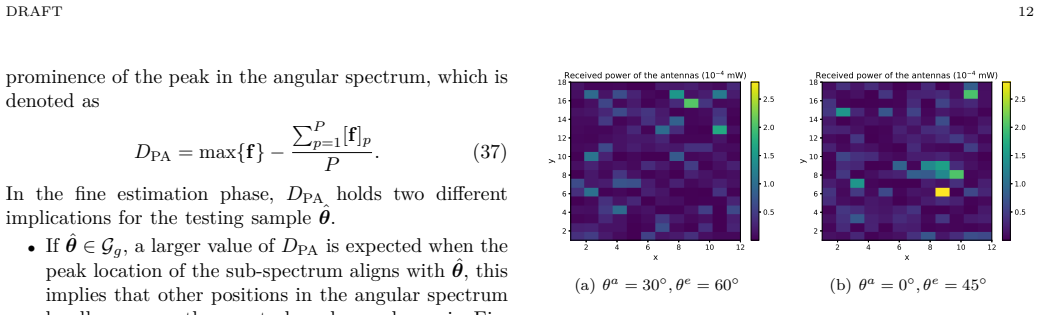
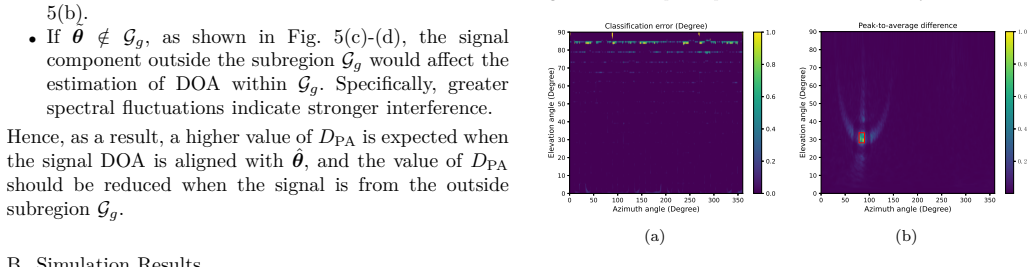
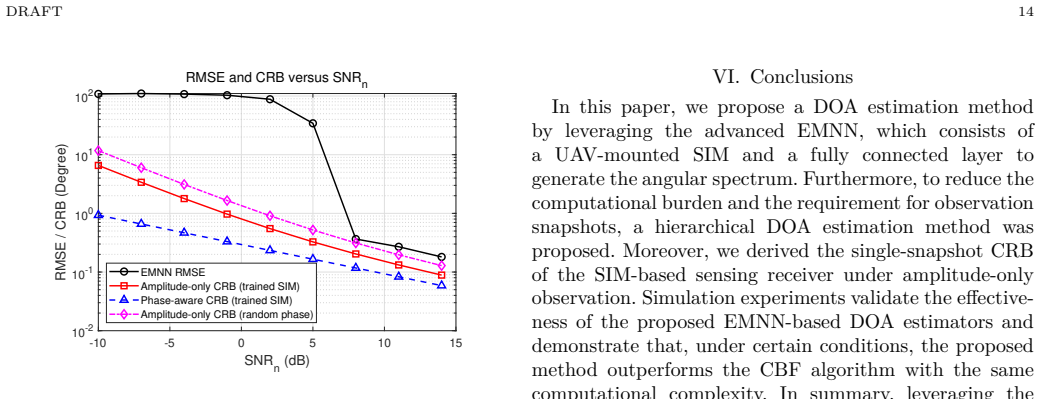
- [Section V-B and Contribution 6 (Abstract)] The claim that the hierarchical protocol achieves a DOA estimation error of approximately 0.01° is not supported by the reported simulations. The hierarchical estimator is evaluated only through classification error (Eq. (33)) and peak-to-average difference (Eq. (37)). But Eq. (33) is zero whenever the true DOA lies inside the predicted subregion, regardless of the actual offset between the estimate and the true angle. With the stated grid parameters Ga=32, Ge=16, Va=16, Ve=8, Eq. (27) gives E_a,fine=E_e,fine≈0.703°; even the 'high-resolution' spectrum in Fig. 6(a) uses Ga=512, Ge=128, i.e., cells of about 0.7°. A center-of-bin peak readout therefore has a quantization floor of order 0.1–0.2° RMSE, not 0.01°. No RMSE curve, interpolation, sub-cell refinement, or error histogram is provided for the hierarchical output. The authors should report RMSE for Algorithm 1 (or a comparable locali
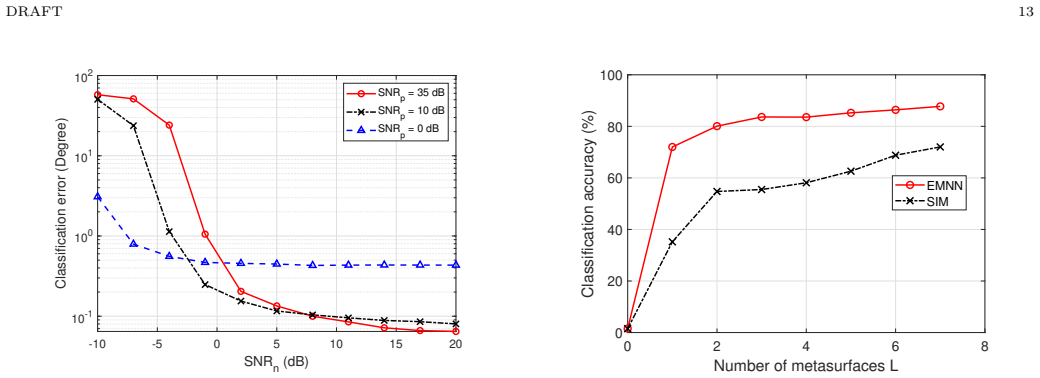
- [Section V-B, Fig. 12] The 'approximately 13 dB gain' over CBF is demonstrated only in classification-error space, not in DOA estimation error. Classification error as defined by Eq. (33) collapses to zero inside the correct cell, so a classification-error reduction does not translate directly into localization accuracy. Moreover, the comparison is not apples-to-apples: the EMNN receiver uses SIM configurations and a fully connected layer, while CBF is evaluated on a bare antenna array with d_A=λ/2, whereas the EMNN setup uses d_A=λ. Since the two systems have different apertures and processing, the 13 dB statement should be rephrased as a classification-error gain for the specific simulated setting, and ideally supplemented by RMSE comparisons at matched SNR and antenna geometry. The current wording in the abstract and contribution 6 overstates the significance of the comparison.
- [Section IV-D and Remark 4] Algorithm 1 takes as inputs the exact number of incident signals K, the noise power σ_n², and all EMNN parameters, while Remark 3 assumes perfectly known propagation coefficients W_l. In practice, K and σ_n² must be estimated, and W_l will deviate from the Rayleigh–Sommerfeld model (Eqs. (6)–(9)). Remark 4 addresses only the bias term in Eq. (12); it does not quantify how a misestimate of σ_n² or W_l corrupts peak locations. The manuscript contains no sensitivity analysis or calibration experiment for these quantities. Since the proposed method's main selling point is deployment on embedded UAV platforms, the authors should add at least a parameter-mismatch study (e.g., σ_n² errors, W_l perturbation, K over/under-estimation) to show the method's robustness or to delineate the operating conditions.
- [Section IV-C and V-B] The EMNN is trained and evaluated on data generated from the same simulated forward model (Eqs. (5)–(10)). This is an in-simulation evaluation, not a validation against experimental data or even a mismatched channel model. The paper should explicitly acknowledge this limitation and, if possible, include a test with perturbed propagation coefficients, non-ideal phase quantization, or a different noise profile. Otherwise the claims of 'feasibility' and 'validation' in Sections I and VI are stronger than the evidence.
minor comments (5)
- [Section V-A] The simulation setup states Ga=32, Ge=16, Va=16, Ve=8, but Fig. 12 says 'we use the same grid resolution for the coarse estimation only and the hierarchical method, i.e., Ga=512, Ge=128.' Clarify whether the hierarchical method in Fig. 12 uses a different grid than in the rest of the numerical study, and how this affects the comparison.
- [Eq. (13)] The notation ̃y_s uses a tilde that is easy to confuse with the stacked vector ̃y defined just before Eq. (11). Please define ̃y_s explicitly as the s-th snapshot of the stacked received signal.
- [Eq. (29)] The training forward model in Eq. (29) includes the perturbation term |n_p|² but does not show the noise-power subtraction that appears in Eq. (12). Clarify whether the trained network is meant to be used with the σ_n²-subtracted input or with the raw input, since Remark 4 suggests the subtraction is important.
- [Figure 8(b)] The colorbar labels contain corrupted Unicode characters (e.g., '/uni00000013/uni00000011/...'). The figure should be regenerated with proper labels.
- [References] Some reference entries are incomplete (e.g., [23], [25] are arXiv-only citations without full titles/IDs), and [2] duplicates the 3GPP TR 38.811 report number across two references. Please check for consistency.
Circularity Check
No circular reduction found; the EMNN is a supervised classifier trained on independent samples, and the CRB/CBF comparisons provide external checks. The 0.01° claim lacks reported RMSE support but is a verifiability gap, not circularity.
full rationale
Walking the derivation chain: the EMNN forward model (Eqs. (5)-(13)) defines a learned map WFC from SIM-encoded amplitude power to class scores; target spectra are computed from random DOA draws via Eq. (28), and WFC is fitted by cross-entropy (Eqs. (29)-(30)) on independent training samples. Test outputs are therefore not equal to the fitted labels by construction; this is ordinary supervised learning, not a fitted-input-called-prediction loop. The single-snapshot CRB (Eqs. (15)-(23), Appendix A) is a first-principles Fisher-information calculation for the stated observation model and is compared against the EMNN RMSE in Fig. 13 as an external lower bound; it does not incorporate the fully connected layer or the hierarchical grid, so it is not a restatement of the network output. The CBF baseline in Fig. 12 is a standard classical algorithm, providing an external comparison. The many self-citations ([1], [19], [22], [23], [25], [31]-[40]) are background or calibration references; none is used as a uniqueness theorem or as the sole justification of a central claim, so patterns 3-5 do not apply. The paper's limitation of relying on simulated data from the same forward model (Eqs. (2)-(10)) affects external validity but is not circularity: no parameter fitted to the evaluation quantity is later reported as an independent prediction. I do flag one non-circular verifiability issue: contribution 6 asserts 'the proposed hierarchical estimation protocol achieves a DOA estimation error of approximately 0.01°', but the paper reports no hierarchical RMSE curve; with the stated grid Ga=32, Ge=16, Va=16, Ve=8, Eq. (27c) gives fine cells of ~0.703° in both angles, so the 0.01° figure is not supported by the metrics actually reported (classification error and DPA). This is a correctness/evidence concern, not a circular equivalence.
Axiom & Free-Parameter Ledger
free parameters (5)
- SIM phase shifts Φ (per configuration) =
continuous, trained; 5 layers × 1600 meta-atoms per configuration
- Fully-connected weight matrix WFC =
e.g., 512×216 (coarse), 129×72 (fine)
- Perturbation SNR (SNR_p) =
10 dB (also 0 and 35 dB in Fig. 9)
- Fine-estimation sample ratio (inside Gg : surrounding : outside) =
1:1:1
- Grid resolutions (Ga, Ge, Va, Ve) =
32×16 and 16×8 (default); various in experiments
axioms (5)
- domain assumption Far-field narrowband planar-wave signal model with array response a(θ) as in Eqs. (2)-(4)
- domain assumption Rayleigh-Sommerfeld diffraction accurately models inter-layer and layer-to-antenna propagation, with perfectly known coefficients W_l (Eqs. (6)-(9))
- domain assumption Noise power σ_n^2 and number of incident signals K are known a priori
- domain assumption Constant-modulus signals with uniformly distributed random phases for the CRB derivation
- ad hoc to paper The training label q_p = K_p/K (Eq. (28)) and cross-entropy loss (30) produce an angular spectrum whose peak heights are proportional to incident signal power
read the original abstract
Accurate and real-time direction of arrival (DOA) estimation is crucial for beamforming in unmanned aerial vehicle (UAV) communication systems. However, the existing high-precision DOA estimation algorithms encounter high computational complexity when implemented on a UAV with on-board signal processing constraints. To tackle this issue, an electromagnetic neural network (EMNN) is developed for DOA estimation, which is capable of generating the angular spectrum of the incident signal based solely on amplitude observation. Specifically, the proposed EMNN consists of two components: a stacked intelligent metasurfaces (SIM) is mounted on the UAV, and each meta-atom is an artificial neuron that can process signals in the electromagnetic domain with low energy consumption and ultra-fast computing speed. Furthermore, a fully connected layer is cascaded to process the received amplitude signal, enhancing the non-linear extraction and representational ability of EMNN. Moreover, to reduce the computational complexity and observation snapshots required for high-resolution DOA estimation, we develop a hierarchical DOA estimation framework, which involves two stages for conducting coarse and fine DOA estimation, respectively. For each stage, EMNN is trained on randomly generated training samples and their corresponding spectra to achieve the desired estimation goal. Finally, the simulation results validate that the proposed EMNN achieves approximately 13 dB gain in classification error reduction over the conventional beamforming (CBF) method in dual-signal scenarios, albeit its lower cost and radio frequency (RF)-related power consumption.
Figures




Reference graph
Works this paper leans on
-
[1]
UA V-mounted SIM: A hybrid optical-electronic neural network for DoA estimation,
S. Lin, J. An, L. Gan, and M. Debbah, “UA V-mounted SIM: A hybrid optical-electronic neural network for DoA estimation,” in IEEE Int. Conf. Acoust., Speech Signal Process. (ICASSP), Apr. 2025, pp. 1–5
2025
-
[2]
Study on New Radio (NR) to Support Non-Terrestrial Net- works (Release 15),
“Study on New Radio (NR) to Support Non-Terrestrial Net- works (Release 15),” 3GPP, Sophia Antipolis, Valbonne, France, document TR 38.811, V15.4.0, Sep. 2020
2020
-
[3]
CRB weighted source localization method based on deep neural networks in multi- UA V network,
J. Cong, X. Wang, C. Yan et al., “CRB weighted source localization method based on deep neural networks in multi- UA V network,” IEEE Internet Things J., vol. 10, no. 7, pp. 5747–5759, Apr. 2023
2023
-
[4]
Joint optimisation of real-time deployment and resource allocation for UA V-aided disaster emergency commu- nications,
T. Do-Duy, L. D. Nguyen, T. Q. Duong, S. R. Khosravirad, and H. Claussen, “Joint optimisation of real-time deployment and resource allocation for UA V-aided disaster emergency commu- nications,” IEEE J. Sel. Areas Commun., vol. 39, no. 11, pp. 3411–3424, Nov. 2021
2021
-
[5]
Cooperative downlink interference transmission and cancellation for cellular-connected UA V: A divide-and-conquer approach,
W. Mei and R. Zhang, “Cooperative downlink interference transmission and cancellation for cellular-connected UA V: A divide-and-conquer approach,” IEEE Trans. Commun., vol. 68, no. 2, pp. 1297–1311, Feb. 2020
2020
-
[6]
Location- based robust beamforming design for cellular-enabled UA V communications,
W. Miao, C. Luo, G. Min, Y. Mi, and Z. Yu, “Location- based robust beamforming design for cellular-enabled UA V communications,” IEEE Internet Things J., vol. 8, no. 12, pp. 9934–9944, Jun. 2021
2021
-
[7]
Multiple emitters localization by UA V with nested linear array: System scheme and 2D-DOA estimation algorithm,
X. Lin, X. Zhang, L. He et al., “Multiple emitters localization by UA V with nested linear array: System scheme and 2D-DOA estimation algorithm,” China Commun., vol. 17, no. 3, pp. 117– 130, Mar. 2020
2020
-
[8]
Two decades of array signal processing research: the parametric approach,
H. Krim and M. Viberg, “Two decades of array signal processing research: the parametric approach,” IEEE Signal Process. Mag., vol. 13, no. 4, pp. 67–94, Jul. 1996
1996
-
[9]
Multiple emitter location and signal parameter estimation,
R. Schmidt, “Multiple emitter location and signal parameter estimation,” IEEE Trans. Antennas Propag., vol. 34, no. 3, pp. 276–280, Mar. 1986
1986
-
[10]
ESPRIT-estimation of signal pa- rameters via rotational invariance techniques,
R. Roy and T. Kailath, “ESPRIT-estimation of signal pa- rameters via rotational invariance techniques,” IEEE Trans. Acoustics Speech Signal Process., vol. 37, no. 7, pp. 984–995, Jul. 1989
1989
-
[11]
Improving the resolution performance of eigenstructure-based direction-finding algorithms,
A. Barabell, “Improving the resolution performance of eigenstructure-based direction-finding algorithms,” in Proc. IEEE Int. Conf. Acoust., Speech, Signal Process., vol. 8, Apr. 1983, pp. 336–339
1983
-
[12]
Unitary ESPRIT: How to obtain increased estimation accuracy with a reduced computational burden,
M. Haardt and J. A. Nossek, “Unitary ESPRIT: How to obtain increased estimation accuracy with a reduced computational burden,” IEEE Trans. Signal Process., vol. 43, no. 5, pp. 1232– 1242, May. 1995
1995
-
[13]
Deep networks for direction-of-arrival estimation in low SNR,
G. K. Papageorgiou, M. Sellathurai, and Y. C. Eldar, “Deep networks for direction-of-arrival estimation in low SNR,” IEEE Trans. Signal Process., vol. 69, pp. 3714–3729, Jun. 2021
2021
-
[14]
Direction-of-arrival estimation based on deep neural networks with robustness to array imperfections,
Z.-M. Liu, C. Zhang, and S. Y. Philip, “Direction-of-arrival estimation based on deep neural networks with robustness to array imperfections,” IEEE Trans. Antennas Propag., vol. 66, no. 12, pp. 7315–7327, Dec. 2018
2018
-
[15]
DeepMUSIC: Multiple signal classification via deep learning,
A. M. Elbir, “DeepMUSIC: Multiple signal classification via deep learning,” IEEE Sens. Lett., vol. 4, no. 4, pp. 1–4, Apr. 2020
2020
-
[16]
Deep aug- mented music algorithm for data-driven DoA estimation,
J. P. Merkofer, G. Revach, N. Shlezinger et al., “Deep aug- mented music algorithm for data-driven DoA estimation,” in Proc. IEEE Int. Conf. Acoust. Speech Signal Process. (ICASSP), May 2022, pp. 3598–3602
2022
-
[17]
Artificial neural network for direction-of-arrival estimation and secure wireless communications via space-time-coding digital metasurfaces,
X. Q. Chen, L. Zhang, S. Liu, and T. J. Cui, “Artificial neural network for direction-of-arrival estimation and secure wireless communications via space-time-coding digital metasurfaces,” Adv. Opt. Mater., vol. 10, no. 23, p. 2201900, Dec. 2022
2022
-
[18]
Integrated sensing and communication based on space-time-coding metasurfaces,
X. Q. Chen, L. Zhang, Y. N. Zheng et al., “Integrated sensing and communication based on space-time-coding metasurfaces,” Nat. Commun., vol. 16, no. 1, p. 1836, Feb. 2025
2025
-
[19]
Two-dimensional direction- of-arrival estimation using stacked intelligent metasurfaces,
J. An, C. Yuen, Y. L. Guan et al., “Two-dimensional direction- of-arrival estimation using stacked intelligent metasurfaces,” IEEE J. Sel. Areas Commun., vol. 42, no. 10, pp. 2786–2802, Oct. 2024
2024
-
[20]
Super-resolution diffractive neural network for all-optical direction of arrival estimation beyond diffraction limits,
S. Gao, H. Chen, Y. Wang et al., “Super-resolution diffractive neural network for all-optical direction of arrival estimation beyond diffraction limits,” Light-Sci. Appl., vol. 13, no. 1, p. 161, July. 2024
2024
-
[21]
All-optical machine learning using diffractive deep neural networks,
X. Lin, Y. Rivenson, N. T. Yardimci, M. Veli, Y. Luo, M. Jarrahi, and A. Ozcan, “All-optical machine learning using diffractive deep neural networks,” Science, vol. 361, no. 6406, pp. 1004–1008, Jul. 2018
2018
-
[22]
A programmable diffractive deep neural network based on a digital-coding metasurface array,
C. Liu, Q. Ma, Z. J. Luo et al., “A programmable diffractive deep neural network based on a digital-coding metasurface array,” Nature Electronics, vol. 5, no. 2, pp. 113–122, Feb. 2022
2022
-
[23]
H. Liu, J. An, X. Jia, S. Lin, X. Yao, L. Gan, B. Clerckx, C. Yuen, M. Bennis, and M. Debbah, “Stacked intelligent metasurfaces for wireless sensing and communication: Applications and challenges,” 2024. [Online]. A vailable: https://arxiv.org/abs/2407.03566
Pith/arXiv arXiv 2024
-
[24]
Diffraction neural network for multi-source information of arrival sensing,
M. Huang, B. Zheng, R. Li, X. Li, Y. Zou, T. Cai, and H. Chen, “Diffraction neural network for multi-source information of arrival sensing,” Laser Photon. Rev., p. 2300202, Oct. 2023
2023
-
[25]
Emerging technologies in intelligent metasurfaces: Shaping the future of wireless communications,
J. An, M. Debbah, T. J. Cui et al., “Emerging technologies in intelligent metasurfaces: Shaping the future of wireless communications,” 2024. [Online]. A vailable: https://arxiv.org/ abs/2411.19754
Pith/arXiv arXiv 2024
-
[26]
A tutorial on holographic MIMO communications—part I: Channel modeling and channel estimation,
J. An, C. Yuen, C. Huang et al., “A tutorial on holographic MIMO communications—part I: Channel modeling and channel estimation,” IEEE Commun. Lett., vol. 27, no. 7, pp. 1664–1668, Jul. 2023
2023
-
[27]
Flexible intelligent metasurfaces for downlink multiuser MISO communications,
J. An, C. Yuen, M. D. Renzo et al., “Flexible intelligent metasurfaces for downlink multiuser MISO communications,” IEEE Trans. Wireless. Commun., pp. 1–1, 2025, Early Access
2025
-
[28]
Codebook-based solutions for reconfigurable intelligent surfaces and their open challenges,
J. An, C. Xu, Q. Wu et al., “Codebook-based solutions for reconfigurable intelligent surfaces and their open challenges,” IEEE Wireless. Commun., vol. 31, no. 2, pp. 134–141, Apr. 2024
2024
-
[29]
High-efficiency transmissive tunable metasurfaces DRAFT 16 for binary cascaded diffractive layers,
Y. Jia, H. Lu, Z. Fan, B. Wu, F. Qu, M.-j. Zhao, C. Qian, and H. Chen, “High-efficiency transmissive tunable metasurfaces DRAFT 16 for binary cascaded diffractive layers,” IEEE Trans. Antennas Propag., May. 2024
2024
-
[30]
Efficient beamforming and radiation pattern control using stacked intelligent metasurfaces,
N. U. Hassan, J. An et al., “Efficient beamforming and radiation pattern control using stacked intelligent metasurfaces,” IEEE Open J. Commun. Soc., vol. 5, pp. 599–611, Jan. 2024
2024
-
[31]
Stacked intelligent metasurfaces for multiuser downlink beamforming in the wave domain,
J. An, M. D. Renzo, M. Debbah et al., “Stacked intelligent metasurfaces for multiuser downlink beamforming in the wave domain,” IEEE Trans. Wireless. Commun., pp. 1–1, May, Early Access 2025
2025
-
[32]
DRL-based orchestration of multi-user MISO systems with stacked intelligent metasur- faces,
H. Liu, J. An, D. W. K. Ng et al., “DRL-based orchestration of multi-user MISO systems with stacked intelligent metasur- faces,” in Proc. IEEE Int. Conf. Commun. (ICC), Jun. 2024, pp. 4991–4996
2024
-
[33]
Stacked intelligent metasur- faces for efficient holographic MIMO communications in 6G,
J. An, C. Xu, D. W. K. Ng et al., “Stacked intelligent metasur- faces for efficient holographic MIMO communications in 6G,” IEEE J. Sel. Areas Commun., vol. 41, no. 8, pp. 2380–2396, Aug. 2023
2023
-
[34]
Stacked Intelligent Metasurface- Aided MIMO Transceiver Design,
J. An, C. Yuen, C. Xu et al., “Stacked Intelligent Metasurface- Aided MIMO Transceiver Design,” IEEE Wirel. Commun., vol. 31, no. 4, pp. 123–131, Apr. 2024
2024
-
[35]
Achievable rate optimization for stacked intelligent metasurface-assisted holographic MIMO communications,
A. Papazafeiropoulos, J. An, P. Kourtessis et al., “Achievable rate optimization for stacked intelligent metasurface-assisted holographic MIMO communications,” IEEE Trans. Wireless. Commun., vol. 23, no. 10, pp. 13 173–13 186, Oct. 2024
2024
-
[36]
Stacked intelligent metasurfaces for integrated sensing and communications,
H. Niu, J. An, A. Papazafeiropoulos et al., “Stacked intelligent metasurfaces for integrated sensing and communications,” IEEE Wireless. Commun. Lett., vol. 13, no. 10, pp. 2807–2811, Oct. 2024
2024
-
[37]
Stacked intelligent metasurface enabled LEO satellite communications relying on statistical CSI,
S. Lin, J. An, L. Gan et al., “Stacked intelligent metasurface enabled LEO satellite communications relying on statistical CSI,” IEEE Wireless. Commun. Lett., vol. 13, no. 5, pp. 1295– 1299, May. 2024
2024
-
[38]
Uplink performance of stacked intelligent metasurface-enhanced cell-free massive MIMO sys- tems,
E. Shi, J. Zhang, Y. Zhu et al., “Uplink performance of stacked intelligent metasurface-enhanced cell-free massive MIMO sys- tems,” IEEE Trans. Wireless. Commun., pp. 1–1, 2025, Early Access
2025
-
[39]
On the efficient design of stacked intelligent metasurfaces for secure SISO transmission,
H. Niu, X. Lei, J. An, L. Zhang, and C. Yuen, “On the efficient design of stacked intelligent metasurfaces for secure SISO transmission,” IEEE Trans. Inf. Forensic Secur., vol. 20, pp. 60–70, Jan. 2025
2025
-
[40]
Stacked intelligent metasurfaces for task-oriented semantic communications,
G. Huang, J. An, Z. Yang, L. Gan, M. Bennis, and M. Debbah, “Stacked intelligent metasurfaces for task-oriented semantic communications,” IEEE Wireless. Commun. Lett., vol. 14, no. 2, pp. 310–314, Feb. 2025
2025
-
[41]
All-optical information-processing capacity of diffractive surfaces,
O. Kulce, D. Mengu, Y. Rivenson, and A. Ozcan, “All-optical information-processing capacity of diffractive surfaces,” Light- Sci. Appl., vol. 10, no. 1, p. 25, Jan. 2021
2021
-
[42]
Hybrid optical-electronic convolutional neural networks with optimized diffractive optics for image classification,
J. Chang, V. Sitzmann, X. Dun et al., “Hybrid optical-electronic convolutional neural networks with optimized diffractive optics for image classification,” SCI REP-UK, vol. 8, no. 1, pp. 1–10, Aug. 2018
2018
-
[43]
Optical-electronic hybrid Fourier convolutional neural network based on super-pixel complex- valued modulation,
L. Fan, X. Long, J. Dai et al., “Optical-electronic hybrid Fourier convolutional neural network based on super-pixel complex- valued modulation,” Appl. Opt, vol. 62, no. 5, pp. 1337–1344, Feb. 2023
2023
-
[44]
All-dielectric metasurface empowered optical-electronic hybrid neural networks,
G. Qu, G. Cai, X. Sha et al., “All-dielectric metasurface empowered optical-electronic hybrid neural networks,” Laser Photon. Rev., vol. 16, no. 10, p. 2100732, Oct. 2022
2022
-
[45]
Large-scale neuromorphic optoelectronic computing with a reconfigurable diffractive processing unit,
T. Zhou, X. Lin, J. Wu, Y. Chen, H. Xie, Y. Li, J. Fan, H. Wu, L. Fang, and Q. Dai, “Large-scale neuromorphic optoelectronic computing with a reconfigurable diffractive processing unit,” Nat. Photonics, vol. 15, no. 5, pp. 367–373, Apr. 2021
2021
-
[46]
Analysis of diffractive optical neural networks and their integration with electronic neural networks,
D. Mengu, Y. Luo, Y. Rivenson, and A. Ozcan, “Analysis of diffractive optical neural networks and their integration with electronic neural networks,” IEEE J. Sel. Top. Quantum Electron., vol. 26, no. 1, pp. 1–14, Jan. 2020
2020
-
[47]
All-analog photoelectronic chip for high-speed vision tasks,
Y. Chen, M. Nazhamaiti, H. Xu, Y. Meng, T. Zhou, G. Li, J. Fan, Q. Wei, J. Wu, F. Qiao et al., “All-analog photoelectronic chip for high-speed vision tasks,” Nature, pp. 1–10, Oct. 2023
2023
-
[48]
Direct electromagnetic information processing with planar diffractive neural network,
Z. Gu, Q. Ma, X. Gao, J. W. You, and T. J. Cui, “Direct electromagnetic information processing with planar diffractive neural network,” Sci. Adv., vol. 10, no. 29, p. eado3937, Jul. 2024
2024
-
[49]
Low complexity aoa estimation with planar electromagnetic lens arrays,
W. Xu, D. Inserra, G. Wen, and A. M. Tonello, “Low complexity aoa estimation with planar electromagnetic lens arrays,” in IEEE Int. Conf. Control, Electron. Comput. Technol. (IC- CECT), Apr. 2023, pp. 1582–1587
2023
-
[50]
Non-coherent direction of arrival estimation from magnitude-only measure- ments,
H. Kim, A. M. Haimovich, and Y. C. Eldar, “Non-coherent direction of arrival estimation from magnitude-only measure- ments,” IEEE Signal Process. Lett., vol. 22, no. 7, pp. 925–929, Jul. 2015
2015
-
[51]
Target localization based on distributed array networks with magnitude-only measure- ments,
Z. Wan, W. Liu, and P. Willett, “Target localization based on distributed array networks with magnitude-only measure- ments,” IEEE Trans. Aerosp. Electron. Syst., vol. 59, no. 6, pp. 9704–9710, Dec. 2023
2023
-
[52]
S. M. Kay, Fundamentals of Statistical Signal Processing: Estimation Theory. Upper Saddle River, NJ: Prentice-Hall, 1993
1993
-
[53]
MUSIC, maximum likelihood, and Cramér-Rao bound,
P. Stoica and A. Nehorai, “MUSIC, maximum likelihood, and Cramér-Rao bound,” IEEE Trans. Acoust., Speech, Signal Process., vol. 37, no. 5, pp. 720–741, May 1989
1989
-
[54]
Adam: A method for stochastic optimization,
D. P. Kingma and J. Ba, “Adam: A method for stochastic optimization,” in Proc. 3rd Int. Conf. Learn. Representations, 2014
2014
-
[55]
Programmable surface plasmonic neural networks for microwave detection and processing,
X. Gao, Q. Ma, Z. Gu et al., “Programmable surface plasmonic neural networks for microwave detection and processing,” Nat. Electron., vol. 6, no. 4, pp. 319–328, Apr. 2023
2023
-
[56]
NIST digital library of mathematical functions,
NIST Digital Library of Mathematical Functions, “NIST digital library of mathematical functions,” 2024, f. W. J. Olver et al., eds
2024
-
[57]
Highly Cited Researchers
N. L. Johnson, S. Kotz, and N. Balakrishnan, Continuous univariate distributions, 2nd ed. New York, NY, USA: Wiley, 1995, vol. 2. Shining Lin received his B.S. degree in 2022 and M.S. degree in 2025, both from the School of Information and Communication Engineer- ing at the University of Electronic Science and Technology of China (UESTC), Chengdu. His cur...
1995
discussion (0)
Sign in with ORCID, Apple, or X to comment. Anyone can read and Pith papers without signing in.