REVIEW 4 major objections 6 minor 104 references
Quantum fluctuation-driven transport crossover between two liquid states in distinguishable helium-4
T0 review · 4 major / 6 minor · reviewed 2026-08-01 · deepseek-v4-flash
Pith's one-line read In distinguishable helium-4, nuclear quantum fluctuations alone turn the liquid gas-like on cooling—superdiffusion, ultralow viscosity, and a second Frenkel line, with no superfluidity.
desk verdict Plausible and interesting qualitative crossover, but every exciting number rides on an unvalidated centroid approximation, so treat the magnitudes as provisional. read the letter →
The pith
A machine-rendered reading of the paper's core claim, the machinery that carries it, and where it could break.
The reading
What carries the argument
The central object is the atomic necklace of path-integral centroid molecular dynamics: each atom is a ring polymer whose spatial delocalization is quantified by the quantum wavelength λ_quantum ≈ 2R_g, with expansion factor α_λ = λ_quantum/λ_dB. The transport coefficients (self-diffusion, shear viscosity, thermal conductivity, and derived kinematic viscosity, thermal diffusivity, Prandtl number) are computed via the centroid approximation to the Green–Kubo formula, where canonical correlation functions of stress and energy current are replaced by centroid-variable correlations. The crossover is diagnosed by the shape of the normalized velocity autocorrelation function (oscillatory vs. monot
What would settle it
Perform a benchmark simulation of distinguishable 4He at 0.1–0.3 K and 1–10 bar using a method that does not rely on the centroid approximation for nonlinear operators—for example, a ring-polymer approach with an energy-current estimator based on the intermediate scattering function—and check whether the VAF remains monotonic, γ > 1, and η_s ≈ 10⁻⁷ Pa·s. Alternatively, measure diffusion and viscosity of 4He confined in extremely narrow nanopores where exchange is suppressed; if the predicted superdiffusion and viscosity minimum do not appear, the centroid approximation is the likely culprit.
Extended reading notes
Core claim
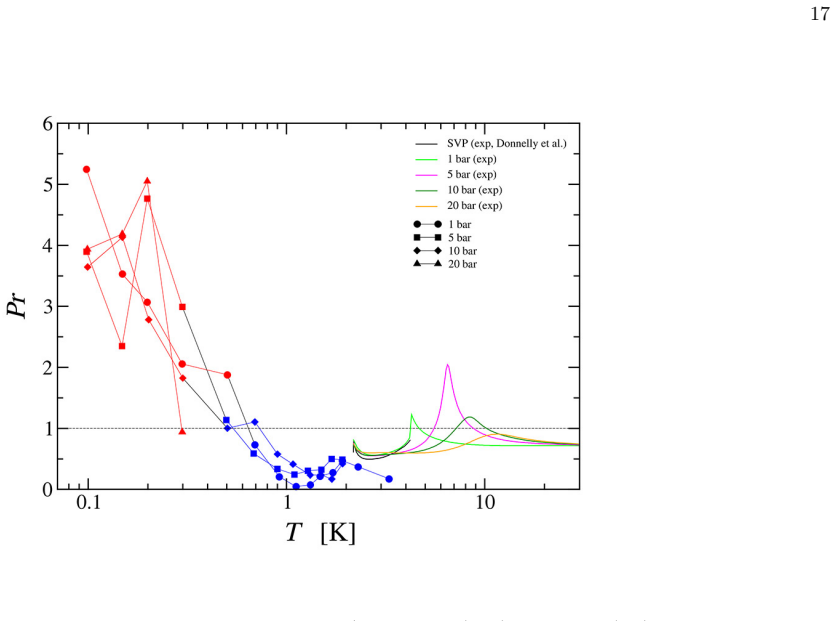
The central discovery is that distinguishable helium-4, modeled without Bose exchange, exhibits a transport crossover upon cooling rather than simply becoming more solid-like. In the HQDL state below about 0.5 K, the velocity autocorrelation function decays monotonically instead of oscillating, the mean-square displacement exponent exceeds unity (superdiffusion), the shear viscosity reaches 7.83×10⁻⁷ Pa·s at 0.15 K and 5 bar—below the experimental minimum of the normal-fluid component of He II—and the fractional Stokes-Einstein exponent drops to ξ ≈ 0.23–0.30. These gas-like transport properties arise from nuclear quantum delocalization, which widens the atomic 'necklaces' to quantum wavelen
Load-bearing premise
The key load-bearing assumption is that the centroid approximation to the Green–Kubo formula, which replaces the true canonical correlation functions by centroid-variable correlations for nonlinear stress and energy-current operators, accurately reproduces the long-time decay of these correlation functions at 0.1–0.3 K; the authors state that no rigorous justification exists and validation is only for He I above T_λ and para-hydrogen.
Editorial extensions
If this is right
- If distinguishable helium-4 is realized (e.g., in nanopore confinement that suppresses exchange), its low-temperature liquid should show the gas-like signatures predicted here: superdiffusion, monotonic VAF, fractional Stokes-Einstein exponent ≈0.2–0.3, and Prandtl number >1.
- The transport minima found in η_s, λ, ν, and α in the subcritical regime are a new class of minima, distinct from the well-known supercritical ones, and should appear as a 'reentrant gas-like' regime in any sufficiently quantum liquid that does not freeze.
- The identification of a second Frenkel line extends the liquid–gas dynamical crossover concept to the subcritical low-temperature region, where the driving fluctuation switches from thermal to nuclear quantum.
- For glassy states, HQDA should be a 'glassy yet fluidic' state: suppressed self-diffusion but viscosity and thermal conductivity close to the liquid values, providing a new criterion for vitrification.
- A direct comparison with bosonic 4He would isolate the role of Bose exchange: the same ingredients without exchange should produce no superfluid transition and no λ divergence, but retain the low-viscosity HQDL behavior.
Reading between the lines
- The paper's mechanism—quantum delocalization smoothing the effective potential—suggests a testable prediction for other light-atom liquids (e.g., hydrogen or neon isotopes): if zero-point motion is large enough to prevent freezing, they too should exhibit a low-temperature gas-like transport crossover and a second Frenkel line.
- The fractional Stokes-Einstein exponent ξ≈0.2–0.3 with no dynamical heterogeneity challenges the usual attribution of SE breakdown to heterogeneity; if confirmed, percolated necklace interpenetration would be a new structural route to SE breakdown, possibly relevant to metallic liquids and polymer networks.
- Because the centroid approximation's validity is empirical, the quantitative claims (e.g., the exact viscosity minimum) could be tested by recomputing with a different dynamical approximation that avoids nonlinear centroid currents; if the monotonic VAF and superdiffusion persist, the crossover is robust.
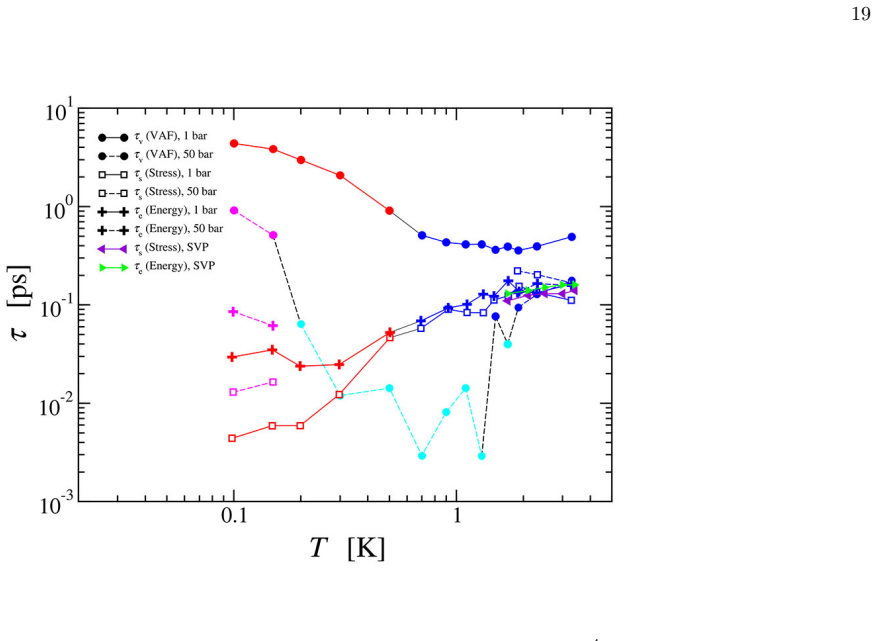
- If Bose statistics were switched on, the paper's estimate that the exchange timescale (≈h/(k_B T) ≈ 100 ps at 0.1 K) exceeds all relaxation times (τ_v ≈ 4.4 ps) suggests that transport in real He II below 0.1 K might be viewed as the same quantum-fluctuation-driven fluidity, with superfluidity adding a coherent component rather than being the sole origin.
Signed reviews
Editorial analysis
A structured set of objections, weighed in public.
Referee Report
Summary. The paper reports extensive path-integral centroid molecular dynamics (CMD) simulations of distinguishable (Boltzmann) 4He over 0.1–3.3 K and 1–60 bar, with transport coefficients obtained from centroid-approximated Green–Kubo formulas. It identifies two liquid states, LQDL and HQDL, and claims that upon cooling the system crosses from a conventional liquid to a gas-like liquid driven solely by nuclear quantum effects. Evidence includes a monotonic centroid VAF in HQDL, MSD exponent γ>1, shear viscosity minimum 7.83×10^-7 Pa·s, fractional Stokes–Einstein exponent ξ≈0.23–0.30, Prandtl number >1, and transport minima in ηs, λ, ν, and α. The authors introduce a 'second Frenkel line' in the subcritical region, distinguished from the supercritical Frenkel line by the driver being quantum rather than thermal fluctuations.
Significance. If the central claims are correct, the paper provides a striking qualitative result: a liquid can become gas-like upon cooling because of nuclear quantum delocalization, without Bose exchange or superfluidity. This would establish an exchange-free reference for interpreting transport anomalies in real and confined 4He. The study is systematic—115 state points, multiple independent observables, error bars from integration-window variation, and favorable comparison to He I in the high-temperature regime—which are genuine strengths. However, the quantitative claims and the very existence of the HQDL transport crossover rest on the centroid approximation for nonlinear correlation functions, which the authors concede is not rigorously justified. The significance is therefore conditional until that approximation is validated in the strongly quantum regime.
major comments (4)
- [Eq. (14), Secs. II B, V F, III G–H] All collective transport coefficients (ηs, λ, ν, α, Pr, SE exponent) and the VAF-shape-based second Frenkel line flow through Eq. (14), which replaces canonical Kubo correlations of nonlinear operators—the stress tensor (Eq. 18) and energy current (Eq. 23)—by classical centroid correlations. The authors state in Sec. V F that rigorous justification is unavailable, and exactness for linear operators [13] does not apply here. The cited empirical validation (He I above Tλ [27], para-H2 [25,26]) is in the nearly classical regime, not at 0.1–0.3 K where λ_quantum reaches 6.6 Å and necklaces overlap. No benchmark is provided for the HQDL regime. Moreover, Sec. III H reports that the same scheme overestimates λ relative to experiment even in the validated He I regime, showing the approximation has quantitative error. I request a direct validation at representative HQDL state points, e.g., finit
- [Sec. II C, Sec. III E, Sec. IV C] No finite-size or Trotter convergence checks are reported for dynamical quantities; N=256 and Nb=500 are used exclusively. At 0.1 K and 1 bar, λ_quantum=6.6 Å, and the simulation box is only about 23 Å across, so necklace overlap and periodic boundary effects could be severe. The superdiffusive MSD exponent γ is fitted over t=20–60 ps (Sec. III E), and the VAF relaxation time τ_v≈4.4 ps (Sec. IV C) is comparable to the time needed to traverse a significant fraction of the box. The authors should report box lengths and provide N- and Nb-convergence data for the MSD, VAF, and stress autocorrelation at least at the 0.1 K, 1 bar and 5 bar state points.
- [Sec. V B, Table III, Fig. 2] The second Frenkel line is defined only by a qualitative change in the VAF from oscillatory to monotonic decay. No numerical criterion, uncertainty, or reproducible algorithm is given for T_F2, yet the line is drawn in Fig. 2 and used as a central diagnostic. The authors should specify a quantitative operational definition—e.g., the first zero of C_v(t), a threshold on the depth of the first minimum of the normalized VAF, or a fit parameter—and show the crossover points and their scatter. Without this, the existence and location of the second Frenkel line cannot be independently assessed.
- [Sec. III A, Figs. 4–10] The NVE simulations are labeled by the nominal pressure of the preceding NPT run, but Sec. III A explicitly states that the average pressure in the NVE runs deviates significantly for some state points. The isobaric temperature dependences in Figs. 4, 5, 7, 9, 10 and the extracted minima and crossover temperatures therefore mix different actual pressures. The authors should report the actual NVE pressures (or densities) for each state point and quantify the deviation, or replot the data against density. As it stands, the minima claimed at '1 bar' or '5 bar' may be shifted by the pressure drift.
minor comments (6)
- [Eq. (1)] The partition function includes a 1/N! factor while the text repeatedly calls the particles 'distinguishable.' If the 1/N! is retained as the Gibbs-correction factor for Boltzmann statistics, this should be stated explicitly, since for truly distinguishable particles the factor should be absent (it cancels in the transport averages but is conceptually confusing).
- [Throughout] The notation 'P r' and 'V AF' appears with extra spaces; it should read 'Pr' and 'VAF' consistently. Also, Table I uses 'P r <1' without space.
- [Sec. IV A] The thermal diffusivity α uses C_P obtained from fitted enthalpy–temperature curves (Figs. S6–S7), but the fitting procedure and its uncertainty are not described. Since Pr = ηs C_P / λ depends on C_P, the error in C_P should be propagated into Pr and the stated crossover.
- [Sec. III B] The comparison with Nakayama et al. [49] is plausible but under-supported: only two NVT temperatures and one NPT gas-like run are reported, and the original simulation conditions of [49] are not fully analyzed. The authors should provide a clearer demonstration that the Nakayama conditions lie on the gas side of the coexistence boundary.
- [Fig. 2(b)] The 'Frenkel line' in the supercritical region is reproduced from Ref. 15 and not computed here; the caption should state this more prominently, since the reader may otherwise mistake it for a new result of this paper.
- [Sec. V A] The order-of-magnitude estimate of the entropy from the KSS bound is clearly flagged as speculative, but it is not central to the paper and could be moved to the Supplementary Material to sharpen the main text.
Circularity Check
No significant circularity: transport coefficients are computed from Green-Kubo correlation integrals and state labels from independent static criteria; the centroid approximation is a validity caveat, not a circular input.
full rationale
This paper's derivation chain is not circular. Transport coefficients are obtained by time-integrating separately computed centroid correlation functions (Eqs. 15, 20, 25) for 115 state points; no coefficient is fitted to the phenomenon it is later said to explain. The LQDL/HQDL labels are assigned in Sec. II C and Suppl. S1 using static criteria (g_cc penetration and αλ behavior established in Ref. 14), not using the dynamical properties (VAF shape, γ, ξ, Pr) that are then reported as independent characterizations. The 'second Frenkel line' is a definitional boundary (VAF oscillatory-to-monotonic crossover) rather than a prediction, and it is corroborated by transport minima, Prandtl-number crossover, and SE breakdown. The exponents γ and ξ are fitting descriptors of the simulated MSD and fractional SE plots, not fitted inputs that force those outputs. Self-citations to Refs. 14-16 and 25-27 supply prior state classification and method validation; Ref. 14 is used for static state boundaries, while the present transport results are new calculations, and the method's agreement with experimental He I above Tλ is checked here (Fig. 7). The most important caveat—that the centroid approximation Eq. (14) lacks rigorous justification for nonlinear stress/energy-current operators, as the authors concede in Sec. V F—is a correctness/validation risk for the quantitative values in the unexplored HQDL regime, not a circular equivalence between input and output. No step reduces by construction to its own inputs.
Assumptions & free parameters
free parameters (4)
- Liquid/glass diffusion threshold =
2.0 × 10^-10 m^2 s^-1
- Green-Kubo integration cutoff =
3 ps
- MSD power-law exponent γ =
γ > 1 for HQDL; γ ≈ 1 for LQDL
- Fractional SE exponent ξ =
0.23–0.30 (HQDL), 0.83–1.0 (LQDL)
assumptions (5)
- domain assumption Centroid approximation in Eq. (14) is accurate for the nonlinear stress and energy-current operators.
- domain assumption Aziz HFD-B3-FCI1 pair potential describes He-He interactions in this regime.
- domain assumption Path-integral discretization with N_b = 500 is converged for static and dynamical properties.
- domain assumption 256-atom periodic cell is large enough for the long-time correlation and MSD tails.
- ad hoc to paper State identification criteria from Ref. 14 transfer to NVE simulations.
invented entities (1)
-
Second Frenkel line (T_F2)
independent evidence
Cite this review
Pith. "Pith review of Quantum fluctuation-driven transport crossover between two liquid states in distinguishable helium-4." pith.science (2026). https://pith.science/paper/Z6J4HJE4
@misc{pith2026260723127,
  author       = {Pith},
  title        = {Pith review of: Quantum fluctuation-driven transport crossover between two liquid states in distinguishable helium-4},
  year         = {2026},
  howpublished = {\url{https://pith.science/paper/Z6J4HJE4}},
  note         = {Machine review of arXiv:2607.23127}
}
read the original abstract
We show the emergence of a quantum fluctuation-driven transport crossover between two liquid states in distinguishable helium-4 obeying Boltzmann statistics, in the absence of atomic exchange. Using path integral centroid molecular dynamics simulations over 0.1-3.3 K and 1-60 bar, we investigate the transport properties of two distinct liquid states: the low quantum-dispersion liquid (LQDL) and the high quantum-dispersion liquid (HQDL). While LQDL exhibits conventional liquid behavior consistent with the Stokes-Einstein (SE) relation, HQDL emerges at lower temperatures and displays anomalous gas-like transport characterized by superdiffusion and ultralow viscosity, accompanied by a breakdown of the SE relation. This counterintuitive emergence of gas-like dynamics upon cooling reflects the dominant role of nuclear quantum fluctuations, in contrast to thermal fluctuations at higher temperatures. Across the LQDL-HQDL boundary, we identify a transport crossover marked by a qualitative change in the velocity autocorrelation function (VAF), a transition in the Prandtl number, and the emergence of transport minima in shear and kinematic viscosities, thermal conductivity, and thermal diffusivity. These minima reflect a crossover from liquid-like to gas-like transport upon cooling in the low-temperature subcritical region, in addition to the universal transport minima observed in the supercritical regime. The transition from oscillatory to monotonic VAF defines a second Frenkel line, distinct from the conventional Frenkel line observed in the supercritical region. LQDL is a heat-transport-dominated dissipative fluid, whereas HQDL is a momentum-dominated inertial fluid. These results demonstrate that nuclear quantum fluctuations alone induce gas-like liquid behavior and provide a unified picture of transport phenomena in distinguishable helium-4 without superfluidity.
Figures


Figures from the paper (12 more)





Reference graph
Works this paper leans on
-
[13]
Jang and G
S. Jang and G. A. Voth, J. Chem. Phys.111, 2357 (1999)
1999
-
[27]
Imaoka and K
H. Imaoka and K. Kinugawa, Chem. Phys. Lett.671, 174 (2017)
2017
-
[1]
London, Nature141, 643 (1938)
F. London, Nature141, 643 (1938)
1938
-
[2]
London, Phys
F. London, Phys. Rev.54, 947 (1938)
1938
-
[3]
Wilks,An Introduction to Liquid Helium, Oxford Li- brary of the Physical Sciences (Clarendon, Oxford, UK, 1970)
J. Wilks,An Introduction to Liquid Helium, Oxford Li- brary of the Physical Sciences (Clarendon, Oxford, UK, 1970)
1970
-
[4]
Wilks,The Properties of Liquid and Solid Helium (Clarendon, Oxford, UK, 1970)
J. Wilks,The Properties of Liquid and Solid Helium (Clarendon, Oxford, UK, 1970)
1970
-
[5]
R. P. Feynman,Statistical Mechanics(Addison-Wesley, Reading, MA, 1972)
1972
-
[6]
R. P. Feynman, Phys. Rev.94, 262 (1954)
1954
Show all 104 references
-
[7]
Boninsegni, L
M. Boninsegni, L. Pollet, N. Prokof’ev, and B. Svis- tunov, Phys. Rev. Lett.109, 025302 (2012)
2012
-
[8]
Cao and G
J. Cao and G. A. Voth, J. Chem. Phys99, 10070 (1993)
1993
-
[9]
Cao and G
J. Cao and G. A. Voth, J. Chem. Phys100, 5093 (1994)
1994
-
[10]
Cao and G
J. Cao and G. A. Voth, J. Chem. Phys100, 5106 (1994)
1994
-
[11]
Cao and G
J. Cao and G. A. Voth, J. Chem. Phys101, 6157 (1994)
1994
-
[12]
Cao and G
J. Cao and G. A. Voth, J. Chem. Phys101, 6168 (1994)
1994
-
[14]
Tsujimoto and K
M. Tsujimoto and K. Kinugawa, J. Chem. Phys.161, 044501 (2024)
2024
-
[15]
Takemoto and K
A. Takemoto and K. Kinugawa, J. Chem. Phys.149, 204504 (2018)
2018
-
[16]
Kinugawa and A
K. Kinugawa and A. Takemoto, J. Chem. Phys.154, 224503 (2021)
2021
-
[17]
LDA” and “HDA,
In Ref. 16, these phases were abbreviated as “LDA” and “HDA,” respectively. However, these abbreviations may be confused with the low- and high-density amorphous states of classical systems (e.g., water [18]). To avoid this ambiguity, we adopt the abbreviations LQDA and HQDA, ...
-
[18]
Mishima and H
O. Mishima and H. G. Stanley, Nature396, 329 (1998)
1998
-
[19]
P. H. Poole, T. Grande, C. A. Angell, and P. F. McMil- lan, Science275, 322 (1997)
1997
-
[20]
Katayama, Y
Y. Katayama, Y. Inamura, T. Mizutani, M. Yamakata, W. Utsumi, and O. Shimomura, Science306, 848 (2004). 27
2004
-
[21]
T. E. Markland, J. A. Morrone, B. J. Berne, K. Miyazaki, E. Rabani, and D. R. Reichman, Nat. Phys.7, 134 (2011)
2011
-
[22]
T. E. Markland, J. A. Morrone, K. Miyazaki, B. J. Berne, D. R. Reichman, and E. Rabani, J. Chem. Phys. 136, 074511 (2012)
2012
-
[23]
W. A. Phillips, J. Low Temp. Phys.7, 351 (1972)
1972
-
[24]
P. W. Anderson, B. I. Halperin, and C. M. Varma, Phi- los. Mag.25, 1 (1972)
1972
-
[25]
Yonetani and K
Y. Yonetani and K. Kinugawa, J. Chem. Phys.119, 9651 (2003)
2003
-
[26]
Yonetani and K
Y. Yonetani and K. Kinugawa, J. Chem. Phys.120, 10624 (2004)
2004
-
[28]
I. R. Craig and D. E. Manolopoulos, J. Chem. Phys121, 3368 (2004)
2004
-
[29]
Habershon, D
S. Habershon, D. E. Manolopoulos, T. E. Markland, and T. F. Miller III, Ann. Rev. Phys. Chem.64, 387 (2013)
2013
-
[30]
B. J. Sutherland, W. H. D. Moore, and D. E. Manolopoulos, J. Chem. Phys154, 174104 (2021)
2021
-
[31]
Kinugawa, Chem
K. Kinugawa, Chem. Phys. Lett.292, 454 (1998)
1998
-
[32]
F. J. Bermejo, K. Kinugawa, C. Cabrillo, S. M. Benning- ton, B. F ˚ ak, M. T. Fern´ andez-D ´ ıaz, P. Verkerk, J. Daw- idowski, and R. Fern´ andez-Perea, Phys. Rev. Lett.84, 5359 (2000)
2000
-
[33]
Miura, S
S. Miura, S. Okazaki, and K. Kinugawa, J. Chem. Phys. 110, 4523 (1999)
1999
-
[34]
V. V. Brazhkin, Y. D. Fomin, A. G. Lyapin, V. N. Ryzhov, and K. Trachenko, Phys. Rev. E85, 031203 (2012)
2012
-
[35]
V. V. Brazhkin, Y. D. Fomin, A. G. Lyapin, V. N. Ryzhov, E. N. Tsiok, and K. Trachenko, Phys. Rev. Lett.111, 145901 (2013)
2013
-
[36]
Kinugawa, P
K. Kinugawa, P. B. Moore, and M. L. Klein, J. Chem. Phys.106, 1154 (1997)
1997
-
[37]
Chandler and P
D. Chandler and P. G. Wolynes, J. Chem. Phys.74, 4078 (1981)
1981
-
[38]
Rubinstein and R
M. Rubinstein and R. H. Colby,Polymer Physics(Ox- ford University Press, NY, 2003)
2003
-
[39]
Frenkel and B
D. Frenkel and B. Smit,Understanding Molecular Sim- ulation: From Algorithm to Applications(Academic Press, NY, 2002)
2002
-
[40]
R. P. Feynman and A. R. Hibbs,Quantum Mechanics and Path Integrals(McGraw-Hill, NY, 1965)
1965
-
[41]
G. J. Martyna, M. L. Klein, and M. E. Tuckerman, J. Chem. Phys.97, 2635 (1992)
1992
-
[42]
D. J. Tobias, G. J. Martyna, and M. L. Klein, J. Phys. Chem.97, 12959 (1993)
1993
-
[43]
G. J. Martyna, M. E. Tuckerman, D. J. Tobias, and M. L. Klein, Mol. Phys.87, 1117 (1996)
1996
-
[44]
R. Kubo, M. Toda, and N. Hashitsume,Statistical Physics II.(Springer, Berlin, 1991)
1991
-
[45]
Zwanzig and R
R. Zwanzig and R. D. Mountain, J. Chem. Phys.43, 4464 (1965)
1965
-
[46]
R. A. Aziz, A. R. Janzen, and M. R. Moldover, Phys. Rev. Lett.74, 1586 (1995)
1995
-
[47]
C. A. Swenson, Phys. Rev.79, 626 (1950)
1950
-
[48]
Beamish and S
J. Beamish and S. Balibar, Rev. Mod. Phys.92, 045002 (2020)
2020
-
[49]
Nakayama and N
A. Nakayama and N. Makri, Proc. Natl. Acad. Sci. U. S. A.102, 4230 (2005)
2005
-
[50]
Kim and M
E. Kim and M. H. W. Chan, Science305, 1941 (2004)
1941
-
[51]
R. J. Donnelly and C. F. Barenghi, J. Phys. Chem. Ref. Data27, 1217 (1998)
1998
-
[52]
L. D. Landau and E. M. Lifshitz,Statistical Physics, 3rd ed. (Pergamon, Oxford, UK, 1980) revised and enlarged by E. M. Lifshitz and L. P. Pitaevskii
1980
-
[53]
Bernu, J
B. Bernu, J. P. Hansen, Y. Hiwatari, and G. Pastore, Phys. Rev. A36, 4891 (1987)
1987
-
[54]
Rahman, Phys
A. Rahman, Phys. Rev.136, A405 (1964)
1964
-
[55]
W. Kob, C. Donati, S. J. Plimpton, P. H. Poole, and S. C. Glotzer, Phys. Rev. Lett.79, 2827 (1997)
1997
-
[56]
S. Goto, K. Kim, and N. Matsubayashi, J. Chem. Phys. 155, 124901 (2021)
2021
-
[57]
S. Goto, K. Kim, and N. Matsubayashi, ACS Polym. Au3, 437 (2023)
2023
-
[58]
E. W. Lemmon, I. H. Bell, M. L. Huber, and M. O. McLinden, Thermophysical properties of fluid systems, inNIST Chemistry Web Book, NIST Standard Refer- ence Database Number 69, edited by P. J. Linstrom and W. G. Mallard (National Institute of Standards and Technology, Gaithersb...
2025
-
[59]
Eyring, J
H. Eyring, J. Chem. Phys.4, 283 (1936)
1936
-
[60]
M. D. Ediger, C. A. Angell, and S. R. Nagel, J. Phys. Chem.100, 13200 (1996)
1996
-
[61]
C. A. Angell, Science267, 1924 (1995)
1924
-
[62]
P. G. Debenedetti and F. H. Stillinger, Nature410, 259 (2001)
2001
-
[63]
S. A. Khrapak and B. A. Klumov, Phys. Plasmas27, 024501 (2020)
2020
-
[64]
J. C. Dyre, Rev. Mod. Phys.78, 953 (2006)
2006
-
[65]
Bolmatov, V
D. Bolmatov, V. V. Brazhkin, and K. Trachenko, J. Appl. Phys.113, 103514 (2013)
2013
-
[66]
Trachenko and V
K. Trachenko and V. V. Brazhkin, Sci. Adv.6, eaba3747 (2020)
2020
-
[67]
Trachenko, Rep
K. Trachenko, Rep. Prog. Phys.86, 112601 (2023)
2023
-
[68]
Ohtori, S
N. Ohtori, S. Miyamoto, and Y. Ishii, Phys. Rev. E95, 052122 (2017)
2017
-
[69]
S. R. Becker, P. H. Poole, and F. W. Starr, Phys. Rev. Lett.97, 055901 (2006)
2006
-
[70]
K. R. Harris, J. Chem. Phys.131, 054503 (2009)
2009
-
[71]
K. R. Harris, J. Chem. Phys.132, 231103 (2010)
2010
-
[72]
K. R. Harris, J. Phys. Chem. B114, 9572 (2010)
2010
-
[73]
Kawasaki and K
T. Kawasaki and K. Kim, Sci. Adv.3, e1700399 (2017)
2017
-
[74]
S. Pan, Z. W. Wu, W. H. Wang, M. Z. Li, and L. Xu, Sci. Rep.7, 39938 (2017)
2017
-
[75]
S. Wei, Z. Evenson, M. Stolpe, P. Lucas, and C. A. Angell, Sci. Adv.4, eaat8632 (2018)
2018
-
[76]
Yamakawa,Theory of Polymer Solutions(Harper and Row, NY, 1971)
H. Yamakawa,Theory of Polymer Solutions(Harper and Row, NY, 1971)
1971
-
[77]
G. H. Fredrickson,The Equilibrium Theory of Inho- mogeneous Polymers(Oxford University Press, Oxford, UK, 2006)
2006
-
[78]
P. K. Kovtun, D. T. Son, and A. O. Starinets, Phys. Rev. Lett.94, 111601 (2005)
2005
-
[79]
Schafer and D
T. Schafer and D. Teaney, Rep. Prog. Phys.72, 126001 (2009)
2009
-
[80]
Pastore, T
R. Pastore, T. Kikutsuji, F. Rusciano, N. Matsubayashi, K. Kim, and F. Greco, J. Chem. Phys.155, 114503 (2021)
2021
-
[81]
S. Pan, S. Feng, J. Qiao, X. Niu, W. Wang, and J. Qin, Phys. Chem. Chem. Phys.19, 22094 (2017)
2017
-
[82]
B. E. Poling, J. M. Prausnitz, and J. P. O’Connell,The Properties of Gases and Liquids, 5th ed. (McGraw-Hill, NY, 2001). 28
2001
-
[83]
E. R. Dobbs,Helium Three(Oxford University Press, NY, 2000)
2000
-
[84]
E. M. Lifshitz and L. P. Pitaevskii,Physical Kinetics, Course of Theoretical Physics, Vol. 10 (Pergamon Press, 1981)
1981
-
[85]
Chapman and T
S. Chapman and T. G. Cowling,The Mathematical The- ory of Non-Uniform Gases, 3rd ed. (Cambridge Univer- sity Press, NY, 1970)
1970
-
[86]
Trachenko, M
K. Trachenko, M. Baggioli, K. Behnia, and V. V. Brazhkin, Phys. Rev. B103, 014311 (2021)
2021
-
[87]
Trachenko,Theory of liquids(Cambridge University Press, Cambridge, UK, 2023)
K. Trachenko,Theory of liquids(Cambridge University Press, Cambridge, UK, 2023)
2023
-
[88]
Trachenko, J
K. Trachenko, J. Phys. Condens. Matter37, 189401 (2025)
2025
-
[89]
Trachenko, J
K. Trachenko, J. Phys. Condens. Matter35, 085101 (2023)
2023
-
[90]
Trachenko, Phys
K. Trachenko, Phys. Rev. E109, 034122 (2024)
2024
-
[91]
Shirahama, K
K. Shirahama, K. Yamamoto, and Y. Shibayama, J. Phys. Soc. Jpn.77, 111011 (2008)
2008
-
[92]
Shirahama, K
K. Shirahama, K. Yamamoto, and Y. Shibayama, Low Temp. Phys.34, 273 (2008)
2008
-
[93]
Yamamoto, H
K. Yamamoto, H. Nakashima, Y. Shibayama, and K. Shirahama, Phys. Rev. Lett.93, 075302 (2004)
2004
-
[94]
Yamamoto, Y
K. Yamamoto, Y. Shibayama, and K. Shirahama, Phys. Rev. Lett.100, 195301 (2008)
2008
-
[95]
Yamamoto, Y
K. Yamamoto, Y. Shibayama, and K. Shirahama, J. Phys. Soc. Jpn.77, 013601 (2008)
2008
-
[96]
Taniguchi, Y
J. Taniguchi, Y. Aoki, and M. Suzuki, Phys. Rev. B82, 104509 (2010)
2010
-
[97]
Taniguchi, R
J. Taniguchi, R. Fujii, and M. Suzuki, Phys. Rev. B84, 134511 (2011)
2011
-
[98]
Taniguchi, K
J. Taniguchi, K. Demura, and M. Suzuki, Phys. Rev. B 88, 014502 (2013)
2013
-
[99]
Pollet, M
L. Pollet, M. Boninsegni, A. B. Kuklov, N. V. Prokof’ev, B. V. Svistunov, and M. Troyer, Phys. Rev. Lett.98, 135301 (2007)
2007
-
[100]
Boninsegni, N
M. Boninsegni, N. Prokof’ev, and B. Svistunov, Phys. Rev. Lett.96, 105301 (2006)
2006
-
[101]
Scandolo, Proc
S. Scandolo, Proc. Natl. Acad. Sci. U. S. A.100, 3051 (2003)
2003
-
[102]
S. A. Bonev, E. Schwegler, T. Ogitsu, and G. Galli, Nature431, 669 (2004)
2004
-
[103]
M. A. Morales, C. Pierleoni, E. Schwegler, and D. M. Ceperley, Proc. Natl. Acad. Sci. U. S. A.107, 12799 (2010)
2010
-
[104]
Zaccone and K
A. Zaccone and K. Trachenko, Ann. Phys.452, 169272 (2023). ==================== 1 Supplementary Material Quantum fluctuation-driven transport crossover between two liquid states in distinguishable helium-4 Mika Tanabe, Momoko Tsujimoto, and Kenichi Kinugawa Department of Chemi...
2023
Reviewed August 1, 2026 · model on record in the stance chip above.
Discussion (0). Continue with ORCID to comment.