REVIEW 2 major objections 9 minor 65 references
Concept erasure can be both attack-hard and utility-preserving if erase and retain sets are built from how the diffusion model itself steers denoising.
Reviewed by Pith at T0; open to challenge. T0 means a machine referee read the full paper against a public rubric. the ladder, T0–T4 →
T0 review · grok-4.5
2026-07-30 20:53 UTC pith:7ORV5Y5F
load-bearing objection Solid training-free recipe that actually attacks the erase/retain definition problem, with broad evidence and honest limits—not a foundational breakthrough, but worth referee time. the 2 major comments →
To Erase, or Not to Erase: Robust Training-Free Concept Erasure with Preservation aware Adaptive Ranked Subspace Expansion
The pith
A machine-rendered reading of the paper's core claim, the machinery that carries it, and where it could break.
Core claim
PARSE shows that training-free concept erasure can be both robust to re-emergence and utility-preserving when erase and retain banks are discovered by diffusion-grounded CFG steering retrieval, value-space projection is made retain-orthogonal, and the erased subspace expands only for strong residual triggers that do not conflict with retain directions—measured jointly by BEUS.
What carries the argument
Preservation-aware Adaptive Ranked Subspace Expansion (PARSE): two-stage CFG knowledge search builds erase bank E and retain bank R; the closed-form projector P = I − EE⊤ with E = orth((I − RR⊤)E) removes target value directions while fixing retain directions; adaptive expansion appends textual-inversion trigger residuals only when their retain-orthogonal residual norm exceeds η.
Load-bearing premise
The paper assumes that what needs erasing or keeping is well captured by low-rank linear directions in cross-attention values plus steering embeddings from short templated vocabulary prompts, so a few linear projections block re-emergence without needing nonlinear or highly compositional concept structure.
What would settle it
If, after PARSE edits on a held-out compositional or multi-word target, white-box embedding attacks still restore the target at high ASR while FID/CLIP on adjacent retain concepts collapse—or if swapping CFG retrieval for a strong proxy VLM closes the robustness gap—the central claim that diffusion-grounded linear banks plus retain-orthogonal expansion solve the trade-off would fail.
If this is right
- Static human/LLM/CLIP concept banks are a primary source of the robustness–utility trade-off and can be replaced by zero-shot diffusion-steering retrieval.
- Retain-orthogonal value projection can erase targets without the adjacent-concept collapse common in pure target projectors.
- Adaptive expansion should gate new erase directions on a retain-conflict test, not add every discovered trigger.
- BEUS gives a single comparable number that is high only when both attack ASR and FID are low, enabling large multi-baseline trade-off plots.
- The same pipeline extends to multi-target erasure by unioning per-target erase banks while keeping the retain complement.
Where Pith is reading between the lines
- If CFG steering geometry is the right erase/retain index, similar retrieval could guide other safety edits (debiasing, watermark removal) without fine-tuning.
- Tokenizer-and-template limits suggest a natural next test: phrase-level or cross-attention-key edits for compositional NSFW and style prompts.
- Regulators and platform safety stacks could prefer methods scored on joint balance metrics like BEUS rather than isolated ASR or FID.
- One-time vocabulary steering caches may become shared infrastructure for many post-hoc edits on a frozen backbone.
Editorial analysis
A structured set of objections, weighed in public.
Referee Report
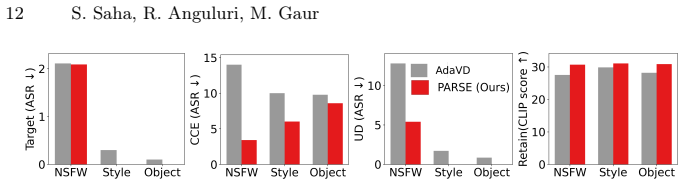
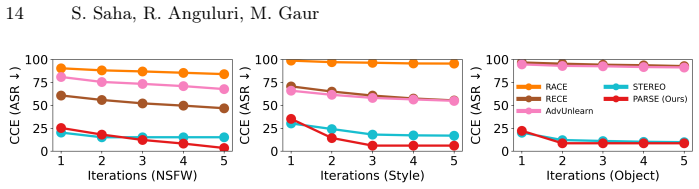
Summary. The paper presents PARSE, a training-free concept-erasure method for latent diffusion models (SD 1.4). Given a target concept, PARSE (i) builds erase/retain token banks by a two-stage "Knowledge Search" over the text-encoder vocabulary, ranking tokens by cosine similarity of classifier-free-guidance (CFG) steering embeddings and filtering with CLIP classification of cached generations; (ii) edits cross-attention value matrices with a closed-form projector P = I − EE⊤ where E is re-orthonormalized after removing components in the retain span, enforcing span(E) ⊥ span(R); and (iii) iteratively discovers re-emergence triggers via textual inversion and appends their residual directions to the erase subspace only when the residual norm (orthogonal to both retain and current erase spans) exceeds a threshold η. The paper also introduces BEUS, a [0,1]-bounded harmonic-mean aggregation of inverted ASR and log-compressed FID, with appendix proofs of boundedness and monotonicity. Experiments cover NSFW, style, and object erasure against eight-plus baselines under CCE, UD, RAB, SEE, and EraseBench attacks, with a full 16-configuration ablation (Table 2), multi-concept AGE/MACE-style evaluation (Table 6), and sensitivity analyses over pooling, K′, η, guidance scale, VLM backbone, and trigger-finder choice. The reported results show PARSE achieving the lowest or near-lowest attack ASR across categories while keeping FID/CLIP close to the unedited model.
Significance. If the results hold, this is a solid contribution to practical concept erasure: a closed-form, training-free edit that is demonstrably more robust to re-emergence attacks than prior projection-based methods (AdaVD) and competitive with adversarially trained methods (STEREO, AdvUnlearn) at a fraction of their utility cost. The strengths are concrete: the ablation in Table 2 toggles all four components across three categories; the evaluation uses five attack families plus multi-concept and mass-erasure protocols; the sensitivity studies (pooling, K′, η, s, VLM backbone, trigger finder) are more thorough than typical for this literature; and the compute costs (≈4.9 h one-time indexing, 10.7 min per-target edit) are disclosed honestly. The CFG-steering-embedding retrieval idea is a genuinely different way to build erase/retain banks and is supported by the proxy-VLM comparison in Fig. 15. BEUS is a modest addition — it is a monotone reparameterization of two existing metrics and does not by itself enforce any trade-off — but the large-scale robustness–utility analysis it organizes (Fig. 5) is useful to the community. The main risks to significance are the underspecified retain-basis co
major comments (2)
- [§3.1–3.2, Eqs. (9)–(10) and Algorithm 1, line 2] The retain-basis construction is dimensionally inconsistent as written. Eq. (9) defines R = V \ E, i.e., essentially the entire CLIP vocabulary minus the erase bank — the paper itself reports an average retain-set cardinality of ≈40k (Supp. Fig. 11). The projector in Eq. (10) assumes R has orthonormal columns (R R⊤ is an orthogonal projector only then), but Gram–Schmidt cannot produce 40k orthonormal vectors in a value space of dimension d ≤ 1280 (SD 1.4 cross-attention inner dimensions are 320/640/1280). Worse, if span(R) = R^d — which a 40k-token vocabulary almost certainly achieves — then (I − RR⊤)E ≈ 0 and the preservation-aware edit removes nothing, contradicting the reported erasure. Something in the description is therefore missing: a rank truncation, a subsampled retain set, a per-layer projection, or a different normalization. Because the retain-orthogonal projection is the cent
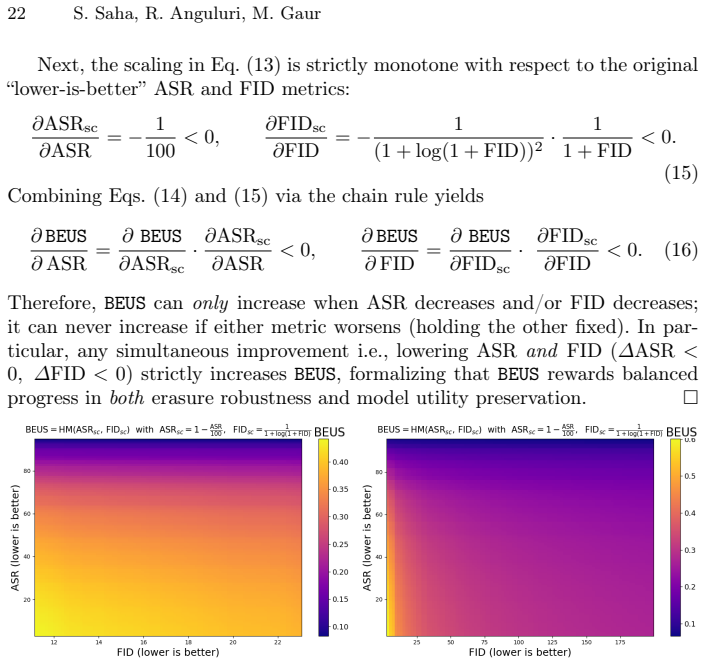
- [§4, Eqs. (11)–(12) vs. Appendix C.4] BEUS is defined inconsistently. The main text defines BEUS as the harmonic mean of ASR_sc and FID_sc only, but Appendix C.4 states that robustness averages 4–5 ASR values per category and that utility 'aggregates FID, CLIP, KID, and LPIPS'. These are different metrics; the bubble areas in Fig. 5 and the BEUS values in Tables 8 cannot be reproduced from Eq. (12) as stated. Since BEUS is one of the three named contributions, its exact operational definition (which ASRs enter the average, how CLIP/KID/LPIPS are mapped to unit-interval 'goodness' scores, and how they are combined) must be given precisely, ideally with a quantitative BEUS table in the main text rather than only bubble areas. Relatedly, the log-compressed FID_sc compresses the observed FID range (≈14–20) into FID_sc ∈ [0.247, 0.267], so in practice BEUS rankings are driven almost entirely by ASR differences; the authors should
minor comments (9)
- [Algorithm 1, lines 7–8] ˜r_n and r_n are scalar multiples of each other (r_n = ||v_n||₂ · ˜r_n, since the projection is linear), so e_new = r_n/||r_n||₂ = ˜r_n/||˜r_n||₂. The two lines are redundant as written; either collapse them or explain the intended distinction.
- [Appendix A.2, Eq. (14)] Algebraic slip: 2y²/(x+y)² is written as '= 2y² = 2×FID_sc²', dropping the denominator. The monotonicity conclusion is unaffected (the sign argument is correct), but the displayed equalities are false and should be corrected.
- [§5.1, Evaluation Metrics / Datasets] The text says FID is computed 'to measure distribution shift with unedited (SD 1.4) model', yet Table 1 reports FID = 14.23 for SD 1.4 itself, which would be 0 under that definition (contrast LPIPS = 0.00 for SD 1.4, which is consistent with a distance-to-base metric). Please clarify whether FID is computed against real MS-COCO images or against base-model generations; this matters for interpreting FID as 'utility' versus 'drift from the unedited model'.
- [Table 2 vs. Table 1] The ablation attack ASRs are round integers (e.g., 55.00, 36.00, 2.09) while Table 1 reports two-decimal values (3.41, 5.41). This suggests a different sample budget or evaluation protocol for the ablation; please state it, and confirm the ablation rows are comparable to Table 1.
- [§3.1, Stage 2] The final erase-bank size K after Stage-2 filtering is never reported. Since K determines the rank of the erased subspace and the precision/recall of the filter is central to the method's claims, please report typical K (and its distribution) per target.
- [§5.1 / §7] All evaluated attacks are prompt- or embedding-space attacks. Weight-space re-emergence (e.g., brief fine-tuning of the edited model to recover the target) is a known failure mode for closed-form edits and is not tested; at minimum this should be acknowledged in Limitations.
- [§2.2] Typo: 'ADaVD' should be 'AdaVD' (twice in §2.2, and again in §3.2).
- [Appendix B, first paragraph] The opening related-work paragraph on medical imaging, traffic signs, and character recognition is tangential to concept erasure and reads as padding; consider trimming it.
- [§5.1, Implementation Details] Please state explicitly whether code and the precomputed CFG-steering index will be released; the project page is mentioned but the submission itself does not state a release commitment.
Circularity Check
No significant circularity: PARSE is an empirical editing pipeline evaluated on external attacks and FID/CLIP; BEUS is a post-hoc metric, not a self-fulfilling prediction.
full rationale
This is a systems/methods paper whose load-bearing claims are empirical (lower ASR under CCE/UD/RAB/SEE/EraseBench and competitive FID/CLIP vs. many CET baselines), not first-principles predictions derived from fitted laws. The method chain—CFG steering retrieval over the frozen vocabulary (Eqs. 5–9), retain-orthogonal value projection P=I−EE⊤ with E=orth((I−RR⊤)E) (Eq. 10), and residual-gated subspace expansion via textual inversion (Alg. 1)—is a constructive edit procedure; success is not equal to the construction by definition. Evaluation uses external oracles (NudeNet, style/ImageNet classifiers) and held-out attack protocols and MS-COCO utility prompts, so reported wins are falsifiable against baselines rather than forced by the objective. BEUS (Eqs. 11–12; App. A) is an author-defined bounded monotone aggregate of ASR and FID; Appendix A only proves metric properties (boundedness, partial derivatives), not that PARSE must maximize BEUS. Design choices (harmonic mean, log-FID) affect ranking preferences but do not make the experimental tables tautological. Author self-citations appear as related-work motivation (e.g., side-effect benchmarks), not as uniqueness theorems that forbid alternatives or smuggle the central result. No fitted-parameter-as-prediction loop, no self-definitional X⇔Y derivation, and no renaming of a known closed form as a new theorem. Honest finding: circularity score 0.
Axiom & Free-Parameter Ledger
free parameters (6)
- Stage-1 top-K′ and final erase bank size K =
K′ default 1000 (sensitivity table)
- Adaptive expansion threshold η =
0.6 (default); tested 0.4–0.8
- Max expansion iterations N and early-stop =
N=5
- CFG guidance scale s for steering embeddings =
7.5 (default in sensitivity)
- Textual inversion attack hyperparameters =
1000 steps, lr 2e-6
- BEUS FID log-compression form =
Eq. 11–12 as stated
axioms (5)
- domain assumption Classifier-free guidance residual (ε_c−ε_u), pooled across layers/seeds/timesteps, is a valid similarity space for ranking vocabulary tokens as erase/retain concepts.
- domain assumption Undesired concepts can be suppressed by a low-rank linear projector on cross-attention values V_edited=P V without weight fine-tuning.
- ad hoc to paper Enforcing span(E)⊥span(R) via E←orth((I−RR⊤)E) preserves retain semantics while removing targets.
- domain assumption ASR under listed attacks plus FID/CLIP (and NudeNet/style/ImageNet oracles) faithfully measure erasure robustness and utility.
- standard math Linear algebra facts used for projectors and Gram–Schmidt re-orthonormalization hold in the finite-dimensional value spaces.
invented entities (3)
-
CFG steering embedding S(v) as diffusion-grounded retrieval key
independent evidence
-
BEUS (Balanced Erasure Utility Score)
no independent evidence
-
PARSE adaptive ranked subspace expansion procedure
no independent evidence
read the original abstract
Concept erasure techniques (CETs) edit text-to-image diffusion models to erase undesired targets such as NSFW content or copyrighted styles, while preserving model utility on benign concepts. Current CETs face a trade-off between erasure robustness and utility: stronger edits erase the target more reliably but degrade utility on non-target concepts, and vice versa. This stems from how existing methods define what to erase and what to preserve. Many CETs rely on static concept banks specified manually, generated by LLMs, or selected by CLIP image-text similarity. Such banks do not model how prompts steer the model during denoising, leaving it vulnerable to triggers that reintroduce the target while suppressing nearby benign concepts. We present Preservation-aware Adaptive Ranked Subspace Expansion (PARSE), a training-free framework for robust concept erasure in latent diffusion models. Given a target, PARSE queries the diffusion model with classifier-free guidance to dynamically discover target-inducing erase concepts and nearby retain concepts in the model vocabulary. It then edits the cross-attention value space with a preservation-aware projection that removes target directions while leaving retain directions intact. For triggers beyond this vocabulary-indexed space, PARSE iteratively searches for re-emergence triggers by textual inversion and adaptively expands the erased subspace only when a new trigger direction does not conflict with retain semantics. We also introduce the Balanced Erasure Utility Score (BEUS), which combines robustness (ASR under multiple attacks) and utility preservation (FID) via bounded monotone transforms and harmonic mean aggregation. Experiments on NSFW, artistic style, and object erasure, with a large-scale robustness-utility analysis over many CET baselines, show that PARSE erases multiple concepts robustly without sacrificing post-edit utility.
Figures






Reference graph
Works this paper leans on
-
[1]
In: Proceedings of the IEEE/CVF International Conference on Computer Vision
Amara, I., Humayun, A.I., Kajic, I., Parekh, Z., Harris, N., Young, S., Nagpal, C., Kim, N., He, J., Vasconcelos, C.N., et al.: Erasing more than intended? how concept erasure degrades the generation of non-target concepts. In: Proceedings of the IEEE/CVF International Conference on Computer Vision. pp. 16420–16430 (2025)
2025
-
[2]
arXiv preprint arXiv:2511.21631 (2025)
Bai, S., Cai, Y., Chen, R., Chen, K., Chen, X., Cheng, Z., Deng, L., Ding, W., Gao, C., Ge, C., et al.: Qwen3-vl technical report. arXiv preprint arXiv:2511.21631 (2025)
Pith/arXiv arXiv 2025
-
[3]
5-vl technical report
Bai, S., Chen, K., Liu, X., Wang, J., Ge, W., Song, S., Dang, K., Wang, P., Wang, S., Tang, J., et al.: Qwen2. 5-vl technical report. arXiv e-prints pp. arXiv–2502 (2025)
2025
-
[4]
URL https://github
Bedapudi, P.: Nudenet: Neural nets for nudity detection and censoring, 2022. URL https://github. com/notAI-tech/NudeNet3(2025)
2022
-
[5]
In: The Thirty-ninth Annual Conference on Neural Information Processing Systems (2025)
Biswas, S.D., Roy, A., Roy, K.: Cure: Concept unlearning via orthogonal repre- sentation editing in diffusion models. In: The Thirty-ninth Annual Conference on Neural Information Processing Systems (2025)
2025
-
[6]
In: International Conference on Learning Representations
Bui, A., Vu, T.T., Vuong, L., Le, T., Montague, P., Abraham, T., Kim, J., Phung, D.: Fantastic targets for concept erasure in diffusion models and where to find them. In: International Conference on Learning Representations. vol. 2025, pp. 64032–64074 (2025)
2025
-
[7]
arXiv preprint arXiv:1902.06705 (2019)
Carlini, N., Athalye, A., Papernot, N., Brendel, W., Rauber, J., Tsipras, D., Good- fellow, I., Madry, A., Kurakin, A.: On evaluating adversarial robustness. arXiv preprint arXiv:1902.06705 (2019)
Pith/arXiv arXiv 1902
-
[8]
In: Proceedings of the AAAI conference on artificial intelligence
Cha, S., Cho, S., Hwang, D., Lee, H., Moon, T., Lee, M.: Learning to unlearn: Instance-wise unlearning for pre-trained classifiers. In: Proceedings of the AAAI conference on artificial intelligence. vol. 38, pp. 11186–11194 (2024)
2024
-
[9]
arXiv preprint arXiv:2309.06135 (2023)
Chin, Z.Y., Jiang, C.M., Huang, C.C., Chen, P.Y., Chiu, W.C.: Prompt- ing4debugging: Red-teaming text-to-image diffusion models by finding problematic prompts. arXiv preprint arXiv:2309.06135 (2023)
arXiv 2023
-
[10]
In: 2009 IEEE conference on computer vision and pattern recognition
Deng, J., Dong, W., Socher, R., Li, L.J., Li, K., Fei-Fei, L.: Imagenet: A large- scale hierarchical image database. In: 2009 IEEE conference on computer vision and pattern recognition. pp. 248–255. Ieee (2009)
2009
-
[11]
In: The Twelfth International Conference on Learning Representations (2024),https://openreview.net/forum?id=gn0mIhQGNM
Fan, C., Liu, J., Zhang, Y., Wong, E., Wei, D., Liu, S.: Salun: Empowering ma- chine unlearning via gradient-based weight saliency in both image classification and generation. In: The Twelfth International Conference on Learning Representations (2024),https://openreview.net/forum?id=gn0mIhQGNM
2024
-
[12]
Gal, R., Alaluf, Y., Atzmon, Y., Patashnik, O., Bermano, A.H., Chechik, G., Cohen-Or, D.: An image is worth one word: Personalizing text-to-image genera- tionusingtextualinversion.In:TheEleventhInternationalConferenceonLearning Representations (2023)
2023
-
[13]
In: Proceedings of the IEEE/CVF international conference on computer vision
Gandikota, R., Materzynska, J., Fiotto-Kaufman, J., Bau, D.: Erasing concepts from diffusion models. In: Proceedings of the IEEE/CVF international conference on computer vision. pp. 2426–2436 (2023)
2023
-
[14]
In: Proceedings of the IEEE/CVF Winter Conference on Applications of Computer Vision
Gandikota, R., Orgad, H., Belinkov, Y., Materzyńska, J., Bau, D.: Unified concept editing in diffusion models. In: Proceedings of the IEEE/CVF Winter Conference on Applications of Computer Vision. pp. 5111–5120 (2024)
2024
-
[15]
In: European Conference on Computer Vision
Gong, C., Chen, K., Wei, Z., Chen, J., Jiang, Y.G.: Reliable and efficient concept erasure of text-to-image diffusion models. In: European Conference on Computer Vision. pp. 73–88. Springer (2024) PARSE 17
2024
-
[16]
Advances in Neural Information Processing Systems34, 16319–16330 (2021)
Gupta, V., Jung, C., Neel, S., Roth, A., Sharifi-Malvajerdi, S., Waites, C.: Adap- tive machine unlearning. Advances in Neural Information Processing Systems34, 16319–16330 (2021)
2021
-
[17]
He,K.,Zhang,X.,Ren,S.,Sun,J.:Deepresiduallearningforimagerecognition.In: Proceedings of the IEEE conference on computer vision and pattern recognition. pp. 770–778 (2016)
2016
-
[18]
Advances in neural information processing systems30(2017)
Heusel,M.,Ramsauer,H.,Unterthiner,T.,Nessler,B.,Hochreiter,S.:Ganstrained by a two time-scale update rule converge to a local nash equilibrium. Advances in neural information processing systems30(2017)
2017
-
[19]
In: NeurIPS 2021 Workshop on Deep Generative Models and Downstream Applications (2021)
Ho, J., Salimans, T.: Classifier-free diffusion guidance. In: NeurIPS 2021 Workshop on Deep Generative Models and Downstream Applications (2021)
2021
-
[20]
In: European Conference on Computer Vision
Huang, C.P., Chang, K.P., Tsai, C.T., Lai, Y.H., Yang, F.E., Wang, Y.C.F.: Re- celer: Reliable concept erasing of text-to-image diffusion models via lightweight erasers. In: European Conference on Computer Vision. pp. 360–376. Springer (2024)
2024
-
[21]
arXiv preprint arXiv:2412.07658 (2024)
Jain, A., Kobayashi, Y., Shibuya, T., Takida, Y., Memon, N., Togelius, J., Mitsufuji, Y.: Trasce: Trajectory steering for concept erasure. arXiv preprint arXiv:2412.07658 (2024)
Pith/arXiv arXiv 2024
-
[22]
Joshi, A., Saha, S., Shukla, D., Vema, S., Jhamtani, H., Gaur, M., Modi, A.: To- wardsrobustevaluationofunlearninginllmsviadatatransformations.In:Findings of the Association for Computational Linguistics: EMNLP 2024. pp. 12100–12119 (2024)
2024
-
[23]
In: European Conference on Computer Vision
Kim, C., Min, K., Yang, Y.: Race: Robust adversarial concept erasure for secure text-to-image diffusion model. In: European Conference on Computer Vision. pp. 461–478. Springer (2024)
2024
-
[24]
In: The Fourteenth International Con- ference on Learning Representations (2026),https://openreview.net/forum?id= Ryc7jKP6H9
Kim, M., Lee, G., Kim, Y., Kim, H., Park, J., Lee, W.: Co-occurring associated REtained concepts in diffusion unlearning. In: The Fourteenth International Con- ference on Learning Representations (2026),https://openreview.net/forum?id= Ryc7jKP6H9
2026
-
[25]
In: Proceedings of the IEEE/CVF International Conference on Computer Vision
Kumari, N., Zhang, B., Wang, S.Y., Shechtman, E., Zhang, R., Zhu, J.Y.: Ablat- ing concepts in text-to-image diffusion models. In: Proceedings of the IEEE/CVF International Conference on Computer Vision. pp. 22691–22702 (2023)
2023
-
[26]
In: Proceedings of the Computer Vision and Pattern Recognition Conference
Lee, B.H., Lim, S., Chun, S.Y.: Localized concept erasure for text-to-image diffu- sion models using training-free gated low-rank adaptation. In: Proceedings of the Computer Vision and Pattern Recognition Conference. pp. 18596–18606 (2025)
2025
-
[27]
In: The Fourteenth International Conference on Learning Representations (2026)
Lee, U., Kim, J., Hwang, S.: Localized concept erasure in text-to-image diffusion models via high-level representation misdirection. In: The Fourteenth International Conference on Learning Representations (2026)
2026
-
[28]
Numerical Linear Algebra with Applications20(3), 492–532 (2013)
Leon, S.J., Björck, Å., Gander, W.: Gram-schmidt orthogonalization: 100 years and more. Numerical Linear Algebra with Applications20(3), 492–532 (2013)
2013
-
[29]
arXiv preprint arXiv:2503.07392 (2025)
Li, O., Wang, Y., Hu, X., Jiang, H., Liang, T., Hao, Y., Ma, G., Feng, F.: Speed: Scalable, precise, and efficient concept erasure for diffusion models. arXiv preprint arXiv:2503.07392 (2025)
arXiv 2025
-
[30]
In: European conference on computer vision
Lin, T.Y., Maire, M., Belongie, S., Hays, J., Perona, P., Ramanan, D., Dollár, P., Zitnick, C.L.: Microsoft coco: Common objects in context. In: European conference on computer vision. pp. 740–755. Springer (2014)
2014
-
[31]
Advances in neural information processing systems35, 5775–5787 (2022) 18 S
Lu, C., Zhou, Y., Bao, F., Chen, J., Li, C., Zhu, J.: Dpm-solver: A fast ode solver for diffusion probabilistic model sampling in around 10 steps. Advances in neural information processing systems35, 5775–5787 (2022) 18 S. Saha, R. Anguluri, M. Gaur
2022
-
[32]
In: Proceedings of the IEEE/CVF Conference on Computer Vision and Pattern Recognition
Lu, S., Wang, Z., Li, L., Liu, Y., Kong, A.W.K.: Mace: Mass concept erasure in diffusion models. In: Proceedings of the IEEE/CVF Conference on Computer Vision and Pattern Recognition. pp. 6430–6440 (2024)
2024
-
[33]
arXiv preprint arXiv:2208.11970 (2022)
Luo, C.: Understanding diffusion models: A unified perspective. arXiv preprint arXiv:2208.11970 (2022)
Pith/arXiv arXiv 2022
-
[34]
In: Chinese Conference on Pattern Recognition and Computer Vision (PRCV)
Meng, Z., Peng, B., Jin, X., Lyu, Y., Wang, W., Dong, J., Tan, T.: Concept cor- rector: Erase concepts on the fly for text-to-image diffusion models. In: Chinese Conference on Pattern Recognition and Computer Vision (PRCV). pp. 91–105. Springer (2025)
2025
-
[35]
arXiv preprint arXiv:2308.01508 (2023)
Pham, M., Marshall, K.O., Cohen, N., Mittal, G., Hegde, C.: Circumventing concept erasure methods for text-to-image generative models. arXiv preprint arXiv:2308.01508 (2023)
Pith/arXiv arXiv 2023
-
[36]
In: The Twelfth Inter- national Conference on Learning Representations (2024)
Pham, M., Marshall, K.O., Cohen, N., Mittal, G., Hegde, C.: Circumventing con- cept erasure methods for text-to-image generative models. In: The Twelfth Inter- national Conference on Learning Representations (2024)
2024
-
[37]
In: International conference on machine learning
Radford, A., Kim, J.W., Hallacy, C., Ramesh, A., Goh, G., Agarwal, S., Sastry, G., Askell, A., Mishkin, P., Clark, J., et al.: Learning transferable visual models from natural language supervision. In: International conference on machine learning. pp. 8748–8763. PmLR (2021)
2021
-
[38]
IEEE Access10, 45997–46013 (2022)
Ravin, N., Saha, S., Schweitzer, A., Elahi, A., Dako, F., Mollura, D., Chapman, D.: Mitigating domain shift in ai-based tb screening with unsupervised domain adaptation. IEEE Access10, 45997–46013 (2022)
2022
-
[39]
In: Proceedings of the IEEE/CVF conference on computer vision and pattern recognition
Rombach, R., Blattmann, A., Lorenz, D., Esser, P., Ommer, B.: High-resolution image synthesis with latent diffusion models. In: Proceedings of the IEEE/CVF conference on computer vision and pattern recognition. pp. 10684–10695 (2022)
2022
-
[40]
In: Christodoulopoulos, C., Chakraborty, T., Rose, C., Peng, V
Saha, S., Saha, S., Gaur, M., Gokhale, T.: Side effects of erasing concepts from diffusion models. In: Christodoulopoulos, C., Chakraborty, T., Rose, C., Peng, V. (eds.) Findings of the Association for Computational Linguistics: EMNLP 2025. pp. 14991–15007. Association for Computational Linguistics, Suzhou, China (Nov 2025)
2025
-
[41]
arXiv preprint arXiv:2312.10933 (2023)
Saha, S., Dipta, S.R.: Seebel: Seeing is believing. arXiv preprint arXiv:2312.10933 (2023)
Pith/arXiv arXiv 2023
-
[42]
In: 2025 IEEE/CVF Winter Con- ference on Applications of Computer Vision (WACV)
Saha, S., Gokhale, T.: Improving shift invariance in convolutional neural networks with translation invariant polyphase sampling. In: 2025 IEEE/CVF Winter Con- ference on Applications of Computer Vision (WACV). pp. 620–629. IEEE (2025)
2025
-
[43]
In: Liakata, M., Moreira, V.P., Zhang, J., Jurgens, D
Saha, S., Gokhale, T.: Zero-shot multimodal retrieval with multi-scale contex- tual representations. In: Liakata, M., Moreira, V.P., Zhang, J., Jurgens, D. (eds.) Proceedings of the 64th Annual Meeting of the Association for Computational Linguistics (Volume 1: Long Papers). pp. 20304–20324. Association for Com- putational Linguistics, San Diego, Californ...
2026
-
[44]
In: Emerg- ing Technologies in Data Mining and Information Security: Proceedings of IEMIS 2018, Volume 3, pp
Saha, S., Islam, M.S., Khaled, M.A.B., Tairin, S.: An efficient traffic sign recogni- tion approach using a novel deep neural network selection architecture. In: Emerg- ing Technologies in Data Mining and Information Security: Proceedings of IEMIS 2018, Volume 3, pp. 849–862. Springer (2018)
2018
-
[45]
In: 2018 21st international conference of computer and information technology (ICCIT)
Saha, S., Kamran, S.A., Sabbir, A.S.: Total recall: understanding traffic signs us- ing deep convolutional neural network. In: 2018 21st international conference of computer and information technology (ICCIT). pp. 1–6. IEEE (2018)
2018
-
[46]
Procedia computer science132, 1760–1770 (2018) PARSE 19
Saha, S., Saha, N.: A lightning fast approach to classify bangla handwritten charac- ters and numerals using newly structured deep neural network. Procedia computer science132, 1760–1770 (2018) PARSE 19
2018
-
[47]
In: Proceedings of the AAAI Conference on Artificial Intelli- gence
Saha, S., Saha, S., Gani, M.O., Oates, T., Chapman, D.: Rfc-net: Learning high res- olution global features for medical image segmentation on a computational budget (student abstract). In: Proceedings of the AAAI Conference on Artificial Intelli- gence. vol. 37, pp. 16314–16315 (2023)
2023
-
[48]
In: Medical Imaging 2022: Computer-Aided Di- agnosis
Saha, S., Yesha, Y., Yesha, Y., Gangopadhyay, A., Chapman, D., Morris, M., Saboury, B., Nguyen, P.: Pairwise meta learning pipeline: classifying covid-19 ab- normalities on chest radio-graphs. In: Medical Imaging 2022: Computer-Aided Di- agnosis. p. PC1203302. SPIE (2022)
2022
-
[49]
In: Proceedings of the IEEE/CVF conference on computer vision and pattern recognition
Schramowski, P., Brack, M., Deiseroth, B., Kersting, K.: Safe latent diffusion: Mitigating inappropriate degeneration in diffusion models. In: Proceedings of the IEEE/CVF conference on computer vision and pattern recognition. pp. 22522– 22531 (2023)
2023
-
[50]
In: Proceedings of the IEEE/CVF Conference on Computer Vision and Pattern Recognition
Shen, D., Song, G., Xue, Z., Wang, F.Y., Liu, Y.: Rethinking the spatial incon- sistency in classifier-free diffusion guidance. In: Proceedings of the IEEE/CVF Conference on Computer Vision and Pattern Recognition. pp. 9370–9379 (2024)
2024
-
[51]
In: Proceedings of the IEEE/CVF Winter Conference on Applications of Computer Vision
Shenoy, R., Pan, Z., Balakrishnan, K., Cheng, Q., Jeon, Y., Yang, H., Kim, J.: Gradient-free classifier guidance for diffusion model sampling. In: Proceedings of the IEEE/CVF Winter Conference on Applications of Computer Vision. pp. 3162– 3171 (2026)
2026
-
[52]
In: Proceedings of the Computer Vision and Pattern Recognition Conference
Srivatsan, K., Shamshad, F., Naseer, M., Patel, V.M., Nandakumar, K.: Stereo: A two-stage framework for adversarially robust concept erasing from text-to-image diffusion models. In: Proceedings of the Computer Vision and Pattern Recognition Conference. pp. 23765–23774 (2025)
2025
-
[53]
IEEE transactions on neural networks and learning systems 35(9), 13046–13055 (2023)
Tarun, A.K., Chundawat, V.S., Mandal, M., Kankanhalli, M.: Fast yet effective machine unlearning. IEEE transactions on neural networks and learning systems 35(9), 13046–13055 (2023)
2023
-
[54]
In: Proceedings of the IEEE/CVF Conference on Computer Vision and Pattern Recognition
Thakral, K., Glaser, T., Hassner, T., Vatsa, M., Singh, R.: Fine-grained era- sure in text-to-image diffusion-based foundation models. In: Proceedings of the IEEE/CVF Conference on Computer Vision and Pattern Recognition. pp. 9121– 9130 (2025)
2025
-
[55]
Thakral, K., Pathak, S., Glaser, T., Hassner, T., Garcia-Olano, D., Masi, I., Singh, R.,Vatsa,M.:Genm:Thegenerativemachineunlearningchallenge.In:Proceedings of the IEEE/CVF International Conference on Computer Vision. pp. 2533–2541 (2025)
2025
-
[56]
Tsai, Y.L., Hsu, C.Y., Xie, C., Lin, C.H., Chen, J.Y., Li, B., Chen, P.Y., Yu, C.M., Huang, C.Y.: Ring-a-bell! how reliable are concept removal methods for diffusion models? arXiv preprint arXiv:2310.10012 (2023)
Pith/arXiv arXiv 2023
-
[57]
Tsai, Y.L., Hsu, C.Y., Xie, C., Lin, C.H., Chen, J.Y., Li, B., Chen, P.Y., Yu, C.M., Huang, C.Y.: Ring-a-bell! how reliable are concept removal methods for diffusion models? In: The Twelfth International Conference on Learning Representations (2024)
2024
-
[58]
In: In- ternational Conference on Machine Learning
Ullah, E., Arora, R.: From adaptive query release to machine unlearning. In: In- ternational Conference on Machine Learning. pp. 34642–34667. PMLR (2023)
2023
-
[59]
In: 2025 IEEE/CVF Conference on Computer Vision and Pattern Recognition (CVPR)
Wang, Y., Li, O., Mu, T., Hao, Y., Liu, K., Wang, X., He, X.: Precise, fast, and low-cost concept erasure in value space: Orthogonal complement matters. In: 2025 IEEE/CVF Conference on Computer Vision and Pattern Recognition (CVPR). pp. 28759–28768. IEEE (2025)
2025
-
[60]
arXiv preprint arXiv:2512.17320 (2025) 20 S
Wei, L., Nakashima, Y., Garcia, N.: Emma: Concept erasure benchmark with comprehensive semantic metrics and diverse categories. arXiv preprint arXiv:2512.17320 (2025) 20 S. Saha, R. Anguluri, M. Gaur
arXiv 2025
-
[61]
arXiv preprint arXiv:2510.22851 (2025)
Xiong, L., Liu, C., Ye, J., Liu, Y., Xu, Y.: Semantic surgery: Zero-shot concept erasure in diffusion models. arXiv preprint arXiv:2510.22851 (2025)
arXiv 2025
-
[62]
In: Proceedings of the IEEE/CVF conference on computer vision and pattern recognition
Zhang, G., Wang, K., Xu, X., Wang, Z., Shi, H.: Forget-me-not: Learning to forget in text-to-image diffusion models. In: Proceedings of the IEEE/CVF conference on computer vision and pattern recognition. pp. 1755–1764 (2024)
2024
-
[63]
In: Proceedings of the IEEE/CVF international conference on computer vision
Zhang, L., Rao, A., Agrawala, M.: Adding conditional control to text-to-image diffusion models. In: Proceedings of the IEEE/CVF international conference on computer vision. pp. 3836–3847 (2023)
2023
-
[64]
Advances in neural information processing systems37, 36748– 36776 (2024)
Zhang, Y., Chen, X., Jia, J., Zhang, Y., Fan, C., Liu, J., Hong, M., Ding, K., Liu, S.: Defensive unlearning with adversarial training for robust concept erasure in diffusion models. Advances in neural information processing systems37, 36748– 36776 (2024)
2024
-
[65]
Zhang, Y., Jia, J., Chen, X., Chen, A., Zhang, Y., Liu, J., Ding, K., Liu, S.: To generate or not? safety-driven unlearned diffusion models are still easy to generate unsafeimages...fornow.EuropeanConferenceonComputerVision(ECCV)(2024) PARSE 21 Appendix A: Theoretical Properties ofBEUS We proposeBalanced Erasure Utility Score (BEUS)as a evaluation metric ...
arXiv 2024
discussion (0)
Sign in with ORCID, Apple, or X to comment. Anyone can read and Pith papers without signing in.