REVIEW 4 major objections 6 minor 13 references
Cross-modal attention that aligns OCR tokens with image regions classifies Bengali political memes at Macro-F1 near 0.94, beating unimodal and concatenation baselines.
Reviewed by Pith at T0; open to challenge. T0 means a machine referee read the full paper against a public rubric. the ladder, T0–T4 →
Cross-modal multi-head attention over CLIP vision and XLM-R OCR tokens beats concatenation and unimodal baselines at ~0.94 Macro-F1 on Bengali political meme detection; lexicon priors hurt.
T0 review reviewed 2026-07-30 challenge →
load-bearing objection Solid applied multimodal stack for Bengali political memes with honest ablations; the MAF-vs-concat win is tiny and statistically thin, and the title oversells affect/token-region grounding. the 4 major comments →
Token-Region Guided Cross-Attention Fusion for Multimodal Affect Interpretation
The pith
A machine-rendered reading of the paper's core claim, the machinery that carries it, and where it could break.
The reading
Core claim
On the PoliMemeDecode Bengali meme dataset, Multimodal Attention Fusion that aligns XLM-RoBERTa OCR tokens to CLIP visual features via multi-head cross-attention achieves Macro-F1 ≈ 0.94 and MCC ≈ 0.88 under stratified three-fold out-of-fold evaluation, outperforming unimodal baselines and standard image–text concatenation, while manual lexicon boosting degrades both accuracy and calibration.
What carries the argument
Multimodal Attention Fusion (MAF): multi-head cross-modal attention in which text-token queries attend to visual keys and values, reweighting each semantic token by the image evidence it should ground in before pooling and classification.
Load-bearing premise
The PoliMemeDecode political labels and the cached Vision-Language-Model OCR transcripts are faithful enough that high out-of-fold scores on this single binary set prove genuine token–region grounding of political intent.
What would settle it
Re-annotate a fresh hold-out of Bengali memes with multiple independent political labels, re-extract OCR, and re-run the same MAF pipeline; a clear drop below the reported ~0.94 Macro-F1, or saliency that no longer concentrates on text and identity regions, would falsify the central claim.
If this is right
- Token-to-region cross-attention is preferable to late concatenation for binary political classification of Bengali memes.
- Hard lexicon boosts on political keywords raise false positives and hurt calibration relative to pure learned fusion.
- CLIP vision plus XLM-R text with VLM OCR already support high Macro-F1 without captioning or textual-inversion pipelines.
- SmoothGrad and token-occlusion analyses can verify that the model uses overlaid text and identity cues rather than background.
- The same attention fusion pattern is a practical starting point for other low-resource, script-diverse meme intent tasks.
Where Pith is reading between the lines
- The same token–region attention may transfer to finer affect labels (hate, sarcasm, target-aware propaganda) once comparable Bengali meme sets exist.
- If highly stylized fonts remain the main error source, further gains may come more from better VLM OCR than from heavier fusion modules.
- Because additive lexicon priors hurt, domain knowledge may need soft injection (attention bias or retrieval) rather than logit boosts.
- Binary Political/Non-Political may be too coarse for moderation; multi-label or target-aware tests would show whether the alignment still holds.
Editorial analysis
A structured set of objections, weighed in public.
Referee Report
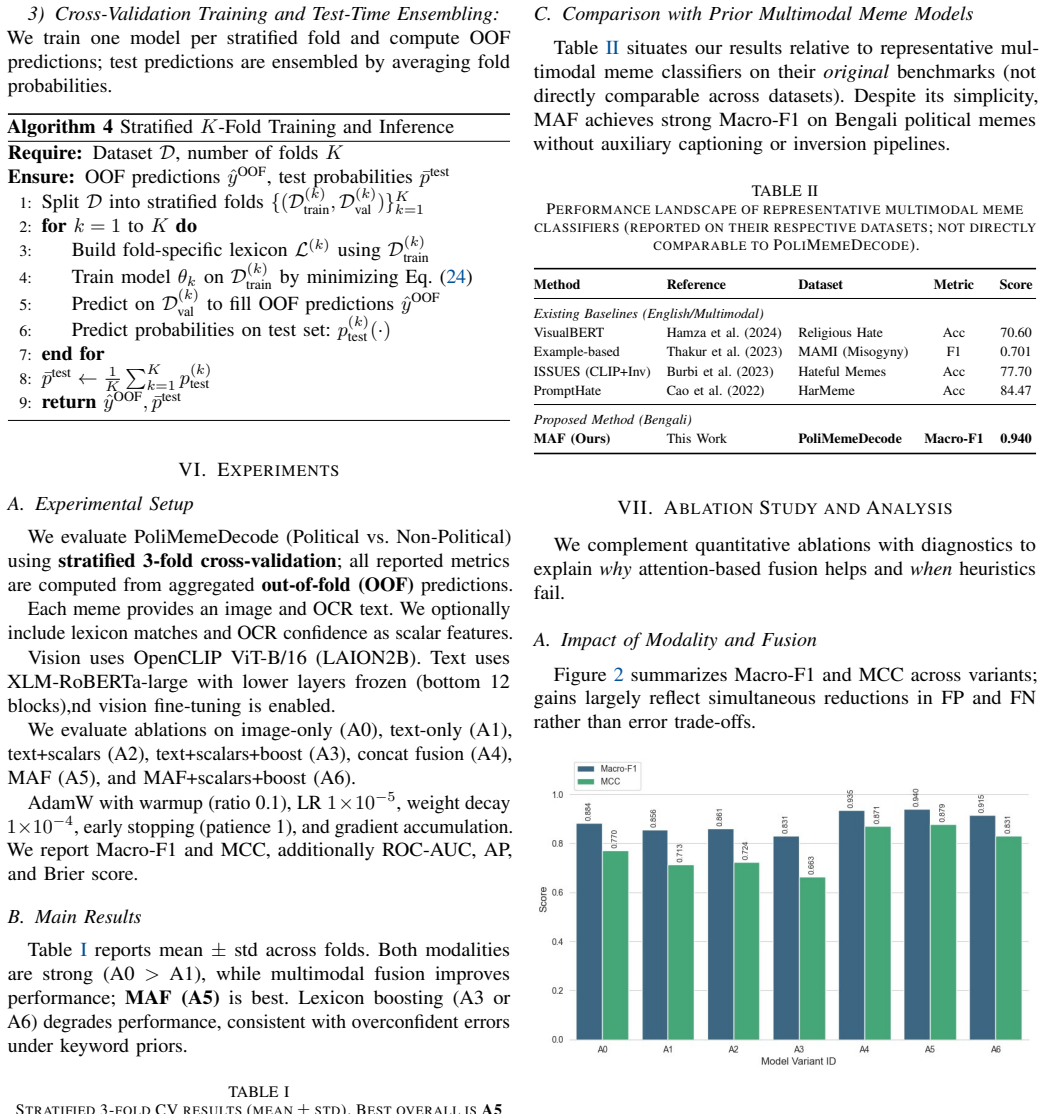
Summary. The manuscript addresses binary Political vs. Non-Political classification of Bengali memes. The pipeline uses a VLM (Qwen2-VL) for OCR, OpenCLIP ViT-B/16 for vision, XLM-RoBERTa-large for text, and fuses them via a cross-modal multi-head attention module (MAF) in which text tokens query visual features. A fold-safe political lexicon (seed set plus smoothed log-odds expansion, Algorithm 2) provides optional scalar priors and logit boosting. Evaluation is stratified 3-fold cross-validation with out-of-fold metrics on the authors' PoliMemeDecode dataset. The headline result (Table I) is that MAF (A5) achieves Macro-F1 0.940±0.005 / MCC 0.879±0.011, versus 0.935±0.011 for concatenation (A4) and 0.884/0.856 for unimodal baselines; lexicon boosting (A3, A6) is honestly reported as degrading performance. Confusion-matrix, calibration (Brier 0.0419), t-SNE, SmoothGrad, and token-occlusion diagnostics are provided.
Significance. If the results hold, the paper makes a useful contribution to low-resource multimodal affect analysis: Bengali political meme detection is under-served, and the paper ships a clean ablation ladder (A0–A6), fold-safe lexicon construction that avoids train leakage into the prior, OOF evaluation, and an unusually honest negative result on lexicon boosting. The calibration and token-occlusion diagnostics add interpretive value beyond a single number. However, the incremental claim over standard late fusion is small (0.005 Macro-F1) and currently unsupported statistically; the robust, well-established finding is "multimodal > unimodal." The dataset is self-collected and undocumented in the manuscript, which limits how far the 0.94 figure generalizes. Overall significance is moderate: a solid applied contribution to Bengali meme analysis rather than a methodological advance in fusion.
major comments (4)
- [§VI.B, Table I; Abstract] The central comparative claim — that MAF 'significantly outperforms ... standard concatenation' — rests on A5 = 0.940±0.005 vs. A4 = 0.935±0.011, a 0.005 Macro-F1 gap with overlapping fold-level standard deviations computed from only K=3 folds. No paired test (e.g., per-fold paired comparison, corrected resampled t-test, or bootstrap over OOF predictions), no per-image McNemar comparison, and no seed replication is reported. With n=3 fold means there is essentially no power to distinguish a 0.005 difference, so 'significantly' in the abstract is colloquial, not statistical. Since the claimed contribution over cited late-fusion work [1][3][4][9] is precisely the attention mechanism, this gap is load-bearing. The authors should either (a) add paired statistics over the pooled OOF predictions and multiple seeds/folds, or (b) soften the claim to 'multimodal fusion substantially outperforms u
- [§V.B, Eqs. (9)–(18); §VI.A] It is ambiguous which visual representation produced the reported numbers. Eq. (9) defines M visual tokens, but §VI.A states only 'OpenCLIP ViT-B/16' without saying whether patch tokens (M=197) or the pooled global embedding (M=1) were used. This matters materially: under Eq. (16), if M=1 the global embedding is replicated L times, cross-attention over identical keys/values collapses to a position-independent linear map, and the 'token–region grounding' story (and the paper's title) is vacuous. Relatedly, Eq. (17) forms F_i = [h̃_i; A_i; ṽ_i] for i=1..L, which requires a per-text-token visual vector ṽ_i; this is only defined if M=L or under the M=1 replication, so as written the architecture is either degenerate or underspecified. Please state explicitly which regime was used, and if patch tokens were used, define how ṽ_i is obtained for the concat in Eq. (17).
- [§III.A, §VI.A; footnote 1] The entire empirical claim rests on PoliMemeDecode, yet the manuscript gives no dataset documentation: no size (inferred ~2860 from Fig. 3), class balance, collection procedure, annotation protocol, annotator agreement, or definition of 'political intent.' Footnote 1 ('Kaggle/PoliMemeDecode') is not a resolvable reference. Because the label is culturally contested and the OCR cache ˆt is produced by an unevaluated VLM pipeline, readers cannot assess label noise or OCR failure modes on stylized Bengali text. A short dataset section (size, splits, annotation guidelines, agreement, OCR accuracy spot-check) is needed for the 0.94 figure and the interpretability conclusions to be interpretable.
- [§I, §II; Abstract] The novelty statement needs sharpening. Ahsan et al. [10] already proposed attention-based fusion explicitly named 'MAF' for Bengali meme classification (MIMOSA, including a Political category), and the manuscript says 'Our work follows this direction.' The claimed 'novel fusion architecture' therefore reduces, as currently described, to (i) a binary political task, (ii) VLM-based OCR, and (iii) a lexicon prior that the authors' own ablation shows hurts performance. Please delineate the concrete architectural delta over [10] (query/key direction, scalar priors, pooling) and temper the novelty and 'state-of-the-art' language accordingly — Table II is explicitly cross-dataset and cannot support an SOTA claim.
minor comments (6)
- [§V.H vs. §V.C] Eq. (26) re-states the lexicon boost of Eq. (22) with different notation (z vs. u, prime vs. tilde). Unify the notation or reference Eq. (22).
- [§VI.A] Early stopping with patience 1 over only 3 folds makes fold scores sensitive to a single epoch of validation noise; consider reporting sensitivity to patience/seeds, or at least noting this as a limitation.
- [Abstract, §I] Typographical issues: 'Bengali Language' (capitalization), 'on thePoliMemeDecode' (missing space), 'eitherPolitical orNon-Political' (missing spaces), 'analyzes' vs. 'analyses' inconsistency.
- [§VII.G, Fig. 8] The token-occlusion analysis is a nice addition, but because XLM-R uses subwords the attributed 'tokens' are fragments; please show a few example memes with their attributions so readers can judge whether the high-magnitude fragments are semantically meaningful.
- [§VI.A] Hyperparameters (d, R, MLP head size, β, α, top-K, ε, class weights) are listed as design elements but their chosen values are not reported; a small table would aid reproducibility.
- [§VII.F, Fig. 7] SmoothGrad saliency on overlaid text regions is only weak evidence of cross-modal grounding, since a unimodal image model would likely produce similar maps; consider a control comparison (e.g., A0 saliency) before concluding the attention alignment is responsible.
Circularity Check
No significant circularity: standard supervised multimodal classification with held-out CV metrics; claims do not reduce to fitted identities or self-citation chains.
full rationale
The paper’s load-bearing claim is empirical: on PoliMemeDecode under stratified 3-fold OOF evaluation, cross-modal multi-head attention (MAF) yields Macro-F1 ≈ 0.94 and beats unimodal and concat baselines (Table I, §VI). That result is obtained by training classifiers on labeled folds and scoring held-out folds (§III.C, Alg. 4); the reported numbers are not algebraic rearrangements of the inputs. Lexicon expansion is explicitly fold-safe (Alg. 2 uses only D_train^(k)), so the prior is not fitted on the evaluation set. Cross-attention (Eqs. 12–15) is a standard architectural choice, not a uniqueness theorem imported from the authors, and the backbones (OpenCLIP, XLM-R) are external pretrained models. Citations to prior meme work ([1],[3],[9],[10], etc.) supply context and baselines; none is a self-authored uniqueness result that forces the present conclusion. Calling the score “SOTA” on a newly introduced dataset is a weak comparative framing, not mathematical circularity. No step equates a “prediction” to a fitted parameter by construction. Score 0 is appropriate.
Axiom & Free-Parameter Ledger
free parameters (5)
- AdamW learning rate and schedule =
1e-5 LR, warmup 0.1, wd 1e-4
- Lexicon boost coefficient β
- Log-odds smoothing α and top-K lexicon expansion
- Label smoothing ε and class weights w_k
- Shared projection dimension d, head count R, MLP head
axioms (6)
- domain assumption Pretrained OpenCLIP ViT-B/16 and XLM-RoBERTa-large embeddings transfer to stylized Bengali meme images and code-mixed OCR text with only partial fine-tuning.
- domain assumption Cached VLM OCR text ˆt (and confidence c) is accurate enough that text tokens are valid semantic queries for visual grounding.
- domain assumption Binary labels y∈{Political, Non-Political} on PoliMemeDecode correctly capture 'political intent' for Macro-F1/MCC as the right success criteria.
- ad hoc to paper Scaled dot-product multi-head attention with Q from text and K/V from vision implements meaningful token–region alignment (including when M=1 via replication).
- domain assumption Stratified 3-fold OOF ensembling yields a stable estimate of generalization for SOTA comparison on this dataset.
- standard math Standard softmax cross-entropy optimization and attention algebra are well-defined.
invented entities (2)
-
Lexicon-Augmented Multimodal Attention Fusion (MAF) pipeline
no independent evidence
-
PoliMemeDecode political lexicon L (seed L0 + fold log-odds expansion)
no independent evidence
Cite this review
Pith. "Pith review of Token-Region Guided Cross-Attention Fusion for Multimodal Affect Interpretation." pith.science (2026). https://pith.science/paper/RCFLI6YI
@misc{pith2026260723493,
  author       = {Pith},
  title        = {Pith review of: Token-Region Guided Cross-Attention Fusion for Multimodal Affect Interpretation},
  year         = {2026},
  howpublished = {\url{https://pith.science/paper/RCFLI6YI}},
  note         = {Machine review of arXiv:2607.23493}
}
read the original abstract
Automated analysis of multimodal content on social networks has become a critical task for understanding public sentiment and information diffusion in the digital age. However, classifying internet memes remains computationally challenging due to the intricate interplay between visual cues and embedded, often stylized, text, particularly in low-resource languages like Bengali Language. This paper addresses the detection of political intent in Bengali memes by introducing Multimodal Cross-Attention Fusion framework. We first leverage a Vision-Language Model to extract high-fidelity OCR text from noisy meme images. Subsequently, we encode visual and textual features and synthesize them through a cross-modal multi-head attention mechanism that aligns semantic tokens with visual regions. We also investigate the integration of a domain-specific political lexicon as a knowledge prior. Experimental evaluation on the PoliMemeDecode1 dataset shows that our attention-based fusion significantly outperforms unimodal baselines and standard concatenation methods, achieving a state-of-the-art Macro-F1 of approximately 0.94. Interpretability analyzes further confirm that the model effectively learns to ground textual semantics in visual evidence.
Figures



Reference graph
Works this paper leans on
-
[1]
The hateful memes challenge: Detecting hate speech in multimodal memes,
D. Kiela, H. Firooz, A. Mohan, V . Goswami, A. Singh, P. Ringshia, and D. Testuggine, “The hateful memes challenge: Detecting hate speech in multimodal memes,”Advances in neural information processing systems, vol. 33, pp. 2611–2624, 2020
2020
-
[2]
Knowmeme: A knowledge-enriched graph neural network solution to offensive meme detection,
L. Shang, C. Youn, Y . Zha, Y . Zhang, and D. Wang, “Knowmeme: A knowledge-enriched graph neural network solution to offensive meme detection,” in2021 IEEE 17th International Conference on eScience (eScience), 2021, pp. 186–195
2021
-
[3]
MOMENTA: A multimodal framework for detecting harmful memes and their targets,
S. Pramanick, S. Sharma, D. Dimitrov, M. S. Akhtar, P. Nakov, and T. Chakraborty, “MOMENTA: A multimodal framework for detecting harmful memes and their targets,” inFindings of the Association for Computational Linguistics: EMNLP 2021, M.-F. Moens, X. Huang, L. Specia, and S. W.-t. Yih, Eds. Punta Cana, Dominican Republic: Association for Computational Li...
2021
-
[4]
Disarm: Detecting the victims targeted by harmful memes,
S. Sharma, M. S. Akhtar, P. Nakov, and T. Chakraborty, “Disarm: Detecting the victims targeted by harmful memes,”arXiv preprint arXiv:2205.05738, 2022
Pith/arXiv arXiv 2022
-
[5]
Prompting for multimodal hateful meme classification,
R. Caoet al., “Prompting for multimodal hateful meme classification,” inEMNLP, 2022
2022
-
[6]
Mapping memes to words for multimodal hateful meme classification,
G. Burbiet al., “Mapping memes to words for multimodal hateful meme classification,” inICCVW, 2023
2023
-
[7]
Multimodal and explainable internet meme classification,
A. K. Thakuret al., “Multimodal and explainable internet meme classification,”arXiv preprint arXiv:2212.05612, 2023
Pith/arXiv arXiv 2023
-
[8]
Multimodal religiously hateful social media memes classification,
A. Hamzaet al., “Multimodal religiously hateful social media memes classification,”ACM Transactions on Asian and Low-Resource Language Information Processing, 2024
2024
-
[9]
MUTE: A multimodal dataset for detecting hateful memes,
E. Hossain, O. Sharif, and M. M. Hoque, “MUTE: A multimodal dataset for detecting hateful memes,” inProceedings of the 2nd Conference of the Asia-Pacific Chapter of the Association for Computational Linguistics and the 12th International Joint Conference on Natural Language Processing: Student Research Workshop, Y . Hanqi, Y . Zonghan, S. Ruder, and W. Xi...
2022
-
[10]
A multimodal framework to detect target aware aggression in memes,
S. Ahsan, E. Hossain, O. Sharif, A. Das, M. M. Hoque, and M. Dewan, “A multimodal framework to detect target aware aggression in memes,” inProceedings of the 18th Conference of the European Chapter of the Association for Computational Linguistics (Volume 1: Long Papers), Y . Graham and M. Purver, Eds. St. Julian’s, Malta: Association for Computational Lin...
2024
-
[11]
Deciphering hate: identifying hateful memes and their targets,
E. Hossain, O. Sharif, M. M. Hoque, and S. M. Preum, “Deciphering hate: identifying hateful memes and their targets,” inProceedings of the 62nd Annual Meeting of the Association for Computational Linguistics (Volume 1: Long Papers), 2024, pp. 8347–8359
2024
-
[12]
Learning transferable visual models from natural language supervision,
A. Radford, J. W. Kim, C. Hallacy, A. Ramesh, G. Goh, S. Agarwal, G. Sastry, A. Askell, P. Mishkin, J. Clarket al., “Learning transferable visual models from natural language supervision,” inInternational Conference on Machine Learning. PMLR, 2021, pp. 8748–8763
2021
-
[13]
Unsupervised cross-lingual representation learning at scale,
A. Conneau, K. Khandelwal, N. Goyal, V . Chaudhary, G. Wenzek, F. Guzmán, E. Grave, M. Ott, L. Zettlemoyer, and V . Stoyanov, “Unsupervised cross-lingual representation learning at scale,” in Proceedings of the 58th Annual Meeting of the Association for Computational Linguistics, D. Jurafsky, J. Chai, N. Schluter, and J. Tetreault, Eds. Online: Associatio...
2020
This paper was first reviewed by grok-4.5 on July 30, 2026.
discussion (0)
Sign in with ORCID, Apple, or X to comment. Anyone can read and Pith papers without signing in.