Numerical Analysis · arXiv:2607.23571 v3 · submitted 26 Jul 2026
Optimal Polynomial Tractability Exponents for the Inverse Star Discrepancy
The paper says
“The inverse of the star discrepancy n∗(d,ε) satisfies \[ d ǎrepsilon^-1 \lesssim n^{\ast}(d,ǎrepsilon)\lesssim dǎrepsilon^-2 \] for all d ∈ ℕ and 0 < ε < ε0.”
more of the abstract
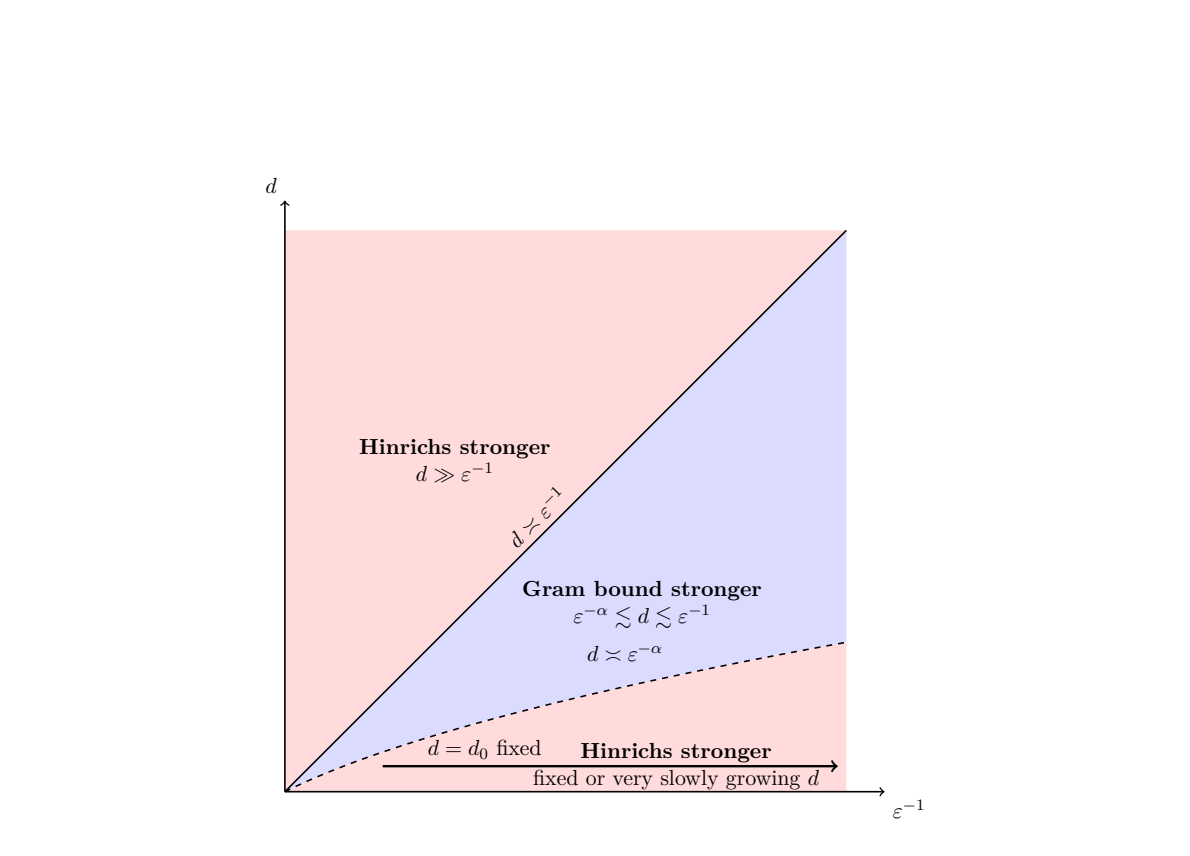
The upper bound was established by Heinrich, Novak, Wasilkowski and Woźniakowski (2001), while the lower bound is due to Hinrichs (2004). Steinerberger (2023) subsequently gave an elementary proof of the latter result. These bounds imply that the inverse of the star discrepancy depends linearly on the dimension, but the exact exponent of ε−1 had remained open. In this paper we prove a lower bound which shows that the exponent 2 of ε−1 in the upper bound cannot be improved. More precisely, for every 0 < α < 1 and fixed 0 < A ≤ B, there exist constants cα,B > 0 and εα,A > 0 such that, for every 0 < ε < εα,A and every integer d satisfying \[ Aǎrepsilon^{-\alpha}\le d\le Bǎrepsilon^{-\alpha}, \] one has \[ n^\ast(d,ǎrepsilon) \ge c_{\alpha,B}\,d\,ǎrepsilon^{-(2-\alpha)}. \] Along these polynomial strips the right-hand side is of order ε−2. Consequently, every uniform polynomial upper estimate n∗(d,ε) ≤ Cdqε−p must satisfy p ≥ 2. Together with the lower bound of Hinrichs (2004), which forces q ≥ 1, this proves that the exponents p = 2 and q = 1 in the Heinrich–Novak–Wasilkowski–Woźniakowski upper bound are individually optimal. In particular, the optimal exponent p∗ = 2.
from the abstract
Pith says
Machine review · deepseek-v4-flash · 4 Aug 2026 · of version 2 of the paper; version 3 is newer · what was read was not recorded · not checked by a person
It can be wrong. Challenge this review or reply to it.
Holds up. Dick's proof of p* = 2 for the inverse star discrepancy is sound, new, and worth a serious referee; the only caveats are black-box use of two classical bounds and an unverifiable Lean claim. This line is wrong
3 minor
How often objections from reviews like this one are right: not yet measured
Not checked: figures, code, what the references say.
3 minor objections
The paper says, at §3, proof of q* ≥ 1
Pith says: minor objection 1 of 3
In the proof that q* ≥ 1, the text fixes 0 < ε̄ ≤ ε_H and then combines the assumed upper estimate with Hinrichs' lower bound. The assumed upper estimate has its own threshold ε_1, so the argument should choose ε̄ ≤ min(ε_H, ε_1). This is a small quantifier oversight and is easily fixed.
The paper says, at Theorem 1.1 vs. abstract
Pith says: minor objection 2 of 3
The abstract states existence of constants c_{α,B} and ε_{α,A}, while the theorem requires choosing an integer m > 2/α and defines constants depending on m. For readability, Theorem 1.1 could note that one may concretely take m = ⌊2/α⌋ + 1, making the abstract formulation an immediate corollary.
show 1 more
The paper says, at Formal verification
Pith says: minor objection 3 of 3
The statement that the Lean project 'can be checked by running lake build' would be easier to reproduce if the ancillary files were pinned with a commit hash or version identifier. This is a minor reproducibility suggestion, not a technical defect.
What would settle it
Run the accompanying Lean 4 project via `lake build` against a pinned commit hash and confirm that Theorem 1.1 and the derivation of p*≥2 compile. If the formal proof verifies, the internal Gram-matrix argument is machine-checked and the central claim is secure.
from the skeptic's reading
How the review went
4 readings by deepseek-v4-flash · 4 Aug 2026
- Reader holds up
- Skeptic partly agrees
- Editor wrote the verdict above
- Referee accept: 3 minor
Not run on this paper: the simulated authors' defence.
Pith did not check this review's objections against the paper.
The review in full
The review in brief, machine-written
Just read the Dick paper. The headline is that it settles the Novak–Woźniakowski conjecture: the exponent 2 on ε−1 in the Heinrich–Novak–Wasilkowski–Woźniakowski upper bound is optimal, so p* = 2 and q* = 1. The new ingredient is a Gram-matrix/trace–rank lower bound along polynomial strips d ≍ ε−α. That is a genuinely different route from Hinrichs' combinatorial argument and Steinerberger's elementary proof, and it is the part that makes the whole thing work. I checked the main steps: Lemma 2.1 is just definition chasing, Lemma 2.2's coefficient sums and the trace–rank inequality are handled correctly, and the reduction from Theorem 1.1 to p* ≥ 2 is tight — choosing α small enough that p + αq < 2 forces the contradiction. The constants are explicit and the arithmetic in Theorem 1.1 checks out.
What the paper does well beyond the result is that it is honest about scope. It explicitly says there is no pointwise lower bound n*(d,ε) ≳ d ε−2, because fixed d gives the classical o(ε−2) rate from low-discrepancy constructions. It also flags the remaining mixed-dependence gap on the strip, where the upper bound is still ε−(2+α). That kind of clarity is rare and useful.
Soft spots are minor. The tractability theorem imports the HNWW upper bound and Hinrichs' lower bound as black boxes; those are well-established and independently checkable, so I do not see that as a flaw, just a boundary. The Lean 4 formalization appears only as ancillary files with no commit hash, so I cannot verify it, and it is not needed for the proof. One thing worth asking in review is whether the strip lower bound could be pushed to a clean statement for all intermediate d, but the paper already explains why the reach ε−2/m ≲ d ≲ ε−1 is the right trade-off for the method.
Overall, this deserves a serious referee. It is a major within-field result, the proof appears complete, and the self-imposed limitations make the paper stronger, not weaker. I would be happy to cite it and will likely assign it in a reading group.
The strongest objection
No significant objection identified. The internal argument is sound: Lemma 2.2's Gram-matrix estimate follows from the anchored-box transfer and the trace–rank inequality; the constants are handled correctly; and the reduction from Theorem 1.1 to p*≥2 is logically tight, since for any fixed p<2 and finite q one can choose α small enough that p+αq<2 and then use the strip d≈ε^{-α} to force a contradiction. The only external dependencies are the classical HNWW upper bound and Hinrichs' lower bound; these are well-established, independently checkable results, and the paper explicitly treats them as imported hypotheses for Theorem 1.2. The manuscript's self-declared limitations (no pointwise lower bound, remaining mixed-dependence gap, Lean formalization without a commit hash) are honest and do not threaten the central claim.
The paper's central claim is that p*=2 and q*=1 for the inverse star discrepancy. The new contribution is the strip lower bound n*(d,ε)≳ε^{-2} for d≍ε^{-α}, which is proved via a Gram-matrix/trace-rank argument. I checked the proof line by line: the expansion of φ_S^2 and φ_Sφ_T into anchored boxes is correct; the coefficient-sum bounds 2^m and 8^m are valid; the trace–rank inequality is applied correctly; and the resulting bound N≥M/(9+4M64^mD^2) yields the claimed ε^{-2} lower bound after the choice m>2/α. The subsequent step from Theorem 1.1 to p*≥2 is also correct: for any proposed polynomial upper bound with p<2 and finite q, choosing α<(2-p)/q makes p+αq<2, and the lower bound along d≈ε^{-α} has order ε^{-2} while the hypothesized upper bound has order ε^{-(p+αq)}, giving a contradiction as ε→0. The q*=1 argument via Hinrichs' lower bound is standard and correct. The only minor issue I noticed is a typographical one in Eq. (12), where the printed equality appears to read ε^2 instead of ε^{-2}; the preceding derivation and the subsequent t≥9/4 step unambiguously use the ε^{-2} version, so this is not a substantive flaw. The reader's weakest-assumption concern about external bounds is reasonable but does not rise to a load-bearing objection: those bounds are classical results, and the novel half of the theorem (p*≥2) does not depend on them. The Lean formalization claim would benefit from a commit hash, but its absence does not undermine the mathematical argument. Overall, the central claim is well-supported and the ACCEPT verdict should stand.
The referee's report
This is a significant contribution: it settles a long-standing open problem in the tractability theory of the star discrepancy. The new lower-bound proof is self-contained, uses explicit constants, and introduces no free or fitted parameters. The Gram-matrix technique is a fresh approach in this area, complementing the geometric arguments of Hinrichs and Steinerberger. The accompanying Lean 4 formalization is a notable strength, and the paper is honest about its limitations, including the absence of a pointwise lower bound and the remaining mixed-dependence gap on individual strips. The two classical external bounds are imported as stated hypotheses, not as ingredients of the new lower-bound proof.
Pith's reading of the paper (a machine's summary, not the authors')
The paper proves that no uniform polynomial upper estimate n*(d,ε) ≤ C d^q ε^{-p} can have accuracy exponent p < 2, no matter how large the fixed dimension exponent q is. The proof works by exhibiting lower bounds along polynomial strips d ≍ ε^{-α} where the inverse discrepancy must be at least of order ε^{-2}. Since an existing upper bound with p=2 and q=1 matches this, and an existing lower bound rules out q<1, the optimal polynomial tractability exponents are p*=2 and q*=1. This settles the Novak–Woźniakowski conjecture and clarifies the exact polynomial cost of approximating the star discrepancy to accuracy ε.
What carries the argument. The key object is a Gram matrix of tensor-product test functions. The paper picks a one-dimensional step function h(t) = (3·1_{[0,1/3)}(t)−1)/√2, which has mean zero, unit L2 norm, and square that can be written as a linear combination of anchored-box indicators. For each m-element subset S of coordinates, it forms ϕ_S(x)=∏_{j∈S} h(x_j); these ϕ_S are orthonormal in L2([0,1]^d), so the continuous Gram matrix is the identity of size M = C(d,m). The empirical Gram matrix of the point set P, with entries (1/N)∑ϕ_S(x_n)ϕ_T(x_n), is close to this identity whenever the star discrepancy D is small. A trace–rank inequality bounds rank(G) ≥ (tr G)^2/tr(G^2); since the vectors live in R^N, rank(G) ≤ N
Core claim. The central discovery is a sharply quantified lower bound for the inverse star discrepancy in regimes where the dimension grows polynomially with ε^{-1}. For any 0<α<1 and fixed constants 0<A≤B, the paper shows there exist constants c>0 and ε0>0 such that whenever Aε^{-α} ≤ d ≤ Bε^{-α} and 0<ε≤ε0, one has n*(d,ε) ≥ c d ε^{-(2-α)}. Since d ε^{-(2-α)} ≍ ε^{-2} on such strips, this forces the accuracy exponent p in any uniform polynomial bound n*(d,ε) ≤ C d^q ε^{-p} to satisfy p ≥ 2. Together with the known upper bound (which has p=2,q=1) and the known dimension lower bound (which gives q≥1), the paper derives the optimal tractability exponents p*=2 and q*=1, proving the Novak–Woźniakowski conj
The premise it rests on. The proof of the optimal tractability exponents imports, as black boxes, the known upper bound n*(d,ε) ≤ C d ε^{-2} and the known lower bound n*(d,ε) ≥ c d ε^{-1}; if either bound were wrong or mis-stated, the conclusion p*=2 and q*=1 would not follow.
If the paper is right (Pith's inferences, not the authors')
The accuracy exponent p=2 in the known upper bound n*(d,ε) ≤ C d ε^{-2} is optimal: no uniform polynomial estimate with p<2 can hold, regardless of the dimension exponent q.
The optimal polynomial tractability exponents are exactly p*=2 and q*=1, settling the Novak–Woźniakowski conjecture.
The dimension dependence of the inverse star discrepancy is exactly linear, and the accuracy dependence is exactly quadratic in the worst case.
Along polynomial strips d≍ε^{-α}, the inverse discrepancy must grow at least as ε^{-2}; this is the mechanism that forces p≥2.
The lower bound does not hold pointwise in fixed dimension; for fixed d, low-discrepancy constructions give n*(d,ε) ≲ d ε^{-1} (log ε^{-1})^{d-1}, so the ε^{-2} obstruction only appears as d grows polynomially with ε^{-1}.
The Gram-matrix construction suggests a general strategy for lower bounds in tractability: build a large orthonormal system of test functions, let the discretisation error control the perturbation of the Gram matrix, and use a trace–rank inequality to force N large. This could apply to other discrepancy or numerical integration problems.
The paper leaves the exact mixed (d,ε) behaviour inside a strip open; the lower bound gives ε^{-2} while the upper bound is ε^{-(2+α)}. Closing that gap would reveal whether the true cost is d ε^{-2} or something smaller in intermediate regimes.
The proof is parameterized by m; choosing m large makes α small, which yields the p≥2 conclusion. An interesting testable extension is to optimise the constants and see if the trace–rank inequality is tight, or if a sharper inequality could improve the lower bound on strips closer to d≍ε^{-1}.
The result has a practical consequence for quasi-Monte Carlo: any algorithm that claims to achieve accuracy ε in high dimension with polynomial cost must spend at least ~ε^{-2} function evaluations in the worst case, independent of polynomial dimension factors; this sharpens the practical cost barrier.
Check this review
Pith stored no record of this review's passes and took no fingerprint of it. Reviews made by code from 13 Nov 2026 on carry both.
How often reviews like this one are right
Reviews like this one: written by deepseek-v4-flash, where what was read was not recorded.
How often objections from reviews like this one are right: not yet measured
Reviews by people
This review was written by a machine. No person has reviewed this paper on Pith yet. A scientist listed on Pith can review it for a fee, and their review is published here whatever it concludes.
How Pith checks papers · The full audit of this paper · Review history (2 versions)
The paper
Abstract
The inverse of the star discrepancy n∗(d,ε) satisfies \[ d ǎrepsilon^-1 \lesssim n^{\ast}(d,ǎrepsilon)\lesssim dǎrepsilon^-2 \] for all d ∈ ℕ and 0 < ε < ε0. The upper bound was established by Heinrich, Novak, Wasilkowski and Woźniakowski (2001), while the lower bound is due to Hinrichs (2004). Steinerberger (2023) subsequently gave an elementary proof of the latter result. These bounds imply that the inverse of the star discrepancy depends linearly on the dimension, but the exact exponent of ε−1 had remained open. In this paper we prove a lower bound which shows that the exponent 2 of ε−1 in the upper bound cannot be improved. More precisely, for every 0 < α < 1 and fixed 0 < A ≤ B, there exist constants cα,B > 0 and εα,A > 0 such that, for every 0 < ε < εα,A and every integer d satisfying \[ Aǎrepsilon^{-\alpha}\le d\le Bǎrepsilon^{-\alpha}, \] one has \[ n^\ast(d,ǎrepsilon) \ge c_{\alpha,B}\,d\,ǎrepsilon^{-(2-\alpha)}. \] Along these polynomial strips the right-hand side is of order ε−2. Consequently, every uniform polynomial upper estimate n∗(d,ε) ≤ Cdqε−p must satisfy p ≥ 2. Together with the lower bound of Hinrichs (2004), which forces q ≥ 1, this proves that the exponents p = 2 and q = 1 in the Heinrich–Novak–Wasilkowski–Woźniakowski upper bound are individually optimal. In particular, the optimal exponent p∗ = 2.
The paper's own sentences, arranged, kept beside the review and separate from it. Each label is drawn from a closed vocabulary; the number beside it is the probability the classifier gave that label. No sentence in this record was written by a model.
abstract compiled · 2026-09-23
The authors' main claim, as the classifier picked it out 0.96
“In particular, the optimal exponent $p^\ast = 2$, thereby proving the Novak--Wo\'{z}niakowski conjecture.”
How the main claim is stated: asserted 1.00
What the abstract itself states, as probabilities: claims first 0.08 · states limitation 0.13 · human participants 0.01 · controlled comparison 0.02 · randomized assignment 0.01 · states quantitative result 0.98 · compares with prior results 0.96 · mentions code or data availability 0.02
The abstract, sentence by sentence
This table labels the abstract only (arXiv listing abstract v2). The number is the probability the classifier gave the label.
| Sentence | Role | The authors' own work | States the main conclusion | Strength |
|---|---|---|---|---|
| The inverse of the star discrepancy $n^\ast(d, \varepsilon)$ satisfies \[ d \varepsilon^{-1} \lesssim n^{\ast}(d,\varepsilon)\lesssim d\varepsilon^{-2} \] for all $d \in \mathbb{N}$ and $0 < \varepsilon < \varepsilon_0$. | background 0.95 | 0.08 | 0.09 | asserted 1.00 |
| The upper bound was established by Heinrich, Novak, Wasilkowski and Wo\'{z}niakowski (2001), while the lower bound is due to Hinrichs (2004). | background 1.00 | 0.03 | 0.02 | asserted 1.00 |
| Steinerberger (2023) subsequently gave an elementary proof of the latter result. | background 1.00 | 0.04 | 0.02 | asserted 1.00 |
| These bounds imply that the inverse of the star discrepancy depends linearly on the dimension, but the exact exponent of $\varepsilon^{-1}$ had remained open. | gap 0.95 | 0.09 | 0.03 | asserted 1.00 |
| In this paper we prove a lower bound which shows that the exponent $2$ of $\varepsilon^{-1}$ in the upper bound cannot be improved. | contribution 0.84 | 0.95 | 0.78 | asserted 1.00 |
| More precisely, for every $0<\alpha<1$ and fixed $0<A\le B$, there exist constants $c_{\alpha,B}>0$ and $\varepsilon_{\alpha,A}>0$ such that, for every $0<\varepsilon<\varepsilon_{\alpha,A}$ and every integer $d$ satisfying \[ A\varepsilon^{-\alpha}\le d\le B\varepsilon^{-\alpha}, \] one has \[ n^\ast(d,\varepsilon) \ge c_{\alpha,B}\,d\,\varepsilon^{-(2-\alpha)}. | result 0.97 | 0.90 | 0.40 | asserted 1.00 |
| \] Along these polynomial strips the right-hand side is of order $\varepsilon^{-2}$. | interpretation 0.91 | 0.63 | 0.05 | asserted 1.00 |
| Consequently, every uniform polynomial upper estimate $n^{\ast}(d,\varepsilon)\le C d^q\varepsilon^{-p}$ must satisfy $p\ge2$. | interpretation 0.71 | 0.79 | 0.18 | asserted 1.00 |
| Together with the lower bound of Hinrichs (2004), which forces $q\ge1$, this proves that the exponents $p=2$ and $q=1$ in the Heinrich--Novak--Wasilkowski--Wo\'{z}niakowski upper bound are individually optimal. | interpretation 0.58 | 0.72 | 0.35 | asserted 1.00 |
| In particular, the optimal exponent $p^\ast = 2$, thereby proving the Novak--Wo\'{z}niakowski conjecture. | result 0.60 | 0.89 | 0.93 | asserted 1.00 |
What kind of paper the classifier reports this is: theoretical result 1.00 · evidence from proof or derivation 1.00
What was examined, and what was not
Sources read
- arXiv listing abstract v2
Not examined
- full text
- figures and tables
- references and citing sentences
- relations to other papers
Levels run
- P abstract
Not run
- S sections
- T body sentences
- C citations
- R cross-paper relations
How the labels were made
Compiled by classifier-1.13.0 via TypeSafe API, question bank abstract-p1-20260923, 2026-09-23: 1 request, 8,165 input tokens.
Every quoted sentence on this record is the authors'. Every label is from Pith's closed vocabulary, with the probability shown beside it. This record as JSON
Figures (1)
Figures are the authors', reproduced from the paper.
Cited by 2 Pith papers
Reviewed papers on Pith that cite this one. The full citation record
- Low Moments, Small Balls and Star Discrepancy math.CA · Nov 2026
- Asymptotically optimal bracketing covers for anchored boxes with applications to star discrepancy math.CO · Aug 2026
How the literature uses it
2 arXiv papers cite this in 2 sentences
Challenges and discussion
Disagree with the review, or know something it missed? Leave a comment, or challenge this review formally: a challenge becomes a permanent entry in this paper's record, and its decision is published here.
Come back by email
A short list of the week's newly reviewed papers. Nothing is sent until you confirm from your inbox, and every email has a link that stops it. No account.
No comments yet.
Sign in to comment