REVIEW 19 references
Picking the lowest predicted cost can get worse as you sample more actions; reconstructing from a dense neighborhood of low-cost prefixes recovers the task.
Reviewed by Pith at T0; open to challenge. T0 means a machine referee read the full paper against a public rubric. the ladder, T0–T4 →
T0 review · grok-4.5
2026-07-30 17:49 UTC pith:IUWM4DPK
load-bearing objection Real Cube gains and a clean audit of min-cost ranking failure, but the named overgeneration story and the closed-loop remedy are only loosely coupled.
Action from Adjacent Set in Physical Space Outperforms the Best Prediction in World Models
The pith
A machine-rendered reading of the paper's core claim, the machinery that carries it, and where it could break.
Core claim
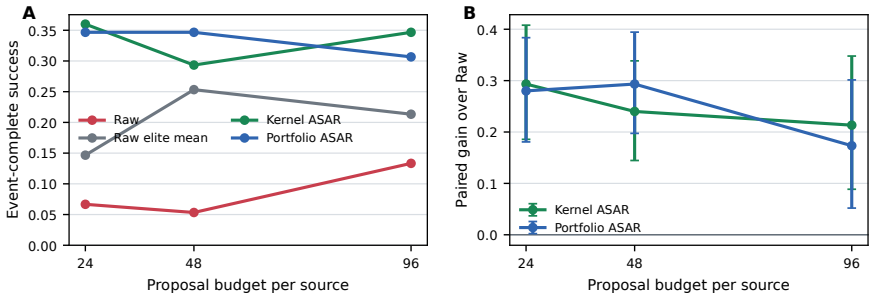
Under residual world-model error, minimum terminal-cost selection suffers proposal overgeneration: larger finite proposal pools can make the selected sequence less feasible even when every pool contains a feasible sequence. Reconstructing the executed sequence from an adjacent set of low-cost early action prefixes (ASAR), with a light anchor to the raw minimum-cost sequence, recovers closed-loop success on Cube Carry-and-Release under both latent and reachability costs.
What carries the argument
Adjacent Set Action Reconstruction (ASAR): among the low-cost candidates, score isolation of standardized early action prefixes by mean distance to nearest neighbors, form an adjacent set around the least isolated center, and reconstruct a full action sequence by locally weighted averaging plus a small mixture with the minimum-cost sequence.
Load-bearing premise
Feasible low-cost actions must sit in a denser early-prefix neighborhood than the misleading low-cost failures, and the rebuilt full sequence must stay inside a locally feasible region—if the dense cluster is the wrong one, or the only good action is isolated, or the task needs behaviors missing from one neighborhood, the method fails.
What would settle it
On the same matched Cube Carry-and-Release pools, if reconstructing from the adjacent low-cost prefix set no longer beats minimum-cost selection (and least-isolated existing selection) under both latent and reachability costs as the proposal budget grows, or if denser infeasible prefixes systematically win the isolation score in candidate-execution audits, the central claim fails.
If this is right
- Reporting feasible presence, top-k feasible coverage, and ranking-blocker counts separately is necessary; candidate count alone can hide selection getting worse.
- Better terminal objectives (e.g. reachability costs) and ASAR-style post-scoring reconstruction address different failure stages and can be stacked in one controller.
- When low-cost feasible actions form a locally dense prefix region suitable for interpolation, proposal pools should be used to rebuild actions, not only to pick a predicted minimum.
- Gains are phase- and geometry-dependent: long multi-behavior pick-and-place and tasks without that Cube prefix structure need different neighborhood or multi-mode rules.
Where Pith is reading between the lines
- Any planner that ranks noisy model scores over a growing sample set faces a similar lower-tail selection risk; density-aware reconstruction may transfer beyond latent CEM to other sampling MPC stacks.
- Safe real-robot use likely needs reset or recovery when trying complementary reconstruction variants, because the paper’s mixture-of-controllers gain relies on replaying from the same start after failure.
- Learned or adaptive prefix metrics, rather than a fixed early-action KNN, are a natural next test where contact-rich tasks did not inherit the Cube geometry.
Editorial analysis
A structured set of objections, weighed in public.
Circularity Check
No significant circularity: empirical controller gains are measured against external simulator outcomes; finite-pool propositions are standard bounds, not tautologies of the method.
full rationale
The paper's load-bearing claims are (i) an empirical diagnosis of proposal overgeneration in open-loop candidate-execution audits and (ii) closed-loop event-completion gains of Kernel ASAR over matched minimum-cost and least-isolated baselines. Neither claim is forced by definition. Feasibility labels Yi and event-completion success come from physical/simulator execution (FH, environment success + release contact), not from the prefix-density objective or the reconstruction weights. Latent distance and TRM are treated as interchangeable cost inputs Q; ASAR is applied after scoring and is shown under both, so the companion TRM citation is not load-bearing for the method claim. Propositions 1–7 are ordinary finite-pool identities and concentration/containment bounds (order statistics, Hoeffding, triangle inequality) stated under explicit assumptions the paper does not claim follow from prefix KNN alone. Hyperparameters are fixed on held-out development seeds before confirmatory evaluation; they are not fitted to the reported success rates and then relabeled as predictions. No uniqueness theorem, ansatz-via-self-citation, or renaming of a known law carries the central result. The skeptic concern that overgeneration does not reproduce in the closed-loop Carry-and-Release sweep is a causal/evidence-scope issue, not circularity.
Axiom & Free-Parameter Ledger
free parameters (9)
- eligible_low_cost_count =
80
- prefix_knn_k =
3
- kernel_adjacent_set_size_and_pool =
pool 32, set 12
- kernel_temperature_tau =
0.75
- terminal_cost_energy_weight =
0.35
- min_cost_anchor_alpha =
0.10 (Kernel); 0.25/0.15/0.10 (Portfolio)
- portfolio_rho_thresholds_and_elite_size =
elite 7; thresholds 1.0 and 1.75
- proposal_noise_scales_and_budgets =
scales 1.0/1.5/2.0; B in {72,144,288}
- feasibility_tolerance_epsilon_and_event_thresholds =
task-specific (e.g. contact error ≤0.1)
axioms (6)
- domain assumption Residual predictor error leaves a nontrivial lower tail of infeasible sequences under the chosen terminal cost Q.
- standard math Conditional independence (or linearity of expectation) of infeasible costs for lower-tail / blocker analysis.
- domain assumption Feasible candidates have higher expected radius support than ranking blockers by a gap p+>p− in prefix space.
- domain assumption Action parameterization permits coordinatewise interpolation; reconstructed sequences near an adjacent-set center remain feasible if inside a robust ball of radius γ.
- domain assumption Fixed pretrained LeWM encoder/dynamics and OGBench Cube simulator are an adequate testbed for the claimed control failure and fix.
- ad hoc to paper Early action-prefix Euclidean geometry after robust standardization is a useful proxy for local behavioral similarity on Cube.
invented entities (4)
-
proposal overgeneration
independent evidence
-
Adjacent Set Action Reconstruction (Kernel/Portfolio ASAR)
independent evidence
-
ranking blocker
independent evidence
-
local prefix isolation score u_i
no independent evidence
read the original abstract
Controllers based on sampling and latent world models assign a predicted terminal cost to each candidate action sequence, choose the minimum, execute its first action block, and replan. This rule can fail even when the terminal cost perfectly and accurately reflects the true task objective in the physical world. Residual prediction error can give an infeasible sequence an anomalously low cost, and a larger proposal pool gives such errors more chances to outrank feasible alternatives. We call this conditional failure proposal overgeneration. In Cube candidate execution audits, increasing the total proposal budget from 72 to 288 reduces the feasibility of selection by minimum latent cost from .375 to .062 for position targets and from .344 to .031 for targets defined by position and yaw, although every larger pool contains a feasible sequence. We introduce Adjacent Set Action Reconstruction (ASAR). Among proposals with low cost, ASAR measures density from standardized early action prefixes and reconstructs a full sequence from an adjacent set with a light anchor from the sequence with minimum cost. On a Carry and Release evaluation set of 75 queries, Kernel ASAR improves event completion success over matching selection by 28.0, 24.0, and 18.7 percentage points under latent cost and by 18.7, 20.0, and 17.3 points under a trajectory reachability cost at 72, 144, and 288 proposals. Analysis of finite proposal pools characterizes selection risk from the lower tail, separation by a related radius support statistic, and sequence containment under an explicit local feasibility condition.
Figures



Reference graph
Works this paper leans on
-
[5]
Kurtland Chua, Roberto Calandra, Rowan McAllister, and Sergey Levine
URL https://arxiv.org/abs/2303.04137. Kurtland Chua, Roberto Calandra, Rowan McAllister, and Sergey Levine. Deep reinforcement learning in a handful of trials using probabilistic dynamics models.Advances 23 Item Recorded setting Operating system Ubuntu 22.04.5 LTS, Linux 5.4, x86-64 CPU and memory Two AMD EPYC 7763 processors, 256 hardware threads, 503 Gi...
-
[7]
Benjamin Eysenbach, Ruslan Salakhutdinov, and Sergey Levine
URL https://arxiv.org/abs/2606.21775. Benjamin Eysenbach, Ruslan Salakhutdinov, and Sergey Levine. Search on the replay buffer: Bridging planning and reinforcement learning. InAdvances in Neural In- formation Processing Systems, volume 32,
-
[10]
Nicklas Hansen, Xiaolong Wang, and Hao Su
URL https://arxiv.org/abs/2301.04104. Nicklas Hansen, Xiaolong Wang, and Hao Su. Temporal difference learning for model predictive control. InPro- ceedings of the 39th International Conference on Ma- chine Learning, volume 162 ofProceedings of Machine Learning Research, pages 8387–8406. PMLR,
-
[13]
Nathan Lambert, Brandon Amos, Omry Yadan, and Roberto Calandra
URL https://papers.nips.cc/paper_files/paper/2019/hash/ 5faf461eff3099671ad63c6f3f094f7f-Abstract.html. Nathan Lambert, Brandon Amos, Omry Yadan, and Roberto Calandra. Objective mismatch in model-based reinforce- ment learning. InProceedings of the 2nd Conference on Learning for Dynamics and Control, volume 120 ofPro- ceedings of Machine Learning Research...
2019
-
[15]
Vivek Myers, Bill Chunyuan Zheng, Benjamin Eysenbach, andSergeyLevine
URL https://proceedings.mlr.press/ v235/myers24a.html. Vivek Myers, Bill Chunyuan Zheng, Benjamin Eysenbach, andSergeyLevine. Offlinegoal-conditionedreinforcement learning with quasimetric representations.arXiv preprint arXiv:2509.20478,
-
[17]
URL https: //arxiv.org/abs/2410.20092. Arjun Parthasarathy, Nimit Kalra, Rohun Agrawal, Yann Le- Cun, Oumayma Bounou, Pavel Izmailov, and Micah Gold- blum. Closing the train-test gap in world models for gradient-basedplanning.arXiv preprint arXiv:2512.09929,
-
[18]
URL https://arxiv.org/abs/2512.09929. Cristina Pinneri, Shambhuraj Sawant, Sebastian Blaes, Jan Achterhold, Joerg Stueckler, Michal Rolinek, and Georg Martius. Sample-efficient cross-entropy method for real- time planning. InProceedings of the 2020 Conference on Robot Learning, volume 155 ofProceedings of Machine Learning Research, pages 1049–1065. PMLR,
arXiv 2020
-
[24]
Gaoyue Zhou, Hengkai Pan, Yann LeCun, and Lerrel Pinto
URL https://openreview.net/forum?id=yql6px0bcT. Gaoyue Zhou, Hengkai Pan, Yann LeCun, and Lerrel Pinto. DINO-WM: World models on pre-trained vi- sual features enable zero-shot planning.arXiv preprint arXiv:2411.04983,
-
[1963]
Michael Janner, Justin Fu, Marvin Zhang, and Sergey Levine
doi: 10.1080/ 01621459.1963.10500830. Michael Janner, Justin Fu, Marvin Zhang, and Sergey Levine. When to trust your model: Model-based policy optimization. InAdvances in Neural In- formation Processing Systems, volume 32,
arXiv 1963
-
[2006]
25 YuhaiWang,JiaweiXia,RongxuanZhou,XiaoHu,Yongliang Shi, Jing Du, and Yang Ye
doi: 10.1287/ mnsc.1050.0451. 25 YuhaiWang,JiaweiXia,RongxuanZhou,XiaoHu,Yongliang Shi, Jing Du, and Yang Ye. PRISM: PRior-guided imagination sampling in world models.arXiv preprint arXiv:2606.07974,
-
[2017]
doi: 10.2514/1. G001921. Lunjun Zhang, Ge Yang, and Bradly C. Stadie. World model asagraph:Learninglatentlandmarksforplanning. InPro- ceedings of the 38th International Conference on Machine Learning, volume 139 ofProceedings of Machine Learn- ing Research, pages 12611–12620. PMLR,
-
[2018]
Tianqi Du, Qi Zhang, Yifei Wang, and Yisen Wang
URL https://arxiv.org/abs/1805.12114. Tianqi Du, Qi Zhang, Yifei Wang, and Yisen Wang. Beyond thenextstep:Variable-lengthlatentworldmodelsforlong- horizon planning.arXiv preprint arXiv:2606.21775,
-
[2019]
URL https://arxiv.org/abs/1906.05253. Danijar Hafner, Timothy Lillicrap, Ian Fischer, Ruben Ville- gas, David Ha, Honglak Lee, and James Davidson. Learn- ing latent dynamics for planning from pixels. InPro- ceedings of the 36th International Conference on Ma- chine Learning, volume 97 ofProceedings of Machine Learning Research, pages 2555–2565. PMLR,
Pith/arXiv arXiv 1906
-
[2020]
Liangyu Li, Shengzhi Wang, and Qingwen Liu
URL https://proceedings.mlr.press/v120/ lambert20a.html. Liangyu Li, Shengzhi Wang, and Qingwen Liu. Beyond euclidean proximity: Repairing latent world models with horizon-matched trajectory reachability metrics.arXiv preprint arXiv:2605.22164, 2026a. URL https://arxiv.org/ abs/2605.22164. Wenyuan Li, Guang Li, Keisuke Maeda, Takahiro Ogawa, and Miki Hase...
-
[2021]
Yuan Pu, Yazhe Niu, Zhenjie Yang, Jiyuan Ren, Hongsheng Li, and Yu Liu
URL https://proceedings.mlr.press/v155/pinneri21a.html. Yuan Pu, Yazhe Niu, Zhenjie Yang, Jiyuan Ren, Hongsheng Li, and Yu Liu. UniZero: Generalized and efficient plan- ning with scalable latent world models.arXiv preprint arXiv:2406.10667,
-
[2022]
Nicklas Hansen, Hao Su, and Xiaolong Wang
URL https://proceedings.mlr.press/v162/hansen22a.html. Nicklas Hansen, Hao Su, and Xiaolong Wang. TD-MPC2: Scalable,robustworldmodelsforcontinuouscontrol. InIn- ternational Conference on Learning Representations,2024. URL https://openreview.net/forum?id=Oxh5CstDJU. Wassily Hoeffding. Probability inequalities for sums of bounded random variables.Journal of...
2024
-
[2023]
URL https://arxiv.org/ abs/2307.10846. Reuven Y. Rubinstein. The cross-entropy method for com- binatorial and continuous optimization.Methodology and Computing in Applied Probability, 1(2):127–190,
-
[2025]
Junik Bae, Kwanyoung Park, and Youngwoon Lee
URL https://arxiv.org/abs/2506.09985. Junik Bae, Kwanyoung Park, and Youngwoon Lee. TLDR: Unsupervised goal-conditioned reinforcement learning via temporal distance-aware representations.arXiv preprint arXiv:2407.08464,
-
[2026]
URL https://arxiv.org/abs/2607.17973. Cheng Chi, Zhenjia Xu, Siyuan Feng, Eric Cousineau, Yilun Du, Benjamin Burchfiel, Russ Tedrake, and Shuran Song. Diffusion policy: Visuomotor policy learning via action diffusion.arXiv preprint arXiv:2303.04137,
discussion (0)
Sign in with ORCID, Apple, or X to comment. Anyone can read and Pith papers without signing in.