REVIEW 2 major objections 7 minor 46 references
De novo MS/MS structure recovery improves when a noisy fingerprint posterior is turned into a calibrated band of queries for a molecule-language model, not one thresholded fingerprint.
Reviewed by Pith at T0; open to challenge. T0 means a machine referee read the full paper against a public rubric. the ladder, T0–T4 →
T0 review · grok-4.5
2026-07-30 17:42 UTC pith:AN5JIWJ2
load-bearing objection Real empirical SOTA on de novo MS/MS via a clean fix for the oracle-vs-posterior mismatch; the fingerprint interface is still the ceiling. the 2 major comments →
MS-GPT: Rethinking MS/MS De Novo Structure Elucidation as Spectrum-Induced Posterior Querying of a Molecule-Language Model
The pith
A machine-rendered reading of the paper's core claim, the machinery that carries it, and where it could break.
Core claim
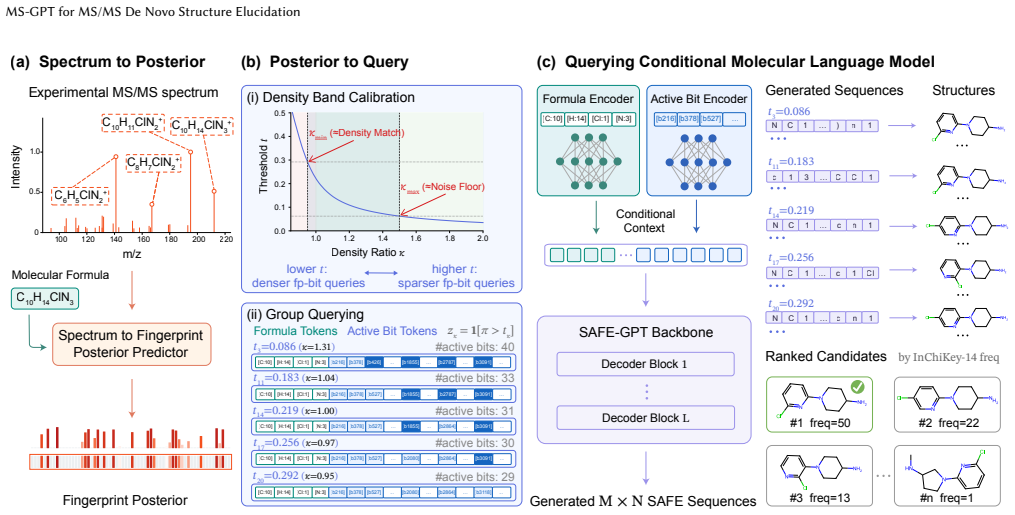
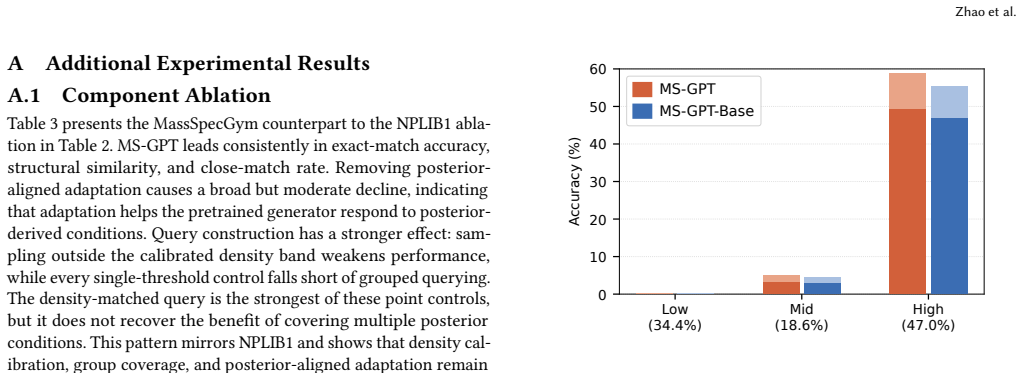
Fingerprint-mediated MS/MS de novo elucidation should be cast as spectrum-induced posterior querying of a conditional molecule-language model. Converting the continuous fingerprint posterior into a density-calibrated band of queries, distributing a fixed candidate budget across that band, ranking by generation-frequency consensus, and lightly adapting only the query-reading path yields new state-of-the-art Top-1/Top-10 exact-match accuracy of 29.8%/41.1% on NPLIB1 and 23.9%/28.7% on MassSpecGym.
What carries the argument
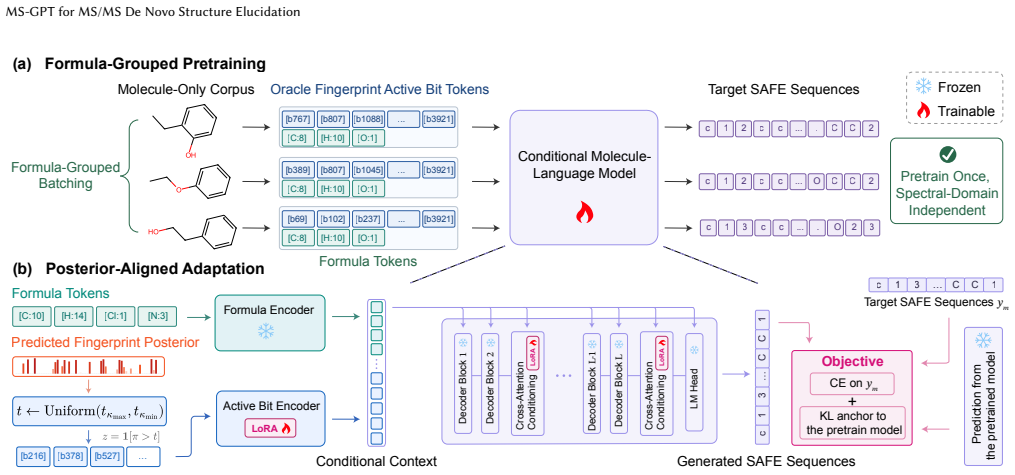
Spectrum-induced posterior querying: active-bit density band calibration chooses thresholds so query fingerprints stay near oracle active-bit density; fixed-size group querying spreads a fixed candidate pool across those thresholds; posterior-aligned LoRA adapts fingerprint encoding and cross-attention while freezing the molecule backbone.
Load-bearing premise
The method assumes that a fixed-bit fingerprint predicted from the spectrum, after population-level density calibration, still carries enough identifying structural signal for the language model to recover the true molecule.
What would settle it
On held-out spectra whose posterior already agrees well with the true fingerprint inside the calibrated band, multi-query pooling plus adaptation would fail to beat strong single-threshold controls on Top-10 exact match; that result would collapse the posterior-querying claim.
If this is right
- Fingerprint-mediated pipelines should keep the full posterior and query multiple operating points instead of one threshold.
- A molecule-only pretrained decoder can be shared across spectral datasets, with only the spectrum encoder and a tiny adapter made domain-specific.
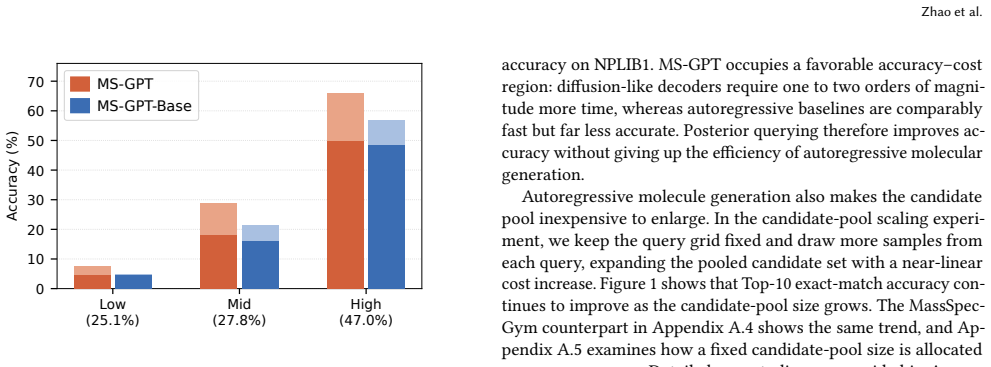
- Autoregressive generation can raise structure recall by enlarging the candidate pool at near-linear extra inference cost.
- Exact-match gains track spectrum-induced posterior fidelity; better encoders transfer directly into better elucidation.
- Ranking by generation-frequency consensus across the query band is a workable substitute for collapsing uncertainty into one fingerprint.
Where Pith is reading between the lines
- Fixed-radius fingerprints can make true isomers indistinguishable even under a perfect oracle query, so some failures are representational ceilings, not posterior noise.
- The same band-query pattern could apply to other inverse problems that force a continuous sensor posterior through a discrete pretrained interface.
- Gains that concentrate at Top-10 more than Top-1 suggest the main product is a richer shortlist for expert review, not only a single automatic ID.
- The fidelity analyses point next toward training or refining the spectrum encoder against the decoder’s query manifold rather than freezing it.
Editorial analysis
A structured set of objections, weighed in public.
Referee Report
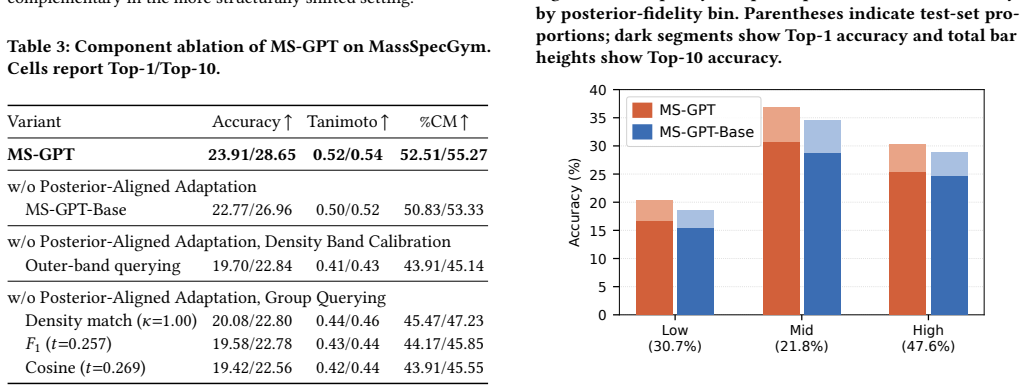
Summary. The paper addresses the training–inference mismatch in fingerprint-mediated MS/MS de novo structure elucidation: decoders are pretrained on oracle Morgan fingerprints but queried at inference with a single thresholded spectrum-induced posterior. MS-GPT recasts decoding as posterior querying of a fingerprint–formula-conditioned molecule-language model (a cross-attention-augmented SAFE-GPT, pretrained on ~100M molecules). Three mechanisms are proposed: (i) active-bit density band calibration, which maps a density-ratio interval K=[0.95,1.50] (matched to encoder-training-set active-bit density) to a threshold band; (ii) fixed-size group querying, which spreads a candidate pool B=M×N over M=20 interpolated thresholds; and (iii) posterior-aligned adaptation, a rank-4 LoRA on the query-reading pathway trained with recoverability-grouped CE+KL losses. On NPLIB1 and MassSpecGym under the known-formula protocol, MS-GPT reports Top-1/Top-10 exact match of 29.76%/41.07% and 23.91%/28.65%, exceeding FRIGID by 4–8 points. Ablations (Tables 2–3), posterior-fidelity and pretraining-proximity stratifications, allocation and pool-scaling sweeps, pretraining-data scaling, and failure-mode case studies support the claims.
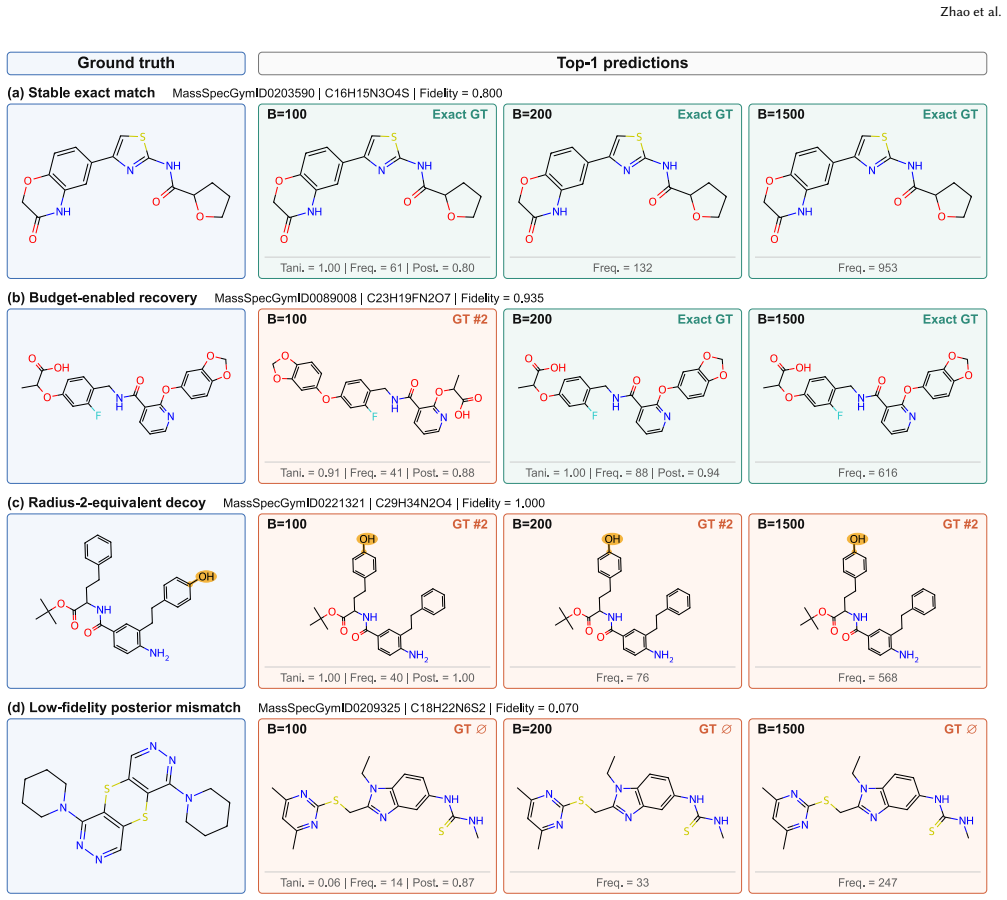
Significance. If the results hold, this is a useful contribution to an actively contested benchmark area. The exact-match gains over the strongest diffusion baseline (FRIGID) are large (+4.7/+7.7 points Top-1/Top-10 on NPLIB1; +5.6/+6.7 on MassSpecGym) and the method is inference-cheap. Notable strengths that weigh positively: the pretraining corpus explicitly excludes connectivity-equivalent (InChIKey-14) validation/test structures, addressing the most obvious leakage channel; source code and checkpoints are released, making the pipeline reproducible; the ablations cleanly separate the three components across two benchmarks; the stratified analyses (posterior fidelity, pretraining proximity) directly test and largely rule out the memorization explanation; and the case studies honestly document a hard representational ceiling (radius-2 Morgan non-identifiability, Fig. 14(c)/Table 9) rather than hiding it. The reframing itself — treating the fingerprint posterior as a query distribution rather than a point estimate — is conceptually simple but, on this evidence, effective, and the candidate-pool scaling results give the field a falsifiable, easy-to-replicate direction.
major comments (2)
- [Table 1 / §4.2 / Fig. 1] The SOTA claim rests on comparing MS-GPT at candidate-pool size B=100 against FRIGID's numbers transcribed from [2], but the manuscript never states the inference budget (number of diffusion steps / candidate evaluations per spectrum) underlying FRIGID's Table 1 entries. This matters because FRIGID's central contribution is inference-time scaling, and MS-GPT's own Table 4 shows Top-10 gains of ~6 points from B=100 to B=1500. Figure 1 partially addresses this by plotting FRIGID's compute point, but the x-axis provenance ('timings taken from FRIGID') does not establish that the accuracy marker corresponds to FRIGID's best-budget configuration rather than a budget-matched one. Please state, in Table 1 or its caption, the per-spectrum evaluation budget of each baseline, and ideally include a FRIGID-at-matched-compute point on the Figure 1 frontier.
- [§3.3 / App. A.6 / App. B.4] The density band K=[0.95,1.50] is selected 'empirically with reference to validation-set metrics' and shared across benchmarks, and Appendix A.6 itself concludes the band 'may have been more conservative than necessary.' The component ablation brackets the band's value (outer-band and point-query controls in Tables 2–3), but there is no sensitivity analysis over (κ_min, κ_max) itself. Given that the headline margin over the strongest point-query control is ~4 Top-1 points (Table 2), and that Figures 11–12 show non-trivial val/test divergence in fidelity shares on NPLIB1, the robustness of the headline numbers to the band choice is load-bearing for the claim that calibration (rather than fortuitous endpoint tuning) drives the gain. A small sweep over band endpoints on the validation split, reported for both benchmarks, would close this. Relatedly, please clarify how much of the band selec
minor comments (7)
- [Eq. (6) / §3.3] The uniform grid average in Eq. (6) is presented as approximating the posterior expectation in Eq. (1), but no weighting connects the linear-in-threshold grid to the actual posterior over fingerprints; the approximation is heuristic. A sentence clarifying that Eq. (6) is a coverage/ensemble device rather than a Monte Carlo estimate of Eq. (1) would prevent over-reading.
- [§4.2 / Table 1] No test-set sizes or confidence intervals are reported anywhere. With Top-1 margins of 4.7–5.6 points over FRIGID this is likely not decisive, but standard errors (or Wilson intervals) for the Table 1 entries should be added, particularly for MassSpecGym.
- [Table 1 / §4.1 metrics] Top-k Tanimoto is reported for all methods, but only MCES gets a comparability appendix (B.6). Please state the fingerprint type/radius used for the Tanimoto metric and confirm baseline papers used compatible definitions; otherwise add a comparability caveat analogous to the MCES one.
- [§4.1 Implementation / App. A.7 (Table 5)] Table 5 shows a one-epoch MS-GPT-Base trained on 500M–1B structures substantially outperforming the main model's Base variant (31.55/37.80 vs 28.42/33.78 Top-1/Top-10 on NPLIB1), yet the main results use two epochs over 100M. Please explain why the larger corpus was not used for the headline model, or clarify the chronology; as written it leaves open whether the main numbers are pretraining-limited.
- [§3.3 / App. B.4] The rationale that extending below κ=1.00 'maps to the flat, high-threshold region of A(t)' is plausible but unsupported; a small plot of A(t) per dataset (or a pointer to where it can be found in the supplement) would help.
- [Abstract / Table 1] LaTeX artifacts: '29.8\%/41.1\%' and '23 .9%/28.7%' have stray spacing/escaping in the abstract; similar spacing issues appear in Table 1 ('25.037.100.58', '29.767.380.61'). Please proof the compiled tables.
- [§3.3, Eq. (3)] D_enc is defined as a mean active-bit count over (x,C,m) drawn from T_enc (Eq. 3), but T_enc is a set of spectrum–structure pairs; please clarify whether multiple spectra per structure are counted with multiplicity and whether D_enc weights spectra or unique molecules.
Circularity Check
No significant circularity: SOTA claims are held-out benchmark evaluations, not quantities forced by construction from fitted inputs.
full rationale
MS-GPT’s load-bearing claim is empirical Top-k exact-match accuracy on public NPLIB1 and MassSpecGym splits under the known-formula protocol, compared to published baselines. The derivation chain is a standard ML pipeline: molecule-only pretraining of p_θ on oracle fingerprints (Eq. 2), a frozen external MIST encoder supplying π, population-level active-bit density calibration of thresholds from the encoder’s training split alone (Eqs. 3–5; App. B.4), multi-query sampling (Eq. 6), and optional LoRA adaptation on domain training posteriors (Eq. 7). Pretraining excludes connectivity-equivalent val/test InChIKey-14 blocks. Density band K and recoverability groups are validation/training hyperparameters, not test-label fits renamed as predictions. No self-definitional identity equates a reported accuracy to its inputs; no uniqueness theorem or load-bearing self-citation forces the result. Framing as “posterior querying” is methodological, not a renamed known law. Residual risks (hand-chosen K, radius-2 non-identifiability) are assumption/correctness issues, not circularity.
Axiom & Free-Parameter Ledger
free parameters (5)
- Active-bit density-ratio band K=[κ_min, κ_max] =
[0.95, 1.50]
- Query groups M and samples per group N (pool B=M×N) =
M=20, N=5, B=100
- Posterior-aligned adaptation recoverability thresholds and loss weights (α_g, λ_g) =
c_cut=0.40; weights per Table 7
- LoRA rank and adaptation schedule =
rank=4, α=8; 3000/2500 steps selected
- Generation sampling hyperparameters =
T=1.0, top-k=50, top-p=0.95
axioms (6)
- domain assumption De novo elucidation factors as E_{z~q_φ(z|x,C)}[p_θ(y|z,C)] with z a discrete Morgan fingerprint (Eq. 1).
- ad hoc to paper Population active-bit density matching keeps thresholded posterior queries near the oracle-fingerprint manifold in aggregate (Eqs. 3–5).
- ad hoc to paper Finite group average over M thresholds approximates the posterior expectation (Eq. 6).
- domain assumption Molecular formula C is known at inference (known-formula protocol).
- domain assumption InChIKey-14 identity defines exact 2D structural match for metrics.
- domain assumption SAFE-GPT molecular prior plus cross-attention conditioning can map fingerprint-formula queries to valid structures after molecule-only pretraining.
invented entities (3)
-
Active-bit density band calibration
no independent evidence
-
Fixed-size group querying
no independent evidence
-
Posterior-aligned LoRA adapter with recoverability-grouped CE+KL objective
no independent evidence
read the original abstract
Molecular structure elucidation from tandem mass spectra (MS/MS) is a central inverse problem in analytical chemistry. Most existing approaches to MS/MS identification remain tied to reference libraries or predefined candidate sets, whereas de novo methods aim to generate structures directly from spectra. A common de novo route predicts a molecular fingerprint from the spectrum and then decodes structures from it, enabling decoder pretraining on large molecule-only corpora. However, this paradigm creates a training-inference mismatch: the decoder is trained on oracle fingerprints computed from molecules, but at inference it is queried with a noisy spectrum-induced fingerprint posterior that is typically collapsed to a single thresholded fingerprint. We introduce MS-GPT, which recasts fingerprint-mediated de novo elucidation as spectrum-induced posterior querying of a conditional molecule-language model. MS-GPT conditions a molecule-language model on fingerprints and formulas, then converts the spectrum-induced posterior into a band of fingerprint queries near the oracle-fingerprint manifold through active-bit density calibration. Candidates sampled across this band are pooled and ranked by generation-frequency consensus. A lightweight LoRA adapter further mitigates domain-specific posterior bias while preserving the pretrained molecular prior. On NPLIB1 and MassSpecGym, MS-GPT sets a new state of the art, reaching Top-1/Top-10 exact-match accuracy of 29.8\%/41.1\% and 23.9\%/28.7\%, respectively. Candidate-pool scaling shows that efficient autoregressive molecular generation continues to improve recall with a little additional inference cost. The source code and model checkpoints are available at https://github.com/VIKI623/MS-GPT.
Figures




Reference graph
Works this paper leans on
-
[1]
Dorrestein
Wout Bittremieux, Mingxun Wang, and Pieter C. Dorrestein. 2022. The criti- cal role that spectral libraries play in capturing the metabolomics community knowledge.Metabolomics18, 12 (2022), 94
2022
-
[2]
Montgomery Bohde, Hongxuan Liu, Mrunali Manjrekar, Magdalena Lederbauer, Shuiwang Ji, Runzhong Wang, and Connor W. Coley. 2026. FRIGID: Scaling Diffusion-Based Molecular Generation from Mass Spectra at Training and Infer- ence Time.arXiv preprint arXiv:2604.16648(2026)
Pith/arXiv arXiv 2026
-
[3]
Montgomery Bohde, Mrunali Manjrekar, Runzhong Wang, Shuiwang Ji, and Connor W. Coley. 2025. DiffMS: Diffusion Generation of Molecules Conditioned on Mass Spectra.arXiv preprint arXiv:2502.09571(2025)
Pith/arXiv arXiv 2025
-
[4]
de Jonge, Adamo Young, Fleming Kretschmer, Raman Samusevich, Janne Heirman, Fei Wang, Luke Zhang, Kai Dührkop, et al
Roman Bushuiev, Anton Bushuiev, Niek F. de Jonge, Adamo Young, Fleming Kretschmer, Raman Samusevich, Janne Heirman, Fei Wang, Luke Zhang, Kai Dührkop, et al. 2024. MassSpecGym: A benchmark for the discovery and iden- tification of molecules. InAdvances in Neural Information Processing Systems, Vol. 37. 110010–110027
2024
-
[5]
Roman Bushuiev, Anton Bushuiev, Raman Samusevich, et al . 2025. Self- supervised learning of molecular representations from millions of tandem mass spectra using DreaMS.Nature Biotechnology(2025)
2025
-
[6]
Thomas Butler, Abraham Frandsen, Rose Lightheart, et al . 2023. MS2Mol: A transformer model for illuminating dark chemical space from mass spectra. ChemRxiv(2023)
2023
-
[7]
Seyone Chithrananda, Gabriel Grand, and Bharath Ramsundar. 2020. Chem- BERTa: Large-Scale Self-Supervised Pretraining for Molecular Property Predic- tion.arXiv preprint arXiv:2010.09885(2020)
Pith/arXiv arXiv 2020
-
[8]
de Jonge, Joris J
Niek F. de Jonge, Joris J. R. Louwen, Elena Chekmeneva, et al. 2023. MS2Query: reliable and scalable MS2 mass spectra-based analogue search.Nature Commu- nications14, 1 (2023), 1752
2023
-
[9]
Hoffmann, Daniel Petras, William H
Kai Dührkop, Louis-Félix Nothias, Markus Fleischauer, Raphael Reher, Marcus Ludwig, Martin A. Hoffmann, Daniel Petras, William H. Gerwick, Juho Rousu, Pieter C. Dorrestein, and Sebastian Böcker. 2021. Systematic classification of unknown metabolites using high-resolution fragmentation mass spectra.Nature Biotechnology39, 4 (2021), 462–471
2021
-
[10]
Kai Dührkop, Huibin Shen, Marvin Meusel, Juho Rousu, and Sebastian Böcker
-
[11]
Carl Edwards, Tuan Lai, Kevin Ros, Garrett Honke, Kyunghyun Cho, and Heng Ji
-
[12]
P. Franco, N. Porta, John D. Holliday, and Peter Willett. 2014. The use of 2D fingerprint methods to support the assessment of structural similarity in orphan drug legislation.Journal of Cheminformatics6, 1 (2014), 5. doi:10.1186/1758- 2946-6-5
doi:10.1186/1758- 2014
-
[13]
Xavier, and Connor W
Samuel Goldman, Jeremy Wohlwend, Martin Strazar, Guy Haroush, Ramnik J. Xavier, and Connor W. Coley. 2023. Annotating metabolite mass spectra with domain-inspired chemical formula transformers.Nature Machine Intelligence5, 9 (2023), 965–979
2023
-
[14]
Yang Han, Pengyu Wang, Kai Yu, Xin Chen, and Lu Chen. 2025. MS-BART: Unified Modeling of Mass Spectra and Molecules for Structure Elucidation.arXiv preprint arXiv:2510.20615(2025)
arXiv 2025
-
[15]
Shion Honda, Shoi Shi, and Hiroki R. Ueda. 2019. SMILES Transformer: Pre- trained Molecular Fingerprint for Low Data Drug Discovery.arXiv preprint arXiv:1911.04738(2019)
Pith/arXiv arXiv 2019
-
[16]
Hisayuki Horai, Masanori Arita, Shigehiko Kanaya, et al . 2010. MassBank: a public repository for sharing mass spectral data for life sciences.Journal of Mass Spectrometry45, 7 (2010), 703–714
2010
-
[17]
Hu, Yelong Shen, Phillip Wallis, Zeyuan Allen-Zhu, Yuanzhi Li, Shean Wang, Lu Wang, and Weizhu Chen
Edward J. Hu, Yelong Shen, Phillip Wallis, Zeyuan Allen-Zhu, Yuanzhi Li, Shean Wang, Lu Wang, and Weizhu Chen. 2021. LoRA: Low-Rank Adaptation of Large Language Models.arXiv preprint arXiv:2106.09685(2021)
Pith/arXiv arXiv 2021
-
[18]
Florian Huber, Sven van der Burg, Justin J. J. van der Hooft, and Lars Ridder. 2021. MS2DeepScore: a novel deep learning similarity measure to compare tandem mass spectra.Journal of Cheminformatics13, 1 (2021), 84
2021
-
[19]
Math- iowetz, and Markus Boehm
Raphael Klein, Sascha Jung, Alexander Neumann, Mehran Jalaie, Alan M. Math- iowetz, and Markus Boehm. 2026. Strategies for Identifying Molecules of Interest in Large Chemical Spaces.Journal of Chemical Information and Modeling(2026). doi:10.1021/acs.jcim.6c01496
-
[20]
Mario Krenn, Florian Häse, Akshat Kumar Nigam, Pascal Friederich, and Alán Aspuru-Guzik. 2020. SELFIES: A 100% robust molecular string representation. Machine Learning: Science and Technology1, 4 (2020), 045024
2020
-
[21]
Tuan Le, Robin Winter, Frank Noé, and Djork-Arné Clevert. 2020. Neuraldecipher–reverse-engineering extended-connectivity fingerprints (ECFPs) to their molecular structures.Chemical Science11, 38 (2020), 10378–10389
2020
-
[22]
Litsa, Vijil Chenthamarakshan, Payel Das, and Lydia E
Eleni E. Litsa, Vijil Chenthamarakshan, Payel Das, and Lydia E. Kavraki. 2023. An end-to-end deep learning framework for translating mass spectra to de-novo molecules.Communications Chemistry6, 1 (2023), 132
2023
-
[23]
Mrunali Manjrekar, Runzhong Wang, Samuel Goldman, Jenna C. Fromer, and Connor W. Coley. 2026. Generative structural elucidation from mass spectra as an iterative optimization problem.arXiv preprint arXiv:2602.07709(2026)
arXiv 2026
-
[24]
Laura Mismetti, Marvin Alberts, Andreas Krause, and Mara Graziani. 2025. Test- Time Tuned Language Models Enable End-to-end De Novo Molecular Structure Generation from MS/MS Spectra.arXiv preprint arXiv:2510.23746(2025)
arXiv 2025
-
[25]
Harry L. Morgan. 1965. The generation of a unique machine description for chemical structures–a technique developed at chemical abstracts service.Journal of Chemical Documentation5, 2 (1965), 107–113
1965
-
[26]
Ghaith Mqawass, Tuan Le, Fabian Theis, and Djork-Arné Clevert. 2026. De Novo Molecular Structure Elucidation from Mass Spectra via Flow Matching.arXiv preprint arXiv:2602.19912(2026)
arXiv 2026
-
[27]
Neng Kai Nigel Neo, Jing Lim, Yong Zhau Preston Ngoui, Xue Ting Serene Koh, and Bingquan Shen. 2025. One Small Step with Fingerprints, One Giant Leap for De NovoMolecule Generation from Mass Spectra.arXiv preprint arXiv:2508.04180 (2025)
arXiv 2025
-
[28]
Jianan Nie and Peng Gao. 2026. FlowMS: Flow Matching for De Novo Structure Elucidation from Mass Spectra.arXiv preprint arXiv:2603.18397(2026)
arXiv 2026
-
[29]
Emmanuel Noutahi, Cristian Gabellini, Michael Craig, Jonathan S. C. Lim, and Prudencio Tossou. 2024. Gotta be SAFE: a new framework for molecular design. Digital Discovery3 (2024), 796–804
2024
-
[30]
Xiaohan Qin, Chao Wang, Zhengyang Zhou, Linjiang Chen, Wenjie Du, and Yang Wang. 2026. MSAnchor: De Novo Molecular Generation from Mass Spectrometry Data with Anchor-Extended Molecular Scaffolds. InProceedings of the AAAI Conference on Artificial Intelligence, Vol. 40. 953–961
2026
-
[31]
David Rogers and Mathew Hahn. 2010. Extended-connectivity fingerprints. Journal of Chemical Information and Modeling50, 5 (2010), 742–754
2010
-
[32]
Jerret Ross, Brian Belgodere, Vijil Chenthamarakshan, Inkit Padhi, Youssef Mroueh, and Payel Das. 2022. Large-Scale Chemical Language Representa- tions Capture Molecular Structure and Properties.Nature Machine Intelligence4, 12 (2022), 1256–1264
2022
-
[33]
Hoffman, Vijil Chenthamarakshan, Youssef Mroueh, and Payel Das
Jerret Ross, Brian Belgodere, Samuel C. Hoffman, Vijil Chenthamarakshan, Youssef Mroueh, and Payel Das. 2024. GP-MoLFormer: A Foundation Model for Molecular Generation.arXiv preprint arXiv:2405.04912(2024)
Pith/arXiv arXiv 2024
-
[34]
Schymanski, Sebastian Wolf, Juliane Hollender, and Steffen Neumann
Christoph Ruttkies, Emma L. Schymanski, Sebastian Wolf, Juliane Hollender, and Steffen Neumann. 2016. MetFrag relaunched: incorporating strategies beyond in silico fragmentation.Journal of Cheminformatics8, 1 (2016), 3
2016
-
[35]
Shrivastava, Neil Swainston, Sudeshna Samanta, Ian Roberts, Marc Wright Muelas, and Douglas B
Anubhav D. Shrivastava, Neil Swainston, Sudeshna Samanta, Ian Roberts, Marc Wright Muelas, and Douglas B. Kell. 2021. MassGenie: A transformer-based deep learning method for identifying small molecules from their mass spectra. Biomolecules11, 12 (2021), 1793
2021
-
[36]
Stravs, Kai Dührkop, Sebastian Böcker, and Nicola Zamboni
Michael A. Stravs, Kai Dührkop, Sebastian Böcker, and Nicola Zamboni. 2022. MSNovelist: de novo structure generation from mass spectra.Nature Methods 19, 7 (2022), 865–870
2022
-
[37]
Xichen Sun, Wentao Wei, Jiahua Rao, Jiancong Xie, and Yuedong Yang. 2026. De Novo Molecular Generation from Mass Spectra via Many-Body Enhanced Diffusion. InAAAI Conference on Artificial Intelligence
2026
-
[38]
Ucak, Ikuo Ashyrmamatov, and Juyong Lee
Umut V. Ucak, Ikuo Ashyrmamatov, and Juyong Lee. 2023. Reconstruction of lossless molecular representations from fingerprints.Journal of Cheminformatics 15, 1 (2023), 26
2023
-
[39]
Gomez, Lukasz Kaiser, and Illia Polosukhin
Ashish Vaswani, Noam Shazeer, Niki Parmar, Jakob Uszkoreit, Llion Jones, Aidan N. Gomez, Lukasz Kaiser, and Illia Polosukhin. 2017. Attention is all you need. InAdvances in Neural Information Processing Systems, Vol. 30
2017
-
[40]
Fei Wang, Jaanus Liigand, Siyang Tian, David Arndt, Russell Greiner, and David S. Wishart. 2021. CFM-ID 4.0: more accurate ESI-MS/MS spectral prediction and compound identification.Analytical Chemistry93, 34 (2021), 11692–11700
2021
-
[41]
Carver, Vanessa V
Mingxun Wang, Jeremy J. Carver, Vanessa V. Phelan, Laura M. Sanchez, Neha Garg, Yao Peng, Don Duy Nguyen, et al. 2016. Sharing and community cura- tion of mass spectrometry data with Global Natural Products Social Molecular Networking.Nature Biotechnology34, 8 (2016), 828–837
2016
-
[42]
Runzhong Wang, Mrunali Manjrekar, Behnam Mahjour, Julijana Avila-Pacheco, Justin Provenzano, Emily Reynolds, Magdalena Lederbauer, Evgeny Mashin, Samuel Goldman, Mingxun Wang, et al . 2025. Neural spectral prediction for structure elucidation with tandem mass spectrometry.bioRxiv(2025)
2025
-
[43]
Yinkai Wang, Xiaohui Chen, Liping Liu, and Soha Hassoun. 2025. MADGEN: Mass-Spec attends to De Novo Molecular Generation. InInternational Conference on Learning Representations
2025
-
[44]
confidently wrong
David Weininger. 1988. SMILES, a chemical language and information system. 1. Introduction to methodology and encoding rules.Journal of Chemical Information and Computer Sciences28, 1 (1988), 31–36. 9 Zhao et al. A Additional Experimental Results A.1 Component Ablation Table 3 presents the MassSpecGym counterpart to the NPLIB1 abla- tion in Table 2. MS-GP...
1988
-
[2015]
Searching molecular structure databases with tandem mass spectra using CSI:FingerID.Proceedings of the National Academy of Sciences112, 41 (2015), 12580–12585
2015
-
[2022]
InProceedings of the 2022 Conference on Empirical Methods in Natural Language Processing (EMNLP)
Translation between Molecules and Natural Language. InProceedings of the 2022 Conference on Empirical Methods in Natural Language Processing (EMNLP). Association for Computational Linguistics, Abu Dhabi, United Arab Emirates
2022
discussion (0)
Sign in with ORCID, Apple, or X to comment. Anyone can read and Pith papers without signing in.