REVIEW 3 major objections 3 minor
Understanding Machine Unlearning Through the Lens of Mode Connectivity
T0 review · 3 major / 3 minor · reviewed 2026-08-04 · deepseek-v4-flash
Pith's one-line read Machine unlearning can be understood through mode connectivity, the smooth low-loss paths connecting unlearned models in parameter space.
desk verdict Nice idea, plausible claims, but the abstract leaves the definition of 'low-loss path' in unlearning unspecified, and that is the load-bearing choice. read the letter →
The pith
A machine-rendered reading of the paper's core claim, the machinery that carries it, and where it could break.
The reading
What carries the argument
Mode connectivity in unlearning (MCU), the central object, is the finding that two models in parameter space—here, a model trained on all data and its unlearned counterpart—can be joined by a path along which the loss stays low. The paper uses MCU to measure basin membership, path smoothness, and nonlinearity of the unlearning trajectory, and uses it as a tool for ensembling and as a predictor of unlearning difficulty.
What would settle it
One concrete check: fix an unlearning method and compute MCU using retain loss only versus forget loss only versus a weighted sum; if the reported correlations with unlearning difficulty or privacy change sign or vanish under the choice, the central claim is protocol-dependent. Another check: train the same unlearning method from different seeds and see whether the 'same basin' conclusion holds under a stricter path definition, such as Bézier curves with a low maximum loss along the path.
Extended reading notes
Core claim
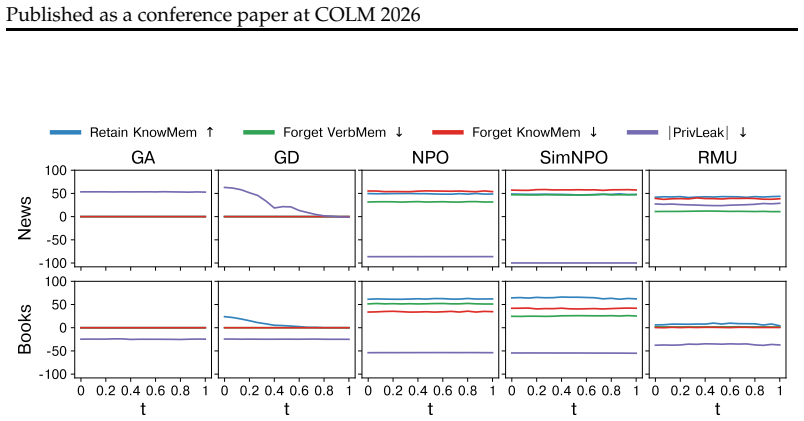
The paper introduces mode connectivity in unlearning (MCU) and reports that many unlearned models lie in connected basins with smooth retain/forget behavior. It finds that changes in training dynamics can move solutions into different basins, that models in the same basin can differ substantially on privacy metrics, and that unlearning progresses nonlinearly from the original model to the unlearned model. Linear connectivity across different unlearning methods indicates that approximate unlearning methods are mechanistically distinct from retraining. MCU-based ensembling improves generalization and robustness to relearning attacks, and MCU smoothness correlates with unlearning difficulty.
Load-bearing premise
The load-bearing premise is that a low-loss path between the original and unlearned model is well-defined and informative when the forget set's loss is deliberately raised; the notion of 'smoothness' and which loss combination defines the path are not specified.
Editorial extensions
If this is right
- Unlearning difficulty can be read off the geometry: smoother MCU paths correlate with easier unlearning.
- Ensembling models along an MCU path yields a final model that generalizes better and resists relearning attacks.
- Approximate unlearning methods fall into basins distinct from retraining, so their outputs should not be treated as close to a retrained model.
- Curriculum learning or second-order optimization can move unlearning into a different basin, changing privacy behavior.
- Privacy metrics can vary substantially among models in the same basin, so basin membership alone does not determine privacy.
Reading between the lines
- If MCU smoothness is a reliable proxy for unlearning difficulty, then cheap path-smoothing checks could replace expensive attacks as a first screening for unlearning quality.
- The nonlinear progression from original to unlearned model hints that intermediate checkpoints along the path are not simple interpolations; this could matter for audits that try to trace what was removed.
- A natural testable extension is to check whether MCU also predicts resistance to membership inference, not only relearning, and whether the correlation survives when the path is defined by retain loss only rather than a weighted combination.
- Because the abstract does not specify the loss combination that defines a smooth low-loss path, MCU is best interpreted as a family of measures; the reported correlations may depend on that unspecified choice.
Editorial analysis
A structured set of objections, weighed in public.
Referee Report
Summary. The paper proposes 'mode connectivity in unlearning' (MCU), a framework for studying the loss-landscape geometry of machine unlearning. Based on the abstract, the authors claim that, across various training settings (curriculum learning, second-order optimization, and different unlearning methods), many unlearned models lie in connected basins with smooth retain/forget behavior; that training dynamics can move solutions into different basins; that models within the same basin can differ substantially on privacy metrics; that unlearning progresses nonlinearly from the original model; that linear connectivity indicates most approximate unlearning methods are mechanistically distinct from retraining; that MCU-based ensembling improves generalization and robustness to relearning attacks; and that MCU smoothness correlates with unlearning difficulty. The abstract presents these as empirical findings, but no full text, datasets, protocols, or numerical evidence are available for review.
Significance. If the claims hold, this would be a novel and potentially useful geometric perspective on machine unlearning: basin membership and path smoothness could inform privacy behavior, ensembling across connected models could improve robustness, and MCU smoothness could serve as a proxy for unlearning difficulty. The proposed framework is falsifiable and testable. However, because this review is based solely on the abstract, the significance cannot be assessed beyond the plausibility of the claims; the central definitions and evidence are not yet visible.
major comments (3)
- [Abstract (central definition of MCU)] The abstract does not specify what loss function defines a 'low-loss path' or a 'connected basin' in the unlearning setting. Unlearning deliberately raises the forget loss at the unlearned model, so a path that is low-loss on the full objective cannot exist between the original and unlearned models. The authors must have chosen a sub-objective (e.g., retain loss only), a weighted combination, or a path constrained to a particular subspace, but this choice is not stated. Every subsequent claim about basin membership, smooth retain/forget behavior, and linear connectivity is conditional on this unstated protocol.
- [Abstract (MCU smoothness as a difficulty proxy)] The claimed correlation between 'MCU smoothness' and 'unlearning difficulty' is at risk of being partly tautological if the two quantities are computed from the same underlying loss terms, gradients, or path integrals. The abstract does not state how 'difficulty' is measured (e.g., retrain distance, relearn resistance, or forget-loss magnitude). If the difficulty metric and the smoothness metric share components, the reported correlation would not be informative. This needs an explicit independent definition.
- [Abstract (empirical scope and evidence)] The abstract claims that MCU is 'evaluated across a range of settings' and reports qualitative findings ('many unlearned models lie in connected basins,' 'MCU-based ensembling can improve generalization'), but no datasets, baselines, error bars, or negative controls are mentioned. Without these, the central empirical claims are unevidenced at the abstract level. The reader cannot judge whether the findings are robust across architectures, data modalities, or unlearning methods, or whether they depend on particular hyperparameters.
minor comments (3)
- [Abstract (terminology)] The term 'MCU smoothness' is introduced without a formal definition; the abstract should at least sketch what quantity is being measured.
- [Abstract (mechanical distinctness claim)] The phrase 'linear connectivity suggests that most approximate unlearning methods are mechanistically distinct from retraining' is vague. The reader cannot tell what threshold of nonlinearity counts as 'mechanistically distinct' or how this is derived.
- [Abstract (nonlinear progression)] The claim that 'unlearning progresses nonlinearly' needs a concrete notion of progression (e.g., interpolation parameter, training time, or loss trajectory). Without that, the statement is not checkable.
Circularity Check
No circularity demonstrable from abstract-only evidence; protocol-dependence remains an unverified risk.
full rationale
The provided manuscript is an abstract only: it contains no equations, no method section, no definitions of MCU, low-loss paths, or unlearning difficulty, and no cited prior results on which the argument depends. The central claim that 'MCU smoothness correlates with unlearning difficulty' could in principle be partially tautological if both quantities were computed from the same forget-loss path integrals, but the abstract does not state any such construction, so no specific reduction can be quoted or exhibited. The concern about an unstated path-loss definition is a protocol-dependence or correctness risk, not a demonstrated circular step. No self-citations are present. Under the hard rule that circularity may only be flagged when the paper's own text exhibits the reduction, the appropriate finding is no significant circularity.
Assumptions & free parameters
assumptions (3)
- domain assumption Trained models of the same task lie on connected, low-loss basins in parameter space (the standard mode-connectivity hypothesis)
- ad hoc to paper A low-loss path between original and unlearned models is well-defined when the forget loss is intentionally raised
- domain assumption 'Unlearning difficulty' is measured independently of path smoothness (e.g., by relearning-attack success or forget quality)
invented entities (1)
-
MCU (mode connectivity in unlearning) — a named framework/descriptor for the loss-landscape geometry of unlearning
independent evidence
Cite this review
Pith. "Pith review of Understanding Machine Unlearning Through the Lens of Mode Connectivity." pith.science (2026). https://pith.science/paper/YA7HGF7J
@misc{pith2026260723970,
  author       = {Pith},
  title        = {Pith review of: Understanding Machine Unlearning Through the Lens of Mode Connectivity},
  year         = {2026},
  howpublished = {\url{https://pith.science/paper/YA7HGF7J}},
  note         = {Machine review of arXiv:2607.23970}
}
read the original abstract
Machine Unlearning aims to remove undesired information from trained models without full retraining from scratch. Despite recent progress, the loss landscape and optimization geometry of unlearning are poorly understood. In this paper, we study machine unlearning through the lens of mode connectivity--the phenomenon that independently trained models can often be connected by smooth low-loss paths in parameter space. We introduce {\em mode connectivity in unlearning} (MCU) and evaluate it across a range of settings, including curriculum learning, second-order optimization, and connectivity across different unlearning methods. We find that many unlearned models lie in connected basins with smooth retain/forget behavior, while changes in training dynamics can move solutions into different basins. MCU also reveals that models within the same basin can differ substantially on privacy metrics, and that unlearning progresses nonlinearly from the original model to the unlearned model. In addition, linear connectivity suggests that most approximate unlearning methods are mechanistically distinct from retraining. Finally, MCU-based ensembling can improve generalization and robustness to relearning attacks, and MCU smoothness correlates with unlearning difficulty. To our knowledge, this is the first study of machine unlearning through the lens of mode connectivity.
Figures


Figures from the paper (25 more)


Reviewed August 4, 2026 · model on record in the stance chip above.
Discussion (0). Sign in to comment.