REVIEW 4 major objections 7 minor 71 references
Decoupling video prediction from action prediction, then guiding both with affordance and depth, yields stronger robot policies from fewer demos.
Reviewed by Pith at T0; open to challenge. T0 means a machine referee read the full paper against a public rubric. the ladder, T0–T4 →
T0 review · grok-4.5
2026-07-31 22:20 UTC pith:VLPOZMR6
load-bearing objection Solid modular VAM recipe with real efficiency evidence; sim story holds, real-world headline is softer than the abstract implies. the 4 major comments →
DeVA: Decoupled Video-Action Model with physical guidance for robot policy learning
The pith
A machine-rendered reading of the paper's core claim, the machinery that carries it, and where it could break.
Core claim
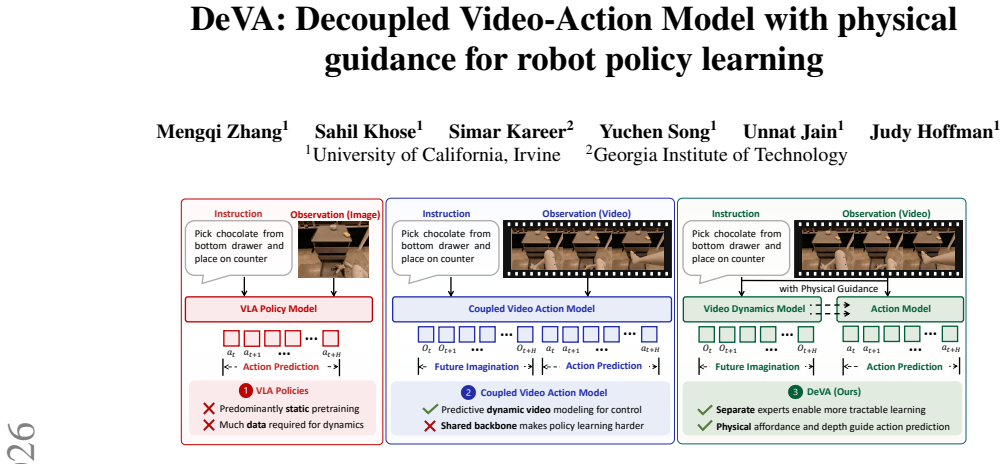
DeVA shows that robot policy learning from video generative priors works better when video dynamics and action prediction are handled by separate transformer experts linked by multi-level feature transfer and by explicit affordance and depth guidance, rather than by a single shared backbone or by sparse, single-layer video conditioning. Under limited demonstrations this yields higher success, faster optimization, and clear gains from the physical signals on both simulation benchmarks and real bimanual hardware.
What carries the argument
The decoupled video-action architecture: a pretrained video diffusion expert and a separate action diffusion expert, connected by layer-wise cross-attention plus learnable bridge tokens, with intermediate video features also decoded into task-conditioned affordance and relative-depth maps that supervise the video stream and are injected as guidance tokens into the action expert.
Load-bearing premise
The claim depends on intermediate video features, shaped by imperfect affordance and depth labels, actually carrying the right control information across the multi-level interface rather than the gains coming mostly from extra model capacity or training setup.
What would settle it
Train a capacity-matched unified backbone and a decoupled model without affordance/depth guidance on the same filtered demos and budget; if success and convergence gaps on RoboCasa, LIBERO, and the three real bimanual tasks disappear, the central architectural claim fails.
If this is right
- Video world-model pretraining can be turned into data-efficient robot policies without forcing video and actions into one shared representation.
- Multi-layer video features plus compact bridge tokens are a practical interface for transferring predictive dynamics into control heads.
- Lightweight affordance and depth supervision can steer generative video features toward interaction regions and geometry that matter for manipulation.
- Under matched optimization budgets, specialized experts can converge faster than unified video-action backbones on the same tasks.
Where Pith is reading between the lines
- If the physical decoders stay useful after freezing in stage two, similar auxiliary geometry or contact heads could regularize other generative backbones used only as frozen feature banks.
- The real-robot gains with thirty demos per task suggest the same recipe may transfer to other multi-camera bimanual setups where large action pretraining corpora are unavailable.
- A natural next stress test is whether multi-level transfer still helps when the video expert is trained on much longer horizons or open-world video rather than short task clips.
Editorial analysis
A structured set of objections, weighed in public.
Referee Report
Summary. The paper presents DeVA, a video-action model for language-conditioned manipulation in which a pretrained video diffusion transformer (Cosmos-Predict2, 2B params) and a separate flow-matching action expert are trained jointly but kept parameter-decoupled, exchanging information through layer-wise cross-attention from eight video layers plus learnable bridge tokens. Intermediate video features are additionally supervised with task-conditioned affordance heatmaps and relative depth via lightweight DPT-style decoders, whose features are injected as guidance tokens into the action expert's cross-attention. The authors report: (i) RoboCasa 72.0% success with only 50 demos/task, exceeding baselines trained on 300–3,000 demos; (ii) 99.0% average on LIBERO and 80.8% on LIBERO-Plus (+11.2 over the best baseline); (iii) faster convergence and much higher success than a matched unified-backbone variant (66–71% vs 34% at ~40–50K steps); (iv) real-world bimanual results on three tasks with an average "success rate" of 74% vs 48% (GR00T-N1.6) and 34% (Cosmos-Policy); and (v) ablations attributing ~6 points on RoboCasa to affordance+depth guidance. The simulation evidence is substantial; the real-world evidence is weaker than the headline numbers suggest, for reasons detailed below.
Significance. If the results hold, DeVA is a useful contribution to the video-action-model line of work: it gives a concrete, ablated answer to how to interface a pretrained video diffusion backbone with an action expert (layer-wise cross-attention plus bridge tokens, multi-step denoising features), and the RoboCasa data-efficiency result (72.0% at 50 demos/task, with 3,600 rollouts over 3 seeds) and the LIBERO-Plus robustness margin (+11.2 over the strongest baseline) are practically meaningful. The component ablations (Fig. 8), coupled-vs-decoupled convergence comparison under matched budget (Fig. 7(b)), and detailed appendix (parameter accounting in Table 2, per-dataset normalization in Table 4, denoising-step and interaction-mechanism ablations in Tables 7–9) are the kind of evidence that lets others build on the work. The promised release of code, configs, and checkpoints, and the documented real-world evaluation criteria (App. C.2), are genuine reproducibility strengths. The contribution is incremental relative to concurrent dual-DiT VAMs [9,10] in architecture, but the physical-guidance mechanism and the systematic efficiency analysis differentiate it.
major comments (4)
- [§4.4, Fig. 6(b), Table 6, Appendix C.2] Fig. 6(b) and Table 6 vs. Appendix C.2: the quantity reported as 'Success Rate' for real-world deployment is not a success rate. Appendix C.2 defines a stage-completion partial-credit score in [0,1] (e.g., Lift Pot awards 0.25/0.5/0.75 for incomplete episodes; Handover Marker awards 0.5 when one gripper lifts but the transfer fails). With 10 trials per task, a binary success rate must be a multiple of 0.1, yet Table 6 reports 0.88, 0.45, 0.23, 0.68 — values only possible under partial credit. This is load-bearing for the abstract and §4.4 claim 'DeVA achieves an average success rate of 74%, compared with 48%/34%': partial credit inflates all methods, and it does so differentially depending on where credit is granted (e.g., the 0.5 bin for 'one gripper lifts' is generous and may reward failure modes unevenly across methods). The fix is straightforward but mandatory: relabel the metric as
- [§4.4, Fig. 6(b), Table 6] Table 6 and Fig. 6(b): the real-world comparison in the main text omits the strongest baseline. Table 6 (appendix) reports π0.5 at 0.67 average vs. DeVA's 0.74, yet Fig. 6(b) and §4.4 compare only against GR00T-N1.6 (0.48) and Cosmos-Policy (0.34), and the abstract-level real-world claim rests on that comparison. With n=10 trials per task per method, the per-task standard error under the partial-credit metric is roughly 8–12 points, so the 0.74 vs. 0.67 gap over π0.5 is well within noise, and even the 0.74 vs. 0.48 gap over GR00T-N1.6 is only about 2σ on the per-task level. π0.5 must be included in the main-text figure and discussion (including, per §C.3, the caveat that π0.5 brings large-scale robot-centric pretraining and a 50-step action horizon vs. 25 for DeVA), and the claims should be tempered to what n=10×3 tasks can support — or the trial count increased. As written, the headline
- [§5, Fig. 8(b), Appendix B.3] Fig. 8(b) and Appendix B.3: the claim of 'clear performance gains from physical guidance' is established only in simulation, where affordance targets are oracle MuJoCo contacts/projected end-effector positions (§B.3). In the real-world pipeline the affordance targets are pseudo-labels from an off-the-shelf model [50] used 'out-of-the-box' and depth targets come from [57]; the authors themselves note these contain 'moderate prediction noise.' No real-world ablation isolates the contribution of physical guidance, so it is possible that on hardware the guidance tokens add little or that noisier pseudo-labels erode the sim-measured 6-point gain (66.0→72.0). The paper should either add a real-world ablation (base vs. +guidance on at least one task) or explicitly scope the physical-guidance claim to simulation in the abstract and §7. Given that the guidance module is a named contribution of th
- [§4.5, Fig. 7(b)] Fig. 7(b): the 'faster convergence than a unified architecture' claim is supported only over the plotted horizon (~60K steps). The coupled variant is at ~34% at 40–50K steps when the decoupled variants plateau at 66–71%, but the figure does not show whether the coupled model eventually catches up with more steps, i.e., whether decoupling buys asymptotic performance or only optimization speed. This matters because the coupled variant is the paper's own construction (not a published baseline), so the reader cannot rule out that it is simply under-tuned. Please either extend the coupled curve to convergence, or state explicitly that the claim is about matched-budget efficiency, and report the coupled variant's final performance under its own best budget.
minor comments (7)
- [§3.3 / Table 5] §3.3 defines Stage-1 loss weights λ_aff and λ_depth, but their values appear only in Appendix Table 5 (both 1.0). State the values in the main text where the objective is introduced.
- [Table 1, Fig. 5] Simulation results use 3 seeds × 50 rollouts, but no variance or confidence intervals are reported in Table 1 or Fig. 5. On LIBERO, DeVA's 99.0 vs. DiT4DiT's 98.6 and Cosmos-Policy's 98.5 is almost certainly within seed noise; please report standard errors so that 'highest overall average' claims are calibrated.
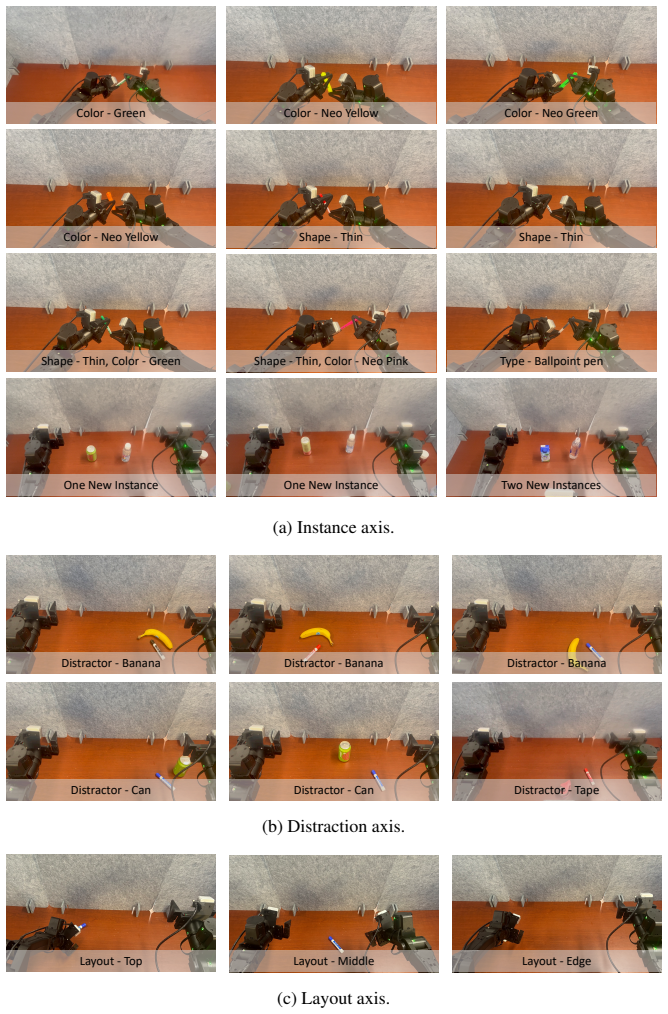
- [Fig. 5(c)] Fig. 5(c) ('Perturbation') is never referenced or described in the text; the caption mentions 'Robot Init' and 'Camera View' axes but no numbers or discussion are given. Either integrate it into §4.3 or remove it.
- [Fig. 3] Fig. 3 contains a label 'Bit Addition' (presumably an addition/fusion op); clarify or correct the terminology.
- [Appendix D.3, Table 9] Appendix D.3 reports 30K-step checkpoint results (49.6/53.2/22.4) that are far below the ~55K-step numbers elsewhere (e.g., 66.0 base). Please note the different budget explicitly in the table caption to avoid confusion with main-text numbers.
- [General] Formatting/typos: 'DeV A' appears with a spurious space throughout the extracted text (e.g., title, §3, §4.1); Table 1's last row reads 'Ours5072.0' with missing column separation; §4.1 says 'three complementary simulation benchmarks' and the introduction says 'three simulation benchmarks, including RoboCasa, LIBERO, LIBERO-plus' — 'including' suggests the list is non-exhaustive; make it exact.
- [Appendix B.1] §B.1: training uses Cosmos-Policy's replay-filtered (success-only) demonstrations for LIBERO and RoboCasa. It would help to state explicitly which baselines in Table 1 and Fig. 5(a) were trained on the same filtered data versus their original data, since filtering changes the effective data budget (1,199 episodes for RoboCasa across 24 tasks).
Circularity Check
No significant circularity: empirical architecture and policy results evaluated on external simulators and robots, not algebraic restatements of fitted inputs.
full rationale
DeVA is an empirical robotics/ML paper. Its load-bearing claims are comparative success rates, convergence curves, and ablations on RoboCasa, LIBERO/LIBERO-Plus, and real bimanual hardware. Those metrics are produced by rolling out policies in external simulators or on physical robots under stated protocols; they are not defined by the training losses or by parameters fitted to the same quantities being reported. Video and action objectives (EDM denoising, flow matching), multi-level cross-attention, and affordance/depth auxiliary losses are design choices supervised by simulator contacts, off-the-shelf depth/affordance models, or pseudo-labels—standard external supervision, not self-definition of the evaluation metric. Pretrained Cosmos weights and community-filtered demonstration sets are ordinary transfer/data practice and do not force the reported margins by construction. There is no uniqueness theorem, self-citation chain that substitutes for evidence, or renaming of a known identity as a derived prediction. Concerns about partial-credit real-world scoring, small trial counts, or missing baselines affect evaluation integrity, not circularity of a derivation chain.
Axiom & Free-Parameter Ledger
free parameters (5)
- λ_aff and λ_depth (Stage-1 auxiliary loss weights) =
1.0 / 1.0
- Number and placement of transferred video layers / bridge tokens =
8 layers; 12 tokens × 1024
- Learning-rate piecewise schedule and Stage-1/2 step budgets =
peak 1e-4; ~55K sim / 40K real
- Affordance Gaussian kernel and positive-class weighting =
3×3 Gaussian σ=1.0
- Noise-weighting w(t)=1/(1+σ_t)^2 for auxiliary losses =
w(t)=1/(1+σ_t)^2
axioms (6)
- domain assumption Pretrained video diffusion backbones encode spatiotemporal dynamics useful for downstream robot control when fine-tuned with future-frame objectives.
- domain assumption Diffusion features at different layers/denoising stages carry complementary abstractions worth multi-level transfer to actions.
- domain assumption Task-conditioned affordance maps and relative depth are sufficiently complete physical signals to shape intermediate video features for manipulation.
- ad hoc to paper Off-the-shelf affordance and video-depth models provide adequate pseudo-labels for real-world supervision without metric multi-view consistency.
- standard math EDM video denoising and action flow-matching are appropriate generative objectives for joint video-action learning.
- ad hoc to paper Decoupling video and action parameters makes policy optimization more tractable than a shared backbone under matched budgets.
invented entities (2)
-
DeVA dual-expert Video-Action architecture with bridge-token interface
no independent evidence
-
Physical guidance tokens from affordance/depth DPT-style decoders
no independent evidence
read the original abstract
Generalizable robot manipulation requires policies that can anticipate how visual scenes evolve while executing language instructions. While recent Vision-Language-Action models benefit from large-scale pretraining, their predominantly static pretraining objectives provide limited supervision for physical dynamics and temporal causality, leaving control-relevant knowledge to be learned from downstream robot demonstrations. Video generative models offer a promising foundation by encoding rich spatiotemporal priors through future predictions. However, existing Video-Action Models either couple video and action prediction in a shared backbone, making policy adaptation harder to optimize, or under-utilize video information when guiding the action branch. In this work, we introduce DeVA, a Decoupled Video-Action model with specialized video and action experts, multi-level feature transfer, and physically salient guidance. DeVA transfers representations from multiple video layers to the action expert, enabling rich information exchange while making policy learning more tractable. It further supervises intermediate video features and the action stream with physically salient guidance (affordance/depth). Experiments on both simulation benchmarks and real-world deployment demonstrate strong performance with limited data, faster convergence than a unified architecture, and clear performance gains from physical guidance.
Figures


Reference graph
Works this paper leans on
-
[1]
M. J. Kim, K. Pertsch, S. Karamcheti, T. Xiao, A. Balakrishna, S. Nair, R. Rafailov, E. P. Foster, P. R. Sanketi, Q. Vuong, et al. Openvla: An open-source vision-language-action model. In Conference on Robot Learning, pages 2679–2713. PMLR, 2025
2025
-
[2]
K. Black, N. Brown, D. Driess, A. Esmail, M. Equi, C. Finn, N. Fusai, L. Groom, K. Hausman, B. Ichter, et al. π0: A vision-language-action flow model for general robot control.arXiv preprint arXiv:2410.24164, 2024
Pith/arXiv arXiv 2024
-
[3]
P. Intelligence, K. Black, N. Brown, J. Darpinian, K. Dhabalia, D. Driess, A. Esmail, M. Equi, C. Finn, N. Fusai, et al. π0.5: a vision-language-action model with open-world generalization. arXiv preprint arXiv:2504.16054, 2025
Pith/arXiv arXiv 2025
-
[4]
Zitkovich, T
B. Zitkovich, T. Yu, S. Xu, P. Xu, T. Xiao, F. Xia, J. Wu, P. Wohlhart, S. Welker, A. Wahid, et al. Rt-2: Vision-language-action models transfer web knowledge to robotic control. InConference on Robot Learning, pages 2165–2183. PMLR, 2023
2023
-
[5]
C. Zhu, R. Yu, S. Feng, B. Burchfiel, P. Shah, and A. Gupta. Unified world models: Coupling video and action diffusion for pretraining on large robotic datasets. InProceedings of Robotics: Science and Systems (RSS), 2025
2025
-
[6]
M. J. Kim, Y . Gao, T.-Y . Lin, Y .-C. Lin, Y . Ge, G. Lam, P. Liang, S. Song, M.-Y . Liu, C. Finn, and J. Gu. Cosmos policy: Fine-tuning video models for visuomotor control and planning. In International Conference on Learning Representations (ICLR), 2026
2026
-
[7]
S. Ye, Y . Ge, K. Zheng, S. Gao, S. Yu, G. Kurian, S. Indupuru, Y . L. Tan, C. Zhu, J. Xiang, A. Malik, K. Lee, W. Liang, N. Ranawaka, J. Gu, Y . Xu, G. Wang, F. Hu, A. Narayan, J. Bjorck, J. Wang, G. Kim, D. Niu, R. Zheng, Y . Xie, J. Wu, Q. Wang, R. Julian, D. Xu, Y . Du, Y . Chebotar, S. Reed, J. Kautz, Y . Zhu, L. J. Fan, and J. Jang. World action mod...
-
[8]
Y . Hu, Y . Guo, P. Wang, X. Chen, Y .-J. Wang, J. Zhang, K. Sreenath, C. Lu, and J. Chen. Video prediction policy: A generalist robot policy with predictive visual representations. In International Conference on Machine Learning, pages 24328–24346. PMLR, 2025
2025
-
[9]
J. Pai, L. Achenbach, V . Montesinos, B. Forrai, O. Mees, and E. Nava. mimic-video: Video- action models for generalizable robot control beyond vlas.arXiv preprint 2512.15692, 2025
Pith/arXiv arXiv 2025
-
[10]
T. Ma, J. Zheng, Z. Wang, C. Jiang, A. Cui, J. Liang, and S. Yang. Dit4dit: Jointly modeling video dynamics and actions for generalizable robot control.arXiv preprint arXiv:2603.10448, 2026
arXiv 2026
-
[11]
G. Luo, L. Dunlap, D. H. Park, A. Holynski, and T. Darrell. Diffusion hyperfeatures: Search- ing through time and space for semantic correspondence.Advances in Neural Information Processing Systems, 36:47500–47510, 2023
2023
-
[12]
D. Kim, X. Thomas, and D. Ghadiyaram. Revelio: Interpreting and leveraging semantic information in diffusion models. InProceedings of the IEEE/CVF International Conference on Computer Vision, pages 4659–4669, 2025
2025
-
[13]
Nasiriany, A
S. Nasiriany, A. Maddukuri, L. Zhang, A. Parikh, A. Lo, A. Joshi, A. Mandlekar, and Y . Zhu. Robocasa: Large-scale simulation of everyday tasks for generalist robots. InRobotics: Science and Systems (RSS), 2024. 9
2024
-
[14]
B. Liu, Y . Zhu, C. Gao, Y . Feng, Q. Liu, Y . Zhu, and P. Stone. Libero: Benchmarking knowledge transfer for lifelong robot learning.Advances in Neural Information Processing Systems, 36: 44776–44791, 2023
2023
-
[15]
S. Fei, S. Wang, J. Shi, Z. Dai, J. Cai, P. Qian, L. Ji, X. He, S. Zhang, Z. Fei, et al. Libero-plus: In- depth robustness analysis of vision-language-action models.arXiv preprint arXiv:2510.13626, 2025
Pith/arXiv arXiv 2025
-
[16]
A. Brohan, N. Brown, J. Carbajal, Y . Chebotar, J. Dabis, C. Finn, K. Gopalakrishnan, K. Haus- man, A. Herzog, J. Hsu, et al. Rt-1: Robotics transformer for real-world control at scale.arXiv preprint arXiv:2212.06817, 2022
Pith/arXiv arXiv 2022
-
[17]
Driess, F
D. Driess, F. Xia, M. S. Sajjadi, C. Lynch, A. Chowdhery, B. Ichter, A. Wahid, J. Tompson, Q. Vuong, T. Yu, et al. Palm-e: An embodied multimodal language model. InInternational Conference on Machine Learning, pages 8469–8488. PMLR, 2023
2023
-
[18]
K. Bousmalis, G. Vezzani, D. Rao, C. Devin, A. X. Lee, M. Bauzá, T. Davchev, Y . Zhou, A. Gupta, A. Raju, et al. Robocat: A self-improving generalist agent for robotic manipulation. arXiv preprint arXiv:2306.11706, 2023
Pith/arXiv arXiv 2023
-
[19]
Ghosh, H
Octo Model Team, D. Ghosh, H. Walke, K. Pertsch, K. Black, O. Mees, S. Dasari, J. Hejna, C. Xu, J. Luo, T. Kreiman, Y . Tan, L. Y . Chen, P. Sanketi, Q. Vuong, T. Xiao, D. Sadigh, C. Finn, and S. Levine. Octo: An open-source generalist robot policy. InProceedings of Robotics: Science and Systems, Delft, Netherlands, 2024
2024
-
[20]
Q. Li, Y . Liang, Z. Wang, L. Luo, X. Chen, M. Liao, F. Wei, Y . Deng, S. Xu, Y . Zhang, et al. Cogact: A foundational vision-language-action model for synergizing cognition and action in robotic manipulation.arXiv preprint arXiv:2411.19650, 2024
Pith/arXiv arXiv 2024
-
[21]
S. Liu, L. Wu, B. Li, H. Tan, H. Chen, Z. Wang, K. Xu, H. Su, and J. Zhu. Rdt-1b: a diffusion foundation model for bimanual manipulation. InInternational Conference on Learning Representations, volume 2025, pages 29982–30009, 2025
2025
-
[22]
J. Bjorck, F. Castañeda, N. Cherniadev, X. Da, R. Ding, L. Fan, Y . Fang, D. Fox, F. Hu, S. Huang, et al. Gr00t n1: An open foundation model for generalist humanoid robots.arXiv preprint arXiv:2503.14734, 2025
Pith/arXiv arXiv 2025
-
[23]
K. Pertsch, K. Stachowicz, B. Ichter, D. Driess, S. Nair, Q. Vuong, O. Mees, C. Finn, and S. Levine. Fast: Efficient action tokenization for vision-language-action models.arXiv preprint arXiv:2501.09747, 2025
Pith/arXiv arXiv 2025
-
[24]
M. J. Kim, C. Finn, and P. Liang. Fine-tuning vision-language-action models: Optimizing speed and success.arXiv preprint arXiv:2502.19645, 2025
Pith/arXiv arXiv 2025
-
[25]
H. Zhen, X. Qiu, P. Chen, J. Yang, X. Yan, Y . Du, Y . Hong, and C. Gan. 3d-vla: A 3d vision- language-action generative world model. InInternational Conference on Machine Learning, pages 61229–61245. PMLR, 2024
2024
-
[26]
D. Qu, H. Song, Q. Chen, Y . Yao, X. Ye, Y . Ding, Z. Wang, J. Gu, B. Zhao, D. Wang, et al. Spatialvla: Exploring spatial representations for visual-language-action model.arXiv preprint arXiv:2501.15830, 2025
Pith/arXiv arXiv 2025
-
[27]
Zheng, Y
R. Zheng, Y . Liang, S. Huang, J. Gao, H. Daumé III, A. Kolobov, F. Huang, and J. Yang. Tracevla: Visual trace prompting enhances spatial-temporal awareness for generalist robotic policies. InInternational Conference on Learning Representations, volume 2025, pages 54277– 54296, 2025
2025
-
[28]
Q. Bu, Y . Yang, J. Cai, S. Gao, G. Ren, M. Yao, P. Luo, and H. Li. Univla: Learning to act anywhere with task-centric latent actions.arXiv preprint arXiv:2505.06111, 2025. 10
Pith/arXiv arXiv 2025
-
[29]
W. Li, R. Zhang, R. Shao, J. He, and L. Nie. Cogvla: Cognition-aligned vision-language- action model via instruction-driven routing & sparsification.Advances in neural information processing systems, 2025
2025
-
[30]
Y . Du, S. Yang, B. Dai, H. Dai, O. Nachum, J. Tenenbaum, D. Schuurmans, and P. Abbeel. Learning universal policies via text-guided video generation.Advances in neural information processing systems, 36:9156–9172, 2023
2023
-
[31]
Black, M
K. Black, M. Nakamoto, P. Atreya, H. Walke, C. Finn, A. Kumar, and S. Levine. Zero- shot robotic manipulation with pre-trained image-editing diffusion models. InInternational Conference on Learning Representations, volume 2024, pages 33431–33452, 2024
2024
-
[32]
Bharadhwaj, D
H. Bharadhwaj, D. Dwibedi, A. Gupta, S. Tulsiani, C. Doersch, T. Xiao, D. Shah, F. Xia, D. Sadigh, and S. Kirmani. Gen2act: Human video generation in novel scenarios enables generalizable robot manipulation. InConference on Robot Learning, pages 3936–3951. PMLR, 2025
2025
-
[33]
J. Jang, S. Ye, Z. Lin, J. Xiang, J. Bjorck, Y . Fang, F. Hu, S. Huang, K. Kundalia, Y .-C. Lin, et al. Dreamgen: Unlocking generalization in robot learning through video world models. In Conference on Robot Learning, pages 5170–5194. PMLR, 2025
2025
-
[34]
S. Ye, J. Jang, B. Jeon, S. J. Joo, J. Yang, B. Peng, A. Mandlekar, R. Tan, Y .-W. Chao, B. Y . Lin, et al. Latent action pretraining from videos. InInternational Conference on Learning Representations, volume 2025, pages 28213–28239, 2025
2025
-
[35]
H. Wu, Y . Jing, C. Cheang, G. Chen, J. Xu, X. Li, M. Liu, H. Li, and T. Kong. Unleashing large- scale video generative pre-training for visual robot manipulation. InInternational Conference on Learning Representations, volume 2024, pages 10641–10662, 2024
2024
-
[36]
Zheng, J
R. Zheng, J. Wang, S. Reed, J. Bjorck, Y . Fang, F. Hu, J. Jang, K. Kundalia, Z. Lin, L. Magne, et al. Flare: Robot learning with implicit world modeling. InConference on Robot Learning, pages 3952–3971. PMLR, 2025
2025
-
[37]
S. Li, Y . Gao, D. Sadigh, and S. Song. Unified video action model.arXiv preprint arXiv:2503.00200, 2025
Pith/arXiv arXiv 2025
-
[38]
J. Liang, P. Tokmakov, R. Liu, S. Sudhakar, P. Shah, R. Ambrus, and C. V ondrick. Video generators are robot policies.arXiv preprint arXiv:2508.00795, 2025
Pith/arXiv arXiv 2025
-
[39]
S. Routray, H. Pan, U. Jain, S. Bahl, and D. Pathak. Vipra: Video prediction for robot actions. arXiv preprint arXiv:2511.07732, 2025
arXiv 2025
-
[40]
T. Yuan, Z. Dong, Y . Liu, and H. Zhao. Fast-wam: Do world action models need test-time future imagination?arXiv preprint arXiv:2603.16666, 2026
Pith/arXiv arXiv 2026
-
[41]
K. Mo, L. J. Guibas, M. Mukadam, A. Gupta, and S. Tulsiani. Where2act: From pixels to actions for articulated 3d objects. InProceedings of the IEEE/CVF International Conference on Computer Vision, pages 6813–6823, 2021
2021
-
[42]
S. Deng, X. Xu, C. Wu, K. Chen, and K. Jia. 3d affordancenet: A benchmark for visual object affordance understanding. Inproceedings of the IEEE/CVF conference on computer vision and pattern recognition, pages 1778–1787, 2021
2021
-
[43]
S. Bahl, R. Mendonca, L. Chen, U. Jain, and D. Pathak. Affordances from human videos as a versatile representation for robotics. InProceedings of the IEEE/CVF Conference on Computer Vision and Pattern Recognition, pages 13778–13790, 2023
2023
-
[44]
C. Yuan, C. Wen, T. Zhang, and Y . Gao. General flow as foundation affordance for scalable robot learning. InConference on Robot Learning, pages 1541–1566. PMLR, 2025. 11
2025
-
[45]
W. Yuan, J. Duan, V . Blukis, W. Pumacay, R. Krishna, A. Murali, A. Mousavian, and D. Fox. Robopoint: A vision-language model for spatial affordance prediction in robotics. InConference on Robot Learning, pages 4005–4020. PMLR, 2025
2025
-
[46]
Huang, C
W. Huang, C. Wang, Y . Li, R. Zhang, and L. Fei-Fei. Rekep: Spatio-temporal reasoning of relational keypoint constraints for robotic manipulation. InConference on Robot Learning, pages 4573–4602. PMLR, 2025
2025
-
[47]
Nasiriany, S
S. Nasiriany, S. Kirmani, T. Ding, L. Smith, Y . Zhu, D. Driess, D. Sadigh, and T. Xiao. Rt- affordance: Affordances are versatile intermediate representations for robot manipulation. In 2025 IEEE International Conference on Robotics and Automation (ICRA), pages 8249–8257. IEEE, 2025
2025
-
[48]
K. Rana, J. Abou-Chakra, S. Garg, R. Lee, I. Reid, and N. Suenderhauf. Learning from 10 demos: Generalisable and sample-efficient policy learning with oriented affordance frames. In Conference on Robot Learning, pages 5464–5482. PMLR, 2025
2025
-
[49]
S. Wu, Y . Zhu, Y . Huang, K. Zhu, J. Gu, J. Yu, Y . Shi, and J. Wang. Afforddp: Generalizable diffusion policy with transferable affordance. InProceedings of the Computer Vision and Pattern Recognition Conference, pages 6971–6980, 2025
2025
-
[50]
Y . Tang, W. Huang, Y . Wang, C. Li, R. Yuan, R. Zhang, J. Wu, and L. Fei-Fei. Uad: Un- supervised affordance distillation for generalization in robotic manipulation. In2025 IEEE International Conference on Robotics and Automation (ICRA), pages 3822–3831. IEEE, 2025
2025
-
[51]
Shridhar, L
M. Shridhar, L. Manuelli, and D. Fox. Perceiver-actor: A multi-task transformer for robotic manipulation. InConference on Robot Learning, pages 785–799. PMLR, 2023
2023
-
[52]
Goyal, J
A. Goyal, J. Xu, Y . Guo, V . Blukis, Y .-W. Chao, and D. Fox. Rvt: Robotic view transformer for 3d object manipulation. InConference on Robot Learning, pages 694–710. PMLR, 2023
2023
-
[53]
Gervet, Z
T. Gervet, Z. Xian, N. Gkanatsios, and K. Fragkiadaki. Act3d: 3d feature field transformers for multi-task robotic manipulation. InConference on Robot Learning, pages 3949–3965. PMLR, 2023
2023
-
[54]
Y . Ze, G. Zhang, K. Zhang, C. Hu, M. Wang, and H. Xu. 3d diffusion policy: Generalizable visuomotor policy learning via simple 3d representations. InProceedings of Robotics: Science and Systems (RSS), 2024
2024
-
[55]
Y . Jia, J. Liu, S. Chen, C. Gu, Z. Wang, L. Luo, L. Lee, P. Wang, Z. Wang, R. Zhang, et al. Lift3d foundation policy: Lifting 2d large-scale pretrained models for robust 3d robotic manipulation. arXiv preprint arXiv:2411.18623, 2024
Pith/arXiv arXiv 2024
-
[56]
L. Yang, B. Kang, Z. Huang, Z. Zhao, X. Xu, J. Feng, and H. Zhao. Depth anything v2. Advances in Neural Information Processing Systems, 37:21875–21911, 2024
2024
-
[57]
S. Chen, H. Guo, S. Zhu, F. Zhang, Z. Huang, J. Feng, and B. Kang. Video depth anything: Consistent depth estimation for super-long videos. In2025 IEEE/CVF Conference on Computer Vision and Pattern Recognition (CVPR), pages 22831–22840. IEEE, 2025
2025
-
[58]
L. Yang, B. Kang, Z. Huang, X. Xu, J. Feng, and H. Zhao. Depth anything: Unleashing the power of large-scale unlabeled data. InCVPR, 2024
2024
-
[59]
L. Fan, Z. Xu, C. Cao, W. Zhang, M. Yuan, and J. Chen. Aim: Intent-aware unified world action modeling with spatial value maps.arXiv preprint arXiv:2604.11135, 2026
Pith/arXiv arXiv 2026
-
[60]
Cosmos-predict2: World simulation model for physical ai, 2025
NVIDIA. Cosmos-predict2: World simulation model for physical ai, 2025. URL https: //github.com/nvidia-cosmos/cosmos-predict2. 12
2025
-
[61]
B. Han, J. Kim, and J. Jang. A dual process vla: Efficient robotic manipulation leveraging vlm. arXiv preprint arXiv:2410.15549, 2024
Pith/arXiv arXiv 2024
-
[62]
J. Won, K. Lee, H. Jang, D. Kim, and J. Shin. Dual-stream diffusion for world-model augmented vision-language-action model.arXiv preprint arXiv:2510.27607, 2025
Pith/arXiv arXiv 2025
-
[63]
M. Koo, D. Choi, T. Kim, K. Lee, C. Kim, Y . Seo, and J. Shin. Hamlet: Switch your vision- language-action model into a history-aware policy.arXiv preprint arXiv:2510.00695, 2025
Pith/arXiv arXiv 2025
-
[64]
C. Chi, Z. Xu, S. Feng, E. Cousineau, Y . Du, B. Burchfiel, R. Tedrake, and S. Song. Diffusion policy: Visuomotor policy learning via action diffusion.The International Journal of Robotics Research, 44(10-11):1684–1704, 2025
2025
-
[65]
J. Cen, C. Yu, H. Yuan, Y . Jiang, S. Huang, J. Guo, X. Li, Y . Song, H. Luo, F. Wang, et al. Worldvla: Towards autoregressive action world model.arXiv preprint arXiv:2506.21539, 2025
Pith/arXiv arXiv 2025
-
[66]
C.-Y . Hung, Q. Sun, P. Hong, A. Zadeh, C. Li, U. Tan, N. Majumder, S. Poria, et al. Nora: A small open-sourced generalist vision language action model for embodied tasks.arXiv preprint arXiv:2504.19854, 2025
Pith/arXiv arXiv 2025
-
[67]
S. Tan, K. Dou, Y . Zhao, and P. Krähenbühl. Interactive post-training for vision-language-action models.arXiv preprint arXiv:2505.17016, 2025
Pith/arXiv arXiv 2025
-
[68]
Y AM Arm Series.https://doc.i2rt.com/products/yam, 2024
I2RT Robotics. Y AM Arm Series.https://doc.i2rt.com/products/yam, 2024
2024
-
[69]
Cheng, J
X. Cheng, J. Li, S. Yang, G. Yang, and X. Wang. Open-television: Teleoperation with immersive active visual feedback. InConference on Robot Learning, pages 2729–2749. PMLR, 2025
2025
-
[70]
J. Xu, S. Liu, A. Vahdat, W. Byeon, X. Wang, and S. De Mello. Open-vocabulary panoptic segmentation with text-to-image diffusion models. InProceedings of the IEEE/CVF conference on computer vision and pattern recognition, pages 2955–2966, 2023. 13 Appendix A Implementation Details A.1 Video Expert Architecture In DeV A, we adopt Cosmos-Predict2 [60] as th...
2023
-
[2026]
URLhttps://arxiv.org/abs/2602.15922
discussion (0)
Sign in with ORCID, Apple, or X to comment. Anyone can read and Pith papers without signing in.