REVIEW 3 major objections 7 minor 123 references
Lattice QCD gives the first nonperturbative constraints on the gluon Collins-Soper kernel for transverse momenta from 300 MeV to 1.3 GeV.
Reviewed by Pith at T0; open to challenge. T0 means a machine referee read the full paper against a public rubric. the ladder, T0–T4 →
T0 review · grok-4.5
2026-07-31 11:09 UTC pith:4XHXAADR
load-bearing objection First lattice numbers on the gluon CS kernel; real advance, but the Casimir-scaling 1–2σ claim is statistical only and the small-b_T points are uncontrolled. the 3 major comments →
First constraints on the nonperturbative gluon Collins-Soper kernel
The pith
A machine-rendered reading of the paper's core claim, the machinery that carries it, and where it could break.
Core claim
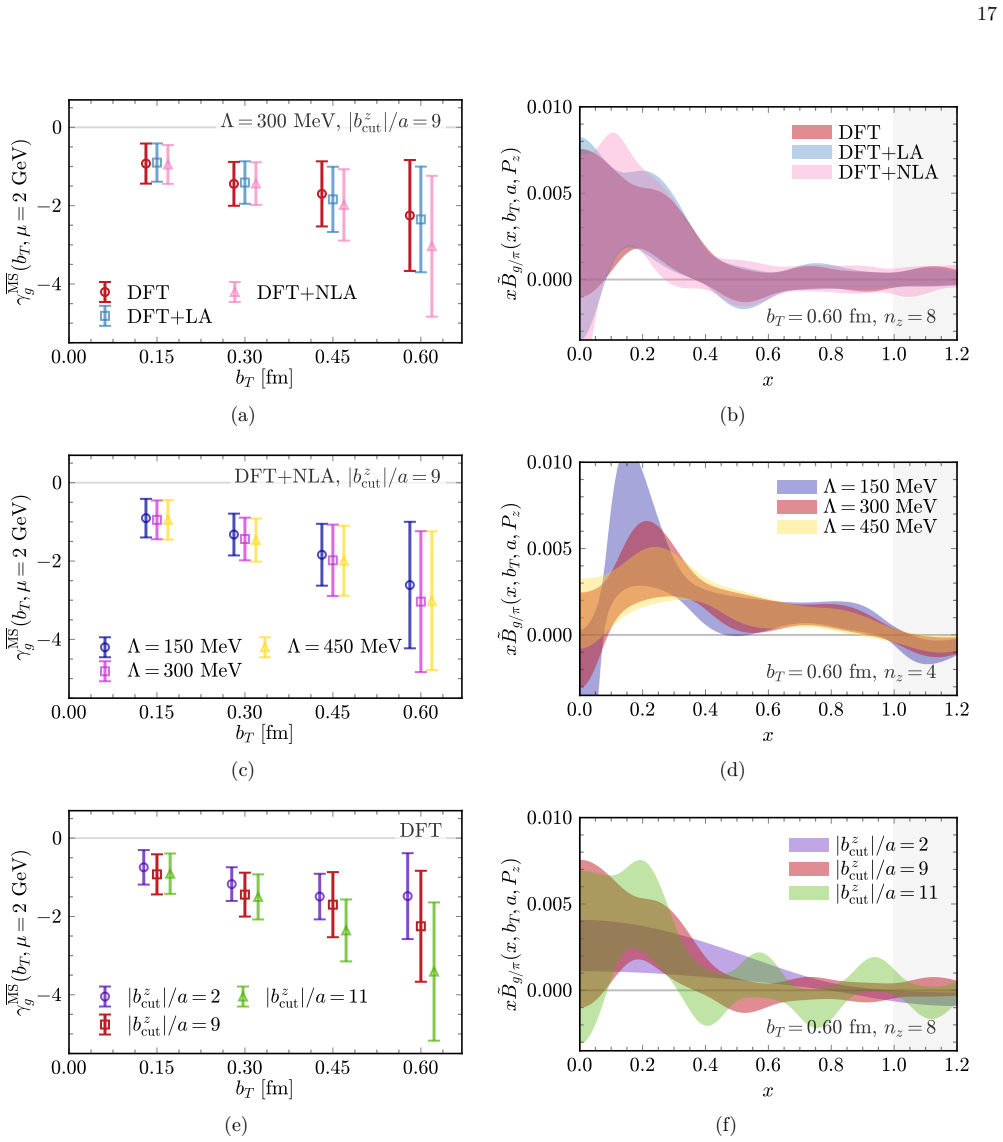
The nonperturbative gluon Collins-Soper kernel γ_g(b_T, μ = 2 GeV) is constrained for the first time over q_T ∈ [300 MeV, 1.3 GeV] from lattice QCD at M_π = 172(3) MeV and a = 0.15 fm, with uNNLL LaMET matching of quasi-TMD beam functions; the constraints are compatible within 1–2σ with Casimir scaling of the continuum-extrapolated quark kernel.
What carries the argument
The Pz derivative of the logarithm of the renormalized quasi-TMD gluon beam function after subtraction of the uNNLL LaMET matching kernel H_g, which isolates the Collins-Soper kernel once power corrections in 1/(x Pz) are controlled.
Load-bearing premise
Discretization artifacts and small-b_T power corrections remain uncontrolled on the single lattice spacing a = 0.15 fm and are expected to be large below roughly 0.3 fm.
What would settle it
A multi-spacing continuum extrapolation of the same quasi-TMD matrix elements that moves the extracted γ_g outside the present 1–2σ band around Casimir-scaled quark results, or a statistically significant deviation once full convolutional b_T-dependent matching is included.
If this is right
- Phenomenological fits of unpolarized gluon TMDs can replace pure Casimir-scaling assumptions with first lattice anchors in the nonperturbative region.
- Future higher-precision lattice determinations can test whether Casimir scaling of the CS kernels survives beyond perturbation theory.
- The same framework supplies nonperturbative input for gluon-sensitive observables at the EIC, LHC quarkonium, and Higgs q_T spectra.
- Coulomb-gauge or flow-based formulations are identified as practical routes to the precision already achieved for the quark kernel.
Where Pith is reading between the lines
- If the mild tension with pure perturbation theory at the smallest b_T persists after continuum extrapolation, it would signal genuine nonperturbative breaking of Casimir scaling that global TMD analyses must absorb.
- The computational cost scaling noted for adjoint Wilson lines implies that gluon CS-kernel campaigns will likely migrate to Coulomb-gauge quasi-TMDs sooner than the corresponding quark program did.
- Joint experimental-plus-lattice fits already performed for the quark kernel can be repeated for gluons once a second lattice spacing appears.
Editorial analysis
A structured set of objections, weighed in public.
Referee Report
Summary. This Letter reports the first lattice-QCD constraint on the nonperturbative gluon Collins-Soper (CS) kernel γ_g(b_T, μ=2 GeV), the rapidity-evolution anomalous dimension of gluon TMDs. The extraction uses quasi-TMD beam functions built from staple-shaped gluon field-strength operators with adjoint Wilson-line divergence subtraction, computed on a single MILC HISQ ensemble (a=0.15 fm, L≈4.8 fm, 1105 configurations) with Wilson-clover valence quarks at M_π=172(3) MeV, boosted pion states at P_z ≈ 1.0–2.1 GeV, and Large-Momentum Effective Theory matching at (b_T-unexpanded) NNLL accuracy. The kernel is extracted from the ln P_z slope of matched quasi-beam functions, with x-windows selected by a perturbative-coupling bound and a χ² criterion, yielding constraints for transverse scales q_T ∈ [300 MeV, 1.3 GeV] (b_T = 0.15–0.60 fm). The results are stated to be compatible within 1–2σ with Casimir scaling of the continuum-extrapolated quark CS kernel, while the paper itself notes that O(a) artifacts and small-b_T power corrections are uncontrolled and comparable in size to the gluon–Casimir difference.
Significance. If the results hold, this is a genuine first: no nonperturbative constraint on the gluon Collins-Soper kernel exists to date, and the quantity enters every global TMD analysis, the recent gluon-TMD extraction from Higgs data [28], and EIC physics. The manuscript ships several concrete strengths: (i) a fully documented extraction chain with internal cross-checks — Lanczos matrix elements validated against summed-ratio/statistical fits (SM B, Figs. 4–6), ℓ→∞ extrapolations checked against ℓ-dependent ansätze (SM D), DFT truncation checked against analytic-tail transforms and b_z^cut variations (SM E), and consistency across four operator definitions including differently trace-subtracted ones (SM I); (ii) external, non-circular benchmarks — the kernel is obtained from the P_z-dependence of lattice matrix elements after perturbative matching and compared against N⁴LL perturbation theory and the continuum-extrapolated quark result of Ref. [42], not fit to the data it aims to inform; (iii) an unusually candid accounting of which systematics are controlled and which are not; and (iv) a clear, falsifiable path to improvement (Coulomb-gauge and flow-based observables, NNLO and convolution-
major comments (3)
- [Intro; 'Statistical and systematic uncertainties'; Fig. 3] Intro (4th paragraph) and Summary vs. 'Statistical and systematic uncertainties' section: the headline statement that the results are 'compatible within 1–2σ with the Casimir scaling of the quark CS kernel' uses bands that are statistical (plus checked analysis variations) only. The body of the paper states that O(a) discretization artifacts and small-b_T power corrections 'cannot be fully quantified from the present results and are expected to be significant at the current precision level,' with magnitude 'comparable to the difference between the final results and ... the perturbatively-expected Casimir scaling of the quark kernel.' The uncertainty class that decides whether 1–2σ agreement is meaningful is therefore exactly the one absent from the bands. Moreover, the comparison is between a finite-a gluon result (a=0.15 fm, O(a)-unimproved valence action) and the continuum-extrapolated
- [Abstract; Fig. 3 caption] Abstract and main text: the quoted upper end of the range, q_T = 1.3 GeV, is Fourier-conjugate to b_T = 0.15 fm = 1a — precisely the point the Fig. 3 caption flags as uncontrolled ('expected to be significant for b_T ≲ 0.30 fm (b_T/a ≲ 2)'). Two of the four b_T points entering Fig. 3 lie in or at the boundary of the flagged region. As written, the abstract's range [300 MeV, 1.3 GeV] rests on the b_T/a=1 point without qualification. The authors should either restrict the quoted range or state explicitly in the abstract that the upper end corresponds to b_T/a=1 where discretization artifacts and power corrections are uncontrolled; at minimum the b_T=0.15 fm point in Fig. 3 should be visually distinguished from the controlled points.
- [Eq. (42); SM Sec. G, Eqs. (43)–(48); Figs. 13–14] Eq. (42) and SM Sec. G: the uNNLL matching kernel is constructed by taking the b_T-dependent correction δC^{NkLO}(b_T, μ, xP_z) derived for quark matching in Ref. [41] and rescaling it by C_A/C_F. This is a perturbative Casimir-scaling assumption built into the matching, while the paper's phenomenological motivation is precisely to test Casimir scaling nonperturbatively. The assumption is defensible at the relevant perturbative order, but it is load-bearing because the matching correction is as large as the signal: Fig. 14b,c show δγ shifts of roughly −1 to −3 in the retained x-range, of the same order as the extracted γ_g(b_T), and the uNNLL–NNLL difference exceeds statistical errors at small b_T (Figs. 2, 13). The text should state explicitly at what order the b_T-dependent piece is known to Casimir-scale, what residual uncertainty this construction leaves, and how the uNNLL–NNLL sprea
minor comments (7)
- [Eq. (18); SM Sec. F, Fig. 12b] The final x-interval selection uses an asymmetric, χ²-driven window (Eq. (18), δ_χ²=0.5). SM Sec. F reports that symmetric intervals shift the final constraints negatively by up to 1σ at small b_T. Since this shift is of the same size as other effects discussed, it would be cleaner to report it as an explicit analysis systematic rather than absorbing it into the window choice; a sentence of justification for the a posteriori asymmetry would also help.
- ['Extraction of the gluon CS kernel'] The final-value construction uses weights given by the ratio of a bootstrap fit p-value to the bootstrap variance at each x. This is unconventional; a sentence motivating this weight choice, and a check against a simple inverse-variance average, would strengthen it.
- ['Computational setup'; SM Sec. B] The mixed-action setup (HISQ sea, Wilson-clover valence with c_sw=1.0) yields continuum-dispersion deviations growing to 0.14(1) at n_z=8 (SM Sec. B, Fig. 5 discussion). The insensitivity check on N_{g/π} is reassuring, but a brief comment on expected mixed-action and O(a) effects in the matrix elements themselves would be useful context for Major Comment 1.
- [SM Secs. D–E; Eq. (15)] Finite-volume effects for nonlocal operators (Ref. [121]) are invoked at SM Sec. D/E to explain behavior at ℓ, |b_z| ∼ L, and the alternate operator in Eq. (52) is noted to have 'higher sensitivity to finite-volume effects at large ℓ.' A quantitative statement (e.g., M_π L, and the b_z^cut=1.35 fm truncation relative to L/2=2.4 fm) would clarify how close the analysis sits to finite-volume systematics.
- [SM Sec. E, Fig. 10] Fig. 10 is labeled 'LO Fourier-transformed quasi-TMD beam functions'; 'LO' here appears to refer to the tree-level Fourier implementation rather than matching order — please clarify to avoid confusion with the LO matching curves of Fig. 13.
- [Eq. (17); SM Sec. F] Eq. (17) uses α_s at NLO with α_s(2 GeV) from the 2009 world average (Ref. [123]); the value is reasonable, but a one-line sensitivity statement (the bound δ_p.c.=0.5 is itself a free analysis parameter) would be appropriate.
- [Abstract and throughout] The arXiv text shows missing spaces in several places ('scalesq_T', 'massM_π', 'dependenceB^ℓ', 'functionsdonotaccount'); presumably extraction artifacts, but please check the proofs.
Circularity Check
No significant circularity: gluon CS kernel is extracted from new lattice quasi-TMD matrix elements via LaMET, not forced by definition or by fitting the phenomenological targets it aims to inform.
full rationale
The load-bearing chain is: (i) compute bare gluon quasi-TMD beam-function matrix elements on a single MILC ensemble; (ii) subtract divergences, extrapolate staple length, Fourier-transform; (iii) remove perturbative LaMET matching H_g and fit the residual P_z slope to obtain γ_g(b_T, μ). Equation (5) and the fit form (16) define an extraction from Euclidean data, not a tautology: the lattice correlators are independent inputs, and the matching kernels are taken from fixed-order/resummed QCD (adapted from external Refs. [71,72] plus the authors’ prior multiplicative uNNLL prescription). Comparison to Casimir-scaled continuum quark results and to N4LL perturbation theory is an external benchmark, not a fitted constraint. Self-citations supply reusable methodology (Lanczos spectroscopy, uNNLL form, quark-kernel continuum band) but do not close a definitional loop that would make the reported γ_g values equal to their inputs by construction. Uncontrolled O(a) and small-b_T systematics affect correctness/robustness of the 1–2σ Casimir claim; they are not circularity. Score 0 with empty steps is the honest finding.
Axiom & Free-Parameter Ledger
free parameters (7)
- δ_p.c. = 0.5 =
0.5
- δ_χ² = 0.5 =
0.5
- b_z^cut = 1.35 fm (9a) =
1.35 fm
- ℓ_min = 1.20 fm (8a) =
1.20 fm
- μ = 2 GeV (MS-bar) =
2 GeV
- gradient-flow times t/a² = 2.0 (gluons) and 1.0 (2pt) =
2.0 / 1.0
- Gaussian momentum smearing K_z = 1.16 GeV, 32 iterations, ε=0.2 =
K_z=1.16 GeV
axioms (6)
- domain assumption Large-Momentum Effective Theory quasi-TMD factorization: γ_g equals d ln B~/d ln P_z minus the perturbative matching kernel H_g up to power corrections in Λ/(xP_z) and 1/(b_T x P_z) that vanish as P_z o∞.
- domain assumption Multiplicative, P_z-independent renormalizability of the chosen trace-subtracted gluon quasi-TMD operator after Wilson-loop subtraction, so renormalization constants drop out of the P_z derivative.
- domain assumption uNNLL (b_T-unexpanded NNLL) matching kernel constructed from NLO fixed-order coefficients plus NNLO resummation and a CA/CF-rescaled b_T-dependent correction adapted from the quark case is adequate for the quoted precision.
- ad hoc to paper O(a) discretization effects and finite-volume corrections are smaller than or comparable to the reported statistical errors for the b_T range emphasized, or at least do not reverse the 1–2σ Casimir-scaling compatibility.
- domain assumption Boosted pion matrix elements with the mixed-action clover valence setup at M_π=172 MeV adequately represent the universal CS kernel (process- and hadron-independent).
- domain assumption Nested bootstrap median estimators with ZCW-filtered Lanczos Ritz values yield unbiased matrix elements and energies for the noise levels encountered.
read the original abstract
The gluon Collins-Soper kernel, which encodes the rapidity evolution of transverse-momentum-dependent gluon distributions, is constrained for the first time in the nonperturbative regime, for transverse momentum scales $q_{T} \in [ 300\text{ MeV}, 1.3\text{ GeV}]$. The constraints are determined in lattice QCD at a close-to-physical pion mass $M_\pi = 172(3)\text{ MeV}$, a single lattice spacing $a=0.15\text{ fm}$, and next-to-next-to-leading logarithmic matching in Large-Momentum Effective Theory. These results represent the first step toward a controlled determination of the gluon Collins-Soper kernel in QCD, with eventual phenomenological import and relevance to present and future experiments sensitive to the gluon structure of hadronic matter.
Figures




Reference graph
Works this paper leans on
-
[1]
E.-C. Aschenaueret al.,The RHIC SPIN Pro- gram: Achievements and Future Opportunities, (2015), arXiv:1501.01220 [nucl-ex]
Pith/arXiv arXiv 2015
-
[2]
Aschenaueret al.(RHIC SPIN),The RHIC Cold QCD Program, (2023), arXiv:2302.00605 [nucl-ex]
E.-C. Aschenaueret al.(RHIC SPIN),The RHIC Cold QCD Program, (2023), arXiv:2302.00605 [nucl-ex]
Pith/arXiv arXiv 2023
-
[3]
Dudeket al.,Physics Opportunities with the 12 GeV Upgrade at Jefferson Lab, Eur
J. Dudeket al.,Physics Opportunities with the 12 GeV Upgrade at Jefferson Lab, Eur. Phys. J. A48, 187 (2012), arXiv:1208.1244 [hep-ex]
Pith/arXiv arXiv 2012
-
[4]
S. Diehlet al.(CLAS),Multidimensional, High Preci- sion Measurements of Beam Single Spin Asymmetries in Semi-inclusiveπ+ Electroproduction off Protons in the Valence Region, Phys. Rev. Lett.128, 062005 (2022), arXiv:2101.03544 [hep-ex]
Pith/arXiv arXiv 2022
-
[5]
A. Accardiet al.,Electron Ion Collider: The Next QCD Frontier: Understanding the glue that binds us all, Eur. Phys. J. A52, 268 (2016), arXiv:1212.1701 [nucl-ex]
Pith/arXiv arXiv 2016
-
[6]
R. Abdul Khaleket al.,Snowmass 2021 White Paper: Electron Ion Collider for High Energy Physics, (2022), arXiv:2203.13199 [hep-ph]
Pith/arXiv arXiv 2021
-
[7]
Agostiniet al.(LHeC, FCC-he Study Group),The Large Hadron–Electron Collider at the HL-LHC, J
P. Agostiniet al.(LHeC, FCC-he Study Group),The Large Hadron–Electron Collider at the HL-LHC, J. Phys. G48, 110501 (2021), arXiv:2007.14491 [hep-ex]
arXiv 2021
-
[8]
D. P. Anderleet al.,Electron-ion collider in China, Front. Phys. (Beijing)16, 64701 (2021), arXiv:2102.09222 [nucl- ex]
Pith/arXiv arXiv 2021
-
[9]
P. J. Mulders and J. Rodrigues,Transverse momen- tum dependence in gluon distribution and fragmentation functions, Phys. Rev. D63, 094021 (2001), arXiv:hep- ph/0009343
arXiv 2001
-
[10]
Diehl,Introduction to GPDs and TMDs, Eur
M. Diehl,Introduction to GPDs and TMDs, Eur. Phys. J. A52, 149 (2016), arXiv:1512.01328 [hep-ph]
Pith/arXiv arXiv 2016
-
[11]
Boussarieet al.,TMD Handbook, (2023), arXiv:2304.03302 [hep-ph]
R. Boussarieet al.,TMD Handbook, (2023), arXiv:2304.03302 [hep-ph]
Pith/arXiv arXiv 2023
-
[12]
D. Boer, S. J. Brodsky, P. J. Mulders, and C. Pisano, Direct Probes of Linearly Polarized Gluons inside Unpo- larized Hadrons, Phys. Rev. Lett.106, 132001 (2011), arXiv:1011.4225 [hep-ph]
Pith/arXiv arXiv 2011
-
[13]
Z.-B. Kang, J. Reiten, D. Y. Shao, and J. Terry,QCD evolution of the gluon Sivers function in heavy flavor dijet production at the Electron-Ion Collider, JHEP05, 286, arXiv:2012.01756 [hep-ph]
Pith/arXiv arXiv 2012
-
[14]
M. G. Echevarria, P. A. G. García, and I. Scimemi,Gluon Sivers function in dijet production at the EIC, (2026), arXiv:2603.00375 [hep-ph]
arXiv 2026
-
[15]
R. Kishore, A. Mukherjee, A. Pawar, and M. Siddiqah, cos2ϕt azimuthal asymmetry in back-to-back J/ψ-jet pro- duction in ep→eJ/ψ jet X at the EIC, Phys. Rev. D106, 034009 (2022), arXiv:2203.13516 [hep-ph]
Pith/arXiv arXiv 2022
-
[16]
P. M. Nadolsky, C. Balazs, E. L. Berger, and C. P. Yuan,Gluon-gluon contributions to the production of continuum diphoton pairs at hadron colliders, Phys. Rev. D76, 013008 (2007), arXiv:hep-ph/0702003
Pith/arXiv arXiv 2007
-
[17]
J.-W. Qiu, M. Schlegel, and W. Vogelsang,Probing Glu- onic Spin-Orbit Correlations in Photon Pair Production, Phys. Rev. Lett.107, 062001 (2011), arXiv:1103.3861 [hep-ph]
Pith/arXiv arXiv 2011
-
[18]
S. Anedda, F. Murgia, and C. Pisano,First insight into transverse-momentum-dependent fragmentation physics at photon-photon colliders, Phys. Rev. D112, 014013 (2025), arXiv:2504.12802 [hep-ph]
Pith/arXiv arXiv 2025
-
[19]
D. Boer and C. Pisano,Polarized gluon studies with charmonium and bottomonium at LHCb and AFTER, Phys. Rev. D86, 094007 (2012), arXiv:1208.3642 [hep- ph]
Pith/arXiv arXiv 2012
-
[20]
M. G. Echevarria,Proper TMD factorization for quarko- nia production: pp→η c,b as a study case, JHEP10, 144, arXiv:1907.06494 [hep-ph]
Pith/arXiv arXiv 1907
-
[21]
W. J. den Dunnen, J. P. Lansberg, C. Pisano, and M. Schlegel,Accessing the Transverse Dynamics and Polarization of Gluons inside the Proton at the LHC, Phys. Rev. Lett.112, 212001 (2014), arXiv:1401.7611 [hep-ph]
Pith/arXiv arXiv 2014
-
[22]
J.-P. Lansberg, C. Pisano, and M. Schlegel,Associ- ated production of a dilepton and aΥ( J/ψ)at the LHC as a probe of gluon transverse momentum depen- dent distributions, Nucl. Phys. B920, 192–210 (2017), arXiv:1702.00305 [hep-ph]
Pith/arXiv arXiv 2017
-
[23]
N. Kato, L. Maxia, and C. Pisano,Spin asymme- tries for C-even quarkonium production as a probe of gluon distributions, Phys. Rev. D110, 034038 (2024), arXiv:2403.20017 [hep-ph]
Pith/arXiv arXiv 2024
-
[24]
F. Scarpa, D. Boer, M. G. Echevarria, J.-P. Lansberg, C. Pisano, and M. Schlegel,Studies of gluon TMDs and their evolution using quarkonium-pair production at the LHC, Eur. Phys. J. C80, 87 (2020), arXiv:1909.05769 [hep-ph]
Pith/arXiv arXiv 2020
-
[25]
D.Chakrabarti, R.Kishore, A.Mukherjee,andS.Rajesh, Azimuthal asymmetries in J/ψ-photon production at the EIC, Phys. Rev. D107, 014008 (2023), arXiv:2211.08709 [hep-ph]
Pith/arXiv arXiv 2023
-
[26]
S. Catani and M. Grazzini,QCD transverse-momentum resummation in gluon fusion processes, Nucl. Phys. B 845, 297–323 (2011), arXiv:1011.3918 [hep-ph]
Pith/arXiv arXiv 2011
-
[27]
M. G. Echevarria, T. Kasemets, P. J. Mulders, and 7 C. Pisano,QCD evolution of (un)polarized gluon TMD- PDFs and the HiggsqT-distribution, JHEP07, 158, [Er- ratum: JHEP 05, 073 (2017)], arXiv:1502.05354 [hep-ph]
Pith/arXiv arXiv 2017
-
[28]
S. Anedda, V. Bertone, G. Bozzi, and M. Cerutti,A first extraction of gluon TMDs from Higgs data at the LHC, (2026), arXiv:2605.28216 [hep-ph]
Pith/arXiv arXiv 2026
-
[29]
J. C. Collins and D. E. Soper,Back-To-Back Jets: Fourier Transform from B to K-Transverse, Nucl. Phys. B197, 446–476 (1982)
1982
-
[30]
J. C. Collins and D. E. Soper,Back-To-Back Jets in QCD, Nucl. Phys. B193, 381 (1981), [Erratum: Nucl.Phys.B 213, 545 (1983)]
1981
-
[31]
J. C. Collins, D. E. Soper, and G. F. Sterman,Transverse Momentum Distribution in Drell-Yan Pair and W and Z Boson Production, Nucl. Phys. B250, 199–224 (1985)
1985
-
[32]
F. Landry, R. Brock, P. M. Nadolsky, and C. P. Yuan, Tevatron Run-1Z boson data and Collins-Soper-Sterman resummation formalism, Phys. Rev. D67, 073016 (2003), arXiv:hep-ph/0212159
Pith/arXiv arXiv 2003
-
[33]
V. Moos, I. Scimemi, A. Vladimirov, and P. Zurita, Determination of unpolarized TMD distributions from the fit of Drell-Yan and SIDIS data at N4LL, JHEP11, 134, arXiv:2503.11201 [hep-ph]
-
[34]
A. Bacchetta, V. Bertone, C. Bissolotti, M. Cerutti, M. Radici, S. Rodini, and L. Rossi (MAP (Multi- dimensional Analyses of Partonic distributions)), Neural-Network Extraction of Unpolarized Transverse- Momentum-Dependent Distributions, Phys. Rev. Lett. 135, 021904 (2025), arXiv:2502.04166 [hep-ph]
Pith/arXiv arXiv 2025
-
[35]
A. Avkhadiev, V. Bertone, C. Bissolotti, M. Cerutti, Y. Fu, S. Rodini, P. Shanahan, M. Wagman, and Y. Zhao, Extraction of the Collins-Soper Kernel from a Joint Anal- ysis of Experimental and Lattice Data, Phys. Rev. Lett. 136, 171902 (2026), arXiv:2510.26489 [hep-ph]
arXiv 2026
-
[36]
Z.-B. Kang, J. Penttala, and C. Zhang,Determination of the strong coupling constant and the Collins-Soper kernel from the energy-energy correlator ine+e− collisions, (2024), arXiv:2410.21435 [hep-ph]
Pith/arXiv arXiv 2024
-
[37]
S. Camarda, G. Ferrera, and L. Rossi,Drell-Yan lepton pair production at low invariant masses: transverse- momentum resummation and non-perturbative effects in QCD, JHEP01, 150, arXiv:2508.06201 [hep-ph]
-
[38]
A.B.Martinez, F.Hautmann, L.Keersmaekers, A.Lelek, M. Mendizabal Morentin, S. Taheri Monfared, and A. M. van Kampen,Soft-gluon coupling and the TMD par- ton branching Sudakov form factor, Phys. Lett. B868, 139762 (2025), arXiv:2412.21116 [hep-ph]
Pith/arXiv arXiv 2025
-
[39]
P. Shanahan, M. Wagman, and Y. Zhao,Collins-Soper kernel for TMD evolution from lattice QCD, Phys. Rev. D102, 014511 (2020), arXiv:2003.06063 [hep-lat]
Pith/arXiv arXiv 2020
-
[40]
P. Shanahan, M. Wagman, and Y. Zhao,Lattice QCD calculation of the Collins-Soper kernel from quasi-TMDPDFs, Phys. Rev. D104, 114502 (2021), arXiv:2107.11930 [hep-lat]
Pith/arXiv arXiv 2021
-
[41]
A. Avkhadiev, P. Shanahan, M. Wagman, and Y. Zhao, Collins-Soper kernel from lattice QCD at the physical pion mass, (2023), arXiv:2307.12359 [hep-lat]
Pith/arXiv arXiv 2023
-
[42]
A. Avkhadiev, P. E. Shanahan, M. L. Wagman, and Y. Zhao,Determination of the Collins-Soper Kernel from Lattice QCD, Phys. Rev. Lett.132, 231901 (2024), arXiv:2402.06725 [hep-lat]
Pith/arXiv arXiv 2024
-
[43]
Q.-A. Zhanget al.(Lattice Parton),Lattice QCD Calcu- lations of Transverse-Momentum-Dependent Soft Func- tion through Large-Momentum Effective Theory, Phys. Rev. Lett.125, 192001 (2020), arXiv:2005.14572 [hep- lat]
Pith/arXiv arXiv 2020
-
[44]
M.-H. Chuet al.(LPC),Nonperturbative determina- tion of the Collins-Soper kernel from quasitransverse- momentum-dependent wave functions, Phys. Rev. D106, 034509 (2022), arXiv:2204.00200 [hep-lat]
Pith/arXiv arXiv 2022
-
[45]
M.-H. Chuet al.,Lattice Calculation of the Intrinsic Soft Function and the Collins-Soper Kernel, (2023), arXiv:2306.06488 [hep-lat]
Pith/arXiv arXiv 2023
-
[46]
J.-X. Tanet al.,Lattice QCD determination of the Collins-Soper kernel in the continuum and physi- cal mass limits, Phys. Rev. D113, 054505 (2026), arXiv:2511.22547 [hep-lat]
arXiv 2026
-
[47]
M. Schlemmer, A. Vladimirov, C. Zimmermann, M. En- gelhardt, and A. Schäfer,Determination of the Collins- Soper Kernel from Lattice QCD, JHEP08, 004, arXiv:2103.16991 [hep-lat]
-
[48]
H.-T. Shu, M. Schlemmer, T. Sizmann, A. Vladimirov, L. Walter, M. Engelhardt, A. Schäfer, and Y.-B. Yang, Universality of the Collins-Soper kernel in lattice calcu- lations, (2023), arXiv:2302.06502 [hep-lat]
Pith/arXiv arXiv 2023
-
[49]
Y. Liet al.,Systematic study of transverse-momentum dependent soft function from lattice QCD, (2021), arXiv:2106.13027 [hep-lat]
Pith/arXiv arXiv 2021
-
[50]
C. Alexandrou, S. Bacchio, K. Cichy, M. Constantinou, A. Sen, G. Spanoudes, F. Steffens, and J. Tarello,Collins- Soper kernel and reduced soft function in lattice QCD, Phys. Rev. D113, 074506 (2026), arXiv:2509.26316 [hep- lat]
arXiv 2026
-
[51]
D. Bollweg, X. Gao, S. Mukherjee, and Y. Zhao,Non- perturbative Collins-Soper kernel from chiral quarks with physical masses, Phys. Lett. B852, 138617 (2024), arXiv:2403.00664 [hep-lat]
Pith/arXiv arXiv 2024
-
[52]
D. Bollweg, X. Gao, J. He, S. Mukherjee, and Y. Zhao, Transverse-momentum-dependent pion structures from lattice QCD: Collins-Soper kernel, soft factor, TMDWF, and TMDPDF, Phys. Rev. D112, 034501 (2025), arXiv:2504.04625 [hep-lat]
arXiv 2025
-
[53]
A. Francis, C. J. D. Lin, W. Morris, and Y. Zhao,The Collins-Soper kernel from a vacuum soft function, (2026), arXiv:2606.19221 [hep-lat]
Pith/arXiv arXiv 2026
-
[54]
A. von Manteuffel, E. Panzer, and R. M. Schabinger, Cusp and collinear anomalous dimensions in four-loop QCD from form factors, Phys. Rev. Lett.124, 162001 (2020), arXiv:2002.04617 [hep-ph]
Pith/arXiv arXiv 2020
-
[55]
I. Moult, H. X. Zhu, and Y. J. Zhu,The four loop QCD rapidity anomalous dimension, JHEP08, 280, arXiv:2205.02249 [hep-ph]
-
[56]
C. Duhr, B. Mistlberger, and G. Vita,Four-Loop Rapid- ity Anomalous Dimension and Event Shapes to Fourth Logarithmic Order, Phys. Rev. Lett.129, 162001 (2022), arXiv:2205.02242 [hep-ph]
Pith/arXiv arXiv 2022
-
[57]
G. S. Bali,Casimir scaling of SU(3) static potentials, Phys. Rev. D62, 114503 (2000), arXiv:hep-lat/0006022
Pith/arXiv arXiv 2000
-
[58]
I. Moult and H. X. Zhu,Energy Correlators: A Journey From Theory to Experiment, (2025), arXiv:2506.09119 [hep-ph]
Pith/arXiv arXiv 2025
- [59]
-
[60]
M. Jaarsma, Y. Li, I. Moult, W. J. Waalewijn, and H. X. Zhu,From DGLAP to Sudakov: Precision Predictions for Energy-Energy Correlators, (2025), arXiv:2512.11950 8 [hep-ph]
arXiv 2025
-
[61]
V. Chekhovskyet al.(CMS),High-precision measure- ment of the W boson mass with the CMS experiment, Nature652, 321–327 (2026), arXiv:2412.13872 [hep-ex]
Pith/arXiv arXiv 2026
-
[62]
I. W. Stewart, F. J. Tackmann, and W. J. Waalewijn, Factorization at the LHC: From PDFs to Initial State Jets, Phys. Rev. D81, 094035 (2010), arXiv:0910.0467 [hep-ph]
Pith/arXiv arXiv 2010
-
[63]
A. Jain, M. Procura, and W. J. Waalewijn,Fully- Unintegrated Parton Distribution and Fragmenta- tion Functions at Perturbative kT, JHEP04, 132, arXiv:1110.0839 [hep-ph]
-
[64]
J.-y. Chiu, A. Jain, D. Neill, and I. Z. Rothstein,The Rapidity Renormalization Group, Phys. Rev. Lett.108, 151601 (2012), arXiv:1104.0881 [hep-ph]
Pith/arXiv arXiv 2012
-
[65]
J.-Y. Chiu, A. Jain, D. Neill, and I. Z. Rothstein,A Formalism for the Systematic Treatment of Rapidity Logarithms in Quantum Field Theory, JHEP05, 084, arXiv:1202.0814 [hep-ph]
-
[66]
Ji,Parton Physics on a Euclidean Lattice, Phys
X. Ji,Parton Physics on a Euclidean Lattice, Phys. Rev. Lett.110, 262002 (2013), arXiv:1305.1539 [hep-ph]
Pith/arXiv arXiv 2013
-
[67]
X. Ji, P. Sun, X. Xiong, and F. Yuan,Soft factor sub- traction and transverse momentum dependent parton distributions on the lattice, Phys. Rev. D91, 074009 (2015), arXiv:1405.7640 [hep-ph]
Pith/arXiv arXiv 2015
-
[68]
M. A. Ebert, I. W. Stewart, and Y. Zhao,Determining the Nonperturbative Collins-Soper Kernel From Lattice QCD, Phys. Rev. D99, 034505 (2019), arXiv:1811.00026 [hep-ph]
Pith/arXiv arXiv 2019
-
[69]
Ji,Parton Physics from Large-Momentum Effective Field Theory, Sci
X. Ji,Parton Physics from Large-Momentum Effective Field Theory, Sci. China Phys. Mech. Astron.57, 1407– 1412 (2014), arXiv:1404.6680 [hep-ph]
Pith/arXiv arXiv 2014
-
[70]
X. Ji, Y.-S. Liu, Y. Liu, J.-H. Zhang, and Y. Zhao,Large- momentum effective theory, Rev. Mod. Phys.93, 035005 (2021), arXiv:2004.03543 [hep-ph]
Pith/arXiv arXiv 2021
-
[71]
S. T. Schindler, I. W. Stewart, and Y. Zhao,One- loop matching for gluon lattice TMDs, JHEP08, 084, arXiv:2205.12369 [hep-ph]
-
[72]
R. Zhu, Y. Ji, J.-H. Zhang, and S. Zhao, Gluon transverse-momentum-dependent distributions from large-momentum effective theory, JHEP02, 114, arXiv:2209.05443 [hep-ph]
-
[73]
J.-H. Zhang, X. Ji, A. Schäfer, W. Wang, and S. Zhao, Accessing Gluon Parton Distributions in Large Momen- tum Effective Theory, Phys. Rev. Lett.122, 142001 (2019), arXiv:1808.10824 [hep-ph]
Pith/arXiv arXiv 2019
-
[74]
Z.-Y. Li, Y.-Q. Ma, and J.-W. Qiu,Multiplicative Renormalizability of Operators defining Quasiparton Distributions, Phys. Rev. Lett.122, 062002 (2019), arXiv:1809.01836 [hep-ph]
Pith/arXiv arXiv 2019
-
[75]
X. Ji, L.-C. Jin, F. Yuan, J.-H. Zhang, and Y. Zhao, Transverse momentum dependent parton quasidistribu- tions, Phys. Rev. D99, 114006 (2019), arXiv:1801.05930 [hep-ph]
Pith/arXiv arXiv 2019
-
[76]
K. Zhang, X. Ji, Y.-B. Yang, F. Yao, and J.-H. Zhang (Lattice Parton (LPC)),Renormalization of Transverse-Momentum-Dependent Parton Distribution on the Lattice, Phys. Rev. Lett.129, 082002 (2022), arXiv:2205.13402 [hep-lat]
Pith/arXiv arXiv 2022
-
[77]
H. Dorn, D. Robaschik, and E. Wieczorek,Renormal- ization and short distance properties of gauge invariant gluonium and hadron operators, Annalen Phys.40, 166 (1983)
1983
-
[78]
X. Ji, Y. Liu, and Y.-S. Liu,Transverse-momentum- dependent parton distribution functions from large- momentum effective theory, Phys. Lett. B811, 135946 (2020), arXiv:1911.03840 [hep-ph]
Pith/arXiv arXiv 2020
-
[79]
M. A. Ebert, S. T. Schindler, I. W. Stewart, and Y. Zhao, Factorization connecting continuum & lattice TMDs, JHEP04, 178, arXiv:2201.08401 [hep-ph]
-
[80]
J. Gaunt, M. Stahlhofen, and F. J. Tackmann,The Gluon Beam Function at Two Loops, JHEP08, 020, arXiv:1405.1044 [hep-ph]
discussion (0)
Sign in with ORCID, Apple, or X to comment. Anyone can read and Pith papers without signing in.