REVIEW 3 major objections 7 minor 89 references
Structure-dependent NLO corrections to radiative pion-pair production shift mass spectra at the few-permille level and angular observables at the percent level, matching an independent model.
Reviewed by Pith at T0; open to challenge. T0 means a machine referee read the full paper against a public rubric. the ladder, T0–T4 →
T0 review · grok-4.5
2026-07-31 09:21 UTC pith:SMV732YW
load-bearing objection Solid first FsQED NLO for radiative return, with clean IR handling and useful MC implementation; the (2γ*,FSR) kernel remains the known soft spot, not a hidden flaw. the 3 major comments →
Next-to-leading order FsQED corrections to radiative pion pair production
The pith
A machine-rendered reading of the paper's core claim, the machinery that carries it, and where it could break.
Core claim
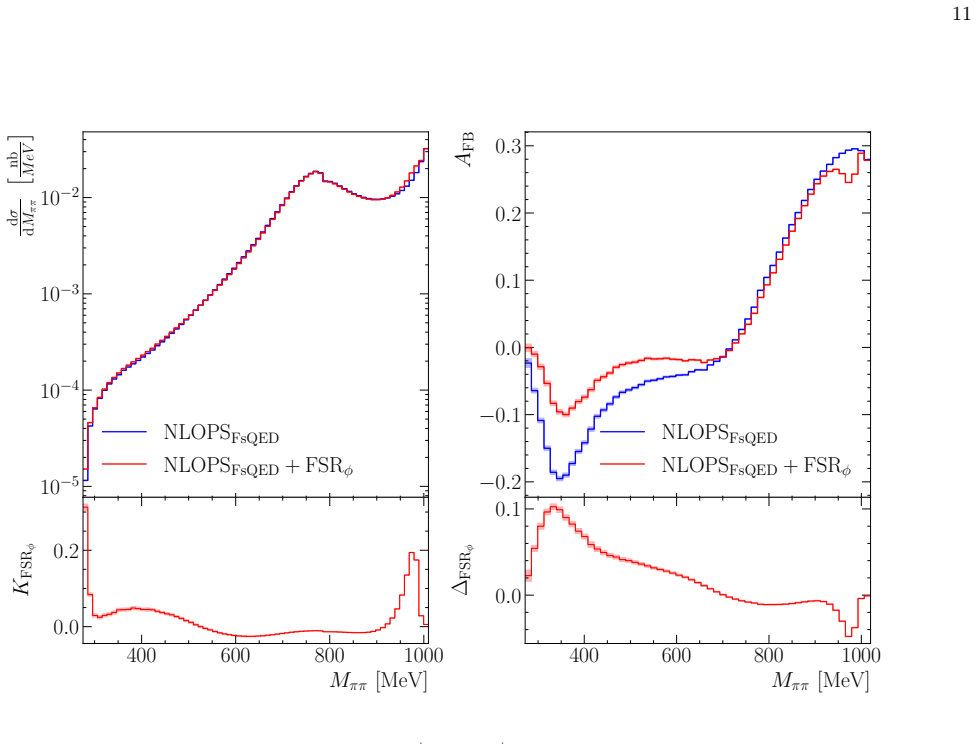
Next-to-leading-order structure-dependent corrections to e+e− → π+π−γ, obtained by inserting the pion form factor into virtual final-state and interference amplitudes via FsQED, affect the invariant-mass distribution at the few-permille level and angular distributions including the forward-backward asymmetry at the percent level across KLOE, BESIII and B-factory selections, and agree with the generalised vector-meson-dominance treatment at the 10−4 level on the asymmetry.
What carries the argument
FsQED: a once-subtracted dispersive representation of the pion form factor is inserted into one-loop FSR and initial-final interference integrals, so structure dependence lives inside the loops and infrared cancellations are preserved after an add-and-subtract treatment of end-point singularities.
Load-bearing premise
That the charged-pion-pole insertion already captures the leading piece of the still-unknown full dispersive description of the two-virtual-photon to pion-pair-plus-photon kernel.
What would settle it
A complete dispersive evaluation of the γ*γ* → π+π−γ kernel, or a sub-percent measurement of the forward-backward asymmetry near the ρ peak that disagrees with the predicted percent-level structure-dependent shift under KLOE large-angle cuts.
If this is right
- Sub-percent radiative-return extractions of the pion form factor must include structure-dependent NLO corrections or assign a systematic of comparable size.
- Modelling uncertainty from pion-photon interaction can be assessed by comparing FsQED and generalised vector-meson-dominance results inside the same generator.
- Near the φ, direct scalar-mediated radiative decays, double-resonance channels and chiral bremsstrahlung must be kept for accurate mass spectra and asymmetries at KLOE.
- Neutral pseudoscalar-pole additions beyond FsQED stay below the permille level in the scenarios studied and do not dominate the present theory uncertainty.
Where Pith is reading between the lines
- The close numerical agreement of two independent structure models on the asymmetry suggests the percent-level angular shift is largely stable against form-factor modelling at current targets.
- The same dispersive insertion applied to radiative kaon-pair production would give a parallel handle on hadronic-vacuum-polarisation systematics.
- If data confirm the predicted asymmetry correction, residual tension in the two-pion contribution to the muon anomaly would more cleanly point away from radiative-modelling error.
Editorial analysis
A structured set of objections, weighed in public.
Referee Report
Summary. The paper computes NLO structure-dependent (FsQED) corrections to e+e− → π+π−γ, embedding the dispersive pion form factor in the one-loop FSR and IFI amplitudes. The (1γ*) and (2γ*) topologies are treated separately: IR divergences are isolated analytically via add-and-subtract procedures (Eqs. 6–14), five-point functions are reduced to four- and lower-point functions, and the end-point singularities of the single-dispersive integrals are subtracted and integrated analytically. Beyond-FsQED neutral pseudoscalar poles (π0, η, η′) in the (2γ*,FSR) sector are estimated via VMD transition form factors, and additional FSR mechanisms relevant around the φ resonance (radiative φ decays through f0/σ, double-resonance processes, χPT bremsstrahlung) are implemented. Numerical results for KLOEI LA, KLOEII SA, BESIII and B-factory selections show few-permille effects on the dipion-mass spectrum and percent-level effects on angular distributions and A_FB, with FsQED–GVMD agreement at the 10^-4 level on A_FB. Everything is implemented in BabaYaga@NLO at NLOPS accuracy.
Significance. If the results hold, this is a directly useful contribution to the sub-percent program of pion form factor measurements underlying data-driven HVP evaluations for (g−2)_μ. It completes the FsQED treatment of radiative return (the last missing piece after [40] for energy scan), provides topology-resolved, falsifiable predictions for KLOE/BESIII/B-factory selections, quantifies the FsQED vs F×sQED modelling uncertainty on the very observables used to extract F_π, and delivers the first estimate of beyond-FsQED pseudoscalar-pole effects in the (2γ*,FSR) sector. The calculation carries meaningful verification: analytic isolation of all IR structures (including the end-point singularities of the five-point topologies, reduced via hexagon.m), an analytic treatment of the singular dispersive integrals, MC statistical bands on all results, and an independent-implementation cross-check against GVMD at the 10^-4 level on A_FB. Implementation in the public BabaYaga@NLO generator (with amplitudes promised for release) makes the work reproducible and usable by experiments. The φ-resonance FSR study is additionally of direct use to KLOE.
major comments (3)
- [§II B / Eq. (7) and §IV A, Fig. 4] The FsQED insertion in the (2γ*,FSR) sector is, as the authors themselves state, the charged-pion-pole approximation to a γ*γ*→π+π−γ kernel whose full dispersive representation is not known. This is directly load-bearing: Fig. 4 (KLOEI LA panel) shows K^(2γ*,FSR)_FsQED comparable in size to the other topologies, so the quoted few-permille K^full_FsQED in that scenario inherits an unquantified model dependence. The pseudoscalar-pole estimate of Sec. II B is a useful first step but is not a bound on the omitted ππ rescattering continuum or on additional tensor structures of Eq. (18). The paper should (i) state explicitly, in Sec. IV A and in the conclusions, that K^(2γ*,FSR) and hence K^full carry an uncontrolled contribution from the missing continuum, and (ii) give a simple quantification, e.g. the size of K^(2γ*,FSR) itself in each scenario, so the reader can read off the potential scal
- [§IV A, paragraph following Eq. (25)] The claim that neutral pseudoscalar-pole contributions 'remain below the permille level in all considered scenarios' is central to the argument that the FsQED-plus-pole treatment is adequate for sub-percent analyses, yet no number or figure is shown: there is no table of the maximal |K| from the P = π0, η, η' poles per observable and per scenario, and no error estimate attached to the VMD TFF and the couplings |g_ρππ|≃6, |g_ργ|≃5 (Eqs. 15–16). Please provide a small table (or an additional panel) with these numbers, including a variation of the TFF normalisations/couplings within their uncertainties, since the helicity-suppression argument given does not by itself quantify the t/u-channel ρ-enhanced pieces.
- [§IV A, Fig. 6 and concluding remarks] The 10^-4 FsQED–GVMD agreement on A_FB is described as occurring 'despite being based on completely different methodologies and pion form factor parameterisations'. This overstates the independence: both calculations use data-driven F_π fits dominated by the same six-resonance content (ρ,ω,ϕ,ρ′,ρ′′,ρ′′′), and [54] is by the same group. A genuinely external benchmark exists in the independent GVMD calculation of [53]; a quantitative comparison with [53] (even at a few phase-space points) would substantially strengthen the cross-validation claim and should either be added or the wording moderated.
minor comments (7)
- [§II, opening paragraph] 'will be made publicly available ... on GitHub/github' — the duplicated word and, more importantly, the deferral to a 'future public release' weaken the reproducibility claim. Given that the amplitudes were derived with the FeynRules→FeynArts→FeynCalc chain, including them (or at least the subtracted kernels of Eqs. 9–14) with this submission would be preferable.
- [§III, first paragraph] Broken sentence: 'these additional contributions to do not contribute to the definition of pion form factor' — please rephrase.
- [Eq. (6)] In the double-dispersive term of Eq. (6) the prescription appears as 's′′ − s′ − iε′′ + iε′'; the origin and sign convention of the two distinct iε's is not explained. A brief remark (or reference to [40]) would help.
- [§IV B, Eq. (26)] The simplified selection of Eq. (26) is said to be 'relevant for the KLOE experiment', but KLOE analyses use specific fiducial cuts (cf. the KLOEI/KLOEII scenarios of [33,36]). Please comment on how representative Eq. (26) is, and note the small inconsistency that the KLOE scenarios of Sec. IV use √s = 1.02 GeV while Sec. IV B uses √s = m_ϕ.
- [§IV B / Fig. 7] The f_0 and σ parameters of [82] and the χPT bremsstrahlung input of [79] are adopted without any uncertainty discussion, yet Fig. 7 shows several-percent effects near 980 MeV. One sentence on the parametric uncertainty of the FSR_φ contribution (or a reference where it is quantified) is needed.
- [References, [59]] Reference [59] is listed as 'unpublished (2026)'. Since the beyond-FsQED implementation depends on it, please make the needed formulas (Eqs. 15–16) fully self-contained or point to an accessible source.
- [various] Typos/grammar: 'in all experimental setup' → 'setups' (Conclusions); 'the two model' → 'the two models' (§I); 'Actual correction reaches up to ∼0.6%' in §IV B — specify relative to what (NLOPS ππ cross section, per Fig. 8, presumably).
Circularity Check
No significant circularity: FsQED NLO shifts are a genuine loop computation given external form-factor and resonance inputs
full rationale
The central claim is the numerical size of structure-dependent NLO corrections to e+e−→π+π−γ relative to F×sQED (and their comparison to GVMD). The pion form factor enters as an external dispersive input (Eq. 1, taken from the literature [33]); real corrections coincide with F×sQED by Fπ(0)=1; virtual structure dependence is obtained by inserting that form factor into one-loop kernels and performing the stated IR-regularized single- and double-dispersive integrals (Eqs. 6–13). That is a computation, not a tautology. Neutral pseudoscalar-pole and φ-region FSR pieces are likewise built from external VMD/χPT/resonance models cited from the literature, not fitted to the observables being reported. Self-citations to the group’s energy-scan and GVMD papers supply methodology continuity and a cross-check (AFB agreement at 10−4), but do not define or force the FsQED result. Concerns about whether charged-pion-pole FsQED adequately approximates the unknown full γ*γ*→π+π−γ kernel are assumption/correctness issues, not circularity. No step reduces a claimed prediction to its inputs by construction.
Axiom & Free-Parameter Ledger
free parameters (4)
- Pion form factor Fπ(q²) parametrisation (six resonances) =
external fit (Ref. [33] / [54])
- g_ρππ ≃ 6 and g_ργ ≃ 5 =
|g_ρππ|≃6, |g_ργ|≃5
- Scalar/vector resonance parameters in φ-region FSR (f0, σ, ρ±, ω', …) =
literature values (Achasov/Kiselev, Dubinsky et al., Pancheri et al.)
- F_Pγγ normalisations for π⁰, η, η' =
standard PDG/dispersive values [75,76]
axioms (6)
- domain assumption Once-subtracted dispersion relation for Fπ(q²) with Fπ(0)=1 and the sum rule that enforces Fπ(s)→0 as s←∞ (Eqs. 1–2).
- domain assumption Elastic unitarity is sufficient for the imaginary part of Fπ that enters the loop integrals.
- standard math On-shell renormalisation scheme for the virtual amplitudes, with IR regulator λ (fictitious photon mass).
- ad hoc to paper FsQED insertion of Fπ at photon virtualities is the leading (charged-pion-pole) approximation to the unknown full dispersive γ*γ*→π+π−γ kernel.
- domain assumption VMD model for Pγ*γ* transition form factors and amputation prescription (Eq. 16) for neutral pseudoscalar poles.
- domain assumption Lorentz- and gauge-invariant FSR tensor decomposition M^μν = −ie² Σ f_i τ_i^μν with f_i = f_i^V + f_i^S + f_i^Br (Eqs. 18–19).
read the original abstract
We compute the next-to-leading order corrections to the radiative return process $e^+ e^- \to \pi^+ \pi^- \gamma$ within the FsQED approach to embed the pion form factor in the calculation of loop integrals. We compare our results with those of the factorised scalar QED approach, as well as with previous predictions obtained by us in the generalised vector meson dominance model. We show the numerical impact of the structure-dependent corrections on various observables of interest for radiative return experiments at flavour factories. Following recent input from the literature, we include in our calculation also leading corrections beyond FsQED and we provide a first estimate of such contributions. We also investigate additional mechanisms contributing to final-state radiation at center-of-mass energies around the $\phi$-meson resonance, such as radiative $\phi$ decays, presenting numerical results that are relevant for the KLOE experiment. These novel features are implemented in the Monte Carlo event generator BabaYaga@NLO, which can now be used to evaluate the impact of the modelling of pion-photon interaction in radiative return measurements.
Figures



Reference graph
Works this paper leans on
-
[1]
Jegerlehner, The Anomalous Magnetic Moment of the Muon, Springer Tracts Mod
F. Jegerlehner, The Anomalous Magnetic Moment of the Muon, Springer Tracts Mod. Phys.274, 1 (2017)
2017
-
[2]
= lim q2 1 →M 2ρ FP γ∗γ∗ (q2 1, q2
-
[3]
Beyond the Standard Model dis- covery and Standard Model precision at LHC Run III
gργ eM 2ρ (q2 1−M 2 ρ ),(16) whereeis the electric charge and|g ργ| ≃5[77]. 6 = P P P FIG. 3. Representation of(2γ∗,FSR)contribution as given by the sum of the charged pion pole, where the shaded blob is the pion form factorFπ(q2), and the additional contributions are given by theP=π0, η, η′ pole in the HLbL, where the blue blob representsF P γ∗γ∗ (q2 1, ...
2022
-
[4]
G. Colangelo, M. Hoferichter, and P. Stoffer, Two-pion contribution to hadronic vacuum polarization, JHEP02, 006, arXiv:1810.00007 [hep-ph]
-
[5]
A. Keshavarzi, D. Nomura, and T. Teubner,g−2 of charged leptons,α(M 2 Z ), and the hyperfine split- ting of muonium, Phys. Rev. D101, 014029 (2020), arXiv:1911.00367 [hep-ph]
Pith/arXiv arXiv 2020
-
[6]
M.Benayoun, L.Delbuono,andF.Jegerlehner,BHLS 2, a New Breaking of the HLS Model and its Phenomenology, Eur. Phys. J. C80, 81 (2020), [Erratum: Eur.Phys.J.C 80, 244 (2020)], arXiv:1903.11034 [hep-ph]
Pith/arXiv arXiv 2020
-
[7]
M. Davier, A. Hoecker, B. Malaescu, and Z. Zhang, A new evaluation of the hadronic vacuum polarisation con- tributions to the muon anomalous magnetic moment and toα(m 2 Z ), Eur. Phys. J. C80, 241 (2020), [Erratum: Eur.Phys.J.C 80, 410 (2020)], arXiv:1908.00921 [hep-ph]
Pith/arXiv arXiv 2020
-
[8]
Aoyamaet al., The anomalous magnetic moment of the muon in the Standard Model, Phys
T. Aoyamaet al., The anomalous magnetic moment of the muon in the Standard Model, Phys. Rept.887, 1 (2020), arXiv:2006.04822 [hep-ph]
Pith/arXiv arXiv 2020
-
[9]
A. Keshavarzi, D. Nomura, T. Teubner, and A. Wright, Muon g-2: Blinding for data-driven hadronic vac- uum polarization, Phys. Rev. D111, L011901 (2025), arXiv:2409.02827 [hep-ph]
Pith/arXiv arXiv 2025
-
[10]
Alibertiet al., The anomalous magnetic moment of 13 the muon in the Standard Model: an update, Phys
R. Alibertiet al., The anomalous magnetic moment of 13 the muon in the Standard Model: an update, Phys. Rept. 1143, 1 (2025), arXiv:2505.21476 [hep-ph]
Pith/arXiv arXiv 2025
-
[11]
A. Keshavarzi, D. Nomura, T. Teubner, and A. Wright, Muong−2: correlation-induceduncertaintiesinprecision data combinations, (2026), arXiv:2604.25004 [hep-ph]
Pith/arXiv arXiv 2026
-
[12]
F. V. Ignatovet al.(CMD-3), Measurement of the e+e− →π +π− cross section from threshold to 1.2 GeV with the CMD-3 detector, Phys. Rev. D109, 112002 (2024), arXiv:2302.08834 [hep-ex]
arXiv 2024
-
[13]
F. V. Ignatovet al.(CMD-3), Measurement of the Pion Form Factor with CMD-3 Detector and its Implication to the Hadronic Contribution to Muon(g−2), Phys. Rev. Lett.132, 231903 (2024), arXiv:2309.12910 [hep-ex]
arXiv 2024
-
[14]
M. N. Achasovet al., Update of thee+e− →π +π− cross- section measured by SND detector in the energy region 400 MeV< √s <1000 MeV, J. Exp. Theor. Phys.103, 380 (2006), arXiv:hep-ex/0605013
Pith/arXiv arXiv 2006
-
[15]
M. N. Achasovet al.(SND), Measurement of thee+e− → π+π− process cross section with the SND detector at the VEPP-2000 collider in the energy region0.525< √s < 0.883GeV, JHEP01, 113, arXiv:2004.00263 [hep-ex]
Pith/arXiv arXiv 2000
-
[16]
R. R. Akhmetshinet al.(CMD-2), Measurement of e+e− →π +π− cross-section with CMD-2 aroundρ meson, Phys. Lett. B527, 161 (2002), arXiv:hep- ex/0112031
arXiv 2002
-
[17]
V. M. Aulchenkoet al.(CMD-2), Measurement of the pion form-factor in the range 1.04-GeV to 1.38-GeV with the CMD-2 detector, JETP Lett.82, 743 (2005), arXiv:hep-ex/0603021
Pith/arXiv arXiv 2005
-
[18]
R. R. Akhmetshinet al.(CMD-2), High-statistics mea- surement of the pion form factor in the rho-meson energy range with the CMD-2 detector, Phys. Lett. B648, 28 (2007), arXiv:hep-ex/0610021
Pith/arXiv arXiv 2007
-
[19]
Biselloet al., The pion electromagnetic form factor in the time-like energy range1.35≤ √s≤2.4GeV, Physics Letters B220, 321 (1989)
D. Biselloet al., The pion electromagnetic form factor in the time-like energy range1.35≤ √s≤2.4GeV, Physics Letters B220, 321 (1989)
1989
-
[20]
J. P. Leeset al.(BaBar), Precise Measurement of the e+e− →π +π−(γ)Cross Section with the Initial-State Radiation Method at BABAR, Phys. Rev. D86, 032013 (2012), arXiv:1205.2228 [hep-ex]
Pith/arXiv arXiv 2012
-
[21]
M. Ablikimet al.(BESIII), Measurement of thee+e− → π+π− cross section between 600 and 900 MeV using ini- tial state radiation, Phys. Lett. B753, 629 (2016), [Erra- tum: Phys.Lett.B 812, 135982 (2021)], arXiv:1507.08188 [hep-ex]
arXiv 2016
-
[22]
A. Aloisioet al.(KLOE), Measurement ofσ(e +e− → π+π−γ) and extraction ofσ(e +e− →π +π−) below 1- GeV with the KLOE detector, Phys. Lett. B606, 12 (2005), arXiv:hep-ex/0407048
Pith/arXiv arXiv 2005
-
[23]
F. Ambrosinoet al.(KLOE), Measurement ofσ(e+e− → π+π−γ(γ))and the dipion contribution to the muon anomaly with the KLOE detector, Phys. Lett. B670, 285 (2009), arXiv:0809.3950 [hep-ex]
Pith/arXiv arXiv 2009
-
[24]
F. Ambrosinoet al.(KLOE), Measurement ofσ(e+e− → π+π−)from threshold to 0.85 GeV2 using Initial State Radiation with the KLOE detector, Phys. Lett. B700, 102 (2011), arXiv:1006.5313 [hep-ex]
Pith/arXiv arXiv 2011
-
[25]
D. Babusciet al.(KLOE), Precision measurement of σ(e+e− →π +π−γ)/σ(e +e− →µ +µ−γ)and determi- nation of theπ +π− contribution to the muon anomaly with the KLOE detector, Phys. Lett. B720, 336 (2013), arXiv:1212.4524 [hep-ex]
Pith/arXiv arXiv 2013
-
[26]
A. Anastasiet al.(KLOE-2), Measurement of the run- ning of the fine structure constant below 1 GeV with the KLOE Detector, Phys. Lett. B767, 485 (2017), arXiv:1609.06631 [hep-ex]
Pith/arXiv arXiv 2017
-
[27]
A. Anastasiet al.(KLOE-2), Combination of KLOE σ e+e− →π +π−γ(γ) measurements and determination ofa π+π− µ in the energy range0.10< s <0.95GeV 2, JHEP03, 173, arXiv:1711.03085 [hep-ex]
-
[28]
D. P. Aguillardet al.(Muon g-2), Measurement of the Positive Muon Anomalous Magnetic Moment to 127 ppb, Phys. Rev. Lett.135, 101802 (2025), arXiv:2506.03069 [hep-ex]
arXiv 2025
-
[29]
A. Kupich,Recent results from the SND experiment at the VEPP-2000 collider,14th edition of the International Workshop one+e− collisions from Phi to Psi, Pisa, Italy (2026), slides available online
2000
-
[30]
Liu,e +e→π+π−(γ)measurement at Belle II, Talk at theMuong−2TheoryInitiativeworkshop, Orsay, France (2025), slides available online
Q. Liu,e +e→π+π−(γ)measurement at Belle II, Talk at theMuong−2TheoryInitiativeworkshop, Orsay, France (2025), slides available online
2025
-
[31]
Cotrozzi,Updates from the KLOEe+e→π+π−γanal- ysis, Talk at the Muong−2Theory Initiative workshop, Orsay, France (2025), slides available online
L. Cotrozzi,Updates from the KLOEe+e→π+π−γanal- ysis, Talk at the Muong−2Theory Initiative workshop, Orsay, France (2025), slides available online
2025
-
[32]
Denig,Status of R measurements at low-energye+e− colliders, Talk at the Muong−2Theory Initiative work- shop, Orsay, France (2025), slides available online
A. Denig,Status of R measurements at low-energye+e− colliders, Talk at the Muong−2Theory Initiative work- shop, Orsay, France (2025), slides available online
2025
-
[33]
Z. Zhang, Review of hadronic vacuum polarization cal- culations viae+e− measurements, inLP2025 Proceedings (2026) arXiv:2601.11966 [hep-ex]
arXiv 2026
-
[34]
L. Polat, New precise measurement of the e+e− →π +π−(γ)cross section with BABAR (2026) arXiv:2601.16587 [hep-ex]
arXiv 2026
-
[35]
R. Alibertiet al., Radiative corrections and Monte Carlo tools for low-energy hadronic cross sections ine +e− collisions, SciPost Phys. Comm. Rep. , Sep. (2025), arXiv:2410.22882 [hep-ph]
Pith/arXiv arXiv 2025
-
[36]
P. Banerjee, T. Engel, A. Signer, and Y. Ulrich, QED at NNLO with McMule, SciPost Phys.9, 027 (2020), arXiv:2007.01654 [hep-ph]
Pith/arXiv arXiv 2020
-
[37]
E. Budassi, C. M. Carloni Calame, M. Ghilardi, A. Gur- gone, G. Montagna, M. Moretti, O. Nicrosini, F. Pic- cinini, and F. P. Ucci, Pion pair production ine +e− annihilation at next-to-leading order matched to Parton Shower, JHEP05, 196, arXiv:2409.03469 [hep-ph]
-
[38]
E. Budassi, C. M. Carloni Calame, M. Ghilardi, A. Gur- gone, G. Montagna, M. Moretti, O. Nicrosini, F. Pic- cinini, and F. P. Ucci, Radiative return at NLOPS accu- racy, JHEP05, 221, arXiv:2601.19530 [hep-ph]
-
[39]
Bothmannet al.(Sherpa), Event generation with Sherpa 3, JHEP12, 156, arXiv:2410.22148 [hep-ph]
E. Bothmannet al.(Sherpa), Event generation with Sherpa 3, JHEP12, 156, arXiv:2410.22148 [hep-ph]
-
[40]
A. Price and F. Krauss, Toward a fully automated dif- ferential NNLOEW generator for lepton colliders, Phys. Rev. D113, 073008 (2026), arXiv:2512.04959 [hep-ph]
Pith/arXiv arXiv 2026
-
[41]
F. Ignatov and R. N. Lee, Charge asymmetry ine+e− → π+π− process, Phys. Lett. B833, 137283 (2022), arXiv:2204.12235 [hep-ph]
Pith/arXiv arXiv 2022
-
[42]
G. Colangelo, M. Hoferichter, J. Monnard, and J. R. de Elvira, Radiative corrections to the forward-backward asymmetry ine +e− →π +π−, JHEP08, 295, [Erratum: JHEP 09, 177 (2024)], arXiv:2207.03495 [hep-ph]
Pith/arXiv arXiv 2024
-
[43]
Gurgone,High-precision theoretical predictions for particle physics at the intensity frontier, Ph.D
A. Gurgone,High-precision theoretical predictions for particle physics at the intensity frontier, Ph.D. thesis, Pavia U. (2025)
2025
-
[44]
Y. Fang, S. Kollatzsch, M. Rocco, A. Signer, Y. Ulrich, and M. Zoller, Disperon QED, SciPost Phys.20, 116 (2026), arXiv:2512.10709 [hep-ph]. 14
Pith/arXiv arXiv 2026
-
[45]
G. Colangelo, M. Cottini, M. Hoferichter, and S. Holz, Radiative corrections toτ→ππν τ, JHEP02, 181, arXiv:2511.07507 [hep-ph]
-
[46]
Monnard,Radiative corrections for the two-pion con- tribution to the hadronic vacuum polarization contribu- tion to the muon g-2, Ph.D
J. Monnard,Radiative corrections for the two-pion con- tribution to the hadronic vacuum polarization contribu- tion to the muon g-2, Ph.D. thesis, Bern U. (2021)
2021
-
[47]
F. V. Flores-Baez, G. L. Castro, and G. Toledo, Beyond scalar QED radiative corrections: Theρ ± −ρ 0 width difference, final state radiation corrections, and their im- pact on∆a HVP,LO µ [τ], Phys. Rev. D113, 093002 (2026), arXiv:2510.02723 [hep-ph]
Pith/arXiv arXiv 2026
-
[48]
G. Rodrigo, A. Gehrmann-De Ridder, M. Guilleaume, and J. H. Kuhn, NLO QED corrections to ISR in e+e− annihilation and the measurement ofσ(e +e− → hadrons)using tagged photons, Eur. Phys. J. C22, 81 (2001), arXiv:hep-ph/0106132
Pith/arXiv arXiv 2001
-
[49]
G. Rodrigo, H. Czyz, J. H. Kuhn, and M. Szopa, Radia- tive return at NLO and the measurement of the hadronic cross-section in electron positron annihilation, Eur. Phys. J. C24, 71 (2002), arXiv:hep-ph/0112184
Pith/arXiv arXiv 2002
-
[50]
J. H. Kuhn and G. Rodrigo, The Radiative return at small angles: Virtual corrections, Eur. Phys. J. C25, 215 (2002), arXiv:hep-ph/0204283
Pith/arXiv arXiv 2002
-
[51]
H. Czyz, A. Grzelinska, J. H. Kuhn, and G. Rodrigo, The radiative return atϕandBfactories: small angle photon emission at next-to-leading order, Eur. Phys. J. C27, 563 (2003), arXiv:hep-ph/0212225
Pith/arXiv arXiv 2003
-
[52]
H. Czyz, A. Grzelinska, J. H. Kuhn, and G. Rodrigo, The Radiative return atϕandBfactories: FSR at next-to- leading order, Eur. Phys. J. C33, 333 (2004), arXiv:hep- ph/0308312
arXiv 2004
-
[53]
F. Campanario, H. Czyż, J. Gluza, T. Jeliński, G. Ro- drigo, S. Tracz, and D. Zhuridov, Standard model radia- tive corrections in the pion form factor measurements do not explain thea µ anomaly, Phys. Rev. D100, 076004 (2019), arXiv:1903.10197 [hep-ph]
Pith/arXiv arXiv 2019
-
[54]
S. J. Tracz,Radiative corrections to hadrons-photons in- teractions, Ph.D. thesis, Silesia U. (2018)
2018
-
[55]
P. Petit Rosàs, O. Shekhovtsova, and W. J. Tor- res Bobadilla, Radiative return meets GVMD, (2026), arXiv:2603.13171 [hep-ph]
arXiv 2026
-
[56]
C.M.CarloniCalame, M.Ghilardi, A.Gurgone, G.Mon- tagna, M. Moretti, O. Nicrosini, F. Piccinini, and F. P. Ucci, Structure-dependent radiative corrections to e+e− →π +π−γin the GVMD approach, Phys. Lett. B 879, 140666 (2026), arXiv:2603.28621 [hep-ph]
Pith/arXiv arXiv 2026
-
[57]
A. B. Arbuzov, V. A. Astakhov, A. V. Fedorov, G. V. Fe- dotovich, E. A. Kuraev, and N. P. Merenkov, Radiative corrections for pion and kaon production ate+e− collid- ers of energies below 2-GeV, JHEP10, 006, arXiv:hep- ph/9703456
-
[58]
G. Balossini, C. M. Carloni Calame, G. Montagna, O.Nicrosini,andF.Piccinini,Matchingperturbativeand parton shower corrections to Bhabha process at flavour factories, Nucl. Phys.B758, 227 (2006), arXiv:hep- ph/0607181 [hep-ph]
arXiv 2006
-
[59]
G. Balossini, C. Bignamini, C. M. C. Calame, G. Mon- tagna, O. Nicrosini, and F. Piccinini, Photon pair pro- duction at flavour factories with per mille accuracy, Phys. Lett. B663, 209 (2008), arXiv:0801.3360 [hep-ph]
Pith/arXiv arXiv 2008
-
[60]
M. Hoferichter,Thoughts on rescattering corrections, Talk at the Workshop on Radiative Corrections and Monte Carlo Simulations at Electron–Positron Colliders, Turin, Italy (2026), slides available online
2026
-
[61]
Hoferichter,Towards mixed initial- and final-state corrections toe +e− →π +π−γbeyond scalar QED, un- published (2026)
M. Hoferichter,Towards mixed initial- and final-state corrections toe +e− →π +π−γbeyond scalar QED, un- published (2026)
2026
-
[62]
Alloul, N
A. Alloul, N. D. Christensen, C. Degrande, C. Duhr, and B. Fuks, Feynrules 2.0— a complete toolbox for tree-level phenomenology, Computer Physics Communi- cations185, 2250 (2014)
2014
-
[63]
T. Hahn and M. Perez-Victoria, Automatized one loop calculations in four-dimensions and D-dimensions, Comput. Phys. Commun.118, 153 (1999), arXiv:hep- ph/9807565 [hep-ph]
arXiv 1999
-
[64]
Hahn, Generating Feynman diagrams and amplitudes with FeynArts 3, Comput
T. Hahn, Generating Feynman diagrams and amplitudes with FeynArts 3, Comput. Phys. Commun.140, 418 (2001), arXiv:hep-ph/0012260
Pith/arXiv arXiv 2001
-
[65]
T. Hahn, Feynman Diagram Calculations with FeynArts, FormCalc, and LoopTools,Proceedings, 13th Interna- tional Workshop on Advanced computing and analysis techniques in physics research (ACAT2010): Jaipur, In- dia, February 22-27, 2010, PoSACA T2010, 078 (2010), arXiv:1006.2231 [hep-ph]
Pith/arXiv arXiv 2010
-
[66]
V. Shtabovenko, R. Mertig, and F. Orellana, New Devel- opments in FeynCalc 9.0, Comput. Phys. Commun.207, 432 (2016), arXiv:1601.01167 [hep-ph]
Pith/arXiv arXiv 2016
-
[67]
V. Shtabovenko, R. Mertig, and F. Orellana, FeynCalc 9.3: New features and improvements, Comput. Phys. Commun.256, 107478 (2020), arXiv:2001.04407 [hep- ph]
Pith/arXiv arXiv 2020
-
[68]
V. Shtabovenko, R. Mertig, and F. Orellana, Feyn- Calc 10: Do multiloop integrals dream of computer codes?, Comput. Phys. Commun.306, 109357 (2025), arXiv:2312.14089 [hep-ph]
Pith/arXiv arXiv 2025
-
[69]
T. Diakonidis, J. Fleischer, J. Gluza, K. Kajda, T. Rie- mann,andJ.B.Tausk,ACompletereductionofone-loop tensor 5 and 6-point integrals, Phys. Rev. D80, 036003 (2009), arXiv:0812.2134 [hep-ph]
Pith/arXiv arXiv 2009
-
[70]
G. Colangelo, M. Hoferichter, M. Procura, and P. Stoffer, Dispersive approach to hadronic light-by-light scattering, JHEP09, 091, arXiv:1402.7081 [hep-ph]
-
[71]
G. Colangelo, M. Hoferichter, M. Procura, and P. Stoffer, Dispersion relation for hadronic light-by-light scattering: theoretical foundations, JHEP09, 074, arXiv:1506.01386 [hep-ph]
-
[72]
Hoferichter,Rescattering corrections to the pion Compton scattering, Talk at the RadioMonteCarloLow 2 Working Group Meeting, Liverpool, UK (2025), slides available online
M. Hoferichter,Rescattering corrections to the pion Compton scattering, Talk at the RadioMonteCarloLow 2 Working Group Meeting, Liverpool, UK (2025), slides available online
2025
-
[73]
E. Lymperiadou,Dispersive description of new subpro- cesses for tensor-meson contribution to muong−2,14th edition of the International Workshop one+e− collisions from Phi to Psi, Pisa, Italy (2026), slides available online
2026
-
[74]
F. Klingl, N. Kaiser, and W. Weise, Effective Lagrangian approach to vector mesons, their structure and decays, Z. Phys. A356, 193 (1996), arXiv:hep-ph/9607431
Pith/arXiv arXiv 1996
-
[75]
M. Knecht and A. Nyffeler, Hadronic light by light cor- rections to the muon g-2: The Pion pole contribution, Phys. Rev. D65, 073034 (2002), arXiv:hep-ph/0111058
Pith/arXiv arXiv 2002
-
[76]
M. Hoferichter, B. Kubis, and M. Zanke, Radiative res- onance couplings inγπ→ππ, Phys. Rev. D96, 114016 (2017), arXiv:1710.00824 [hep-ph]
Pith/arXiv arXiv 2017
-
[77]
M. Hoferichter, B.-L. Hoid, B. Kubis, S. Leupold, and S. P. Schneider, Dispersion relation for hadronic light-by-light scattering: pion pole, JHEPOct., 141, arXiv:1808.04823 [hep-ph]
-
[78]
S. Holz, M. Hoferichter, B.-L. Hoid, and B. Kubis, Dis- 15 persion relation for hadronic light-by-light scattering:η andη ′ poles, JHEP04, 147, arXiv:2412.16281 [hep-ph]
-
[79]
M. Hoferichter, J. Ruiz de Elvira, B. Kubis, and U.-G. Meißner, Nucleon resonance parameters from Roy–Steinerequations,Phys.Lett.B853,138698(2024), arXiv:2312.15015 [hep-ph]
Pith/arXiv arXiv 2024
-
[80]
N. N. Achasov and V. V. Gubin, Interference in the re- actione +e− →γπ +π− and the final state interaction, Phys. Rev. D57, 1987 (1998), arXiv:hep-ph/9706363
Pith/arXiv arXiv 1987
discussion (0)
Sign in with ORCID, Apple, or X to comment. Anyone can read and Pith papers without signing in.