REVIEW 3 major objections 5 minor 79 references
On-shell 2+J o2 amplitudes isolate every left-hand cut from light-particle exchange, leaving one smooth real short-distance function.
Reviewed by Pith at T0; open to challenge. T0 means a machine referee read the full paper against a public rubric. the ladder, T0–T4 →
T0 review · grok-4.5
2026-07-31 09:09 UTC pith:YVWZAULH
load-bearing objection Solid formal merger of the authors’ 2+J→2 and OPE left-hand-cut frameworks; Eq. (101) is the real deliverable, but it still lacks the toy-model cross-check that secured the OPE-free predecessor. the 3 major comments →
Analytic decomposition of two-body electroweak processes with left-hand cuts
The pith
A machine-rendered reading of the paper's core claim, the machinery that carries it, and where it could break.
Core claim
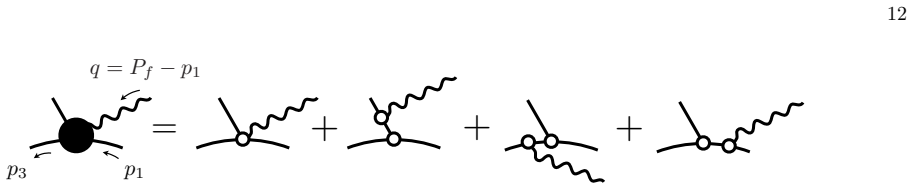
The fully connected 2+J o2 amplitude admits an on-shell representation in which the divergence-free piece is expressed solely through the purely hadronic amplitude (including its one-particle-exchange dressing), a new exchange-current kernel E^A, a finite set of triangle integrals, and one real smooth short-distance matrix A^A. All left-hand singularities generated by light-particle exchange are thereby isolated and removed from the unknown dynamical content.
What carries the argument
The exchange-current kernel E^A (single- and double-pole diagrams in which the current couples to the exchanged particle or to the exchange vertices) together with the dressed end-caps built from the hadronic one-particle-exchange amplitude; these objects allow every singular loop to be written as a three-dimensional integral that can be reduced to two dimensions.
Load-bearing premise
Everything is derived for spinless particles in a single elastic two-body channel with the current kept strictly at leading order; if spin or multi-channel dynamics introduce qualitatively new singular structures, the isolation claim no longer holds as written.
What would settle it
Compute the partial-wave projection of the double-pole exchange kernel for a toy mass spectrum that places the left-hand cut near threshold and verify that the only remaining non-analyticities match the Landau singularities predicted in the appendix; any extra singularity would falsify the completeness of the decomposition.
If this is right
- Form factors of near-threshold states controlled by one-pion exchange can be extracted once the smooth matrix A^A is fixed by lattice or data.
- The same skeleton expansion supplies the infinite-volume side of a future finite-volume matching formula for 2+J o2 matrix elements.
- Long-range contributions to processes such as deuteron photodisintegration or coherent neutrino-deuteron scattering become analytically controlled.
- Coupled-channel and spin extensions reduce to matrix enlargements of the same objects once the angular-momentum algebra is enlarged.
Where Pith is reading between the lines
- Once the finite-volume counterpart is written, lattice calculations of Tcc or deuteron electromagnetic radii become feasible without uncontrolled left-hand-cut systematics.
- The double-pole term in E^A is the relativistic analogue of the meson-exchange current familiar from nuclear physics; the decomposition therefore unifies lattice and effective-field-theory treatments of two-body currents.
- The reduction of all triangle integrals to two-dimensional numerical integrals opens a practical path to global fits of multi-hadron form factors below inelastic thresholds.
Editorial analysis
A structured set of objections, weighed in public.
Referee Report
Summary. The paper derives an on-shell representation of the fully connected 2+J→2 electroweak amplitude for spinless two-hadron states in the presence of one-particle t/u-channel exchange (e.g. OPE). Working at leading order in the current and to all orders in the strong interaction, the authors merge the OPE-free 2+J→2 formalism of Ref. [19] with the left-hand-cut 2→2 formalism of Ref. [47]. The main result, Eq. (101), decomposes W^A_df into (i) an exchange-current piece W^A_E built from a new kernel E^A containing single- and double-pole diagrams, (ii) four classes of triangle functions (G^A_0, G^A_R, G^A_L, G^A_E) with their endcap dressings, and (iii) a residual short-distance matrix A^A claimed to be real and smooth in the stated kinematic region. Appendix A analyzes the partial-wave-projected singularities of E^A via Landau conditions and cross-checks analytic S-wave projections against numerical integration (Figs. 8–9).
Significance. If correct, this closes a real gap: no existing formalism treats 2+J→2 amplitudes when left-hand cuts lie near or under the region of interest, which is precisely the situation for T_cc, the deuteron, and related near-threshold systems. Strengths deserving explicit note: the construction is parameter-free — every object in Eq. (101) except A^A is fixed by on-shell sub-processes; the only integral equation to solve is the 1D partial-wave-projected Eq. (30), with all remaining quantities reduced to 3D (and, via the azimuthal reduction of Sec. IV.C, 2D) integrals; and the partial-wave projection of the new E^A kernel is obtained analytically and verified numerically (Figs. 8–9). The paper also provides a concrete input list for a future T_cc application (Sec. II.1). These are the properties that make the result usable rather than merely formal.
major comments (3)
- [Sec. IV.B, Eq. (101)] The final assembly (Eq. 101, built from Eqs. 88–100) recombines four triangle classes and three endcap-dressed exchange terms with specific relative signs and dressing assignments (e.g. the minus sign on G^A_{EC,j} in Eq. 98, and the [f·iĜ^A_R]−W^A_R vs. [f·iĜ^A_L]−W^A_L pairing in Eq. 101). This assembly is verified only by the internal logic of the derivation. Unlike the OPE-free predecessor, which was checked against solvable models in Refs. [40, 41], no independent cross-check is given. A misassigned sign or endcap would leave A^A formally smooth but wrong. A tractable concrete test: expand both sides of Eq. (101) to first order in E and E^A and compare against a direct skeleton/Feynman-diagram evaluation of W^A_df at that order. I would like the authors to either supply such a check or state explicitly what has and has not been verified.
- [Sec. IV.D / Appendix A] Sec. IV.D and App. A identify endpoint singularities for γ>1 with leading behavior √δ log δ (Eq. A79) when one channel is above and the other below threshold, plus 'further regions of non-analytic behavior' deferred to the appendix (visible as yellow contours in Fig. 8). The central claim is that A^A is real and smooth in the whole stated kinematic region. The manuscript should state explicitly whether these non-analytic structures lie inside or outside the region of validity, and confirm that they are entirely carried by W^A_E and the triangle functions rather than leaking into A^A. As written, the smoothness claim is asserted for A^A but the singularity inventory in Sec. IV.D is presented without an explicit one-to-one assignment to terms in Eq. (101).
- [Sec. IV.A.2, Eqs. (82)–(83)] The 3D triangle function G^A_{0,j} (Eqs. 82–83) differs from the 4D G^A_j of Ref. [19] (Eq. 42) by a smooth function, with the difference 'absorbed into the definition of A^A' (text below Eq. 83). This means A^A of the present paper is not the same function as A^A in the E→0 limit of Ref. [19], even though Eq. (72)/(87) recover the old structure. Since eventual EFT matching of one- and two-body currents (motivation given in the Introduction) depends on the precise definition of A^A, the manuscript should state this scheme dependence explicitly in Sec. II and Sec. IV.B, not only in passing below Eq. (83).
minor comments (5)
- [Sec. II / Sec. IV.A.1] The endcaps êL and êR are introduced twice: Eqs. (6)–(7) in Sec. II and Eqs. (65)–(66) in Sec. IV. A cross-reference at the first occurrence would help the reader.
- [Sec. III.A] Typo below Eq. (26): 'as long as the cutoff is energy is much higher than all masses' — superfluous 'is'.
- [Sec. IV.D / Figs. 8–9] The notation switch between E^A_t (Eq. 48) and the figure labels E_t1a, E_t2 (Figs. 8–9, footnote 8) should be unified or a dictionary given; likewise Ĝ vs G hats/tildes in Eqs. (98)–(100) are dense and would benefit from a summary table of the four triangle classes and their dressings.
- [Eq. (50)] In Eq. (50), the third term on the right-hand side uses 'P−k' while the surrounding terms use P_i/P_f; please check for consistency of notation.
- [Sec. IV.C] The claim in Sec. IV.C that the azimuthal integral in Eq. (112) can be done analytically is illustrated only for rank-1 K^A_j with ℓ≤1; a remark on the general rank/ℓ case (or a reference) would strengthen the reduction claim.
Circularity Check
No circularity: Eq. (101) is an algebraic skeleton-expansion reorganization; A^A is the residual smooth piece by construction, not a fitted or self-predicted quantity.
full rationale
The paper presents a purely formal on-shell decomposition of the 2+J→2 amplitude in the presence of one-particle-exchange left-hand cuts. The central object A^A is defined as whatever remains after all identified singular pieces (threshold factors, triangle integrals, single- and double-pole exchange-current kernels E^A, and endcap dressings built from M_0 and M_E) have been isolated; it is not fitted to data and is not used to 'predict' any quantity that entered its definition. There are no empirical fits, no uniqueness theorems imported to forbid alternatives, and no renaming of a known empirical pattern. Self-citations to the authors' prior formalisms (OPE-free 2+J→2 and purely hadronic OPE) supply the starting skeleton expansions and notation; the present work re-derives the combined structure in Sec. IV rather than treating those citations as load-bearing black-box theorems that force the final formula. The smoothness of A^A below unaccounted-for thresholds is the intended output of the isolation procedure (standard for on-shell/K-matrix-style representations), not a circular claim that the inputs already contained the result. No circular step meets the quote-and-exhibit standard.
Axiom & Free-Parameter Ledger
axioms (5)
- domain assumption Hadronic interactions admit a Bethe–Salpeter skeleton expansion that can be reduced to 3D on-shell integrals with a real K-matrix / M_0 above the nearest unaccounted left-hand cut and below the first inelastic threshold.
- domain assumption The electroweak current is inserted only once (leading order in the external field); multi-current or strong corrections to the current vertex beyond the defined kernels are absorbed into smooth pieces.
- domain assumption Only the nearest one-particle t- and u-channel exchanges are kept explicit; two-particle exchange cuts and higher are outside the region of interest and absorbed into smooth kernels.
- ad hoc to paper The symmetric off-shell prescription for the OPE kernel E (Eq. 27) and its current-dressed analogue E^A (Eq. 50) correctly captures all on-shell singularities without introducing spurious poles.
- standard math Partial-wave projection and angular-momentum matrix algebra close for spinless particles; modified spherical harmonics remove threshold artifacts.
invented entities (3)
-
Exchange-current kernel E^A (double-pole + single-pole pieces built from w^A_e,on and h^A_on)
independent evidence
-
Short-distance two-body transition matrix A^A
no independent evidence
-
Four classes of triangle functions (G_0, G_R, G_L, G_E) and their endcap-dressed versions
independent evidence
read the original abstract
We derive an on-shell representation for electroweak $2+J\to2$ transition amplitudes involving two hadrons in both the initial and final state for systems where there are left-hand singularities generated by light-particle exchange, e.g. one-pion exchange. The derivation treats the insertion of the electroweak current perturbatively, keeping only the leading-order contribution in the external field, while the hadronic interactions are treated to all orders, including one-particle exchange effects. We find that, in such processes, the amplitude can have logarithmic singularities, as well as one-particle pole singularities, due to these exchanges. We isolate those contributions, as well as previously identified triangle singularities. The result is expressed in terms of the purely hadronic amplitude, exchange-current kernels, triangle functions, and a class of short-distance transition functions that are real and smooth below unaccounted-for thresholds. While we consider only transitions with spinless particles, this work is an important step toward constraining form factors of systems involving nucleons or vector mesons in the heavy quark sector, where the one-pion-exchange singularity is quite close to threshold.
Figures




Reference graph
Works this paper leans on
-
[1]
1 + ∞X n=0 [(i eB+iE)·i∆ 2 ·] niE ·i∆2 · # iW A df, /E A E=0
Analytic decomposition ofW A df,2B Let us start by taking a closer look atW A df,E A because it is the most distinct term from those considered in prior derivations. Its skeleton expansion takes the form iW A df,E A = 1 +iM ·i∆2 · iE A ·i∆ 2 ·iM+ 1 ,(53) Following the same steps presented in Ref. [47] for the purely hadronic amplitude with an OPE, reviewe...
-
[2]
triangle-type
Derivation ofW A df,1B Having considered the contributions due toE A and eBA insertions, we now turn our attention toW A df,1B . This comprises all diagrams in which the current attaches to one of the particles, which are not being exchanged, in a two-particle loop. We refer to these as “triangle-type” diagrams. Having already performed the reduction from...
2019
-
[3]
A. Rodas, J. J. Dudek, and R. G. Edwards (Hadron Spectrum), Phys. Rev. D109, 034513 (2024), arXiv:2304.03762 [hep-lat]
Pith/arXiv arXiv 2024
-
[4]
R. A. Briceno, J. J. Dudek, R. G. Edwards, and D. J. Wilson, Phys. Rev. D97, 054513 (2018), arXiv:1708.06667 [hep-lat]
Pith/arXiv arXiv 2018
-
[5]
J. J. Dudek, R. G. Edwards, and D. J. Wilson (Hadron Spectrum), Phys. Rev. D93, 094506 (2016), arXiv:1602.05122 [hep-ph]
Pith/arXiv arXiv 2016
-
[6]
A. J. Woss, J. J. Dudek, R. G. Edwards, C. E. Thomas, and D. J. Wilson (Hadron Spectrum), Phys. Rev. D103, 054502 (2021), arXiv:2009.10034 [hep-lat]
Pith/arXiv arXiv 2021
-
[7]
R. F. Lebed, R. E. Mitchell, and E. S. Swanson, Prog. Part. Nucl. Phys.93, 143 (2017), arXiv:1610.04528 [hep-ph]
Pith/arXiv arXiv 2017
-
[8]
N. Brambilla, S. Eidelman, C. Hanhart, A. Nefediev, C.-P. Shen, C. E. Thomas, A. Vairo, and C.-Z. Yuan, Phys. Rept. 873, 1 (2020), arXiv:1907.07583 [hep-ex]
Pith/arXiv arXiv 2020
-
[9]
A. Francis, Prog. Part. Nucl. Phys.140, 104143 (2025), arXiv:2502.04701 [hep-lat]
Pith/arXiv arXiv 2025
-
[10]
M. Padmanath and S. Prelovsek, Phys. Rev. Lett.129, 032002 (2022), arXiv:2202.10110 [hep-lat]
Pith/arXiv arXiv 2022
-
[11]
T. Whyte, D. J. Wilson, and C. E. Thomas (Hadron Spectrum), Phys. Rev. D111, 034511 (2025), arXiv:2405.15741 [hep-lat]
Pith/arXiv arXiv 2025
-
[12]
Y. Lyu, S. Aoki, T. Doi, T. Hatsuda, Y. Ikeda, and J. Meng, Phys. Rev. Lett.131, 161901 (2023), arXiv:2302.04505 [hep-lat]
Pith/arXiv arXiv 2023
-
[13]
N. Pitanga Lachini and R. A. Brice˜ no, (2026), arXiv:2607.19009 [hep-lat]
Pith/arXiv arXiv 2026
-
[14]
M. Nagatsuka and S. Sasaki, Phys. Rev. D112, 114510 (2025), arXiv:2507.20712 [hep-lat]
arXiv 2025
-
[15]
Aaijet al.(LHCb), Nature Commun.13, 3351 (2022), arXiv:2109.01056 [hep-ex]
R. Aaijet al.(LHCb), Nature Commun.13, 3351 (2022), arXiv:2109.01056 [hep-ex]
arXiv 2022
-
[16]
Aaijet al.(LHCb), Nature Phys.18, 751 (2022), arXiv:2109.01038 [hep-ex]
R. Aaijet al.(LHCb), Nature Phys.18, 751 (2022), arXiv:2109.01038 [hep-ex]
arXiv 2022
-
[17]
M. Abolnikov, V. Baru, E. Epelbaum, A. A. Filin, C. Hanhart, and L. Meng, Phys. Lett. B860, 139188 (2025), arXiv:2407.04649 [hep-ph]
Pith/arXiv arXiv 2025
-
[18]
I. Vujmilovic, S. Collins, L. Leskovec, and S. Prelovsek, (2025), arXiv:2510.17549 [hep-lat]
Pith/arXiv arXiv 2025
-
[19]
R. A. Brice˜ no and M. T. Hansen, Phys. Rev. D94, 013008 (2016), arXiv:1509.08507 [hep-lat]
Pith/arXiv arXiv 2016
-
[20]
A. Baroni, R. A. Brice˜ no, M. T. Hansen, and F. G. Ortega-Gama, Phys. Rev. D100, 034511 (2019), arXiv:1812.10504 [hep-lat]
Pith/arXiv arXiv 2019
-
[21]
R. A. Brice˜ no, A. W. Jackura, F. G. Ortega-Gama, and K. H. Sherman, Phys. Rev. D103, 114512 (2021), arXiv:2012.13338 [hep-lat]
Pith/arXiv arXiv 2021
-
[22]
D. C. Hackett, D. A. Pefkou, and P. E. Shanahan, Phys. Rev. Lett.132, 251904 (2024), arXiv:2310.08484 [hep-lat]
Pith/arXiv arXiv 2024
-
[23]
C. Egereret al.(HadStruc), Phys. Rev. D105, 034507 (2022), arXiv:2111.01808 [hep-lat]
Pith/arXiv arXiv 2022
-
[24]
H. Dutrieux, R. G. Edwards, C. Egerer, J. Karpie, C. Monahan, K. Orginos, A. Radyushkin, D. Richards, E. Romero, and S. Zafeiropoulos (HadStruc), JHEP08, 162 (2024), arXiv:2405.10304 [hep-lat]
Pith/arXiv arXiv 2024
-
[25]
H.-W. Lin, Phys. Lett. B824, 136821 (2022), arXiv:2112.07519 [hep-lat]
Pith/arXiv arXiv 2022
-
[26]
C. Alexandrouet al., Phys. Rev. D101, 034519 (2020), arXiv:1908.10706 [hep-lat]
Pith/arXiv arXiv 2020
-
[27]
S. Bhattacharya, K. Cichy, M. Constantinou, X. Gao, A. Metz, J. Miller, S. Mukherjee, P. Petreczky, F. Steffens, and Y. Zhao, Phys. Rev. D108, 014507 (2023), arXiv:2305.11117 [hep-lat]
Pith/arXiv arXiv 2023
-
[28]
S. Bhattacharya, K. Cichy, M. Constantinou, X. Gao, A. Metz, J. Miller, S. Mukherjee, P. Petreczky, F. Steffens, and Y. Zhao, JHEP01, 146 (2025), arXiv:2410.03539 [hep-lat]
Pith/arXiv arXiv 2025
-
[29]
M.-H. Chu, M. Cola¸ co, S. Bhattacharya, K. Cichy, M. Constantinou, A. Metz, and F. Steffens, Phys. Rev. D112, 094510 (2025), arXiv:2508.17998 [hep-lat]
Pith/arXiv arXiv 2025
-
[30]
L. Lellouch and M. Luscher, Commun. Math. Phys.219, 31 (2001), arXiv:hep-lat/0003023
Pith/arXiv arXiv 2001
-
[31]
N. H. Christ, C. Kim, and T. Yamazaki, Phys. Rev. D72, 114506 (2005), arXiv:hep-lat/0507009
Pith/arXiv arXiv 2005
-
[32]
R. A. Brice˜ no, M. T. Hansen, and A. Walker-Loud, Phys. Rev. D91, 034501 (2015), arXiv:1406.5965 [hep-lat]
Pith/arXiv arXiv 2015
-
[33]
R. A. Brice˜ no and M. T. Hansen, Phys. Rev. D92, 074509 (2015), arXiv:1502.04314 [hep-lat]
Pith/arXiv arXiv 2015
-
[34]
A. Agadjanov, V. Bernard, U.-G. Meißner, and A. Rusetsky, Nucl. Phys. B910, 387 (2016), arXiv:1605.03386 [hep-lat]
Pith/arXiv arXiv 2016
-
[35]
R. A. Brice˜ no, J. J. Dudek, R. G. Edwards, C. J. Shultz, C. E. Thomas, and D. J. Wilson, Phys. Rev. D93, 114508 (2016), [Erratum: Phys.Rev.D 105, 079902 (2022)], arXiv:1604.03530 [hep-ph]
Pith/arXiv arXiv 2016
-
[36]
C. Alexandrou, L. Leskovec, S. Meinel, J. Negele, S. Paul, M. Petschlies, A. Pochinsky, G. Rendon, and S. Syritsyn, Phys. Rev. D98, 074502 (2018), [Erratum: Phys.Rev.D 105, 019902 (2022)], arXiv:1807.08357 [hep-lat]. 25
Pith/arXiv arXiv 2018
-
[37]
X. Feng, S. Aoki, S. Hashimoto, and T. Kaneko, Phys. Rev. D91, 054504 (2015), arXiv:1412.6319 [hep-lat]
Pith/arXiv arXiv 2015
-
[38]
C. Andersen, J. Bulava, B. H¨ orz, and C. Morningstar, Nucl. Phys. B939, 145 (2019), arXiv:1808.05007 [hep-lat]
Pith/arXiv arXiv 2019
-
[39]
F. Erben, J. R. Green, D. Mohler, and H. Wittig, Phys. Rev. D101, 054504 (2020), arXiv:1910.01083 [hep-lat]
Pith/arXiv arXiv 2020
-
[40]
A. Radhakrishnan, J. J. Dudek, and R. G. Edwards (Hadron Spectrum), Phys. Rev. D106, 114513 (2022), arXiv:2208.13755 [hep-lat]
Pith/arXiv arXiv 2022
-
[41]
F. G. Ortega-Gama, J. J. Dudek, and R. G. Edwards (Hadron Spectrum), Phys. Rev. D110, 094505 (2024), arXiv:2407.20617 [hep-lat]
Pith/arXiv arXiv 2024
-
[42]
R. A. Brice˜ no, M. T. Hansen, and A. W. Jackura, Phys. Rev. D100, 114505 (2019), arXiv:1909.10357 [hep-lat]
Pith/arXiv arXiv 2019
-
[43]
R. A. Brice˜ no, M. T. Hansen, and A. W. Jackura, Phys. Rev. D101, 094508 (2020), arXiv:2002.00023 [hep-lat]
Pith/arXiv arXiv 2020
-
[44]
J. Moscoso, F. G. Ortega-Gama, R. A. Brice˜ no, A. W. Jackura, C. Kacir, and A. N. Nicholson, (2026), arXiv:2602.20373 [hep-lat]
arXiv 2026
-
[45]
Z.-Y. Wang, X. Feng, B.-H. Jian, L.-C. Jin, and C. Liu, (2026), arXiv:2603.09554 [hep-lat]
Pith/arXiv arXiv 2026
-
[46]
M.-L. Du, A. Filin, V. Baru, X.-K. Dong, E. Epelbaum, F.-K. Guo, C. Hanhart, A. Nefediev, J. Nieves, and Q. Wang, Phys. Rev. Lett.131, 131903 (2023), arXiv:2303.09441 [hep-ph]
Pith/arXiv arXiv 2023
-
[47]
J. R. Green, A. D. Hanlon, P. M. Junnarkar, and H. Wittig, Phys. Rev. Lett.127, 242003 (2021), arXiv:2103.01054 [hep-lat]
Pith/arXiv arXiv 2021
-
[48]
A. Bai˜ ao Raposo and M. T. Hansen, JHEP08, 075 (2024), arXiv:2311.18793 [hep-lat]
Pith/arXiv arXiv 2024
-
[49]
A. B. Raposo, R. A. Brice˜ no, M. T. Hansen, and A. W. Jackura, JHEP06, 186 (2025), arXiv:2502.19375 [hep-lat]
Pith/arXiv arXiv 2025
-
[50]
L. Meng, V. Baru, E. Epelbaum, A. A. Filin, and A. M. Gasparyan, Phys. Rev. D109, L071506 (2024), arXiv:2312.01930 [hep-lat]
Pith/arXiv arXiv 2024
-
[51]
R. Bubna, H.-W. Hammer, F. M¨ uller, J.-Y. Pang, A. Rusetsky, and J.-J. Wu, JHEP05, 168 (2024), arXiv:2402.12985 [hep-lat]
Pith/arXiv arXiv 2024
-
[52]
M. T. Hansen, F. Romero-L´ opez, and S. R. Sharpe, JHEP06, 051 (2024), arXiv:2401.06609 [hep-lat]
Pith/arXiv arXiv 2024
-
[53]
S. M. Dawid, A. W. Jackura, and A. P. Szczepaniak, Phys. Lett. B864, 139442 (2025), arXiv:2411.15730 [hep-lat]
Pith/arXiv arXiv 2025
- [54]
-
[55]
L. Meng, E. Ortiz-Pacheco, V. Baru, E. Epelbaum, M. Padmanath, and S. Prelovsek, Phys. Rev. D111, 034509 (2025), arXiv:2411.06266 [hep-lat]
Pith/arXiv arXiv 2025
-
[56]
S. M. Dawid, F. Romero-L´ opez, and S. R. Sharpe, JHEP01, 060 (2025), arXiv:2409.17059 [hep-lat]
Pith/arXiv arXiv 2025
-
[57]
M. Abolnikov, L. Meng, V. Baru, E. Epelbaum, A. A. Filin, and A. M. Gasparyan, (2026), arXiv:2602.02176 [hep-ph]
arXiv 2026
-
[58]
H. Alharazin, A. B. Raposo, J. Bulava, S. Dawid, J. R. Green, C. Morningstar, F. Romero-L´ opez, M. Salg, S. R. Sharpe, and A. Stump, in42th International Symposium on Lattice Field Theory(2026) arXiv:2602.17204 [hep-lat]
arXiv 2026
-
[59]
A. Rodas, L. Qiu, C. Fern´ andez-Ram ´ ırez, V. Mathieu, G. Monta˜ na, A. Pilloni, and A. P. Szczepaniak, (2026), arXiv:2605.22957 [hep-lat]
Pith/arXiv arXiv 2026
-
[60]
A. Nicholson, E. Berkowitz, C. C. Chang, M. A. Clark, B. Joo, T. Kurth, E. Rinaldi, B. Tiburzi, P. Vranas, and A. Walker-Loud, PoSLA TTICE2016, 017 (2016), arXiv:1608.04793 [hep-lat]
Pith/arXiv arXiv 2016
-
[61]
D. B. Kaplan, M. J. Savage, and M. B. Wise, Phys. Rev. C59, 617 (1999), arXiv:nucl-th/9804032
Pith/arXiv arXiv 1999
-
[62]
T.-S. Park, D.-P. Min, and M. Rho, Nucl. Phys. A596, 515 (1996), arXiv:nucl-th/9505017
Pith/arXiv arXiv 1996
-
[63]
S. Pastore, L. Girlanda, R. Schiavilla, and M. Viviani, Phys. Rev. C84, 024001 (2011), arXiv:1106.4539 [nucl-th]
Pith/arXiv arXiv 2011
-
[64]
S. Kolling, E. Epelbaum, H. Krebs, and U. G. Meissner, Phys. Rev. C84, 054008 (2011), arXiv:1107.0602 [nucl-th]
Pith/arXiv arXiv 2011
-
[65]
A. W. Jackura, R. A. Brice˜ no, S. M. Dawid, M. H. E. Islam, and C. McCarty, Phys. Rev. D104, 014507 (2021), arXiv:2010.09820 [hep-lat]
Pith/arXiv arXiv 2021
-
[66]
S. M. Dawid, M. H. E. Islam, and R. A. Brice˜ no, Phys. Rev. D108, 034016 (2023), arXiv:2303.04394 [nucl-th]
Pith/arXiv arXiv 2023
-
[67]
A. W. Jackura and R. A. Brice˜ no, Phys. Rev. D109, 096030 (2024), arXiv:2312.00625 [hep-ph]
Pith/arXiv arXiv 2024
-
[68]
V. Bernard, D. Hoja, U. G. Meissner, and A. Rusetsky, JHEP09, 023 (2012), arXiv:1205.4642 [hep-lat]
Pith/arXiv arXiv 2012
-
[69]
U.-G. Meißner, A. Rusetsky, A. S. Sakthivasan, G. Schierholz, and J.-J. Wu, JHEP06, 164 (2026), arXiv:2602.23044 [hep-lat]
Pith/arXiv arXiv 2026
-
[70]
Bulavaet al.(Baryon Scattering), Phys
J. Bulavaet al.(Baryon Scattering), Phys. Rev. C113, 024002 (2026), arXiv:2505.05547 [hep-lat]
arXiv 2026
-
[71]
B. H¨ orzet al., Phys. Rev. C103, 014003 (2021), arXiv:2009.11825 [hep-lat]
Pith/arXiv arXiv 2021
-
[72]
S. Amarasinghe, R. Baghdadi, Z. Davoudi, W. Detmold, M. Illa, A. Parreno, A. V. Pochinsky, P. E. Shanahan, and M. L. Wagman, Phys. Rev. D107, 094508 (2023), [Erratum: Phys.Rev.D 110, 119904 (2024)], arXiv:2108.10835 [hep-lat]
Pith/arXiv arXiv 2023
-
[73]
W. Detmold, M. Illa, W. I. Jay, A. Parre˜ no, R. J. Perry, P. E. Shanahan, and M. L. Wagman (NPLQCD), Phys. Rev. D 111, 114501 (2025), arXiv:2404.12039 [hep-lat]
Pith/arXiv arXiv 2025
-
[74]
qeFaSx5y5nmUhSDJgoCpOR9oLGI=
L. D. Landau, Zh. Eksp. Teor. Fiz.37, 62 (1960). 26 <latexit sha1_base64="qeFaSx5y5nmUhSDJgoCpOR9oLGI=">AAACCnicbVDLSsNAFJ34rPVVdelmsAiuSiJSuyy4cVnBPqBJy2Q6aYZOJmHmRgihf+AHuNVPcCdu/Qm/wN9w2mZhWw9cOJxzL+dy/ERwDbb9bW1sbm3v7Jb2yvsHh0fHlZPTjo5TRVmbxiJWPZ9oJrhkbeAgWC9RjES+YF1/cjfzu09MaR7LR8gS5kVkLHnAKQEjDVwIGZAhH7gaiBpWqnbNngOvE6cgVVSgNaz8uKOYphGTQAXRuu/YCXg5U...
1960
-
[75]
Kinematics As illustrated in Fig. 10, the four-momenta in the initial CMF are pµ⋆ 1,i = ω⋆ 1,i p⋆ i , p µ,⋆ 2,i = ω⋆ 2,i −p⋆ i ,(A1) wherep ⋆ i =q ⋆ i ˆ p⋆ i and ˆ p⋆ i = sinθ ⋆ i cosϕ ⋆ i sinθ ⋆ i sinϕ ⋆ i cosθ ⋆ i .(A2) The four-momenta in the final CM frame are pµ⋆ 3,f = ω⋆ 3,f p⋆ f , p µ,⋆ 4,f = ω⋆ 4,f −p⋆ f ,(A3) wherep ⋆ f =q ⋆ f ˆ p⋆ f and,...
-
[76]
Furthermore, we will assume that the current is a Lorentz scalar that does not introduce any angular dependence
Partial wave projection ofE t1 andE t2 In this section, we consider the simplest possible partial wave projection ofE A t1k, andE A t2, namely the case where both the initial and final states have been projected to an S-wave. Furthermore, we will assume that the current is a Lorentz scalar that does not introduce any angular dependence. This simple exampl...
-
[77]
That implies that the singularities in the scalar S-wave amplitude will in general also occur in other partial-wave projections and for currents with different Lorentz structures
Singularities Whenever poles of the integrand appear within the integration region, the amplitudes are dominated by the leading singular term, which is independent of the behavior of the integrand numerator as long as it is smooth and non-zero. That implies that the singularities in the scalar S-wave amplitude will in general also occur in other partial-w...
-
[78]
They need to vanish in the integration region, αkDk = 0 fork= 1,2,(A51) whereα k ≥0 is a real parameter
-
[79]
Note that our integrands are periodic in Φ such that there is no end-point condition in this variable
The resulting pole needs to get pinched by anintegration endpoint, in our case z⋆ i =±1, z⋆ f =±1, (A52) or in thebulk, X k αk∇(z⋆ i ,z⋆ f ,Φ)Dk =0.(A53) End-point and bulk pinches can in principle mix, for instance a zero of the denominator in some integration variable might get constrained by an endpoint and for other variables by a vanishing derivative...
discussion (0)
Sign in with ORCID, Apple, or X to comment. Anyone can read and Pith papers without signing in.