REVIEW 2 major objections 5 minor 1 cited by
Quantum fluctuation theorems for autonomous work keep an extra work-source term that noncommutativity will not let vanish.
Reviewed by Pith at T0; open to challenge. T0 means a machine referee read the full paper against a public rubric. the ladder, T0–T4 →
T0 review · grok-4.5
2026-07-31 07:47 UTC pith:PVMEZ7QI
load-bearing objection Clean quantum upgrade of the 2025 classical autonomous FTs; the inclusive/exclusive split on the nonautonomous limit is the real payload, though the obstruction claim stays qualitative. the 2 major comments →
Fluctuation theorems for autonomous work in the quantum regime
The pith
A machine-rendered reading of the paper's core claim, the machinery that carries it, and where it could break.
Core claim
Successive projective measurements of a work-source observable Â_R and of the conditional system Hamiltonian yield Jarzynski-type ⟨e^{-R}⟩_F = 1 and Crooks-type P_F(R)/P_B(-R) = e^R relations for autonomous inclusive work, with the stochastic quantity R = βw − βΔF_S + Δφ that explicitly includes the change in the source's measurement statistics. Quantum noncommutativity prevents these relations from reducing to ordinary non-autonomous fluctuation theorems even for large sources with negligible back-action; the exclusive-work version recovers that limit only when the measured source observable commutes with the bare source Hamiltonian.
What carries the argument
The three-term entropy-like quantity R[Γ] ≡ ln(P_F[Γ]/P_B[Γ̃]) = βw[Γ] − βΔF_S[Γ] + Δφ[Γ], obtained from joint projectors onto eigenstates of Â_R and of the conditional Hamiltonian Ĥ_S(a). Unitary reversibility plus an initially block-thermal state then imply the integral and detailed fluctuation theorems for R.
Load-bearing premise
The composite system must start in a mixed state that is already diagonal in the work-source observable, with each block a thermal state of the corresponding conditional system Hamiltonian; any initial coherence between source sectors is excluded by hand.
What would settle it
In the Dicke-model numerics (or an equivalent circuit-QED experiment), prepare a large atomic ensemble in a sharp eigenstate of J_x with vanishing back-action and check whether the measured distribution of J_x remains sharp; if it spreads, the third term Δφ cannot be dropped and the non-autonomous limit fails for inclusive work.
If this is right
- Thermodynamic accounting for fully quantum autonomous engines must retain an explicit contribution from the work source's measurement statistics.
- Inclusive and exclusive work definitions are no longer interchangeable once the work source is treated quantum-mechanically.
- The non-autonomous fluctuation theorems used in most quantum-thermodynamics literature are recovered only under extra commutativity assumptions that are not automatic.
- The same measurement scheme supplies an operational route to test autonomous fluctuation theorems in circuit-QED or trapped-ion platforms that realize Dicke-like couplings.
Where Pith is reading between the lines
- Any attempt to define a continuous-spectrum work source will require generalized measurements or quasiprobabilities, because the present projective construction assumes a discrete observable.
- If the initial block-diagonal assumption can be relaxed while still keeping a well-defined free energy, the three-term structure may survive for a broader class of autonomous devices.
- The obstruction identified here suggests that semiclassical mean-field driving is the only controlled way to recover ordinary work statistics from a quantum autonomous machine.
Editorial analysis
A structured set of objections, weighed in public.
Referee Report
Summary. The manuscript studies a time-independent composite of a work source R and a system S with coupling A_R⊗V_S. It introduces successive projective measurements of A_R and of the conditional system Hamiltonian H_S(a), assumes an initially block-diagonal state with thermal conditional system states, and defines R[Γ]=ln(P_F[Γ]/P_B[Γ̃])=βw[Γ]-βΔF_S[Γ]+Δφ[Γ]. From this it derives Jarzynski- and Crooks-type relations, generating-function symmetries, and a near-equilibrium fluctuation-dissipation relation. The Dicke model is used to verify the identities numerically. The paper further argues that, for inclusive work, [H_R^0,A_R]≠0 obstructs reduction to nonautonomous fluctuation theorems even when backaction is negligible, whereas exclusive work recovers the nonautonomous result when the measured source observable commutes with H_R^0 and backaction vanishes.
Significance. If the large-source obstruction is quantified as claimed, this is a useful quantum counterpart of recent fluctuation theorems for classical autonomous work. The construction is operational and parameter-free within its stated assumptions: the source entropy term is replaced by measured sector probabilities, the identities follow from unitary reversibility rather than fitting, and the inclusive/exclusive comparison is a clear conceptual contribution. The analytic Dicke-model treatment, direct Crooks-plot checks, truncation tests, and explicit semiclassical comparison are also valuable. The main caveat is that the results assume a discrete measured source observable and a block-thermal initial state, so the work is a well-scoped two-point-measurement theory rather than a treatment of arbitrary initial quantum coherence.
major comments (2)
- [Section IV, Fig. 3, and Appendix A3] The claim in the abstract and §IV that noncommutativity prevents a nonautonomous limit "even in the limit of a large work source" is not yet supported asymptotically. Appendix A3 estimates the mean backaction as δ_ba ~ λ²/(Nω_cω_z), and Fig. 3 shows broadening of p_j for one initial condition at N=400, but neither establishes the size of the residual Δφ contribution as N→∞ at δ_ba→0. Please define the large-source limit precisely (including how λ, T, and the initial state scale) and quantify a direct measure of the obstruction, for example |⟨e^{-β(w-ΔF_S)}⟩_F-1|, the total-variation error caused by omitting Δφ in Eq. (18), or the distance from the corresponding mean-field process. If this error vanishes, the abstract should distinguish an exact algebraic obstruction from a practically negligible one; if it remains finite, its scaling should be reported. There is also a wording issue: non
- [Appendix B, Eqs. (B1)-(B4), and Fig. 7] The derivation of the nonautonomous factorized limit drops δA_R⊗δV_S on the grounds that the system has little backaction on the work source. Weak backaction controls the effect of S on R, but it does not by itself imply that fluctuations of A_R, or system-source correlations relevant to S, are negligible; indeed §IV identifies precisely those A_R fluctuations as the obstruction. The conditions under which Var(A_R), the coupling normalization, and accumulated correlations make the omitted term negligible should be stated, ideally with an error bound for the trace distance used in Fig. 7(a). The single early-time numerical comparison does not establish the asymptotic limit. Otherwise Appendix B should be presented explicitly as an additional mean-field/factorization approximation rather than as the recovered large-source limit.
minor comments (5)
- [Eqs. (7), (11), and (15)-(20)] Since p_a is allowed to be arbitrary, zero weights can make R[Γ] undefined and can invalidate the negative powers of ρ_0^tr in Eqs. (19)-(20). Please state the required positivity or absolute-continuity/support condition on p_a and p_a^tr, and read Eq. (18) only on the common support of the forward and backward distributions.
- [Eq. (7) and footnote 48] Calling ρ_0 a "mixed thermal state" may suggest an ordinary global Gibbs state. Footnote 48 makes the actual assumption clear, but the main text should consistently call it block-diagonal and conditionally thermal, with no coherence between A_R sectors.
- [Appendix A2] In the J_x/Fock representation, complex conjugation K is a valid antiunitary symmetry of the real Hamiltonian and is sufficient for the Crooks construction. It is not, however, the physical spin time-reversal operation, which reverses J. Please clarify that K is a representation-dependent microreversibility symmetry and specify how the backward experiment would be defined if physical spin time reversal were used instead.
- [Eq. (22)] The Gaussian cumulant expansion is performed around u=0 and then evaluated at u=i using K_R^F(i)=0. The stated near-equilibrium regime therefore requires the third and higher cumulants to remain negligible over the relevant contour; this criterion should be stated explicitly.
- [Figs. 2 and 4] The numerical tests would be stronger if the captions or text reported quantitative residuals: ⟨e^{-R}⟩_F and the maximum relative discrepancy between P_F(R) and P_B(-R)e^R in Fig. 2(d), and more digits/error estimates for ⟨e^{-βw_exc}⟩_F=1.00 in Fig. 4. A public notebook or code repository would also aid reproducibility.
Circularity Check
No significant circularity: standard Seifert-type path-ratio identities with independent thermodynamic content from thermal TPM weights.
full rationale
The central equalities follow the ordinary construction of fluctuation theorems. R[Γ] is defined as ln(P_F[Γ]/P_B[Γ̃]) (Eq. 11); ⟨e^{-R}⟩_F = 1 and P_F(R)/P_B(-R) = e^R are then identities from normalization and unitary reversibility, not fitted or self-referential claims. Thermodynamic content enters only when the block-diagonal thermal initial state (Eq. 7) is substituted, yielding the three-term expression R = βw − βΔF_S + Δφ (Eq. 12). That algebra is derived from the paper’s own projectors and partition functions, not imported as a prior result that already contains the quantum autonomous theorems. The classical autonomous FT of Jarzynski–Deffner–Rahav is cited as motivation and analogy, not as an internal lemma that forces the quantum identities. No parameters are fitted to enforce the theorems; the Dicke numerics are consistency checks. Exclusive-work recovery of the nonautonomous limit is likewise a direct consequence of [Ξ_R, H_R^0] = 0 plus vanishing back-action, not a circular reduction. Score 0.
Axiom & Free-Parameter Ledger
axioms (6)
- domain assumption Composite evolution is unitary under a time-independent total Hamiltonian Ĥ_tot (Eq. 2–4).
- domain assumption Initial state is block-diagonal in Â_R with each block thermal at inverse temperature β for Ĥ_S(a) (Eq. 7).
- ad hoc to paper Â_R has discrete nondegenerate spectrum so projectors Π_n^a are well-defined without continuous-spectrum singularities.
- domain assumption Interaction is a single factorized term Â_R ⊗ V̂_S.
- domain assumption Work and free-energy differences are defined via two-time projective measurement outcomes (inclusive: Eq. 8; exclusive: Eq. 33).
- domain assumption Backward process uses time-reversed projectors and an initial source distribution chosen as the forward final measurement distribution of Â_R (or Ξ_R).
invented entities (1)
-
Entropy-like trajectory quantity R[Γ] = βw − βΔF_S + Δφ for quantum autonomous inclusive work
no independent evidence
read the original abstract
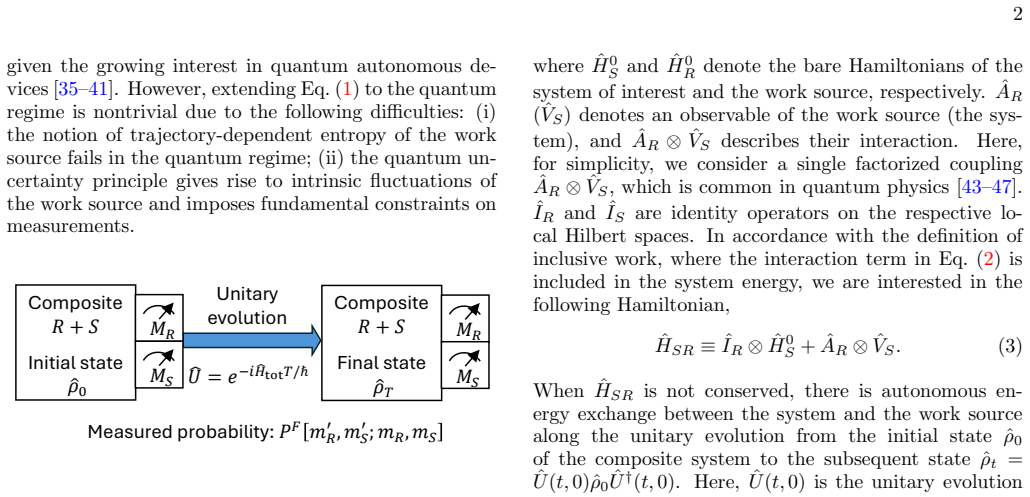
Fluctuation theorems for work provide universal constraints on nonequilibrium fluctuations, yet their quantum generalizations often rely on externally prescribed classical driving protocols. While for classical systems, fluctuation theorems have been extended to autonomous work, where the dynamics of the work source is subject to the backaction of the system, their generalization to the quantum regime is constrained by the uncertainty principle. Here, we extend fluctuation theorems for autonomous work from the classical regime to the quantum regime. By performing successive projective measurements over the work source and the system, we derive Jarzynski-type and Crooks-type fluctuation theorems for autonomous inclusive work from initial mixed thermal states. These relations are analogous to fluctuation theorems for autonomous work in the classical regime and explicitly incorporate the fluctuations of the work source. However, quantum noncommutativity prevents a consistent reduction to the nonautonomous counterparts, even in the limit of a large work source and correspondingly negligible backaction. By contrast, under the exclusive work definition, the nonautonomous limit is recovered when the measured observable of the work source commutes with its bare Hamiltonian and the backaction of the system on the work source is negligible. Our results are illustrated with the Dicke model, where a single-mode radiation field and an ensemble of two-level atoms act as the system of interest and the work source, respectively.
Figures


Forward citations
Cited by 1 Pith paper
-
Work Statistics of Autonomous Quantum Energy Pumps
A terminal-resolved autonomous framework that exactly represents multi-terminal work statistics on the pump, connects fluctuations to Floquet geometry, and introduces a work-variance gap for nonideal terminals.
Reference graph
Works this paper leans on
-
[1]
While the forward evolution operator ˆU(t,0) satisfiesd ˆU(t,0)/dt=−iℏ −1 ˆH ˆU(t,0), the backward evolution oper- ator ˆUB(t,0) satisfiesd ˆUB(t,0)/dt=−iℏ −1 ˆH B ˆUB(t,0)
The time-reversal process For a generic Hamiltonian ˆH(t) governing the forward evolution from time 0 toT, the corresponding Hamil- tonian dominating the time-reversal process is ˆH B(t) = ˆΘ ˆH(T−t) ˆΘ†, where ˆΘ is the time-reversal operator. While the forward evolution operator ˆU(t,0) satisfiesd ˆU(t,0)/dt=−iℏ −1 ˆH ˆU(t,0), the backward evolution ope...
-
[2]
Numerical representation of the Dicke model /uni00000013/uni00000019/uni00000014/uni00000015/uni00000014/uni0000001b/uni00000015/uni00000017/uni00000016/uni00000013/uni00000016/uni00000019/uni00000017/uni00000015/uni00000017/uni0000001bnF /uni00000013/uni00000011/uni00000013/uni00000013 /uni00000013/uni00000011/uni00000013/uni00000018 /uni00000013/uni0000...
2000
-
[3]
The limit of vanishing backaction in the Dicke model FIG. 6. The evolution of the atoms and the radiation field in the regime of vanishing backaction. (a) The evolution of the expected value⟨ ˆJx⟩. Blue data correspond to the evolution under the total Hamiltonian ˆHtot, while the grey dashed line corresponds to⟨ ˆJx⟩t =⟨ ˆJx⟩0 cos(ωzt)− ⟨ˆJy⟩0 sin(ωzt). (...
-
[4]
General derivation With the Hamiltonian ˆHtot = ˆIR ⊗ ˆH 0 S + ˆAR ⊗ ˆVS + ˆH 0 R × ˆIS, the backaction of the system on the work source can be reflected on the second-order differential equation of⟨ ˆAR⟩, that is,ℏ 2d2⟨ ˆAR⟩/dt2 =⟨[[ ˆH 0 R, ˆAR], ˆH 0 R]⟩+⟨[[ ˆH 0 R, ˆAR], ˆAR⊗ ˆVS]⟩. We first consider the semi-decoupling limit where the backaction of t...
-
[5]
F actorized semiclassical limit in the Dicke model We use the Dicke model to demonstrate the evolution in the factorized semiclassical limit, which is tied to the limit of vanishing backaction. With the Hamiltonian ˆHtot =ℏω c ˆIam ⊗ˆa†ˆa+ 2λ√ N ˆJx ⊗ ˆa† + ˆa +ω z ˆJz ⊗ ˆIrf, in the semi-deoupling limit where the backaction of the radiation field on the ...
-
[6]
Sekimoto,Stochastic Energetics(Springer, Berlin ; Heidelberg, 2010)
K. Sekimoto,Stochastic Energetics(Springer, Berlin ; Heidelberg, 2010)
2010
-
[7]
Peliti and S
L. Peliti and S. Pigolotti,Stochastic Thermodynam- ics: An Introduction(Princeton University Press, 2021) google-Books-ID: 8rAPEAAAQBAJ
2021
-
[8]
Shiraishi,An Introduction to Stochastic Thermody- namics: From Basic to Advanced(Springer Nature, 2023)
N. Shiraishi,An Introduction to Stochastic Thermody- namics: From Basic to Advanced(Springer Nature, 2023)
2023
-
[9]
Seifert,Stochastic Thermodynamics(Cambridge Uni- versity Press, Cambridge, 2025)
U. Seifert,Stochastic Thermodynamics(Cambridge Uni- versity Press, Cambridge, 2025)
2025
-
[10]
G. N. Bochkov and I. E. Kuzovlev, General theory of thermal fluctuations in nonlinear systems, Zh. Eksp. Teor. Fiz72, 238 (1977)
1977
-
[11]
D. J. Evans, E. G. D. Cohen, and G. P. Morriss, Proba- bility of second law violations in shearing steady states, Phys. Rev. Lett.71, 2401 (1993)
1993
-
[12]
Gallavotti and E
G. Gallavotti and E. G. D. Cohen, Dynamical ensembles in stationary states, J Stat Phys80, 931 (1995)
1995
-
[13]
Gallavotti and E
G. Gallavotti and E. G. D. Cohen, Dynamical Ensem- bles in Nonequilibrium Statistical Mechanics, Phys. Rev. Lett.74, 2694 (1995)
1995
-
[14]
Jarzynski, Nonequilibrium Equality for Free Energy Differences, Phys
C. Jarzynski, Nonequilibrium Equality for Free Energy Differences, Phys. Rev. Lett.78, 2690 (1997)
1997
-
[15]
G. E. Crooks, Entropy production fluctuation theorem and the nonequilibrium work relation for free energy dif- ferences, Phys. Rev. E60, 2721 (1999)
1999
-
[16]
Liphardt, S
J. Liphardt, S. Dumont, S. B. Smith, I. Tinoco, and C. Bustamante, Equilibrium Information from Nonequi- librium Measurements in an Experimental Test of Jarzynski’s Equality, Science296, 1832 (2002)
2002
-
[17]
Seifert, Entropy Production along a Stochastic Tra- jectory and an Integral Fluctuation Theorem, Phys
U. Seifert, Entropy Production along a Stochastic Tra- jectory and an Integral Fluctuation Theorem, Phys. Rev. Lett.95, 040602 (2005)
2005
-
[18]
Chen and H
J.-F. Chen and H. T. Quan, Hierarchical structure of fluc- tuation theorems for a driven system in contact with mul- tiple heat reservoirs, Phys. Rev. E107, 024135 (2023)
2023
-
[19]
Kurchan, A Quantum Fluctuation Theorem (2000), arXiv:cond-mat/0007360
J. Kurchan, A Quantum Fluctuation Theorem (2000), arXiv:cond-mat/0007360
Pith/arXiv arXiv 2000
-
[20]
Tasaki, Jarzynski Relations for Quantum Systems and Some Applications (2000), arXiv:cond-mat/0009244
H. Tasaki, Jarzynski Relations for Quantum Systems and Some Applications (2000), arXiv:cond-mat/0009244
Pith/arXiv arXiv 2000
-
[21]
Talkner, E
P. Talkner, E. Lutz, and P. H¨ anggi, Fluctuation theo- rems: Work is not an observable, Phys. Rev. E75, 050102 (2007)
2007
-
[22]
Talkner and P
P. Talkner and P. H¨ anggi, The Tasaki–Crooks quantum fluctuation theorem, J. Phys. A: Math. Theor.40, F569 (2007)
2007
-
[23]
Esposito, U
M. Esposito, U. Harbola, and S. Mukamel, Nonequilib- rium fluctuations, fluctuation theorems, and counting statistics in quantum systems, Rev. Mod. Phys.81, 1665 (2009)
2009
-
[24]
Campisi, P
M. Campisi, P. H¨ anggi, and P. Talkner, Colloquium: Quantum fluctuation relations: Foundations and appli- cations, Rev. Mod. Phys.83, 771 (2011)
2011
-
[25]
An, J.-N
S. An, J.-N. Zhang, M. Um, D. Lv, Y. Lu, J. Zhang, Z.-Q. Yin, H. T. Quan, and K. Kim, Experimental test of the quantum Jarzynski equality with a trapped-ion system, Nat. Phys.11, 193 (2015)
2015
-
[26]
Jarzynski, H
C. Jarzynski, H. Quan, and S. Rahav, Quantum-Classical Correspondence Principle for Work Distributions, Phys. Rev. X5, 031038 (2015)
2015
-
[27]
H. T. Quan, Y.-x. Liu, C. P. Sun, and F. Nori, Quantum thermodynamic cycles and quantum heat engines, Phys. Rev. E76, 031105 (2007)
2007
-
[28]
Schmiedl and U
T. Schmiedl and U. Seifert, Efficiency at maximum power: An analytically solvable model for stochastic heat engines, Europhys. Lett.81, 20003 (2008)
2008
-
[29]
Ma, R.-X
Y.-H. Ma, R.-X. Zhai, J. Chen, C. P. Sun, and H. Dong, Experimental Test of the 1/τ-Scaling Entropy Genera- tion in Finite-Time Thermodynamics, Phys. Rev. Lett. 125, 210601 (2020)
2020
-
[30]
Li and Z
G. Li and Z. C. Tu, Nonequilibrium work relations meet engineered thermodynamic control: A perspective for nonequilibrium measurements, Europhys. Lett.142, 61001 (2023)
2023
-
[31]
R. X. Zhai and C. P. Sun, Quantum Thermodynamic Integrability for Canonical and Noncanonical Statistics, Phys. Rev. Lett.134, 160404 (2025)
2025
-
[32]
Serra-Garcia, A
M. Serra-Garcia, A. Foehr, M. Moler´ on, J. Lydon, C. Chong, and C. Daraio, Mechanical Autonomous Stochastic Heat Engine, Phys. Rev. Lett.117, 010602 (2016)
2016
-
[33]
Jarzynski, S
C. Jarzynski, S. Deffner, and S. Rahav, Fluctuation the- orems for autonomous work, Proc. Natl. Acad. Sci. U. S. A.122, e2524775122 (2025)
2025
-
[34]
Bennett, The search for ‘uniform and equable motion’ A study of the early methods of control of the steam 15 engine, Int
S. Bennett, The search for ‘uniform and equable motion’ A study of the early methods of control of the steam 15 engine, Int. J. Control21, 113 (1975)
1975
-
[35]
Roulet, S
A. Roulet, S. Nimmrichter, J. M. Arrazola, S. Seah, and V. Scarani, Autonomous rotor heat engine, Phys. Rev. E 95, 062131 (2017)
2017
-
[36]
Niedenzu, M
W. Niedenzu, M. Huber, and E. Boukobza, Concepts of work in autonomous quantum heat engines, Quantum3, 195 (2019)
2019
-
[37]
R. Iino, K. Kinbara, and Z. Bryant, Introduction: Molec- ular Motors, Chem. Rev.120, 1 (2020)
2020
-
[38]
Antonio Mar ´ ın Guzm´ an, P
J. Antonio Mar ´ ın Guzm´ an, P. Erker, S. Gasparinetti, M. Huber, and N. Yunger Halpern, Key issues review: useful autonomous quantum machines, Rep. Prog. Phys. 87, 122001 (2024)
2024
-
[39]
Y. Jha, D. Karevski, and C. Elouard, Jaynes-Cummings model as an autonomous Maxwell demon, Phys. Rev. A 112, 062212 (2025)
2025
-
[40]
Tonner and G
F. Tonner and G. Mahler, Autonomous quantum ther- modynamic machines, Phys. Rev. E72, 066118 (2005)
2005
-
[41]
M. F. Frenzel, D. Jennings, and T. Rudolph, Quasi- autonomous quantum thermal machines and quantum to classical energy flow, New J. Phys.18, 023037 (2016)
2016
-
[42]
Elouard and C
C. Elouard and C. Lombard Latune, Extending the Laws of Thermodynamics for Arbitrary Autonomous Quantum Systems, PRX Quantum4, 020309 (2023)
2023
-
[43]
C. Han, D. Cohen, and E. Sela, Quantum limitation on experimental testing of nonequilibrium fluctuation theo- rems, Phys. Rev. B110, 115153 (2024)
2024
-
[44]
C. Han, N. Katz, and E. Sela, Measuring work in quan- tum many-body systems using a dynamical work agent, Phys. Rev. B112, 035416 (2025)
2025
-
[45]
A. V. Varma and D. Cohen, Quantum measurement of work in mesoscopic systems (2025), arXiv:2507.09977
Pith/arXiv arXiv 2025
-
[46]
C. Cepollaro, D. Chughtai, A. Spalvieri, M. Huber, and A. Rolandi, Autonomization of Quantum Sys- tems and the Emergence of the Work Operator (2026), arXiv:2607.20602 [quant-ph] version: 1
Pith/arXiv arXiv 2026
-
[47]
Jarzynski, Comparison of far-from-equilibrium work relations, Comptes Rendus Physique Work, dissipation, and fluctuations in nonequilibrium physics,8, 495 (2007)
C. Jarzynski, Comparison of far-from-equilibrium work relations, Comptes Rendus Physique Work, dissipation, and fluctuations in nonequilibrium physics,8, 495 (2007)
2007
-
[48]
H. T. Quan, Z. Song, X. F. Liu, P. Zanardi, and C. P. Sun, Decay of Loschmidt Echo Enhanced by Quantum Criticality, Phys. Rev. Lett.96, 140604 (2006)
2006
-
[49]
Schr¨ oder and G
H. Schr¨ oder and G. Mahler, Work exchange between quantum systems: The spin-oscillator model, Phys. Rev. E81, 021118 (2010)
2010
-
[50]
Aspelmeyer, T
M. Aspelmeyer, T. J. Kippenberg, and F. Marquardt, Cavity optomechanics, Rev. Mod. Phys.86, 1391 (2014)
2014
-
[51]
Kirton, M
P. Kirton, M. M. Roses, J. Keeling, and E. G. Dalla Torre, Introduction to the Dicke Model: From Equilibrium to Nonequilibrium, and Vice Versa, Adv. Quantum Technol.2, 1800043 (2019)
2019
-
[52]
Felicetti and A
S. Felicetti and A. Le Boit´ e, Universal Spectral Features of Ultrastrongly Coupled Systems, Phys. Rev. Lett.124, 040404 (2020)
2020
-
[53]
To obtain fluctuation theorems for the inclusive work, the initial state of the work source is assumed to be in- coherent between different sectors of the observable ˆAR, ensuring that the free energy of the system is well defined
-
[54]
Maes, On the Origin and the Use of Fluctuation Rela- tions for the Entropy, inPoincar´ e Seminar 2(2003) pp
C. Maes, On the Origin and the Use of Fluctuation Rela- tions for the Entropy, inPoincar´ e Seminar 2(2003) pp. 29–62
2003
-
[55]
Bakemeier, A
L. Bakemeier, A. Alvermann, and H. Fehske, Dynamics of the Dicke model close to the classical limit, Phys. Rev. A88, 043835 (2013)
2013
-
[56]
Campisi, P
M. Campisi, P. Talkner, and P. H¨ anggi, Quantum Bochkov–Kuzovlev work fluctuation theorems, Phil. Trans. R. Soc. A369, 291 (2011)
2011
-
[57]
Watanabe, B
G. Watanabe, B. P. Venkatesh, and P. Talkner, Gen- eralized energy measurements and modified transient quantum fluctuation theorems, Phys. Rev. E89, 052116 (2014)
2014
-
[58]
Micadei, G
K. Micadei, G. T. Landi, and E. Lutz, Quantum Fluctu- ation Theorems beyond Two-Point Measurements, Phys. Rev. Lett.124, 090602 (2020)
2020
-
[59]
Pei, J.-F
J.-H. Pei, J.-F. Chen, and H. T. Quan, Explor- ing quasiprobability approaches to quantum work in the presence of initial coherence: Advantages of the Margenau-Hill distribution, Phys. Rev. E108, 054109 (2023)
2023
-
[60]
Prech and P
K. Prech and P. P. Potts, Quantum Fluctuation Theorem for Arbitrary Measurement and Feedback Schemes, Phys. Rev. Lett.133, 140401 (2024)
2024
-
[61]
Rasola, V
M. Rasola, V. Vadimov, T. Uusn¨ akki, and M. M¨ ott¨ onen, Proposal for an autonomous quantum heat engine, Sci- Post Phys.19, 101 (2025)
2025
-
[62]
Mandal, H
D. Mandal, H. T. Quan, and C. Jarzynski, Maxwell’s Re- frigerator: An Exactly Solvable Model, Phys. Rev. Lett. 111, 030602 (2013)
2013
-
[63]
W. Chen, M. Chen, and Y.-H. Ma, Finite-Time Ther- modynamics of an Autonomous Information Machine (2026)
2026
discussion (0)
Sign in with ORCID, Apple, or X to comment. Anyone can read and Pith papers without signing in.