REVIEW 4 major objections 4 minor 22 references
Video recommendation should ask what logically comes next after a watched video; this paper's compact 8B vision-language model does that and lifts watch time (+0.53%) and distinct exposure (+0.51%) in production.
Reviewed by Pith at T0; open to challenge. T0 means a machine referee read the full paper against a public rubric. the ladder, T0–T4 →
T0 review · deepseek-v4-flash
2026-08-02 09:43 UTC pith:53EX3UAA
load-bearing objection Worth a serious referee; the production A/B result is the real contribution, but the DocVQA SOTA claim is undercut by test-set tuning and the LLM judge is under-specified. the 4 major comments →
NEXT: Reasoning-Driven Video Recommendation via a Vision-Language Model
The pith
A machine-rendered reading of the paper's core claim, the machinery that carries it, and where it could break.
Core claim
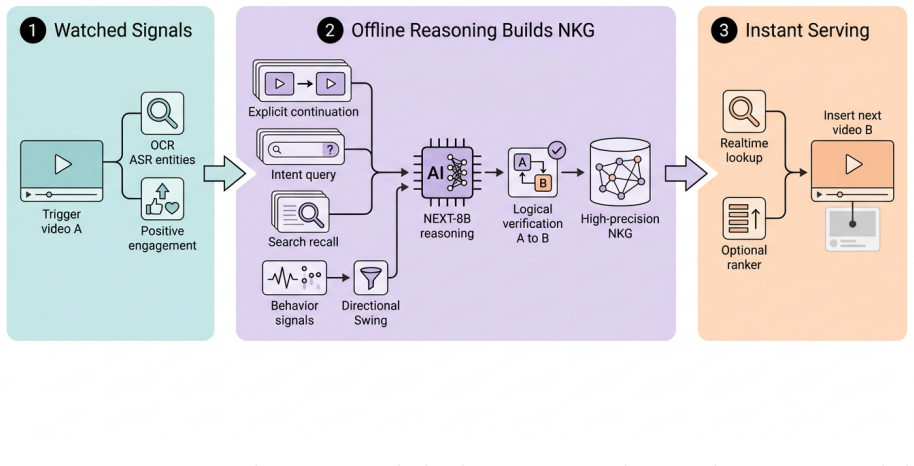
The paper's central claim is that next-video recommendation reduces to a directed transition problem: for a trigger video A, build an edge A->B only when multimodal evidence, user signals, and a verifying vision-language model support a logical next step. Explicit continuity cues are resolved deterministically; implicit needs are converted into searchable intent queries such as 'explain this result' or 'show what happened next.' The load-bearing component is NEXT-8B, an 8B vision-language model whose training separates evidence extraction from reasoning: a frozen text-only verifier answers held-out questions using only the generated visual evidence, so the reward signal pushes the model to p
What carries the argument
The central mechanism is the NEXT Knowledge Graph (NKG), a store of directed edges <v_trigger, v_next> built offline through evidence extraction, multi-source candidate generation, NEXT-8B's intent reasoning, and final verification. Explicit edges (episodes, creator continuations) are written with priority; implicit edges survive only if NEXT-8B confirms that the candidate answers, continues, or resolves the need induced by the trigger. NEXT-8B is an 8B vision-language model trained with three named stages: Perception-Enhanced RL, which makes a multimodal policy produce query-agnostic visual evidence rewarded by a frozen text-only verifier; Distribution-Aligned SFT (supervised fine-tuning),
Load-bearing premise
The load-bearing premise is that a language-model judge's 'logic-wise quality' score tracks whether a real viewer would want to watch the proposed next video, since the reported 3.3% quality lift is measured only by that judge and not by viewer behavior.
What would settle it
Serve a matched sample of next-video candidates that failed NEXT-8B's logical verification alongside verified edges in a live A/B test; if the rejected set produces the same watch-time and exposure lifts as the verified set, then the reasoning/verification step is not what drives the production gain.
If this is right
- Recommendation systems can act on directed, verified transitions rather than only co-engagement or semantic similarity, giving a retrieval path for content that should logically come next.
- A compact 8B vision-language model can generate and verify next-intent edges at production scale, provided the reasoning runs offline and serving is reduced to engagement detection and lookup.
- Because NKG edges are precomputed and written to a graph, the reasoning-driven path is additive to an existing recommender and requires no extra online model.
- The same three-stage training recipe that improves DocVQA transfers to video next-intent generation, suggesting it is reusable for other evidence-to-reasoning tasks.
- The reported production gains indicate that reasoning-linked next-video injection can improve engagement and content diversity simultaneously, without regressing negative feedback or latency.
Where Pith is reading between the lines
- A natural next step is to calibrate the LLM-as-a-judge against a behavioral signal — for example, the completion rate of the inserted next video — to confirm that 'logic-wise quality' corresponds to actual continued viewing rather than stylistic fluency.
- The Item-to-Intent-to-Item scaffold is not video-specific; the same generate-intent-then-verify pattern could apply to news sequencing, tutorial steps, or product follow-ups where a logical next item matters more than similarity.
- Because the same model both proposes and verifies edges, an independent verifier or a human-labeled sample of NKG edges would make the precision claim testable against self-confirmation.
- Multi-step chaining (v1->v1.a->v1.a.b) would turn the NKG into a traversable transition graph, opening the door to path-ranking methods that balance logical continuity with exploration.
Editorial analysis
A structured set of objections, weighed in public.
Referee Report
Summary. The paper presents NEXT, a video recommendation framework that converts the recommendation task from item-to-item similarity to item-to-intent-to-item reasoning. NEXT-8B, an 8B vision-language model, is trained with a three-stage post-training recipe (Perception-Enhanced RL, Distribution-Aligned SFT, and GRPO) to extract visual evidence, generate next-intent queries, and verify candidate follow-up videos. These edges are stored in a NEXT Knowledge Graph (NKG) and injected into a production recommender upon positive engagement. The paper claims state-of-the-art single-model DocVQA performance (97.28 ANLS, behind only a multi-agent system), a 3.3% relative improvement in next-intent logic-wise quality over the base model, and production A/B gains of +0.53% watch time and +0.51% distinct video exposure. The paper also describes the NKG pipeline, including explicit continuation detection, implicit intent mining, behavior-based signals, and a directional Swing variant, with NEXT-8B acting as both generator and verifier of candidate edges.
Significance. If the results hold, the paper would demonstrate that a compact 8B VLM can achieve state-of-the-art fine-grained visual understanding and serve as a practical reasoning engine for next-interest exploration at production scale. The paper has genuine strengths: the offline/nearline architecture removes the VLM from the online critical path; the three-stage training recipe is clearly motivated; and the production A/B test addresses the recommendation problem in a real system with meaningful engagement and diversity metrics. The separation of evidence production from reasoning in Perception-Enhanced RL is an interesting design choice. However, the central claims are weakened by methodological gaps: the DocVQA headline is based on test-set ablations, and the next-intent quality evidence relies on an uncalibrated LLM-as-a-judge evaluation where the same model family generates and verifies the outputs. These issues currently prevent the paper from supporting its strongest statements.
major comments (4)
- [§4.2, Table 3] The ablation study is conducted directly on the DocVQA test set, and the same test set is used for the headline 97.28 ANLS result. Selecting among training-stage configurations (which stages to include, their ordering, and potentially stopping criteria) by looking at test-set performance invalidates the final number as an unbiased estimate of generalization. The paper provides no validation split, no pre-registered protocol, and no evidence that the test set was used only once. Consequently, the claim of 'best single-model DocVQA performance' is not supported as stated. The authors should either rerun ablations on a held-out validation split, pre-register the test-set evaluation, or explicitly weaken the claim to a reported test-set score without generalization guarantees.
- [§4.3; §3.2.1; §5.1] The only evidence for improved next-intent quality is an LLM-as-a-judge evaluation, but the judge model is not named and there is no demonstration that it is independent of the NEXT-8B/Qwen model family. Since NEXT-8B is both the generator of next-intent queries and the verifier of A-to-B candidate edges, the reported +3.3% lift in 'logic-wise quality' and +4.0% in evidence grounding could reflect self-consistency bias rather than genuine logical improvement. No calibration against human judgments or behavioral ground truth is reported, and no confidence intervals are provided. The paper should add an independent judge from a different model family, a human-evaluation sample, or a behavioral metric (e.g., next-video click or completion) to validate the quality claims.
- [§3.2.1, Eq. (3)] The Scene-Aware Reasoning Swing formula is not well-defined as written. The denominator uses |I_SID(u) ∩ I_SID(u')|, i.e., the intersection of semantic-ID sets between two users, whereas the text states that 'pairs must share a Semantic ID prefix,' which should constrain the tested item pair (i, j). As printed, the score does not depend on the semantic similarity of i and j at all, making the 'semantic partitioning' constraint meaningless. This is a load-bearing definition for the behavior-based collaborative signal; please correct the formula or the notation and re-specify how the semantic partition enters the score.
- [§5.2, Table 5] The online A/B test is a central pillar of the validation, but the reporting is too thin to assess. Only aggregate lifts and p-values are given; there is no description of the number of users or sessions, assignment methodology, test duration, number of metrics examined, or how guardrail metrics (negative feedback, safety, latency) were measured. The claim that the confidence interval 'excludes 0' for each primary metric is helpful but insufficient without accounting for multiple comparisons or showing the actual interval bounds. Please provide a fuller experimental protocol, including the guardrail results.
minor comments (4)
- [§3.4–§3.6; Eq. (2), (3), (7), (8)] Several hyperparameters are left unspecified: w_ocr, w_asr, tau in Eq. (2); gamma, alpha, w_u in Eq. (3); epsilon and beta in Eq. (7); lambda in Eq. (8). For reproducibility, please report their values or the tuning procedure.
- [§4.3, Table 4] The LLM-as-a-judge evaluation reports a 3.3% relative lift but no confidence interval, inter-annotator agreement, or number of judge calls. A bootstrapped CI would help assess whether the difference is stable given the 1,000-video sample.
- [Table 2] The Table 2 entries appear to have missing spaces, e.g., '95.0398.19' and '97.0997.68', likely a formatting error. Please correct the table so each subcolumn is legible.
- [§5.2] The statement 'we observe no statistically significant regression in negative feedback, safety, or latency guardrails' is made without showing the corresponding metrics or p-values. Please include these numbers or explicitly state that they are omitted for confidentiality reasons.
Circularity Check
DocVQA headline is a test-set-selected value; next-intent 'quality' is a judge-defined metric with no independent calibration
specific steps
-
fitted input called prediction
[Table 3 and Section 4.2]
"Table 3: Ablation study of the NEXT-8B training recipe on the DocVQA test set. ... NEXT-8B reaches 97.28% ANLS, the best single-model DocVQA result and second overall behind a multi-agent system."
The paper reports the final DocVQA number as the last row of an ablation table explicitly run on the DocVQA test set. The recipe stages (data augmentation, SFT, Perception-Enhanced RL, GRPO) and their contributions were selected by comparing ANLS on that same test set, and then the same test set is used to report 97.28 as an independent state-of-the-art result. Thus the headline number is a test-set-selected maximum rather than a held-out estimate; the evaluation set was an input to model selection, so the reported 'prediction' is not an unbiased measure of generalization.
-
self definitional
[Section 3.2.1 and Section 4.3, Table 4]
"Across all sources, NEXT-8B acts as both a generator and a verifier. ... we ... ask a strong LLM-as-a-judge evaluator to score logic-wise quality ... high quality means judge score>=4 on a 1-5 scale."
The paper defines the quality of its reasoning outputs as 'high quality means judge score>=4' and measures the reported 3.3% lift with a 'strong LLM-as-a-judge evaluator.' At the same time, NEXT-8B is both the generator and the verifier of the candidate edges being judged, and the judge's independence from the model family is not stated. By construction, 'logic-wise quality' is the judge's score, and the candidates shown to the judge were already filtered by the very model family being evaluated. Without an independent judge or behavioral ground truth, the improvement can reflect self-consistency of the model family rather than externally validated reasoning.
full rationale
The paper's production A/B test is externally falsifiable and does not reduce to the model's own outputs, so the overall contribution is not fully circular. Similarly, the DocVQA leaderboard comparison is against external systems, but the paper's use of the DocVQA test set for ablations (Table 3) contaminates the headline SOTA claim with selection bias: the final recipe and the reported 97.28 ANLS come from the same test set. The next-intent evidence is weaker: the 3.3% 'logic-wise quality' lift is defined and measured by an uncalibrated LLM judge, and NEXT-8B serves as both generator and verifier in the pipeline, so the evaluation can be self-confirming. No load-bearing self-citations or imported uniqueness theorems appear; references to external work (e.g., Swing, GRPO, HSTU) are standard. The Limitations section only mentions computational cost and does not address the judge calibration or test-set selection issues. Score 5 reflects partial circularity in the DocVQA and next-intent evidence chains, while recognizing the independent A/B results.
Axiom & Free-Parameter Ledger
free parameters (4)
- w_ocr, w_asr, tau (Eq. 2) =
not reported
- gamma, alpha, w_u (Eq. 3) =
not reported
- epsilon, beta (Eq. 7, GRPO) =
not reported
- lambda (Eq. 8) =
not reported
axioms (4)
- domain assumption DocVQA-style visual evidence extraction is a valid proxy for video next-intent reasoning (Section 3.5).
- domain assumption A frozen text-only verifier provides a reliable reward signal in Perception-Enhanced RL (Section 3.4).
- domain assumption LLM-as-a-judge scores reflect true logic-wise quality of next-intent outputs (Section 4.3).
- domain assumption Positive engagement with a trigger video is a sufficient condition to activate a next-video edge (Section 5.1).
invented entities (1)
-
NEXT Knowledge Graph (NKG)
no independent evidence
Cite this review
Pith. "Pith review of NEXT: Reasoning-Driven Video Recommendation via a Vision-Language Model." pith.science (2026). https://pith.science/paper/53EX3UAA
@misc{pith2026260724789,
  author       = {Pith},
  title        = {Pith review of: NEXT: Reasoning-Driven Video Recommendation via a Vision-Language Model},
  year         = {2026},
  howpublished = {\url{https://pith.science/paper/53EX3UAA}},
  note         = {Machine review of arXiv:2607.24789}
}
read the original abstract
We present NEXT (Next-interest EXploration Transformer), a reasoning-driven video recommendation framework that reasons over the video a user has just watched, infers the viewer's next intent, and retrieves concrete follow-up videos. Explicit continuations such as episodes are linked directly; implicit cases are handled by generating intent queries and searching for matching candidates. This Item-to-Intent-to-Item formulation produces directed recommendations beyond co-engagement correlation or semantic similarity. To make this framework reliable at scale, we train NEXT-8B, a purpose-trained 8B vision-language model with a three-stage recipe: Perception-Enhanced Reinforcement Learning for query-agnostic evidence extraction, Distribution-Aligned Supervised Fine-Tuning over real and synthetic visual QA mixtures, and Group Relative Policy Optimization for last-mile alignment. NEXT-8B achieves the best single-model DocVQA performance, ranking second overall only behind a multi-agent system while surpassing a substantially larger 200B+ scale model, and improves next-intent logic-wise quality by 3.3% over the base model in a task-specific LLM-as-a-judge evaluation. We deploy NEXT as an additional retrieval path in a large-scale social media recommendation system and observe statistically significant production gains, including +0.53% watch time and +0.51% distinct video exposure. Overall, NEXT shows that a carefully trained compact vision-language model can serve as a practical reasoning engine for next-interest exploration at production scale.
Figures

Reference graph
Works this paper leans on
-
[1]
Qwen3-VL Technical Report.arXiv preprint arXiv:2511.21631, 2025
Shuai Bai et al. Qwen3-VL Technical Report.arXiv preprint arXiv:2511.21631, 2025
Pith/arXiv arXiv 2025
-
[2]
Seed1.5-VL Technical Report.arXiv preprint arXiv:2505.07062, 2025
Dong Guo et al. Seed1.5-VL Technical Report.arXiv preprint arXiv:2505.07062, 2025
Pith/arXiv arXiv 2025
-
[3]
Self-Attentive Sequential Recommendation
Wang-Cheng Kang and Julian McAuley. Self-Attentive Sequential Recommendation. In Proceedings of the 2018 IEEE International Conference on Data Mining (ICDM), pages 197–
2018
-
[4]
Matrix Factorization Techniques for Recom- mender Systems.Computer, 42(8):30–37, 2009
Yehuda Koren, Robert Bell, and Chris Volinsky. Matrix Factorization Techniques for Recom- mender Systems.Computer, 42(8):30–37, 2009
2009
-
[5]
Visual Instruction Tuning
Haotian Liu, Chunyuan Li, Qingyang Wu, and Yong Jae Lee. Visual Instruction Tuning. In Advances in Neural Information Processing Systems 37, pages 1–19. Curran Associates, Inc., 2024
2024
-
[6]
ChartQA: A Benchmark for Question Answering about Charts with Visual and Logical Reasoning
Ahmed Masry, Do Xuan Long, Jia Qing Tan, Shafiq Joty, and Enamul Hoque. ChartQA: A Benchmark for Question Answering about Charts with Visual and Logical Reasoning. InFindings of the Association for Computational Linguistics: ACL 2022, pages 2263–2279. Association for Computational Linguistics, 2022
2022
-
[7]
Minesh Mathew, Viraj Bagal, Rubèn Tito, Dimosthenis Karatzas, Ernest Valveny, and C.V. Jawahar. InfographicVQA. InProceedings of the IEEE/CVF Winter Conference on Applications of Computer Vision (WACV), pages 1697–1706. IEEE, 2022
2022
-
[8]
Minesh Mathew, Dimosthenis Karatzas, and C.V. Jawahar. DocVQA: A Dataset for VQA on Document Images. InProceedings of the IEEE/CVF Winter Conference on Applications of Computer Vision (WACV), pages 2200–2209. IEEE, 2021
2021
-
[9]
Maxim Naumov et al. Deep Learning Recommendation Model for Personalization and Recom- mendation Systems.arXiv preprint arXiv:1906.00091, 2019
Pith/arXiv arXiv 1906
-
[10]
GPT-4V(ision) System Card
OpenAI. GPT-4V(ision) System Card. Technical report, OpenAI, 2023
2023
-
[11]
Learning Transferable Visual Models From Natural Language Supervision
Alec Radford, Jong Wook Kim, Chris Hallacy, Aditya Ramesh, Gabriel Goh, Sandhini Agarwal, Girish Sastry, Amanda Askell, Pamela Mishkin, Jack Clark, Gretchen Krueger, and Ilya Sutskever. Learning Transferable Visual Models From Natural Language Supervision. In Proceedings of the 38th International Conference on Machine Learning, volume 139 ofICML ’21, page...
2021
-
[12]
TIGER: Recommender Systems with Generative Retrieval
Shishir Rajput et al. TIGER: Recommender Systems with Generative Retrieval. InAdvances in Neural Information Processing Systems 36, pages 1–21. Curran Associates, Inc., 2023. 12
2023
-
[13]
Zhihong Shao et al. DeepSeekMath: Pushing the Limits of Mathematical Reasoning in Open Language Models.arXiv preprint arXiv:2402.03300, 2024
Pith/arXiv arXiv 2024
-
[14]
BERT4Rec: Sequential Recommendation with Bidirectional Encoder Representations from Transformer
Fei Sun, Jun Liu, Jian Wu, Changhua Pei, Xiao Lin, Wenwu Ou, and Peng Jiang. BERT4Rec: Sequential Recommendation with Bidirectional Encoder Representations from Transformer. InProceedings of the 28th ACM International Conference on Information and Knowledge Management, CIKM ’19, pages 1441–1450. ACM, 2019
2019
-
[15]
LLMs for User Interest Exploration in Large-scale Recommendation Systems
Jianling Wang et al. LLMs for User Interest Exploration in Large-scale Recommendation Systems. InProceedings of the 18th ACM Conference on Recommender Systems, RecSys ’24, pages 928–933. ACM, 2024
2024
-
[16]
Peng Wang, Shuai Bai, et al. Qwen2-VL: Enhancing Vision-Language Model’s Perception of the World at Any Resolution.arXiv preprint arXiv:2409.12191, 2024
Pith/arXiv arXiv 2024
-
[17]
Deconfounded Recommendation for Alleviating Bias Amplification
Wenjie Wang, Fuli Feng, Xiangnan He, Xiang Wang, and Tat-Seng Chua. Deconfounded Recommendation for Alleviating Bias Amplification. InProceedings of the 27th ACM SIGKDD Conference on Knowledge Discovery and Data Mining, KDD ’21, pages 1717–1725. ACM, 2021
2021
-
[18]
MiMo-VL Technical Report.arXiv preprint arXiv:2506.03569, 2025
Xiaomi LLM-Core Team, Zihao Yue, et al. MiMo-VL Technical Report.arXiv preprint arXiv:2506.03569, 2025
Pith/arXiv arXiv 2025
-
[19]
Xiaoyong Yang, Yadong Zhu, Yi Zhang, Xiaobo Wang, and Quan Yuan. Large Scale Product Graph Construction for Recommendation in E-commerce.arXiv preprint arXiv:2010.05525, 2020
Pith/arXiv arXiv 2010
-
[20]
Sampling-Bias-Corrected Neural Modeling for Large Corpus Item Recommendations
Xinyang Yi, Ji Yang, Lichan Hong, Derek Zhiyuan Cheng, Lukasz Heldt, Aditee Kumthekar, Zhe Zhao, Li Wei, and Ed Chi. Sampling-Bias-Corrected Neural Modeling for Large Corpus Item Recommendations. InProceedings of the 13th ACM Conference on Recommender Systems, RecSys ’19, pages 269–277. ACM, 2019
2019
-
[21]
Actions Speak Louder than Words: Trillion-Parameter Sequential Transducers for Generative Recommendations
Jiaqi Zhai et al. Actions Speak Louder than Words: Trillion-Parameter Sequential Transducers for Generative Recommendations. InProceedings of the 41st International Conference on Machine Learning, ICML ’24, 2024
2024
-
[22]
Causal Intervention for Leveraging Popularity Bias in Recommendation
Yang Zhang, Fuli Feng, Xiangnan He, Tianxin Wei, Chonggang Song, Guohui Ling, and Yongdong Zhang. Causal Intervention for Leveraging Popularity Bias in Recommendation. In Proceedings of the 44th International ACM SIGIR Conference on Research and Development in Information Retrieval, SIGIR ’21, pages 11–20. ACM, 2021. 13
2021
discussion (0)
Sign in with ORCID, Apple, or X to comment. Anyone can read and Pith papers without signing in.