REVIEW 5 major objections 9 minor 41 references
Traffic flow forecasts improve when models stop treating road-to-road effects as instantaneous and instead fuse short lag graphs with masked temporal attention.
Reviewed by Pith at T0; open to challenge. T0 means a machine referee read the full paper against a public rubric. the ladder, T0–T4 →
T0 review · grok-4.5
2026-07-31 19:42 UTC pith:DOIRI5ZB
load-bearing objection Solid multi-graph traffic forecaster with real gains on several PeMS/LargeST sets, but the “eliminating propagation delay” story is oversold relative to how the delay graphs are built. the 5 major comments →
Eliminating Propagation Delay: Attention-Based Spatial-Temporal Fusion Graph Convolution Network for Traffic Flow Prediction
The pith
A machine-rendered reading of the paper's core claim, the machinery that carries it, and where it could break.
Core claim
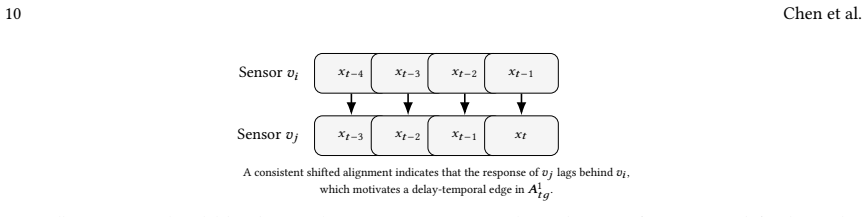
The central claim is that explicitly removing short propagation-delay errors—by aligning neighboring sensor series under 1- and 2-step shifts and convolving on the resulting spatial-temporal fusion graph, then complementing that with DTW-masked multi-head temporal attention and macro-micro transmit fusion—yields more accurate traffic flow prediction than models that assume synchronous spatial messaging or only learn implicit dynamic graphs, without a prohibitive training-time cost.
What carries the argument
The Spatial-Temporal Fusion Block (STF-Block): offline FastDTW delay-temporal graphs A¹_tg and A²_tg fused with the physical adjacency and temporal self-correlation into A_stfg for gated graph convolution, plus a DTW similarity mask on multi-head temporal self-attention, after a spectral-cluster transmit block that injects region-level features into each node.
Load-bearing premise
The important cross-sensor delays are mostly fixed 5- and 10-minute lags that can be ranked once by historical DTW on the training split and reused unchanged at test time.
What would settle it
On a held-out period or city where true spillback often exceeds 10 minutes or shifts with incidents and weather, replace the offline 1-/2-step DTW graphs with synchronous-only edges (or longer adaptive lags) and check whether the claimed MAE/RMSE gains over strong baselines disappear while other modules stay fixed.
If this is right
- Hour-ahead traffic predictors should treat short lag structure as an explicit graph prior, not only as something attention or adaptive adjacency must rediscover every batch.
- Building delay and cluster graphs offline once can keep accuracy gains without stacking heavier online modules that inflate training time on large sensor networks.
- Macro regional context plus node-level delay edges is especially useful as the road network grows (more sensors, more heterogeneous propagation), as suggested by larger gains on bigger PeMS and California sets.
- If the delay prior is wrong or stale, the same pipeline needs periodic graph refresh rather than only more attention depth.
Where Pith is reading between the lines
- The same short-shift alignment idea could transfer to other networked flows where effects travel slower than the sampling rate—power load, bike-share demand, or river gauges—without redesigning the whole backbone.
- Event-heavy days (games, crashes, weather) are the natural stress test: exogenous flags fused into the delay graph may matter more than deeper pure traffic history.
- If cities continuously retime signals or add sensors, the offline prior becomes a maintenance contract; adaptive multi-resolution clustering the authors flag in future work is the practical next bottleneck.
Editorial analysis
A structured set of objections, weighed in public.
Referee Report
Summary. The manuscript proposes A-STFGCN for one-hour traffic prediction. It combines a spectral-cluster macro graph and dynamic transmit block with STF-Blocks containing gated graph convolution and multi-head temporal self-attention. Its central novelty is a pair of offline FastDTW-derived 1- and 2-step delay-temporal graphs, intended to compensate for 5–10 minute cross-sensor propagation delays, together with a DTW-based temporal attention mask. Experiments on PeMS04/07/08 and the LargeST CA/GLA datasets compare MAE, RMSE, and accuracy with eight baselines; ablations remove the fusion GCN, delay graphs, or attention mask. The authors claim the best overall predictive performance with favorable computational and data-utilization efficiency. The evaluation is broader than in many comparable papers, and constructing the delay graphs only from the training split avoids an obvious test-leakage problem. However, the manuscript does not yet show that the proposed graphs implement or isolate directional propagation delays, and several experimental and notation gaps bear directly on the main claims.
Significance. If the delay mechanism is substantiated, the work would offer a lightweight and comparatively interpretable alternative to fully learned dynamic traffic graphs: lag relations are explicit, computed offline from training data, and reusable at inference. The five-dataset evaluation, inclusion of the larger CA/GLA benchmarks, chronological splits, training-time comparison, module ablations, and reproducibility table are useful strengths. The present evidence, however, does not yet isolate directional lead–lag effects, and the empirical superiority and efficiency claims are not uniformly supported. The likely contribution is therefore a useful architecture and empirical study rather than, at present, a demonstrated elimination of propagation delay.
major comments (5)
- [§4.3.1, Table 2, Eq. (5)] The construction and use of A_stfg are not defined sufficiently to establish delayed propagation. A_sg, A1_tg, A2_tg, and A_tc are all specified as N×N, whereas H1 is N×T1×2D. Unless an unstated reshape or NT1×NT1 block construction connects node j at time t to node i at t+1 or t+2, Eq. (5) performs only synchronous node mixing. Please specify the block matrix, edge orientation, normalization, tensor reshaping, and exact point at which lagged observations enter. If the learned edges are only applied to same-time features, the title-level claim should be revised.
- [§3.1 Definition 3; §4.3.1 Algorithm 1; §5.3, Table 6; §5.6] Definition 3 requires shifted similarity to exceed synchronous similarity, but Algorithm 1 selects top-k pairs solely by shifted FastDTW distance and never performs that comparison. As written, its input has T1=12 and Table 6 gives search length 12, making lag estimation on strongly autocorrelated 12-point series especially fragile. Lines 9–13 then symmetrize the edges and Table 6 binarizes them, removing both lag direction and magnitude. Please use the full training history (or justify windowing), require a shifted-over-synchronous improvement, report lag distributions and search-length sensitivity, and test degree-matched shuffled/reversed/synchronous graphs rather than relying only on the current w/o-Delay ablation.
- [§4.3.2, Eqs. (8)–(10)] The mask operation is mathematically and dimensionally unclear. M_t is T1×T1, while MultiHead(X) after value aggregation is a temporal feature tensor (T1×hidden dimension per node), so MultiHead(X)⊙M_t is not generally defined and is not equivalent to masking attention logits. If the mask is intended to select time-step pairs, it should modify QK^T/sqrt(d_k), or the attention weights, before aggregation. Please give explicit shapes and the corrected equation; otherwise the DTW-mask mechanism and the w/o-mask ablation cannot be interpreted.
- [§5.4–5.5, Tables 3–4] The empirical basis for “best overall” needs tightening. §5.4 lists eight baselines but omits GWNET, which appears in Table 4; STAGCN-EC is absent from CA/GLA and its PeMS08 entries are missing. The statement that poorly performing models are not included raises a selection concern. On GLA, A-STFGCN is second in MAE (20.252 versus GWNET’s 20.232) and only ties accuracy, so the superiority claim is aggregate rather than uniform. Please clarify whether all baselines were rerun under identical splits and tuning, complete the tables, and report multi-run means and variability or statistical comparisons, especially where margins are small.
- [Abstract; §5.5, Table 8; §7] The abstract and conclusion claim both computational efficiency and “data utilization efficiency,” but Table 8 reports only total training time for two baselines on PeMS04/PeMS07. There are no parameter counts, peak-memory measurements, inference latency, preprocessing costs for CA/GLA, or experiments varying the amount of training data. Either provide these measurements across representative baselines and datasets, or narrow the claim to the specific training-time result actually demonstrated.
minor comments (9)
- [§5.2] “Accuracy” is never defined. Please give the formula, treatment of zero or missing observations, and whether it is computed per horizon and then averaged.
- [Abstract; §5.1; §5.5] The manuscript alternates between traffic flow and traffic speed prediction, while the cited PeMS/LargeST benchmarks are commonly speed datasets. State the predicted variable and units consistently in the abstract, datasets, and results.
- [§4.3.1, Eq. (5)] The Laplacian-based matrix A in Eq. (5) is not defined. Please specify the adjacency, degree, self-loop, and normalization convention, and confirm that it is the same across datasets.
- [§4.3.1, Eq. (7)] Eq. (7) says Attention(X) but sums terms involving H3; C is undefined; W3* is unexplained; and the usual softmax/scaling are omitted. The two consecutive assignments to H4 also make the residual operation ambiguous.
- [Algorithm 1; Table 6] Algorithm 1 returns “Weighted Matrices,” but lines 9–13 assign only ones and Table 6 states that all fused subgraphs are binarized. Use consistent terminology.
- [§5.3, Table 6] Table 6 is helpful, but reproducibility still lacks the top-k value, hidden dimensions, number of attention heads, number of STF-Blocks, dilation/kernel settings beyond dilation, validation-tuning ranges, and a code or configuration release.
- [§5.1; §5.3] The construction of A_sg from sensor distances or road connections is not specified. Please provide the thresholding/weighting rule and explain why the final graph is binarized.
- [Tables 3–4] Several table entries lack spacing, e.g. STFGNN’s “33.0030.878” in Table 3 and GWNET’s “20.23232.8860.883” in Table 4.
- [§5.6, Figures 6–7] Figures 6–7 would be more informative with exact numerical values, horizon-specific results, and variability across runs; Figure 6 currently supports only a qualitative ablation comparison.
Circularity Check
No significant circularity: standard supervised forecasting with offline graph priors and held-out metrics, not predictions forced by construction.
full rationale
A-STFGCN’s chain is architectural design plus empirical evaluation, not a first-principles derivation that collapses into its inputs. Delay-temporal graphs (Algorithm 1, Def. 3) and the spectral cluster/transmit path are offline structural priors built from training topology and series; the model is then trained with MAE on chronological splits and scored on held-out test MAE/RMSE/Accuracy (Tables 3–4). Those test metrics are not algebraic identities of the DTW masks, Nc, or adjacency entries. Hyperparameters (Nc, top-k) chosen on validation are ordinary model selection, not “fitted inputs renamed as predictions.” Related-work positioning against STFGNN/PDFormer/HGCN etc. is comparative context, not a self-citation uniqueness theorem that forces the result. Skeptical concerns about symmetrized/binarized lag graphs or weak ablations go to correctness and causal attribution of gains, not circularity. No step reduces Eq. X to Eq. Y by definition or makes the reported forecast equal the fitted object by construction.
Axiom & Free-Parameter Ledger
free parameters (6)
- Nc (macro cluster count) =
PeMS04=20, PeMS07=40, PeMS08=40, CA=400, GLA=200
- top-k delay neighbors in Algorithm 1 =
validation-selected (unspecified numeric k)
- Delay horizon {1,2} steps only =
1-step and 2-step only
- FastDTW search length =
12
- Optimizer and training hyperparameters =
lr=1e-4, batch=32, epochs=80, dil=2
- Attention/projection and GCN weight matrices =
trained parameters (not published)
axioms (6)
- domain assumption Road network is an undirected static graph with binary adjacency sufficient for spatial message passing.
- domain assumption If DTW similarity after a k-step shift exceeds synchronous similarity, the pair exhibits k-step propagation delay useful for forecasting.
- ad hoc to paper Dominant local propagation lies in a 5–10 minute window; longer effects are handled by depth and temporal attention.
- domain assumption Spectral clusters of the static topology yield stable regional context that improves node forecasts when re-injected via a learned transmit matrix.
- domain assumption Offline graphs built on the training split remain valid for validation/test under chronological split and Z-score normalization.
- standard math MAE on flow/speed series is an adequate training objective for the reported Accuracy/MAE/RMSE claims.
invented entities (4)
-
A-STFGCN / STF-Block with GSTF-GCN
no independent evidence
-
Delay-temporal graphs A1_tg, A2_tg from FastDTW top-k shifts
no independent evidence
-
Dynamic transmit matrix Mat^d_T
no independent evidence
-
DTW-based temporal mask Mt for multi-head self-attention
no independent evidence
read the original abstract
Predicting traffic flow is crucial to optimizing transportation systems and improving urban mobility. Many graph convolution-based models have been proposed to extract spatial-temporal features and predict traffic flow. However, most focus on spatial-temporal and semantic correlation in topological relationships. There are two primary problems to address. Firstly, the convolutional structure in the model focuses on utilizing static spatial dependencies and spatial-temporal relationships in topological structures, while neglecting the different information propagation delays between adjacent nodes in the convolution. Secondly, these methods often stack a large number of complex structures, resulting in a substantial increase in computational time during the model training phase, thereby disregarding the model's requirements for timeliness. In this paper, we propose a novel network called the Attention-Based Spatial-Temporal Fusion Graph Convolution Network (A-STFGCN). We design a spatial-temporal fusion block to extract the spatial-temporal feature correlations with propagation delay errors removed and to capture both long-term and short-term temporal characteristics of the data within a multi-head self-attention mechanism based on a mask matrix. Extensive experiments on five real-world datasets demonstrate that our method achieves the best overall performance while having good computation and data utilization efficiency compared with the eight baseline methods.
Figures




Reference graph
Works this paper leans on
-
[1]
Lingxiao Cao, Bin Wang, Guiyuan Jiang, Yanwei Yu, and Junyu Dong. 2025. Spatiotemporal-aware trend-seasonality decomposition network for traffic flow forecasting. InProceedings of the AAAI Conference on Artificial Intelligence, Vol. 39. AAAI Press, 11463–11471
2025
-
[2]
Changlu Chen, Yanbin Liu, Ling Chen, and Chengqi Zhang. 2022. Bidirectional spatial-temporal adaptive transformer for urban traffic flow forecasting.IEEE Transactions on Neural Networks and Learning Systems34, 10 (2022), 6913–6925
2022
-
[3]
Jinsong Chen, Boyu Li, Qiuting He, and Kun He. 2024. PAMT: A Novel Propagation-Based Approach via Adaptive Similarity Mask for Node Classification.IEEE Transactions on Computational Social Systems(2024)
2024
-
[4]
J. Chen, L. Zheng, and Y. Hu. 2024. Traffic flow matrix-based graph neural network with attention mechanism for traffic flow prediction.Information Fusion104 (2024), 102146
2024
-
[5]
Kyunghyun Cho, Bart Van Merriënboer, Dzmitry Bahdanau, and Yoshua Bengio. 2014. On the properties of neural machine translation: Encoder- decoder approaches.Proceedings of SSST@EMNLP 2014(2014), 103–111
2014
-
[6]
Shengdong Du, Tianrui Li, Xun Gong, Yan Yang, and Shi Jinn Horng. 2017. Traffic flow forecasting based on hybrid deep learning framework. In 12th international conference on intelligent systems and knowledge engineering (ISKE). IEEE, 1–6
2017
-
[7]
Canyang Guo, Chi-Hua Chen, Feng-Jang Hwang, Ching-Chun Chang, and Chin-Chen Chang. 2022. Fast Spatiotemporal Learning Framework for Traffic Flow Forecasting.IEEE Transactions on Intelligent Transportation Systems(2022), 8606–8616
2022
-
[8]
Kan Guo, Yongli Hu, Yanfeng Sun, Sean Qian, Junbin Gao, and Baocai Yin. 2021. Hierarchical graph convolution network for traffic forecasting. In Proceedings of the AAAI conference on artificial intelligence, Vol. 35. 151–159
2021
-
[9]
Shengnan Guo, Youfang Lin, Ning Feng, Chao Song, and Huaiyu Wan. 2019. Attention based spatial-temporal graph convolutional networks for traffic flow forecasting. InProceedings of the AAAI conference on artificial intelligence, Vol. 33. 922–929
2019
-
[10]
Xiaohui Huang, Yuming Ye, Xiaofei Yang, and Liyan Xiong. 2023. Multi-view dynamic graph convolution neural network for traffic flow prediction. Expert Systems with Applications222 (2023), 119779
2023
-
[11]
Jiawei Jiang, Chengkai Han, Wayne Xin Zhao, and Jingyuan Wang. 2023. PDFormer: Propagation Delay-aware Dynamic Long-range Transformer for Traffic Flow Prediction.Thirty-Seventh AAAI Conference on Artificial Intelligence(2023), 4365–4373
2023
-
[12]
Danqing Kang, Yisheng Lv, and Yuan-yuan Chen. 2017. Short-term traffic flow prediction with LSTM recurrent neural network. InIEEE 20th international conference on intelligent transportation systems (ITSC). IEEE, 1–6
2017
-
[13]
Qifeng Lai, Jinyu Tian, Wei Wang, and Xiping Hu. 2022. Spatial-temporal attention graph convolution network on edge cloud for traffic flow prediction.IEEE Transactions on Intelligent Transportation Systems24, 4 (2022), 4565–4576. Manuscript submitted to ACM Attention-Based Spatial-Temporal Fusion GCN 19
2022
-
[14]
Shiyong Lan, Yitong Ma, Weikang Huang, Wenwu Wang, Hongyu Yang, and Pyang Li. 2022. Dstagnn: Dynamic spatial-temporal aware graph neural network for traffic flow forecasting. InInternational Conference on Machine Learning, ICML 2022. 11906–11917
2022
-
[15]
Mengzhang Li and Zhanxing Zhu. 2021. Spatial-temporal fusion graph neural networks for traffic flow forecasting. InProceedings of the AAAI conference on artificial intelligence, Vol. 35. 4189–4196
2021
-
[16]
Yaguang Li, Rose Yu, Cyrus Shahabi, and Yan Liu. 2018. Diffusion convolutional recurrent neural network: Data-driven traffic forecasting.6th International Conference on Learning Representations(2018), 01926
2018
-
[17]
Saiqun Lu, Qiyan Zhang, Guangsen Chen, and Dewen Seng. 2021. A combined method for short-term traffic flow prediction based on recurrent neural network.Alexandria Engineering Journal60, 1 (2021), 87–94
2021
-
[18]
Selim Reza, Marta Campos Ferreira, José Joaquim M Machado, and João Manuel RS Tavares. 2022. A multi-head attention-based transformer model for traffic flow forecasting with a comparative analysis to recurrent neural networks.Expert Systems with Applications202 (2022), 117275
2022
-
[19]
Yanli Shao, Yiming Zhao, Feng Yu, Huawei Zhu, and Jinglong Fang. 2021. The traffic flow prediction method using the incremental learning-based CNN-LTSM model: the solution of mobile application.Mobile Information Systems2021 (2021), 1–16
2021
-
[20]
Chao Song, Youfang Lin, Shengnan Guo, and Huaiyu Wan. 2020. Spatial-temporal synchronous graph convolutional networks: A new framework for spatial-temporal network data forecasting. InProceedings of the AAAI conference on artificial intelligence, Vol. 34. 914–921
2020
-
[21]
Jie Su, Zhongfu Jin, Jie Ren, Jiandang Yang, and Yong Liu. 2022. GDFormer: a graph diffusing attention based approach for traffic flow prediction. Pattern Recognition Letters156 (2022), 126–132
2022
-
[22]
Xinyu Su, Feng Liu, Yanchuan Chang, Egemen Tanin, Majid Sarvi, and Jianzhong Qi. 2025. DualCast: A Model to Disentangle Aperiodic Events from Traffic Series. InProceedings of the Thirty-Fourth International Joint Conference on Artificial Intelligence, IJCAI-25, James Kwok (Ed.). International Joint Conferences on Artificial Intelligence Organization, 3290...
2025
-
[23]
Yongxue Tian and Li Pan. 2015. Predicting short-term traffic flow by long short-term memory recurrent neural network. InIEEE international conference on smart city/SocialCom/SustainCom (SmartCity). IEEE, 153–158
2015
-
[24]
Ashish Vaswani, Noam Shazeer, Niki Parmar, Jakob Uszkoreit, Llion Jones, Aidan N Gomez, Łukasz Kaiser, and Illia Polosukhin. 2017. Attention is all you need.Advances in neural information processing systems30 (2017)
2017
-
[25]
Petar Veličković, Guillem Cucurull, Arantxa Casanova, Adriana Romero, Pietro Lio, and Yoshua Bengio. 2018. Graph attention networks.6th International Conference on Learning Representations(2018)
2018
-
[26]
Hanqiu Wang, Rongqing Zhang, Xiang Cheng, and Liuqing Yang. 2022. Hierarchical traffic flow prediction based on spatial-temporal graph convolutional network.IEEE Transactions on Intelligent Transportation Systems23, 9 (2022), 16137–16147
2022
-
[27]
Meng Wang, Longgang Xiang, Chenhao Wu, Zejiao Wang, Xin Chen, Shaozu Xie, and Ying Luo. 2025. Latent Graph Structure Learning for Large-Scale Traffic Forecasting. InProceedings of the 34th ACM International Conference on Information and Knowledge Management. 5314–5318
2025
-
[28]
Zonghan Wu, Shirui Pan, Guodong Long, Jing Jiang, and Chengqi Zhang. 2019. Graph wavenet for deep spatial-temporal graph modeling.Proceedings of the Twenty-Eighth International Joint Conference on Artificial Intelligence(2019), 1907–1913
2019
-
[29]
Yi Xie, Yun Xiong, and Yangyong Zhu. 2020. SAST-GNN: a self-attention based spatio-temporal graph neural network for traffic prediction. In Database Systems for Advanced Applications: 25th International Conference, DASFAA 2020, Proceedings, Part I 25. Springer, 707–714
2020
-
[30]
Mingxing Xu, Wenrui Dai, Chunmiao Liu, Xing Gao, Weiyao Lin, Guo-Jun Qi, and Hongkai Xiong. 2020. Spatial-temporal transformer networks for traffic flow forecasting.arXiv preprint arXiv:2001.02908(2020), 02908
Pith/arXiv arXiv 2020
-
[31]
Xuran Xu, Tong Zhang, Chunyan Xu, Zhen Cui, and Jian Yang. 2022. Spatial–Temporal Tensor Graph Convolutional Network for Traffic Speed Prediction.IEEE Transactions on Intelligent Transportation Systems24, 1 (2022), 92–103
2022
-
[32]
Haoyang Yan, Xiaolei Ma, and Ziyuan Pu. 2021. Learning dynamic and hierarchical traffic spatiotemporal features with transformer.IEEE Transactions on Intelligent Transportation Systems23, 11 (2021), 22386–22399
2021
-
[33]
Xue Ye, Shen Fang, Fang Sun, Chunxia Zhang, and Shiming Xiang. 2022. Meta graph transformer: A novel framework for spatial–temporal traffic prediction.Neurocomputing491 (2022), 544–563
2022
-
[34]
ChuanTao Yin, Zhang Xiong, Hui Chen, JingYuan Wang, Daven Cooper, and Bertrand David. 2015. A literature survey on smart cities.Sci. China Inf. Sci.58, 10 (2015), 1–18
2015
-
[35]
Xueyan Yin, Genze Wu, Jinze Wei, Yanming Shen, Heng Qi, and Baocai Yin. 2021. Deep learning on traffic prediction: Methods, analysis, and future directions.IEEE Transactions on Intelligent Transportation Systems23, 6 (2021), 4927–4943
2021
-
[36]
Bing Yu, Haoteng Yin, and Zhanxing Zhu. 2018. Spatio-temporal graph convolutional networks: A deep learning framework for traffic forecasting. Proceedings of the Twenty-Seventh International Joint Conference on Artificial Intelligence(2018), 3634–3640
2018
-
[37]
Wu Z. 2024. Deep learning with improved metaheuristic optimization for traffic flow prediction.Journal of Computer Science and Technology Studies (2024), 47–53
2024
-
[38]
Wendong Zhang, Ruobai Xiang, Zhifang Liao, Peng Lan, and Qihao Liang. 2025. FEDDGCN: A Frequency-Enhanced Decoupling Dynamic Graph Convolutional Network for Traffic Flow Prediction. InProceedings of the 34th ACM International Conference on Information and Knowledge Management. 4222–4231
2025
-
[39]
Weibin Zhang, Yinghao Yu, Yong Qi, Feng Shu, and Yinhai Wang. 2019. Short-term traffic flow prediction based on spatio-temporal analysis and CNN deep learning.Transportmetrica A: Transport Science15, 2 (2019), 1688–1711
2019
-
[40]
Ling Zhao, Yujiao Song, Chao Zhang, Yu Liu, Pu Wang, Tao Lin, Min Deng, and Haifeng Li. 2019. T-gcn: A temporal graph convolutional network for traffic prediction.IEEE transactions on intelligent transportation systems21, 9 (2019), 3848–3858. Manuscript submitted to ACM 20 Chen et al
2019
-
[41]
Yiqing Zou, Hanning Yuan, Qianyu Yang, Ziqiang Yuan, Shuliang Wang, and Sijie Ruan. 2026. Meta Dynamic Graph for Traffic Flow Prediction. In Proceedings of the AAAI Conference on Artificial Intelligence, Vol. 40. AAAI Press, 16584–16592. Manuscript submitted to ACM
2026
discussion (0)
Sign in with ORCID, Apple, or X to comment. Anyone can read and Pith papers without signing in.