REVIEW 3 major objections 5 minor 29 references
Partial, utility-scaled neuron resets keep continual RL agents plastic without triggering policy collapse.
Reviewed by Pith at T0; open to challenge. T0 means a machine referee read the full paper against a public rubric. the ladder, T0–T4 →
T0 review · grok-4.5
2026-07-31 04:01 UTC pith:C6B5UFAW
load-bearing objection Solid empirical stabilizer for long-horizon continual RL; the zero-collapse result holds, but the causal story is still under-isolated. the 3 major comments →
Calibrated Partial Resets: Preventing Policy Collapse in Continual Reinforcement Learning
The pith
A machine-rendered reading of the paper's core claim, the machinery that carries it, and where it could break.
Core claim
Binary full-unit resets restore plasticity but introduce abrupt weight changes that destabilize long-horizon continual RL and can cause policy collapse; CPR replaces that all-or-nothing rule with a continuous, utility-scaled pull toward initialization so that low-utility neurons are refreshed more strongly and high-utility ones only weakly, preserving both trainability and peak performance.
What carries the argument
Calibrated Partial Resets (CPR): every f steps, each neuron’s incoming and outgoing weights are moved toward reinitialization by a fraction r = ρ · ϕ(u), where u is a layer-normalized EMA of gradient-magnitude utility and ϕ is a sharp decreasing map of that utility, so adjustment concentrates on the units that need it most without fully wiping them.
Load-bearing premise
That a sustained drop of at least 8000 return lasting at least 4 million steps is the right definition of policy collapse, and that gradient-magnitude utility is a faithful enough signal that scaling the partial reset by it is what actually prevents collapse.
What would settle it
Run the same 400M-step SlipperyAnt protocol with the same collapse definition: if any binary-reset or decay baseline matches CPR’s zero collapses across 15 seeds while matching its peak and final return, or if swapping CPR’s utility signal for a uniform or random score eliminates the collapse-free advantage, the central claim fails.
If this is right
- Long-horizon continual RL can keep recovering after environment shifts without early stopping or aggressive learning-rate annealing.
- The plasticity–stability tradeoff becomes a single tunable scalar (maximum reset fraction ρ) rather than a brittle threshold.
- Utility-scaled partial reinitialization is a general design point between uniform decay and binary resets for any non-stationary training regime.
- Diagnostics such as dormant-neuron ratio, gradient-norm spikes, and parameter-norm growth can be kept flat without sacrificing peak return.
Where Pith is reading between the lines
- The same continuous utility-to-reset map may stabilize other feedback-loop settings (e.g., offline-to-online fine-tuning or multi-agent non-stationarity) where full resets currently cause brittle drops.
- If gradient-magnitude utility is only a proxy, replacing it with a cheaper activation- or age-based score while keeping the partial rule could cut the small wall-clock overhead further.
- Collapse-free training over hundreds of millions of steps suggests partial resets could let practitioners drop large rollout buffers that today are used only to mask plasticity loss.
Editorial analysis
A structured set of objections, weighed in public.
Referee Report
Summary. The paper proposes Calibrated Partial Resets (CPR), a continual-learning optimizer that periodically pulls each neuron toward its initialization by a coefficient r = ρ·ϕ(u) scaled by a layer-normalized, EMA-smoothed gradient-magnitude utility (Eqs. 3, 5–7). CPR is positioned between binary reset methods (CBP, ReDo, ReGraMa), which fully reinitialize low-utility units and zero their outgoing weights, and uniform decay methods (Shrink & Perturb). The central empirical claim is that, among compared methods, only CPR avoids policy collapse over 400M PPO steps in SlipperyAnt (zero collapses across 15 seeds, robust to the collapse threshold choice), while maintaining peak performance after friction shifts and improving over baselines on SlipperyHumanoid, Continual MetaWorld, and Continual MinAtar. Supporting evidence includes dormancy/linearization diagnostics, gradient- and parameter-norm trajectories, ablations over ρ, κ, and the utility-to-reset shape ϕ, collapse-threshold sensitivity, and stationary-setting controls (MT1, Permuted MNIST). Code is open-sourced with pinned dependencies.
Significance. If the results hold, this is a useful and well-executed empirical contribution to continual RL. The 400M-step horizon with 20 friction shifts goes well beyond typical reset-method evaluations and exposes a genuine long-horizon failure mode of binary resets; the 15-seed IQM/IQR reporting, the collapse-threshold sensitivity analysis in §4.3, and the wide ρ and κ plateaus (Figures 5, 12) make the headline "zero collapses" result credible rather than anecdotal. The work ships a reproducible, MIT-licensed JAX/Optax codebase with pinned dependencies and per-benchmark hyperparameter tables, and the authors are commendably honest about saturated benchmarks (MT1, Permuted MNIST) and about the limits of their causal story (§5). The selective-and-smooth design point is conceptually clean and cheap (~6% wall-clock overhead), so the method is practically adoptable. The main caveat to significance is that the attribution of collapse avoidance to utility-scaled partial resets specifically — rather than to correlated design differences — is not yet established, which matters for how the community should build on the result.
major comments (3)
- [§3, Eq. (7) vs. Eq. (4); Appendix H; §5] The paper's named contribution is that utility-scaled *partial* resets are the stabilizer, but CPR differs from the binary-reset baselines in at least three simultaneous ways, and the experiments do not isolate which one prevents collapse: (a) outgoing-weight handling — baselines zero the outgoing column W^{l+1}_{:,i} on reset (Eq. 4) while CPR scales it by (1−r) (Eq. 7); (b) optimizer-state handling — Appendix H states baselines reset Adam's µ, ν for affected units while CPR leaves optimizer state intact; (c) CPR's continuous (1−r) pull acts as utility-scaled shrinkage that constrains parameter norms (Figure 15), a mechanism Dohare et al. (2024) independently identify as a driver of plasticity loss and one achievable by plain weight decay or regenerative regularization (Kumar et al., 2023, cited but not benchmarked). The κ-ablation (Figure 12) isolates targeted-vs-uniform reset *magnitu
- [§4.1, Tables 1–2; Abstract] The abstract claims CPR 'outperforms prior decay and reset-based methods on Continual MetaWorld and Continual MinAtar,' but these tables use only 5 seeds and the IQRs overlap substantially: in Table 1 the Avg column has CPR at 0.231±0.005 against CBP 0.204±0.009 and ReDo 0.199±0.017, and in Table 2 CPR's 75.6±14.3 overlaps ReDo's 68.0±7.6. With n=5, IQM/IQR error bars of this width cannot support an unqualified 'outperforms' claim (the authors themselves cite Agarwal et al. 2021, which recommends stratified bootstrap CIs precisely for such comparisons). Please either increase the seed count, report bootstrap confidence intervals on the IQM differences, or temper the abstract and §4.1 language to 'competitive with / improves final performance' where the intervals overlap.
- [§4.3, Figure 1] The collapse-threshold sensitivity analysis is the right response to the obvious concern about the 8,000/4M-step definition, and the 4,000-threshold result is convincing. However, the lenient-threshold paragraph is confusingly argued: 'Under a lenient 10,000 threshold, CPR, ReDo, and ReGraMa each have zero collapses, but this threshold excludes any method whose peak return does not exceed it' — a method whose peak is below 10,000 cannot collapse under this definition *by construction*, so the 10,000 row carries no information about those methods and should not be presented as evidence either way. Please report the per-method collapse counts at each threshold in a small table (currently only Figure 1's bar chart), and clarify that the informative thresholds are those below every method's peak (~6,000–8,000).
minor comments (5)
- [Algorithm 1, line 10; §3] After each reset step all utilities are recentered to u=1, discarding the EMA history. With β=0.99 the EMA horizon is ~100 steps against a reset period f=1000, so utilities spend much of each cycle re-equilibrating from a uniform state. A brief discussion (or an ablation without recentering) of why this re-initialization of the selection signal is benign would help, since it partially undercuts the 'smoothed over multiple steps' motivation in §2.2.
- [§3, Eq. (5)] The gradient-magnitude utility is justified only by citation to ReGraMa/Liu et al. (2025). A neuron can have persistently large incoming-weight gradients because it is unstable or churning rather than useful; one sentence on why high gradient magnitude is treated as high utility (and how this interacts with PPO's advantage normalization) would close the gap.
- [Appendix F, Table 5] The tuning budgets are asymmetric across methods (e.g., CPR's ρ grid has 9 points; ReDo/ReGraMa tune an uncapped 'None' reset fraction). Please state the total number of sweep configurations per method so readers can assess whether CPR's advantage could partly reflect a larger effective search budget, even though separate sweep seeds were used.
- [References / Abstract] Typographical: 'V olodymyr Mnih' in the Mnih et al. (2013) entry; missing spaces in the abstract ('binary reset methods,partialresets', 'decay,calibratedutility-scaling'); 'linearised' vs 'linearized' inconsistency between Figure 9 caption and main text; Appendix H 'Reset operator' item 2 says outgoing columns are scaled 'towards zero,' which should be harmonized with the exact (1−r) scaling in Eq. (7).
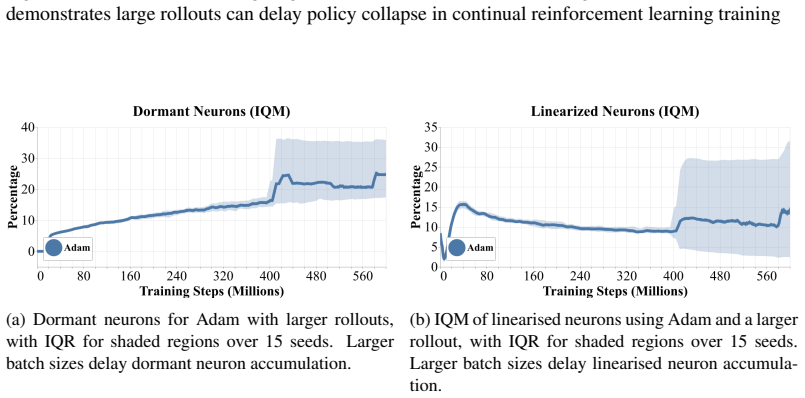
- [§4.2, Figure 3] The caption/text claim 'lower linearization correlates with higher representation capacity' sits awkwardly next to the observation that methods which suppress dormancy have *higher* linearized-unit ratios initially, and that CPR 'maintains steady' ratios rather than lowering them. Please tighten this paragraph so the diagnostic narrative matches what the figure shows.
Circularity Check
No significant circularity: CPR is an empirical optimizer design evaluated on external returns and collapse counts, not a derivation that reduces to its inputs.
full rationale
This is a standard continual-RL methods paper. The central objects—utility score (Eq. 5), EMA normalization (Eq. 3), shape map ϕ (Eq. 6), and partial-reset operator (Eq. 7)—are design choices, not quantities derived from the claimed outcome (zero policy collapses / higher IQM return). Those outcomes are measured on held-out training trajectories against external baselines (Adam, CBP, ReDo, ReGraMa, Shrink & Perturb) with multi-seed IQM reporting. Hyperparameters (ρ, κ, β, f) are swept on the same task family, which is ordinary optimizer practice and does not make the collapse/return results true by construction. Citations for gradient-magnitude utility (ReGraMa/Liu et al., CBP/Dohare et al.) are to external authors and supply motivation, not a self-citation uniqueness chain that forces the result. No fitted parameter is relabeled as a prediction; no uniqueness theorem is imported from the present authors; no known empirical law is merely renamed. Causal-attribution confounds (outgoing-weight handling, optimizer-state resets, implicit norm control) are real scientific concerns but are not circularity. Score 0 is appropriate.
Axiom & Free-Parameter Ledger
free parameters (5)
- ρ (max per-unit reset fraction) =
0.015 (Ant, MetaWorld, MinAtar); 0.05 (Humanoid)
- κ (sigmoid sharpness) =
16
- β (utility EMA decay) =
0.99
- f (reset update frequency) =
1000 (main continuous-control); 10^3 on MetaWorld/MinAtar
- collapse thresholds (Δreturn, persistence) =
8000 return / 4M steps (primary)
axioms (5)
- domain assumption Mean incoming-weight gradient magnitude is a valid per-neuron utility for deciding reset strength.
- domain assumption Plasticity loss in deep nets under non-stationarity is substantially driven by dormant/linearized units and rising parameter norms.
- domain assumption Binary full reinitialization plus outgoing-weight zeroing introduces abrupt updates that can destabilize long-horizon RL.
- ad hoc to paper Layer-normalized EMA utility with mean recentered to 1 after each reset step is a stable selection signal across layers and time.
- domain assumption Standard PPO/SAC/Adam/Muon training stacks and Brax/MetaWorld/MinAtar task constructions are faithful continual-RL testbeds.
invented entities (2)
-
Calibrated Partial Resets (CPR) operator
independent evidence
-
Utility-to-reset shape ϕ (anchored sigmoid)
independent evidence
read the original abstract
Neural networks are hindered by accumulating dormant neurons and loss of expressivity throughout training, particularly in non-stationary data settings, such as continual supervised and reinforcement learning. Recently, neuron resets have been used to maintain gradient flow and restore plasticity. However, full unit reinitialization often sacrifices peak performance and can destabilize training, leading to policy collapse. To preserve plasticity without destabilizing training, we propose Calibrated Partial Resets (CPR), an optimizer that periodically pulls low-utility neurons toward their initialization, with pull strength scaled by each neuron's utility. Unlike binary reset methods, partial resets avoid brittleness; unlike uniform decay, calibrated utility-scaling concentrates adjustment on the units that need it most. Among compared methods, only CPR avoids policy collapse over 400M training steps in SlipperyAnt, and it outperforms prior decay and reset-based methods on Continual MetaWorld and Continual MinAtar benchmarks. Ablations reveal a tunable trade-off between plasticity and peak performance, highlighting utility-scaled reinitialization as a promising direction for continual learning.
Figures




Reference graph
Works this paper leans on
-
[1]
or training horizons extend into the regime where plasticity loss compounds into collapse (SlipperyAnt, 400M steps). We include MT1 results not as the principal evidence for CPR, but to verify the method imposes no penalty in stationary settings, a necessary property for a general-purpose continual learning optimizer. Robustness and sample efficiency.On c...
2023
-
[3]
Shibhansh Dohare, Richard S Sutton, and A Rupam Mahmood
URLhttp: //github.com/google-deepmind. Shibhansh Dohare, Richard S Sutton, and A Rupam Mahmood. Continual backprop: Stochastic gradient descent with persistent randomness.arXiv preprint arXiv:2108.06325,
-
[5]
C Daniel Freeman, Erik Frey, Anton Raichuk, Sertan Girgin, Igor Mordatch, and Olivier Bachem. Brax–a differentiable physics engine for large scale rigid body simulation.arXiv preprint arXiv:2106.13281,
-
[8]
Adam: A method for stochastic optimization.arXiv preprint arXiv:1412.6980,
Diederik P Kingma and Jimmy Ba. Adam: A method for stochastic optimization.arXiv preprint arXiv:1412.6980,
-
[10]
Measure gradients, not activations! enhancing neuronal activity in deep reinforcement learning
Jiashun Liu, Zihao Wu, Johan Obando-Ceron, Pablo Samuel Castro, Aaron Courville, and Ling Pan. Measure gradients, not activations! enhancing neuronal activity in deep reinforcement learning. arXiv preprint arXiv:2505.24061,
-
[11]
Sgdr: Stochastic gradient descent with warm restarts.arXiv preprint arXiv:1608.03983,
Ilya Loshchilov and Frank Hutter. Sgdr: Stochastic gradient descent with warm restarts.arXiv preprint arXiv:1608.03983,
-
[13]
Meta-world+: An improved, standardized, rl benchmark.arXiv preprint arXiv:2505.11289,
Reginald McLean, Evangelos Chatzaroulas, Luc McCutcheon, Frank Röder, Tianhe Yu, Zhanpeng He, KR Zentner, Ryan Julian, JK Terry, Isaac Woungang, et al. Meta-world+: An improved, standardized, rl benchmark.arXiv preprint arXiv:2505.11289,
-
[14]
Playing atari with deep reinforcement learning.arXiv preprint arXiv:1312.5602,
V olodymyr Mnih, Koray Kavukcuoglu, David Silver, Alex Graves, Ioannis Antonoglou, Daan Wier- stra, and Martin Riedmiller. Playing atari with deep reinforcement learning.arXiv preprint arXiv:1312.5602,
-
[16]
Chinmay Savadikar, Michelle Dai, and Tianfu Wu. Continual learning via learning a continual memory in vision transformer.arXiv preprint arXiv:2303.08250,
-
[17]
Proximal policy optimization algorithms.arXiv preprint arXiv:1707.06347,
John Schulman, Filip Wolski, Prafulla Dhariwal, Alec Radford, and Oleg Klimov. Proximal policy optimization algorithms.arXiv preprint arXiv:1707.06347,
-
[19]
Deep reinforcement learning and the deadly triad.arXiv preprint arXiv:1812.02648,
Hado Van Hasselt, Yotam Doron, Florian Strub, Matteo Hessel, Nicolas Sonnerat, and Joseph Mo- dayil. Deep reinforcement learning and the deadly triad.arXiv preprint arXiv:1812.02648,
-
[21]
Neural networks under prolonged non-stationary training forget prior knowledge (French, 1999; Kirkpatrick et al.,
and trust regions (Schulman et al., 2015). Neural networks under prolonged non-stationary training forget prior knowledge (French, 1999; Kirkpatrick et al.,
2015
-
[22]
Dohare et al
and lose their ability to adapt (Lyle et al., 2024; Nauman et al., 2024; Dohare et al., 2021), a phenomenon that has drawn increasing attention across class-incremental learning (Savadikar et al., 2023), supervised learning (Ash & Adams, 2020), and RL (Lyle et al., 2022). Dohare et al. (2024) links plasticity loss to rising parameter norms, dormant units,...
2024
-
[24]
We chose SAC over PPO as it is standard for the benchmark and allows us to verify CPR’s performance under off-policy methods
using Soft Actor Critic (SAC) (Haarnoja et al., 2018). We chose SAC over PPO as it is standard for the benchmark and allows us to verify CPR’s performance under off-policy methods. We compare CPR against Adam and other reset-based baselines across 10 distinct manipulation tasks over 2 million training steps. Reset methods hyperparameters are reported in Table
2018
-
[26]
Transformation Peak Average Final Linear 8223.515 5778.549 5873.256 Exponential 8326.043 5999.8797598.191 Softplus 8145.749 5917.624 6896.087 Sigmoid 8360.509 6066.2867498.798 Table 10: Training performance on SlipperyAnt (IQM across 15 seeds) withρ= 0.015andκ=
-
[27]
To ensure a fair comparison, we calibrated each function to share the same threshold value and fixed ρ= 0.015
As shown in Table 10, the Sigmoid and Exponential transformations yield the highest returns. To ensure a fair comparison, we calibrated each function to share the same threshold value and fixed ρ= 0.015. We observe that the choice of transformation shape has a measurable impact on performance. The Exponential, Sigmoid, and Softplus functions all amplify r...
2014
-
[28]
While ContinualWorld has a focus on catas- trophic forgetting we instead measure the adaptation performance using the latest versions of Meta- World environments
tasks sequentially. While ContinualWorld has a focus on catas- trophic forgetting we instead measure the adaptation performance using the latest versions of Meta- World environments. We use the average and final performance of plasticity preservation baselines on this benchmark. This benchmark would take 3 days to run using an RTX3090. Continual MinAtar.T...
2025
-
[29]
tx", tx), (
with Optax (DeepMind et al., 2020). Once attached, the Optax optimizer can be used in the same way as a regular Optax optimizer, only if the reset method requires features (i.e. ReDo or CBP) then these are taken as an input to the optimizer.updatefunction. A simple optimizer setup is shown in Listing 1 Listing 1: Demonstration of simple optimizer using a ...
2020
-
[1998]
Hongyao Tang, Johan Obando-Ceron, Pablo Samuel Castro, Aaron Courville, and Glen Berseth. Mitigating plasticity loss in continual reinforcement learning by reducing churn.arXiv preprint arXiv:2506.00592,
-
[2013]
10 Michal Nauman, Michał Bortkiewicz, Piotr Miło ´s, Tomasz Trzci ´nski, Mateusz Ostaszewski, and Marek Cygan. Overestimation, overfitting, and plasticity in actor-critic: the bitter lesson of rein- forcement learning.arXiv preprint arXiv:2403.00514,
-
[2015]
J Fernando Hernandez-Garcia, Shibhansh Dohare, Jun Luo, and Rich S Sutton. Reinitializing weights vs units for maintaining plasticity in neural networks.arXiv preprint arXiv:2508.00212,
-
[2016]
(2025) suggests reinitialization provides additional benefit
can mitigate plasticity loss, but prior work Hernandez-Garcia et al. (2025) suggests reinitialization provides additional benefit. CBP (Dohare et al., 2021
2025
-
[2017]
Saurabh Kumar, Henrik Marklund, and Benjamin Van Roy. Maintaining plasticity in continual learning via regenerative regularization.arXiv preprint arXiv:2308.11958,
-
[2018]
URLhttp: //github.com/jax-ml/jax. Greg Brockman, Vicki Cheung, Ludwig Pettersson, Jonas Schneider, John Schulman, Jie Tang, and Wojciech Zaremba. Openai gym, june 2016.arXiv preprint arXiv:1606.01540,
Pith/arXiv arXiv 2016
-
[2020]
Layer normalization.arXiv preprint arXiv:1607.06450,
Jimmy Lei Ba, Jamie Ryan Kiros, and Geoffrey E Hinton. Layer normalization.arXiv preprint arXiv:1607.06450,
-
[2021]
Policy shifts can be amplified through feedback loops, spiraling into catastrophic per- formance collapse (Juliani & Ash, 2024)
A CPR Algorithm Algorithm 1CPR (utilities every step; resets everyfsteps) Require:Update frequencyf, EMA decayβ, steepnessκ, max resetρ 1:Input:current stept 2:Compute per-neuron utilityS ℓ i (t){layer-normalized} 3:Update EMA:u ℓ i ←β uℓ i + (1−β) ˜Sℓ i 4:iftmodf= 0andt >0then{apply resets everyfsteps} 5:foreach layerℓdo 6:foreach neuronido 7:r ℓ i ←ρ·mi...
1998
-
[2023]
URLhttps://proceedings.mlr. press/v202/lyle23b.html. Clare Lyle, Zeyu Zheng, Khimya Khetarpal, Hado van Hasselt, Razvan Pascanu, James Martens, and Will Dabney. Disentangling the causes of plasticity loss in neural networks.arXiv preprint arXiv:2402.18762,
-
[2024]
Self-normalized resets for plasticity in continual learning
Vivek F Farias and Adam D Jozefiak. Self-normalized resets for plasticity in continual learning. arXiv preprint arXiv:2410.20098,
-
[2025]
Maximilian Igl, Gregory Farquhar, Jelena Luketina, Wendelin Boehmer, and Shimon Whiteson. Transient non-stationarity and generalisation in deep reinforcement learning.arXiv preprint arXiv:2006.05826,
Pith/arXiv arXiv 2006
discussion (0)
Sign in with ORCID, Apple, or X to comment. Anyone can read and Pith papers without signing in.