REVIEW 1 major objections 6 minor 76 references
A neural network called GSpyNetTree-O4, run automatically around gravitational-wave candidates, catches 95.4% to 97.9% of detector glitches on test data, and for the first time can report a glitch and a gravitational-wave signal together wh
Reviewed by Pith at T0; open to challenge. T0 means a machine referee read the full paper against a public rubric. the ladder, T0–T4 →
An updated convolutional-neural-network classifier for LIGO data identifies glitches near gravitational-wave candidates in 95–98% of test cases and can flag a glitch and a gravitational-wave signal in the same spectrogram.
T0 review reviewed 2026-08-01 challenge →
load-bearing objection The multi-label architecture and O4 deployment are real contributions, but the headline test recalls may be inflated by a post-augmentation train/test split that lets near-duplicates land on both sides. the 1 major comments →
GSpyNetTree-O4: an event validation tool used in the fourth LIGO-Virgo-KAGRA observing run
The pith
A machine-rendered reading of the paper's core claim, the machinery that carries it, and where it could break.
The reading
Core claim
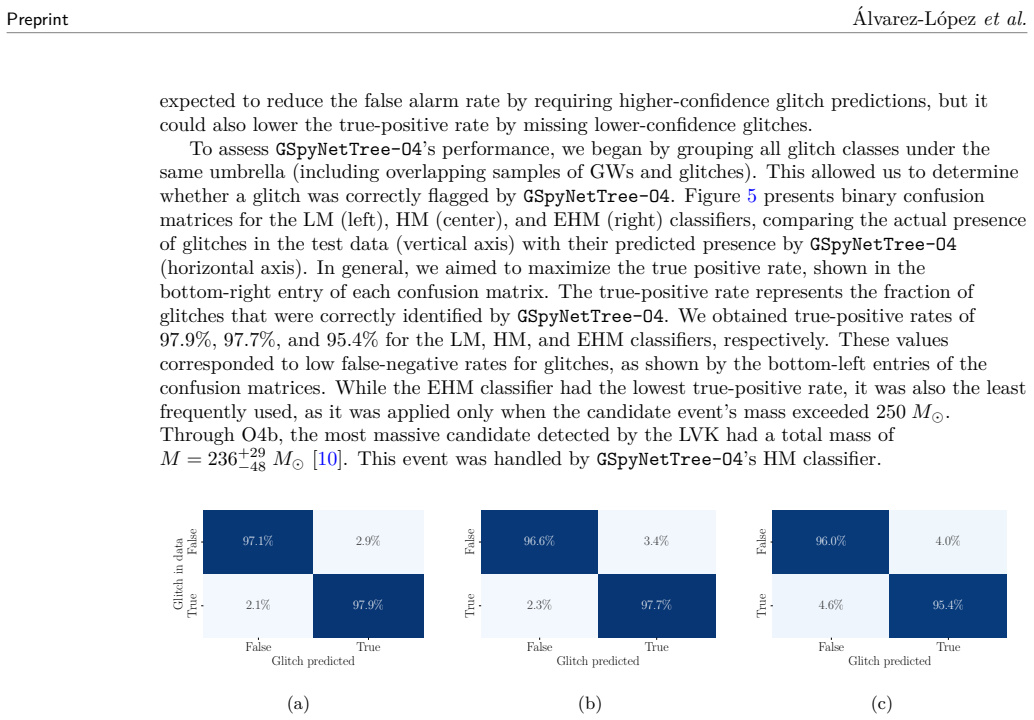
GSpyNetTree-O4 is an ensemble of three convolutional neural networks—low-mass, high-mass, and extremely-high-mass—each fed a 2×2 grid of spectrograms spanning 0.5, 1, 2, and 4 seconds around a candidate. Its discovery is the combination of a multi-label output layer (sigmoid activations with binary cross-entropy loss) with a training set that deliberately includes simulated gravitational waves overlapping or near real glitches, plus quieter and more varied background noise segments and a 60 Hz calibration subtraction. On held-out test data, the low-mass, high-mass, and extremely-high-mass classifiers achieved glitch recall of 97.9%, 97.7%, and 95.4%, respectively, and true-negative rates (no
What carries the argument
The engine is a three-branch decision tree of InceptionV3-derived convolutional networks. Each branch handles a mass range, with output probabilities converted to labels by a 50% threshold. The key new mechanism is multi-label classification, which replaces the previous single-label softmax with independent sigmoid outputs per class, letting one input be labeled as both a glitch and a gravitational wave. Training data was built by injecting simulated signals into automatically selected quiet detector stretches, adding real glitches, and constructing overlapping glitch-plus-signal examples with controlled time offsets; spectrograms were generated at Q=20 to reduce saturation. This constructio
Load-bearing premise
The offline test distribution—simulated gravitational-wave signals injected into automatically selected quiet O3 detector stretches plus real glitches, all after 60 Hz subtraction—is representative of the real O4 LIGO noise conditions near gravitational-wave candidates; if the background drifted in morphology or frequency content, the reported recall numbers would not describe deployment behavior.
What would settle it
Take a set of real O4 LIGO noise transients that human validators label as glitches and that belong to classes absent from the training set, such as high-frequency whistles, and count how often the tool reports 'No Glitch'. The paper already shows this happens for such classes in a validation study, so the decisive test is whether these misses inflate the false-negative rate on real LIGO candidates above the claimed test-set level (2.1–4.6%), which would contradict the central claim of reliable event validation.
If this is right
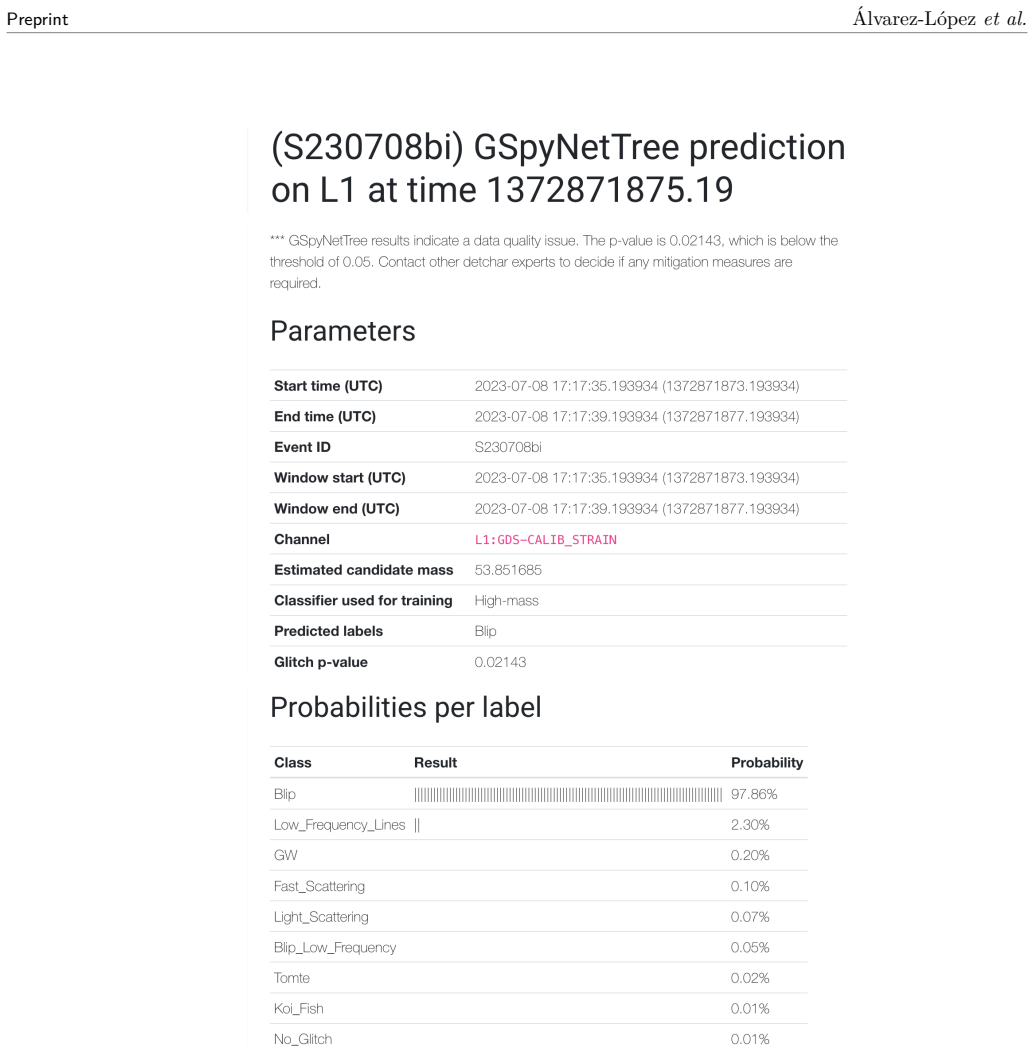
- Candidates whose data are contaminated by a nearby glitch can be flagged and retracted or mitigated within minutes, as demonstrated by the retracted O4 candidate that GSpyNetTree-O4 identified as a blip with 97.8% probability.
- Clean inputs are rarely mislabeled as problematic—false-positive rates are 2.9% to 4.0%—so validators can trust a 'no data-quality issue' report most of the time, reducing manual review workload.
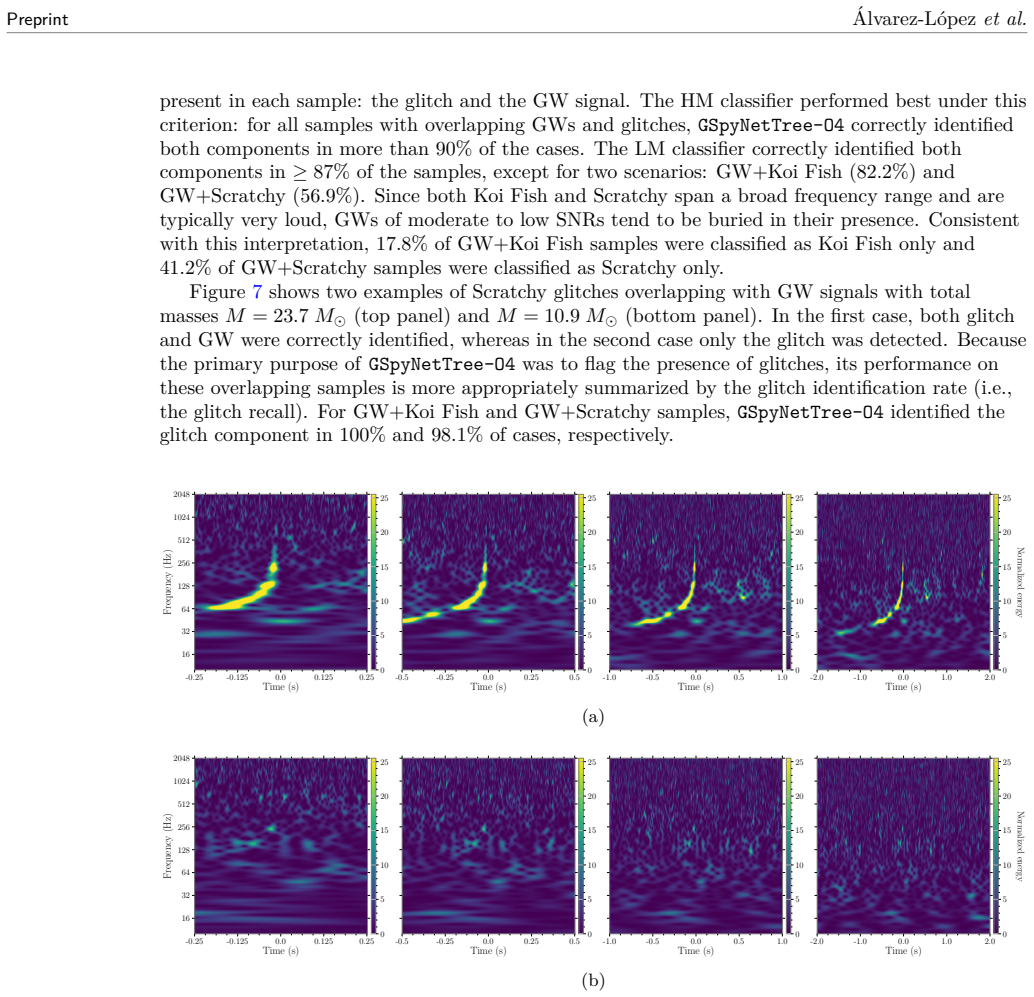
- When a glitch overlaps a gravitational wave, the tool usually catches the glitch even if it misses the faint signal, which is sufficient for its stated data-quality purpose but not for claiming a signal is absent.
- Low-frequency Lines remain the weakest glitch class (recall 80.8% to 85.7%), a direct consequence of the lack of overlapping Gravitrophonal-wave training samples for that class.
- Performance depends on the spectrogram Q-value only slightly; for the high-mass classifier a Q of 30 gave a marginal improvement in gravitational-wave discrimination, but Q=20 remained the balanced default.
Where Pith is reading between the lines
- The headline 95–98% recall numbers are test-set values built from a quiet-background injection procedure; production behavior in the fourth observing run likely differs because the collaboration applied a more restrictive threshold to reduce false alarms, which would lower true-positive recall below the reported figures.
- Generalization to unseen glitches is morphological: saturated and repeating-blip-like patterns transfer well, while high-frequency whistle-like glitches are missed more than half the time, suggesting that the current architecture is only as good as its class coverage and cannot yet serve as a general anomaly detector.
- A natural extension, consistent with the paper's own discussion, is to train a Virgo-specific version; on a small set of real Virgo glitches the tool missed 34–51% of samples, so the current deployment should be considered LIGO-only until Virgo training data are added.
- For crowded or repeated glitches, a segmentation approach that localizes multiple instances would complement this classifier, since the multi-label design can label 'a glitch' but does not count or localize several overlapping occurrences.
Editorial analysis
A structured set of objections, weighed in public.
Referee Report
Summary. The paper describes GSpyNetTree-O4, a multi-label convolutional-neural-network ensemble deployed in the LIGO-Virgo-KAGRA Data Quality Report workflow during the fourth observing run. It reports three classifiers (low-mass, high-mass, extremely high-mass) built on InceptionV3 and trained to identify glitches and gravitational-wave signals, including overlapping samples. On held-out test data the classifiers achieve glitch recall of 97.9%, 97.7%, and 95.4% with false-positive rates of 2.9%, 3.4%, and 4.0%. The paper also presents robustness studies on unseen glitch morphologies, the effect of the spectrogram Q-value, and a small set of O4 Virgo glitches, and describes the tool's contribution to the retraction of candidate S230708bi.
Significance. If the reported test-set performance is a faithful measure of generalization, the paper is a useful contribution to LVK data-quality infrastructure. The multi-label architecture allowing simultaneous flagging of glitches and gravitational-wave signals is a genuine improvement over the predecessor, and the use of explicit confusion matrices on a held-out set is a strength. The authors are also transparent about domain-shift limitations, reporting poor performance on high-frequency unseen glitches and on O4 Virgo glitches. However, the central quantitative claim depends on the test set being independent of training, and the current description of the train/test split leaves open a serious leakage risk from augmented copies of the same underlying events.
major comments (1)
- [§2.3, last paragraph] The text states 'We used 80% of the entire data set for training ... The remaining samples were used for testing.' This appears to be a sample-level split applied after the augmentation described in §2.1–§2.3: (i) every LHO/LLO glitch and GW is duplicated by applying/non-applying the 60 Hz subtraction, and (ii) time-offset augmentation adds four additional shifted copies of glitches or GWs. If the split is at the sample level, then near-duplicates of the same underlying glitch or GW injection can appear in both training and test (e.g., the same blip with a different time offset, or the same event with/without 60 Hz subtraction). The reported 97.9%/97.7%/95.4% recalls and ≤4.0% false-positive rates would then reflect recognition of near-duplicates rather than generalization to independent events. Please specify the split unit (unique glitch event / unique GW injection / unique quiet backg
minor comments (6)
- [§3, Figure 5] The headline metrics are quoted at the 50% classification threshold, while the text says production DQR used a more restrictive threshold. Since the paper's title emphasizes production use, please state the actual production threshold or mark the operating point on an ROC curve, so readers can assess the deployed behavior rather than only the training-consistent threshold.
- [§3, Figures 5 and 6] Reported recall and false-positive rates are point estimates without confidence intervals. Given the test-set sizes (≈10^4 per classifier), binomial confidence intervals should be straightforward to add and would allow meaningful comparison between classifiers.
- [§4.3, Figure 16] The Virgo test set contains only 200 samples, with class-level counts much smaller. The percentages in Figure 16 and the text (e.g., '34%, 42%, and 51%') should be accompanied by confidence intervals or at least raw counts per class; otherwise the differences between classifiers are difficult to interpret.
- [Table 1 caption] The caption says time-offset augmentation 'adds four more examples by shifting the glitch or GW from t=0 s.' Section 2.2 only explicitly describes time-shifting simulated GWs. Please clarify whether glitches are also time-shifted and, if so, with what distribution and maximum offset.
- [§2.2] The energy threshold of 24 for flagging a segment as containing a glitch is described as 'determined empirically.' A brief explanation of how it was calibrated, or a reference, would improve reproducibility.
- [Figure 6] The axis label 'Blip Low Frequency' is inconsistent with the class name 'Low-frequency Blip' used elsewhere. Please harmonize the labeling.
Circularity Check
Post-augmentation 80/20 split may place time-shifted and 60Hz-subtracted copies of the same glitch/GW in both training and test, making the headline recalls partially in-sample.
specific steps
-
fitted input called prediction
[Section 2.3 (data split), with augmentation described in Section 2.2 and the note to Table 1]
"These total numbers include the following data augmentation techniques: 1) doubling the number of LIGO samples by applying the nonlinear 60 Hz AC power artifact subtraction for noise robustness (described in Section 2.3), and 2) applying time-offset augmentation, which adds four more examples by shifting the glitch or GW from t=0 s. [...] We used 80% of the entire data set for training (20% of which was used for validation). The remaining samples were used for testing."
The augmentation creates up to ten samples per original glitch or simulated GW (two 60 Hz variants times five time offsets). Section 2.3 then applies the 80/20 split to 'the entire data set' after these augmented totals. Under this construction, a random sample-level split places copies of the same event in both training and test with high probability. A test copy that differs only by a small time shift or by the 60 Hz subtraction variant is a near-duplicate of a training sample, so the model can score it by memorization rather than by generalization. The headline glitch recalls (97.9%, 97.7%, 95.4%) and false-positive rates (≤4.0%) are therefore not established as independent out-of-sample measurements. The paper does not report a provenance-based split or group-level counts to rule out t
full rationale
This is an ML systems paper rather than a formal derivation, so the usual circularity failure modes (self-definition, imported uniqueness, ansatz-via-citation) are largely absent. The multi-label architecture change (softmax to sigmoid with binary cross-entropy) and the training procedure are not circular. The central issue is the construction of the test set: the paper's own text says the reported sample totals include two augmentation procedures and then states that 80% of the entire data set was used for training with the remainder for testing. If, as the wording implies, the split happens after augmentation, then near-duplicate samples from the same original glitch or GW injection can appear on both sides of the split. The test-set metrics in Figure 5 and the abstract would then reflect partial in-sample recognition, not purely out-of-sample generalization. This is a genuine partial circularity because the 'prediction' on test data is partly forced by construction from training inputs. However, the paper is not wholly circular: Section 4.1 tests on unseen Gravity Spy morphologies, Section 4.3 tests on O4 Virgo glitches, and Section 3.2 describes a real retracted event (S230708bi). Those external checks are independent and show both strengths and clear limitations, so the tool is not merely a tautology. The headline numbers, though, should be read with caution unless a provenance-based split is confirmed.
Axiom & Free-Parameter Ledger
free parameters (4)
- Sigmoid class-presence threshold =
0.5
- Spectrogram Q-value =
Q=20 (Q=30 marginally better for HM classifier)
- Quiet-segment energy threshold =
24 (normalized energy of four consecutive time-frequency bins)
- Simulated GW injection ranges =
M=5–350 Msun; SNR=8–35; spins 0.05–0.95; uniform sampling
axioms (5)
- domain assumption Gravity Spy and manual labels are correct ground truth for glitch classes.
- domain assumption IMRPhenomPv2 injections with uniform parameters represent gravitational-wave signals relevant near O4 candidates.
- domain assumption The automatically selected quiet O3 segments are glitch-free.
- domain assumption Applying the O4 60 Hz nonlinear subtraction to training samples matches the data seen by the deployed tool.
- domain assumption The held-out test set is a clean random split from the same distribution as training.
Cite this review
Pith. "Pith review of GSpyNetTree-O4: an event validation tool used in the fourth LIGO-Virgo-KAGRA observing run." pith.science (2026). https://pith.science/paper/Y2TWCEQX
@misc{pith2026260725208,
  author       = {Pith},
  title        = {Pith review of: GSpyNetTree-O4: an event validation tool used in the fourth LIGO-Virgo-KAGRA observing run},
  year         = {2026},
  howpublished = {\url{https://pith.science/paper/Y2TWCEQX}},
  note         = {Machine review of arXiv:2607.25208}
}
read the original abstract
The frequent presence of non-Gaussian transient noise, or glitches, in gravitational-wave detector data can affect gravitational-wave searches, parameter estimation, and downstream analyses. To identify and mitigate transient noise near gravitational-wave candidates in a timely manner, the LIGO-Virgo-KAGRA Collaboration employs the Data Quality Report. In the fourth observing run, GSpyNetTree-O4 was deployed within this framework as a tool for glitch classification and event validation. We describe GSpyNetTree-O4 and the main developments relative to its predecessor, GSpyNetTree. The most important update was a new architecture that allowed the simultaneous identification of glitches and gravitational-wave signals when both were present in the same input. We also expanded and augmented the training set with examples in which simulated gravitational-wave signals overlapped with real glitches, and applied $60\,\mathrm{Hz}$ calibration corrections to better match the data expected during the fourth observing run. On test data, the low-mass, high-mass, and extremely high-mass classifiers identified $97.9\%$, $97.7\%$, and $95.4\%$ of glitches, respectively. Among samples without a glitch, including gravitational-wave-only and No Glitch samples, the classifiers correctly reported no data-quality issues in $97.1\%$, $96.6\%$, and $96.0\%$ of cases, respectively. We further assessed the robustness of GSpyNetTree-O4 on unseen glitch morphologies, a small set of Virgo glitches from the fourth observing run, and different choices of the $Q$-value used to construct the time-frequency inputs. GSpyNetTree-O4 was successfully deployed as a Data Quality Report tool and increased automation in gravitational-wave event validation workflows.
Figures







Reference graph
Works this paper leans on
-
[1]
Advanced LIGO
LIGO Scientific Collaboration et al., “Advanced LIGO”, Classical and Quantum Gravity32, 074001 (2015)
2015
-
[2]
Advanced LIGO detector performance in the fourth observing run
E. Capote et al., “Advanced LIGO detector performance in the fourth observing run”, Phys. Rev. D111, 062002 (2025)
2025
-
[3]
Advanced Virgo: a second-generation interferometric gravitational wave detector
F. Acernese et al., “Advanced Virgo: a second-generation interferometric gravitational wave detector”, Classical and Quantum Gravity32, 024001 (2015)
2015
-
[4]
Virgo detector characterization and data quality: results from the O3 run
F. Acernese et al., “Virgo detector characterization and data quality: results from the O3 run”, Classical and Quantum Gravity40, 185006 (2023)
2023
-
[5]
Overview of KAGRA: Detector design and construction history
T. Akutsu et al., “Overview of KAGRA: Detector design and construction history”, Progress of Theoretical and Experimental Physics2021, 05A101 (2020)
2020
-
[6]
Performance of the KAGRA detector during the first joint observation with GEO 600 (O3GK)
C. KAGRA, “Performance of the KAGRA detector during the first joint observation with GEO 600 (O3GK)”, Progress of Theoretical and Experimental Physics2023, 10A101 (2022)
2022
-
[7]
B. P. Abbott et al. (LIGO Scientific Collaboration and Virgo Collaboration), “GWTC-1: A Gravitational-Wave Transient Catalog of Compact Binary Mergers Observed by LIGO and Virgo during the First and Second Observing Runs”,10.1103/PhysRevX.9.031040
-
[8]
B. P. Abbott et al. (LIGO Scientific Collaboration and Virgo Collaboration), “GWTC-2: Compact Binary Coalescences Observed by LIGO and Virgo During the First Half of the Third Observing Run”,10.1103/PhysRevX.11.021053
-
[9]
B. P. Abbott et al. (LIGO Scientific Collaboration and Virgo Collaboration and KAGRA Collaboration), “GWTC-3: Compact Binary Coalescences Observed by LIGO and Virgo During the Second Part of the Third Observing Run”,10.48550/arXiv.2111.03606
-
[10]
GWTC-4.0: Updating the Gravitational-Wave Transient Catalog with Observations from the First Part of the Fourth LIGO-Virgo-KAGRA Observing Run
A. G. Abac et al., “GWTC-4.0: Updating the Gravitational-Wave Transient Catalog with Observations from the First Part of the Fourth LIGO-Virgo-KAGRA Observing Run”, (2025)
2025
-
[11]
A. H. Nitz et al., “2-OGC: Open Gravitational-wave Catalog of Binary Mergers from Analysis of Public Advanced LIGO and Virgo Data”, The Astrophysical Journal891, 10.3847/1538-4357/ab733f(2020)
-
[12]
3-OGC: Catalog of Gravitational Waves from Compact-binary Mergers
A. H. Nitz et al., “3-OGC: Catalog of Gravitational Waves from Compact-binary Mergers”, The Astrophysical Journal922,10.3847/1538-4357/ac1c03(2021)
-
[13]
Detecting gravitational waves with disparate detector responses: two new binary black hole mergers
B. Zackay et al., “Detecting gravitational waves with disparate detector responses: two new binary black hole mergers”, Phys. Rev. D104, 063030 (2021)
2021
-
[14]
New binary black hole mergers in the second observing run of Advanced LIGO and Advanced Virgo
T. Venumadhav et al., “New binary black hole mergers in the second observing run of Advanced LIGO and Advanced Virgo”, Phys. Rev. D101, 083030 (2020)
2020
-
[15]
Characterization of transient noise in Advanced LIGO relevant to gravitational wave signal GW150914
B. P. Abbott et al., “Characterization of transient noise in Advanced LIGO relevant to gravitational wave signal GW150914”, Classical and Quantum Gravity33, 134001 (2016)
2016
-
[16]
A guide to ligo–virgo detector noise and extraction of transient gravitational-wave signals
B. P. Abbott et al., “A guide to ligo–virgo detector noise and extraction of transient gravitational-wave signals”, Classical and Quantum Gravity37, 055002 (2020)
2020
-
[17]
LIGO detector characterization in the second and third observing runs
D. Davis et al., “LIGO detector characterization in the second and third observing runs”, Classical and Quantum Gravity38, 135014 (2021)
2021
-
[18]
LIGO Detector Characterization in the first half of the fourth Observing run
S. Soni et al., “LIGO Detector Characterization in the first half of the fourth Observing run”, Classical and Quantum Gravity42, 085016 (2025)
2025
-
[19]
Gw170817: observation of gravitational waves from a binary neutron star inspiral
B. P. Abbott et al., “Gw170817: observation of gravitational waves from a binary neutron star inspiral”, Physical review letters119, 161101 (2017)
2017
-
[20]
Effects of data quality vetoes on a search for compact binary coalescences in Advanced LIGO’s first observing run
B. P. Abbott et al., “Effects of data quality vetoes on a search for compact binary coalescences in Advanced LIGO’s first observing run”, Classical and Quantum Gravity35, 065010 (2018)
2018
-
[21]
Effect of sine-Gaussian glitches on searches for binary coalescence
T. D. Canton, S. Bhagwat, S. V. Dhurandhar, and A. Lundgren, “Effect of sine-Gaussian glitches on searches for binary coalescence”, Class. Quant. Grav.31, 015016 (2014)
2014
-
[22]
Assessing and mitigating the impact of glitches on gravitational-wave parameter estimation: a model agnostic approach
S. Ghonge et al., “Assessing and mitigating the impact of glitches on gravitational-wave parameter estimation: a model agnostic approach”, Phys. Rev. D110, 122002 (2024). 20 Preprint ´Alvarez-L´ opezet al
2024
-
[23]
Accurate modeling and mitigation of overlapping signals and glitches in gravitational-wave data
S. Hourihane et al., “Accurate modeling and mitigation of overlapping signals and glitches in gravitational-wave data”, Phys. Rev. D106, 042006 (2022)
2022
-
[24]
Impact of noise transients on low latency gravitational-wave event localization
R. Macas et al., “Impact of noise transients on low latency gravitational-wave event localization”, Phys. Rev. D105, 103021 (2022)
2022
-
[25]
Mitigation of the instrumental noise transient in gravitational-wave data surrounding gw170817
C. Pankow et al., “Mitigation of the instrumental noise transient in gravitational-wave data surrounding gw170817”, Phys. Rev. D98, 084016 (2018)
2018
-
[26]
Curious case of GW200129: Interplay between spin-precession inference and data-quality issues
E. Payne et al., “Curious case of GW200129: Interplay between spin-precession inference and data-quality issues”, Phys. Rev. D106, 104017 (2022)
2022
-
[27]
Parameter estimation and model selection of gravitational wave signals contaminated by transient detector noise glitches
J. Powell, “Parameter estimation and model selection of gravitational wave signals contaminated by transient detector noise glitches”, Classical and Quantum Gravity35, 155017 (2018)
2018
-
[28]
Antialigned spin of GW191109: Glitch mitigation and its implications
R. Udall et al., “Antialigned spin of GW191109: Glitch mitigation and its implications”, Phys. Rev. D111, 024046 (2025)
2025
-
[29]
GWTC-5.0: Methods for Identifying and Characterizing Gravitational-wave Transients
A. G. Abac et al. (LIGO Scientific, VIRGO, KAGRA), “GWTC-5.0: Methods for Identifying and Characterizing Gravitational-wave Transients”, (2026)
2026
-
[30]
Rapid data quality investigations of gravitational-wave events with the Data Quality Report Builder toolkit
D. Davis et al., “Rapid data quality investigations of gravitational-wave events with the Data Quality Report Builder toolkit”, (2026)
2026
-
[31]
Identifying glitches near gravitational-wave signals from compact binary coalescences using the Q-transform
L. Vazsonyi and D. Davis, “Identifying glitches near gravitational-wave signals from compact binary coalescences using the Q-transform”, Class. Quant. Grav.40, 035008 (2023)
2023
-
[32]
Reducing scattered light in LIGO’s third observing run
S. Soni et al., “Reducing scattered light in LIGO’s third observing run”, Classical and Quantum Gravity38, 025016 (2021)
2021
-
[33]
Application of machine learning algorithms to the study of noise artifacts in gravitational-wave data
R. Biswas et al., “Application of machine learning algorithms to the study of noise artifacts in gravitational-wave data”, Phys. Rev. D88, 062003 (2013)
2013
-
[34]
Optimizing Vetoes for Gravitational-Wave Transient Searches
R. Essick, L. Blackburn, and E. Katsavounidis, “Optimizing Vetoes for Gravitational-Wave Transient Searches”, Class. Quant. Grav.30, 155010 (2013)
2013
-
[35]
iDQ: Statistical inference of non-gaussian noise with auxiliary degrees of freedom in gravitational-wave detectors
R. Essick et al., “iDQ: Statistical inference of non-gaussian noise with auxiliary degrees of freedom in gravitational-wave detectors”, Machine Learning: Science and Technology2, 015004 (2020)
2020
-
[36]
GSpyNetTree: A signal-vs-glitch classifier for gravitational-wave event candidates
S. Alvarez-Lopez et al., “GSpyNetTree: A signal-vs-glitch classifier for gravitational-wave event candidates”, Classical and Quantum Gravity (2024)
2024
-
[37]
Gravity Spy: integrating advanced LIGO detector characterization, machine learning, and citizen science
M. Zevin et al., “Gravity Spy: integrating advanced LIGO detector characterization, machine learning, and citizen science”, Classical and Quantum Gravity34, 064003 (2017)
2017
-
[38]
Gravity Spy: lessons learned and a path forward
M. Zevin et al., “Gravity Spy: lessons learned and a path forward”, Eur. Phys. J. Plus139, 100 (2024)
2024
-
[39]
GSpyNetTreeS: a machine learning solution for glitch localization in time and frequency
M. L. Chan et al., “GSpyNetTreeS: a machine learning solution for glitch localization in time and frequency”, (2025)
2025
-
[40]
You only look once: unified, real-time object detection
J. Redmon, S. Divvala, R. Girshick, and A. Farhadi, “You only look once: unified, real-time object detection”, in Proceedings of the ieee conference on computer vision and pattern recognition (2016), pp. 779–788
2016
-
[41]
GSpyNetTree-Bayes: Classification of Glitches and Gravitational Waves with Uncertainty
S. Bandyopadhyay et al., “GSpyNetTree-Bayes: Classification of Glitches and Gravitational Waves with Uncertainty”, in preparation
-
[42]
GWTC-5.0: Observations from the Second Part of the Fourth LIGO-Virgo-KAGRA Observing Run and Updates to the Gravitational-Wave Transient Catalog
A. G. Abac et al. (LIGO Scientific, VIRGO, KAGRA), “GWTC-5.0: Observations from the Second Part of the Fourth LIGO-Virgo-KAGRA Observing Run and Updates to the Gravitational-Wave Transient Catalog”, (2026)
2026
-
[43]
Rethinking the Inception Architecture for Computer Vision
C. Szegedy et al., “Rethinking the Inception Architecture for Computer Vision”, in 2016 IEEE Conference on Computer Vision and Pattern Recognition (CVPR) (2016), pp. 2818–2826
2016
-
[44]
Data quality up to the third observing run of advanced LIGO: Gravity Spy glitch classifications
J. Glanzer et al., “Data quality up to the third observing run of advanced LIGO: Gravity Spy glitch classifications”, Classical and Quantum Gravity40, 065004 (2023)
2023
-
[45]
Discovering features in gravitational-wave data through detector characterization, citizen science, and machine learning
S. Soni et al., “Discovering features in gravitational-wave data through detector characterization, citizen science, and machine learning”, Classical and Quantum Gravity38, 195016 (2021). 21 Preprint ´Alvarez-L´ opezet al
2021
-
[46]
Advancing glitch classification in gravity spy: multi-view fusion with attention-based machine learning for advanced ligo’s fourth observing run
Y. Wu et al., “Advancing glitch classification in gravity spy: multi-view fusion with attention-based machine learning for advanced ligo’s fourth observing run”, Classical and Quantum Gravity42, 165015 (2025)
2025
-
[47]
S. Jarov et al., “A new method to distinguish gravitational-wave signals from detector noise transients with gravity spy”, arXiv preprint arXiv:2307.15867 (2023)
Pith/arXiv arXiv 2023
-
[48]
GraceDB—Gravitational-Wave Candidate Event Database
Pace A, Prestegard T, Moe B and Stephens B, “GraceDB—Gravitational-Wave Candidate Event Database”,https://gracedb.ligo.org/(2020)
2020
-
[49]
The PyCBC search for gravitational waves from compact binary coalescence
S. A. Usman et al., “The PyCBC search for gravitational waves from compact binary coalescence”, Classical and Quantum Gravity33, 215004 (2016)
2016
-
[50]
Detecting binary compact-object mergers with gravitational waves: understanding and improving the sensitivity of the pycbc search
A. H. Nitz et al., “Detecting binary compact-object mergers with gravitational waves: understanding and improving the sensitivity of the pycbc search”, The Astrophysical Journal 849, 118 (2017)
2017
-
[51]
Low-latency analysis pipeline for compact binary coalescences in the advanced gravitational wave detector era
T. Adams et al., “Low-latency analysis pipeline for compact binary coalescences in the advanced gravitational wave detector era”, Classical and Quantum Gravity33, 175012 (2016)
2016
-
[52]
The MBTA pipeline for detecting compact binary coalescences in the third LIGO–Virgo observing run
F. Aubin et al., “The MBTA pipeline for detecting compact binary coalescences in the third LIGO–Virgo observing run”, Classical and Quantum Gravity38, 095004 (2021)
2021
-
[53]
Analysis framework for the prompt discovery of compact binary mergers in gravitational-wave data
C. Messick et al., “Analysis framework for the prompt discovery of compact binary mergers in gravitational-wave data”, Phys. Rev. D95, 042001 (2017)
2017
-
[54]
The GstLAL Search Analysis Methods for Compact Binary Mergers in Advanced LIGO’s Second and Advanced Virgo’s First Observing Runs
S. Sachdev et al., “The GstLAL Search Analysis Methods for Compact Binary Mergers in Advanced LIGO’s Second and Advanced Virgo’s First Observing Runs”, (2019)
2019
-
[55]
Fast evaluation of multidetector consistency for real-time gravitational wave searches
C. Hanna et al., “Fast evaluation of multidetector consistency for real-time gravitational wave searches”, Physical Review D101,10.1103/physrevd.101.022003(2020)
-
[56]
GstLAL: A software framework for gravitational wave discovery
K. Cannon et al., “GstLAL: A software framework for gravitational wave discovery”, 2020
2020
-
[57]
Towards low-latency real-time detection of gravitational waves from compact binary coalescences in the era of advanced detectors
J. Luan, S. Hooper, L. Wen, and Y. Chen, “Towards low-latency real-time detection of gravitational waves from compact binary coalescences in the era of advanced detectors”, Phys. Rev. D85, 102002 (2012)
2012
-
[58]
SPIIR online coherent pipeline to search for gravitational waves from compact binary coalescences
Q. Chu et al., “SPIIR online coherent pipeline to search for gravitational waves from compact binary coalescences”, Phys. Rev. D105, 024023 (2022)
2022
-
[59]
J. S. Areeda et al., LigoDV-web, arXiv:1611.01089 [astro-ph, physics:gr-qc], Nov. 2016
Pith/arXiv arXiv 2016
-
[60]
GWTC-3 Data Release
LIGO Scientific Collaboration, Virgo Collaboration and KAGRA Collaboration, “GWTC-3 Data Release”,https://www.gw-openscience.org/GWTC-3/(2021)
2021
-
[61]
Open data from the first and second observing runs of advanced ligo and advanced virgo
R. Abbott et al., “Open data from the first and second observing runs of advanced ligo and advanced virgo”, SoftwareX13, 100658 (2021)
2021
-
[62]
Open data from the third observing run of ligo, virgo, kagra and geo
R. Abbott et al., “Open data from the third observing run of ligo, virgo, kagra and geo”, arXiv preprint arXiv:2302.03676 (2023)
Pith/arXiv arXiv 2023
-
[63]
Subtracting glitches from gravitational-wave detector data during the third LIGO-virgo observing run
D. Davis et al., “Subtracting glitches from gravitational-wave detector data during the third LIGO-virgo observing run”, Classical and Quantum Gravity39, 245013 (2022)
2022
-
[64]
The LIGO Scientific Collaboration, LIGO Algorithm Library - LALSuite, free software (GPL), 2018
2018
-
[65]
Frequency-domain gravitational waves from nonprecessing black-hole binaries. I. New numerical waveforms and anatomy of the signal
S. Husa et al., “Frequency-domain gravitational waves from nonprecessing black-hole binaries. I. New numerical waveforms and anatomy of the signal”, Phys. Rev. D93, 044006 (2016)
2016
-
[66]
Frequency-domain gravitational waves from nonprecessing black-hole binaries. II. A phenomenological model for the advanced detector era
S. Khan et al., “Frequency-domain gravitational waves from nonprecessing black-hole binaries. II. A phenomenological model for the advanced detector era”, Phys. Rev. D93, 044007 (2016)
2016
-
[67]
Bayesian modeling of scattered light in the LIGO interferometers
R. P. Udall and D. Davis, “Bayesian modeling of scattered light in the LIGO interferometers”, Applied Physics Letters122, 094103 (2023)
2023
-
[68]
Quasiphysical model for removing short glitches from LIGO and Virgo data
R. Bondarescu, A. Lundgren, and R. Macas, “Quasiphysical model for removing short glitches from LIGO and Virgo data”, Phys. Rev. D108, 122004 (2023)
2023
-
[69]
G´ eron, Hands-on machine learning with Scikit-Learn, Keras, and TensorFlow (O’Reilly Media, Inc., 2022)
A. G´ eron, Hands-on machine learning with Scikit-Learn, Keras, and TensorFlow (O’Reilly Media, Inc., 2022)
2022
-
[70]
Meudec, tf-explain, comp
R. Meudec, tf-explain, comp. software, version 0.3.1, Interpretability Methods for tf.keras models with TensorFlow 2.x, Feb. 4, 2021. 22 Preprint ´Alvarez-L´ opezet al
2021
-
[71]
Grad-cam: visual explanations from deep networks via gradient-based localization
R. R. Selvaraju et al., “Grad-cam: visual explanations from deep networks via gradient-based localization”, in Proceedings of the ieee international conference on computer vision (2017), pp. 618–626
2017
-
[72]
GCN Notice for S230708bi, GCN Notice, 2023
2023
-
[73]
LIGO/Virgo/KAGRA S230708bi: Retraction of GW compact binary merger candidate
LIGO Scientific Collaboration, Virgo Collaboration and KAGRA Collaboration, “LIGO/Virgo/KAGRA S230708bi: Retraction of GW compact binary merger candidate”, GRB Coordinates Network34172(2023)
2023
-
[74]
Multiresolution techniques for the detection of gravitational-wave bursts
S. Chatterji, L. Blackburn, G. Martin, and E. Katsavounidis, “Multiresolution techniques for the detection of gravitational-wave bursts”, Classical and Quantum Gravity21, S1809 (2004)
2004
-
[75]
Using t-SNE for characterizing glitches in LIGO detectors
T. A. Ferreira and G. Gonz´ alez, “Using t-SNE for characterizing glitches in LIGO detectors”, Class. Quant. Grav.42, 105010 (2025)
2025
-
[76]
VIGILant: an automatic classification pipeline for glitches in the Virgo detector
T. Fernandes et al., “VIGILant: an automatic classification pipeline for glitches in the Virgo detector”, (2026). 23
2026
This paper was first reviewed by deepseek-v4-flash on August 1, 2026.
discussion (0)
Sign in with ORCID, Apple, or X to comment. Anyone can read and Pith papers without signing in.