REVIEW 3 major objections 5 minor 71 references
KQFuzz: Knowledge-Guided Fuzzing for Quantum Libraries via Large Language Models
T0 review · 3 major / 5 minor · reviewed 2026-08-01 · deepseek-v4-flash
Pith's one-line read By extracting an API knowledge corpus from the library source, KQFuzz grounds LLM-generated tests and reports 13 confirmed bugs in three quantum libraries.
desk verdict Solid engineering with real confirmed bugs, but the coverage/crash superiority claim rests on single-run data and needs repetition before it holds. read the letter →
The pith
A machine-rendered reading of the paper's core claim, the machinery that carries it, and where it could break.
The reading
What carries the argument
The API corpus is the load-bearing object: a structured knowledge base built from the target library's source code, with four parts — static metadata (signature, location), association scores over three dimensions (proximity, type overlap, call relationships), LLM-generated semantic models (input constraints, output description, fuzzing test points), and evolution weights derived from n-gram differences between successive versions. This corpus drives a probabilistic API-selection rule that biases seed generation toward semantically related, actively changing APIs, and it is what distinguishes the approach from generic retrieval-augmented generation, which retrieves text chunks by semantic si
What would settle it
Repeat the head-to-head comparison between KQFuzz and the strongest baseline on the same pinned library versions (e.g., Qiskit 2.3.0) three to five times each with a fresh 24-hour budget, and check whether KQFuzz's coverage edge (reported as exactly 18.44 percentage points on Qiskit) reproduces in every run and by a margin larger than typical run-to-run variance, and whether the 13 reported bugs can be re-triggered by the published test cases.
Extended reading notes
Core claim
The central claim is that a large language model can fuzz quantum libraries effectively if its generation is anchored to the exact library version it is testing. KQFuzz first reads the library source to assemble an API corpus: signatures and locations, association scores between APIs, semantic summaries written by a strong LLM, and evolution metrics that flag frequently changed APIs. During fuzzing, a smaller LLM extends seed programs by adding APIs that are sampled with probability proportional to association strength and evolution weight, so the induced tests are version-aligned and target bug-prone paths. The generated programs are then filtered by a fitness function and mutated with quan
Load-bearing premise
The quantitative superiority claim rests on a single 24-hour fuzzing run per configuration; because the paper itself acknowledges LLM nondeterminism, the reported coverage margin and crash counts could vary across runs, though the 13 confirmed bug reports would remain valid regardless.
Editorial extensions
If this is right
- With the API corpus extracted once per library release, fuzzers can remain valid despite rapid API restructuring, since the knowledge is regenerated from current source rather than the LLM's training data.
- Because the corpus captures associations and evolution, the fuzzer naturally targets high-risk APIs (recently changed, semantically coupled) rather than sampling uniformly.
- The two-level mutation adds crash-triggering exploration on top of generation: the ablation reports mutation contributes little extra coverage but finds dozens of additional unique crashes.
- The reported 13 confirmed bugs (categorized as boundary violations, state divergences, and semantic violations across the three libraries) demonstrate that the approach can catch both low-level edge cases and high-level orchestration logic.
- The framework is model-agnostic: it outperforms existing baselines under multiple LLM backends and scales, and the advantage grows with model size.
Reading between the lines
- Editorial: The paper's approach suggests a general recipe for fuzzing any library with high API churn — treat the library source itself as the ground truth, use a strong model only for one-time semantic summarization, and a cheap model for iterative generation.
- Editorial: The same knowledge-grounding idea could be tested on classical libraries with similarly fast-evolving interfaces (e.g., deep-learning frameworks) to see whether the validity gap closes there too; the paper's own pilot study shows a smaller but analogous gap for stable classical libraries.
- Editorial: Because the crash oracle relies on heuristic exception filtering, it may silently miss bugs that share error signatures with benign failures; a complementary oracle based on output-distribution comparison or metamorphic relations could increase recall, a directly testable extension.
Editorial analysis
A structured set of objections, weighed in public.
Referee Report
Summary. KQFuzz is a knowledge-guided fuzzing framework for quantum Python libraries (Qiskit, PennyLane, Cirq). It extracts an API corpus from the target library's source code — static metadata, association scores across proximity/type/call dimensions, LLM-generated semantic models, and version-evolution metrics — and uses this corpus to prompt an LLM to iteratively extend seed programs. Generated seeds are scored by a fitness function (gate diversity, entangled qubits, API diversity, call depth) and mutated with parameter-level and gate-level operators. The paper evaluates KQFuzz against MorphQ, FuzzQ, and Fuzz4All on three libraries, reporting higher line coverage (up to 18.44 percentage-point improvement over Fuzz4All on Cirq), more unique crashes, and 13 developer-confirmed bugs. Ablations attribute most of the gain to the codebase-knowledge component, and the framework is shown to outperform Fuzz4All across multiple LLM families and scales.
Significance. If the quantitative margins are reproducible, KQFuzz makes a solid contribution to LLM-based software testing for quantum libraries. The core idea — grounding generation in a structured API corpus mined from the target library itself — is pragmatic, cheap, and directly addresses the low validity of LLM-generated quantum code. The paper also ships a public artifact and reports 13 externally confirmed bugs, including several with clear root-cause discussions; this is real external evidence of utility. The ablation study is informative, and the per-sample token/time accounting in the supplementary material is a useful addition. The main weakness is that the headline superiority claims rest on a single 24-hour run per configuration, which is insufficient given the acknowledged nondeterminism of LLM-based fuzzing. The bug-finding result is more robust than the coverage/crash margins, but the latter are central to the paper's stated contribution.
major comments (3)
- [§6.1, Table 2; §7] The central quantitative claim — 'significantly outperforms' and '2.1× more unique crashes' — is supported only by a single continuous 24-hour run for each fuzzer on each library. No repeated runs, random-seed variation, confidence intervals, or statistical tests are reported. §7 explicitly acknowledges LLM nondeterminism and claims it is mitigated by the 24-hour budget, but one long run is still a single sample from a stochastic generation process, not an average over samples. This matters for both coverage (Table 2) and crash counts (685/1027/706), which can be highly sensitive to the particular seed programs sampled. The ablation in Table 3 uses fixed 6,000-seed budgets and is internally consistent, but it does not quantify variance either. Please add repeated runs (e.g., at least 3–5 per configuration) and report medians with IQR or confidence intervals, or provide direct variance ev
- [§6.3, Table 5, Abstract, §6.3 'Answer to RQ3'] The reported number of fixed bugs is internally inconsistent. The Abstract and the 'Answer to RQ3' state that 13 bugs were confirmed and 12 are fixed; the body of §6.3 states '13 bugs, with 13 confirmed and 10 already fixed'; Table 5 lists 13 bugs, of which 12 are marked Fixed and 1 Confirmed. The table agrees with the Abstract (12 fixed), so the '10 already fixed' sentence in §6.3 is an error, but this is a headline result and the inconsistency must be resolved before publication.
- [§6.1, Table 2 vs. §6.3, Table 5] The paper uses 'unique crashes' as a primary effectiveness metric, but it does not establish a relationship between these crashes and genuine bugs. KQFuzz reports 685, 1027, and 706 unique crashes, yet only 13 bugs were confirmed across all libraries. Because the baselines' crashes are not triaged with the same heuristic/manual process, it is possible that a large fraction of KQFuzz's crash advantage is due to different false-positive rates, exception types, or deduplication behavior rather than to more real defects. Please report crash precision (e.g., the number/ratio of crashes that were manually confirmed as bugs) for KQFuzz and, ideally, for a sample of baseline crashes, or explicitly state that 'unique crashes' is only a proxy for exploration and not for bug-finding effectiveness.
minor comments (5)
- [Abstract and §6.1] The phrase 'coverage improved by up to 18.44%' should state whether this is an absolute percentage-point improvement or a relative improvement. From Table 2, 73.79% vs. 55.35% is an 18.44 percentage-point absolute gain; please use this wording for precision.
- [Table 4] The column 'Total Coverage (Unique)' is ambiguous. It is unclear whether this is cumulative unique lines over the 6,000-seed budget, total line coverage, or something else. Please clarify the metric and label it consistently with Table 2.
- [SM B] In the call-association score S_c(a,b), the term 1/(2D(a,b)) is used, while D(a,b)=+∞ is allowed. Please explicitly define 1/∞=0 so the formula is well-defined.
- [§4.2, Figure 9] The two prompt variants (coverage-oriented and call-oriented) are central to the generation strategy, but they are only described in the supplementary material. A one-sentence description in the main text, with an explicit pointer to SM C, would make the method easier to follow.
- [Figure 6] The heatmap labels such as '0% 2.2% 0.1% 0.1%' are difficult to read. Consider reporting the values in a table or annotating the figure more clearly, since the pairwise unique-coverage numbers are important evidence of complementarity.
Circularity Check
No load-bearing circularity; API corpus mining is standard fuzzing input and confirmed bug reports are external evidence.
full rationale
KQFuzz's claimed derivation is an empirical evaluation rather than a mathematical reduction. The API corpus (Sec. 4.1) is constructed from the target library's source code and documentation and then used to prompt the fuzzing LLM; this is standard knowledge/coverage-guided fuzzing, not a fitted parameter being renamed as a prediction. The reported validity and line coverage (Sec. 6.1, Table 2) come from executing generated and mutated programs against pinned library versions; they are not equal by construction to Eqn. (4)'s fitness score (gate diversity + capped entanglement + call depth + weighted API diversity). The fitness score is a heuristic selection signal, not the evaluation metric, so the loop is not self-fulfilling. The 13 bugs (Table 5) were confirmed/fixed by the library developers, providing external ground truth independent of the authors' corpus choices. The paper contains no load-bearing self-citation chain: the cited baselines Fuzz4All [56] and MorphQ [43] are external works with no author overlap, and no uniqueness theorem is imported from prior work by the same authors. Sec. 7's note about LLM nondeterminism raises a statistical-robustness concern (single 24-hour runs), but that is a threat to validity rather than circularity. Overall, the central claims reduce to controlled measurement plus independently confirmed bugs; no circular step is identifiable.
Assumptions & free parameters
free parameters (7)
- Association weights w1, w2, w3 =
2, 1, 2
- Proximity scores α, β, λ =
1.0, 0.6, 0
- Evolution hyperparameters γ, δ =
4, 0.3
- Fitness cap τ and API diversity weight η =
6, 3
- Selection and batch sizes κ, programs/iteration =
10, 30
- Execution time budget =
20 s
- Mutation constant set =
±1, 0, π
assumptions (6)
- domain assumption Line coverage via coverage.py is a valid proxy for fuzzing effectiveness.
- domain assumption Crash-based oracle plus heuristic filtering and manual inspection identifies genuine library bugs.
- ad hoc to paper API association scores from file locality, type overlap, and call reachability capture semantically compatible API usage.
- ad hoc to paper AST n-gram evolution metric M'(i) identifies bug-prone unstable APIs.
- ad hoc to paper Fitness function (gate diversity, entangled qubits, API diversity, call depth) prioritizes seeds that trigger bugs.
- domain assumption The three selected libraries/versions are representative of quantum library bugs.
Cite this review
Pith. "Pith review of KQFuzz: Knowledge-Guided Fuzzing for Quantum Libraries via Large Language Models." pith.science (2026). https://pith.science/paper/4GFYFK6U
@misc{pith2026260725647,
  author       = {Pith},
  title        = {Pith review of: KQFuzz: Knowledge-Guided Fuzzing for Quantum Libraries via Large Language Models},
  year         = {2026},
  howpublished = {\url{https://pith.science/paper/4GFYFK6U}},
  note         = {Machine review of arXiv:2607.25647}
}
read the original abstract
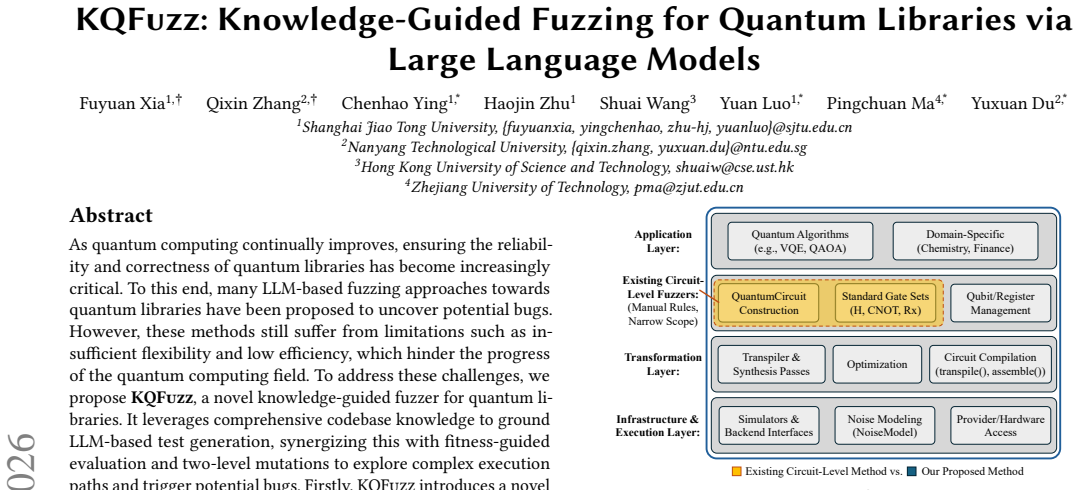
As quantum computing continually improves, ensuring the reliability and correctness of quantum libraries has become increasingly critical. To this end, many LLM-based fuzzing approaches towards quantum libraries have been proposed to uncover potential bugs. However, these methods still suffer from limitations such as insufficient flexibility and low efficiency, which hinder the progress of the quantum computing field. To address these challenges, we propose KQFuzz, a novel knowledge-guided fuzzer for quantum libraries. It leverages comprehensive codebase knowledge to ground LLM-based test generation, synergizing this with fitness-guided evaluation and two-level mutations to explore complex execution paths and trigger potential bugs. Firstly, KQFuzz introduces a novel prompting scheme tailored to quantum programs, which strategically incorporates knowledge of the codebase to efficiently generate high-quality quantum seed programs. Moreover, we develop evaluation and mutation strategies to handle the generated seed programs, facilitating efficient fuzzing execution while further enriching the diversity of the resulting test cases. We implement KQFuzz and conduct fuzzing on three popular quantum libraries, including Qiskit, PennyLane, and Cirq. Experimental results demonstrate that our approach significantly outperforms other state-of-the-art methods, with coverage improved by up to 18.44%. During the development of KQFuzz, we discovered 13 bugs, all of which have been confirmed and 12 have already been fixed by the developers.
Figures


Figures from the paper (7 more)


Reference graph
Works this paper leans on
-
[1]
Amira Abbas, Andris Ambainis, Brandon Augustino, Andreas Bärtschi, Harry Buhrman, Carleton Coffrin, Giorgio Cortiana, Vedran Dunjko, Daniel J Egger, Bruce G Elmegreen, et al. 2024. Challenges and opportunities in quantum opti- mization.Nature Reviews Physics6, 12 (2024), 718–735
2024
-
[2]
Shaukat Ali, Tao Yue, and Rui Abreu. 2022. When software engineering meets quantum computing.Commun. ACM65, 4 (2022), 84–88
2022
-
[3]
Anonymous Authors. 2026. Replication package for anonymous submission. https://doi.org/10.5281/zenodo.19230459
-
[4]
Paolo Arcaini, Andriy Miranskyy, and Hausi Müller. 2025. Introduction to the Special Section on software engineering for hybrid quantum computing systems. , 112362 pages
2025
-
[5]
Nicola Assolini, Alessandra Di Pierro, and Isabella Mastroeni. 2024. Static analysis of quantum programs. InInternational Static Analysis Symposium. Springer, 1–25
2024
-
[6]
Ville Bergholm, Josh Izaac, Maria Schuld, Christian Gogolin, Shahnawaz Ahmed, Vishnu Ajith, M Sohaib Alam, Guillermo Alonso-Linaje, Bharath Akash- Narayanan, Ali Asadi, et al. 2018. Pennylane: Automatic differentiation of hybrid quantum-classical computations.arXiv preprint arXiv:1811.04968(2018)
arXiv 2018
-
[7]
Marcel Böhme, Valentin JM Manès, and Sang Kil Cha. 2020. Boosting fuzzer efficiency: An information theoretic perspective. InProceedings of the 28th ACM Joint Meeting on European Software Engineering Conference and Symposium on the Foundations of Software Engineering. 678–689
2020
-
[8]
Marcel Böhme, Van-Thuan Pham, Manh-Dung Nguyen, and Abhik Roychoudhury
Show all 71 references
-
[9]
Marco Cerezo, Andrew Arrasmith, Ryan Babbush, Simon C Benjamin, Suguru Endo, Keisuke Fujii, Jarrod R McClean, Kosuke Mitarai, Xiao Yuan, Lukasz Cincio, et al. 2021. Variational quantum algorithms.Nature Reviews Physics3, 9 (2021), 625–644
2021
- [10]
-
[11]
Yinlin Deng, Chunqiu Steven Xia, Haoran Peng, Chenyuan Yang, and Lingming Zhang. 2023. Large language models are zero-shot fuzzers: Fuzzing deep-learning libraries via large language models. InProceedings of the 32nd ACM SIGSOFT international symposium on software testing and ...
2023
-
[12]
Yinlin Deng, Chunqiu Steven Xia, Chenyuan Yang, Shizhuo Dylan Zhang, Shu- jing Yang, and Lingming Zhang. 2024. Large language models are edge-case generators: Crafting unusual programs for fuzzing deep learning libraries. In Proceedings of the 46th IEEE/ACM international confe...
2024
-
[13]
Ruiqi Dong, Fanke Tong, He Huang, Xiaogang Zhu, Xi Xiao, Shaohua Wang, Sheng Wen, and Yang Xiang. 2025. One Mutation Fits All: Exploring Universal Library Fuzzing based on Exogenous Mutation.IEEE Transactions on Dependable and Secure Computing(2025)
2025
-
[14]
Wang Fang and Mingsheng Ying. 2024. Symbolic execution for quantum error correction programs.Proceedings of the ACM on Programming Languages8, PLDI (2024), 1040–1065
2024
-
[15]
2020.{AFL++}: Combining incremental steps of fuzzing research
Andrea Fioraldi, Dominik Maier, Heiko Eißfeldt, and Marc Heuse. 2020.{AFL++}: Combining incremental steps of fuzzing research. In14th USENIX workshop on offensive technologies (WOOT 20)
2020
-
[16]
Austin G Fowler, Matteo Mariantoni, John M Martinis, and Andrew N Cleland
-
[17]
Sukhpal Singh Gill, Oktay Cetinkaya, Stefano Marrone, Daniel Claudino, David Haunschild, Leon Schlote, Huaming Wu, Carlo Ottaviani, Xiaoyuan Liu, Sree Pragna Machupalli, et al. 2025. Quantum computing: Vision and challenges. InQuantum computing. Elsevier, 19–42
2025
-
[18]
Sukhpal Singh Gill, Adarsh Kumar, Harvinder Singh, Manmeet Singh, Kamalpreet Kaur, Muhammad Usman, and Rajkumar Buyya. 2022. Quantum computing: A taxonomy, systematic review and future directions.Software: Practice and Experience52, 1 (2022), 66–114
2022
-
[19]
Xiaoyu Guo, Shinobu Saito, and Jianjun Zhao. 2025. M2QCode: A Model-Driven Framework for Generating Multi-Platform Quantum Programs.arXiv preprint arXiv:2510.17110(2025)
2025
-
[20]
Xiaoyu Guo, Minggu Wang, and Jianjun Zhao. 2025. QuanBench: Benchmark- ing Quantum Code Generation with Large Language Models.arXiv preprint arXiv:2510.16779(2025)
2025
-
[21]
Xiaoyu Guo, Jianjun Zhao, and Pengzhan Zhao. 2024. On repairing quantum pro- grams using ChatGPT. InProceedings of the 5th ACM/IEEE International Workshop on Quantum Software Engineering. 9–16
2024
-
[22]
Tianmin Hu, Guixin Ye, Zhanyong Tang, Shin Hwei Tan, Huanting Wang, Meng Li, and Zheng Wang. 2024. Upbeat: Test input checks of q# quantum libraries. ASE ’26, October 12–16, 2026, Munich, Germany Xia et al. InProceedings of the 33rd ACM SIGSOFT International Symposium on Softw...
2024
-
[23]
Binyuan Hui, Jian Yang, Zeyu Cui, Jiaxi Yang, Dayiheng Liu, Lei Zhang, Tianyu Liu, Jiajun Zhang, Bowen Yu, Keming Lu, et al. 2024. Qwen2. 5-coder technical report.arXiv preprint arXiv:2409.12186(2024)
2024 arXiv
-
[24]
Ali Javadi-Abhari, Matthew Treinish, Kevin Krsulich, Christopher J Wood, Jake Lishman, Julien Gacon, Simon Martiel, Paul D Nation, Lev S Bishop, An- drew W Cross, et al . 2024. Quantum computing with Qiskit.arXiv preprint arXiv:2405.08810(2024)
2024 arXiv
-
[25]
Yu Jiang, Jie Liang, Fuchen Ma, Yuanliang Chen, Chijin Zhou, Yuheng Shen, Zhiyong Wu, Jingzhou Fu, Mingzhe Wang, Shanshan Li, et al . 2024. When fuzzing meets llms: Challenges and opportunities. InCompanion Proceedings of the 32nd ACM International Conference on the Foundation...
2024
-
[26]
Tiancheng Jin, Shangzhou Xia, and Jianjun Zhao. 2025. NovaQ: Improving Quantum Program Testing through Diversity-Guided Test Case Generation.arXiv preprint arXiv:2509.04763(2025)
2025 arXiv
-
[27]
Hyungseok Kim, Soomin Kim, Jungwoo Lee, and Sang Kil Cha. 2024. AsFuzzer: Differential testing of assemblers with error-driven grammar inference. InPro- ceedings of the 33rd ACM SIGSOFT International Symposium on Software Testing and Analysis. 1099–1111
2024
-
[28]
Vasileios Klimis, Avner Bensoussan, Elena Chachkarova, Karine Even-Mendoza, Sophie Fortz, and Connor Lenihan. 2025. Shaking Up Quantum Simulators with Fuzzing and Rigour.Proceedings of the ACM on Programming Languages9, OOPSLA2 (2025), 1400–1428
2025
-
[29]
Patrick Lewis, Ethan Perez, Aleksandra Piktus, Fabio Petroni, Vladimir Karpukhin, Naman Goyal, Heinrich Küttler, Mike Lewis, Wen-tau Yih, Tim Rocktäschel, et al. 2020. Retrieval-augmented generation for knowledge-intensive nlp tasks. Advances in neural information processing s...
2020
-
[30]
Yuechen Li, Minqi Shao, Jianjun Zhao, and Qichen Wang. 2026. A Methodological Analysis of Empirical Studies in Quantum Software Testing.arXiv preprint arXiv:2601.08367(2026)
2026 arXiv
-
[31]
Xingshuang Lin, Qinge Xie, Binbin Zhao, Yuan Tian, Saman Zonouz, Na Ruan, Jiliang Li, Raheem Beyah, and Shouling Ji. 2025. PROMFUZZ: Leveraging LLM- Driven and Bug-Oriented Composite Analysis for Detecting Functional Bugs in Smart Contracts.arXiv preprint arXiv:2503.23718(2025)
2025
-
[32]
Peixun Long and Jianjun Zhao. 2024. Equivalence, identity, and unitarity checking in black-box testing of quantum programs.Journal of Systems and Software211 (2024), 112000
2024
-
[33]
Peixun Long and Jianjun Zhao. 2024. Testing multi-subroutine quantum pro- grams: From unit testing to integration testing.ACM Transactions on Software Engineering and Methodology33, 6 (2024), 1–61
2024
-
[34]
Junjie Luo, Shangzhou Xia, Fuyuan Zhang, and Jianjun Zhao. 2026. QEMI: A Quantum Software Stacks Testing Framework via Equivalence Modulo Inputs. InInternational Conference on Fundamental Approaches to Software Engineering. Springer, 149–169
2026
-
[35]
Valentin JM Manès, HyungSeok Han, Choongwoo Han, Sang Kil Cha, Manuel Egele, Edward J Schwartz, and Maverick Woo. 2019. The art, science, and engi- neering of fuzzing: A survey.IEEE Transactions on Software Engineering47, 11 (2019), 2312–2331
2019
-
[36]
Eñaut Mendiluze, Shaukat Ali, Paolo Arcaini, and Tao Yue. 2021. Muskit: A mutation analysis tool for quantum software testing. In2021 36th IEEE/ACM International Conference on Automated Software Engineering (ASE). IEEE, 1266– 1270
2021
-
[37]
Eñaut Mendiluze Usandizaga, Shaukat Ali, Tao Yue, and Paolo Arcaini. 2025. Quantum circuit mutants: Empirical analysis and recommendations.Empirical Software Engineering30, 4 (2025), 100
2025
-
[38]
Asmar Muqeet, Shaukat Ali, Tao Yue, and Paolo Arcaini. 2024. A machine learning-based error mitigation approach for reliable software development on IBM’s quantum computers. InCompanion Proceedings of the 32nd ACM Interna- tional Conference on the Foundations of Software Engin...
2024
-
[39]
Asmar Muqeet, Tao Yue, Shaukat Ali, and Paolo Arcaini. 2024. Mitigating noise in quantum software testing using machine learning.IEEE Transactions on Software Engineering50, 11 (2024), 2947–2961
2024
-
[40]
Juan Manuel Murillo, Jose Garcia-Alonso, Enrique Moguel, Johanna Barzen, Frank Leymann, Shaukat Ali, Tao Yue, Paolo Arcaini, Ricardo Pérez-Castillo, Ignacio García-Rodríguez de Guzmán, et al. 2025. Quantum software engineering: Roadmap and challenges ahead.ACM Transactions on ...
2025
-
[41]
Noah H Oldfield, Christoph Laaber, Tao Yue, and Shaukat Ali. 2025. Faster and better quantum software testing through specification reduction and projective measurements.ACM Transactions on Software Engineering and Methodology34, 7 (2025), 1–39
2025
-
[42]
Matteo Paltenghi and Michael Pradel. 2022. Bugs in quantum computing plat- forms: an empirical study.Proceedings of the ACM on Programming Languages6, OOPSLA1 (2022), 1–27
2022
-
[43]
Matteo Paltenghi and Michael Pradel. 2023. MorphQ: Metamorphic testing of the Qiskit quantum computing platform. In2023 IEEE/ACM 45th International Conference on Software Engineering (ICSE). IEEE, 2413–2424
2023
-
[44]
Baptiste Roziere, Jonas Gehring, Fabian Gloeckle, Sten Sootla, Itai Gat, Xiao- qing Ellen Tan, Yossi Adi, Jingyu Liu, Romain Sauvestre, Tal Remez, et al. 2023. Code llama: Open foundation models for code.arXiv preprint arXiv:2308.12950 (2023)
2023 arXiv
-
[45]
Md Shafiuzzaman, Achintya Desai, Laboni Sarker, and Tevfik Bultan. 2024. STASE: Static analysis guided symbolic execution for UEFI vulnerability signature gener- ation. InProceedings of the 39th IEEE/ACM International Conference on Automated Software Engineering. 1783–1794
2024
-
[46]
Dongdong She, Adam Storek, Yuchong Xie, Seoyoung Kweon, Prashast Srivas- tava, and Suman Jana. 2024. Fox: Coverage-guided fuzzing as online stochastic control. InProceedings of the 2024 on ACM SIGSAC Conference on Computer and Communications Security. 765–779
2024
-
[47]
Nick Stephens, John Grosen, Christopher Salls, Andrew Dutcher, Ruoyu Wang, Jacopo Corbetta, Yan Shoshitaishvili, Christopher Kruegel, and Giovanni Vigna
-
[48]
Gemini Team, Rohan Anil, Sebastian Borgeaud, Jean-Baptiste Alayrac, Jiahui Yu, Radu Soricut, Johan Schalkwyk, Andrew M Dai, Anja Hauth, Katie Millican, et al. 2023. Gemini: a family of highly capable multimodal models.arXiv preprint arXiv:2312.11805(2023)
2023 arXiv
-
[49]
Krishna Upadhyay, Moshood Fakorede, and Umar Farooq. 2026. Understanding Bugs in Quantum Simulators: An Empirical Study. arXiv:2603.22789 [quant-ph] https://arxiv.org/abs/2603.22789
2026
-
[50]
Hanrui Wang, Daniel Bochen Tan, Pengyu Liu, Yilian Liu, Jiaqi Gu, Jason Cong, and Song Han. 2024. Q-pilot: Field programmable qubit array compilation with flying ancillas. InProceedings of the 61st ACM/IEEE Design Automation Conference. 1–6
2024
-
[51]
Jiyuan Wang, Fucheng Ma, and Yu Jiang. 2021. Poster: Fuzz testing of quan- tum program. In2021 14th IEEE Conference on Software Testing, Verification and Validation (ICST). IEEE, 466–469
2021
-
[52]
Jiyuan Wang, Qian Zhang, Guoqing Harry Xu, and Miryung Kim. 2021. QDiff: Dif- ferential testing of quantum software stacks. In2021 36th IEEE/ACM international conference on automated software engineering (ASE). IEEE, 692–704
2021
-
[53]
Xinyi Wang, Shaukat Ali, Tao Yue, and Paolo Arcaini. 2024. Quantum approximate optimization algorithm for test case optimization.IEEE Transactions on Software Engineering50, 12 (2024), 3249–3264
2024
-
[54]
Jason Wei, Xuezhi Wang, Dale Schuurmans, Maarten Bosma, Fei Xia, Ed Chi, Quoc V Le, Denny Zhou, et al. 2022. Chain-of-thought prompting elicits reasoning in large language models.Advances in neural information processing systems35 (2022), 24824–24837
2022
-
[55]
Mingyuan Wu, Ling Jiang, Jiahong Xiang, Yanwei Huang, Heming Cui, Lingming Zhang, and Yuqun Zhang. 2022. One fuzzing strategy to rule them all. InPro- ceedings of the 44th International Conference on Software Engineering. 1634–1645
2022
-
[56]
Chunqiu Steven Xia, Matteo Paltenghi, Jia Le Tian, Michael Pradel, and Lingming Zhang. 2024. Fuzz4all: Universal fuzzing with large language models. InPro- ceedings of the IEEE/ACM 46th International Conference on Software Engineering. 1–13
2024
-
[57]
Shangzhou Xia, Jianjun Zhao, Fuyuan Zhang, and Xiaoyu Guo. 2025. Quantum concolic testing.Proceedings of the ACM on Software Engineering2, ISSTA (2025), 1146–1166
2025
-
[58]
Yuchong Xie, Wenhui Zhang, and Dongdong She. 2025. ZTaint-Havoc: From Havoc mode to zero-execution fuzzing-driven taint inference.Proceedings of the ACM on Software Engineering2, ISSTA (2025), 917–939
2025
-
[59]
Yupeng Yang, Yongheng Chen, Rui Zhong, Jizhou Chen, and Wenke Lee. 2024. Towards generic database management system fuzzing. In33rd USENIX Security Symposium (USENIX Security 24). 901–918
2024
-
[60]
Jiaming Ye, Xiongfei Wu, Shangzhou Xia, Fuyuan Zhang, and Jianjun Zhao. 2025. Is Measurement Enough? Rethinking Output Validation in Quantum Program Testing.arXiv preprint arXiv:2509.16595(2025)
2025
-
[61]
Mingsheng Ying, Li Zhou, and Gilles Barthe. 2025. Laws of Quantum Program- ming.ACM Transactions on Software Engineering and Methodology(2025)
2025
-
[62]
Cen Zhang, Yaowen Zheng, Mingqiang Bai, Yeting Li, Wei Ma, Xiaofei Xie, Yuekang Li, Limin Sun, and Yang Liu. 2024. How effective are they? exploring large language model based fuzz driver generation. InProceedings of the 33rd ACM SIGSOFT International Symposium on Software Tes...
2024
-
[63]
Lingming Zhang, Binbin Zhao, Jiacheng Xu, Peiyu Liu, Qinge Xie, Yuan Tian, Jianhai Chen, and Shouling Ji. 2025. Waltzz:{WebAssembly} Runtime Fuzzing with{Stack-Invariant} Transformation. In34th USENIX Security Symposium (USENIX Security 25). 6159–6178
2025
-
[64]
Qifan Zhang, Xuesong Bai, Xiang Li, Haixin Duan, Qi Li, and Zhou Li. 2024. {ResolverFuzz}: Automated Discovery of{DNS} Resolver Vulnerabilities with {Query-Response} Fuzzing. In33rd USENIX Security Symposium (USENIX Secu- rity 24). 4729–4746
2024
-
[65]
Jianjun Zhao. 2020. Quantum software engineering: Landscapes and horizons. arXiv preprint arXiv:2007.07047(2020)
2020 arXiv
-
[66]
Pengzhan Zhao, Zhongtao Miao, Shuhan Lan, and Jianjun Zhao. 2023. Bugs4Q: A benchmark of existing bugs to enable controlled testing and debugging studies KQFuzz: Knowledge-Guided Fuzzing for Quantum Libraries via Large Language Models ASE ’26, October 12–16, 2026, Munich, Germ...
2023
-
[67]
Pengzhan Zhao, Xiongfei Wu, Zhuo Li, and Jianjun Zhao. 2023. Qchecker: Detecting bugs in quantum programs via static analysis. In2023 IEEE/ACM 4th International Workshop on Quantum Software Engineering (Q-SE). IEEE, 50–57
2023
-
[68]
Input Constraints
Xiaogang Zhu, Sheng Wen, Seyit Camtepe, and Yang Xiang. 2022. Fuzzing: a survey for roadmap.ACM Computing Surveys (CSUR)54, 11s (2022), 1–36. ASE ’26, October 12–16, 2026, Munich, Germany Xia et al. This supplementary material (SM) provides necessary details omitted from the m...
2022
-
[2012]
Surface codes: Towards practical large-scale quantum computation.Physical Review A—Atomic, Molecular, and Optical Physics86, 3 (2012), 032324
2012
-
[2016]
In NDSS, Vol
Driller: Augmenting fuzzing through selective symbolic execution.. In NDSS, Vol. 16. 1–16
-
[2017]
InProceedings of the 2017 ACM SIGSAC conference on computer and communications security
Directed greybox fuzzing. InProceedings of the 2017 ACM SIGSAC conference on computer and communications security. 2329–2344
2017
Reviewed August 1, 2026 · model on record in the stance chip above.
Discussion (0). Continue with ORCID to comment.