REVIEW 3 major objections 4 minor 12 references
Every AKSZ Feynman graph is the partition function of a 1D theory
Reviewed by Pith at T0; open to challenge. T0 means a machine referee read the full paper against a public rubric. the ladder, T0–T4 →
T0 review · deepseek-v4-flash
2026-08-01 16:50 UTC pith:QULJUJNO
load-bearing objection Operator construction is solid; the abstract's general 1d-AKSZ path-integral claim outruns the tentative dequantisation in §4. the 3 major comments →
Towards First Quantisation Formalism for AKSZ Theories
The pith
A machine-rendered reading of the paper's core claim, the machinery that carries it, and where it could break.
Core claim
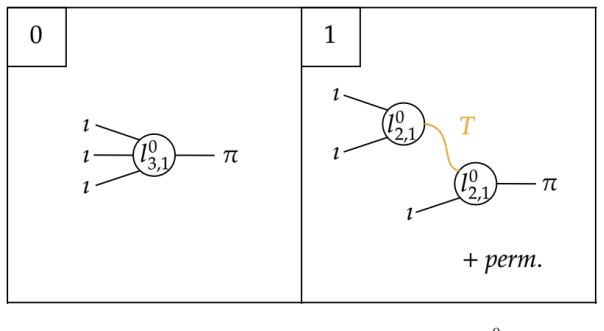
The paper's central claim is the identity (Equation 5.1): for every connected Feynman graph Γ of an AKSZ theory T, the integral over the positive edge lengths of the 1d theory's pre-amplitude I∞_t(Γ)(a) equals the Feynman weight F_Γ(a). The 1d theory t is itself an AKSZ theory with target T^*(T[1](M×R[1])) extended by a symplectic-category object ν that 'dequantises' the target Y of T. The edge length T and its differential dT are the zero modes of the graviton and gravitino of 1d supergravity; a gauge-fixing of T corresponds to a gauge-fixing of t. The vertex structure of t is classical geometric data: Lagrangian submanifolds L_n in Cartesian powers of the phase space, which by geometric qu
What carries the argument
The load-bearing machinery is the pairing of two constructions. (1) A 1d AKSZ theory t on an interval, with target T^*(T[1](M×R[1])), coupled to 1d supergravity by adding the factor T^*(T[1]R[1]). After integrating out the supergravity sector via BV-pushforward and reducing the boundary states, the interval partition function becomes e^{-T H - dT G}, where G is a degree -1 gauge-fixing operator (a chain homotopy) and H=[d_M,G]. The propagator of T is then the integral of this over edge length T>0. (2) The vertex structure: a tentative definition (Definition 4.4) of a cyclic L∞-algebra in the symplectic category—an object ν with a pairing Lagrangian ρ and interaction Lagrangians L_n, satisfyi
Load-bearing premise
The construction depends on the tentative assumption (Definition 4.4) that every AKSZ target Y admits a 'dequantisation' ν in the symplectic category—an object with Lagrangians whose geometric quantisation reproduces the cyclic L∞ operations of Y—together with the unproved Conjecture 4.9 identifying the vertex Lagrangian for simple Lie algebras via a point-like symplectic reduction.
What would settle it
Find an AKSZ theory whose target Y has a cyclic L∞ structure that cannot be obtained as the geometric quantisation of Lagrangian submanifolds in a symplectic category; or compute the symplectic reduction µ^{-1}(0)/G for the adjoint coadjoint orbit of, say, so(7) or sp(6) and show it is not a point, contradicting Conjecture 4.9 and thus the explicit vertex construction for those structure groups.
If this is right
- If correct, every AKSZ theory admits a first-quantised formulation: the Feynman graph sum is literally the partition function of a 1d AKSZ theory on metric graphs, making the 'second-quantised' vs 'first-quantised' relation explicit.
- Gauge-fixing equivalence: choosing a gauge-fixing chain homotopy G on forms (e.g., Lorenz gauge G=d*, or a gradient-flow gauge G=i_v+εd*) is the same as choosing the gauge in the 1d theory; so standard gauge choices for Chern-Simons and BF theory reappear as choices of 1d path-integral measure.
- The quantum master equation for the effective action of T follows from the closedness equation of the 1d theory, giving a structural, graph-combinatorial explanation of why effective actions satisfy the QME.
- The vertex data gives a geometric quantisation dictionary for cyclic L∞-algebras: the paper's paradigm suggests that the interaction tensors of an AKSZ theory are quantisations of Lagrangian submanifolds in a symplectic category, with the SU(2) case worked out explicitly via the vertex Lagrangian of triples summing to zero.
- The construction realises a large class of AKSZ theories as 'topological quantum mechanics on graphs', connecting them to the intersection theory of gradient trajectories, as in the gl_N Chern-Simons example with a gradient-flow gauge.
Where Pith is reading between the lines
- The paper's vertex construction is explicitly tentative; if it can be made precise, it would supply a functorial version of geometric quantisation for cyclic L∞-algebras, likely with implications for quantising higher Lie algebras (e.g., in the Poisson sigma model).
- The identity (5.1) suggests a graph-complex interpretation: the integral over edge lengths is reminiscent of graph integrals appearing in deformation quantisation, so the 1d theory may provide a new combinatorial route to the cohomology of moduli spaces of graphs or to finite-type invariants of manifolds.
- The paper's Conjecture 4.9 (that the symplectic reduction of three adjoint coadjoint orbits is a point for simple Lie algebras other than su(N≥3)) is a concrete, testable geometric statement; if true, it would uniquely pick out the vertex Lagrangian for Chern-Simons theory for any simple compact Lie algebra.
- For BF theory, the construction uses a doubled coadjoint orbit; this hints at a first-quantised description of BF theory as a 'particle on a doubled group manifold', which might be extended to higher-dimensional AKSZ theories such as the Poisson sigma model.
Editorial analysis
A structured set of objections, weighed in public.
Referee Report
Summary. The paper proposes a first-quantisation formalism for AKSZ field theories. For an AKSZ theory T with fields Ω•(M;Y) and target Hamiltonian Θ_Y, the authors construct a one-dimensional theory t on metric graphs. Section 3 builds a 1d AKSZ sigma-model coupled to 1d supergravity, reduces the SUGRA sector by BV pushforward, and shows that a suitable gauge-fixing gives the interval partition function e^{-e^I H - ε^I G}, so that the propagator identity (3.33) reproduces the propagator of T. Section 5.1 gives a Hamiltonian/HTQM presentation in which the pre-amplitude of t integrates to the Feynman weight F_Γ(a) of T, Eq. (5.1). Sections 4 and 5.2 then propose a Lagrangian/path-integral description in which vertices are decorated by Lagrangian submanifolds in a symplectic category, encoded in a tentative cL^{symp}_∞-algebra whose geometric quantisation is supposed to reproduce the cyclic L∞-operations of Y. Worked examples include Chern–Simons theory (including an explicit SU(2)/Wigner Lagrangian), BF theory, and gl(N) Chern–Simons theory in a Fukaya–Morse–Witten gauge.
Significance. If the conjectural part can be completed, the construction would connect BV-BFV quantisation of AKSZ models, Losev's HTQFT, and geometric quantisation, and would give a graph-model repackaging of the perturbative expansion of a general AKSZ theory. The paper is transparent about its tentative assumptions and contains a solid, parameter-free operator-formalism core: the SUGRA reduction and the derivation of the operator e^{-e^I H - ε^I G} in §3, the propagator identity (3.33), and the HTQM amplitude identity (5.1) in §5.1 are explicit and checkable. The main value of the paper lies in this core plus the concrete SU(2) example. The advertised path-integral version of the central claim, however, is conditional on an unproved existence statement about cL^{symp}_∞-algebra dequantisation.
major comments (3)
- [§5.2.1, Definition 4.4, Remark 4.7] The path-integral presentation of the central claim is conditional on an unproved existence statement. Equations (5.3) and (5.19) are stated for an arbitrary AKSZ target (Y, Θ_Y), but §5.2.1 begins with: 'Let (ν,ρ,{L_n}) be a cL^{symp}_∞-algebra corresponding by geometric quantisation to the target Y'. Definition 4.4 is explicitly labelled tentative, Remark 4.7 defers precision to future work, and no theorem proves that geometric quantisation is surjective onto the cyclic L∞ structures arising from Θ_Y. Consequently, the abstract's claim that t is itself a 1d AKSZ theory whose partition functions reproduce the Feynman graphs of T is established only at the Hamiltonian/HTQM level of §5.1, not for the Lagrangian path integral. The §5.1 result is independent of this and is sound, but the path-integral claim needs either a proof in the stated generality or an explicit restriction to a class
- [§4.2, Conjecture 4.9, Appendix C] The Wigner Lagrangian identification, used in Example 5.5 for Chern–Simons theory, rests on Conjecture 4.9: that µ^{-1}(0)/G is a point for simple g ≠ su(N≥3). The evidence in Appendix C is only a dimension count. The remark after Eq. (C.1) correctly notes that the actual dimension of the symplectic reduction is dim_vir + 2k, where k is the stabiliser dimension; for g=so(7), dim_vir=0 but k need not vanish, so the reduction may be positive-dimensional. For g=su(3), dim_vir>0. Thus the conjecture is not supported for general simple g. The explicit su(2) case (Example 4.12) is fine, but the general construction of the Lagrangian for the Lie bracket remains open. This should be flagged as a hypothesis wherever it is used in §5.2.4.
- [§4.1, Definition 4.4] Even granting existence, Definition 4.4 imposes the L∞ relations (4.5) only modulo the kernel of the geometric quantisation functor Q. Since Q is not injective on morphisms, the same quantised cyclic L∞ operations c_n can come from inequivalent symplectic data; conversely, a failure of a relation by an element of ker Q still quantises to a valid relation, but the geometric 'dequantisation' is not unique. The paper does not discuss faithfulness or injectivity of the quantisation functor, and it is not shown that the vertex sewing condition is uniquely determined by Θ_Y. This does not affect the soundness of §5.1, but it weakens the dictionary on which the path-integral construction in §5.2 is based.
minor comments (4)
- [§5.1, bullet list] The sentence 'The operations with nonzero loop number c ≥1 • are all set to zero' is garbled; it should read 'The operations with nonzero loop number are all set to zero.'
- [§3.1, Eq. (3.12)] The formula 'Q_t ec_i = dec+eφ' has an erroneous subscript i; it should be 'Q_t ec = dec+eφ' (or the notation for the superfield should be introduced consistently).
- [Appendix C, table header] The column header 'dimO generic = dimg−rankg' is ambiguous; the intended meaning is the dimension of a generic coadjoint orbit, not the dimension of O. Please clarify the notation.
- [References] The reference [KW96] lacks publication details (journal, volume, pages, or arXiv identifier). Please complete it.
Circularity Check
No circularity: the HTQM/Feynman correspondence is an explicit transcription of the gauge-fixed AKSZ data, and the 1d-AKSZ path-integral claim is conditional on a stated tentative dequantisation assumption, which is a gap, not a circle.
full rationale
The central identity (5.1) is not circular. Section 5.1 explicitly builds the topological quantum mechanics t from the same gauge-fixed data as the AKSZ theory T: V = Ω•(M;Y), Q = d, a self-adjoint chain homotopy G, and vertex operations c^0_n = c^Y_n ⊗ ∫_M. Once the internal-edge integral is evaluated as the propagator (3.33), the HTQM graph amplitude is literally the same contraction as the Feynman weight (1.4). This is a faithful realization/transcription of the Feynman rules, not a prediction of those rules from independent first principles; the paper's own language ('we formulate', 'we associate') presents it as a construction. The only load-bearing gap is the passage to the Lagrangian 1d-AKSZ path integral. In §5.2.1 the paper postulates a cL^{symp}_∞-algebra (ν,ρ,{L_n}) whose geometric quantisation reproduces the cyclic L∞-structure of Y, while Definition 4.4 is explicitly labelled tentative, Remark 4.7 defers precision to future work, and Conjecture 4.9 is supported only by dimension counts in Appendix C. These are unproved existence/identification assumptions, not circular reductions: the path-integral statement is conditional on them, but no step is defined in terms of the conclusion it is used to prove. The self-citations ([BLM24], [CMR18], [Mne15], [CLMY22]) supply background HTQFT, BV-BFV, and Wilson-line technology; they are not used to introduce the claimed equivalence, so they do not create circularity.
Axiom & Free-Parameter Ledger
axioms (5)
- domain assumption Good gauge-fixing datum: G is a square-zero degree -1 operator on Ω•(M)⊗Y with H=[d,G] diagonalisable, non-negative real spectrum, and G vanishing on ker(H).
- standard math Geometric quantisation Q:Symp+ → grVect_C exists with monoidal/duality properties and maps Bohr–Sommerfeld Lagrangians to states; [Q,R]=0 for coadjoint orbits.
- ad hoc to paper For any target (Y, Θ_Y) of an AKSZ theory there exists a cL^{symp}_∞ structure (ν,ρ,L_n) whose quantisation is the cyclic L∞ algebra of Θ_Y.
- ad hoc to paper Conjecture 4.9: for simple g with g ≠ su(N≥3), the symplectic reduction µ^{-1}(0)/G of O×O×O is a point.
- standard math The effective action of T has the connected Feynman expansion (1.3)–(1.4) with weights F_Γ.
invented entities (1)
-
cL^{symp}_∞-algebra dequantisation data (ν, ρ, L_n) in Weinstein's symplectic category
no independent evidence
read the original abstract
\noindent Given an AKSZ theory $\mathbb{T}$ on a manifold $M$, with target a graded vector space $Y$, we formulate a 1-dimensional theory $\mathbb{t}$ on graphs (the ``first quantisation picture for $\mathbb{T}$''), whose partition functions reproduce the Feynman graphs of $\mathbb{T}$. More precisely, the theory $\mathbb{t}$ is itself a 1d AKSZ theory with the target built out of $M$, and involving a coupling to 1d supergravity. It yields a form on the space of metric graphs (with length $T$ of an edge and its de Rham differential $\mathrm{d} T$ interpreted as the zero-modes of the graviton and gravitino, respectively); its integral yields the sum of Feynman graphs of $\mathbb{T}$. We study the theory $\mathbb{t}$ in the BV-BFV formalism; a gauge-fixing of $\mathbb{T}$ corresponds to a gauge-fixing of $\mathbb{t}$. At the classical level, $\mathbb{t}$ assigns to vertices certain Lagrangian submanifolds $L_k$ in Cartesian powers $\Phi^{\times k}$ of the phase space $\Phi$ of $\mathbb{t}$. These submanifolds can be thought of as defining a cyclic $\mathrm{L}_\infty$-algebra in Weinstein's symplectic category (``dequantising'' the cohomological vector field on the target %target AKSZ dg structure of $\mathbb{T}$). In the path integral construction of $\mathbb{t}$, Lagrangians $L_k$ determine sewing conditions for fields on the incident edges at a $k$-valent vertex. We give examples of this paradigm, such as when $\mathbb{t}$ on edges is the Witten-Morse supersymmetric quantum mechanics (which corresponds to a particular type of gauge-fixing for $\mathbb{T}$ and $\mathbb{t}$). In the example where $\mathbb{T}$ is the non-abelian Chern--Simons theory with structure Lie algebra $\mathfrak{su}(2)$, we describe the vertex Lagrangian $L_{\mathrm{W}}$ (the ``Wigner Lagrangian'' ).
Figures




Reference graph
Works this paper leans on
-
[1]
Chern-Simons Theory with Wil- son Lines and Boundary in the BV-BFV Formalism
[ABM13] A. Alekseev, Y. Barmaz, and P. Mnev. “Chern-Simons Theory with Wil- son Lines and Boundary in the BV-BFV Formalism”. In:J. Geom. Phys.67 (2013), pp. 1–15. arXiv:1212.6256 [math-ph]. [ASZK97] M. Alexandrov, A. Schwarz, O. Zaboronsky, and M. Kontsevich. “The Geom- etry of the master equation and topological quantum field theory”. In:Int. J. Mod. Phy...
Pith/arXiv arXiv 2013
-
[53]
Homological mirror symmetry and torus fibrations
[KS00] M. Kontsevich and Y. Soibelman. “Homological mirror symmetry and torus fibrations”. In:KIAS Annual International Conference on Symplectic Geom- etry and Mirror Symmetry. Nov. 2000, pp. 203–263. arXiv:math/0011041. [Los19] A. Losev. “TQFT, homological algebra and elements of K. Saito’s theory of primitive form: an attempt of mathematical text writte...
Pith/arXiv arXiv 2000
-
[93]
Combinatorial QFT on graphs: first quantization formalism
arXiv:2112.12756 [hep-th]. [CKMW23] I. Contreras, S. Kandel, P. Mnev, and K. Wernli. “Combinatorial QFT on graphs: first quantization formalism”. In: (Aug. 2023). arXiv:2308 . 07801 [math-ph]. 49 [CMR95] S. Cordes, G. W. Moore, and S. Ramgoolam. “Lectures on 2-d Yang-Mills theory, equivariant cohomology and topological field theories”. In:Nucl. Phys. B Pr...
Pith/arXiv arXiv 2023
-
[125]
arXiv:2402.04468 [math-ph]. [BGV92] N. Berline, E. Getzler, and M. Vergne.Heat kernels and Dirac operators / Nicole Berline, Ezra Getzler, Michèle Vergne.Grundlehren der mathematis- chen Wissenschaften
-
[411]
Chern-Simons gauge theory as a string theory
[Wit95] E. Witten. “Chern-Simons gauge theory as a string theory”. In:Prog. Math. 133 (1995), pp. 637–678. arXiv:hep-th/9207094. [Woo92] N. M. J. Woodhouse.Geometric quantization. Oxford university press,
Pith/arXiv arXiv 1995
-
[538]
Kirillov-Konstant the- ory and Feynman path integrals on coadjoint orbits on SU(2) and SU(1,1)
[HOOS92] T. Hashimoto, K. Ogura, K. Okamoto, and R. Sawae. “Kirillov-Konstant the- ory and Feynman path integrals on coadjoint orbits on SU(2) and SU(1,1)”. In:Int. J. Mod. Phys. A7S1A (1992), pp. 377–390. [KW96] R. C. King and B. G. Wybourne. “The place of the adjoint representation in the Kronecker square of irreducible representations of simple Lie gro...
1992
-
[1997]
Combinatorial 2d higher topological quan- tum field theory from a local cyclicA∞ algebra
[BLM24] J. Beck, A. Losev, and P. Mnev. “Combinatorial 2d higher topological quan- tum field theory from a local cyclicA∞ algebra”. In:Lett. Math. Phys.114.6 (2024), p
2024
-
[2009]
arXiv:0911.4133 [math.SG]. [Wit82] E.Witten.“SupersymmetryandMorsetheory”.In:J. Diff. Geom.17.4(1982), pp. 661–692. [Wit88] E.Witten.“TopologicalSigmaModels”.In:Commun. Math. Phys.118(1988), p
Pith/arXiv arXiv 1982
-
[2012]
arXiv:1109.4984 [math.SG]. [BC18] P. Biran and O. Cornea.Lagrangian Cobordism and Fukaya Categories
-
[2018]
Classical BV theories on man- ifolds with boundary
arXiv:1304.6032 [math.SG]. [CMR14] A. S. Cattaneo, P. Mnev, and N. Reshetikhin. “Classical BV theories on man- ifolds with boundary”. In:Commun. Math. Phys.332 (2014), pp. 535–603. arXiv:1201.0290 [math-ph]. [CMR18] A. S. Cattaneo, P. Mnev, and N. Reshetikhin. “Perturbative quantum gauge theoriesonmanifoldswithboundary”.In:Commun. Math. Phys.357.2(2018), ...
Pith/arXiv arXiv 2014
-
[2019]
arXiv:2301.01390 [math-ph]. 50 [Mne08] P. Mnev. “Discrete BF theory”. In: (Sept. 2008). arXiv:0809.1160 [hep-th]. [Mne15] P. Mnev. “A construction of observables for AKSZ sigma models”. In:Lett. Math. Phys.105.12 (2015), pp. 1735–1783. arXiv:1212.5751 [math-ph]. [MW25] P. Mnev and K. Wernli. “Globalization of perturbative Chern-Simons theory on the moduli...
Pith/arXiv arXiv 2008
-
[5637]
arXiv: quant-ph/0703104. [BW97] S. Bates and A. Weinstein.Lectures on the geometry of quantization. Vol
discussion (0)
Sign in with ORCID, Apple, or X to comment. Anyone can read and Pith papers without signing in.