REVIEW 3 major objections 3 minor 168 references
FPSGen replaces partial-scan point initialization with a BEV density prior plus a teacher-student straightening flow, improving distributional completion metrics and enabling flexible cue-conditioned generation.
Reviewed by Pith at T0; open to challenge. T0 means a machine referee read the full paper against a public rubric. the ladder, T0–T4 →
T0 review · deepseek-v4-flash
2026-08-01 11:38 UTC pith:SNFYB5F4
load-bearing objection A solid two-stage BEV-to-point flow matching system for LiDAR scene generation with honest diagnostics; the main risk is the untested train/inference gap in BEV priors, but the central contribution holds. the 3 major comments →
FPSGen: Flexible Point Cloud Scene Generation with BEV-Supported Transport Flows
The pith
A machine-rendered reading of the paper's core claim, the machinery that carries it, and where it could break.
Core claim
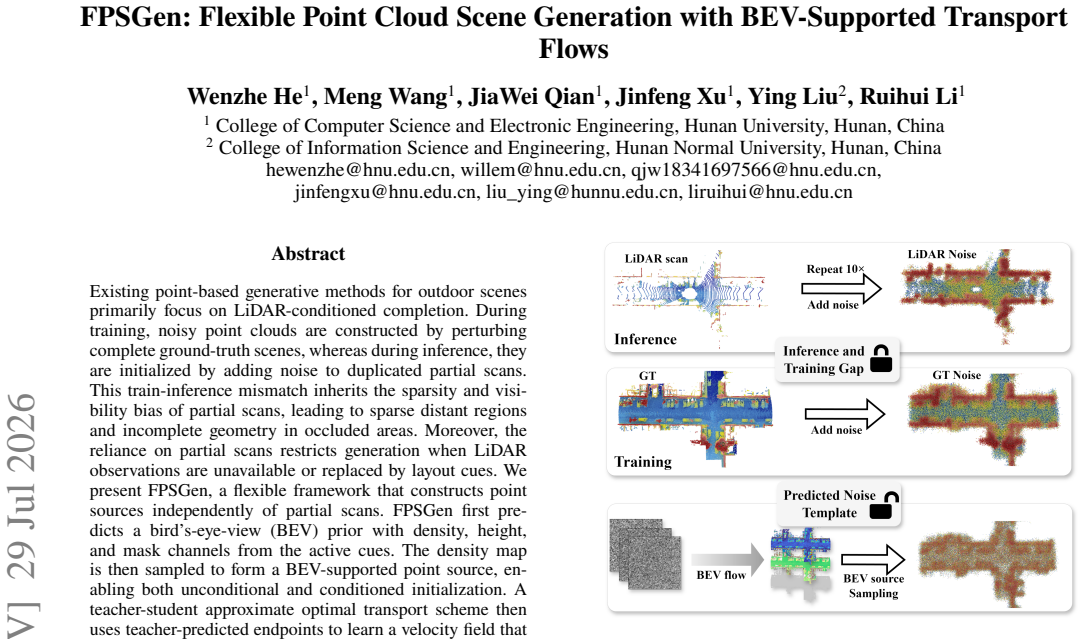
On the paper's own terms, the key discovery is that the source distribution for scene-level point flow matching can be constructed from a density channel of a predicted BEV prior rather than from the partial scan. The teacher network provides a source-indexed clean endpoint for each sampled source point under Chamfer and repulsion supervision, giving the student a fixed per-point target and thereby inducing nearly straight transport paths. Because the source already follows the scene layout, the transport is short enough that a single Euler step delivers competitive distributional quality, and the same machinery works with or without LiDAR conditions by simply toggling the condition mask.
What carries the argument
The central mechanism is the BEV-supported point source sampler R plus the teacher-student Approx-OT pair. R converts the BEV prior's density channel into a categorical distribution over metric grid cells, samples N points with replacement, and perturbs them with Gaussian noise, so the source marginal mirrors the scene's spatial density. The teacher then predicts a clean endpoint for each source point (trained with Chamfer distance and a repulsion term), and the student regresses the straight line from source to that endpoint; this replaces an explicit scene-scale optimal transport plan with an amortized, source-indexed pairing that keeps paths short and the one-step solution accurate.
Load-bearing premise
The framework presupposes that the BEV flow's generated priors at inference are close to the ground-truth BEV priors used to train the point flow; if the generated density maps are systematically off, the point flow transports from a mismatched source and the distributional gains wash out.
What would settle it
Take the trained FPSGen pipeline and replace the generated BEV prior with the oracle ground-truth prior at inference, then degrade the oracle prior's density channel by blurring or additive noise with increasing magnitude. If completion JSD and voxel IoU do not degrade monotonically with the corruption level, then the BEV prior is not the load-bearing pathway for the reported gains; if they degrade sharply, the framework's stated dependence on prior quality is confirmed.
If this is right
- If the claims hold, LiDAR-conditioned completion no longer needs the train/inference source mismatch; a single model can do completion, layout-conditioned generation, and unconditional generation without changing the source constructors.
- The single-step point transport result implies that high-quality scene generation can run in about one second per frame on a single consumer GPU, which makes large-scale synthetic data augmentation for driving perception practical.
- Adding layout cues such as road and vehicle masks improves both completion and generation metrics, showing that weak semantic priors can offload the generative model from relying on a raw LiDAR scan.
Where Pith is reading between the lines
- Editorial: Because the paper leaves the BEV normalization constants (density clipping, height range, noise covariance) unspecified, a reader cannot immediately reproduce the source sampler; if those constants are brittle, the reported gains may be sensitive to their exact settings.
- Editorial: The two-stage BEV-to-point design suggests a direct extension to temporal generation: making the BEV flow recurrent over frames could provide coherent priors that keep vehicles and roads aligned across time, which the paper lists as future work but does not test.
- Editorial: The Approx-OT teacher can be viewed as a learned amortization of scene-scale matching; a natural stress test would be to evaluate the teacher's endpoint predictions against a Sinkhorn plan at 1× scale on a small subset, to see how close the amortized coupling is to an exact OT solution.
Editorial analysis
A structured set of objections, weighed in public.
Referee Report
Summary. FPSGen proposes a two-stage flow-matching framework for outdoor point cloud scene generation. A BEV flow first generates a density/height/mask prior from active cues (LiDAR, road mask, vehicle mask, or none); the density channel is sampled to produce a BEV-supported point source; a teacher-student approximate optimal transport point flow then transports this source to a complete scene. The paper argues this removes the train-inference source mismatch of prior LiDAR completion methods and enables unconditional and cue-conditioned generation in one framework. Experiments on SemanticKITTI and KITTI-360 report state-of-the-art JSD and voxel IoU for completion, strong single-step point transport, and best COV among compared methods on KITTI-360 unconditional generation.
Significance. If the claims hold, FPSGen addresses a real limitation of point-based LiDAR scene completion: the dependence on partial scans for both conditioning and source construction. The framework is well designed internally: the independent-transport diagnostic (Tables 12–13) directly tests the need for source-indexed teacher pairing, the hybrid-coupling marginal-preservation derivation (Eqs. 31–34) is a clean formal check, the Sinkhorn scalability study (Table 14) justifies the amortized teacher approach, and the condition ablations are extensive. The paper is honest about its dependencies, explicitly acknowledging that inference quality depends on the generated BEV prior. The main risk is the train/inference gap between ground-truth and generated BEV priors, which is acknowledged but not quantified; the reported sensitivity to BEV sampling steps makes this a load-bearing concern for the central claims.
major comments (3)
- [Method: Flexible Condition BEV Flow Prior / Unified Inference (Eqs. 6, 14, 25)] The point flow is trained exclusively on the ground-truth BEV prior B̄ = Φ(Pgt) and deployed on the generated prior B̂. The paper states that 'inference quality depends on the generated prior B̂' but never measures the distributional gap between p(B̂) and p(B1) or its effect on the point flow. Table 18 shows the full generation pipeline is highly sensitive to BEV integration steps (KITTI-360 COV-CD jumps from 17.68 at KB=10 to 41.25 at KB=50), and Table 20 shows completion also degrades at KB=1. Because the central SOTA claims are obtained with the generated prior, this is a load-bearing issue. Please add an oracle comparison: run the same point flow with B̄ in place of B̂ at matched KP, report BEV-prior reconstruction metrics (e.g., density/height/mask error, JSD between B̂ and B1), and, if the gap is large, evaluate a point flow trained with augmented or generated BEV priors.
- [Eqs. (11)–(13), (44)] The BEV source sampler and BEV target normalization depend on free constants—nmax, Σ, zmin, Δz, εw—whose numerical values are never stated. These constants determine the source point distribution and the BEV target scale, so the reported results cannot be reproduced or audited without them. Please report all values (and any clipping/rounding) in the implementation section; if they are dataset-dependent, give the exact setting for SemanticKITTI and KITTI-360.
- [Experiments: Generation evaluation / Implementation Details] For the unconditional generation comparison, LiDiff and LiDPM are evaluated with their partial-scan repetition source replaced by a 'LiDAR-free BEV Gaussian source,' while their trained denoisers are kept unchanged. These models were trained for scan-conditioned completion, so this protocol likely places them out of distribution and may understate their generative performance. The 'best COV' claim on KITTI-360 therefore needs a fairness check: report the same baselines under their native repeated-scan source as well as the adapted source, and justify that the adapted source is a meaningful common protocol.
minor comments (3)
- [Eq. (12) / Eq. (30)] The denominator in the cell-sampling weight uses the letter P as a summation index, which clashes with the notation for point clouds. Please use a different index (e.g., q′ already used) or define the summation explicitly.
- [Table 7 / Table 21] The one-step CD values are reported as 0.321 in Table 7 and 0.3207 in Table 21. Please unify the rounding or state that one is from a different subset (if so, specify).
- [Abstract / Conclusion] The phrase 'state-of-the-art JSD and voxel IoU performance on SemanticKITTI completion' is accurate for Table 2, but CD is not SOTA (LiFlow achieves 0.309). Consider phrasing the claim to avoid implying all completion metrics are SOTA.
Circularity Check
No circularity: FPSGen is a supervised conditional generation pipeline; its predictions are not equivalent to its inputs by construction.
full rationale
FPSGen's derivation chain is a standard two-stage conditional flow-matching model. The BEV prior B1 = Φ(Pgt) is a rasterization of the complete training point cloud (Eq. 7); the BEV flow is trained to predict this prior from cues using conditional flow matching (Eqs. 8–10). The point stage trains a teacher to map a BEV-sampled source to a source-indexed clean endpoint with Chamfer-plus-repulsion loss (Eqs. 15–17), and then trains a student velocity field to reproduce the teacher displacement (Eqs. 18–21). At inference the teacher is discarded and the student integrates from a source sampled from the generated BEV prior (Eqs. 23–27). None of these steps is self-definitional: the teacher endpoint is an auxiliary target distinct from the student output, the student is evaluated on held-out scenes (SemanticKITTI seq 08 and KITTI-360), and no parameter is fitted to the reported test metrics. The paper's own limitations—'inference quality depends on the generated prior \hat B' and the BEV-step sensitivity in Table 18 (COV-CD 17.68→41.25)—describe a train/inference distribution gap, not a circular reduction. The text also leaves normalization constants (nmax, zmin, Δz, Σ) unspecified in Eqs. 11–13 and 44, a reproducibility risk, but missing hyperparameters do not make the derivation circular. No load-bearing self-citation or imported uniqueness theorem appears; cited prior work (flow matching, rectified flow, LiDiff/LiDPM) provides external baselines and standard losses. The central claims are therefore independent of the inputs in the required sense.
Axiom & Free-Parameter Ledger
free parameters (7)
- nmax (density clipping constant)
- Σ (source coordinate noise covariance)
- zmin, Δz (height normalization constants)
- εw (density weight stabilizer)
- r_rep, λ_rep =
r_rep=0.2 m, λ_rep=0.5
- CFG guidance scales s_B, s_P =
2 for conditioned modes, 0 for unconditional
- Point budget N and default step counts KB, KP =
N=180,000; KB=10, KP=32 (KP=1 also used)
axioms (6)
- standard math The conditional flow-matching objective of Eq. (2) yields a valid generative model for both BEV tensors and 180k-point clouds.
- domain assumption The linear interpolation path z_t = (1-t)z0 + t z1 with velocity z1-z0 is an adequate transport path for scene-scale point clouds in this setting.
- domain assumption A teacher trained with Chamfer distance plus a repulsion term on the ground-truth target produces a source-indexed endpoint mapping that the student can learn and that generalizes at inference.
- domain assumption Generated BEV priors \hat B are within the training distribution of ground-truth BEV priors for the point stage.
- domain assumption A 256x256 BEV grid over [-50,50]^2 m with density, max-height, and occupancy channels adequately summarizes scene geometry for point transport.
- standard math Classifier-free guidance interpolating conditional and unconditional velocity fields works as a sampling-time control for both flow stages.
read the original abstract
Existing point-based generative methods for outdoor scenes primarily focus on LiDAR-conditioned completion. During training, noisy point clouds are constructed by perturbing complete ground-truth scenes, whereas during inference, they are initialized by adding noise to duplicated partial scans. This train-inference mismatch inherits the sparsity and visibility bias of partial scans, leading to sparse distant regions and incomplete geometry in occluded areas. Moreover, the reliance on partial scans restricts generation when LiDAR observations are unavailable or replaced by layout cues. We present FPSGen, a flexible framework that constructs point sources independently of partial scans. FPSGen first predicts a bird's-eye-view (BEV) prior with density, height, and mask channels from the active cues. The density map is then sampled to form a BEV-supported point source, enabling both unconditional and conditioned initialization. A teacher-student approximate optimal transport scheme then uses teacher-predicted endpoints to learn a velocity field that induces straighter transport paths. By integrating BEV point source construction with path-straightening transport, FPSGen provides a unified framework for unconditional and flexible cue-conditioned scene generation. Extensive experiments show that FPSGen achieves state-of-the-art JSD and voxel IoU performance on SemanticKITTI completion while maintaining strong performance with a single point transport step. On KITTI-360 unconditional generation, it also achieves the best Coverage (COV) among the compared methods.
Figures


Reference graph
Works this paper leans on
-
[1]
M.L. Men. The Jensen-Shannon divergence , journal =. 1997 , issn =. doi:https://doi.org/10.1016/S0016-0032(96)00063-4 , url =
-
[2]
and Maragos, P
Akmal Butt, M. and Maragos, P. , journal=. Optimum design of chamfer distance transforms , year=
-
[3]
MotionSC: Data Set and Network for Real-Time Semantic Mapping in Dynamic Environments
Wilson, Joey and Song, Jingyu and Fu, Yuewei and Zhang, Arthur and Capodieci, Andrew and Jayakumar, Paramsothy and Barton, Kira and Ghaffari, Maani , keywords =. MotionSC: Data Set and Network for Real-Time Semantic Mapping in Dynamic Environments , publisher =. 2022 , copyright =. doi:10.48550/ARXIV.2203.07060 , url =
work page internal anchor Pith review Pith/arXiv arXiv doi:10.48550/arxiv.2203.07060 2022
-
[4]
2024 IEEE International Conference on Robotics and Automation (ICRA) , pages=
PointSSC: A Cooperative Vehicle-Infrastructure Point Cloud Benchmark for Semantic Scene Completion , author=. 2024 IEEE International Conference on Robotics and Automation (ICRA) , pages=. 2024 , organization=
2024
-
[5]
Multi-modal point cloud completion with interleaved attention enhanced T ransformer
Chenghao Fang and Jianqing Liang and Jiye Liang and Hangkun Wang and Kaixuan Yao and Feilong Cao. Multi-modal point cloud completion with interleaved attention enhanced T ransformer. Proceedings of the International Joint Conference on Artificial Intelligence (IJCAI). 2025
2025
-
[6]
Towards Realistic Scene Generation with LiDAR Diffusion Models , year=
Ran, Haoxi and Guizilini, Vitor and Wang, Yue , booktitle=. Towards Realistic Scene Generation with LiDAR Diffusion Models , year=
-
[7]
2025 IEEE/CVF Conference on Computer Vision and Pattern Recognition (CVPR) , year=
ESCAPE: Equivariant Shape Completion via Anchor Point Encoding , author=. 2025 IEEE/CVF Conference on Computer Vision and Pattern Recognition (CVPR) , year=
2025
-
[8]
2024 , eprint=
PointCFormer: a Relation-based Progressive Feature Extraction Network for Point Cloud Completion , author=. 2024 , eprint=
2024
-
[9]
2025 , eprint=
DiffPCN: Latent Diffusion Model Based on Multi-view Depth Images for Point Cloud Completion , author=. 2025 , eprint=
2025
-
[10]
2025 , journal=
PCDreamer: Point Cloud Completion Through Multi-view Diffusion Priors , author=. 2025 , journal=
2025
-
[11]
Bi-SSC: Geometric-Semantic Bidirectional Fusion for Camera-Based 3D Semantic Scene Completion , year=
Xue, Yujie and Li, Ruihui and Wu, Fan and Tang, Zhuo and Li, Kenli and Duan, Mingxing , booktitle=. Bi-SSC: Geometric-Semantic Bidirectional Fusion for Camera-Based 3D Semantic Scene Completion , year=
-
[12]
2025 , eprint=
Learning Temporal 3D Semantic Scene Completion via Optical Flow Guidance , author=. 2025 , eprint=
2025
-
[13]
ECCV , year =
Yanlong Li and Chamara Madarasingha and Kanchana Thilakarathna , title =. ECCV , year =
-
[14]
2024 , eprint=
DiffPoint: Single and Multi-view Point Cloud Reconstruction with ViT Based Diffusion Model , author=. 2024 , eprint=
2024
-
[15]
2022 , eprint=
LION: Latent Point Diffusion Models for 3D Shape Generation , author=. 2022 , eprint=
2022
-
[16]
ArXiv , year=
A Conditional Point Diffusion-Refinement Paradigm for 3D Point Cloud Completion , author=. ArXiv , year=
-
[17]
2021 , eprint=
Diffusion Probabilistic Models for 3D Point Cloud Generation , author=. 2021 , eprint=
2021
-
[18]
Proceedings of the IEEE/CVF Conference on Computer Vision and Pattern Recognition (CVPR) , year=
VoxFormer: Sparse Voxel Transformer for Camera-based 3D Semantic Scene Completion , author=. Proceedings of the IEEE/CVF Conference on Computer Vision and Pattern Recognition (CVPR) , year=
-
[19]
arXiv preprint arXiv:2409.19987 , year=
OccRWKV: Rethinking Efficient 3D Semantic Occupancy Prediction with Linear Complexity , author=. arXiv preprint arXiv:2409.19987 , year=
-
[20]
arXiv preprint arXiv:2405.17429 , year=
GaussianFormer: Scene as Gaussians for Vision-Based 3D Semantic Occupancy Prediction , author=. arXiv preprint arXiv:2405.17429 , year=
-
[21]
arXiv preprint arXiv:2412.04384 , year=
GaussianFormer-2: Probabilistic Gaussian Superposition for Efficient 3D Occupancy Prediction , author=. arXiv preprint arXiv:2412.04384 , year=
-
[22]
arXiv preprint arXiv:1611.08974 , year =
Song, Shuran and Yu, Fisher and Zeng, Andy and Chang, Angel X and Savva, Manolis and Funkhouser, Thomas , title =. arXiv preprint arXiv:1611.08974 , year =
-
[23]
Make it Dense: Self-Supervised Geometric Scan Completion of Sparse
Vizzo, Ignacio and Mersch, Benedikt and Marcuzzi, Rodrigo and Wiesmann, Louis and Behley, Jens and Stachniss, Cyrill , journal=. Make it Dense: Self-Supervised Geometric Scan Completion of Sparse
-
[24]
3DV , year=
Lmscnet: Lightweight multiscale 3d semantic completion , author=. 3DV , year=
-
[25]
ICRA , year=
Li, Pengfei and Zhao, Ruowen and Shi, Yongliang and Zhao, Hao and Yuan, Jirui and Zhou, Guyue and Zhang, Ya-Qin , title=. ICRA , year=
-
[26]
Proceedings of the IEEE/CVF Conference on Computer Vision and Pattern Recognition , pages=
Completionformer: Depth completion with convolutions and vision transformers , author=. Proceedings of the IEEE/CVF Conference on Computer Vision and Pattern Recognition , pages=
-
[27]
2025 , eprint=
Distilling Monocular Foundation Model for Fine-grained Depth Completion , author=. 2025 , eprint=
2025
-
[28]
2021 IEEE International Conference on Robotics and Automation (ICRA) , pages =
Hu, Mu and Wang, Shuling and Li, Bin and Ning, Shiyu and Fan, Li and Gong, Xiaojin , title =. 2021 IEEE International Conference on Robotics and Automation (ICRA) , pages =. 2021 , publisher =. doi:10.1109/ICRA48506.2021.9561035 , abstract =
arXiv 2021
-
[29]
The IEEE Conference on Computer Vision and Pattern Recognition (CVPR) , month =
Qiu, Jiaxiong and Cui, Zhaopeng and Zhang, Yinda and Zhang, Xingdi and Liu, Shuaicheng and Zeng, Bing and Pollefeys, Marc , title =. The IEEE Conference on Computer Vision and Pattern Recognition (CVPR) , month =
-
[30]
ICRA , year=
Sparse-to-Dense: Depth Prediction from Sparse Depth Samples and a Single Image , author=. ICRA , year=
-
[31]
ICCV , year=
3d shape generation and completion through point-voxel diffusion , author=. ICCV , year=
-
[32]
2025 , eprint=
UPP: Unified Point-Level Prompting for Robust Point Cloud Analysis , author=. 2025 , eprint=
2025
-
[33]
Cao, Helin and Behnke, Sven , booktitle =
-
[34]
CVPR , year=
Diffusion probabilistic models for 3d point cloud generation , author=. CVPR , year=
-
[35]
LiDPM: Rethinking Point Diffusion for Lidar Scene Completion , year =
Martyniuk, Tetiana and Puy, Gilles and Boulch, Alexandre and Marlet, Renaud and de Charette, Raoul , booktitle =. LiDPM: Rethinking Point Diffusion for Lidar Scene Completion , year =
-
[36]
CVPR , year=
Nunes, Lucas and Marcuzzi, Rodrigo and Mersch, Benedikt and Behley, Jens and Stachniss, Cyrill , title=. CVPR , year=
-
[37]
2019 , url=
Behley, Jens and Garbade, Martin and Milioto, Andres and Quenzel, Jan and Behnke, Sven and Stachniss, Cyrill and Gall, Juergen , booktitle=. 2019 , url=
2019
-
[38]
Yiyi Liao and Jun Xie and Andreas Geiger , journal=
-
[39]
and Vora, Sourabh and Caesar, Holger and Zhou, Lubing and Yang, Jiong and Beijbom, Oscar , booktitle=
Lang, Alex H. and Vora, Sourabh and Caesar, Holger and Zhou, Lubing and Yang, Jiong and Beijbom, Oscar , booktitle=. PointPillars: Fast Encoders for Object Detection From Point Clouds , year=
-
[40]
CVPR , year=
LiDAR R-CNN: An Efficient and Universal 3D Object Detector , author=. CVPR , year=
-
[41]
PVTransformer: Point-to-Voxel Transformer for Scalable 3D Object Detection , year=
Leng, Zhaoqi and Sun, Pei and He, Tong and Anguelov, Dragomir and Tan, Mingxing , booktitle=. PVTransformer: Point-to-Voxel Transformer for Scalable 3D Object Detection , year=
-
[42]
2025 , eprint=
Flying on Point Clouds with Reinforcement Learning , author=. 2025 , eprint=
2025
-
[43]
Flying in Highly Dynamic Environments With End-to-End Learning Approach , year=
Fan, Xiyu and Lu, Minghao and Xu, Bowen and Lu, Peng , journal=. Flying in Highly Dynamic Environments With End-to-End Learning Approach , year=
-
[44]
CVPR , year=
RangeViT: Towards Vision Transformers for 3D Semantic Segmentation in Autonomous Driving , author=. CVPR , year=
-
[45]
2024 IEEE International Conference on Robotics and Automation (ICRA) , year=
LiDARFormer: A Unified Transformer-based Multi-task Network for LiDAR Perception , author=. 2024 IEEE International Conference on Robotics and Automation (ICRA) , year=
2024
-
[46]
RangeNet ++: Fast and Accurate LiDAR Semantic Segmentation , year=
Milioto, Andres and Vizzo, Ignacio and Behley, Jens and Stachniss, Cyrill , booktitle=. RangeNet ++: Fast and Accurate LiDAR Semantic Segmentation , year=
-
[47]
Cognitive Mapping and Planning for Visual Navigation , author=
-
[48]
IEEE Transactions on Pattern Analysis and Machine Intelligence , pages=
Anisotropic Convolutional Neural Networks for RGB-D Based Semantic Scene Completion , author=. IEEE Transactions on Pattern Analysis and Machine Intelligence , pages=
-
[49]
Expert Systems with Applications , volume=
Multi-modal Fusion Architecture Search for Camera-Based Semantic Scene Completion , author=. Expert Systems with Applications , volume=
-
[50]
International Journal of Computer Vision , pages=
2D Semantic-Guided Semantic Scene Completion , author=. International Journal of Computer Vision , pages=
-
[51]
, author=
DDIT: Semantic Scene Completion Via Deformable Deep Implicit Templates. , author=. IEEE International Conference on Computer Vision , pages=
-
[52]
arXiv preprint arXiv:2403.00762 , year=
Point could mamba: Point cloud learning via state space model , author=. arXiv preprint arXiv:2403.00762 , year=
-
[53]
Proceedings of the AAAI Conference on Artificial Intelligence , volume=
CRA-PCN: Point Cloud Completion with Intra- and Inter-level Cross-Resolution Transformers , author=. Proceedings of the AAAI Conference on Artificial Intelligence , volume=
-
[54]
2021 IEEE International Conference on Robotics and Automation (ICRA) , pages=
SSCNav: Confidence-Aware Semantic Scene Completion for Visual Semantic Navigation , author=. 2021 IEEE International Conference on Robotics and Automation (ICRA) , pages=. 2021 , organization=
2021
-
[55]
2017 IEEE/RSJ International Conference on Intelligent Robots and Systems (IROS) , pages=
Shape Completion Enabled Robotic Grasping , author=. 2017 IEEE/RSJ International Conference on Intelligent Robots and Systems (IROS) , pages=. 2017 , organization=
2017
-
[56]
Semantic Scene Completion from a Single Depth Image , author=
-
[57]
Proceedings of the International Joint Conference on Artificial Intelligence , pages=
View-Volume Network for Semantic Scene Completion from a Single Depth Image , author=. Proceedings of the International Joint Conference on Artificial Intelligence , pages=
-
[58]
Advances in Neural Information Processing Systems , pages=
See and Think: Disentangling Semantic Scene Completion , author=. Advances in Neural Information Processing Systems , pages=
-
[59]
Two Stream 3
Garbade, Martin and Chen, Yueh-Tung and Sawatzky, Johann and Gall, Juergen , booktitle=. Two Stream 3
-
[60]
Attention-based Multi-modal Fusion Network for Semantic Scene Completion , author=
-
[61]
European conference on computer vision , pages=
Seedformer: Patch seeds based point cloud completion with upsample transformer , author=. European conference on computer vision , pages=. 2022 , organization=
2022
-
[62]
and Deschaud, Jean-Emmanuel and Marcotegui, Beatriz and Goulette, Fran
Thomas, Hugues and Qi, Charles R. and Deschaud, Jean-Emmanuel and Marcotegui, Beatriz and Goulette, Fran. KPConv: Flexible and Deformable Convolution for Point Clouds , Journal =
-
[63]
CVPR 2024 , year=
KPConvX: Modernizing Kernel Point Convolution with Kernel Attention , author=. CVPR 2024 , year=
2024
-
[64]
EdgeNet: Semantic Scene Completion from a Single
Dourado, Aloisio and De Campos, Teofilo E and Kim, Hansung and Hilton, Adrian , booktitle=ICPR, pages=. EdgeNet: Semantic Scene Completion from a Single. 2021 , organization=
2021
-
[65]
Data Augmented 3
Dourado, Aloisio and Guth, Frederico and de Campos, Teofilo , booktitle=. Data Augmented 3
-
[66]
FFNet: Frequency Fusion Network for Semantic Scene Completion , author=
-
[67]
IMENet: Joint 3
Li, Jie and Ding, Laiyan and Huang, Rui , booktitle =. IMENet: Joint 3
-
[68]
Efficient Semantic Scene Completion Network with Spatial Group Convolution , author=
-
[69]
Deep Octree-based CNNs with Output-Guided Skip Connections for 3
Wang, Peng-Shuai and Liu, Yang and Tong, Xin , booktitle=. Deep Octree-based CNNs with Output-Guided Skip Connections for 3
-
[70]
Li, Jie and Liu, Yu and Gong, Dong and Shi, Qinfeng and Yuan, Xia and Zhao, Chunxia and Reid, Ian , booktitle=CVPR, pages=
-
[71]
Anisotropic Convolutional Networks for 3
Li, Jie and Han, Kai and Wang, Peng and Liu, Yu and Yuan, Xia , booktitle=CVPR, pages=. Anisotropic Convolutional Networks for 3
-
[72]
Chen, Xiaokang and Lin, Kwan-Yee and Qian, Chen and Zeng, Gang and Li, Hongsheng , booktitle=CVPR, pages=. 3
-
[73]
Semantic Point Completion Network for 3
Zhong, Min and Zeng, Gang , booktitle=. Semantic Point Completion Network for 3. 2020 , publisher=
2020
-
[74]
Semantic Scene Completion via Integrating Instances and Scene in-the-Loop , author=
-
[75]
Not All Voxels Are Equal: Semantic Scene Completion from the Point-Voxel Perspective , author=
-
[76]
Point Cloud Semantic Scene Completion from
Zhang, Shoulong and Li, Shuai and Hao, Aimin and Qin, Hong , booktitle=AAAI, volume=. Point Cloud Semantic Scene Completion from
-
[77]
Proceedings of the IEEE/CVF International Conference on Computer Vision , pages=
3d-front: 3d furnished rooms with layouts and semantics , author=. Proceedings of the IEEE/CVF International Conference on Computer Vision , pages=
-
[78]
International Journal of Computer Vision , pages=
3d-future: 3d furniture shape with texture , author=. International Journal of Computer Vision , pages=. 2021 , publisher=
2021
-
[79]
THIRTY-SEVENTH AAAI CONFERENCE ON ARTIFICIAL INTELLIGENCE, VOL 37 NO 3 , year=
CasFusionNet: A Cascaded Network for Point Cloud Semantic Scene Completion by Dense Feature Fusion , author=. THIRTY-SEVENTH AAAI CONFERENCE ON ARTIFICIAL INTELLIGENCE, VOL 37 NO 3 , year=
-
[80]
Learning Local Displacements for Point Cloud Completion , author=
discussion (0)
Sign in with ORCID, Apple, or X to comment. Anyone can read and Pith papers without signing in.