REVIEW 2 major objections 6 minor 41 references
One-step inversion with brief adversarial LoRA training beats 50-step DDIM on watermark robustness for diffusion images.
Reviewed by Pith at T0; open to challenge. T0 means a machine referee read the full paper against a public rubric. the ladder, T0–T4 →
T0 review · grok-4.5
2026-07-30 22:56 UTC pith:6UXI4UAW
load-bearing objection Solid systems paper: one-step adversarially LoRA-tuned inversion beats 50-step DDIM on watermark robustness with ~20 min fine-tune; curvature observation is the real hook. the 2 major comments →
FARI: Robust One-Step Inversion for Watermarking in Diffusion Models
The pith
A machine-rendered reading of the paper's core claim, the machinery that carries it, and where it could break.
Core claim
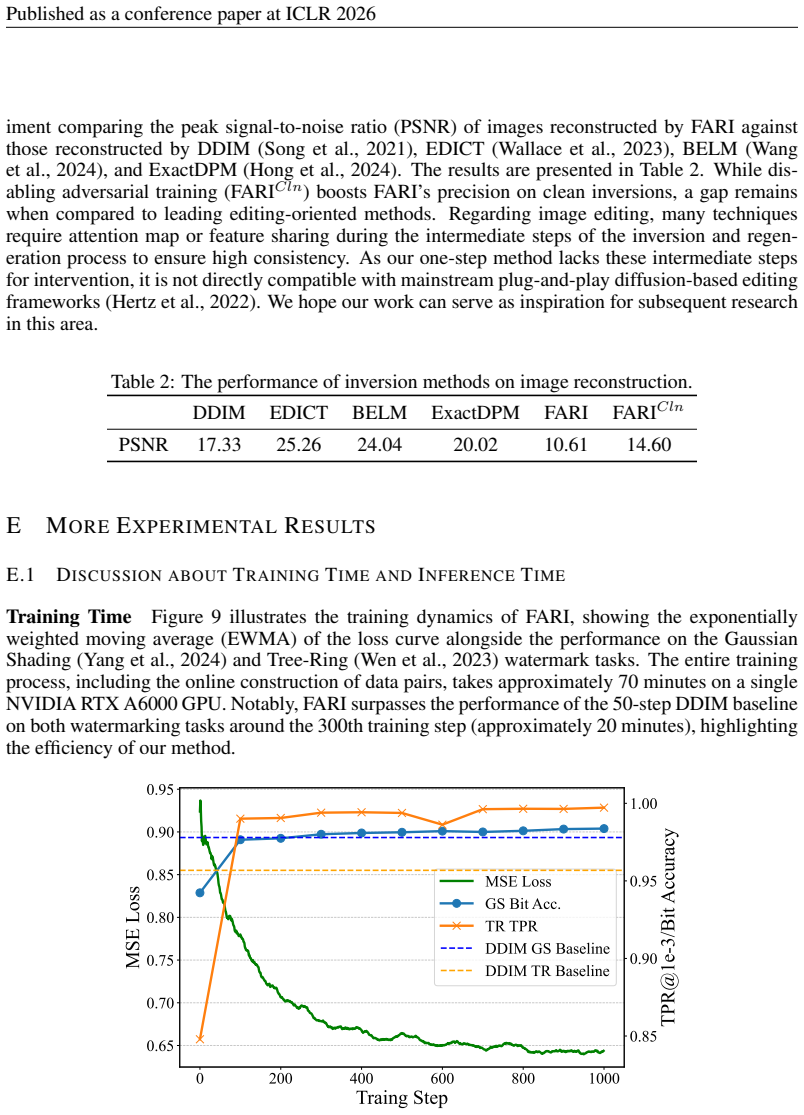
The DDIM inversion trajectory has markedly lower curvature than the forward generation path, making it compressible to one step; because external channel distortions already dominate internal truncation error in the watermark setting, that one-step map can be adversarially LoRA-fine-tuned end-to-end and still outperform 50-step DDIM on verification robustness after roughly twenty minutes of training.
What carries the argument
FARI: a single-step inversion that reconstructs initial noise from a (possibly distorted) latent by evaluating a LoRA-adapted denoiser at t≈0, trained with an MSE loss against ground-truth noise under random distortions; the LoRA is enabled only at extraction so generation quality is unchanged.
Load-bearing premise
That the lower curvature of inversion paths remains usable under real distortions, so one linear step plus light fine-tuning can absorb leftover error without erasing the watermark.
What would settle it
Measure bit accuracy (Gaussian Shading) and TPR at FPR 1e-3 (Tree-Ring) for one-step FARI versus 50-step DDIM on held-out distortion types or higher intensities after the same training budget; if FARI falls below the baseline, the robustness claim fails.
If this is right
- Watermark verification for diffusion images can run in one denoiser call instead of dozens.
- End-to-end adversarial training of inverters becomes practical on a single GPU in minutes.
- LoRA can carry inversion robustness without altering the base model’s generation quality.
- High-NFE inversion methods built for editing are the wrong default for watermark extraction under channel noise.
- Cheaper inversion graphs also make gradient-based watermark removal attacks easier to study.
Where Pith is reading between the lines
- The same low-curvature observation may let other verification tasks such as tamper localization drop to few-step inversion.
- Once inversion is one step, white-box adaptive attacks on inversion watermarks become routinely affordable, shifting the arms race.
- Generation-oriented distillation methods systematically underperform on inversion because the input distribution is reversed (structured image versus pure noise).
- Dependence on ODE samplers leaves open whether similar compressibility holds for SDE or flow-matching trajectories.
Editorial analysis
A structured set of objections, weighed in public.
Referee Report
Summary. The paper addresses the practical bottleneck of slow, error-prone inversion in inversion-based watermarking for diffusion models. It observes that (i) DDIM inversion trajectories have substantially lower curvature than generation trajectories and are therefore more compressible to low NFE, and (ii) external channel distortions dominate internal truncation error for watermark verification, so high-NFE optimization of internal error is misaligned. Building on this, FARI collapses inversion to a single step via LoRA fine-tuning of the denoiser, trained end-to-end with an MSE objective to the ground-truth initial noise under a suite of random distortions. LoRA is activated only at extraction, preserving generation quality. Empirically, after ~20 minutes of training on one A6000, one-step FARI outperforms 50-step DDIM (and several specialized inversion and acceleration baselines) on Gaussian Shading bit accuracy and Tree-Ring TPR@FPR=1e-3 across nine distortions on SD v1.5 and v2.1, with additional generalization and ablation studies.
Significance. If the empirical claims hold, FARI removes a major deployment obstacle for inversion-based watermarks by simultaneously cutting NFE from 50 to 1 and improving robustness under realistic distortions, at negligible fine-tuning cost and without degrading the base generator. The geometric asymmetry observation (lower inversion curvature) and the dual-benefit argument (speed enabling end-to-end adversarial training) are useful conceptual contributions beyond the specific method. Strengths include public code and pretrained models, head-to-head evaluation on two watermark schemes with their native metrics, multiple strong baselines (EDICT, BELM, ExactDPM, adversarially-tuned AMED, LCM-LoRA, DMD2), and ablations on LoRA rank, training NFE, unseen distortions, guidance scales, and samplers. Limitations (ODE-only; poor clean reconstruction PSNR; unsuitable for editing) are stated and orthogonal to the watermark-extraction claim.
major comments (2)
- [§3.1, Figure 1] §3.1 and Fig. 1 (middle): the curvature comparison that motivates one-step compressibility is measured on clean, unconditional trajectories. While Fig. 1 (right), Fig. 3, Table 1, and Fig. 5 (left) provide strong downstream empirical support that external error remains dominant after consolidation, the manuscript would be tighter if it also reported discrete curvature (or an analogous local linearity measure) on trajectories starting from distorted latents, to directly confirm that the geometric premise survives the channel noise the method is designed to handle.
- [§3.2, Equations (9)–(10)] §3.2, Eqs. (9)–(10): setting the one-step inversion timestep to t=0 (rather than t=T) is presented as an empirical fix for the violated piecewise-linear assumption. The appendix ablation (Table 10) shows t≈0 is best, but the main text should briefly state the range of t that works and whether this choice interacts with the noise schedule or VAE latent scale, so that the one-step map is reproducible without consulting the appendix.
minor comments (6)
- [Figure 1] Figure 1 (left) PCA visualization of inversion residual is helpful but the caption should note the number of components retained and whether the same projection is used for generation vs. inversion for fair visual comparison.
- [Table 1] Table 1: the Adv. column is not defined in the main caption; clarify whether it is a fixed composite attack or the average over the training distortion set.
- [§4.1] §4.1: state explicitly that training is watermark-agnostic (MSE to z_T) so that the same LoRA applies to both Tree-Ring and Gaussian Shading; this is clear from the method but easy to miss.
- [§4 / Appendix E.1] Appendix E.1 inference-time note on LoRA overhead and merge strategy is important for practitioners; a one-sentence pointer in the main efficiency discussion would help.
- [Throughout] Typos / formatting: title line breaks (“ROBUSTONE-STEP”, “WATER-MARKING”); “T olerance” in Fig. 1; occasional missing spaces before citations. Minor polish only.
- [§5] §5 Limitations correctly flags SDE failure and editing unsuitability; consider one sentence on whether multi-step FARI (NFE=2–4) could recover intermediate features for editing without losing the robustness gains (Fig. 5 right already suggests NFE>1 does not help watermark metrics).
Circularity Check
No significant circularity: empirical method paper; training MSE and curvature measurements do not force downstream watermark metrics.
full rationale
FARI is a systems/method paper, not a first-principles derivation. The load-bearing chain is: (i) discrete curvature of DDIM inversion trajectories is measured lower than generation (Fig. 1 middle, κ_t = θ_t/s_t on unconditional SD trajectories); (ii) therefore a one-step map is trainable; (iii) LoRA is optimized by MSE to ground-truth initial noise under random distortions (Eq. 11); (iv) success is reported on external watermark metrics (GS bit accuracy; TR TPR@FPR=1e-3) against independent inversion baselines (DDIM, EDICT, BELM, ExactDPM, AMED, LCM-LoRA, DMD2) in Table 1. None of these steps is definitional or algebraically forced: the MSE objective does not determine bit-accuracy or TPR; curvature plots are measurements, not fits to watermark scores; and evaluation uses held-out prompts and distortion intensities (Fig. 4) plus partial transfer to unseen distortions (Fig. 5 left). Self-use of Gaussian Shading (overlapping authors) is only as one of two downstream benchmarks alongside independent Tree-Ring; it does not justify the method or uniqueness of the result. Limitations (ODE-only; poor clean PSNR) are stated openly. No self-definitional loop, fitted-as-prediction, or load-bearing self-citation chain exists.
Axiom & Free-Parameter Ledger
free parameters (5)
- LoRA rank r =
8 (default)
- Inversion timestep t in one-step map =
t=0
- Adversarial distortion set T and intensities =
9 types (Fig. 6)
- Training hyperparameters (lr, steps, batch, gen NFE) =
1e-4 / 1000 / 4 / 20
- Guidance and sampler settings for gen/eval =
gs=7.5, NFE_gen=50
axioms (5)
- domain assumption DDIM defines a deterministic invertible ODE path so z_T can be recovered from z_0 in the clean case (Song et al. 2021).
- ad hoc to paper External channel distortions dominate accumulated inversion error relative to internal truncation error in the watermark setting.
- ad hoc to paper Discrete trajectory curvature κ_t = θ_t / s_t is a valid proxy for numerical compressibility / truncation-error tolerance.
- domain assumption Watermark verification metrics (GS bit accuracy; TR TPR at FPR=1e-3) are the right success criteria; clean PSNR/editing fidelity may be sacrificed.
- domain assumption ODE-based sampling is used at generation and inversion time; SDE samplers are out of scope.
invented entities (1)
-
FARI one-step asymmetric robust inverter (LoRA-augmented denoiser map)
independent evidence
read the original abstract
Inversion-based watermarking is a promising approach to authenticate diffusion-generated images, yet practical use is bottlenecked by inversion that is both slow and error-prone. While the primary challenge in the watermarking setting is robustness against external distortions, existing approaches over-optimize internal truncation error, and because that error scales with the sampler step size, they are inherently confined to high-NFE (number of function evaluations) regimes that cannot meet the dual demands of speed and robustness. In this work, we have two key observations: (i) the inversion trajectory has markedly lower curvature than the forward generation path does, making it highly compressible and amenable to low-NFE approximation; and (ii) in inversion for watermark verification, the trade-off between speed and truncation error is less critical, since external distortions dominate the error. A faster inverter provides a dual benefit: it is not only more efficient, but it also enables end-to-end adversarial training to directly target robustness, a task that is computationally prohibitive for the original, lengthy inversion trajectories. Building on this, we propose \textbf{FARI} (\textbf{F}ast \textbf{A}symmetric \textbf{R}obust \textbf{I}nversion), a one-step inversion framework paired with lightweight adversarial LoRA fine-tuning of the denoiser for watermark extraction. While consolidation slightly increases internal error, FARI delivers large gains in both speed and robustness: with approximately 20 minutes of fine-tuning on a single NVIDIA RTX A6000 GPU, it surpasses 50-step DDIM inversion on watermark-verification robustness while dramatically reducing inference time. Code and pretrained models are available at https://github.com/0xD009/FARI.
Figures




Reference graph
Works this paper leans on
-
[1]
Variational image compression with a scale hyperprior.arXiv preprint arXiv:1802.01436,
Johannes Ball´e, David Minnen, Saurabh Singh, Sung Jin Hwang, and Nick Johnston. Variational image compression with a scale hyperprior.arXiv preprint arXiv:1802.01436,
-
[2]
While dis- abling adversarial training (FARI Cln) boosts FARI’s precision on clean inversions, a gap remains when compared to leading editing-oriented methods. Regarding image editing, many techniques require attention map or feature sharing during the intermediate steps of the inversion and regen- eration process to ensure high consistency. As our one-st...
2022
-
[4]
Prompt-to-prompt image editing with cross attention control.arXiv preprint arXiv:2208.01626,
Amir Hertz, Ron Mokady, Jay Tenenbaum, Kfir Aberman, Yael Pritch, and Daniel Cohen-Or. Prompt-to-prompt image editing with cross attention control.arXiv preprint arXiv:2208.01626,
-
[7]
Xuan Ju, Ailing Zeng, Yuxuan Bian, Shaoteng Liu, and Qiang Xu. Direct inversion: Boosting diffusion-based editing with 3 lines of code.arXiv preprint arXiv:2310.01506,
-
[8]
Gaussmarker: Robust dual-domain watermark for diffusion models.arXiv preprint arXiv:2506.11444,
Kecen Li, Zhicong Huang, Xinwen Hou, and Cheng Hong. Gaussmarker: Robust dual-domain watermark for diffusion models.arXiv preprint arXiv:2506.11444,
-
[9]
Microsoft coco: Common objects in context
Tsung-Yi Lin, Michael Maire, Serge Belongie, James Hays, Pietro Perona, Deva Ramanan, Piotr Doll´ar, and C Lawrence Zitnick. Microsoft coco: Common objects in context. InComputer vision–ECCV 2014: 13th European conference, zurich, Switzerland, September 6-12, 2014, pro- ceedings, part v 13, pp. 740–755. Springer,
2014
-
[11]
Dpm-solver: A fast ode solver for diffusion probabilistic model sampling in around 10 steps
11 Published as a conference paper at ICLR 2026 Cheng Lu, Yuhao Zhou, Fan Bao, Jianfei Chen, Chongxuan LI, and Jun Zhu. Dpm-solver: A fast ode solver for diffusion probabilistic model sampling in around 10 steps. InAdvances in Neural Information Processing Systems, volume 35, pp. 5775–5787, 2022a. Cheng Lu, Yuhao Zhou, Fan Bao, Jianfei Chen, Chongxuan Li,...
Pith/arXiv arXiv 2026
-
[12]
Lcm-lora: A universal stable-diffusion acceleration module
Simian Luo, Yiqin Tan, Suraj Patil, Daniel Gu, Patrick von Platen, Apolin ´ario Passos, Longbo Huang, Jian Li, and Hang Zhao. Lcm-lora: A universal stable-diffusion acceleration module. arXiv preprint arXiv:2311.05556,
-
[13]
Negative-prompt inversion: Fast image inversion for editing with text-guided diffusion models
Daiki Miyake, Akihiro Iohara, Yu Saito, and Toshiyuki Tanaka. Negative-prompt inversion: Fast image inversion for editing with text-guided diffusion models. In2025 IEEE/CVF Winter Con- ference on Applications of Computer Vision (WACV), pp. 2063–2072. IEEE,
2063
-
[14]
Andreas M ¨uller, Denis Lukovnikov, Jonas Thietke, Asja Fischer, and Erwin Quiring. Black-box forgery attacks on semantic watermarks for diffusion models.arXiv preprint arXiv:2412.03283,
-
[15]
Dustin Podell, Zion English, Kyle Lacey, Andreas Blattmann, Tim Dockhorn, Jonas M ¨uller, Joe Penna, and Robin Rombach. Sdxl: Improving latent diffusion models for high-resolution image synthesis.arXiv preprint arXiv:2307.01952,
-
[16]
Progressive distillation for fast sampling of diffusion models.arXiv preprint arXiv:2202.00512,
Tim Salimans and Jonathan Ho. Progressive distillation for fast sampling of diffusion models.arXiv preprint arXiv:2202.00512,
-
[17]
Lightning-fast image inversion and editing for text-to-image diffusion models
Dvir Samuel, Barak Meiri, Haggai Maron, Yoad Tewel, Nir Darshan, Shai Avidan, Gal Chechik, and Rami Ben-Ari. Lightning-fast image inversion and editing for text-to-image diffusion models. arXiv preprint arXiv:2312.12540,
-
[20]
Łukasz Staniszewski, Łukasz Kuci ´nski, and Kamil Deja. There and back again: On the relation between noise and image inversions in diffusion models.arXiv preprint arXiv:2410.23530,
-
[21]
Edict: Exact diffusion inversion via coupled trans- formations
12 Published as a conference paper at ICLR 2026 Bram Wallace, Akash Gokul, and Nikhil Naik. Edict: Exact diffusion inversion via coupled trans- formations. InProceedings of the IEEE/CVF Conference on Computer Vision and Pattern Recog- nition, pp. 22532–22541,
2026
-
[22]
Yuxin Wen, John Kirchenbauer, Jonas Geiping, and Tom Goldstein. Tree-ring watermarks: Fin- gerprints for diffusion images that are invisible and robust.arXiv preprint arXiv:2305.20030,
-
[23]
Zijin Yang, Xin Zhang, Kejiang Chen, Kai Zeng, Qiyi Yao, Han Fang, Weiming Zhang, and Nenghai Yu. Gaussian shading++: Rethinking the realistic deployment challenge of performance-lossless image watermark for diffusion models.arXiv preprint arXiv:2504.15026,
-
[24]
Tianwei Yin, Micha ¨el Gharbi, Taesung Park, Richard Zhang, Eli Shechtman, Fredo Durand, and Bill Freeman. Improved distribution matching distillation for fast image synthesis.Advances in neural information processing systems, 37:47455–47487, 2024a. Tianwei Yin, Micha¨el Gharbi, Richard Zhang, Eli Shechtman, Fredo Durand, William T Freeman, and Taesung Pa...
-
[25]
Fast ode-based sampling for diffusion models in around 5 steps
Zhenyu Zhou, Defang Chen, Can Wang, and Chun Chen. Fast ode-based sampling for diffusion models in around 5 steps. InProceedings of the IEEE/CVF Conference on Computer Vision and Pattern Recognition, pp. 7777–7786, 2024a. Zhenyu Zhou, Defang Chen, Can Wang, Chun Chen, and Siwei Lyu. Simple and fast distillation of diffusion models.Advances in Neural Infor...
2026
-
[26]
Notably, these methods do not actually change the result of the initial inversion; their focus is on the reconstruction phase
also follows this path by decoupling the source and target diffusion branches. Notably, these methods do not actually change the result of the initial inversion; their focus is on the reconstruction phase. Therefore, their performance in a watermarking scenario is nearly identical to that of standard DDIM inversion, and we do not include them in our quant...
2023
-
[27]
However, their design carries an implicit assumption that the entire process is free from external error
modify the sampler to achieve a smaller theoretical error bound. However, their design carries an implicit assumption that the entire process is free from external error. This holds true for reconstruction but is clearly violated in watermarking, where the image is subject to various distortions after generation that can push it out of the method’s conver...
2025
-
[28]
module. However, its purpose is different: it is designed to adapt to various user-personalized models, enabling accelerated sampling without requiring a separate distillation for each fine-tuned model. DMD2 (Yin et al., 2024a), on the other hand, uses distribution matching distillation. It does not directly learn the teacher’s output but rather its targe...
2022
-
[29]
trailing
watermarks, we use the official open-source code provided by the authors on GitHub. We use Tree-Ring in itsrandmode, with the watermark embedded in the fourth channel of the latent space. For Gaussian Shading, we adopt the default settings (f ch = 4, fh = 8, fw = 8, for a 256-bit capacity) and use a stream cipher to encrypt the watermark message. Baseline...
2021
-
[30]
The NFE is set to 50 steps, and EDICT’s hyperparameterpis set to 0.93 as recom- mended in the original paper
and BELM (Wang et al., 2024), we use the implementation pro- vided by BELM. The NFE is set to 50 steps, and EDICT’s hyperparameterpis set to 0.93 as recom- mended in the original paper. For ExactDPM (Hong et al., 2024), we use the official implementation with the Backward Euler method for inversion. To ensure a fair and efficient comparison, we disable th...
2024
-
[31]
We set LCM-LoRA to use two steps (within its allowed 2-8 range) and use a single step for DMD2, which has one-step sampling capabilities
and DMD2 (Yin et al., 2024a), we use the officially provided weights. We set LCM-LoRA to use two steps (within its allowed 2-8 range) and use a single step for DMD2, which has one-step sampling capabilities. 15 Published as a conference paper at ICLR 2026 Training and Evaluation.For FARI’s training, we use a batch size of 4 with the Adam opti- mizer and a...
2026
-
[32]
(d) 80% area Random Drop (R.Drop)
(c) 60% area Random Crop (R.Crop). (d) 80% area Random Drop (R.Drop). (e) 25% Resize and restore (Resize). (f) Gaussian Blur,r= 4 (G.Blur). (g) Median Blur,k= 7 (M.Blur). (h) Gaussian Noise,µ= 0,σ= 0.05 (G.Noise). (i) Salt and Pepper Noise,p= 0.05 (S&P). (j) Brightness,f actor= 6 (Bright). C DETAILS ABOUT THECURVATUREEVALUATION. In Section 3.1, we measure...
2022
-
[33]
All other settings remain identical to our main experiments
For con- ditional generation, we use prompts from the Stable-Diffusion-Prompts dataset. All other settings remain identical to our main experiments. First, we used conditional generation to create an image, and then compared the curvature of the original generation trajectory against two types of inversion: one that was conditionally-aligned and one that ...
2024
-
[34]
0 200 400 600 800 1000 Timestep 0.0 0.5 1.0 1.5 2.0 2.5 3.0Curvature Curvature over Sampling (SDP dataset) generation w/ condition inversion w/ condition inversion w/o condition 0 200 400 600 800 1000 Timestep 0 2 4 6 8 10Curvature Curvature over Sampling generation inversion regeneration Figure 7:Left: The curvature of the conditional generation, uncondi...
2026
-
[36]
While this introduces latency, the total time remains less than that of a two-step inversion
modules affects the denoiser’s inference efficiency, with the average time per function evaluation on an NVIDIA RTX A6000 GPU increasing from 0.0247 s to 0.0358 s. While this introduces latency, the total time remains less than that of a two-step inversion. To eliminate this overhead during inference, a practical solution is to merge the LoRA weights byW ...
2026
-
[37]
Since SD v3.5M does not support DDIM sampler, we implement inver- sion for this model via naive Euler Method
and SDXL- Turbo (Podell et al., 2023). Since SD v3.5M does not support DDIM sampler, we implement inver- sion for this model via naive Euler Method. SDXL-Turbo inherently supports one-step generation, so we compare the performance of one-step DDIM inversion against FARI. Given that SD v3.5 has 16 latent channels, we setf ch = 2andf h =f w = 8for Gaussian ...
2023
-
[39]
We therefore opted for the more parameter- efficient default setting
Although training more modules yields a marginal improvement, the increase is not significant. We therefore opted for the more parameter- efficient default setting. /uni0000003d/uni0000004b/uni00000044/uni00000052/uni00000015/uni00000013/uni00000015/uni00000017/uni00000046/uni0000004b/uni00000048/uni00000051/uni0000004a/uni00000015/uni00000013/uni00000015...
2026
-
[40]
and Tree-Ring (Wen et al., 2023), we directly measure and report the MSE of FARI’s reconstructed latent noise in Table 11, with visual results shown in Fig- ure
2023
-
[41]
Table 11: The MSE of inversion methods under various image distortions. DM Methods NFE Clean Adv. Jpeg R.Crop R.Drop Resize G.Blur M.Blur G.Noise S&P Bright SD v1.5 DDIM 50 0.20030.92850.8740 0.8734 0.8834 0.7671 0.9706 0.6920 1.1860 1.2963 0.81391 0.7108 0.90160.8981 0.9646 0.9621 0.8294 0.8987 0.8157 0.9067 0.9316 0.9074EDICT 50 0.2646 1.04771.0400 1.04...
arXiv 2065
-
[300]
(2020) and Ball´e et al
For Cheng et al. (2020) and Ball´e et al. (2018), we set the quality parameter to 3 (representing the highest attack strength). For the adversarial optimization attack (Lukas et al., 2023), we use the following settings:ϵ= 4/255, Adam optimizer, learning rate of 0.01, and 5 optimization steps per image, all of which are con- sistent with the default confi...
2020
-
[2014]
Pseudo numerical methods for diffusion models on manifolds.arXiv preprint arXiv:2202.09778,
Luping Liu, Yi Ren, Zhijie Lin, and Zhou Zhao. Pseudo numerical methods for diffusion models on manifolds.arXiv preprint arXiv:2202.09778,
-
[2020]
Consistency models.arXiv preprint arXiv:2303.01469,
Yang Song, Prafulla Dhariwal, Mark Chen, and Ilya Sutskever. Consistency models.arXiv preprint arXiv:2303.01469,
-
[2021]
Yang Song, Jascha Sohl-Dickstein, Diederik P Kingma, Abhishek Kumar, Stefano Ermon, and Ben Poole. Score-based generative modeling through stochastic differential equations.arXiv preprint arXiv:2011.13456,
Pith/arXiv arXiv 2011
-
[2022]
Classifier-free diffusion guidance.arXiv preprint arXiv:2207.12598,
Jonathan Ho and Tim Salimans. Classifier-free diffusion guidance.arXiv preprint arXiv:2207.12598,
-
[2023]
Scaling rectified flow transformers for high-resolution image synthesis
10 Published as a conference paper at ICLR 2026 Patrick Esser, Sumith Kulal, Andreas Blattmann, Rahim Entezari, Jonas M ¨uller, Harry Saini, Yam Levi, Dominik Lorenz, Axel Sauer, Frederic Boesel, et al. Scaling rectified flow transformers for high-resolution image synthesis. InForty-first international conference on machine learning,
2026
-
[2024]
An undetectable watermark for generative image models.arXiv preprint arXiv:2410.07369,
Sam Gunn, Xuandong Zhao, and Dawn Song. An undetectable watermark for generative image models.arXiv preprint arXiv:2410.07369,
-
[2025]
Huayang Huang, Yu Wu, and Qian Wang
URLhttps: //arxiv.org/abs/2501.14195. Huayang Huang, Yu Wu, and Qian Wang. Robin: Robust and invisible watermarks for diffusion models with adversarial optimization.Advances in Neural Information Processing Systems, 37: 3937–3963,
discussion (0)
Sign in with ORCID, Apple, or X to comment. Anyone can read and Pith papers without signing in.