REVIEW 6 minor 36 references
Photon-energy and polarization ARPES separate bulk bands from surface states on both terminations of PtBi2(0001).
Reviewed by Pith at T0; open to challenge. T0 means a machine referee read the full paper against a public rubric. the ladder, T0–T4 →
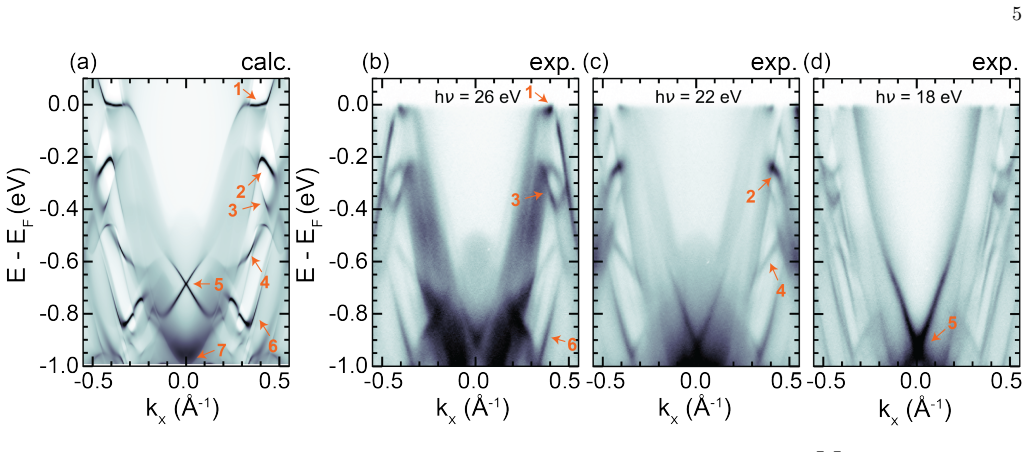
Photon-energy and polarization-dependent ARPES plus DFT disentangle and assign bulk and surface states on both DH and KL terminations of PtBi2(0001), with orbital character matching polarization trends.
T0 review reviewed 2026-07-30 challenge →
load-bearing objection Solid termination-resolved ARPES+DFT atlas that finally sorts bulk from surface on both PtBi2(0001) faces; useful infrastructure, not a mechanism paper.
Disentangling bulk and surface states in the electronic structure of PtBi$_2$(0001)
The pith
A machine-rendered reading of the paper's core claim, the machinery that carries it, and where it could break.
The reading
Core claim
By combining photon-energy-dependent ARPES (to track kz bulk dispersion) with polarization-dependent intensity and semi-infinite slab spectral-weight calculations, the bulk continuum can be disentangled from true surface states on both DH and KL terminations of PtBi2(0001). Several surface features are assigned on each face, experiment and calculation agree well enough to give a coherent picture, and the orbital makeup of those bands explains the observed polarization contrast.
What carries the argument
Photon-energy series plus polarization matrix-element contrast in ARPES, read against DFT surface spectral weight on semi-infinite Wannier slabs for the two terminations—the tool that labels which intensity is bulk (kz-dispersive continuum) versus surface (sharp, kz-independent).
Load-bearing premise
That VUV photon energies, with their finite escape-depth kz broadening, plus standard GGA slab calculations, are accurate enough to uniquely tag mixed bulk–surface bands even when theory and experiment sit a few tenths of an eV apart.
What would settle it
A soft-X-ray or broader photon-energy ARPES series in which any of the assigned surface features (the Fermi arc, the DH Γ Dirac-like crossing, or the steep near-EF KL band labeled mixed) clearly disperses with kz, or a slab calculation that moves that DH crossing into agreement with experiment while destroying the other surface assignments.
If this is right
- Termination must be specified when linking ARPES or STM gaps to topological surface superconductivity on PtBi2.
- The DH Dirac-like crossing and the KL Fermi-arc mixing with bulk continuum are distinct spectroscopic fingerprints of each face.
- Polarization can be used as an orbital filter to enhance or suppress specific surface bands in future gap or spin measurements.
- Bulk Rashba-like branches and steep A-plane bands are now experimentally anchored against calculation across a wide photon-energy range.
Where Pith is reading between the lines
- Any claim that the superconducting gap lives only on Fermi arcs needs termination-controlled samples; mixed bulk–surface weight on KL could dilute or mimic a surface gap.
- The ~0.2 eV theory–experiment offset of the DH Dirac crossing is a natural target for beyond-GGA or surface-relaxation calculations before using that state as a topological marker.
- Spin-resolved ARPES on the polarization-selected DH pz-dominated crossing would test whether that state carries a distinct spin texture from the arc.
Editorial analysis
A structured set of objections, weighed in public.
Referee Report
Summary. The manuscript presents a VUV-ARPES and DFT study of trigonal non-centrosymmetric PtBi2(0001), aimed at disentangling bulk dispersions from surface states on the two cleave terminations (decorated-honeycomb, DH, and Kagome-like, KL). Photon-energy-dependent spectra are used to separate Γ-plane versus A-plane bulk features (notably Rashba-like branches near M and steeper A-plane bands), while surface spectral-weight calculations on semi-infinite Wannier slabs are compared to termination-resolved ARPES to assign several surface features, including the Fermi arc and a DH-only Dirac-like crossing at Γ. Orbital projections (Bi 6p) are then related to polarization-dependent intensity trends. The authors conclude that experiment and calculation agree sufficiently to give a coherent, termination-resolved picture of the surface electronic structure relevant to reported surface superconductivity.
Significance. If the assignments hold, the work supplies a practical multi-handle atlas (hν, polarization, termination) for a material in which surface-localized topological superconductivity has been claimed but remains experimentally contested. The combination of kz-sensitive bulk stacks, semi-infinite surface spectral weight, and orbital/polarization cross-checks is the right toolkit for this problem, and the side-by-side DH versus KL comparison fills a genuine gap left by prior Fermi-arc-focused studies. Strengths include systematic labeling of multiple surface features (1)–(7), explicit acknowledgment of kz broadening and residual energy offsets, and orbital-resolved calculations that give a concrete (if qualitative) account of polarization matrix-element trends. The result is incremental rather than transformative, but it is useful reference work for the PtBi2 community.
minor comments (6)
- [Results, Bulk bands; Fig. 2] Results, bulk bands / Fig. 2: The free-electron-like kz assignment (56 eV ~ Γ-plane, 18 eV ~ A-plane) is standard and consistent with the data, but the inner potential and the estimated kz-broadening window are never stated. A short sentence (or a note pointing to Fig. S1) would make the mapping reproducible.
- [Results, Surface states; Figs. 3–4] Results, surface states / Figs. 3–4: The DH Dirac-like crossing (feature 5) is ~0.2 eV deeper in experiment than in the surface calculation; the KL steep near-EF feature is described as mixed bulk–surface. Both points are already noted, but a brief quantitative summary of residual energy shifts across the labeled features would help readers judge assignment robustness without hunting through the text.
- [Orbital character and polarization dependence] Orbital character section / Eq. (1) and Fig. 6: The dipole-selection discussion correctly notes that ΓM is not a strict crystal mirror plane, yet still applies even/odd language. Clarifying that this is only a qualitative guide (and that final-state and photon-energy effects also matter) would avoid over-reading the polarization contrast, especially for the Rashba-like bulk bands that show little systematic polarization dependence.
- [Fig. 2; Fig. 4] Fig. 2(e) green arrow and related text: The mixed bulk–surface character of the steep near-EF band on KL is important for Fermi-arc discussions; a cross-reference to the surface calculation panel (Fig. 4a) at that momentum would make the mixed assignment easier to verify.
- [Throughout / Experimental Details] Minor presentation: several figure captions and the main text refer to Supplemental Figs. S1–S6 that are not in the submitted main file; ensure they are complete and that energy/momentum scales and polarization labels are consistent with the main figures. Also fix small typos (e.g., “EXPERIMENT AL DET AILS”, “i-wave” spacing, author-name umlauts/encoding).
- [Introduction] Introduction: The contested experimental status of surface superconductivity is summarized fairly; a single sentence stating that the present work does not itself address the gap or Tc would set expectations cleanly for readers coming from the SC literature.
Circularity Check
No significant circularity: ARPES assignments rest on independent photon-energy, polarization, and termination knobs compared to parameter-free DFT/Wannier spectral weight.
full rationale
The paper's load-bearing chain is experimental ARPES (hν series 10–120 eV, s/p polarization, two cleave terminations) compared to standard GGA bulk bands and semi-infinite Wannier surface spectral weight. Bulk vs surface labels are fixed by kz-dispersion (or its absence) and by termination dependence, not by fitting free parameters to the same spectra that are then 'predicted.' Orbital projections are used only to rationalize already-observed polarization matrix-element trends; they are not tuned to force agreement. Prior theory citations (including author-overlapping surface-structure papers) supply computational context and nomenclature but are not invoked as uniqueness theorems or as the sole evidence for the assignments. Energy offsets (e.g., ~0.2 eV for the DH Dirac-like crossing) are disclosed rather than absorbed into a fit. The derivation is therefore self-contained and non-circular.
Axiom & Free-Parameter Ledger
free parameters (2)
- Effective kz (inner potential / free-electron final-state mapping) =
Not numerically stated; representative hν=56 eV (Γ) and 18 eV (A)
- Overall DFT energy alignment relative to EF
axioms (6)
- domain assumption GGA-DFT with the experimental P31m structure adequately describes bulk Bi 6p / Pt 5d bands near EF for assignment purposes.
- domain assumption Semi-infinite slabs of a Wannier Hamiltonian (Bi 6s/6p, Pt 6s/5d) yield surface spectral weight that can be compared directly to ARPES for state assignment.
- domain assumption VUV ARPES intensity variations with hν primarily reflect kz dispersion plus matrix elements, so non-dispersive sharp features are surface-localized.
- domain assumption Dipole selection with approximate even/odd character relative to the incidence plane explains s- versus p-polarization contrast (even px/pz vs odd py), even though ΓM is not a strict crystal mirror in the setup geometry.
- domain assumption Repeated cleaves of a given crystal expose a single homogeneous termination (DH or KL) suitable for assignment.
- standard math Standard relativistic Kohn–Sham DFT / tetrahedron BZ integration mathematics as implemented in FPLO.
Cite this review
Pith. "Pith review of Disentangling bulk and surface states in the electronic structure of PtBi$_2$(0001)." pith.science (2026). https://pith.science/paper/OU7JW7GR
@misc{pith2026260726804,
  author       = {Pith},
  title        = {Pith review of: Disentangling bulk and surface states in the electronic structure of PtBi$_2$(0001)},
  year         = {2026},
  howpublished = {\url{https://pith.science/paper/OU7JW7GR}},
  note         = {Machine review of arXiv:2607.26804}
}
abstract
Recent reports of surface-localized topological superconductivity in trigonal PtBi$_2$ highlight the importance of understanding its surface electronic structure. We investigate the bulk and surface band structure of PtBi$_2$ using angle-resolved photoemission spectroscopy (ARPES) and first-principles calculations. Through photon-energy- and polarization-dependent measurements, we disentangle bulk dispersions from surface states on the two distinct surface terminations of PtBi$_2$(0001). For both terminations, we assign several different surface states and find good agreement between experiment and calculations. Based on our calculations, we analyze the orbital composition in the surface and bulk bands and compare the results to polarization-dependent ARPES measurements. Together, our results provide a coherent picture of the surface electronic structure of PtBi$_2$ across both surface terminations.
Figures




Reference graph
Works this paper leans on
-
[1]
Nayak, S
C. Nayak, S. H. Simon, A. Stern, M. Freedman, and S. Das Sarma, Non-abelian anyons and topological quan- tum computation, Rev. Mod. Phys.80, 1083 (2008)
2008
-
[2]
N. P. Armitage, E. J. Mele, and A. Vishwanath, Weyl and Dirac semimetals in three-dimensional solids, Rev. Mod. Phys.90, 015001 (2018)
2018
-
[3]
Kuibarov, O
A. Kuibarov, O. Suvorov, R. Vocaturo, A. Fedorov, 9 R. Lou, L. Merkwitz, V. Voroshnin, J. I. Facio, K. Koepernik, A. Yaresko, G. Shipunov, S. Aswartham, J. van den Brink, B. B¨ uchner, and S. Borisenko, Evidence of superconducting Fermi arcs, Nature626, 294 (2024)
2024
-
[4]
Changdar, O
S. Changdar, O. Suvorov, A. Kuibarov, S. Thirupatha- iah, G. Shipunov, S. Aswartham, S. Wurmehl, I. Ko- valchuk, K. Koepernik, C. Timm, B. B¨ uchner, I. C. Fulga, S. Borisenko, and J. van den Brink, Topologi- cal nodal i-wave superconductivity in PtBi2, Nature647, 613 (2025)
2025
-
[5]
Zabala, V
J. Zabala, V. F. Correa, F. J. Castro, and P. Pedrazzini, Enhanced weak superconductivity in trigonalγ-PtBi 2, J. Phys.: Condens. Matter36, 285701 (2024)
2024
-
[6]
Schimmel, Y
S. Schimmel, Y. Fasano, S. Hoffmann, J. Besproswanny, L. T. Corredor Bohorquez, J. Puig, B.-C. Elshalem, B. Kalisky, G. Shipunov, D. Baumann, S. Aswartham, B. B¨ uchner, and C. Hess, Surface superconductivity in the topological Weyl semimetal t-PtBi 2, Nat. Commun. 15, 9895 (2024)
2024
-
[7]
Kuibarov, S
A. Kuibarov, S. Changdar, A. Fedorov, R. Lou, O. Suvorov, V. Misheneva, L. Harnagea, I. Kovalchuk, S. Wurmehl, B. B¨ uchner, and S. Borisenko, Measur- ing superconducting arcs by angle-resolved photoemis- sion spectroscopy, Phys. Rev. B112, 144518 (2025)
2025
-
[8]
O’Leary, Z
E. O’Leary, Z. Li, L.-L. Wang, B. Schrunk, A. Eaton, P. C. Canfield, and A. Kaminski, Topography of Fermi arcs int-PtBi 2 using high-resolution angle-resolved pho- toemission spectroscopy, Phys. Rev. B112, 085154 (2025)
2025
-
[9]
X. Huang, L. Zhao, S. Schimmel, J. Besproswanny, P. H¨ artl, C. Hess, B. B¨ uchner, and M. Bode, Sizable superconducting gap and anisotropic chiral topological superconductivity in the Weyl semimetal PtBi 2 (2025), arXiv:2507.13843
Pith/arXiv arXiv 2025
-
[10]
Hoffmann, S
S. Hoffmann, S. Schimmel, R. Vocaturo, J. Puig, G. Shipunov, O. Janson, S. Aswartham, D. Baumann, B. B¨ uchner, J. van den Brink, Y. Fasano, J. I. Facio, and C. Hess, Fermi arcs dominating the electronic surface properties of trigonal PtBi 2, Adv. Phys. Res.4, 2400150 (2025)
2025
-
[11]
Mæland, M
K. Mæland, M. Bahari, and B. Trauzettel, Phonon- mediated intrinsic topological superconductivity in Fermi arcs, Phys. Rev. B112, 104507 (2025)
2025
-
[12]
Mæland, G
K. Mæland, G. Sangiovanni, and B. Trauzettel, Mech- anism for nodal topological superconductivity on PtBi 2 surface, Phys. Rev. Lett.137, 056001 (2026)
2026
-
[13]
R. Dsouza, N. Parthenios, B. M. Andersen, and M. H. Christensen, Kohn-Luttinger superconductivity of Weyl Fermi arcs in PtBi 2 (2026), arXiv:2605.31501
Pith/arXiv arXiv 2026
-
[14]
F. Buccheri, A. de Martino, and J. van den Brink, Phonon-driven nodal surface superconductivity of Fermi arcs (2026), arXiv:2606.02371
Pith/arXiv arXiv 2026
-
[15]
Jiang, F
W. Jiang, F. Zhu, P. Li, Y. Li, G. Wang, Q. Jing, W. Gao, M. Tian, J. Ma, W. Zhang, W. Luo, and D. Qian, Elec- tronic structure of non-centrosymmetric PtBi 2 studied by angle-resolved photoemission spectroscopy, J. Appl. Phys.128, 135103 (2020)
2020
-
[16]
A. Kuibarov, S. Changdar, R. Vocaturo, O. Suvorov, A. Fedorov, R. Lou, M. Krivenkov, L. Harnagea, S. Wurmehl, J. van den Brink, B. B¨ uchner, and S. Borisenko, Three prerequisites for high-temperature superconductivity in t-PtBi 2 (2025), arXiv:2509.02178
Pith/arXiv arXiv 2025
-
[17]
Vocaturo, K
R. Vocaturo, K. Koepernik, J. I. Facio, C. Timm, I. C. Fulga, O. Janson, and J. van den Brink, Electronic structure of the surface-superconducting Weyl semimetal PtBi2, Phys. Rev. B110, 054504 (2024)
2024
-
[18]
Veyrat, V
A. Veyrat, V. Labracherie, D. L. Bashlakov, F. Caglieris, J. I. Facio, G. Shipunov, T. Charvin, R. Acharya, Y. Naidyuk, R. Giraud, J. van den Brink, B. B¨ uchner, C. Hess, S. Aswartham, and J. Dufouleur, Berezin- skii–Kosterlitz–Thouless transition in the type-I Weyl semimetal PtBi2, Nano Lett.23, 1229 (2023)
2023
-
[19]
Palumbo, P
S. Palumbo, P. S. Cornaglia, and J. I. Facio, Interplay between inversion and translation symmetries in trigonal PtBi2, Phys. Rev. B112, 205125 (2025)
2025
-
[20]
Veyrat, K
A. Veyrat, K. Koepernik, L. Veyrat, G. Shipunov, I. Ko- valchuk, S. Aswartham, J. Qu, A. Kumar, M. Ceccardi, F. Caglieris, N. P´ erez, R. Giraud, B. B¨ uchner, J. van den Brink, C. Ortix, and J. Dufouleur, Dissipationless trans- port signature of topological nodal lines, Nat. Commun. 16, 6711 (2025)
2025
-
[21]
Majchrzak, C
P. Majchrzak, C. Sanders, Y. Zhang, A. Kuibarov, O. Suvorov, E. Springate, I. Kovalchuk, S. Aswartham, G. Shipunov, B. B¨ uchner, A. Yaresko, S. Borisenko, and P. Hofmann, Machine-learning approach to understand- ing ultrafast carrier dynamics in the three-dimensional Brillouin zone of PtBi 2, Phys. Rev. Research7, 013025 (2025)
2025
-
[22]
Y. Feng, Q. Jiang, B. Feng, M. Yang, T. Xu, W. Liu, X. Yang, M. Arita, E. F. Schwier, K. Shimada, H. O. Jeschke, R. Thomale, Y. Shi, X. Wu, S. Xiao, S. Qiao, and S. He, Rashba-like spin splitting along three momen- tum directions in trigonal layered PtBi 2, Nat. Commun. 10, 4765 (2019)
2019
-
[23]
A. C. Mathisen, X. L. Tan, S. S. Brinkman, K. Mæland, F. G¨ ohler, Øyvind Finnseth, G. Shipunov, F. Pabst, M. A. Lemos, B. Thiagarajan, C. Polley, B. Trauzettel, A. Isaeva, J. I. Facio, and H. Bentmann, Fermiology and spin polarization of topological surface states in PtBi 2 (2026), arXiv:2607.01947
Pith/arXiv arXiv 2026
-
[24]
Thirupathaiah, Y
S. Thirupathaiah, Y. Kushnirenko, E. Haubold, A. V. Fedorov, E. D. L. Rienks, T. K. Kim, A. N. Yaresko, C. G. F. Blum, S. Aswartham, B. B¨ uchner, and S. V. Borisenko, Possible origin of linear magnetoresistance: Observation of Dirac surface states in layered PtBi 2, Phys. Rev. B97, 035133 (2018)
2018
-
[25]
Q. Yao, Y. P. Du, X. J. Yang, Y. Zheng, D. F. Xu, X. H. Niu, X. P. Shen, H. F. Yang, P. Dudin, T. K. Kim, M. Hoesch, I. Vobornik, Z.-A. Xu, X. G. Wan, D. L. Feng, and D. W. Shen, Bulk and surface electronic structure of hexagonal structured PtBi2 studied by angle- resolved photoemission spectroscopy, Phys. Rev. B94, 235140 (2016)
2016
-
[26]
Momma and F
K. Momma and F. Izumi, Vesta 3 for three-dimensional visualization of crystal, volumetric and morphology data, J. Appl. Crystallogr.44, 1272–1276 (2011)
2011
-
[27]
Shipunov, I
G. Shipunov, I. Kovalchuk, B. R. Piening, V. Labracherie, A. Veyrat, D. Wolf, A. Lubk, S. Subakti, R. Giraud, J. Dufouleur, S. Shokri, F. Caglieris, C. Hess, D. V. Efremov, B. B¨ uchner, and S. Aswartham, Poly- morphic PtBi2: Growth, structure, and superconducting properties, Phys. Rev. Mater.4, 124202 (2020)
2020
-
[28]
Koepernik and H
K. Koepernik and H. Eschrig, Full-potential nonorthog- onal local-orbital minimum-basis band-structure scheme, Phys. Rev. B59, 1743 (1999)
1999
-
[29]
J. P. Perdew, K. Burke, and M. Ernzerhof, Generalized Gradient Approximation made simple, Phys. Rev. Lett. 77, 3865 (1996). 10
1996
-
[30]
Koepernik, O
K. Koepernik, O. Janson, Y. Sun, and J. van den Brink, Symmetry-conserving maximally projected Wan- nier functions, Phys. Rev. B107, 235135 (2023)
2023
-
[31]
Biswas and K
T. Biswas and K. Schubert, Strukturuntersuchungen in den mischungen Pt-Tl-Pb und Pt-Pb-Bi, J. Less- Common Met.19, 223 (1969)
1969
-
[32]
Kaiser, A
M. Kaiser, A. I. Baranov, and M. Ruck, Bi 2Pt(hP9) by low-temperature reduction of Bi13Pt3I7: Reinvestigation of the crystal structure and chemical bonding analysis, Z. Anorg. Allg. Chem.640, 2742 (2014)
2014
-
[33]
W. Gao, X. Zhu, F. Zheng, M. Wu, J. Zhang, C. Xi, P. Zhang, Y. Zhang, N. Hao, W. Ning, and M. Tian, A possible candidate for triply degenerate point fermions in trigonal layered PtBi 2, Nat. Commun.9, 3249 (2018)
2018
-
[34]
Tusche, P
C. Tusche, P. Goslawski, D. Kutnyakhov, M. Ellguth, K. Medjanik, H. Elmers, S. Chernov, R. Wallauer, D. En- gel, A. Jankowiak, and G. Sch¨ onhense, Multi-MHz time- of-flight electronic bandstructure imaging of graphene on Ir(111), Appl. Phys. Lett.108(2016)
2016
-
[35]
See Supplemental Material at [URL to be inserted by publisher]
-
[36]
Damascelli, Probing the electronic structure of com- plex systems by ARPES, Physica Scripta2004, 61 (2004)
A. Damascelli, Probing the electronic structure of com- plex systems by ARPES, Physica Scripta2004, 61 (2004)
2004
This paper was first reviewed by grok-4.5 on July 30, 2026.
discussion (0)
Sign in with ORCID, Apple, or X to comment. Anyone can read and Pith papers without signing in.