REVIEW 2 major objections 1 minor 2 cited by
Fermiology and spin polarization of topological surface states in PtBi$_2$
T0 review · 2 major / 1 minor · reviewed 2026-07-03 · grok-4.3
Pith's one-line read The Fermi arcs in PtBi₂ are singly degenerate and spin-polarized, establishing their nontrivial topology.
desk verdict Spin-ARPES data on PtBi2 shows polarized singly degenerate surface bands with termination dependence, but topology assignment rests on DFT match. read the letter →
The pith
A machine-rendered reading of the paper's core claim, the machinery that carries it, and where it could break.
The reading
What carries the argument
Spin- and angle-resolved photoemission spectroscopy that measures single degeneracy and spin polarization of the Fermi-arc surface states.
What would settle it
Observation of spin-degenerate or doubly degenerate bands at the reported Fermi-arc locations would contradict the topological assignment.
Extended reading notes
Core claim
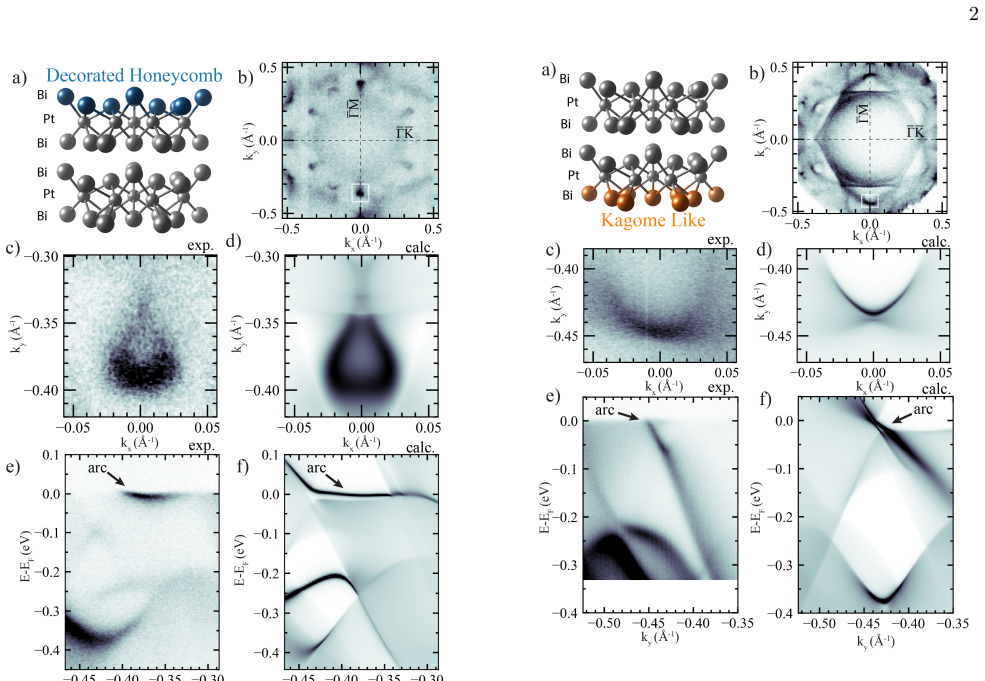
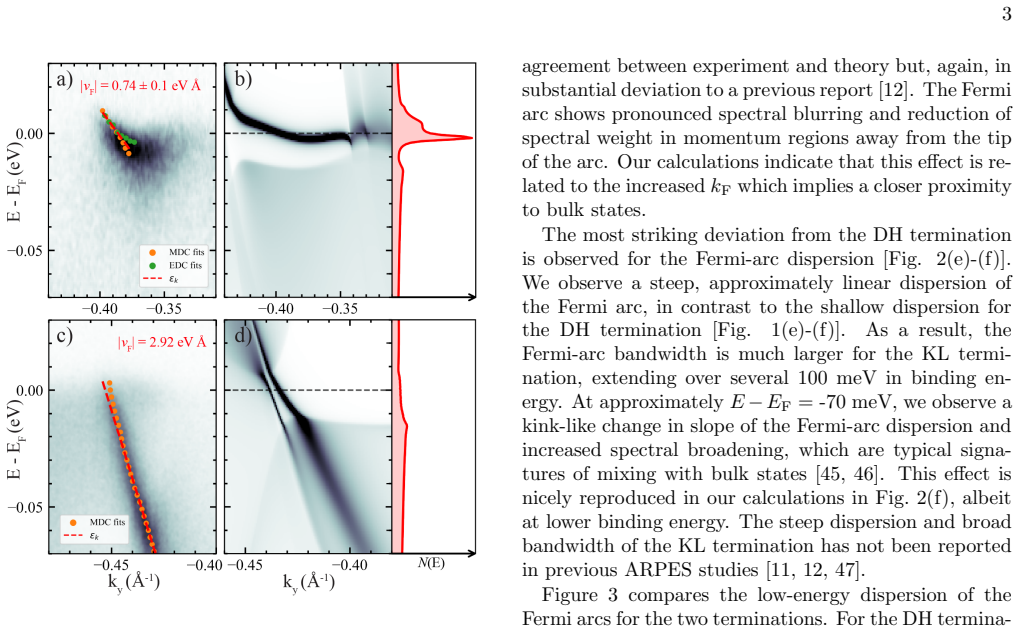
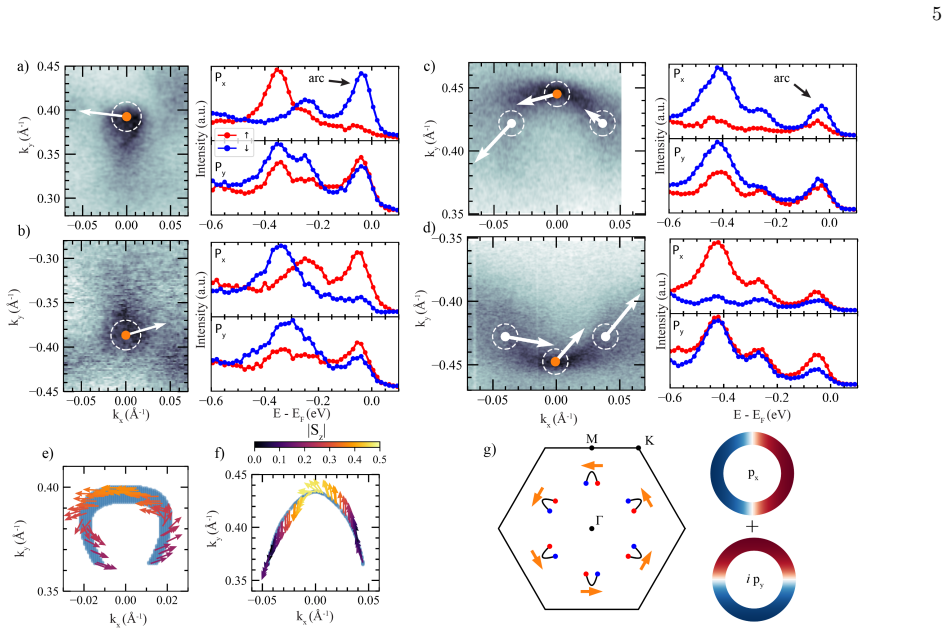
Using spin- and angle-resolved photoemission spectroscopy, we demonstrate that the Fermi arcs in PtBi₂ are singly degenerate and spin-polarized, which establishes their nontrivial topology and constitutes a necessary condition for topological superconductivity. We further uncover a pronounced surface-termination dependence of the Fermi-arc dispersion, yielding either nearly flat or approximately linear bands in agreement with first-principles calculations.
Load-bearing premise
That the measured singly degenerate and spin-polarized bands are the topological Fermi-arc surface states and not trivial states or measurement artifacts.
Editorial extensions
If this is right
- Single degeneracy combined with spin polarization confirms the nontrivial topology of the arcs.
- This topology supplies a necessary condition for topological superconductivity to emerge in PtBi₂.
- Surface termination tunes the Fermi-arc bandwidth between nearly flat and approximately linear dispersions.
- The observed spin texture and bandwidth control together identify key ingredients for topological superconductivity.
Reading between the lines
- Surface termination engineering could be used to adjust the conditions under which topological superconductivity appears.
- Similar spin-resolved measurements on related layered compounds might identify additional candidates with comparable arc properties.
- If topological superconductivity is realized, the spin-polarized arcs would be the likely location for protected boundary modes.
Editorial analysis
A structured set of objections, weighed in public.
Referee Report
Summary. The manuscript reports spin- and angle-resolved photoemission spectroscopy (SARPES) measurements on layered PtBi₂, claiming that the Fermi-arc surface states are singly degenerate and spin-polarized. This is presented as establishing their nontrivial topology and as a necessary condition for topological superconductivity. The work additionally reports a strong surface-termination dependence of the arc dispersion (nearly flat or linear), in agreement with first-principles calculations.
Significance. If the assignment of the observed states as topological Fermi arcs is robust, the result would supply direct experimental support for the topological character of surface states in a candidate topological superconductor and would highlight termination dependence as a control parameter. The spin-polarization data and termination-dependent bandwidth measurements constitute concrete experimental inputs that could be used to test models of topological superconductivity.
major comments (2)
- [Abstract] Abstract: The central claim equates observation of singly degenerate, spin-polarized surface bands with establishment of nontrivial topology. This interpretation rests on agreement with DFT calculations and termination dependence rather than an independent experimental verification of bulk-boundary correspondence (e.g., explicit kz dispersion or surface spectral-function comparison that would falsify a trivial Rashba-like assignment). No quantitative details on energy/momentum resolution, background subtraction, or spin-resolution calibration are supplied to support the single-degeneracy assertion.
- [Results] Results (SARPES data presentation): The manuscript does not describe a concrete test that would exclude matrix-element effects or residual bulk contributions capable of producing apparently singly degenerate spin textures within experimental resolution. Because this step is load-bearing for the topology assignment, the lack of such a falsification criterion weakens the link between the measured spin polarization and the claimed nontrivial topology.
minor comments (1)
- [Abstract] The abstract would benefit from a brief quantitative statement of data quality (e.g., energy resolution, spin asymmetry magnitude) to allow readers to assess the single-degeneracy claim.
Simulated Author's Rebuttal
We thank the referee for their detailed and constructive comments on our manuscript. We address each major comment below and indicate the revisions made to the manuscript.
read point-by-point responses
-
Referee: [Abstract] Abstract: The central claim equates observation of singly degenerate, spin-polarized surface bands with establishment of nontrivial topology. This interpretation rests on agreement with DFT calculations and termination dependence rather than an independent experimental verification of bulk-boundary correspondence (e.g., explicit kz dispersion or surface spectral-function comparison that would falsify a trivial Rashba-like assignment). No quantitative details on energy/momentum resolution, background subtraction, or spin-resolution calibration are supplied to support the single-degeneracy assertion.
Authors: The nontrivial topology is inferred from the experimental observation of singly degenerate, spin-polarized Fermi-arc states whose dispersion depends on surface termination in a manner that agrees with our DFT calculations, consistent with the bulk-boundary correspondence. We acknowledge the value of providing quantitative experimental details and will add information on energy/momentum resolution, background subtraction, and spin-resolution calibration to the revised manuscript. Explicit kz dispersion measurements are not straightforward in this system due to its layered structure and limited kz resolution in ARPES, but the termination dependence provides an experimental distinction from bulk or trivial Rashba states. revision: partial
-
Referee: [Results] Results (SARPES data presentation): The manuscript does not describe a concrete test that would exclude matrix-element effects or residual bulk contributions capable of producing apparently singly degenerate spin textures within experimental resolution. Because this step is load-bearing for the topology assignment, the lack of such a falsification criterion weakens the link between the measured spin polarization and the claimed nontrivial topology.
Authors: In the revised manuscript, we will expand the Results section to include a discussion of matrix-element effects and potential bulk contributions. We will explain that the pronounced surface-termination dependence of the arc dispersion, which matches calculations only for surface states, serves as evidence against dominant bulk contributions. Furthermore, the consistency of the spin polarization across different measurement geometries helps mitigate concerns about matrix elements. revision: yes
Circularity Check
No circularity: experimental measurements reported directly
full rationale
The paper is an experimental SARPES study reporting measured spin polarization, degeneracy, and termination-dependent dispersions of surface states in PtBi2. The central claim equates these observations with nontrivial topology via agreement with external first-principles calculations, but no derivation chain, fitted parameters renamed as predictions, self-definitional steps, or load-bearing self-citations are present. The measurements stand as independent data; interpretation relies on comparison to separate DFT results rather than reducing to the paper's own inputs by construction. This is the expected non-finding for pure experimental reporting.
Assumptions & free parameters
assumptions (1)
- domain assumption Spin- and angle-resolved photoemission spectroscopy can reliably determine spin polarization and band degeneracy of surface states.
Cite this review
Pith. "Pith review of Fermiology and spin polarization of topological surface states in PtBi$_2$." pith.science (2026). https://pith.science/paper/HWBA5OSQ
@misc{pith2026260701947,
  author       = {Pith},
  title        = {Pith review of: Fermiology and spin polarization of topological surface states in PtBi$_2$},
  year         = {2026},
  howpublished = {\url{https://pith.science/paper/HWBA5OSQ}},
  note         = {Machine review of arXiv:2607.01947}
}
abstract
Layered PtBi$_2$ is a candidate for topological superconductivity arising in Fermi-arc surface states. Using spin- and angle-resolved photoemission spectroscopy, we demonstrate that the Fermi arcs in PtBi$_2$ are singly degenerate and spin-polarized, which establishes their nontrivial topology and constitutes a necessary condition for topological superconductivity. We further uncover a pronounced surface-termination dependence of the Fermi-arc dispersion, yielding either nearly flat or approximately linear bands in agreement with first-principles calculations. Together, the observed spin polarization and termination-dependent bandwidth of the Fermi-arc surface states identify key ingredients underlying the potential emergence of topological superconductivity in PtBi$_2$.
Figures
Forward citations
Cited by 2 Pith papers
-
A minimal model for the Weyl nodes and Fermi arcs of PtBi$_2$
A minimal two-orbital continuum model constrained by C3v and time-reversal symmetries reproduces PtBi2 Weyl-node evolution under SOC, node annihilations, and Fermi-arc spin texture.
-
Disentangling bulk and surface states in the electronic structure of PtBi$_2$(0001)
Photon-energy and polarization-dependent ARPES plus DFT disentangle and assign bulk and surface states on both DH and KL terminations of PtBi2(0001), with orbital character matching polarization trends.
Reference graph
Works this paper leans on
-
[1]
B. Keimer and J. E. Moore, The physics of quantum materials, Nat. Phys.13, 1045 (2017)
work page 2017
- [2]
-
[3]
B. A. Bernevig, C. Felser, and H. Beidenkopf, Progress and prospects in magnetic topological materials, Nature 603, 41 (2022)
work page 2022
-
[4]
D. Di Sante, T. Neupert, G. Sangiovanni, R. Thomale, R. Comin, I. Zeljkovic, J. G. Checkelsky, and S. D. Wil- son, Kagome metals, arXiv preprint arXiv:2511.12731 (2025)
- [5]
-
[6]
M. Sato and Y. Ando, Topological superconductors: a review, Rep. Prog. Phys.80, 076501 (2017)
work page 2017
- [7]
-
[8]
S. Kobayashi and M. Sato, Topological superconductivity in dirac semimetals, Phys. Rev. Lett.115, 187001 (2015)
work page 2015
Show all 58 references
-
[9]
S. H. Lee, Y. Qian, and B.-J. Yang, Fermi surface spin texture and topological superconductivity in spin-orbit free noncollinear antiferromagnets, Phys. Rev. Lett.132, 196602 (2024)
2024
-
[10]
Mandal, N
M. Mandal, N. C. Drucker, P. Siriviboon, T. Nguyen, A. Boonkird, T. N. Lamichhane, R. Okabe, A. Chotrat- tanapituk, and M. Li, Topological superconductors from a materials perspective, Chem. Mater.35, 6184 (2023)
2023
-
[11]
Kuibarov, O
A. Kuibarov, O. Suvorov, R. Vocaturo, A. Fedorov, R. Lou, L. Merkwitz, V. Voroshnin, J. I. Facio, K. Koepernik, A. Yaresko, G. Shipunov, S. Aswartham, J. v. d. Brink, B. B¨ uchner, and S. Borisenko, Evidence of superconducting Fermi arcs, Nature626, 294 (2024)
2024
-
[12]
Changdar, O
S. Changdar, O. Suvorov, A. Kuibarov, S. Thirupatha- iah, G. Shipunov, S. Aswartham, S. Wurmehl, I. Ko- valchuk, K. Koepernik, C. Timm, B. B¨ uchner, I. C. Fulga, S. Borisenko, and J. v. d. Brink, Topological nodal i-wave superconductivity in PtBi 2, Nature647, 613 (2025)
2025
-
[13]
Schimmel, Y
S. Schimmel, Y. Fasano, S. Hoffmann, J. Besproswanny, L. T. Corredor Bohorquez, J. Puig, B.-C. Elshalem, B. Kalisky, G. Shipunov, D. Baumann, S. Aswartham, B. B¨ uchner, and C. Hess, Surface superconductivity in the topological Weyl semimetal t-PtBi 2, Nat. Commun. 15, 9895 (2024)
2024
-
[14]
Huang, L
X. Huang, L. Zhao, S. Schimmel, J. Besproswanny, P. H¨ artl, C. Hess, B. B¨ uchner, and M. Bode, Sizable superconducting gap and anisotropic chiral topological superconductivity in the weyl semimetal ptbi 2, arXiv preprint arXiv:2507.13843 (2025)
2025
-
[15]
Nomani and P
A. Nomani and P. Hosur, Intrinsic surface superconduct- ing instability in type-I Weyl semimetals, Phys. Rev. B 108, 165144 (2023)
2023
-
[16]
X. Bai, W. LiMing, and T. Zhou, Superconductivity in Weyl semimetals with time reversal symmetry, New J. Phys.27, 013003 (2025)
2025
-
[17]
Trama, V
M. Trama, V. K¨ onye, I. C. Fulga, and J. van den Brink, Self-consistent surface superconductivity in time-reversal symmetric Weyl semimetals, Phys. Rev. B112, 064514 (2025)
2025
-
[18]
H. Waje, F. Jakubczyk, J. van den Brink, and C. Timm, Ginzburg-Landau theory for unconventional surface su- perconductivity in PtBi 2, Phys. Rev. B112, 144519 (2025)
2025
-
[19]
Mæland, M
K. Mæland, M. Bahari, and B. Trauzettel, Phonon- mediated intrinsic topological superconductivity in Fermi arcs, Phys. Rev. B112, 104507 (2025)
2025
-
[20]
Mæland, G
K. Mæland, G. Sangiovanni, and B. Trauzettel, Mech- anism for nodal topological superconductivity on PtBi 2 surface (2025), arXiv:2512.09994 [cond-mat.supr-con]
2025 arXiv
-
[21]
Huang, Z
J. Huang, Z. D. Wang, and T. Zhou, Higher-order topo- logical superconductivity in type-II time-reversal sym- metric Weyl semimetals with a hybrid pairing, Phys. Rev. B113, 054523 (2026)
2026
-
[22]
Buccheri, A
F. Buccheri, A. de Martino, and J. v. d. Brink, Phonon- driven nodal surface superconductivity of Fermi arcs, arXiv:2606.02371 (2026)
2026 arXiv
-
[23]
Dsouza, N
R. Dsouza, N. Parthenios, B. M. Andersen, and M. H. Christensen, Kohn-Luttinger Superconductivity of Weyl Fermi Arcs in PtBi 2, arXiv:2605.31501 (2026)
2026 arXiv
-
[24]
Kaiser, A
M. Kaiser, A. I. Baranov, and M. Ruck, Bi 2Pt(hP9) by low-temperature reduction of Bi 13Pt3I7: Reinvestigation of the crystal structure and chemical bonding analysis, Z. anorg. allg. Chem.640, 2742 (2014)
2014
-
[25]
Y. Feng, Q. Jiang, B. Feng, M. Yang, T. Xu, W. Liu, X. Yang, M. Arita, E. F. Schwier, K. Shimada, H. O. Jeschke, R. Thomale, Y. Shi, X. Wu, S. Xiao, S. Qiao, and S. He, Rashba-like spin splitting along three momen- tum directions in trigonal layered PtBi 2, Nat. Commun. 10, 47...
2019
-
[26]
Shipunov, I
G. Shipunov, I. Kovalchuk, B. R. Piening, V. Labracherie, A. Veyrat, D. Wolf, A. Lubk, S. Subakti, R. Giraud, J. Dufouleur, S. Shokri, F. Caglieris, C. Hess, D. V. Efremov, B. B¨ uchner, and S. Aswartham, Poly- morphic ptbi 2: Growth, structure, and superconducting properties,...
2020
-
[27]
Veyrat, V
A. Veyrat, V. Labracherie, D. L. Bashlakov, F. Caglieris, J. I. Facio, G. Shipunov, T. Charvin, R. Acharya, 7 Y. Naidyuk, R. Giraud, J. van den Brink, B. B¨ uchner, C. Hess, S. Aswartham, and J. Dufouleur, Berezin- skii–Kosterlitz–Thouless Transition in the Type-I Weyl Semimet...
2023
-
[28]
Jiang, F
W. Jiang, F. Zhu, P. Li, Y. Li, G. Wang, Q. Jing, W. Gao, M. Tian, J. Ma, W. Zhang, W. Luo, and D. Qian, Elec- tronic structure of non-centrosymmetric PtBi 2 studied by angle-resolved photoemission spectroscopy, J. Appl. Phys.128, 135103 (2020)
2020
-
[29]
Vocaturo, K
R. Vocaturo, K. Koepernik, J. I. Facio, C. Timm, I. C. Fulga, O. Janson, and J. van den Brink, Electronic structure of the surface-superconducting Weyl semimetal PtBi2, Phys. Rev. B110, 054504 (2024)
2024
-
[30]
Biswas and K
T. Biswas and K. Schubert, Strukturuntersuchungen in den mischungen Pt-Tl-Pb und Pt-Pb-Bi, J. Less- Common Met.19, 223 (1969)
1969
-
[31]
X. Yang, H. Bai, Z. Wang, Y. Li, Q. Chen, J. Chen, Y. Li, C. Feng, Y. Zheng, and Z.-a. Xu, Giant linear magneto- resistance in nonmagnetic PtBi 2, Appl. Phys. Lett.108, 252401 (2016)
2016
-
[32]
Q. Yao, Y. P. Du, X. J. Yang, Y. Zheng, D. F. Xu, X. H. Niu, X. P. Shen, H. F. Yang, P. Dudin, T. K. Kim, M. Hoesch, I. Vobornik, Z.-A. Xu, X. G. Wan, D. L. Feng, and D. W. Shen, Bulk and surface electronic structure of hexagonal structured PtBi2 studied by angle- resolved pho...
2016
-
[33]
Thirupathaiah, Y
S. Thirupathaiah, Y. Kushnirenko, E. Haubold, A. V. Fedorov, E. D. L. Rienks, T. K. Kim, A. N. Yaresko, C. G. F. Blum, S. Aswartham, B. B¨ uchner, and S. V. Borisenko, Possible origin of linear magnetoresistance: Observation of Dirac surface states in layered PtBi 2, Phys. Rev...
2018
-
[34]
W. Gao, X. Zhu, F. Zheng, M. Wu, J. Zhang, C. Xi, P. Zhang, Y. Zhang, N. Hao, W. Ning, and M. Tian, A possible candidate for triply degenerate point fermions in trigonal layered PtBi 2, Nat. Commun.9, 3249 (2018)
2018
-
[35]
J. Wang, X. Chen, Y. Zhou, C. An, Y. Zhou, C. Gu, M. Tian, and Z. Yang, Pressure-induced superconductiv- ity in trigonal layered PtBi2 with triply degenerate point fermions, Phys. Rev. B103, 014507 (2021)
2021
-
[36]
D. L. Bashlakov, O. E. Kvitnitskaya, G. Shipunov, S. Aswartham, O. D. Feya, D. V. Efremov, B. B¨ uchner, and Y. G. Naidyuk, Electron-phonon interaction and point contact enhanced superconductivity in trigonal PtBi2, Low Temp. Phys.48, 747 (2022)
2022
-
[37]
See Supplemental Material at [URL to be inserted by publisher]
-
[38]
Koepernik and H
K. Koepernik and H. Eschrig, Full-potential nonorthog- onal local-orbital minimum-basis band-structure scheme, Phys. Rev. B59, 1743 (1999)
1999
-
[39]
J. P. Perdew, K. Burke, and M. Ernzerhof, Generalized gradient approximation made simple, Phys. Rev. Lett. 78, 1396 (1997)
1997
-
[40]
Koepernik, O
K. Koepernik, O. Janson, Y. Sun, and J. van den Brink, Symmetry-conserving maximally projected Wan- nier functions, Phys. Rev. B107, 235135 (2023)
2023
-
[41]
O’Leary, Z
E. O’Leary, Z. Li, L.-L. Wang, B. Schrunk, A. Eaton, P. C. Canfield, and A. Kaminski, Topography of Fermi arcs int-PtBi 2 using high-resolution angle-resolved pho- toemission spectroscopy, Phys. Rev. B112, 085154 (2025)
2025
-
[42]
Hoffmann, S
S. Hoffmann, S. Schimmel, R. Vocaturo, J. Puig, G. Shipunov, O. Janson, S. Aswartham, D. Baumann, B. B¨ uchner, J. v. d. Brink,et al., Fermi arcs dominating the electronic surface properties of trigonal PtBi 2, Adv. Phys. Res.4, 2400150 (2025)
2025
-
[43]
Kuibarov, S
A. Kuibarov, S. Changdar, A. Fedorov, R. Lou, O. Suvorov, V. Misheneva, L. Harnagea, I. Kovalchuk, S. Wurmehl, B. B¨ uchner, and S. Borisenko, Measur- ing superconducting arcs by angle-resolved photoemis- sion spectroscopy, Phys. Rev. B112, 144518 (2025)
2025
-
[44]
C.-H. Min, H. Bentmann, J. N. Neu, P. Eck, S. Moser, T. Figgemeier, M. ¨Unzelmann, K. Kissner, P. Lutz, R. J. Koch, C. Jozwiak, A. Bostwick, E. Rotenberg, R. Thomale, G. Sangiovanni, T. Siegrist, D. Di Sante, and F. Reinert, Orbital fingerprint of topological Fermi arcs in the...
2019
-
[45]
D. L. Bergman and G. Refael, Bulk metals with helical surface states, Phys. Rev. B82, 195417 (2010)
2010
-
[46]
Seibel, H
C. Seibel, H. Bentmann, J. Braun, J. Min´ ar, H. Maaß, K. Sakamoto, M. Arita, K. Shimada, H. Ebert, and F. Reinert, Connection of a topological surface state with the bulk continuum in Sb 2Te3(0001), Phys. Rev. Lett. 114, 066802 (2015)
2015
-
[47]
Kuibarov, S
A. Kuibarov, S. Changdar, R. Vocaturo, O. Suvorov, A. Fedorov, R. Lou, M. Krivenkov, L. Harnagea, S. Wurmehl, J. v. d. Brink, B. B¨ uchner, and S. Borisenko, Three prerequisites for high-temperature superconduc- tivity in t-PtBi 2 (2025), arXiv:2509.02178 [cond-mat] version: 1
2025
-
[48]
D. J. Chadi, (110) surface states of GaAs: Sensitivity of electronic structure to surface structure, Phys. Rev. B 18, 1800 (1978)
1978
-
[49]
Bertel, Symmetry of surface states, Phys
E. Bertel, Symmetry of surface states, Phys. Rev. B50, 4925 (1994)
1994
-
[50]
Bentmann, F
H. Bentmann, F. Forster, G. Bihlmayer, E. Chulkov, L. Moreschini, M. Grioni, and F. Reinert, Origin and ma- nipulation of the rashba splitting in surface alloys, EPL 87, 37003 (2009)
2009
-
[51]
Sun, S.-C
Y. Sun, S.-C. Wu, and B. Yan, Topological surface states and Fermi arcs of the noncentrosymmetric Weyl semimet- als TaAs, TaP, NbAs, and NbP, Phys. Rev. B92, 115428 (2015)
2015
-
[52]
Z.-H. Zhu, C. N. Veenstra, G. Levy, A. Ubaldini, P. Syers, N. P. Butch, J. Paglione, M. W. Haverkort, I. S. Elfimov, and A. Damascelli, Layer-by-layer entangled spin-orbital texture of the topological surface state in Bi 2Se3, Phys. Rev. Lett.110, 216401 (2013)
2013
-
[53]
N. P. Armitage, E. J. Mele, and A. Vishwanath, Weyl and dirac semimetals in three-dimensional solids, Rev. Mod. Phys.90, 015001 (2018)
2018
-
[54]
M. S. Scheurer, Mechanism, time-reversal symmetry, and topology of superconductivity in noncentrosymmet- ric systems, Phys. Rev. B93, 174509 (2016)
2016
-
[55]
N. B. Kopnin, T. T. Heikkil¨ a, and G. E. Volovik, High-temperature surface superconductivity in topologi- cal flat-band systems, Phys. Rev. B83, 220503 (2011)
2011
-
[56]
Peotta and P
S. Peotta and P. T¨ orm¨ a, Superfluidity in topologically nontrivial flat bands, Nat. Commun.6, 8944 (2015)
2015
-
[57]
Mæland and A
K. Mæland and A. Sudbø, Exceeding the Chandrasekhar- Clogston limit in flat-band superconductors: A multi- band strong-coupling approach, Phys. Rev. B108, 214511 (2023)
2023
-
[58]
Morel and P
P. Morel and P. W. Anderson, Calculation of the Su- perconducting State Parameters with Retarded Electron- 8 Phonon Interaction, Phys. Rev.125, 1263 (1962)
1962
Reviewed July 3, 2026 · model on record in the stance chip above.
Discussion (0). Sign in to comment.