REVIEW 2 major objections 5 minor 62 references
Keeping the nonareal polymer area function reorganizes thin-shell wormhole matter, stability, entropy, and images.
Reviewed by Pith at T0; open to challenge. T0 means a machine referee read the full paper against a public rubric. the ladder, T0–T4 →
T0 review · grok-4.5
2026-07-30 18:12 UTC pith:G2WX2IB4
load-bearing objection Solid nonareal thin-shell construction on the polymer-quintessence seed: the flux term is real, the math is clean, and the stability/optics headlines are scoped honestly. the 2 major comments →
Junction Conditions, Radial Stability, Thermodynamics, Optical Geometry and Appearance of Polymer-Quintessence Thin-Shell Wormholes
The pith
A machine-rendered reading of the paper's core claim, the machinery that carries it, and where it could break.
Core claim
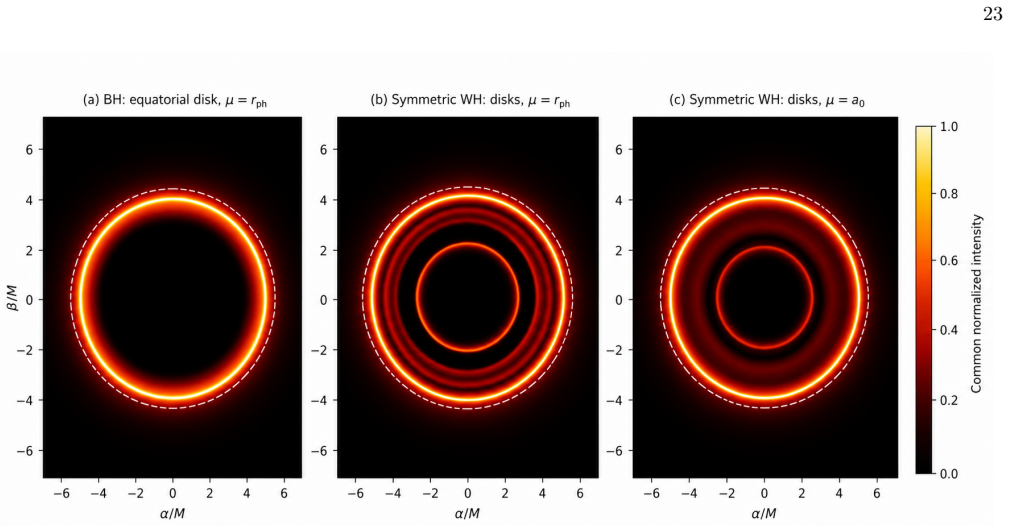
A reflection-symmetric thin-shell wormhole cut from the positive-lapse sector of the polymer-quintessence geometry must retain the nonareal area function throughout. That choice yields negative surface energy density on every static positive-branch throat, a momentum-flux correction in the conservation law and effective potential, modified local stability criteria and first-law entropy gradients, and additional cross-throat inner image branches despite a shared exterior critical curve; among the three calibrated closures examined, only the variable Chaplygin gas admits finite linear radial stability windows in the sampled windows.
What carries the argument
The nonareal balance law dσ/da = −(2a/H)(σ+p) + (ℓ²/(a H))σ and the associated effective potential V(a)=F(a)−4π² H(a)² σ(a)²/a², whose second derivative at a calibrated static throat supplies the local stability test once a surface equation of state is fixed.
Load-bearing premise
The stability and thermodynamic conclusions rest on three phenomenological surface equations of state that are calibrated once at each static throat and then judged only by the local sign of the potential curvature on finite parameter samples.
What would settle it
Recompute V''(a0) for the same polymer-quintessence seed with a different surface closure or a global (not single-point-calibrated) constitutive law; if no positive-curvature windows appear for any Chaplygin-like model, or if the flux term can be gauged away without changing the area function, the central reorganization claim fails.
If this is right
- Pure-polymer (cq→0) thin shells still carry the flux correction; only the areal limit ℓ→0 recovers standard transparent-shell bookkeeping.
- Shell entropy is not constant along fixed-parameter radial sequences when the polymer angular sector is kept.
- Variable Chaplygin surface matter is the only sampled closure that can be locally linearly stable on this seed.
- Wormhole and black-hole exteriors can share the same critical curve yet differ by inner rings fed by second-exterior disk crossings.
Where Pith is reading between the lines
- Any effective metric whose angular sector is not r² will force an analogous flux term, so the lesson is not special to this hybrid seed.
- Equal-power normalization of the two wormhole disks is doing heavy lifting; unequal disk brightness could wash out or exaggerate the reported inner rings.
- A systematic scan over n and the full (λ,cq,wq) domain for the Chaplygin branch would turn the sampled windows into a stability map useful for model building.
Editorial analysis
A structured set of objections, weighed in public.
Referee Report
Summary. The manuscript constructs a reflection-symmetric thin-shell wormhole by gluing two copies of a connected positive-lapse sector of the polymer-quintessence geometry of Araújo et al., retaining the nonareal angular function H(r)=r²+ℓ² throughout. Using the Israel junction conditions, the authors obtain a negative static surface density on every admissible throat, with NEC/SEC combinations controlled by the local lapse slope. The contracted junction identity yields a momentum-flux term in the surface balance law that survives in the pure-polymer limit; this term is carried into an effective radial potential and into a general V''(a0) stability criterion for radius-dependent surface equations of state. For sampled calibrated throats, linear barotropic and variable phantomlike closures remain locally unstable, while a variable Chaplygin gas admits finite linear stability windows. The same nonareal correction modifies fixed-parameter first-law/entropy bookkeeping, and a simplified thin-disk transfer model shows additional inner image branches from cross-throat propagation despite a shared exterior critical curve with the black-hole control.
Significance. If the derivations hold, the paper makes a clear and useful point for the thin-shell literature: once the seed metric is nonareal, reciprocal g_tt and g_rr coefficients alone do not justify the standard transparent-shell bookkeeping. The flux term in Eq. (24), its consistent appearance in V'' (Eq. 28) and dS_Σ/da0 (Eq. 37), and the optical distinction between a shared b_c and extra cross-throat image branches form a coherent geometric chain rather than a cosmetic deformation of known formulas. The work is carefully scoped as local and sample-based, connects directly to prior polymer thin-shell and polymer-quintessence analyses, and treats junction, stability, thermodynamics, and optics within one nonareal framework. That combination is a solid incremental contribution for gr-qc audiences working on effective black-hole seeds and thin-shell phenomenology.
major comments (2)
- [Secs. V–VII; Abstract; Sec. IX] Secs. V–VII and Eqs. (41)–(52): the stability headlines (abstract and Sec. IX) rest on single-point calibration of three phenomenological closures at each static throat, followed by the sign of V''(a0) on finite (λ,c_q,w_q,n,E) windows. This is standard thin-shell practice and is disclosed, but the abstract’s phrasing (“admits finite linear radial stability windows”) can be read as a broader existence claim than the sampled local test supports. Please tighten the abstract/conclusion wording to “for the sampled calibrated configurations” consistently, and state explicitly that no global stability classification of the Chaplygin family is claimed.
- [Sec. VI] Sec. VI, Eqs. (35)–(37): the fixed-parameter entropy gradient dS_Σ/da0 = −8πℓ² F0/(H0 |F'(a0)|) is a direct thermodynamic counterpart of the flux term and is valuable, but the section mixes a local kinematical temperature with an area-law horizon entropy adopted as a “geometric convention.” Please separate more sharply (i) the model-independent local first-law balance for the shell from (ii) any comparison with horizon entropies S_α=πH(r_α), and avoid language that could be read as establishing thermodynamic stability or a full equilibrium phase structure for the polymer–quintessence background.
minor comments (5)
- [Sec. II; Fig. 1] Fig. 1 caption and surrounding text: the disks are smallest positive roots of F(r)=0, not spatial shells; this is stated, but a one-line reminder in the main text near the first citation of Fig. 1 would reduce misreading.
- [Secs. V, VII, VIII] The displacement parameter is called both E (stability plots) and sometimes conflated with the Killing energy E in the geodesic section. Consider renaming the throat-offset label (e.g., Δ or ε_off) to avoid collision with E=F(r)ṫ.
- [Sec. VIII.A–F] Eq. (64)–(66): the representative optical configuration is well chosen (r_h < a0 < r_ph < r_c), but the main text could briefly note how sensitive the inner-ring visibility is to a0/r_ph before the image discussion in Sec. VIII.F.
- [References; Sec. II] References include several 2026 arXiv preprints by overlapping author sets; ensure all cited results used as inputs (especially the seed metric [45] and nearby thin-shell works) are uniquely identified and that any numerical inputs taken from them are stated explicitly.
- [Abstract; figures] Minor typography: “butalso” in the abstract; inconsistent en-dashes vs. hyphens in polymer-quintessence; and a few figure labels use encoding artifacts (e.g., “¡2=3” style w_q labels in plot text).
Circularity Check
No significant circularity: nonareal flux, V'', entropy, and cross-throat optics are derived from Israel junction plus the seed metric, not forced by fit or self-definition.
full rationale
The load-bearing chain is standard cut-and-paste thin-shell analysis on a fixed seed. Surface stress (Eqs. 18–23) follows from Israel jumps of the extrinsic curvature; the momentum-flux term (Eq. 24) is the contracted junction identity for H=a²+ℓ²; V(a) and V''(a0) (Eqs. 26–28) are obtained by differentiating that balance with a general p(σ,a); thermodynamic dSΣ/da0 (Eq. 37) is the same flux term rewritten in first-law form; optical extra inner branches follow from null continuation across the throat with a second emitting exterior while sharing the exterior critical curve. EOS constants are calibrated once so each static throat satisfies the junction (ws=p0/σ0, etc.) and then held fixed under the local quadratic test—standard practice that does not define the sign of V'' into existence. Citations to the polymer-quintessence seed and nearby thin-shell papers supply the bulk metric and constitutive templates; they do not smuggle the target stability/optical claims by definition. No fitted-data-as-prediction loop, no uniqueness theorem used to forbid alternatives, and no renaming of an empirical pattern as a derived law. Scope limits (phenomenological EOS, local linear V'', finite scans) are modeling assumptions, not circularity.
Axiom & Free-Parameter Ledger
free parameters (5)
- λ/M² (polymer scale) =
sampled in [0.2, 0.8]; representative 0.5
- cq M^{3wq+1} and wq (Kiselev amplitude and EOS) =
representative cqM=0.05, wq=−2/3
- Throat offset E or a0 (static throat location) =
e.g. a0/M=1.8 in optical section
- EOS calibration constants ws, AP, BC and exponent n =
ws=p0/σ0; AP=a0^n p0/σ0; BC=a0^n σ0 p0; n∈{1,2,4}
- Disk emission profile (μ, ς, γ, A) and observer placement =
ς/M=1/8, γ=−2; μ=rph or a0; robs=rh+0.92(rc−rh)
axioms (6)
- domain assumption Israel–Lanczos thin-shell junction: S_ij = −(1/8π)([K_ij]−η_ij[K]) on a timelike hypersurface.
- domain assumption The hybrid polymer-quintessence line element of Araújo et al. with F(r), H(r)=r²+ℓ² is a valid effective static seed.
- domain assumption Local linear radial stability is decided by the sign of V''(a0) for a=a0(1+εy) with |ε|≪1.
- ad hoc to paper Surface matter obeys one of three phenomenological closures (linear barotropic, variable phantomlike, variable Chaplygin) with constants calibrated once at equilibrium.
- domain assumption Shell temperature is the local acceleration temperature TΣ=|F'(a0)|/(4π√F0); horizon entropy uses area law Sα=πH(rα).
- standard math Standard differential geometry and GR geodesic conservation laws on static spherical metrics.
read the original abstract
Thin-shell wormholes built from effective black hole geometries are sensitive not only to the lapse function but also to the choice of areal radius. We construct a reflection-symmetric thin-shell wormhole from the positive-lapse sector of a polymer black hole surrounded by Kiselev-type quintessence and keep the nonareal angular function throughout the junction, stability, thermodynamic, and optical analyses. The Israel junction conditions give a negative surface energy density for every static throat on the positive branch, while the tangential null and intrinsic strong energy combinations are controlled by the local lapse slope. The radial dynamics is written as an effective-potential problem in which the nonareal sector produces a momentum-flux term and modifies the local stability criterion for surface equations of state with explicit radius dependence. For the sampled calibrated configurations, the linear barotropic and variable phantomlike closures remain locally unstable, whereas the variable Chaplygin gas admits finite linear radial stability windows. The same geometric correction also modifies the local first-law balance and shell entropy bookkeeping, while the optical analysis shows that cross-throat propagation generates additional inner image branches despite the wormhole and black hole geometries sharing the same exterior critical curve. These results identify how polymer corrections and a quintessence environment jointly reorganize the matter content, radial response, thermodynamic bookkeeping, and optical appearance of the resulting thin-shell wormhole.
Figures


Reference graph
Works this paper leans on
-
[1]
R. Konoplya and A. Zhidenko, Wormholes versus black holes: quasinormal ringing at early and late times, Journal of Cosmology and Astroparticle Physics2016(12), 043, arXiv:1606.00517 [gr-qc]
-
[2]
X. Wang, P.-C. Li, C.-Y. Zhang, and M. Guo, Novel shadows from the asymmetric thin-shell wormhole, Physics Letters B 811, 135930 (2020), arXiv:2007.03327 [gr-qc]
Pith/arXiv arXiv 2020
-
[3]
Z. Luo, H. Yu, and J. Li, Observational appearance and additional photon rings of the asymmetric thin-shell wormhole in horndeski theory (2023), arXiv:2312.07018 [gr-qc]
Pith/arXiv arXiv 2023
- [4]
-
[5]
Israel, Singular hypersurfaces and thin shells in general relativity, Il Nuovo Cimento B44, 1 (1966)
W. Israel, Singular hypersurfaces and thin shells in general relativity, Il Nuovo Cimento B44, 1 (1966)
1966
-
[6]
E. Poisson and M. Visser, Thin-shell wormholes: Linearization stability, Physical Review D52, 7318 (1995), arXiv:gr- qc/9506083
arXiv 1995
-
[7]
J. P. S. Lemos and F. S. N. Lobo, Plane symmetric thin-shell wormholes: Solutions and stability, Physical Review D78, 10.1103/PhysRevD.78.044030 (2008), arXiv:0806.4459 [gr-qc]
Pith/arXiv arXiv 2008
-
[8]
M. Sharif and M. Azam, Mechanical stability of cylindrical thin-shell wormholes, The European Physical Journal C73, 10.1140/epjc/s10052-013-2407-9 (2013), arXiv:1308.0196 [gr-qc]
Pith/arXiv arXiv 2013
-
[9]
A. Ovgun, Rotating thin-shell wormhole, The European Physical Journal Plus131, 10.1140/epjp/i2016-16389-6 (2016), arXiv:1604.08477 [gr-qc]
Pith/arXiv arXiv 2016
-
[10]
M. R. Mehdizadeh, M. K. Zangeneh, and F. S. N. Lobo, Higher-dimensional thin-shell wormholes in third-order lovelock gravity, Physical Review D92, 10.1103/PhysRevD.92.044022 (2015), arXiv:1506.03427 [gr-qc]
Pith/arXiv arXiv 2015
-
[11]
F. Rahaman, K. A. Rahman, S. A. Rakib, and P. K. F. Kuhfittig, Thin-shell wormholes from regular charged black holes, International Journal of Theoretical Physics49, 2364 (2010), arXiv:0909.1071 [gr-qc]
Pith/arXiv arXiv 2010
-
[12]
S. D. Forghani, S. H. Mazharimousavi, and M. Halilsoy, Thin-shells and thin-shell wormholes in new massive gravity, The European Physical Journal C79, 10.1140/epjc/s10052-019-6964-4 (2019), arXiv:1812.05074 [gr-qc]
Pith/arXiv arXiv 2019
-
[13]
C.-Y. Zhang, C. Niu, W.-L. Qian, X. Wang, and P. Liu, Traversable thin-shell wormhole in the 4d einstein–gauss–bonnet theory, Chinese Journal of Physics83, 527 (2023), arXiv:2004.14267 [gr-qc]
Pith/arXiv arXiv 2023
-
[14]
T. Tangphati, A. Chatrabhuti, D. Samart, and P. Channuie, Thin-shell wormholes in de rham–gabadadze–tolley massive gravity, The European Physical Journal C80, 10.1140/epjc/s10052-020-8294-y (2020), arXiv:1912.12208 [gr-qc]
Pith/arXiv arXiv 2020
-
[15]
E. F. Eiroa and C. Simeone, Stability of chaplygin gas thin-shell wormholes, Physical Review D76, 024021 (2007), arXiv:0704.1136
Pith/arXiv arXiv 2007
-
[16]
E. F. Eiroa, Thin-shell wormholes with a generalized chaplygin gas, Physical Review D80, 10.1103/PhysRevD.80.044033 (2009), arXiv:0907.2205 [gr-qc]
Pith/arXiv arXiv 2009
-
[17]
C. Bejarano and E. F. Eiroa, Dilaton thin-shell wormholes supported by a generalized chaplygin gas, Physical Review D84, 10.1103/PhysRevD.84.064043 (2011), arXiv:1106.6340 [gr-qc]
Pith/arXiv arXiv 2011
-
[18]
E. F. Eiroa and G. F. Aguirre, Thin-shell wormholes with a generalized chaplygin gas in einstein–born–infeld theory, The European Physical Journal C72, 10.1140/epjc/s10052-012-2240-6 (2012), arXiv:1205.2685 [gr-qc]
Pith/arXiv arXiv 2012
-
[19]
M. Sharif and M. Azam, Spherical thin-shell wormholes and modified chaplygin gas, Journal of Cosmology and Astroparticle Physics2013(05), 025, arXiv:1310.0326 [gr-qc]
-
[20]
V. Varela, A note on linearized stability of schwarzschild thin-shell wormholes with variable equations of state, Physical Review D92, 044002 (2015), arXiv:1310.6420
Pith/arXiv arXiv 2015
-
[21]
P. K. F. Kuhfittig, The stability of thin-shell wormholes with a phantom-like equation of state, Acta Phys.Polon.B41:2017- 2019,2010 (2010), arXiv:1008.3111 [gr-qc]
Pith/arXiv arXiv 2017
-
[22]
M. Azam, Born-infeld thin-shell wormholes supported by generalized cosmic chaplygin gas, Astrophysics and Space Science 361, 10.1007/s10509-016-2685-4 (2016), arXiv:1606.08309 [physics.gen-ph]
Pith/arXiv arXiv 2016
-
[23]
S. D. Forghani, S. H. Mazharimousavi, and M. Halilsoy, Thin-shell wormhole satisfying energy conditions, Physics Letters B804, 135374 (2020), arXiv:1912.04275 [gr-qc]
Pith/arXiv arXiv 2020
-
[24]
S. D. Forghani, S. H. Mazharimousavi, and M. Halilsoy, Thermodynamic stability of a schwarzschild thin-shell wormhole, International Journal of Modern Physics D28, 1950142 (2019), arXiv:1812.04340 [gr-qc]
Pith/arXiv arXiv 2019
-
[25]
E. F. Eiroa, G. Figueroa-Aguirre, M. L. Peñafiel, and S. E. P. Bergliaffa, Dynamical and thermodynamical stabil- ity of a charged thin-shell wormhole, The European Physical Journal C84, 10.1140/epjc/s10052-024-13465-3 (2024), arXiv:2408.14328 [gr-qc]
Pith/arXiv arXiv 2024
-
[26]
F. S. N. Lobo and M. E. Rodrigues, Thermodynamics of thin-shell wormholes (2026), arXiv:2606.26370 [gr-qc]
Pith/arXiv arXiv 2026
-
[27]
F. S. N. Lobo and M. E. Rodrigues, Generalized unruh temperature for dynamical thin-shell wormholes (2026), arXiv:2607.03577 [gr-qc]
Pith/arXiv arXiv 2026
-
[28]
V. Diemer and E. Smolarek, Dynamics of test particles in thin-shell wormhole spacetimes, Classical and Quantum Gravity 30, 175014 (2013), arXiv:1302.1705
Pith/arXiv arXiv 2013
-
[29]
S. H. Mazharimousavi, Generic spherically symmetric thin-shell wormholes with equilibrium throat at the innermost photonsphere are unstable, The European Physical Journal C84, 10.1140/epjc/s10052-024-12678-w (2024), arXiv:2403.08932 [gr-qc]. 26
Pith/arXiv arXiv 2024
-
[30]
J. B. Achour, F. Lamy, H. Liu, and K. Noui, Polymer schwarzschild black hole: An effective metric, EPL (Europhysics Letters)123, 20006 (2018), arXiv:1803.01152 [gr-qc]
Pith/arXiv arXiv 2018
-
[31]
E. R. Livine and D. R. Terno, Entropy in the classical and quantum polymer black hole models, Classical and Quantum Gravity29, 224012 (2012), arXiv:1205.5733 [gr-qc]
Pith/arXiv arXiv 2012
-
[32]
Y.-C. Liu, J.-X. Feng, F.-W. Shu, and A. Wang, Extended geometry of gambini-olmedo-pullin polymer black hole and its quasinormal spectrum, Physical Review D104, 10.1103/PhysRevD.104.106001 (2021), arXiv:2109.02861 [gr-qc]
Pith/arXiv arXiv 2021
-
[33]
Y.-L. Liu, Z.-Q. Feng, and X.-D. Zhang, Solar system constraints of a polymer black hole in loop quantum gravity, Physical Review D105, 10.1103/PhysRevD.105.084068 (2022), arXiv:2201.10202 [gr-qc]
Pith/arXiv arXiv 2022
-
[34]
F. M. Mele, J. Münch, and S. Pateloudis, Quantum corrected polymer black hole thermodynamics: mass relations and logarithmic entropy correction, Journal of Cosmology and Astroparticle Physics2022(02), 011, arXiv:2102.04788 [gr-qc]
-
[35]
Z.-Y. Tu, T. Zhu, and A. Wang, Periodic orbits and their gravitational wave radiations in a polymer black hole in loop quantum gravity, Physical Review D108, 10.1103/PhysRevD.108.024035 (2023), arXiv:2304.14160 [gr-qc]
Pith/arXiv arXiv 2023
-
[36]
K. Chen and S.-W. Wei, Motion of spinning particles around a polymer black hole in loop quantum gravity, Physical Review D110, 10.1103/PhysRevD.110.024041 (2024), arXiv:2403.14164 [gr-qc]
Pith/arXiv arXiv 2024
-
[37]
J. Münch, A. Perez, S. Speziale, and S. Viollet, Generic features of a polymer quantum black hole, Classical and Quantum Gravity40, 135003 (2023), arXiv:2212.06708 [gr-qc]
Pith/arXiv arXiv 2023
-
[38]
J. A. Rebouças and E. Otoniel, Thin-shell wormholes from entropy-induced black-hole geometries (2026), arXiv:2607.14130 [gr-qc]
Pith/arXiv arXiv 2026
-
[39]
V. V. Kiselev, Quintessence and black holes, Classical and Quantum Gravity20, 1187 (2003), arXiv:gr-qc/0210040
Pith/arXiv arXiv 2003
-
[40]
A. Younas, M. Jamil, S. Bahamonde, and S. Hussain, Strong gravitational lensing by kiselev black hole, Physical Review D 92, 10.1103/PhysRevD.92.084042 (2015), arXiv:1502.01676 [gr-qc]
Pith/arXiv arXiv 2015
-
[41]
B. Majeed, M. Jamil, and P. Pradhan, Thermodynamic relations for kiselev and dilaton black hole, Advances in High Energy Physics2015, 1 (2015), arXiv:1508.04761 [gr-qc]
Pith/arXiv arXiv 2015
-
[42]
O. Pedraza, L. A. López, R. Arceo, and I. Cabrera-Munguia, Geodesics of hayward black hole surrounded by quintessence, General Relativity and Gravitation53, 10.1007/s10714-021-02798-z (2021), arXiv:2008.00061 [gr-qc]
Pith/arXiv arXiv 2021
-
[43]
M. Visser, The kiselev black hole is neither perfect fluid, nor is it quintessence, Classical and Quantum Gravity37, 045001 (2020), arXiv:1908.11058 [gr-qc]
Pith/arXiv arXiv 2020
-
[44]
C.-H. Wu, X. Liang, and Y.-P. Hu, Kiselev black hole and the ultra-slow evaporating behavior, Physics Letters B879, 140638 (2026), arXiv:2606.19110 [gr-qc]
Pith/arXiv arXiv 2026
-
[45]
M. C. Araújo, J. G. Lima, C. R. Muniz, and J. Furtado, Polymer black hole surrounded by quintessence, European Physical Journal Plus141, 217 (2026)
2026
-
[46]
Javed, A
F. Javed, A. Waseem, G. Fatima, and B. Almutairi, Stability of thin-shell wormholes via polymer black hole in loop quantum gravity, Physics of the Dark Universe46, 101605 (2024)
2024
-
[47]
J. A. Rebou{ç}as, E. Otoniel, and F. S. N. Lobo, Thin-shell wormholes in cosmic voids (2026), arXiv:2607.11995 [gr-qc]
Pith/arXiv arXiv 2026
-
[48]
A. Banerjee, K. Jusufi, and S. Bahamonde, Stability of a d-dimensional thin-shell wormhole surrounded by quintessence, Gravitation and Cosmology24, 71 (2018), arXiv:1612.06892 [gr-qc]
Pith/arXiv arXiv 2018
-
[49]
K. Jusufi, Quantum corrected schwarzschild thin-shell wormhole, The European Physical Journal C76, 10.1140/epjc/s10052- 016-4456-3 (2016), arXiv:1607.04070 [gr-qc]
Pith/arXiv arXiv 2016
-
[50]
H. Alshal, Linearized stability of bardeen-de sitter thin-shell wormholes, EPL (Europhysics Letters)128, 60007 (2020), arXiv:1909.07811 [gr-qc]
Pith/arXiv arXiv 2020
-
[51]
H. Alshal, L. Ding, A. Hernandez, L. A. Illing, and I. Rydstrom, Linearized stability of harada thin-shell wormholes, General Relativity and Gravitation57, 10.1007/s10714-024-03344-3 (2025), arXiv:2407.08945 [gr-qc]
Pith/arXiv arXiv 2025
-
[52]
N. Bodendorfer, F. M. Mele, and J. Münch, (b,v)-type variables for black to white hole transitions in effective loop quantum gravity, Phys. Lett. B819, 136390 (2021), arXiv:1911.12646 [gr-qc]
Pith/arXiv arXiv 2021
-
[53]
N. Bodendorfer, F. M. Mele, and J. Münch, Effective Quantum Extended Spacetime of Polymer Schwarzschild Black Hole, Class. Quant. Grav.36, 195015 (2019), arXiv:1902.04542 [gr-qc]
Pith/arXiv arXiv 2019
-
[54]
S. Brahma, C.-Y. Chen, and D.-h. Yeom, Testing Loop Quantum Gravity from Observational Consequences of Nonsingular Rotating Black Holes, Phys. Rev. Lett.126, 181301 (2021), arXiv:2012.08785 [gr-qc]
Pith/arXiv arXiv 2021
-
[55]
A. Ashtekar and P. Singh, Loop Quantum Cosmology: A Status Report, Class. Quant. Grav.28, 213001 (2011), arXiv:1108.0893 [gr-qc]
Pith/arXiv arXiv 2011
-
[56]
A. Ashtekar, T. Pawlowski, and P. Singh, Quantum Nature of the Big Bang: Improved dynamics, Phys. Rev. D74, 084003 (2006), arXiv:gr-qc/0607039
Pith/arXiv arXiv 2006
-
[57]
A. Ashtekar and E. Wilson-Ewing, Loop quantum cosmology of Bianchi I models, Phys. Rev. D79, 083535 (2009), arXiv:0903.3397 [gr-qc]
Pith/arXiv arXiv 2009
-
[58]
A. Ashtekar and A. Barrau, Loop quantum cosmology: From pre-inflationary dynamics to observations, Class. Quant. Grav. 32, 234001 (2015), arXiv:1504.07559 [gr-qc]
Pith/arXiv arXiv 2015
-
[59]
D. Oriti, L. Sindoni, and E. Wilson-Ewing, Bouncing cosmologies from quantum gravity condensates, Class. Quant. Grav. 34, 04LT01 (2017), arXiv:1602.08271 [gr-qc]
Pith/arXiv arXiv 2017
-
[60]
P. Diener, A. Joe, M. Megevand, and P. Singh, Numerical simulations of loop quantum Bianchi-I spacetimes, Class. Quant. Grav.34, 094004 (2017), arXiv:1701.05824 [gr-qc]
Pith/arXiv arXiv 2017
-
[61]
S. E. Gralla, A. Lupsasca, and D. P. Marrone, The Shape of the Black Hole Photon Ring: A Precise Test of Strong-Field General Relativity, Phys. Rev. D102, 124004 (2020), arXiv:2008.03879 [gr-qc]
Pith/arXiv arXiv 2020
-
[62]
C. F. B. Macedo, J. L. Rosa, D. Rubiera-Garcia, and A. Rueda, Multiphoton ring structure of reflection-asymmetric traversable thin-shell wormholes, Phys. Rev. D113, 064004 (2026), arXiv:2510.19677 [gr-qc]
arXiv 2026
discussion (0)
Sign in with ORCID, Apple, or X to comment. Anyone can read and Pith papers without signing in.