REVIEW 3 major objections 3 minor 1 cited by
This paper shows that thin-shell wormholes built from entropy-modified black-hole metrics carry negative surface energy density in every positive-lapse domain, and that only a variable Chaplygin shell can be linearly stable.
Reviewed by Pith at T0; open to challenge. T0 means a machine referee read the full paper against a public rubric. the ladder, T0–T4 →
T0 review · deepseek-v4-flash
2026-08-02 08:24 UTC pith:VTGGMSCB
load-bearing objection A careful, honest thin-shell wormhole paper whose advertised "entropy-induced geometry" route is really a prescribed relabeling of the lapse; as a systematic catalogue of stability formulas for eight seed metrics, it holds up and deserves refereeing. the 3 major comments →
Thin-Shell Wormholes from Entropy-Induced Black-Hole Geometries
The pith
A machine-rendered reading of the paper's core claim, the machinery that carries it, and where it could break.
Core claim
On the paper's own terms, the discovery is a transfer principle: any entropy function S(r) with a positive derivative defines a static, spherically symmetric black-hole geometry through F_S(r)=1−4πM/S'(r), and all thin-shell wormhole observables—surface density, pressure, energy-condition combinations, conservation equation, and radial effective potential—can be written directly in terms of S and its derivatives. Applying this to eight entropy families, the paper finds that the weak energy condition is violated on the throat in every positive-lapse region, that the intrinsic-shell null energy condition can change sign at a scale that in the Schwarzschild limit coincides with the photon-spher
What carries the argument
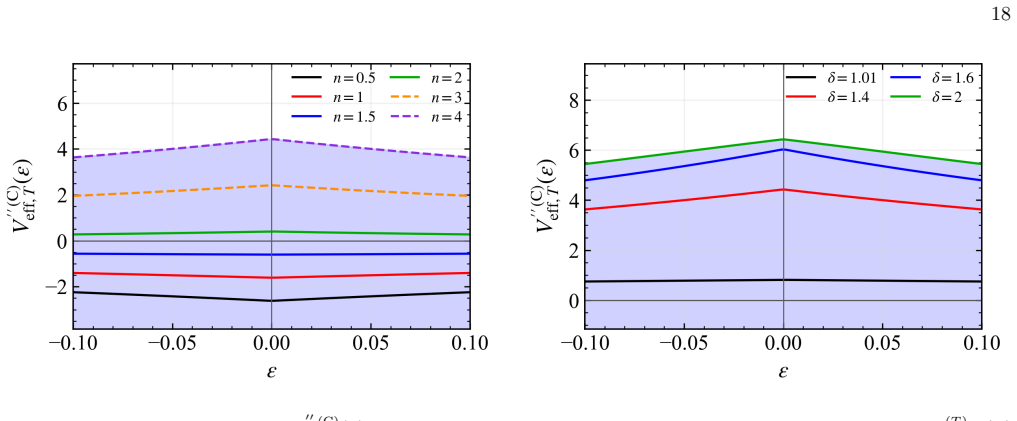
The central object is the entropic lapse function F_S(r)=1−4πM/S'(r), obtained by promoting the horizon relation S'(r_h)=4πM to all radii; it carries the entire seed geometry. Around it the paper builds the cut-and-paste wormhole and writes the Darmois–Israel junction conditions, the surface stress tensor, the conservation equation, and the radial effective potential V_eff(a)=F_S(a)−4π²a²σ²(a) in terms of S and its derivatives. The sign of the second derivative V''_eff(a0) at the static throat is the linear-radial-stability diagnostic, and the two shell models—constant barotropic p=wσ and variable Chaplygin p=Ωσ/a^n—enter through the conservation equation to fix σ(a).
Load-bearing premise
The whole construction rests on the seed relation F_S(r)=1−4πM/S'(r) being valid at every radius, but the first law determines it only at the horizon; if that global continuation is arbitrary, the entropy interpretation of the wormhole results is a repackaging of the lapse rather than an independent physical input.
What would settle it
Take a positive lapse not in the eight families but with the same horizon, for example F(r)=1−2M/r+ε/r³; define S by S'(r)=4πM/(1−F(r)), build the symmetric thin-shell wormhole, and evaluate V''_eff(a0) for a constant-barotropic shell. If any such configuration has V''_eff(a0)>0, the paper's claim that constant-barotropic branches are unstable in the considered settings would fail for that setting; if none does, the instability follows from the junction geometry rather than from the entropy deformation.
If this is right
- Any symmetric thin-shell wormhole from an entropy-induced lapse requires negative surface energy density at the throat; the entropy prescription changes only the distribution and magnitude of the exotic matter, not its presence.
- Constant-barotropic shells are linearly radially unstable across all eight entropy families in the parameter domains considered; entropy deformations rescale the near-horizon instability but never remove it.
- Variable Chaplygin shells can produce stable throats, and the n=4 branch is stable for every tested entropy family, with stability thresholds shifted by the entropy parameters.
- The horizon structure of the seed matters: two-horizon static patches (Rényi, logarithmic outer branch, loop-quantum-gravity-inspired with q>1) restrict the admissible throat interval and can truncate stable regions that would otherwise exist.
- Because all junction quantities are expressed through S and its derivatives, the framework turns any future entropy proposal into an immediate thin-shell wormhole analysis.
Where Pith is reading between the lines
- Inference: because any lapse F(r)<1 can be written as 1−4πM/S'(r) by choosing S'(r)=4πM/(1−F(r)), the entropy input is a reparametrization of the metric function once the continuation away from the horizon is prescribed; the eight-model comparison is therefore a scan over lapse shapes rather than over independent thermodynamic inputs.
- Inference: the sharp split between unstable barotropic and stable Chaplygin branches suggests stability is controlled largely by the shell response, so a sufficiently stiff nonlinear or anisotropic shell equation of state might also stabilize even the Schwarzschild seed—an extension the paper does not test.
- Inference: for exponential and loop-quantum-gravity-inspired entropies, corrections are localized near the horizon and vanish for macroscopic masses, so observational wormhole signatures would be indistinguishable from Schwarzschild unless the throat sits in a small-mass or near-horizon regime.
- Inference: repeating the stability analysis with a different global continuation of the same horizon data—same S'(r_h) but different S(r) away from the horizon—would show which of the paper's conclusions are robust to the seed prescription and which are artifacts of the chosen continuation.
Editorial analysis
A structured set of objections, weighed in public.
Referee Report
Summary. This paper develops the Darmois–Israel thin-shell formalism for the static, spherically symmetric seed metric F_S(r)=1-4πM/S'(r), treating the entropy function S(r) as the input that determines the geometry. After deriving the dynamic surface density, pressure, conservation equation, and the radial effective potential for constant-barotropic and variable-Chaplygin shell equations of state, the authors apply the formalism to eight entropy prescriptions (Bekenstein–Hawking/Schwarzschild, Barrow, Tsallis–Cirto, Rényi, Kaniadakis, logarithmic, LQG-inspired, and exponential). The principal quantitative claims are: (i) the symmetric static throat always has negative surface energy density in a positive-lapse domain; (ii) for the parameter domains considered, every constant-barotropic branch is linearly radially unstable; and (iii) variable-Chaplygin shells can be stable, with the stability region controlled by the exponent n, the throat radius, and the seed lapse. The paper explicitly acknowledges in Sec. II that the entropy–geometry relation is a prescribed global continuation rather than a consequence of the first law away from the horizon.
Significance. If the entropy–geometry correspondence were physically derived, this would provide a unified thermodynamic route to wormhole seed geometries. The paper is also valuable as an explicit catalog: the generic formulas are given in closed form, the per-model expressions are explicit enough to be checked, and the authors state the equilibrium conditions without fitting to stability targets. However, because Eq. (1) can be inverted to represent any smooth positive lapse, the 'entropy-induced' family is the full class of metrics of this form; the entropy variable is a reparametrization, not a new physical input. Thus the thermodynamic interpretation is not supported, and the significance of the paper rests on the wormhole calculations for the chosen lapse families rather than on a new entropy–geometry principle.
major comments (3)
- [Sec. II, Eq. (1); Secs. VI–VII] The central interpretive premise is explicitly acknowledged to be a prescribed global continuation, but the consequences are not drawn. Since Eq. (1) can be inverted as S'(r)=4πM/[1-F_S(r)] for any smooth positive lapse F_S with a simple horizon and F_S(a)>0 on the throat domain, every metric of this form admits an 'entropy' representation with S'(r_h)=4πM. The family of entropy-induced geometries is therefore the full class of static, spherically symmetric metrics with g_tt=-1/g_rr; the entropy function is a rewriting of the lapse, not an independent physical input. The abstract's statement that 'modified black-hole entropies can induce effective spacetime geometries' and the cross-model comparison in Sec. VI are thus not consequences of distinct thermodynamic inputs. This is a framing issue, and it can be repaired only by substantially rephrasing the central claim—e.g., presenting the
- [Sec. VI.G (LQG-inspired entropy)] The LQG-inspired entropy is listed as one of the eight models and appears in the abstract, but the section contains only the lapse, horizon radii, and a statement that 'our numerical evaluation ... confirms' the same qualitative behavior. No surface stresses, no w0, no Ω0, no V''_eff formulas, and no figure are given for either q<1 or q>1 branch. Since this model has two qualitatively different horizon structures and is used in the summary comparisons, the absence of explicit results makes the claimed inclusion unverifiable. Please add the analogous formulas/figures or explicitly reduce the claims for this case.
- [Secs. VI.E and VI.H] For the Kaniadakis and exponential barotropic branches, the sign of V''_eff is the basis of the universal instability claim, but the paper asserts negativity over the parameter domains without a full proof; Eq. (121) and Eq. (165) contain sums of terms of mixed sign (hyperbolic/exponential factors multiplied by quadratic brackets). In the exponential case the formula is long enough that a reader cannot verify the sign by inspection. Similarly, the text states 'our numerical evaluation' for the LQG case. Because the conclusion 'all examined constant-barotropic branches are linearly radially unstable' is a headline result, please provide either an analytic sign proof with bounds for each parameter domain or a clear statement of numerical sampling and an accompanying plot/table.
minor comments (3)
- [Throughout Sec. VI] The figures and text use the displacement parameter E (e.g., a0=2M+|E|) without a single unified definition in the main text. Please define E once in Sec. VI.A and refer to it consistently.
- [Sec. II] The statement that M coincides with the ADM mass only in asymptotically Schwarzschild sectors is important, especially for the Rényi and LQG q>1 branches. Consider making this point earlier and more prominently so that the mass parameter is not misread as the physical mass in those models.
- [Sec. VI.G] The normalization α_L=1 is used in the qualitative discussion, but the formulas (144)–(152) keep α_L general. Since the subsequent numerical claims depend on this choice, state explicitly that the qualitative results correspond to α_L=1 and discuss the effect of changing α_L if it is not marginal.
Circularity Check
No significant circularity: the wormhole derivation is self-contained once the explicitly prescribed entropy-lapse dictionary is accepted.
full rationale
The wormhole material (Secs. III–VI) is not circular: given a lapse F_S, the Darmois–Israel stresses, conservation equation, effective potentials, and stability curvatures are derived algebraically; w0 and Ω0 are fixed by the static junction/equilibrium conditions, not tuned to force stability. The constant-barotropic instability and the conditional Chaplygin stability follow from the signs of explicit expressions. The seed dictionary is the only soft spot: Eq. (1) is stipulated, and Sec. II concedes it is "a prescribed global continuation rather than a direct consequence of the first law away from the horizon." Because any positive lapse can be written as 1−4πM/S′(r) by choosing S′(r)=4πM/[1−F(r)], the "entropy-induced geometry" label is a reparametrization rather than an independent derivation; this limits the thermodynamic-novelty claim but is disclosed and does not infect the subsequent wormhole math. Ref. [64], the source of the dictionary, has no overlapping authors with this paper and is not invoked as a uniqueness theorem. Thus no prediction reduces to its input by construction; residual concerns are about assumption-choice and novelty, not circularity.
Axiom & Free-Parameter Ledger
free parameters (9)
- Barrow deformation Δ
- Tsallis–Cirto nonextensive parameter δ
- Rényi parameter λ_R
- Kaniadakis parameter κ
- Logarithmic correction λ_log
- LQG nonextensive parameter q
- LQG normalization α_L
- Exponential correction η
- Chaplygin radial exponent n
axioms (6)
- domain assumption Entropy–geometry correspondence F_S(r)=1−4πM/S'(r) is adopted as the seed metric.
- domain assumption The seed geometry is interpreted in general relativity as sourced by an effective anisotropic matter sector, so the Darmois–Israel junction conditions apply.
- domain assumption The throat is placed in a positive-lapse region of the seed; for multi-horizon models the construction is a local static patch with no asymptotically flat extension.
- standard math Linear radial stability is diagnosed by the sign of V''_eff(a0).
- domain assumption Variable Chaplygin equation of state p=Ω/(a^n σ) is adopted from Ref. [40].
- domain assumption Entropy model parameter ranges are restricted to those with the stated horizon structure (e.g., δ>1/2, 0≤λ_log<πM², 0<λ_R<1/(16πM²)).
read the original abstract
Modified black-hole entropies can induce effective spacetime geometries and thereby provide a thermodynamic route for investigating thin-shell wormholes. In this work, we construct symmetric cut-and-paste wormholes from the generic entropic lapse function $F_{\mathcal S}(r)=1-4\pi M/\mathcal S'(r)$ and formulate the Darmois--Israel junction conditions directly in terms of the lapse and of the entropy derivatives. We derive the surface stresses, shell energy-condition combinations, conservation equation, and radial effective potential, and then apply the formalism to the Bekenstein--Hawking, Barrow, Tsallis--Cirto, R\'enyi, Kaniadakis, logarithmic, loop-quantum-gravity-inspired, and exponential entropy prescriptions. The analysis shows that the symmetric construction requires negative surface energy density throughout every admissible positive-lapse domain, although entropy deformations can significantly modify the horizon structure, the allowed throat region, and the localization of the surface stresses. Within the parameter domains considered here, all examined constant-barotropic branches are linearly radially unstable, despite quantitative changes in their near-horizon scales. In contrast, a variable Chaplygin shell can support stable configurations, with the stability domains determined jointly by the entropic geometry, the throat radius, and the radial exponent of the shell equation of state. These results establish a unified framework for comparing entropy-induced black-hole geometries as thin-shell wormhole seeds and show that stability is governed not by the entropy deformation alone, but by its interplay with the dynamical response of the matter localized at the throat.
Figures




Forward citations
Cited by 1 Pith paper
-
Junction Conditions, Radial Stability, Thermodynamics, Optical Geometry and Appearance of Polymer-Quintessence Thin-Shell Wormholes
Keeping the nonareal polymer angular sector in a polymer-quintessence thin-shell wormhole adds a momentum-flux term that reshapes stability, thermodynamics, and cross-throat image branches.
Reference graph
Works this paper leans on
-
[1]
M. S. Morris and K. S. Thorne, American Journal of Physics56, 395 (1988)
1988
-
[2]
H. G. Ellis, Journal of Mathematical Physics14, 104 (1973)
1973
-
[3]
K. A. Bronnikov, Acta Physica Polonica B4, 251 (1973)
1973
-
[4]
Visser, Physical Review D39, 3182 (1989)
M. Visser, Physical Review D39, 3182 (1989)
1989
-
[5]
Visser,Lorentzian Wormholes: From Einstein to Hawking(AIP Press, 1995)
M. Visser,Lorentzian Wormholes: From Einstein to Hawking(AIP Press, 1995)
1995
-
[6]
Radhakrishnan, P
R. Radhakrishnan, P. Brown, J. Matulevich, E. Davis, D. Mirfendereski, and G. Cleaver, Symmetry16, 1007 (2024)
2024
-
[7]
D.-C. Dai and D. Stojkovic, Physical Review D100, 083513 (2019), arXiv:1910.00429 [gr-qc]
Pith/arXiv arXiv 2019
-
[8]
J. H. Simonetti, M. J. Kavic, D. Minic, D. Stojkovic, and D.-C. Dai, Physical Review D104, L081502 (2021), arXiv:2007.12184 [gr-qc]
Pith/arXiv arXiv 2021
-
[9]
C. Bambi and D. Stojkovic, Universe7, 136 (2021), arXiv:2105.00881 [gr-qc]
Pith/arXiv arXiv 2021
-
[10]
F. S. N. Lobo, Physical Review D71, 084011 (2005)
2005
-
[11]
S. V. Sushkov, Physical Review D71, 043520 (2005)
2005
-
[12]
Harko, F
T. Harko, F. S. N. Lobo, M. K. Mak, and S. V. Sushkov, Physical Review D87, 067504 (2013)
2013
-
[13]
D.-C. Dai, D. Minic, and D. Stojkovic, The European Physical Journal C80, 1103 (2020), arXiv:2010.03947 [gr-qc]
Pith/arXiv arXiv 2020
-
[14]
D.-C. Dai, D. Minic, and D. Stojkovic, Physical Review D98, 124026 (2018), arXiv:1810.03432 [hep-th]
Pith/arXiv arXiv 2018
-
[15]
M. Cruz, R. Neves, and C. R. Muniz, Journal of Cosmology and Astroparticle Physics2024, 016 (2024)
2024
-
[16]
Alencar, V
G. Alencar, V. B. Bezerra, C. R. Muniz, and H. S. Vieira, Universe7, 238 (2021)
2021
-
[17]
A. C. L. Santos, R. V. Maluf, and C. R. Muniz, Annals of Physics469, 169775 (2024)
2024
-
[18]
Muniz, M
C. Muniz, M. Cruz, R. Neves, M. Farooq, and M. Zubair, Journal of Cosmology and Astroparticle Physics2025, 015 (2025)
2025
-
[19]
T. M. Crispim, G. Alencar, and C. R. Muniz, Classical and Quantum Gravity43, 115013 (2026)
2026
-
[20]
S. Nojiri, S. D. Odintsov, and V. Folomeev, Physical Review D109, 104007 (2024), arXiv:2401.15868 [gr-qc]
Pith/arXiv arXiv 2024
-
[21]
G. Mustafa, I. Hussain, F. Atamurotov, and W. M. Liu, European Physical Journal Plus138(2023), 10.1140/epjp/s13360- 023-03775-y
-
[22]
M. V. de S. Silva, G. Alencar, R. N. C. Filho, R. M. P. Neves, and C. R. Muniz, The European Physical Journal Plus140, 289 (2025)
2025
-
[23]
M. Khatri and P. K. Sahoo, Physics of the Dark Universe49(2025), 10.1016/j.dark.2025.102042
arXiv 2025
-
[24]
J. A. Rebouças, F. T. B. Sampaio, F. B. Lustosa, L. T. de Oliveira, and C. R. Muniz, Annalen der Physik538, e00636 (2026)
2026
-
[25]
Traversable wormholes supported by entropy-inspired effective matter sectors,
J. A. Rebouças, F. B. Lustosa, and C. R. Muniz, “Traversable wormholes supported by entropy-inspired effective matter sectors,” (2026), arXiv:2606.00178 [gr-qc]
Pith/arXiv arXiv 2026
-
[26]
Visser, Nuclear Physics B328, 203 (1989)
M. Visser, Nuclear Physics B328, 203 (1989)
1989
-
[27]
Poisson and M
E. Poisson and M. Visser, Physical Review D52, 7318 (1995)
1995
-
[28]
Darmois,Les équations de la gravitation einsteinienne(Gauthier-Villars, Paris, 1927)
G. Darmois,Les équations de la gravitation einsteinienne(Gauthier-Villars, Paris, 1927)
1927
-
[29]
Lanczos, Ann
C. Lanczos, Ann. Phys.379, 518 (1924)
1924
-
[30]
Israel, Il Nuovo Cimento B Series 1044, 1 (1966)
W. Israel, Il Nuovo Cimento B Series 1044, 1 (1966)
1966
-
[31]
E. F. Eiroa, Physical Review D78, 024018 (2008)
2008
-
[32]
N. M. Garcia, F. S. N. Lobo, and M. Visser, Physical Review D86, 044026 (2012)
2012
-
[33]
F. S. N. Lobo and P. Crawford, Class. Quantum Gravity21, 391 (2004)
2004
-
[34]
E. F. Eiroa and G. E. Romero, General Relativity and Gravitation36, 651 (2004)
2004
-
[35]
E. F. Eiroa and C. Simeone, Phys. Rev. D71, 127501 (2005)
2005
-
[36]
E. F. Eiroa and C. Simeone, Physical Review D76, 024021 (2007)
2007
-
[37]
E. F. Eiroa, Physical Review D80, 044033 (2009)
2009
-
[38]
Varela, Physical Review D92, 044002 (2015)
V. Varela, Physical Review D92, 044002 (2015)
2015
-
[39]
S. D. Forghani, S. H. Mazharimousavi, and M. Halilsoy, International Journal of Modern Physics D28, 1950142 (2019)
2019
-
[40]
Javed, A
F. Javed, A. Waseem, G. Fatima, and B. Almutairi, Physics of the Dark Universe46, 101605 (2024)
2024
-
[41]
E. F. Eiroa, G. Figueroa-Aguirre, M. L. Peñafiel, and S. E. P. Bergliaffa, The European Physical Journal C84, 1160 (2024)
2024
-
[42]
J. D. Bekenstein, Physical Review D7, 2333 (1973)
1973
-
[43]
S. W. Hawking, Communications In Mathematical Physics43, 199 (1975)
1975
-
[44]
G. W. Gibbons and S. W. Hawking, Physical Review D15, 2752 (1977)
1977
-
[45]
R. M. Wald, Physical Review D48, R3427 (1993)
1993
-
[46]
Jacobson, Physical Review Letters75, 1260 (1995)
T. Jacobson, Physical Review Letters75, 1260 (1995)
1995
-
[47]
Padmanabhan, Reports on Progress in Physics73, 046901 (2010)
T. Padmanabhan, Reports on Progress in Physics73, 046901 (2010)
2010
-
[48]
E. P. Verlinde, Journal of High Energy Physics2011, 29 (2011). 37
2011
-
[49]
J. D. Barrow, Physics Letters B808, 135643 (2020)
2020
-
[50]
Tsallis, Journal of Statistical Physics52, 479 (1988)
C. Tsallis, Journal of Statistical Physics52, 479 (1988)
1988
-
[51]
Tsallis and L
C. Tsallis and L. J. L. Cirto, The European Physical Journal C73, 2487 (2013)
2013
-
[52]
Rényi, inProceedings of the Fourth Berkeley Symposium on Mathematical Statistics and Probability, Vol
A. Rényi, inProceedings of the Fourth Berkeley Symposium on Mathematical Statistics and Probability, Vol. 1 (University of California Press, 1961) pp. 547–561
1961
-
[53]
V. G. Czinner and H. Iguchi, Phys. Lett. B752, 306 (2016)
2016
-
[54]
Kaniadakis, Physical Review E66, 056125 (2002)
G. Kaniadakis, Physical Review E66, 056125 (2002)
2002
-
[55]
R. K. Kaul and P. Majumdar, Physical Review Letters84, 5255 (2000)
2000
-
[56]
S. Das, P. Majumdar, and R. K. Bhaduri, Classical and Quantum Gravity19, 2355 (2002)
2002
-
[57]
Chatterjee and A
A. Chatterjee and A. Ghosh, Physical Review Letters125, 041302 (2020)
2020
-
[58]
S. Nojiri, S. D. Odintsov, and V. Faraoni, Physical Review D105, 044042 (2022), arXiv:2201.02424 [gr-qc]
Pith/arXiv arXiv 2022
-
[59]
S. Nojiri, S. D. Odintsov, and T. Paul, Physics Letters B831, 137189 (2022), arXiv:2205.08876 [gr-qc]
Pith/arXiv arXiv 2022
-
[60]
S. Nojiri, S. D. Odintsov, and V. Faraoni, Physical Review D104, 084030 (2021), arXiv:2109.05315 [gr-qc]
Pith/arXiv arXiv 2021
-
[61]
E. Elizalde, S. Nojiri, and S. D. Odintsov, Universe11, 60 (2025), arXiv:2502.05801 [gr-qc]
Pith/arXiv arXiv 2025
-
[62]
H. Lü, S. Di Gennaro, and Y. C. Ong, Annals of Physics474, 169914 (2025), arXiv:2407.00484 [gr-qc]
Pith/arXiv arXiv 2025
-
[63]
Thermodynamic gravity with non-extensive horizon entropy and topological calibration,
M. Figliolia, P. Jizba, and G. Lambiase, “Thermodynamic gravity with non-extensive horizon entropy and topological calibration,” (2026), arXiv:2602.20430 [gr-qc]
arXiv 2026
-
[64]
Anand, S
A. Anand, S. Devdutt, K. Jusufi, and E. N. Saridakis, The European Physical Journal C86, 534 (2026)
2026
discussion (0)
Sign in with ORCID, Apple, or X to comment. Anyone can read and Pith papers without signing in.