REVIEW 3 major objections 5 minor 49 references
GUT-like symmetry breaking forms biased domain walls with monopoles that absorb one another, shed new monopoles when walls collapse, and leave fewer survivors when the bias is weak.
Reviewed by Pith at T0; open to challenge. T0 means a machine referee read the full paper against a public rubric. the ladder, T0–T4 →
T0 review · grok-4.5
2026-07-30 10:42 UTC pith:7A3MSUCD
load-bearing objection First thermal lattice look at simultaneous biased walls and monopoles in a GUT-like model; the flat-space dynamics are real, the cosmological punchlines are not yet earned. the 3 major comments →
Outcomes of Grand Unified Symmetry Breaking
The pith
A machine-rendered reading of the paper's core claim, the machinery that carries it, and where it could break.
Core claim
In thermal simulations of an SU(3) adjoint scalar theory with a small cubic bias ϵ, symmetry breaking produces both biased domain walls and magnetic monopoles. Wall–monopole dynamics include absorption of monopoles on walls, production of (often clustered) monopoles when magnetically charged walls annihilate, and a clear trend that smaller ϵ yields fewer surviving monopoles while larger ϵ yields more monopoles from wall collapse. The paper presents this as a richer outcome of GUT-like breaking than the classic monopole-only picture, with possible routes to magnetically charged black holes and a stochastic gravitational-wave signal once gravity is included.
What carries the argument
An SU(3) gauge theory with an adjoint scalar and a potential that includes a small ϵ Tr(Φ³) bias plus six-dimensional operators choosing SU(3)→U(2). Thermal initial conditions on a 300³ lattice are cooled with a charge-conserving damping term; monopoles are found by local minima of Tr(Φ²) plus topological winding on an unbroken SU(2) block, and wall area by sign flips of Tr(Φ³).
Load-bearing premise
That non-expanding flat-space runs on a periodic lattice with a chosen damping term are a reliable guide to how efficiently walls would sweep monopoles in the real expanding early universe.
What would settle it
Repeat the same thermal SU(3) runs in an expanding cosmology (or a controlled expansion proxy) across the same ϵ range and check whether the late-time monopole density still falls with smaller ϵ, or whether expansion stretches walls enough to reverse or erase that trend.
If this is right
- Weaker GUT-scale Z2 bias can leave fewer free monopoles after walls die, tightening or reshaping the cosmological monopole bound.
- Collapse of magnetically charged walls can seed clustered monopole–antimonopole pairs and residual monopole populations after the wall network is gone.
- With gravity, charged wall collapse may form magnetically charged black holes that could contribute to dark matter.
- Biased wall annihilation should source a stochastic gravitational-wave background whose peak frequency tracks the GUT-era collapse time.
- GUT cosmology is not only a monopole problem: wall–monopole co-evolution becomes a joint probe via monopoles, black holes, and gravitational waves.
Where Pith is reading between the lines
- If wall-born monopoles are strongly clustered, their annihilation rate may differ enough from the usual dilute-gas estimate that standard monopole-abundance formulas need a two-population treatment (primordial vs wall-shed).
- A null high-frequency GW search in the band set by tann(ϵ) would bound the viable ϵ window from above even if no monopoles are ever seen directly.
- Periodic-box lattice walls that refuse to annihilate at very small ϵ may overstate sweeping efficiency; open or expanding boxes could show earlier fragmentation and more residual monopoles.
Editorial analysis
A structured set of objections, weighed in public.
Referee Report
Summary. The paper performs classical lattice simulations of an SU(3) gauge theory with an adjoint scalar whose potential includes a small Z2-bias term ϵ and six-dimensional operators that select SU(3)→U(2). Thermal initial conditions are cooled with a charge-conserving damping term; monopoles are identified by a multi-stage filter (Tr Φ² threshold, local minima, Tr Φ³ sign consistency, fm cut, spherical-triangle winding) and domain-wall area by Tr Φ³ sign flips. Averaging over runs, the authors report co-formation of biased walls and monopoles, absorption of monopoles on walls, production (including clustered pairs) when magnetically charged walls collapse, and an ϵ-dependent residual monopole density: smaller ϵ leaves fewer free monopoles while walls persist, whereas larger ϵ yields a post-transition monopole rise correlated with wall collapse (Sec. IV, Fig. 11). Cosmological implications—sweeping as a monopole solution, magnetically charged black holes, and a stochastic GW background—are discussed as extrapolations requiring gravity and expansion.
Significance. This is a first numerical study of GUT-like adjoint breaking that simultaneously tracks monopoles and biased walls from thermal initial conditions. The observation that walls both absorb monopoles and shed clustered monopole–antimonopole pairs on collapse is a concrete, falsifiable addition to the analytic sweeping picture of Dvali–Liu–Vachaspati and to prior wall/monopole literature. The multi-stage monopole algorithm (profile-motivated thresholds plus topological winding) and the systematic ϵ and γ scans (Figs. 11–12) are genuine technical strengths. If the reported channels survive expansion and gravity, they would open distinctive GUT-epoch signatures (residual clustered monopoles, charged PBHs, high-frequency GWs). Credit is due for honesty in Sec. V that expansion is omitted and that collapse-produced monopoles complicate a definitive solution of the monopole problem.
major comments (3)
- [Sec. IV.A, Fig. 11] Sec. IV.A and Fig. 11 (left): the central claim that smaller ϵ yields fewer surviving monopoles via sweeping is measured while the wall network has not finished annihilating for ϵ=0, 0.002, and largely 0.004 (Fig. 11 right; text notes walls “do not fully annihilate” and may form metastable lattices under PBC). Free-monopole density is therefore counted while walls remain as sinks/hosts for magnetic charge. For ϵ≳0.006, where walls do collapse inside the run, the same figure shows a rise in monopoles correlated with collapse and clustered leftovers (Fig. 8, t=700–900). The cosmologically relevant abundance is the free density after biased walls have gone and finished shedding charge. The ϵ-ordering in Fig. 11 cannot yet be read as demonstrated net elimination in the regime needed for cosmology; Sec. V already flags the complication. Please either (i) extend small-ϵ runs (or bias) until wa
- [Abstract; Sec. VI] Abstract and Sec. VI list “collapse of walls with magnetic charge that can, with gravity taken into account, produce magnetically charged black holes” and “production of a stochastic gravitational wave background” among the outcomes shown by the results. Neither gravity nor GW extraction is present in the runs; these are plausible extrapolations (cited via [17,42,44,45] and the biased-wall GW literature). Please separate simulated findings from gravity-dependent conjectures in the abstract and conclusion so that the load-bearing claims match what Figs. 7–12 actually demonstrate.
- [Sec. V, Eqs. (29)–(31)] Sec. V, Eqs. (29)–(31): the cosmological window for ϵ_GUT assumes scaling (R∼t), radiation domination, and that tann≫t_GUT, while the simulations are flat-space, non-expanding, and (for the strongest suppression) have not reached final wall annihilation. The paper correctly notes that expansion “can have a huge influence” and plans future work. Given that, the quantitative bounds (31) should be presented only as order-of-magnitude motivation, not as a parameter range already supported by the present runs; a short statement that the simulated ϵ values are not directly mapped to ϵ_GUT would prevent over-reading.
minor comments (5)
- [Sec. III.B] Sec. III.B: monopole detection uses several numerical thresholds (Tr Φ²<0.3, f_m²<0.08, 7³ and 3³ sub-lattices). A brief sensitivity check (one alternate threshold set) or a statement that results are stable under modest variations would strengthen confidence in N_m(t).
- [Fig. 9] Fig. 9 is a single 100³ run while the main results use 300³ averages; please state lattice size consistently in captions and note whether the pair-creation/annihilation spikes survive volume averaging.
- [Sec. II, Eq. (9)] Eq. (9) and the choice d6+6λ6≳0 small are motivated but not scanned; a sentence on whether the qualitative channels (absorption vs collapse production) depend on proximity to the O(8) limit would help.
- [Sec. IV headings; bibliography] Typos/clarity: “V arying” and “RESUL TS” in section headings; “anitmonopole” in Sec. IV; arXiv numbers in Refs. [17] and [40] look like placeholders relative to the present submission—please verify bibliography consistency.
- [Sec. IV] The animation URL is helpful; consider also depositing a minimal data/plot script release so that Fig. 11 can be reproduced independently.
Circularity Check
Forward lattice experiment: ϵ and potential couplings are inputs; monopole counts and wall area are measured outputs, not forced by construction.
full rationale
The paper is a classical thermal lattice study of an SU(3) adjoint model. Bias ϵ, damping γ, and the fixed potential parameters (Eq. 9) are chosen inputs that are scanned or held fixed; the reported monopole number density and domain-wall areal density (Sec. IV, Fig. 11) are algorithmic measurements on the evolved fields (winding via spherical-triangle areas; sign flips of Tr(Φ³)). Nothing in that pipeline defines the outputs in terms of the inputs or fits a parameter to data and renames a related quantity as a prediction. Prior self-citations (Dvali–Liu–Vachaspati sweeping, Pogosian–Vachaspati wall solutions, companion arXiv:2606.14996) supply model motivation and analytic profiles used only for detection thresholds, not uniqueness theorems that force the simulation outcomes. Cosmological bounds in Sec. V and black-hole/GW remarks are order-of-magnitude discussion or planned extensions with gravity/expansion omitted from the runs; they are not claimed as first-principles derivations from the lattice data. No self-definitional loop, fitted-as-prediction step, or load-bearing uniqueness import is present. Score 0 is appropriate.
Axiom & Free-Parameter Ledger
free parameters (5)
- ϵ (Z2 bias / Tr Φ³ coupling) =
0–0.1 (fiducial plots 0–0.01; large-ϵ control 0.1)
- Potential couplings (g, m², λ, λ6, d6) =
g=0.5, m²=0.5, λ=0.75, λ6=1.0, d6=-5.9
- Damping coefficient γ =
0.6 (default)
- Lattice and integrator parameters (N, dx, dt, gp2, T_init, μ) =
300³, dx=0.5, dt=dx/3, gp2=0.81, T=μ=1 (scalars)
- Monopole/wall detection thresholds =
as in Sec. III.B–C
axioms (6)
- domain assumption Classical SU(3) Yang–Mills with one adjoint scalar and the given renormalizable+dim-6 potential adequately captures the topological defect content of minimal SU(5)-like GUT breaking.
- domain assumption A radial damping term F_damp ∝ −γ ϕ ∂t ln|ϕ| models fermion-induced energy loss while preserving gauge charge.
- domain assumption Half-thermal Fourier initial conditions with vanishing initial velocities, then interaction thermalization and cooling, represent a cosmological thermal phase transition.
- ad hoc to paper Omitting cosmic expansion and gravity does not reverse the qualitative wall–monopole channels reported.
- standard math π2(SU(3)/U(2))=Z and approximate Z2 from Φ→−Φ imply monopoles and (biased) domain walls as simulated.
- standard math Winding computed from spherical-triangle areas of reconstructed r-hat on plaquettes equals integer monopole charge in the continuum limit of the lattice.
invented entities (2)
-
Magnetically charged black holes from collapse of charged domain walls
no independent evidence
-
Stochastic gravitational wave background from biased GUT-scale domain walls
no independent evidence
read the original abstract
We numerically study the outcome of symmetry breaking motivated by Grand Unified models. Our results show the formation of biased domain walls for a range of parameters together with magnetic monopoles. The interactions of walls and monopoles leads to novel processes such as the absorption of monopoles on walls, production of monopoles when domain walls annihilate, collapse of walls with magnetic charge that can, with gravity taken into account, produce magnetically charged black holes, and production of a stochastic gravitational wave background from biased domain walls. Our findings open new avenues for probing the grand unification epoch by cosmological observables.
Figures


Reference graph
Works this paper leans on
-
[1]
In case of ϵ = 0, the domain walls are topological and stable, while for ϵ̸ = 0 the walls are non-topological and unstable
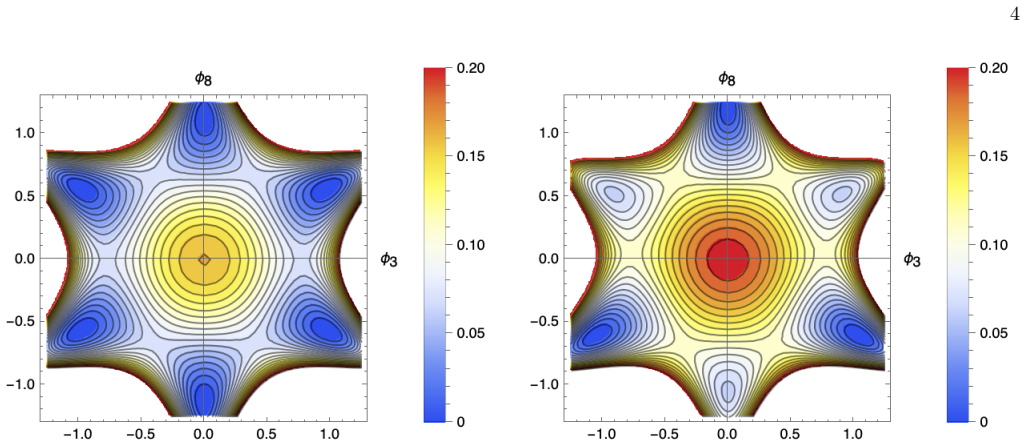
Z2-symmetry produces domain walls. In case of ϵ = 0, the domain walls are topological and stable, while for ϵ̸ = 0 the walls are non-topological and unstable. Similar domain wall solutions have been discussed previously in [5, 7–10, 24]. For ϵ = 0, the potential has 6 minima corresponding to the three permutations of ±T 8. The domain walls interpolate bet...
-
[2]
Langacker and S.-Y
P. Langacker and S.-Y. Pi, Magnetic Monopoles in Grand Unified Theories, Phys. Rev. Lett.45, 1 (1980)
1980
-
[3]
direction after diagonalizing, the symmetry breaking is given by ⟨Φ⟩ ∼T3 :SU(3)→U(1)×U(1),(3) ⟨Φ⟩ ∼T8 :SU(3)→U(2).(4) We can always diagonalize the VEV to be a linear combi- nation of the diagonalT 3 andT 8 generators. The inclusion of six-dimensional terms in the potential lets us choose the symmetry breaking pattern: While the term including λ6 preserve...
-
[4]
triangular plaquette
The ansatz for the domain wall configuration is Φdw(x) =g w(x)T3 +f w(x)T8,(21) with boundary conditions fw(±∞) = ±η/2, fw(0) = 0, g′ w(0) = 0 and gw(±∞) = η √ 3/2. The solution for fw(x) andg w(x) is solved numerically and shown in Fig. 5. Notice that at the center of the domain wall, the field is in the T 3 direction. Thus, the domain wall is a layer wh...
-
[5]
Vilenkin and E
A. Vilenkin and E. P. S. Shellard,Cosmic Strings and Other Topological Defects(Cambridge University Press, 2000)
2000
-
[6]
G. R. Dvali, H. Liu, and T. Vachaspati, Sweeping away the monopole problem, Phys. Rev. Lett.80, 2281 (1998), arXiv:hep-ph/9710301
Pith/arXiv arXiv 1998
-
[7]
L. Pogosian and T. Vachaspati, Interaction of magnetic monopoles and domain walls, Phys. Rev. D62, 105005 (2000), arXiv:hep-ph/9909543
Pith/arXiv arXiv 2000
-
[8]
L. Pogosian and T. Vachaspati, Domain walls in SU(5), Phys. Rev. D62, 123506 (2000), arXiv:hep-ph/0007045
Pith/arXiv arXiv 2000
-
[9]
Vachaspati, A Class of kinks in SU(N) x Z(2), Phys
T. Vachaspati, A Class of kinks in SU(N) x Z(2), Phys. Rev. D63, 105010 (2001), arXiv:hep-th/0102047
Pith/arXiv arXiv 2001
-
[10]
L. Pogosian and T. Vachaspati, Space of kink solutions in SU(N) * Z(2), Phys. Rev. D64, 105023 (2001), arXiv:hep- th/0105128
arXiv 2001
-
[11]
L. Pogosian and T. Vachaspati, Domain wall lattices, Phys. Rev. D67, 065012 (2003), arXiv:hep-th/0210232
Pith/arXiv arXiv 2003
-
[12]
N. D. Antunes, L. Pogosian, and T. Vachaspati, On for- mation of domain wall lattices, Phys. Rev. D69, 043513 (2004), arXiv:hep-ph/0307349
Pith/arXiv arXiv 2004
-
[13]
Vachaspati, Symmetries within domain walls, Phys
T. Vachaspati, Symmetries within domain walls, Phys. Rev. D67, 125002 (2003), arXiv:hep-th/0303137
Pith/arXiv arXiv 2003
-
[14]
M. Brush, L. Pogosian, and T. Vachaspati, Magnetic monopole—domain wall collisions, Phys. Rev. D92, 045008 (2015), arXiv:1505.08170 [hep-th]
Pith/arXiv arXiv 2015
-
[15]
Vachaspati,Kinks and Domain Walls : An Introduc- tion to Classical and Quantum Solitons(Oxford University Press, 2007)
T. Vachaspati,Kinks and Domain Walls : An Introduc- tion to Classical and Quantum Solitons(Oxford University Press, 2007)
2007
-
[16]
G. Dvali and J. S. Valbuena-Berm´ udez, Erasure of strings and vortices, Phys. Rev. D107, 035001 (2023), arXiv:2212.07535 [hep-th]
Pith/arXiv arXiv 2023
-
[17]
M. Bachmaier, G. Dvali, and J. S. Valbuena- Berm´ udez, Radiation emission during the erasure of magnetic monopoles, Phys. Rev. D108, 103501 (2023), arXiv:2306.12958 [hep-th]
Pith/arXiv arXiv 2023
-
[18]
G. Senjanovi´ c and M. Zantedeschi, Minimal Pati- Salam theory: From cosmic defects to gravitational waves and colliders, Phys. Rev. D112, 055018 (2025), arXiv:2504.01893 [hep-ph]
Pith/arXiv arXiv 2025
-
[19]
Bachmaier,The Fate of Magnetic Monopoles in the Early Universe, Ph.D
M. Bachmaier,The Fate of Magnetic Monopoles in the Early Universe, Ph.D. thesis, Munich U. (2026)
2026
-
[20]
H. Hemming, T. Vachaspati, and A. Wachowitz, Domain walls and magnetic monopoles in Grand Unified Models, (2026), arXiv:2606.14996 [hep-ph]
Pith/arXiv arXiv 2026
-
[21]
Y. Zhang, T. Vachaspati, and F. Ferrer, Magnetic field production at a first-order electroweak phase transition, Phys. Rev. D100, 083006 (2019), arXiv:1902.02751 [hep- ph]
Pith/arXiv arXiv 2019
-
[22]
F. A. Bais and H. A. Weldon, Exact Monopole Solutions in SU(n) Gauge Theory, Phys. Rev. Lett.41, 601 (1978)
1978
-
[23]
Wilkinson and F
D. Wilkinson and F. A. Bais, Exact SU(N) Monopole Solutions with Spherical Symmetry, Phys. Rev. D19, 2410 (1979)
1979
-
[24]
Y. Ng, T. W. B. Kibble, and T. Vachaspati, Formation of Non-Abelian Monopoles Connected by Strings, Phys. Rev. D78, 046001 (2008), arXiv:0806.0155 [hep-th]
Pith/arXiv arXiv 2008
-
[25]
T. W. B. Kibble, Topology of Cosmic Domains and Strings, J. Phys. A9, 1387 (1976)
1976
-
[26]
W. H. Zurek, Cosmological experiments in condensed matter systems, Phys. Rept.276, 177 (1996), arXiv:cond- mat/9607135
arXiv 1996
-
[27]
Pogosian, Kink interactions in SU(N) x Z(2), Phys
L. Pogosian, Kink interactions in SU(N) x Z(2), Phys. Rev. D65, 065023 (2002), arXiv:hep-th/0111206
Pith/arXiv arXiv 2002
-
[28]
Vachaspati, Creation of Magnetic Monopoles in Clas- sical Scattering, Phys
T. Vachaspati, Creation of Magnetic Monopoles in Clas- sical Scattering, Phys. Rev. Lett.117, 181601 (2016), arXiv:1607.07460 [hep-th]
Pith/arXiv arXiv 2016
-
[29]
Leese and T
R. Leese and T. Prokopec, Clustering of cosmological defects at the time of formation, Phys. Lett. B260, 27 (1991)
1991
-
[30]
Y. B. Zeldovich and M. Y. Khlopov, On the Concentration of Relic Magnetic Monopoles in the Universe, Phys. Lett. B79, 239 (1978)
1978
-
[31]
Preskill, Cosmological Production of Superheavy Mag- netic Monopoles, Phys
J. Preskill, Cosmological Production of Superheavy Mag- netic Monopoles, Phys. Rev. Lett.43, 1365 (1979)
1979
-
[32]
C. J. A. P. Martins and A. Achucarro, Evolution of local and global monopole networks, Phys. Rev. D78, 083541 (2008)
2008
-
[33]
L. Sousa and P. P. Avelino, Revisiting the velocity- dependent one-scale model for monopoles, Phys. Rev. D96, 023521 (2017), arXiv:1703.09054 [astro-ph.CO]
Pith/arXiv arXiv 2017
-
[34]
M. Hindmarsh, A. Lopez-Eiguren, R. Sepp¨ a, and D. J. Weir, Numerical simulations of magnetic monopole evolu- tion in an expanding universe, (2025), arXiv:2511.14204 [astro-ph.CO]
arXiv 2025
-
[35]
N. D. Antunes and T. Vachaspati, Spontaneous formation of domain wall lattices in two spatial dimensions, Phys. Rev. D70, 063516 (2004), arXiv:hep-ph/0404227
Pith/arXiv arXiv 2004
-
[36]
T. Hiramatsu, M. Kawasaki, and K. Saikawa, Gravita- tional Waves from Collapsing Domain Walls, JCAP05, 032, arXiv:1002.1555 [astro-ph.CO]
-
[37]
M. Kawasaki and K. Saikawa, Study of gravitational radiation from cosmic domain walls, JCAP09, 008, arXiv:1102.5628 [astro-ph.CO]
-
[38]
T. Hiramatsu, M. Kawasaki, and K. Saikawa, On the estimation of gravitational wave spectrum from cosmic do- main walls, JCAP02, 031, arXiv:1309.5001 [astro-ph.CO]
-
[39]
R. Z. Ferreira, A. Notari, O. Pujolas, and F. Rompineve, Gravitational waves from domain walls in Pulsar Timing Array datasets, JCAP02, 001, arXiv:2204.04228 [astro- ph.CO]
-
[40]
N. Kitajima, J. Lee, K. Murai, F. Takahashi, and W. Yin, Gravitational waves from domain wall collapse, and ap- plication to nanohertz signals with QCD-coupled axions, Phys. Lett. B851, 138586 (2024), arXiv:2306.17146 [hep- ph]
Pith/arXiv arXiv 2024
- [41]
-
[42]
E. Babichev, I. Dankovsky, D. Gorbunov, S. Ramazanov, and A. Vikman, Biased domain walls: faster anni- hilation, weaker gravitational waves, JCAP10, 103, arXiv:2504.07902 [hep-ph]
-
[43]
D. Barbini, A. Notari, O. Pujol` as, F. Rompineve, and F. Torrent ´ ı, Biased Domain Wall Networks and their Gravitational Waves, (2026), arXiv:2607.18107 [astro- ph.CO]
Pith/arXiv arXiv 2026
-
[44]
Y. Gouttenoire and E. Vitagliano, Domain wall interpreta- tion of the PTA signal confronting black hole overproduc- 15 tion, Phys. Rev. D110, L061306 (2024), arXiv:2306.17841 [gr-qc]
Pith/arXiv arXiv 2024
-
[45]
Y. Gouttenoire and E. Vitagliano, Primordial black holes and wormholes from domain wall networks, Phys. Rev. D 109, 123507 (2024), arXiv:2311.07670 [hep-ph]
Pith/arXiv arXiv 2024
-
[46]
Y. Gouttenoire, S. F. King, R. Roshan, X. Wang, G. White, and M. Yamazaki, Cosmological consequences of domain walls biased by quantum gravity, Phys. Rev. D112, 075007 (2025), arXiv:2501.16414 [hep-ph]
arXiv 2025
-
[47]
Vachaspati, Lunar Mass Black Holes from QCD Axion Cosmology, (2017), arXiv:1706.03868 [hep-th]
T. Vachaspati, Lunar Mass Black Holes from QCD Axion Cosmology, (2017), arXiv:1706.03868 [hep-th]
Pith/arXiv arXiv 2017
-
[48]
F. Ferrer, E. Masso, G. Panico, O. Pujolas, and F. Rompin- eve, Primordial Black Holes from the QCD axion, Phys. Rev. Lett.122, 101301 (2019), arXiv:1807.01707 [hep-ph]
Pith/arXiv arXiv 2019
-
[49]
D. M. Jennewein, J. Lee, C. Kurtz,et al., The sol su- percomputer at arizona state university, inPractice and Experience in Advanced Research Computing(Association for Computing Machinery, 2023) pp. 296–301
2023
discussion (0)
Sign in with ORCID, Apple, or X to comment. Anyone can read and Pith papers without signing in.