REVIEW 4 major objections 5 minor 62 references
The paper claims that the measured closeness of the CKM unitarity-triangle angles to (π/2, π/8, 3π/8) emerges from the sparsest full-rank Yukawa textures — nine non-zero entries and one CP phase — yielding precise predictions for the angles
Reviewed by Pith at T0; open to challenge. T0 means a machine referee read the full paper against a public rubric. the ladder, T0–T4 →
T0 review · deepseek-v4-flash
2026-08-01 09:37 UTC pith:WNIIYLPR
load-bearing objection Don't be fooled by the 'wonderful surprise': the φ-clustering is a built-in consequence of the 9-link ansatz, but the systematic scan and subleading predictions are a real contribution worth refereeing. the 4 major comments →
The Very Nearly Right Theory of Flavor
The pith
A machine-rendered reading of the paper's core claim, the machinery that carries it, and where it could break.
Core claim
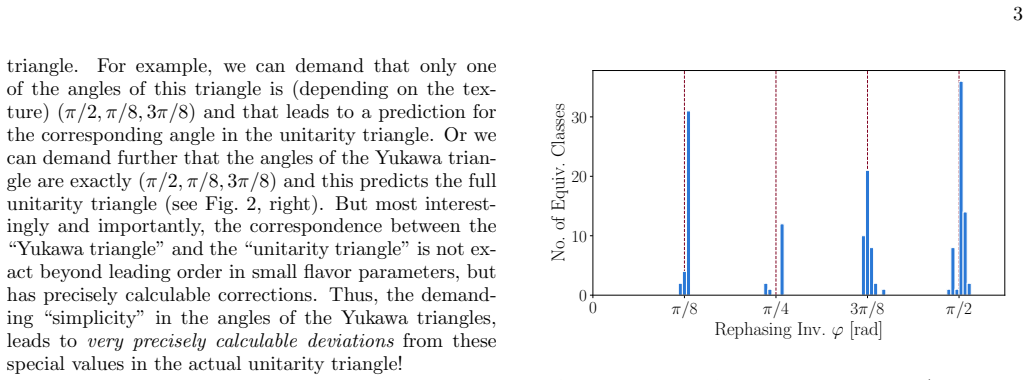
Fitting all 9-link textures — full-rank Yu and Yd with nine non-zero entries and a single rephasing-invariant phase φ — to the ten flavor observables, the paper finds that viable fits force φ to cluster at multiples of π/8, predominantly π/2, π/8, and 3π/8, the measured values of the unitarity-triangle angles (α, β, γ). The mechanism is a leading-order identity: in most textures the angle carried by φ is exactly one of α, β, γ, because the ratio of CKM elements defining that angle equals a ratio of Yukawa entries. That ratio, together with its argument, defines a 'Yukawa triangle' which coincides with the unitarity triangle at leading order in the small flavor parameters. By fixing the Yukaw
What carries the argument
The central object is the 9-link texture: a pair of full-rank 3×3 Yukawa matrices, one up-type and one down-type, with a total of nine non-zero entries arranged so the diagram has a single closed loop; that loop carries the unique rephasing-invariant CP-violating phase φ, with all other entries real and positive after field redefinitions. The identity doing the work is that, for hierarchical solutions, the texture zeros force the CKM ratios — for example Rα = −Vtd Vtb* / (Vud Vub*) — to equal a simple monomial of Yukawa entries such as D12/U12 = (Yd12/Yd22)/(Yu12/Yu22) at leading order, with arg giving φ. This identifies the 'Yukawa triangle' whose sides are those ratios; at leading order it
Load-bearing premise
The sharp predictions assume that the true Yukawa matrices are the most hierarchical fit in each texture class (left- and right-diagonalizing matrices with entries ≥0.95) and that the nine texture zeros are exact; if the underlying theory gives non-hierarchical entries or only approximate zeros, the predicted islands move or disappear.
What would settle it
Measure α, β, and γ with per-angle errors of ~0.1–0.2 degrees, using time-dependent CP asymmetries in B → ππ, ρρ, and B → DK at Belle II and LHCb Upgrade II. If the resulting point lies outside every one of the 55 predicted islands (the paper's Fig. 1), the central claim is falsified; if it lands in exactly one island, that texture class is singled out.
If this is right
- Every surviving equivalence class predicts a sub-0.3° region in the (α, β) plane; with Belle II and LHCb upgrades aiming for ~0.1–0.3° precision, each class is either confirmed or excluded.
- If one predicted island matches the measured angles, the Standard Model's Yukawa sector would need nine texture zeros and one phase fixed by spontaneous CP violation — a strong constraint on UV flavor models.
- For the majority of textures where the determinant is real, confirming the pattern would simultaneously explain the smallness of the QCD θ angle without axions.
- An immediate corollary of the scan is that the θ≃π/4 peak in the phase histogram is accidental, tied to the measured ratio ms/mb, while the π/8, π/2, 3π/8 peaks are structural; future shifts in mass-ratio measurements would distinguish these cases.
Where Pith is reading between the lines
- The 'most hierarchical fit' selection is a modeling assumption; a broader scan allowing non-hierarchical fits would enlarge the islands, so the paper's precision claim is conditional on that choice.
- The same 9-link parametrization could be applied to the lepton sector to check whether the PMNS matrix shows an analogous triangle pattern — an extension the paper does not attempt.
- A systematic survey of how each island moves when zeros are turned on at the few-percent level would tell which textures are robust predictions versus fragile artifacts; the paper only starts this for one texture.
- If future measurements straddle two islands, the framework would need additional structure (e.g., approximate rather than exact zeros) to survive, pointing toward a broader family of textures rather than a unique theory.
Editorial analysis
A structured set of objections, weighed in public.
Referee Report
Summary. The paper proposes a parametrization of the SM quark Yukawa sector by '9-link textures': full-rank Yu,Yd with exactly nine non-zero entries and a single rephasing-invariant phase φ. A systematic fit of these textures to quark masses and CKM observables yields a histogram of φ that peaks near multiples of π/8, including (π/8, π/4, π/2, 3π/8). The authors interpret the (π/2, π/8, 3π/8) peaks as a 'wonderful surprise' and introduce a 'Yukawa triangle' whose leading-order angles coincide with the CKM unitarity-triangle angles. Fixing the Yukawa triangle to (π/2, π/8, 3π/8) leaves 17, 19, and 19 inequivalent texture classes with predictions for (α, β, γ) at the 0.3° level, testable by near-future LHCb/Belle II measurements. The paper also argues that the sparse, phase-real determinants of these textures can solve the strong CP problem in a spontaneous-CP-violation framework. The central analytic derivations are clean, but the claim that the φ clustering is an empirical discovery is weakened by the paper's own Appendix II, which shows that φ is forced at leading order to equal one of the fitted CKM angles. The precise predictions are conditional on a hierarchy-selection rule that is not derived from a UV principle.
Significance. If the selection of hierarchical textures is accepted, the paper supplies a genuinely falsifiable set of narrow islands in (α, β, γ) space, with explicit subleading corrections expressed in terms of observables (e.g., Eqs. S42, S47, S52). The systematic enumeration of textures, the equivalence-class analysis, the analytic explanation of the π/4 peak, and the sensitivity study in App. II.a are valuable and go beyond previous texture-zero literature. The projected LHCb/Belle II sensitivities make the predictions experimentally decisive. However, the paper's headline claim—that fitting all 9-link textures reveals an unexpected clustering of φ around multiples of π/8—is largely a read-off of the input CKM angles, as the manuscript itself demonstrates in App. II and Fig. S3. The independent content resides in the subleading deviations and in the survival of a small subset of textures after imposing the Yukawa-triangle condition. The significance of the paper therefore stands or falls on whether the hierarchical-selection criterion and the exact texture-zero assumption can be justified or at least shown to be robust.
major comments (4)
- [App. II, Eqs. (S34)–(S35), Fig. S3] The central 'surprise' of the abstract—that φ clusters around multiples of π/8—is not an independent discovery. Equation (S34)–(S35) proves that, at leading order, every realistic 9-link texture except the accidental π/4 family has φ equal to one of α, β, or γ. Since the fit inputs already contain α≈π/2, β≈π/8, γ≈3π/8, the peaks in Fig. 3 are a direct mirror of the input angles. The deformed-SM scan in Fig. S3 confirms this: when the input angles are moved to (100°, 5°, 75°), the φ peaks move accordingly. The manuscript should be reframed so that the genuinely predictive content—the subleading corrections and the surviving textures—is clearly separated from the tautological part of the φ histogram. As written, the abstract and Sec. II overstate the novelty.
- [App. V.b, Figs. S4–S6] The sharp 0.3° predictions rely on choosing 'the most hierarchical texture as a representative of each equivalence class' (main text) with a numerical threshold that all diagonal entries of the diagonalizing matrices be ≥0.95. Of the 29/35/35 fixed-phase classes, only 23/25/26 have a fully hierarchical element; the rest are retained via left-hierarchical representatives and marked (†). For the Yukawa-triangle fit, the successful classes are 23/27/33, and after modding out residual rotations one obtains 17/19/19. There is no demonstrated principle that selects this representative, and the paper shows that some classes that fail the hierarchy criterion in the phase-only fit (e.g., 3π/8 classes a,b,c) become hierarchical once the full Yukawa triangle is fixed. The claimed 'predictions from all 9-link textures' are therefore predictions from a subset selected by a criterion that is not deriv
- [Table S2 and Eq. (3) of main text] The input value of α is inconsistent between the main text and the fit. The abstract and Eq. (3) quote α = 91.0 ± 2.8°, derived from unitarity using β and γ, while Table S2 lists α = 84.1 ± 3.7°, the direct experimental average. These two values differ by almost 2σ and the distinction matters: the claim 'α≃π/2 within current precision' is true for the unitarity-derived α but less clean for the direct α. It is not clear which α enters the 17-observable χ² of Eq. (1), and whether the fit also includes the unitarity-derived α. Please state explicitly which α is used in each fit, and quote the resulting best-fit α for comparison with both the direct and unitarity-imposed determinations.
- [Abstract and Sec. 'Spontaneous CP violation and Strong CP'] The strong CP resolution is stated as a consequence of 9-link textures having naturally real determinants. This is true only for exact texture zeros and for the specific placement of the phase on the loop (with five exceptions marked (∗) in Figs. S4–S6). The paper's own sensitivity analysis (App. II.a) shows that switching on a single zero entry shifts α at the degree level for three entries, so the determinant phase is not protected under small deformations unless additional suppression is imposed. Please quantify the maximum allowed size of the 'zero' entries for θ̄ to remain below the neutron EDM bound, and clarify whether the strong CP claim is a prediction or an existence proof for a subset of textures.
minor comments (5)
- [Main text, paragraph after Eq. (1)] The sentence 'We consider full-rank Y^{u,d} matrices with a total of nine zeros' should read 'nine non-zero entries' or 'nine texture zeros'; the surrounding text uses 'nine non-zero entries' correctly.
- [Footnote [29]] Footnote 29 defines 'vanishing' as entries below 1% of natural size, but the main text treats zeros as exact. Please clarify whether the analytic proofs require exact zeros or only sufficiently small entries, and state the quantitative criterion used in the numerical scan.
- [Fig. 1 and Fig. 5] The zoom-ins in Fig. 5 are helpful, but the labels I–IV in Fig. 1 are not defined in the caption; please add a sentence pointing to the corresponding panels in Fig. 5.
- [App. III, Eq. (S41)] In Eq. (S41) there is an inconsistent power: V_td is quoted as O(ϵ^2) and later as O(ϵ^3) in the same line. Please check the ϵ counting and correct the typo.
- [General] The paper would benefit from a short data-availability statement: the scan and fitting code are not provided, so the 156 classes and the 17/19/19 predictions are not independently reproducible without reimplementation. A repository or a detailed table of best-fit parameters for each surviving class would strengthen the paper.
Circularity Check
The φ-clustering 'surprise' is a mirror of the input CKM angles, and the leading-order Yukawa-triangle predictions are imposed by construction; only the subleading deviations are genuinely predictive.
specific steps
-
fitted input called prediction
[App. II, paragraph after Eq. (S36); cf. App. V.a and Fig. S3; main-text Fig. 3]
"However, all other textures lead to (S34) or (S35) at leading order requiring one of (α, β, γ) to be equal to the rephasing-invariant angle φ. This explains both the peaks in Fig. 3 and the absence of textures between the peaks."
In the full scan, φ is a free parameter minimized against a χ² that explicitly includes α, β, γ (Table S2). The paper's own analytic result (S34)/(S35) says that at leading order φ equals one of the input angles for every non-π/4 9-link texture. Therefore the fitted φ values are forced to cluster at the measured α, β, γ; the Fig. 3 histogram is a read-off of the inputs rather than an independent 'surprise.' The subsequent maneuver—fixing φ=π/2, π/8, 3π/8 and 'predicting' the corresponding angle—inverts the fit: the predicted angle is the same observable that determined φ. The genuinely non-trivial content is confined to the subleading corrections and to the π/4 mass-ratio peak.
-
self definitional
[Main text, 'Fixing the Yukawa triangle', after Eq. (7); Fig. 5]
"By construction we have that at leading order the unitarity triangle is exactly the Yukawa triangle, with angles (π/2, π/8, 3π/8); and the subleading corrections are totally calculable!"
The Yukawa-triangle fit fixes both the phase and the magnitude of the rephasing-invariant monomial (e.g. U12/D12 = i tan(π/8)), which is precisely the leading-order unitarity triangle with the target angles. The paper explicitly says 'by construction.' Hence the precise (α, β, γ) outputs are not derived from a deeper principle; they are the imposed inputs at leading order. What is actually predicted is only the O(ε²) deviation from those imposed values, so the claim of 'predicting the full triangle' overstates the case, while the calculable deviation remains a legitimate independent prediction.
full rationale
The paper contains genuine structural results: 9-link textures are full-rank matrices with a single rephasing invariant, and the perturbative diagonalization in App. II/III shows that texture zeros force φ to equal one CKM angle at leading order and give calculable subleading corrections. That theorem is not circular by itself. However, two central claims reduce to their inputs. First, the 'wonderful surprise' that φ clusters at π/8, π/2, 3π/8 is, by the paper's own App. II, the analytic statement that φ equals one of the measured α, β, γ at leading order; Fig. S3 confirms that the peaks move if the input angles are deformed. Second, the full-Yukawa-triangle fit fixes the leading-order triangle to (π/2, π/8, 3π/8) 'by construction,' so the precise predictions plotted in Fig. 1 are dominated by that imposed input rather than by an independent derivation. The real predictive content—the subleading deviations and the π/4 peak tied to a quark-mass coincidence—keeps the paper from being wholly circular. The citation to the coauthor's U(1)^9 formalism [56] is used only for a convenient hierarchical ansatz and is not load-bearing, so no self-citation penalty beyond this. Score 6: partial circularity, with independent content in the corrections.
Axiom & Free-Parameter Ledger
free parameters (3)
- Per-texture Yukawa magnitudes (9 nonzero entries) =
varies; one set per 9-link texture
- Rephasing-invariant phase phi =
Initial scan fits phi; constrained fits pin phi to pi/2, pi/8, 3pi/8
- Hierarchical selection threshold =
0.9 and 0.95
axioms (5)
- domain assumption Standard Model Yukawa sector with two 3x3 Yukawa matrices and no light new physics
- ad hoc to paper 9-link texture ansatz: exactly nine nonzero entries and one rephasing invariant
- domain assumption Hierarchical ordering and approximate U(1)^9 flavor symmetry
- ad hoc to paper Spontaneous CP violation with phases being multiples of pi/8
- domain assumption arg det(Yu Yd) = 0 suffices to solve the strong CP problem
invented entities (2)
-
Yukawa triangle
no independent evidence
-
Z4/Z8 flavon field chi with discrete-symmetry vevs
no independent evidence
read the original abstract
A striking empirical observation about the CKM matrix is that the angles of the unitarity triangle $(\alpha, \beta, \gamma)$ are very close to $(\pi/2, \pi/8, 3 \pi/8) $, simple fractions of $\pi$ that are suggestive of an underlying theory linking flavor and spontaneous CP violation. However, relating this empirical observation to an underlying theory of flavor is challenging, since the unitarity triangle is a complicated function of the Yukawa matrices. In this letter we present a simple picture for the Yukawas where this direct link is possible. We begin by parametrizing the ten-dimensional space of flavor data via "nine-link textures", full-rank $Y_{u,d}$ matrices with a total of nine non-zero entries, with a single CP violating phase. Fitting the ten parameters of all such textures to the flavor data reveals a wonderful surprise: the CP phases cluster tightly around multiples of $\pi/8$! This happens because the entries of $Y_{u,d}$ naturally define a "Yukawa triangle", in most cases identical to the unitarity triangle at leading order in small flavor parameters. Most interestingly, these two triangles are not the same beyond leading order, yielding precise predictions for $(\alpha, \beta, \gamma)$ with calculable deviation from $(\pi/2, \pi/8, 3 \pi/8)$, which can be decisively excluded or strongly confirmed by the next generation of experimental measurements of the angles. The 9-link textures are sparse and their determinants are naturally real, which taken together with spontaneous CP violation can resolve the strong CP problem.
Figures




Reference graph
Works this paper leans on
-
[1]
Cabibbo, Unitary Symmetry and Leptonic Decays, Phys
N. Cabibbo, Unitary Symmetry and Leptonic Decays, Phys. Rev. Lett.10, 531 (1963)
1963
-
[2]
Kobayashi and T
M. Kobayashi and T. Maskawa, CP Violation in the Renormalizable Theory of Weak Interaction, Prog. Theor. Phys.49, 652 (1973)
1973
-
[3]
Gatto, G
R. Gatto, G. Sartori, and M. Tonin, Weak Selfmasses, Cabibbo Angle, and Broken SU(2) x SU(2), Phys. Lett. B28, 128 (1968)
1968
-
[4]
Weinberg, The Problem of Mass, Trans
S. Weinberg, The Problem of Mass, Trans. New York Acad. Sci.38, 185 (1977)
1977
-
[5]
Fritzsch, Calculating the Cabibbo Angle, Phys
H. Fritzsch, Calculating the Cabibbo Angle, Phys. Lett. B70, 436 (1977)
1977
-
[6]
Wilczek and A
F. Wilczek and A. Zee, Discrete Flavor Symmetries and a Formula for the Cabibbo Angle, Phys. Lett. B70, 418 (1977), [Erratum: Phys.Lett.B 72, 504 (1978)]
1977
-
[7]
Wilczek and A
F. Wilczek and A. Zee, Horizontal Interaction and Weak Mixing Angles, Phys. Rev. Lett.42, 421 (1979)
1979
-
[8]
Georgi and C
H. Georgi and C. Jarlskog, A New Lepton - Quark Mass Relation in a Unified Theory, Phys. Lett. B86, 297 (1979)
1979
-
[9]
Fritzsch, Weak Interaction Mixing in the Six - Quark Theory, Phys
H. Fritzsch, Weak Interaction Mixing in the Six - Quark Theory, Phys. Lett. B73, 317 (1978)
1978
-
[10]
Fritzsch, Quark Masses and Flavor Mixing, Nucl
H. Fritzsch, Quark Masses and Flavor Mixing, Nucl. Phys. B155, 189 (1979)
1979
-
[11]
G. C. Branco, L. Lavoura, and F. Mota, Nearest Neighbor Interactions and the Physical Content of Fritzsch Mass Matrices, Phys. Rev. D39, 3443 (1989)
1989
-
[12]
Dimopoulos, L
S. Dimopoulos, L. J. Hall, and S. Raby, A Predictive framework for fermion masses in supersymmetric theo- ries, Phys. Rev. Lett.68, 1984 (1992)
1984
-
[13]
G. F. Giudice, A New ansatz for quark and lepton mass matrices, Mod. Phys. Lett. A7, 2429 (1992), arXiv:hep- ph/9204215
arXiv 1992
-
[14]
L. J. Hall and A. Rasin, On the generality of certain pre- dictions for quark mixing, Phys. Lett. B315, 164 (1993), arXiv:hep-ph/9303303
Pith/arXiv arXiv 1993
- [15]
-
[16]
L. E. Ibanez and G. G. Ross, Fermion masses and mixing angles from gauge symmetries, Phys. Lett. B332, 100 (1994), arXiv:hep-ph/9403338
Pith/arXiv arXiv 1994
-
[17]
R. Barbieri, L. J. Hall, S. Raby, and A. Romanino, Uni- fied theories with U(2) flavor symmetry, Nucl. Phys. B 493, 3 (1997), arXiv:hep-ph/9610449
Pith/arXiv arXiv 1997
-
[18]
G. C. Branco, D. Emmanuel-Costa, and R. Gonzalez Fe- lipe, Texture zeros and weak basis transformations, Phys. Lett. B477, 147 (2000), arXiv:hep-ph/9911418
Pith/arXiv arXiv 2000
-
[19]
R. G. Roberts, A. Romanino, G. G. Ross, and L. Velasco- Sevilla, Precision Test of a Fermion Mass Texture, Nucl. Phys. B615, 358 (2001), arXiv:hep-ph/0104088
Pith/arXiv arXiv 2001
-
[20]
A later figure will zoom in on the regions I→IV in the (α, β) plane populated by the predictions
Note that the predictions are sufficiently precise that the corresponding ellipses in the figure are hard to see. A later figure will zoom in on the regions I→IV in the (α, β) plane populated by the predictions
-
[21]
Here the uncertainty inαis extrapolated from (β, γ) us- ing unitarity
-
[22]
lampposts
=i(1−e iπ/4)/(1+ eiπ/4) =itan(π/8). We defer a discussion of these the- oretical possibilities to future work, as these are not di- rectly relevant for the UV detail-independent, precise ex- perimental predictions we wish to focus on in this letter. But there is a final obvious point worth making in con- nection with spontaneous CP violation. As we have s...
-
[23]
Takahashiet al.(Particle Data Group), Review of Par- ticle Physics, Int
F. Takahashiet al.(Particle Data Group), Review of Par- ticle Physics, Int. J. Mod. Phys. A41, 2630011 (2026)
2026
-
[24]
W. Altmannshoferet al.(Belle-II), The Belle II Physics Book, PTEP2019, 123C01 (2019), [Erratum: PTEP 2020, 029201 (2020)], arXiv:1808.10567 [hep-ex]
arXiv 2019
-
[25]
R. Aaijet al.(LHCb), Physics case for an LHCb Upgrade II - Opportunities in flavour physics, and beyond, in the HL-LHC era (2018), arXiv:1808.08865 [hep-ex]
Pith/arXiv arXiv 2018
-
[26]
Projections for Key Measurements in Heavy Flavour Physics (2025), arXiv:2503.24346 [hep-ex]
Pith/arXiv arXiv 2025
-
[27]
Framework TDR for the LHCb Upgrade II: Opportuni- ties in flavour physics, and beyond, in the HL-LHC era (2021)
2021
-
[28]
Vagnoni (LHCb), Discovery potential of LHCb Up- grade II (2025), arXiv:2503.23087 [hep-ex]
V. Vagnoni (LHCb), Discovery potential of LHCb Up- grade II (2025), arXiv:2503.23087 [hep-ex]
Pith/arXiv arXiv 2025
-
[29]
Throughout the text when we refer toφwe are always refering to the phase we get in the rephasing invariant up to complex conjugation as well as adding/subtractingπ
-
[30]
vanishing
Here, by “vanishing” we mean that the size of the en- tries are less than a percent of the “natural” hierarchical entries for the Yukawa matrix
-
[31]
T.-K. Kuo, S. W. Mansour, and G.-H. Wu, Triangu- lar textures for quark mass matrices, Phys. Rev. D60, 093004 (1999), arXiv:hep-ph/9907314
Pith/arXiv arXiv 1999
-
[32]
S.-H. Chiu, T.-K. Kuo, and G.-H. Wu, Hermitian quark mass matrices with four texture zeros, Phys. Rev. D62, 053014 (2000), arXiv:hep-ph/0003224
Pith/arXiv arXiv 2000
-
[33]
Z.-z. Xing and Z.-h. Zhao, On the four-zero texture of quark mass matrices and its stability, Nucl. Phys. B897, 302 (2015), arXiv:1501.06346 [hep-ph]
Pith/arXiv arXiv 2015
-
[34]
G. C. Branco, M. N. Rebelo, and J. I. Silva-Marcos, Nonfactorizable phases, Yukawa textures and the size of sin 2 beta, Phys. Lett. B597, 155 (2004), arXiv:hep- 9 ph/0403016
arXiv 2004
-
[35]
P. O. Ludl and W. Grimus, A complete survey of tex- ture zeros in general and symmetric quark mass matrices, Phys. Lett. B744, 38 (2015), arXiv:1501.04942 [hep-ph]
Pith/arXiv arXiv 2015
-
[36]
Giraldo, Seeking Texture Zeros in the Quark Mass Matrix Sector of the Standard Model, Nucl
Y. Giraldo, Seeking Texture Zeros in the Quark Mass Matrix Sector of the Standard Model, Nucl. Part. Phys. Proc.267-269, 76 (2015), arXiv:1503.02775 [hep-ph]
Pith/arXiv arXiv 2015
-
[37]
D. Emmanuel-Costa and R. Gonz´ alez Felipe, More about unphysical zeroes in quark mass matrices, Phys. Lett. B 764, 150 (2017), arXiv:1609.09491 [hep-ph]
Pith/arXiv arXiv 2017
-
[38]
I. Masina and C. A. Savoy, Real and imaginary elements of fermion mass matrices, Nucl. Phys. B755, 1 (2006), arXiv:hep-ph/0603101
Pith/arXiv arXiv 2006
-
[39]
I. Masina and C. A. Savoy, Up quark masses from down quark masses, Phys. Lett. B642, 472 (2006), arXiv:hep- ph/0606097
arXiv 2006
-
[40]
Z.-z. Xing, Right Unitarity Triangles, Stable CP- violating Phases and Approximate Quark-Lepton Complementarity, Phys. Lett. B679, 111 (2009), arXiv:0904.3172 [hep-ph]
Pith/arXiv arXiv 2009
-
[41]
S. Antusch, S. F. King, M. Malinsky, and M. Spinrath, Quark mixing sum rules and the right unitarity triangle, Phys. Rev. D81, 033008 (2010), arXiv:0910.5127 [hep- ph]
Pith/arXiv arXiv 2010
-
[42]
P. F. Harrison, D. R. J. Roythorne, and W. G. Scott, Is the Unitarity Triangle Right?, in18th International Conference on Particles and Nuclei(2009) pp. 756–758, arXiv:0904.3014 [hep-ph]
Pith/arXiv arXiv 2009
-
[43]
P. F. Harrison, S. Dallison, and W. G. Scott, The Matrix of Unitarity Triangle Angles for Quarks, Phys. Lett. B 680, 328 (2009), arXiv:0904.3077 [hep-ph]
Pith/arXiv arXiv 2009
-
[44]
S. Antusch, S. F. King, C. Luhn, and M. Spinrath, Right Unitarity Triangles and Tri-Bimaximal Mixing from Dis- crete Symmetries and Unification, Nucl. Phys. B850, 477 (2011), arXiv:1103.5930 [hep-ph]
Pith/arXiv arXiv 2011
-
[45]
S. Antusch, M. Holthausen, M. A. Schmidt, and M. Spin- rath, Solving the Strong CP Problem with Discrete Sym- metries and the Right Unitarity Triangle, Nucl. Phys. B 877, 752 (2013), arXiv:1307.0710 [hep-ph]
Pith/arXiv arXiv 2013
-
[46]
Y. Mimura, Nearly right unitarity triangle and CP phase in quark and lepton flavor mixings (2018), arXiv:1805.07773 [hep-ph]
Pith/arXiv arXiv 2018
-
[47]
P. F. Harrison and W. G. Scott, Unitarity triangle angles explained: a predictive new quark mass matrix texture, JHEP07, 155, arXiv:2501.18508 [hep-ph]
-
[48]
J. Charles, A. Hocker, H. Lacker, S. Laplace, F. R. Le Diberder, J. Malcles, J. Ocariz, M. Pivk, and L. Roos (CKMfitter Group), CP violation and the CKM matrix: Assessing the impact of the asymmetricBfactories, Eur. Phys. J. C41, 1 (2005), arXiv:hep-ph/0406184
Pith/arXiv arXiv 2005
-
[49]
M. Bonaet al.(UTfit), The 2004 UTfit collaboration re- port on the status of the unitarity triangle in the standard model, JHEP07, 028, arXiv:hep-ph/0501199
Pith/arXiv arXiv 2004
-
[50]
Jarlskog, Commutator of the Quark Mass Matrices in the Standard Electroweak Model and a Measure of Maximal CP Nonconservation, Phys
C. Jarlskog, Commutator of the Quark Mass Matrices in the Standard Electroweak Model and a Measure of Maximal CP Nonconservation, Phys. Rev. Lett.55, 1039 (1985)
1985
-
[51]
Navaset al.(Particle Data Group), Review of particle physics, Phys
S. Navaset al.(Particle Data Group), Review of particle physics, Phys. Rev. D110, 030001 (2024)
2024
-
[52]
There is a four-fold ambiguity in the extraction ofβfrom determinations of sin(2β) that can be resolved by the measurement of cos(2β) and by a global fit [47, 48]
-
[53]
Y. S. Amhiset al.(HFLA V), Averages of b-hadron, c- hadron, andτ-lepton properties as of 2021, Phys. Rev. D 107, 052008 (2023), arXiv:2206.07501 [hep-ex]
Pith/arXiv arXiv 2021
-
[54]
J. Charles, O. Deschamps, S. Descotes-Genon, and V. Niess, Isospin analysis of charmless B-meson decays, Eur. Phys. J. C77, 574 (2017), arXiv:1705.02981 [hep- ph]
Pith/arXiv arXiv 2017
-
[55]
Ckmfitter summer 2025 results (2025)
2025
-
[56]
Utfit summer 2025 results (2025)
2025
-
[57]
J. Carrasco-Martinez and L. J. Hall, Maximal Abelian Flavor Symmetries (2026), arXiv:2606.07799 [hep-ph]
Pith/arXiv arXiv 2026
-
[58]
S. Antusch, K. Hinze, and S. Saad, Updated running quark and lepton parameters at various scales, Phys. Rev. D113, 095011 (2026), arXiv:2510.01312 [hep-ph]
arXiv 2026
-
[59]
1 Supplementary Material for The Very NearlyRight Theory of Flavor Nima Arkani-Hamed, Carolina Figueiredo, Lawrence J
Any phase can always be removed by a field redefini- tion of the quark fields, except for the physical CP phase which is confined to the rephasing-invariant. 1 Supplementary Material for The Very NearlyRight Theory of Flavor Nima Arkani-Hamed, Carolina Figueiredo, Lawrence J. Hall and Claudio Andrea Manzari CONTENTS I. The CKM Matrix and the Unitarity Tri...
-
[60]
Further, assume that each entry inY u,d ij is dominated by products of these vevs so that, to leading order, eachY u,d ij and eachs u,d ij has a phase that is a multiple ofπ/8
Consider a theory where CP and flavor symmetries are spontaneously broken via the vevs of a set of flavon fields having phases that are multiples ofπ/8. Further, assume that each entry inY u,d ij is dominated by products of these vevs so that, to leading order, eachY u,d ij and eachs u,d ij has a phase that is a multiple ofπ/8. Could it be that, by choosi...
-
[61]
Substituting into (S29) forβ, and settings u 23 = 0 by a texture zero, the numerators and denominators no longer contain the same term. A similar result occurs forγwhen the relation is in the up sector, thus β≃arg su 13 s12sd 23 , s d 13 ≃ −sd 12sd 23, su 23 ≃0;γ≃arg s12su 23 sd 13 , s u 13 ≃ −su 12su 23, sd 23 ≃0.(S32) Eithers d 13 ≃ −sd 12sd 23 ors u 13...
-
[62]
deformed
+O(ϵ 2) e−iφ − d2 13d2 23d2 33u2 33 u2 13(d2 32 +d 2 33)3 e−i2φϵ2 +O(ϵ 3) ≃ π 8 − 1 2 q 2− √ 2 d13d2 23d33u33 (d2 32 +d 2 33)2u13 ϵ2 ≃ π 8 − 1 2 q 2− √ 2 Vus Vtd y2 s y2 b . (S47) 10 Example III Finally, we analyze a pair of textures withφ= 5π/8. The Yukawa matrices are Yu = u11ϵ5 0 0 0u 22 ϵ2 u23 ϵ 0 0u 33 , Y d = 0e iφd12 ϵ4 d13ϵ4 0d 22 ϵ3 0...
discussion (0)
Sign in with ORCID, Apple, or X to comment. Anyone can read and Pith papers without signing in.