REVIEW 3 major objections 5 minor 108 references
Perturbation theory around flat spacetime in self-gravitating scalar collapse breaks down before black hole formation, once the peak luminosity reaches about 10^-2 times the Planck luminosity; near criticality the scalar spectrum flattens t
Reviewed by Pith at T0; open to challenge. T0 means a machine referee read the full paper against a public rubric. the ladder, T0–T4 →
T0 review · deepseek-v4-flash
2026-08-01 08:59 UTC pith:ZMCPI3PH
load-bearing objection Solid, carefully done NR paper with a new breakdown scale for flat-space perturbation theory; the DSS-based 1/ω explanation is elegant but currently verified only along a central geodesic, not at I+, so the headline claim needs another step. the 3 major comments →
Nonlinear Dynamics near the Threshold of Gravitational Collapse
The pith
A machine-rendered reading of the paper's core claim, the machinery that carries it, and where it could break.
Core claim
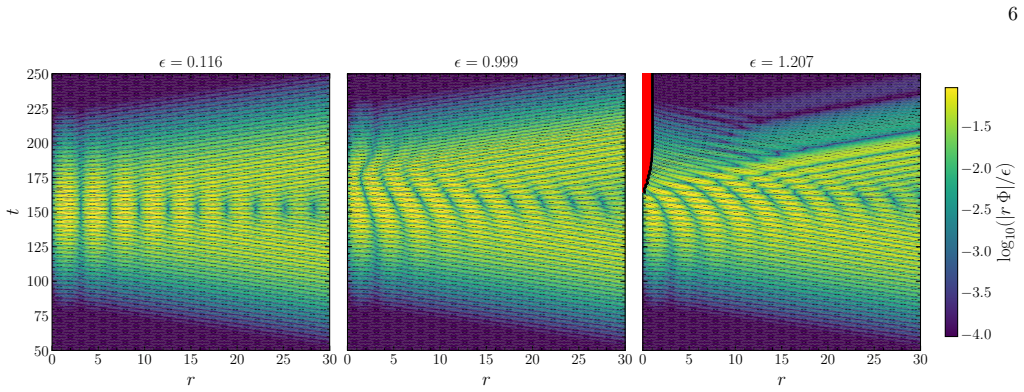
The central discovery is that an O(ε³) expansion around flat spacetime loses predictive power before any black hole forms: for initial amplitudes ε sufficiently close to the critical value, the predicted scalings of the driving harmonic (∝ε), the third harmonic (∝ε³), and the frequency shift (∝ε²) all deviate by more than 5%, and this happens when the peak luminosity reaches roughly 10^-2 L_Planck. Simultaneously, the spectrum of the outgoing scalar field changes from discrete peaks to a continuous distribution that decays as 1/ω. By assuming the near-critical solution is approximately discretely self-similar with period Δ≈3.44 and Fourier-transforming in the proper time at the origin, the p
What carries the argument
The argument rests on two workhorses. First, a second-order perturbative expansion of the scalar field and metric around flat spacetime, carried to O(ε³), which yields analytic predictions for the amplitude of the driving harmonic (∝ε), the third harmonic (∝ε³), and the frequency shift (∝ε²); these scalings are the baselines against which nonlinearity is measured. Second, the approximate discrete self-similarity of the near-critical solution, expressed as X(τ+Δ)≈X(τ) with Δ≈3.44, which through a Fourier-transform identity implies a |ω|^{-1} spectral tail. The luminosity, defined from the conserved flux associated with spherical symmetry, provides the physical scale that localizes the breakdo
Load-bearing premise
The predicted 1/ω spectral flattening rests on the assumption, taken from previous studies and only checked here for a single run, that near-critical solutions are approximately discretely self-similar with period Δ≈3.44; if that property does not hold for other initial-data families, the power-law prediction fails.
What would settle it
Run a near-critical scalar collapse with a different initial-data family (e.g., a Gaussian without the cos(ω₀r) oscillation, or a different width) and extract the Fourier spectrum along a null geodesic that bounces at the origin; if a run with |ε−1| ≤ 10^{-3} does not show a spectral amplitude decaying as |ω|^{-1} over roughly a decade in frequency, the claimed link between discrete self-similarity and spectral flattening is refuted.
If this is right
- Flat-space perturbation theory fails before any horizon forms, so strongly nonlinear features are present outside black holes; because higher harmonics decay faster than 1/r, only observers near the strong-field region can detect them, while asymptotic observers may see an almost linear signal.
- The peak luminosity in Planck units acts as a perturbative parameter: deviations from weak-field predictions appear once L_peak ≳ 10^-2 L_Planck, and this scale lies well below the conjectured maximum luminosity.
- Near-critical scalar collapse produces a continuous 1/ω spectrum, and the same flattening should appear in any near-critical evolution that is approximately discretely self-similar.
- After a black hole forms, the late-time relaxation is accurately described by the quasinormal modes of the static black hole, so the problem has distinct perturbative regimes around flat spacetime (before collapse) and around the black hole (after).
Where Pith is reading between the lines
- If the 1/ω flattening is a generic signature of discrete self-similarity, the spectral slope observed in near-critical collapse of other matter fields could serve as a probe of the self-similarity period, even where the critical solution is not known analytically.
- The luminosity threshold may extend to binary black hole mergers: since a typical merger reaches L_peak ~ 10^-3 L_Planck, the smallness of nonlinear corrections in ringdown is consistent with the proposed scale, while ultra-relativistic encounters reaching ~0.1 L_Planck should show significant deviations from weak-field predictions.
- The derivation leading to the 1/ω prediction implies that oscillations in the log-frequency spectrum (modulation by the DSS period) could provide an independent, observable measurement of the period Δ; extracting that modulation from numerical data is a direct test of the DSS hypothesis.
- The breakdown of low-order flat-space perturbation theory need not signal the end of perturbative methods; an expansion in |ε−1| around the critical solution may remain valid and could explain the deviations seen in the scaling plots.
Editorial analysis
A structured set of objections, weighed in public.
Referee Report
Summary. This paper studies the validity of flat-space perturbation theory for spherically symmetric scalar-field collapse. Using numerical relativity simulations of a quasi-monochromatic pulse, the authors vary the amplitude epsilon and compare diagnostics—the amplitudes of the omega0 and 3*omega0 harmonics and the frequency shift delta_omega—with an O(epsilon^3) perturbative expansion. They find that the predicted epsilon, epsilon^3, and epsilon^2 scalings hold for small epsilon but break down before collapse, when L_peak/L_Planck ~ 1e-2. Near criticality, the spectrum becomes continuous; for an observer on a null geodesic bouncing at the origin, the spectral amplitude follows a 1/omega power law, which the authors attribute to the approximate discrete self-similarity (DSS) of the critical solution. The paper also analyzes the ringdown for supercritical data and the peeling of higher harmonics.
Significance. If correct, the results provide a quantitative boundary for the validity of post-Minkowskian-like flat-space perturbation theory in a dynamical strong-gravity setting, and identify L_peak/L_Planck as a useful nonlinearity parameter. The 1/omega prediction is a parameter-free consequence of the assumed DSS period and is checked against a near-critical run. The numerical work is solid: fourth-order convergence of constraints, recovery of Choptuik scaling, careful luminosity extraction, and multiple independent diagnostics. The main weakness is that the DSS-derived 1/omega law is demonstrated for the central bouncing geodesic, while the headline spectral flattening in Fig. 2 is observed asymptotically; the connection between the two is not established.
major comments (3)
- [§IV.C, Eq. (43), Fig. 2, Sec. V] The 1/omega derivation applies to X = r*Phi along the bouncing null geodesic, Fourier-transformed in the central proper time T0. The flattening shown in Fig. 2, however, is for spectra extracted at r_ext = 150 and v = 400, i.e., in the asymptotic region. No calculation or fit connects Eq. (43) to these observables. Since higher harmonics peel as r^-2 (Eq. (26)) and the asymptotic signal includes tails and (for collapsing runs) QNM absorption, the asymptotic spectrum need not inherit the 1/omega law. The statement in Sec. V that 'a power law omega^{-1} scaling of the spectrum close to criticality ... follows from the approximate discrete self-similarity' is therefore unsupported for the asymptotic spectra. The authors should either fit A/omega to the near-critical curves in Fig. 2 or derive the propagation of the central spectrum to I+.
- [§III.A, Eqs. (28)–(29)] The frequency shift delta_omega = -4*pi*A^2 is obtained by discarding the log-divergent piece of S1 with the assertion that 'any regulator such as a small cosmological constant would eliminate the contribution from this piece.' This is not demonstrated: a regulator could leave finite, cutoff-dependent terms that shift the coefficient. The scaling delta_omega proportional to epsilon^2 is, however, robust from power counting and is confirmed in Fig. 4, so this does not affect the paper's main conclusion. I recommend presenting the coefficient as heuristically motivated.
- [§IV.A, Fig. 4] The breakdown criterion is an arbitrary 5% deviation, and the authors note that the threshold is arbitrary and that the breakdown value depends on the diagnostic and extraction surface. The quantitative claim that perturbation theory fails 'when L_peak/L_P >~ 10^-2' is thus an order-of-magnitude diagnostic rather than a precise boundary. This framing is acceptable, but the abstract and conclusions should avoid implying a sharp threshold.
minor comments (5)
- [Abstract/Sec. V] Clarify that the 1/omega flattening is measured for the bouncing geodesic in the strong-field region, not for the asymptotic observers whose spectra are shown in Fig. 2. As written, the abstract may be read as claiming the asymptotic spectrum follows 1/omega.
- [Eq. (43)] Specify the integration limits and state that the integral is understood in the distributional sense; the |omega|^{-1} factor is a late-time/low-frequency asymptotics. Adding one sentence would prevent confusion.
- [Sec. IV.A] The sentence 'for all except for the third harmonic ... we show the results obtained both at constant r and constant v' is slightly misleading because the center panel of Fig. 4 shows only r = const; the subsequent parenthetical helps, but the main text could be more precise.
- [Sec. IV.C, Fig. 6] The 1/omega check is performed for a single near-critical run (epsilon = 0.999) using the literature value Delta ~ 3.44. The paper itself notes DSS is only approximate near criticality. Since universality across initial data is not tested, the generality of the explanation remains open; this is a limitation rather than an error given the 'consistent with' wording.
- [General] Several references are 2026 arXiv preprints (e.g., [22,23,43,56,98]). For a journal submission, the authors should confirm these have appeared or are still appropriate to cite as preprints.
Circularity Check
No significant circularity; the only mild issue is a non-load-bearing companion-paper self-citation.
full rationale
The central derivation chain is not circular. The perturbative scalings A_omega0 ~ epsilon, A_3omega0 ~ epsilon^3, and delta_omega ~ epsilon^2 are read off from the perturbative ordering in Eqs. (18), (21), and (25): the third harmonic is sourced by O(epsilon^2) metric coefficients multiplying the O(epsilon) scalar, so the epsilon^3 scaling is structural, not fitted. The numerical measurements are compared with these scalings, and the 5% breakdown threshold is a data-driven deviation, not an input. The omega^{-1} spectral law is a parameter-free consequence of the externally cited Choptuik DSS ansatz (Eq. (41), with Delta ~ 3.44 from Ref. [17]); Eq. (43) is a mathematical Fourier identity, and Fig. 6 tests it on a near-critical run without fitting the spectral slope. The authors explicitly state that DSS is only approximate and that universality across initial data is not tested; this is a limitation on validity, not a circularity. The one self-citation, Ref. [43], corroborates the r^{-2} peeling of higher harmonics, but Eq. (26) derives that decay analytically in this paper, so the citation is not load-bearing. The paper's own caveat that the far-field flattening of Fig. 2 and the central-geodesic spectrum of Fig. 6 are distinct observables is a possible logical gap, but it is an unsupported inference, not a reduction of the claim to its inputs. No step in the derivation is equivalent by construction to its conclusion.
Axiom & Free-Parameter Ledger
free parameters (3)
- A* (critical amplitude) =
≈ 8.11e-04
- c1, c2 (luminosity extrapolation coefficients) =
per-run values
- 5% deviation threshold =
0.05
axioms (6)
- standard math Einstein-Klein-Gordon equations (1) govern the system
- domain assumption Choptuik critical collapse scaling M_BH ≈ C|A−A*|^γ with γ=0.37 applies to this initial-data family
- domain assumption Near-critical solutions are approximately discretely self-similar with period Δ≈3.44, X(τ+Δ)≈X(τ) (Eq. 41)
- ad hoc to paper The log-divergence in the frequency-domain perturbation is unphysical and can be removed by a regulator without changing δω=−4πA² (Eq. 29 and following)
- domain assumption Kodama vector flux definition (B1)-(B3) provides the correct luminosity measure
- domain assumption The two-timescale expansion ansatz (21)-(22) captures the leading nonlinear corrections
read the original abstract
Perturbation theory is an essential tool to model and interpret gravitational dynamics, for example, binary black hole mergers. Therefore it is also crucial to precisely understand its regimes of validity. The collapse of a scalar field under its own self-gravity provides a clean laboratory to study these questions. By varying the field's initial amplitude we can transition smoothly between a perturbative regime, where the field scatters in an approximately flat spacetime; and a nonperturbative regime, where a black hole forms in finite time. In this work, we use numerical relativity simulations of this set-up to investigate the accuracy of a perturbative expansion around flat spacetime, including next-to-next-to-leading order effects. Our simulations show deviations from these perturbative predictions before black hole formation, once the maximum luminosity of the process is sufficiently large, $L_{peak} \sim 10^{-2} L_{Planck}$. We characterize these nonlinear effects including a redshift of the driving frequency and a power-law spectral amplitude, which we show is consistent with approximate discrete self-similarity. These results provide a step forward towards understanding the limits of perturbative expansions in more realistic strong-gravity phenomena such as non-spherical collapse and high-velocity black hole mergers.
Figures


Reference graph
Works this paper leans on
-
[1]
Batterman,The Devil in the Details: Asymptotic Reasoning in Explanation, Reduction, and Emergence(Oxford University Press, 2001)
Robert W. Batterman,The Devil in the Details: Asymptotic Reasoning in Explanation, Reduction, and Emergence(Oxford University Press, 2001)
2001
-
[2]
Divergence of perturbation theory in quantum electrodynamics,
F. J. Dyson, “Divergence of perturbation theory in quantum electrodynamics,” Phys. Rev.85, 631–632 (1952)
1952
-
[3]
A Planar Diagram Theory for Strong Interactions,
Gerard ’t Hooft, “A Planar Diagram Theory for Strong Interactions,” Nucl. Phys. B72, 461 (1974)
1974
-
[4]
Effective one-body approach to general relativistic two-body dynamics,
A. Buonanno and T. Damour, “Effective one-body approach to general relativistic two-body dynamics,” Phys. Rev. D59, 084006 (1999), arXiv:gr-qc/9811091
Pith/arXiv arXiv 1999
-
[5]
Inspiral, merger and ring-down of equal- mass black-hole binaries,
Alessandra Buonanno, Gregory B. Cook, and Frans Pretorius, “Inspiral, merger and ring-down of equal- mass black-hole binaries,” Phys. Rev. D75, 124018 (2007), arXiv:gr-qc/0610122
Pith/arXiv arXiv 2007
-
[6]
Maarten van de Meent and Harald P. Pfeiffer, “Inter- mediate mass-ratio black hole binaries: Applicability of small mass-ratio perturbation theory,” Phys. Rev. Lett. 125, 181101 (2020), arXiv:2006.12036 [gr-qc]
Pith/arXiv arXiv 2020
-
[7]
Radiative gravi- tational fields in general relativity I. general structure of the field outside the source,
Luc Blanchet and Thibault Damour, “Radiative gravi- tational fields in general relativity I. general structure of the field outside the source,” Phil. Trans. Roy. Soc. Lond. A320, 379–430 (1986)
1986
-
[8]
On the unreasonable effectiveness of the post-Newtonian approximation in gravitational physics,
Clifford M. Will, “On the unreasonable effectiveness of the post-Newtonian approximation in gravitational physics,” Proc. Nat. Acad. Sci.108, 5938 (2011), arXiv:1102.5192 [gr-qc]
Pith/arXiv arXiv 2011
-
[9]
Post-Newtonian Theory for Gravi- tational Waves,
Luc Blanchet, “Post-Newtonian Theory for Gravi- tational Waves,” Living Rev. Rel.17, 2 (2014), arXiv:1310.1528 [gr-qc]
Pith/arXiv arXiv 2014
-
[10]
Gravitational scattering, post- Minkowskian approximation and Effective One- Body theory,
Thibault Damour, “Gravitational scattering, post- Minkowskian approximation and Effective One- Body theory,” Phys. Rev. D94, 104015 (2016), arXiv:1609.00354 [gr-qc]
Pith/arXiv arXiv 2016
-
[11]
High-energygravitationalscattering and the general relativistic two-body problem,
ThibaultDamour,“High-energygravitationalscattering and the general relativistic two-body problem,” Phys. Rev. D97, 044038 (2018), arXiv:1710.10599 [gr-qc]
Pith/arXiv arXiv 2018
-
[12]
Zvi Bern, Clifford Cheung, Radu Roiban, Chia-Hsien Shen, MikhailP.Solon, andMaoZeng,“ScatteringAm- plitudes and the Conservative Hamiltonian for Binary Systems at Third Post-Minkowskian Order,” Phys. Rev. Lett.122, 201603 (2019), arXiv:1901.04424 [hep-th]
Pith/arXiv arXiv 2019
-
[13]
Black hole spectroscopy: from theory to experiment,
Emanuele Bertiet al., “Black hole spectroscopy: from theory to experiment,” (2025), arXiv:2505.23895 [gr- qc]
Pith/arXiv arXiv 2025
-
[14]
Black hole pertur- bation theory and gravitational self-force,
Adam Pound and Barry Wardell, “Black hole pertur- bation theory and gravitational self-force,” (2021), 10.1007/978-981-15-4702-7_38-1, arXiv:2101.04592 [gr- qc]
Pith/arXiv arXiv 2021
-
[15]
Gravi- tational Waveforms for Compact Binaries from Second- Order Self-Force Theory,
Barry Wardell, Adam Pound, Niels Warburton, Jeremy Miller, Leanne Durkan, and Alexandre Le Tiec, “Gravi- tational Waveforms for Compact Binaries from Second- Order Self-Force Theory,” Phys. Rev. Lett.130, 241402 (2023), arXiv:2112.12265 [gr-qc]
Pith/arXiv arXiv 2023
-
[16]
Coalescence of two spinning black holes: an effective one-body approach,
Thibault Damour, “Coalescence of two spinning black holes: an effective one-body approach,” Phys. Rev. D 64, 124013 (2001), arXiv:gr-qc/0103018
Pith/arXiv arXiv 2001
-
[17]
Universality and scaling in gravitational collapse of a massless scalar field,
Matthew W. Choptuik, “Universality and scaling in gravitational collapse of a massless scalar field,” Phys. Rev. Lett.70, 9–12 (1993)
1993
-
[18]
Black Hole Superradiance in Dynami- cal Spacetime,
William E. East, Fethi M. Ramazanoğlu, and Frans Pretorius, “Black Hole Superradiance in Dynami- cal Spacetime,” Phys. Rev. D89, 061503 (2014), arXiv:1312.4529 [gr-qc]
Pith/arXiv arXiv 2014
-
[19]
Huan Yang, Aaron Zimmerman, and Luis Lehner, “Turbulent Black Holes,” Phys. Rev. Lett.114, 081101 (2015), arXiv:1402.4859 [gr-qc]
Pith/arXiv arXiv 2015
-
[20]
Ultrarelativis- tic black hole formation,
William E. East and Frans Pretorius, “Ultrarelativis- tic black hole formation,” Phys. Rev. Lett.110, 101101 (2013), arXiv:1210.0443 [gr-qc]
Pith/arXiv arXiv 2013
-
[21]
Black-hole head-on collisions in higher dimensions,
William G. Cook, Ulrich Sperhake, Emanuele Berti, and Vitor Cardoso, “Black-hole head-on collisions in higher dimensions,” Phys. Rev. D96, 124006 (2017), arXiv:1709.10514 [gr-qc]
Pith/arXiv arXiv 2017
-
[22]
Hengrui Zhu, Frans Pretorius, and James M. Stone, “Trapping, Irregular Waveforms, and Efficient Ra- diation in Ultra-relativistic Black Hole Encounters,” (2026), arXiv:2604.26253 [gr-qc]. 12
Pith/arXiv arXiv 2026
-
[23]
The weight of light: colliding pulses of radiation in General Relativity,
Jorge Expósito Patiño, Vitor Cardoso, and Hannes R. Rüter, “The weight of light: colliding pulses of radiation in General Relativity,” (2026), arXiv:2607.15761 [gr- qc]
Pith/arXiv arXiv 2026
-
[24]
Emergent Turbulence in Nonlinear Gravity,
Sizheng Ma, Luis Lehner, Huan Yang, Lawrence E. Kid- der, Harald P. Pfeiffer, and Mark A. Scheel, “Emergent Turbulence in Nonlinear Gravity,” Phys. Rev. Lett.136, 061401 (2026), arXiv:2508.13294 [gr-qc]
arXiv 2026
-
[25]
The Problem of a Selfgravitating Scalar Field,
D. Christodoulou, “The Problem of a Selfgravitating Scalar Field,” Commun. Math. Phys.105, 337–361 (1986)
1986
-
[26]
Choptuik scaling in null coordi- nates,
David Garfinkle, “Choptuik scaling in null coordi- nates,” Phys. Rev. D51, 5558–5561 (1995), arXiv:gr- qc/9412008
arXiv 1995
-
[27]
Charles R. Evans and Jason S. Coleman, “Observation of critical phenomena and selfsimilarity in the gravita- tional collapse of radiation fluid,” Phys. Rev. Lett.72, 1782–1785 (1994), arXiv:gr-qc/9402041
Pith/arXiv arXiv 1994
-
[28]
Critical behavior and scaling in vacuum axisymmetric gravitational col- lapse,
A. M. Abrahams and C. R. Evans, “Critical behavior and scaling in vacuum axisymmetric gravitational col- lapse,” Phys. Rev. Lett.70, 2980–2983 (1993)
1993
-
[29]
Universality in ax- isymmetric vacuum collapse,
A. M. Abrahams and C. R. Evans, “Universality in ax- isymmetric vacuum collapse,” Phys. Rev. D49, 3998– 4003 (1994)
1994
-
[30]
The Choptuik space-time as an eigenvalue problem,
Carsten Gundlach, “The Choptuik space-time as an eigenvalue problem,” Phys. Rev. Lett.75, 3214–3217 (1995), arXiv:gr-qc/9507054
Pith/arXiv arXiv 1995
-
[31]
Critical behavior in gravitational collapse of a Yang-Mills field,
Matthew W. Choptuik, Tadeusz Chmaj, and Piotr Bizon, “Critical behavior in gravitational collapse of a Yang-Mills field,” Phys. Rev. Lett.77, 424–427 (1996), arXiv:gr-qc/9603051
Pith/arXiv arXiv 1996
-
[32]
Critical phenomena in gravitational collapse,
Carsten Gundlach, “Critical phenomena in gravitational collapse,” Adv. Theor. Math. Phys.2, 1–49 (1998), arXiv:gr-qc/9712084
Pith/arXiv arXiv 1998
-
[33]
Scaling of cur- vature in subcritical gravitational collapse,
David Garfinkle and G. Comer Duncan, “Scaling of cur- vature in subcritical gravitational collapse,” Phys. Rev. D58, 064024 (1998), arXiv:gr-qc/9802061
Pith/arXiv arXiv 1998
-
[34]
Critical collapse of the massless scalar field in axisymmetry,
Matthew W. Choptuik, Eric W. Hirschmann, Steven L. Liebling, and Frans Pretorius, “Critical collapse of the massless scalar field in axisymmetry,” Phys. Rev. D68, 044007 (2003), arXiv:gr-qc/0305003
Pith/arXiv arXiv 2003
-
[35]
Critical collapse of a complex scalar field with angular momentum,
Matthew W. Choptuik, Eric W. Hirschmann, Steven L. Liebling, and Frans Pretorius, “Critical collapse of a complex scalar field with angular momentum,” Phys. Rev. Lett.93, 131101 (2004), arXiv:gr-qc/0405101
Pith/arXiv arXiv 2004
-
[36]
Collapse of Nonlinear Gravi- tationalWavesinMoving-PunctureCoordinates,
David Hilditch, Thomas W. Baumgarte, Andreas Wey- hausen, Tim Dietrich, Bernd Brügmann, Pedro J. Mon- tero, and Ewald Müller, “Collapse of Nonlinear Gravi- tationalWavesinMoving-PunctureCoordinates,” Phys. Rev. D88, 103009 (2013), arXiv:1309.5008 [gr-qc]
Pith/arXiv arXiv 2013
-
[37]
Critical phenomena in the gravitational col- lapse of electromagnetic waves,
Thomas W. Baumgarte, Carsten Gundlach, and David Hilditch, “Critical phenomena in the gravitational col- lapse of electromagnetic waves,” Phys. Rev. Lett.123, 171103 (2019), arXiv:1909.00850 [gr-qc]
Pith/arXiv arXiv 2019
-
[38]
Critical Phenomena in the Col- lapse of Gravitational Waves,
Thomas W. Baumgarte, Bernd Brügmann, Daniela Cors, Carsten Gundlach, David Hilditch, Anton Khirnov, Tomáš Ledvinka, Sarah Renkhoff, and Is- abel Suárez Fernández, “Critical Phenomena in the Col- lapse of Gravitational Waves,” Phys. Rev. Lett.131, 181401 (2023), arXiv:2305.17171 [gr-qc]
Pith/arXiv arXiv 2023
-
[39]
Twist-freeaxisym- metric critical collapse of a complex scalar field,
Krinio Marouda, Daniela Cors, Hannes R. Rüter, Flo- rianAtteneder, andDavidHilditch,“Twist-freeaxisym- metric critical collapse of a complex scalar field,” Phys. Rev. D109, 124042 (2024), arXiv:2402.06724 [gr-qc]
Pith/arXiv arXiv 2024
-
[40]
Criticalcollapseofvacuumspacetimes: Naka- mura wave initial data,
Thomas W. Baumgarte, Carsten Gundlach, and David Hilditch,“Criticalcollapseofvacuumspacetimes: Naka- mura wave initial data,” (2026), arXiv:2606.27431 [gr- qc]
Pith/arXiv arXiv 2026
-
[41]
CriticalPhenomenainGravitationalCollapse,
CarstenGundlach, DavidHilditch, andJoséM.Martín- García,“CriticalPhenomenainGravitationalCollapse,” (2025), arXiv:2507.07636 [gr-qc]
Pith/arXiv arXiv 2025
-
[42]
On choosing the start time of binary black hole ringdowns,
SwethaBhagwat, MariaOkounkova, StefanW.Ballmer, Duncan A. Brown, Matthew Giesler, Mark A. Scheel, and Saul A. Teukolsky, “On choosing the start time of binary black hole ringdowns,” Phys. Rev. D97, 104065 (2018), arXiv:1711.00926 [gr-qc]
Pith/arXiv arXiv 2018
-
[43]
Nonlinear Dynamics in General Relativity,
Vitor Cardoso, Jaime Redondo-Yuste, Ulrich Sperhake, and Furkan Tuncer, “Nonlinear Dynamics in General Relativity,” (2026), arXiv:2603.04501 [gr-qc]
arXiv 2026
-
[44]
Nonlinear Effects in Black Hole Ringdown,
Mark Ho-Yeuk Cheunget al., “Nonlinear Effects in Black Hole Ringdown,” Phys. Rev. Lett.130, 081401 (2023), arXiv:2208.07374 [gr-qc]
Pith/arXiv arXiv 2023
-
[45]
Nonlinearities in Black Hole Ringdowns,
Keefe Mitmanet al., “Nonlinearities in Black Hole Ringdowns,” Phys. Rev. Lett.130, 081402 (2023), arXiv:2208.07380 [gr-qc]
Pith/arXiv arXiv 2023
-
[46]
Generation and propagation of nonlinear quasinormal modes of a Schwarzschild black hole,
Macarena Lagos and Lam Hui, “Generation and propagation of nonlinear quasinormal modes of a Schwarzschild black hole,” Phys. Rev. D107, 044040 (2023), arXiv:2208.07379 [gr-qc]
Pith/arXiv arXiv 2023
-
[47]
Deruelle and T
N. Deruelle and T. Piran, eds.,GRA VITATIONAL RADIATION. PROCEEDINGS, SUMMER SCHOOL, NATO ADV ANCED STUDY INSTITUTE, LES HOUCHES, FRANCE, JUNE 2-21, 1982(1984)
1982
-
[48]
Freeman J Dyson, “Gravitational machines,” arXiv preprint arXiv:2305.10470 (2023)
Pith/arXiv arXiv 2023
-
[49]
The Maximum tension principle in general relativity,
G W Gibbons, “The Maximum tension principle in general relativity,” Found. Phys.32, 1891–1901 (2002), arXiv:hep-th/0210109
Pith/arXiv arXiv 1901
-
[50]
Maximum Tension: with and without a cosmological constant,
John D. Barrow and G. W. Gibbons, “Maximum Tension: with and without a cosmological constant,” Mon. Not. Roy. Astron. Soc.446, 3874–3877 (2015), arXiv:1408.1820 [gr-qc]
Pith/arXiv arXiv 2015
-
[51]
Maximum mag- netic moment to angular momentum conjecture,
John D. Barrow and G. W. Gibbons, “Maximum mag- netic moment to angular momentum conjecture,” Phys. Rev. D95, 064040 (2017), arXiv:1701.06343 [gr-qc]
Pith/arXiv arXiv 2017
-
[52]
Black hole bombs and explosions: from astrophysics to particle physics,
Vitor Cardoso, “Black hole bombs and explosions: from astrophysics to particle physics,” Gen. Rel. Grav.45, 2079–2097 (2013), arXiv:1307.0038 [gr-qc]
Pith/arXiv arXiv 2079
-
[53]
Remarks on the maximum luminos- ity,
Vitor Cardoso, Taishi Ikeda, Christopher J. Moore, and Chul-Moon Yoo, “Remarks on the maximum luminos- ity,” Phys. Rev. D97, 084013 (2018), arXiv:1803.03271 [gr-qc]
Pith/arXiv arXiv 2018
-
[54]
Reconsidering maxi- mum luminosity,
Aden Jowsey and Matt Visser, “Reconsidering maxi- mum luminosity,” Int. J. Mod. Phys. D30, 2142026 (2021), arXiv:2105.06650 [gr-qc]
Pith/arXiv arXiv 2021
-
[55]
Proper- ties of the Binary Black Hole Merger GW150914,
B. P. Abbottet al.(LIGO Scientific, Virgo), “Proper- ties of the Binary Black Hole Merger GW150914,” Phys. Rev.Lett.116,241102(2016),arXiv:1602.03840[gr-qc]
Pith/arXiv arXiv 2016
-
[56]
Discretely Self- similar Exterior-Naked Singularities for the Einstein- Scalar Field System,
Serban Cicortas and Christoph Kehle, “Discretely Self- similar Exterior-Naked Singularities for the Einstein- Scalar Field System,” Arch. Ration. Mech. Anal.250, 37 (2026), arXiv:2412.09540 [gr-qc]
Pith/arXiv arXiv 2026
-
[57]
New Horizons for Psi: Studying fun- damental fields with numerical relativity,
Katy Clough, “New Horizons for Psi: Studying fun- damental fields with numerical relativity,” (2024) arXiv:2408.07617 [gr-qc]
Pith/arXiv arXiv 2024
-
[58]
Evolution of three-dimensionalgravitationalwaves: Harmonicslicing case,
Masaru Shibata and Takashi Nakamura, “Evolution of three-dimensionalgravitationalwaves: Harmonicslicing case,” Phys. Rev. D52, 5428–5444 (1995). 13
1995
-
[59]
On the numerical integration of Einstein’s field equations,
Thomas W. Baumgarte and Stuart L. Shapiro, “On the numerical integration of Einstein’s field equations,” Phys. Rev. D59, 024007 (1998), arXiv:gr-qc/9810065
Pith/arXiv arXiv 1998
-
[60]
General Relativistic Collapse to Black Holes and Gravitational Waves from Black Holes,
T. Nakamura, K. Oohara, and Y. Kojima, “General Relativistic Collapse to Black Holes and Gravitational Waves from Black Holes,” Prog. Theor. Phys. Suppl.90, 1–218 (1987)
1987
-
[61]
Thomas W. Baumgarte, Pedro J. Montero, Isabel Cordero-Carrion, and Ewald Muller, “Numerical Rela- tivity in Spherical Polar Coordinates: Evolution Calcu- lations with the BSSN Formulation,” Phys. Rev. D87, 044026 (2013), arXiv:1211.6632 [gr-qc]
Pith/arXiv arXiv 2013
-
[62]
The Dynamics of general relativity,
Richard L. Arnowitt, Stanley Deser, and Charles W. Misner, “The Dynamics of general relativity,” Gen. Rel. Grav.40, 1997–2027 (2008), arXiv:gr-qc/0405109
Pith/arXiv arXiv 1997
-
[63]
SENR/NRPy+: Numerical Relativity in Singular Curvilinear Coordinate Systems,
Ian Ruchlin, Zachariah B. Etienne, and Thomas W. Baumgarte, “SENR/NRPy+: Numerical Relativity in Singular Curvilinear Coordinate Systems,” Phys. Rev. D97, 064036 (2018), arXiv:1712.07658 [gr-qc]
Pith/arXiv arXiv 2018
-
[64]
A New formalism for numerical relativity,
Carles Bona, Joan Masso, Edward Seidel, and Joan Stela, “A New formalism for numerical relativity,” Phys. Rev. Lett.75, 600–603 (1995), arXiv:gr-qc/9412071
Pith/arXiv arXiv 1995
-
[65]
Gravitational wave extraction from an inspiraling configuration of merg- ing black holes,
John G. Baker, Joan Centrella, Dae-Il Choi, Michael Koppitz, and James van Meter, “Gravitational wave extraction from an inspiraling configuration of merg- ing black holes,” Phys. Rev. Lett.96, 111102 (2006), arXiv:gr-qc/0511103
Pith/arXiv arXiv 2006
-
[66]
Accurate evolutions of orbiting black- hole binaries without excision,
Manuela Campanelli, C. O. Lousto, P. Marronetti, and Y. Zlochower, “Accurate evolutions of orbiting black- hole binaries without excision,” Phys. Rev. Lett.96, 111101 (2006), arXiv:gr-qc/0511048
Pith/arXiv arXiv 2006
-
[67]
James R. van Meter, John G. Baker, Michael Koppitz, and Dae-Il Choi, “How to move a black hole without excision: Gauge conditions for the numerical evolution of a moving puncture,” Phys. Rev. D73, 124011 (2006), arXiv:gr-qc/0605030
Pith/arXiv arXiv 2006
-
[68]
Gauge conditions for long term nu- merical black hole evolutions without excision,
Miguel Alcubierre, Bernd Bruegmann, Peter Diener, Michael Koppitz, Denis Pollney, Edward Seidel, and Ryoji Takahashi, “Gauge conditions for long term nu- merical black hole evolutions without excision,” Phys. Rev. D67, 084023 (2003), arXiv:gr-qc/0206072
Pith/arXiv arXiv 2003
-
[69]
A Fast apparent horizon finder for three- dimensional Cartesian grids in numerical relativity,
J. Thornburg, “A Fast apparent horizon finder for three- dimensional Cartesian grids in numerical relativity,” Class. Quant. Grav.21, 743–766 (2004), gr-qc/0306056
Pith/arXiv arXiv 2004
-
[70]
Holo- graphic Thermalization, Stability of Anti–de Sitter Space, and the Fermi-Pasta-Ulam Paradox,
Venkat Balasubramanian, Alex Buchel, Stephen R. Green, Luis Lehner, and Steven L. Liebling, “Holo- graphic Thermalization, Stability of Anti–de Sitter Space, and the Fermi-Pasta-Ulam Paradox,” Phys. Rev. Lett.113, 071601 (2014), arXiv:1403.6471 [hep-th]
Pith/arXiv arXiv 2014
-
[71]
Resonant Dynamics and the Instability of Anti–deSitterSpacetime,
Piotr Bizoń, Maciej Maliborski, and Andrzej Rost- worowski, “Resonant Dynamics and the Instability of Anti–deSitterSpacetime,” Phys.Rev.Lett.115,081103 (2015), arXiv:1506.03519 [gr-qc]
Pith/arXiv arXiv 2015
-
[72]
Naritaka Oshita, “Greybody factors imprinted on black hole ringdowns: An alternative to superposed quasi- normal modes,” Phys. Rev. D109, 104028 (2024), arXiv:2309.05725 [gr-qc]
Pith/arXiv arXiv 2024
-
[73]
Greybody factors imprinted on black hole ringdowns. II. Merging binary black holes,
Kazumasa Okabayashi and Naritaka Oshita, “Greybody factors imprinted on black hole ringdowns. II. Merging binary black holes,” Phys. Rev. D110, 064086 (2024), arXiv:2403.17487 [gr-qc]
Pith/arXiv arXiv 2024
-
[74]
Ringdown stability: Graybody factors as sta- ble gravitational-wave observables,
Romeo Felice Rosato, Kyriakos Destounis, and Paolo Pani, “Ringdown stability: Graybody factors as sta- ble gravitational-wave observables,” Phys. Rev. D110, L121501 (2024), arXiv:2406.01692 [gr-qc]
Pith/arXiv arXiv 2024
-
[75]
Romeo Felice Rosato, Sophia Yi, Emanuele Berti, and Paolo Pani, “Modeling the frequency-domain ring- down amplitude of comparable-mass mergers with grey- body factors,” Phys. Rev. D113, 064060 (2026), arXiv:2512.15877 [gr-qc]
Pith/arXiv arXiv 2026
-
[76]
Novel ringdown tests of general relativity with black hole greybody fac- tors,
Romeo Felice Rosato, Francesco Crescimbeni, Sophia Yi, Emanuele Berti, and Paolo Pani, “Novel ringdown tests of general relativity with black hole greybody fac- tors,” (2026), arXiv:2604.11895 [gr-qc]
Pith/arXiv arXiv 2026
-
[77]
Beyond quasinormal modes: a complete mode decomposition of black hole perturbations,
Paolo Arnaudo, Javier Carballo, and Benjamin With- ers, “Beyond quasinormal modes: a complete mode decomposition of black hole perturbations,” (2025), arXiv:2510.18956 [gr-qc]
arXiv 2025
-
[78]
Bouncing sin- gularities in Schwarzschild: a geometric origin of the QNM convergence region,
Paolo Arnaudo and Benjamin Withers, “Bouncing sin- gularities in Schwarzschild: a geometric origin of the QNM convergence region,” (2026), arXiv:2605.16489 [gr-qc]
Pith/arXiv arXiv 2026
-
[79]
Dynamical quasinormal mode excitation,
Marina De Amicis, Enrico Cannizzaro, Gregorio Carullo, and Laura Sberna, “Dynamical quasinormal mode excitation,” Phys. Rev. D113, 024048 (2026), arXiv:2506.21668 [gr-qc]
arXiv 2026
-
[80]
Post- Minkowskian expansion of the Prompt Response in a Schwarzschild background,
Marina De Amicis and Enrico Cannizzaro, “Post- Minkowskian expansion of the Prompt Response in a Schwarzschild background,” (2026), arXiv:2601.11706 [gr-qc]
arXiv 2026
discussion (0)
Sign in with ORCID, Apple, or X to comment. Anyone can read and Pith papers without signing in.