REVIEW 3 major objections 4 minor 70 references
This paper argues that replacing the scalar-field clock with unimodular time allows potential-dominated alpha-attractor bounces in loop quantum cosmology that are observationally viable and may retain quantum-gravity imprints in the CMB.
Reviewed by Pith at T0; open to challenge. T0 means a machine referee read the full paper against a public rubric. the ladder, T0–T4 →
T0 review · deepseek-v4-flash
2026-08-01 08:58 UTC pith:6TR3IB3E
load-bearing objection A careful, exploratory paper on unimodular LQC with genuinely useful exact solutions, but the abstract overclaims observational compatibility without computing a power spectrum. the 3 major comments →
Inflation in unimodular loop quantum cosmology
The pith
A machine-rendered reading of the paper's core claim, the machinery that carries it, and where it could break.
Core claim
The central discovery is that time evolution in unimodular loop quantum cosmology is generated by a true Hamiltonian in unimodular time T, rather than by imposing a Hamiltonian constraint with a free scalar as internal clock. In the effective semiclassical theory, the connection variable b is replaced by sin(b), which modifies the Friedmann equation to (a-dot/a)^2 = (kappa/3)rho(1-rho/rho_c), with maximal energy density rho_c = 3/(kappa*gamma^2*Delta); this yields a universal bounce and removes the singularities of the classical solutions. Analytical solutions for a constant potential are given in cosmic, unimodular, and scalar-field time, with elliptic functions appearing in the scalar-fiel
What carries the argument
The load-bearing mechanism is unimodular time T, defined as the conjugate to the cosmological-constant degree of freedom Lambda that arises as an integration constant; in a homogeneous isotropic minisuperspace, T labels spatial hypersurfaces and turns the Hamiltonian constraint into a Schrodinger equation. On top of that, the effective dynamics use the holonomy replacement b->sin(b), the simplest (but not unique) regularisation of the connection; it produces the modified Friedmann equation with a critical density and thereby the bounce. The alpha-attractor E-model potential V = V0(1-exp(-sqrt(2*kappa/(3*alpha))*phi))^2 with alpha=7 provides the potential shape that makes the potential-domina
Load-bearing premise
The results rely on the non-unique approximation that replaces the connection b by sin(b); a different legitimate prescription could alter or eliminate the potential-dominated bounce.
What would settle it
Compute the full quantum evolution of this unimodular model without the sin(b) approximation, and check whether the alpha-attractor initial conditions (V0=10^-13, phi(0)=-9.38 at alpha=7) still produce a 67-e-fold potential-dominated bounce.
If this is right
- The inflaton is no longer needed as a clock, so models in which the scalar field's potential is non-negligible at the bounce can be studied consistently in a quantum-cosmology setting.
- The effective dynamics imply a maximum energy density rho_c = 3/(kappa*gamma^2*Delta); any solution with an effective cosmological constant below 3/(gamma^2*Delta) has a minimum non-zero volume, i.e., singularity resolution by a bounce.
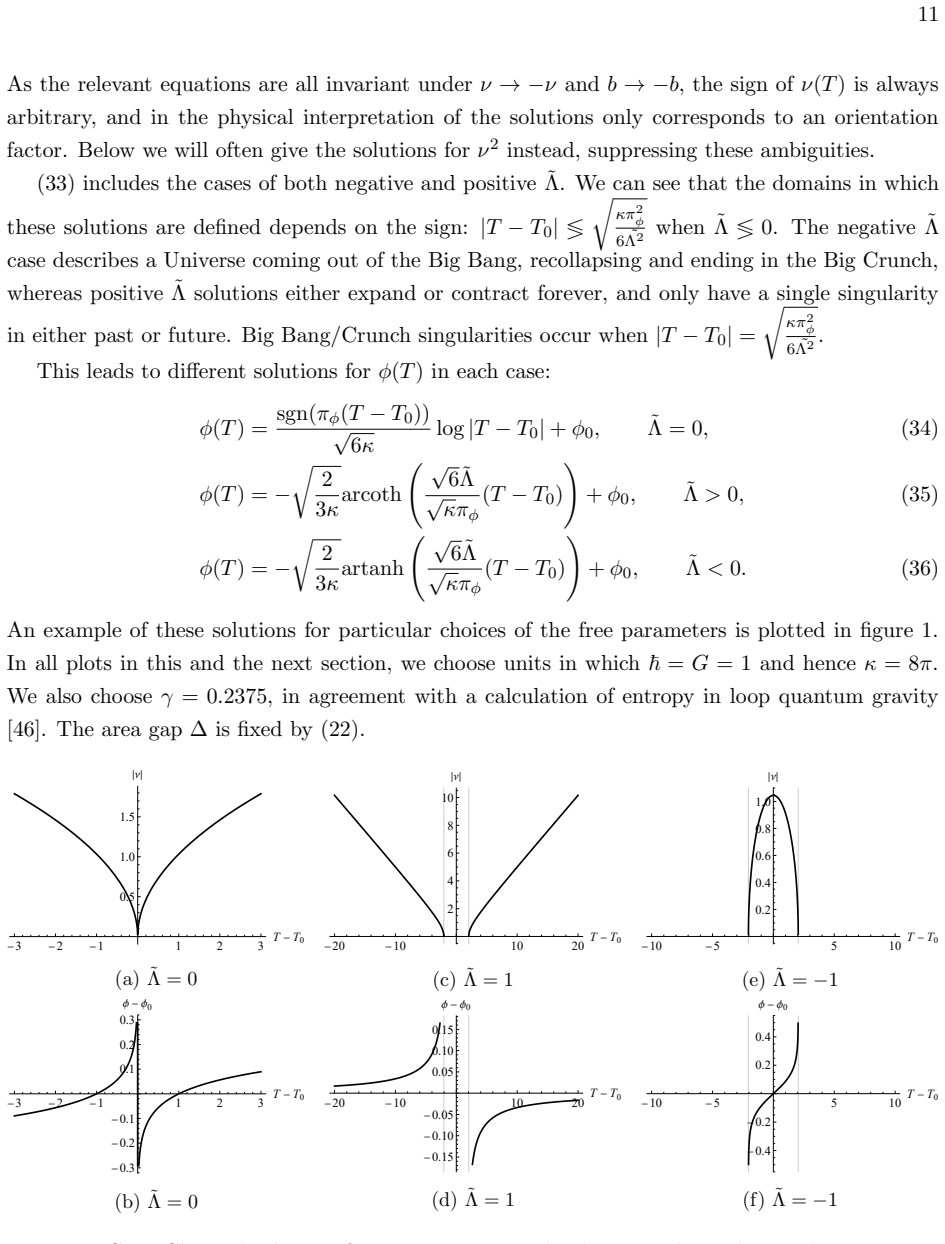
- For a constant potential, the paper obtains explicit analytic solutions (e.g., nu^2(t) = C[1+9(t-t0)^2/(gamma^2*Delta)] for Lambda=0), which can serve as testbeds for perturbation calculations.
- The alpha-attractor case shows that a potential-dominated bounce with about 67 e-folds can be compatible with observations while potentially leaving quantum-gravity signatures in the observable window - something the authors argue the standard scalar-clock formulation cannot describe.
Where Pith is reading between the lines
- My inference, not stated in the paper: if the unimodular-time construction is correct, the same clock-switch should extend to other symmetry-reduced models with a preferred foliation - anisotropic cosmologies and homogeneous black-hole interiors - where it could provide unitary evolution and singularity resolution without adding dust or a scalar clock.
- My inference, not stated in the paper: because the two perturbation quantisations compared here give different horizon evolution for the observationally relevant alpha-attractor scenarios, computing the full scalar power spectrum in both would be a concrete next step; differences at low multipoles would make the choice of quantisation testable.
- My inference, not stated in the paper: the potential-dominated alpha-attractor bounce could be a candidate scenario for low-multipole CMB anomalies, but the paper does not make that leap; predicting the exact spectral shape is the natural way to distinguish it from standard slow-roll inflation.
- My inference, not stated in the paper: since the b->sin(b) prescription is one of several quantisation ambiguities, the numerical survey should be repeated with alternative legitimate regularisations; if the potential-dominated bounce disappears under another quantisation, the scenario would be contingent on that ambiguity.
Editorial analysis
A structured set of objections, weighed in public.
Referee Report
Summary. The paper develops unimodular loop quantum cosmology (LQC) as an alternative to the standard scalar-field-clock formulation. It reviews the unimodular constraint, introduces the effective dynamics via the holonomy substitution b→sin(b), and derives analytic solutions for a constant potential in cosmic, unimodular, and scalar-field times, emphasizing the use of unimodular time T as the evolution parameter. It then studies numerically inflationary models with quadratic, Starobinsky, and α-attractor potentials, considering kinetically and potential-dominated bounces. The central claim is that a potential-dominated α-attractor bounce (the yellow scenario, V0=10^-13, ϕ(0)=-9.38, α=7) produces about 67 e-folds and is 'compatible with observations' while potentially leaving observable quantum-gravity imprints, and that this scenario could not be quantized in standard LQC with the scalar field as clock.
Significance. If the claims are substantiated, the paper would make a useful conceptual and technical contribution: it demonstrates that unimodular time relaxes the need for the inflaton to serve as a clock, allowing potential-dominated bounces to be studied consistently. The analytic solutions of Section IV are worked out in detail and provide a solid reference for future work. The paper is also honest about quantization ambiguities and model dependence. However, the central phenomenological claim of observational compatibility is not demonstrated by the analysis actually performed: it is based on background e-folds and heuristic horizon comparisons, not on a computation of the primordial power spectrum. Furthermore, the perturbation input is imported from standard LQC without deriving it for the unimodular effective background. These gaps are substantial but addressable within the manuscript's scope.
major comments (3)
- [§V.C, Fig. 10] The abstract's claim that the α-attractor scenarios are 'compatible with observations' is not established by the analysis. The text explicitly states 'without having to actually compute primordial power spectra' and only claims 'indications'. For the yellow potential-dominated bounce, the scalar power spectrum (amplitude As≈2.1×10^-9 and spectral index ns within Planck contours) must be computed, because the bounce occurs at Planckian density, the vacuum state at the bounce is non-trivial, and modes may cross the horizon during super-inflation. The parameters V0 and ϕ(0) are also chosen after the fact to produce ~67 e-folds (Sec. V.C), so the scenario is constructed rather than predicted. Please either compute the power spectrum or explicitly reframe the observational claim as tentative.
- [§V, Eq. (86), Fig. 10] The perturbation quantities s(η) from the hybrid and dressed metric approaches are taken from standard LQC, where the background is quantized with the scalar field as clock. Here the background uses unimodular time and the effective substitution b→sin(b); no derivation shows that the Mukhanov–Sasaki equation for the unimodular quantum theory reduces to the same s(η). Since the claims of 'observable imprints' rely on comparing these s(η) curves, this is a load-bearing gap. A derivation or at least a clear statement of assumptions is needed before these curves can support the conclusions.
- [§II.C, Eq. (26)] All bounce and inflation results, including the potential-dominated α-attractor scenario, depend on the replacement b→sin(b). The paper correctly acknowledges that this is 'certainly not a unique procedure', but the abstract and conclusions present the scenario as observationally compatible without repeating this condition. Since a different quantization choice could alter or remove the bounce, the main claim should be explicitly conditional on this choice, or a robustness check with an alternative holonomy prescription should be provided.
minor comments (4)
- [Abstract and §V.C] The abstract says 'compatible with observations', while the body only claims 'indications' from background dynamics. The language should be matched to the actual level of support.
- [Fig. 10] The grey shaded 'observable range' is not defined in the caption. Please specify how this band is chosen (e.g., which k-range corresponds to Planck-observable modes) so the reader can assess the horizon comparisons.
- [§IV, around Eq. (56)] The comparison with the classical limit is helpful, but the notation A, B, C is reused in §V without restating their definitions. A short reminder would improve readability.
- [§V.C, color coding] The yellow scenario is described as a new case, but the color-coding in Figures 8–10 is not listed in the main text at the point where the scenarios are first introduced; please add a sentence summarizing the colors and parameter choices.
Circularity Check
No significant circularity: results are conditional on an explicitly acknowledged quantization prescription, and parameter choices for e-folds are transparent tuning, not predictions.
full rationale
The paper's central effective constraint (53) is obtained by the explicitly acknowledged, non-unique holonomy replacement b -> sin(b) (Eq. 26), imported from the standard (non-self) LQC sLQC literature; this is a stated assumption rather than a hidden regression of the conclusions. The analytical solutions in Secs. III-IV are genuine consequences of that input and the classical equations of motion, not restatements of the target claims. For the inflationary sections, the paper repeatedly states that V0 and phi(0) are 'chosen ... to produce about 67 e-folds' (Sec. V.C), and the abstract only claims that such models 'allow' bounces compatible with observations; this is transparent existence construction, not a fitted parameter renamed as a prediction. The claim of Planck-consistency is hedged ('without having to actually compute primordial power spectra', 'indications', 'potentially') and is an evidentiary gap rather than a circular step. Self-citations (e.g., [16], [25], [37]) support background motivation and the full-theory action but no load-bearing uniqueness theorem or ansatz is imported from them; the b->sin(b) ansatz is attributed to the external sLQC literature and its non-uniqueness is acknowledged explicitly. Therefore no circular step is identifiable under the stated rules.
Axiom & Free-Parameter Ledger
free parameters (5)
- Barbero-Immirzi parameter γ =
0.2375
- Area gap Δ =
√3/2 ℏκγ ≈ 5.17 in Planck units
- m (quadratic potential mass) =
1.2×10⁻⁶ (red/blue), 3.6×10⁻² (green)
- V0 (Starobinsky/α-attractor amplitude) =
1.77×10⁻¹³ to 0.35
- Initial field value φ(0) =
e.g., -9.38 for yellow α-attractor scenario
axioms (5)
- ad hoc to paper The holonomy-corrected Hamiltonian is obtained by the replacement b→sin(b) (Eq. 26).
- domain assumption Unimodular time T, conjugate to the cosmological constant Λ with {T,Λ}=κ, provides a good global clock for homogeneous cosmology.
- domain assumption The symmetry-reduced secondary constraint (Eq. 6) yields an effective cosmological constant as an integration constant.
- domain assumption Flat FLRW minisuperspace with a scalar field and no anisotropies captures the relevant dynamics.
- ad hoc to paper Mukhanov-Sasaki perturbation results from the hybrid and dressed metric approaches of standard LQC apply to unimodular LQC backgrounds.
read the original abstract
We study inflation in the setting of unimodular loop quantum cosmology, where time evolution is defined in unimodular time rather than with respect to a free, massless scalar field as is standard in loop quantum cosmology. The unimodular setting leads to a natural Schr\"odinger time evolution in a time coordinate with clear geometric meaning, defined independently of any particular matter content; an inflaton can be included but is not needed as a clock. We review the unimodular version of loop quantum cosmology and comment on possible connections to full (unimodular) loop quantum gravity. Then, focusing on semiclassical effective equations, we derive analytical solutions in simple cases such as a constant potential, emphasising the use of a unimodular time coordinate. We also discuss numerical solutions for phenomenologically interesting cases such as a quadratic potential and Starobinsky inflation, comparing different possible choices of initial conditions. In particular, we show that choosing an $\alpha$-attractor potential allows for models of a bounce either dominated by kinetic or potential energy, which are compatible with observations while potentially including observable imprints of the quantum-gravity regime.
Figures


Reference graph
Works this paper leans on
-
[1]
Baumann,Cosmology, Cambridge University Press (2022)
D. Baumann,Cosmology, Cambridge University Press (2022)
2022
-
[2]
J. Martin, C. Ringeval and V. Vennin,Encyclopædia Inflationaris: Opiparous Edition,Phys. Dark Univ.5-6(2014) 75 [1303.3787]
Pith/arXiv arXiv 2014
-
[3]
A. Borde, A.H. Guth and A. Vilenkin,Inflationary Spacetimes Are Incomplete in Past Directions, Phys. Rev. Lett.90(2003) 151301 [gr-qc/0110012]
Pith/arXiv arXiv 2003
-
[4]
A. Ashtekar and P. Singh,Loop quantum cosmology: a status report,Class. Quant. Grav.28(2011) 213001 [1108.0893]
Pith/arXiv arXiv 2011
-
[5]
D. Oriti, L. Sindoni and E. Wilson-Ewing,Emergent Friedmann dynamics with a quantum bounce from quantum gravity condensates,Class. Quant. Grav.33(2016) 224001 [1602.05881]
Pith/arXiv arXiv 2016
-
[6]
S. Brahma, R. Brandenberger and S. Laliberte,Emergent cosmology from matrix theory,JHEP03 (2022) 067 [2107.11512]
Pith/arXiv arXiv 2022
-
[7]
J. Khoury, B.A. Ovrut, P.J. Steinhardt and N. Turok,Ekpyrotic universe: Colliding branes and the origin of the hot big bang,Phys. Rev. D64(2001) 123522 [hep-th/0103239]
Pith/arXiv arXiv 2001
-
[8]
terpart when in de Sitter), and with the inverse of the comoving curvature radius
The observable range of modes for each case is shown as the shaded grey region. terpart when in de Sitter), and with the inverse of the comoving curvature radius. Note that the curvature radius is not always in agreement with the horizon of either approach, unlike what was suggested in early literature. In all five scenarios the predictions differ between...
-
[9]
However, due to the different steepness particularly for negativeϕ, we are now also able to set observationally relevant initial conditions with potential dominance at the bounce, as represented in yellow. Because the potential is less steep, even with a low value ofV 0 (chosen to be the same as for the red and purple scenarios), we can increase|ϕ(0)|enou...
-
[10]
M. Bojowald, G. Calcagni and S. Tsujikawa,Observational test of inflation in loop quantum cosmology,JCAP11(2011) 046 [1107.1540]
Pith/arXiv arXiv 2011
-
[11]
R. Brandenberger and P. Peter,Bouncing Cosmologies: Progress and Problems,Found. Phys.47 (2017) 797 [1603.05834]
Pith/arXiv arXiv 2017
-
[12]
L. Marchetti, T.R. Ladst¨ atter and D. Oriti,Cosmic Acceleration from Quantum Gravity: Emergent Inflation and Dynamical Dark Energy,2512.11712
-
[13]
Gielen,Quantum Cosmology, inEncyclopedia of Mathematical Physics (Second Edition), R
S. Gielen,Quantum Cosmology, inEncyclopedia of Mathematical Physics (Second Edition), R. Szabo and M. Bojowald, eds., (Oxford), pp. 520–530, Academic Press (2025) [2309.01790]
Pith/arXiv arXiv 2025
-
[14]
A. Ashtekar and J. Lewandowski,Background independent quantum gravity: a status report,Class. Quant. Grav.21(2004) R53 [gr-qc/0404018]
Pith/arXiv arXiv 2004
-
[15]
Misner,Quantum Cosmology
C.W. Misner,Quantum Cosmology. I,Phys. Rev.186(1969) 1319
1969
-
[16]
S. Gielen and L. Men´ endez-Pidal,Singularity resolution depends on the clock,Class. Quant. Grav.37 (2020) 205018 [2005.05357]
Pith/arXiv arXiv 2020
-
[17]
C.J. Isham,Canonical Quantum Gravity and the Problem of Time, inIntegrable Systems, Quantum 32 Groups, and Quantum Field Theories. Proceedings, NATO Advanced Study Institute, 23rd GIFT International Seminar on Recent Problems in Mathematical Physics, L.A. Ibort and M.A. Rodriguez, eds., pp. 157–287, 1993 [gr-qc/9210011]
Pith/arXiv arXiv 1993
-
[18]
P.A. H¨ ohn,Switching Internal Times and a New Perspective on the ‘Wave Function of the Universe’, Universe5(2019) 116 [1811.00611]
Pith/arXiv arXiv 2019
-
[19]
S. Gielen and L. Men´ endez-Pidal,Black Hole Singularity Resolution in Unimodular Gravity from Unitarity,Phys. Rev. Lett.134(2025) 101501 [2409.03006]
Pith/arXiv arXiv 2025
-
[20]
S. Gryb and K.P.Y. Th´ ebault,Bouncing unitary cosmology I. Mini-superspace general solution,Class. Quant. Grav.36(2019) 035009 [1801.05789]
Pith/arXiv arXiv 2019
-
[21]
S. Gielen and L. Men´ endez-Pidal,Unitarity and quantum resolution of gravitational singularities,Int. J. Mod. Phys. D31(2022) 2241005 [2205.15387]
Pith/arXiv arXiv 2022
-
[22]
J.D. Brown and K.V. Kuchaˇ r,Dust as a standard of space and time in canonical quantum gravity, Phys. Rev. D51(1995) 5600 [gr-qc/9409001]
Pith/arXiv arXiv 1995
-
[23]
S. Gielen and S. Ried,Quantum Schwarzschild-(A)dS black holes: unitarity and singularity resolution, JHEP06(2025) 074 [2502.10104]
Pith/arXiv arXiv 2025
-
[24]
K. Giesel, B.-F. Li and P. Singh,Towards a reduced phase space quantization in loop quantum cosmology with an inflationary potential,Phys. Rev. D102(2020) 126024 [2007.06597]
Pith/arXiv arXiv 2020
-
[25]
S. Gielen and R.B. Neves,Low-curvature quantum corrections from unitary evolution of de Sitter space,Class. Quant. Grav.42(2025) 145001 [2412.01907]
Pith/arXiv arXiv 2025
-
[26]
I. Agullo, A. Ashtekar and W. Nelson,The pre-inflationary dynamics of loop quantum cosmology: Confronting quantum gravity with observations,Class. Quant. Grav.30(2013) 085014 [1302.0254]
Pith/arXiv arXiv 2013
-
[27]
D.-W. Chiou and M. Geiller,Unimodular loop quantum cosmology,Phys. Rev. D82(2010) 064012 [1007.0735]
Pith/arXiv arXiv 2010
-
[28]
Henneaux and C
M. Henneaux and C. Teitelboim,The cosmological constant and general covariance,Phys. Lett. B 222(1989) 195
1989
-
[29]
Buchm¨ uller and N
W. Buchm¨ uller and N. Dragon,Gauge fixing and the cosmological constant,Phys. Lett. B223(1989) 313
1989
-
[30]
D.R. Finkelstein, A.A. Galiautdinov and J.E. Baugh,Unimodular relativity and cosmological constant, J. Math. Phys.42(2001) 340 [gr-qc/0009099]
Pith/arXiv arXiv 2001
-
[31]
Kuchaˇ r,Does an unspecified cosmological constant solve the problem of time in quantum gravity?,Phys
K.V. Kuchaˇ r,Does an unspecified cosmological constant solve the problem of time in quantum gravity?,Phys. Rev. D43(1991) 3332
1991
-
[32]
Sorkin,Role of Time in the Sum-over-Histories Framework for Gravity,Int
R.D. Sorkin,Role of Time in the Sum-over-Histories Framework for Gravity,Int. J. Theor. Phys.33 (1994) 523
1994
-
[33]
Unruh and R.M
W.G. Unruh and R.M. Wald,Time and the interpretation of canonical quantum gravity,Phys. Rev. D 40(1989) 2598
1989
-
[34]
J. Yang and Y. Ma,New Hamiltonian constraint operator for loop quantum gravity,Phys. Lett. B 751(2015) 343 [1507.00986]
Pith/arXiv arXiv 2015
-
[35]
Thiemann,Quantum spin dynamics (QSD),Class
T. Thiemann,Quantum spin dynamics (QSD),Class. Quant. Grav.15(1998) 839 [gr-qc/9606089]
Pith/arXiv arXiv 1998
-
[36]
M. Assanioussi, J. Lewandowski and I. M¨ akinen,New scalar constraint operator for loop quantum gravity,Phys. Rev. D92(2015) 044042 [1506.00299]
Pith/arXiv arXiv 2015
-
[37]
true Hamiltonian
takes the form SCanPV[A, ˜E, α, V;˜N0] = 1 iκ Z d4x ˙Ai a ˜Ea i +α i Da ˜Ea i −V a F i ab ˜Eb i −A i aDb ˜Eb i − ˜N0 ϵij kF k ab ˜Ea i ˜Eb j 2 det ˜E . (4) This corresponds to the special case whereγ=±i and we work with self-dual complex variables. These variables would require reality conditions in the quantum theory and are hence usually avoided, even t...
-
[38]
Varadarajan,Anomaly free quantum dynamics for Euclidean LQG,2205.10779
M. Varadarajan,Anomaly free quantum dynamics for Euclidean LQG,2205.10779
-
[39]
Smolin,Unimodular loop quantum gravity and the problems of time,Phys
L. Smolin,Unimodular loop quantum gravity and the problems of time,Phys. Rev. D84(2011) 044047 [1008.1759]. 33
Pith/arXiv arXiv 2011
-
[40]
S. Gielen and E. Nash,Canonical analysis of unimodular Pleba´ nski gravity,Phys. Rev. D111(2025) 044047 [2411.09748]
Pith/arXiv arXiv 2025
-
[41]
K. Banerjee, G. Calcagni and M. Mart ´ ın-Benito,Introduction to Loop Quantum Cosmology,SIGMA8 (2012) 016 [1109.6801]
Pith/arXiv arXiv 2012
-
[42]
Thiemann,Kinematical Hilbert spaces for fermionic and Higgs quantum field theories,Class
T. Thiemann,Kinematical Hilbert spaces for fermionic and Higgs quantum field theories,Class. Quant. Grav.15(1998) 1487 [gr-qc/9705021]
Pith/arXiv arXiv 1998
-
[43]
A. Ashtekar, T. Pawlowski and P. Singh,Quantum nature of the big bang: Improved dynamics,Phys. Rev. D74(2006) 084003 [gr-qc/0607039]
Pith/arXiv arXiv 2006
-
[44]
A. Ashtekar and E. Bianchi,A short review of loop quantum gravity,Rept. Prog. Phys.84(2021) 042001 [2104.04394]
Pith/arXiv arXiv 2021
-
[45]
M. Bojowald, D. Cartin and G. Khanna,Lattice refining loop quantum cosmology, anisotropic models and stability,Phys. Rev. D76(2007) 064018 [0704.1137]
Pith/arXiv arXiv 2007
-
[46]
A. Ashtekar, A. Corichi and P. Singh,Robustness of key features of loop quantum cosmology,Phys. Rev. D77(2008) 024046 [0710.3565]
Pith/arXiv arXiv 2008
-
[47]
V. Taveras,Corrections to the Friedmann equations from loop quantum gravity for a universe with a free scalar field,Phys. Rev. D78(2008) 064072 [0807.3325]
Pith/arXiv arXiv 2008
-
[48]
M. Assanioussi, A. Dapor, K. Liegener and T. Paw lowski,Emergent de Sitter Epoch of the Quantum Cosmos from Loop Quantum Cosmology,Phys. Rev. Lett.121(2018) 081303 [1801.00768]
Pith/arXiv arXiv 2018
-
[49]
Meissner,Black hole entropy in loop quantum gravity,Class
K.A. Meissner,Black hole entropy in loop quantum gravity,Class. Quant. Grav.21(2004) 5245 [gr-qc/0407052]
Pith/arXiv arXiv 2004
-
[50]
Ratra and P.J.E
B. Ratra and P.J.E. Peebles,Cosmological consequences of a rolling homogeneous scalar field,Phys. Rev. D37(1988) 3406
1988
-
[51]
A. Bhardwaj, E.J. Copeland and J. Louko,Inflation in loop quantum cosmology,Phys. Rev. D99 (2019) 063520 [1812.06841]
Pith/arXiv arXiv 2019
-
[52]
B.C. Paul and S. Saini,Cyclic universe and uniform rate inflation in loop quantum cosmology, 2510.11230
-
[53]
Abramowitz and I.A
M. Abramowitz and I.A. Stegun,Handbook of Mathematical Functions with Formulas, Graphs, and Mathematical Tables(1964)
1964
-
[54]
L. Boyle and N. Turok,Two-Sheeted Universe, Analyticity and the Arrow of Time,2109.06204
-
[55]
T. Paw lowski and A. Ashtekar,Positive cosmological constant in loop quantum cosmology,Phys. Rev. D85(2012) 064001 [1112.0360]
Pith/arXiv arXiv 2012
-
[56]
S. Gielen and L. Men´ endez-Pidal,Unitarity, clock dependence and quantum recollapse in quantum cosmology,Class. Quant. Grav.39(2022) 075011 [2109.02660]
Pith/arXiv arXiv 2022
-
[57]
A. Ashtekar and D. Sloan,Probability of inflation in loop quantum cosmology,Gen. Rel. Grav.43 (2011) 3619 [1103.2475]
Pith/arXiv arXiv 2011
-
[58]
B. Bonga and B. Gupt,Inflation with the Starobinsky potential in loop quantum cosmology,Gen. Rel. Grav.48(2016) 71 [1510.00680]
Pith/arXiv arXiv 2016
-
[59]
S. Iteanu and G.A. Mena Marug´ an,Mass of Cosmological Perturbations in the Hybrid and Dressed Metric Formalisms of Loop Quantum Cosmology for the Starobinsky and Exponential Potentials, Universe8(2022) 463 [2208.01987]
Pith/arXiv arXiv 2022
-
[60]
M. Sharma, M. Shahalam, Q. Wu and A. Wang,Preinflationary dynamics in loop quantum cosmology: monodromy potential,JCAP11(2018) 003 [1808.05134]
Pith/arXiv arXiv 2018
-
[61]
M. Shahalam, M. Sami and A. Wang,Preinflationary dynamics of anα−attractor in loop quantum cosmology,Phys. Rev. D98(2018) 043524 [1806.05815]
Pith/arXiv arXiv 2018
-
[62]
M. Shahalam, M. Al Ajmi, R. Myrzakulov and A. Wang,Revisiting pre-inflationary Universe of 34 family ofα-attractor in loop quantum cosmology,Class. Quant. Grav.37(2020) 195026 [1912.00616]
Pith/arXiv arXiv 2020
-
[63]
C. Brown, J. Fier, B. Phillips, G. Cleaver and A. Wang,Effects of the ekpyrotic mechanism on inflationary phase in loop quantum cosmologies,2510.03907
-
[64]
E. Frion, M. Pascual and F. Vidotto,Quasi-dust ekpyrotic scenario in loop quantum cosmology,Class. Quant. Grav.43(2026) 055012 [2509.06148]
Pith/arXiv arXiv 2026
-
[65]
A. Ijjas, P.J. Steinhardt and A. Loeb,Inflationary paradigm in trouble after Planck2013,Phys. Lett. B723(2013) 261 [1304.2785]
Pith/arXiv arXiv 2013
-
[66]
G.W. Gibbons and N. Turok,Measure problem in cosmology,Phys. Rev. D77(2008) 063516 [hep-th/0609095]
Pith/arXiv arXiv 2008
-
[67]
A. Ashtekar and D. Sloan,Loop quantum cosmology and slow roll inflation,Phys. Lett. B694(2011) 108 [0912.4093]. [65]Planckcollaboration,Planck 2018 results. X. Constraints on inflation,Astron. Astrophys.641 (2020) A10 [1807.06211]
Pith/arXiv arXiv 2011
-
[68]
B. Elizaga Navascu´ es, D. Martin de Blas and G.A. Mena Marug´ an,Time-dependent mass of cosmological perturbations in the hybrid and dressed metric approaches to loop quantum cosmology, Phys. Rev. D97(2018) 043523 [1711.10861]
Pith/arXiv arXiv 2018
-
[69]
R. Kallosh, A. Linde and D. Roest,Superconformal inflationaryα-attractors,JHEP11(2013) 198 [1311.0472]
Pith/arXiv arXiv 2013
-
[70]
R. Kallosh and A. Linde,Planck, LHC, andα-attractors,Phys. Rev. D91(2015) 083528 [1502.07733]
Pith/arXiv arXiv 2015
discussion (0)
Sign in with ORCID, Apple, or X to comment. Anyone can read and Pith papers without signing in.