Earth and Planetary Astrophysics · arXiv:2607.27352 v2 · submitted 29 Jul 2026
A Systematic Trend in the Observed vs. Predicted Radii of Transiting Brown Dwarfs
The paper says
“Transiting brown dwarfs provide a direct empirical test of substellar evolutionary models, and with more than 50 now known we can carry out this test at the population level.”
more of the abstract
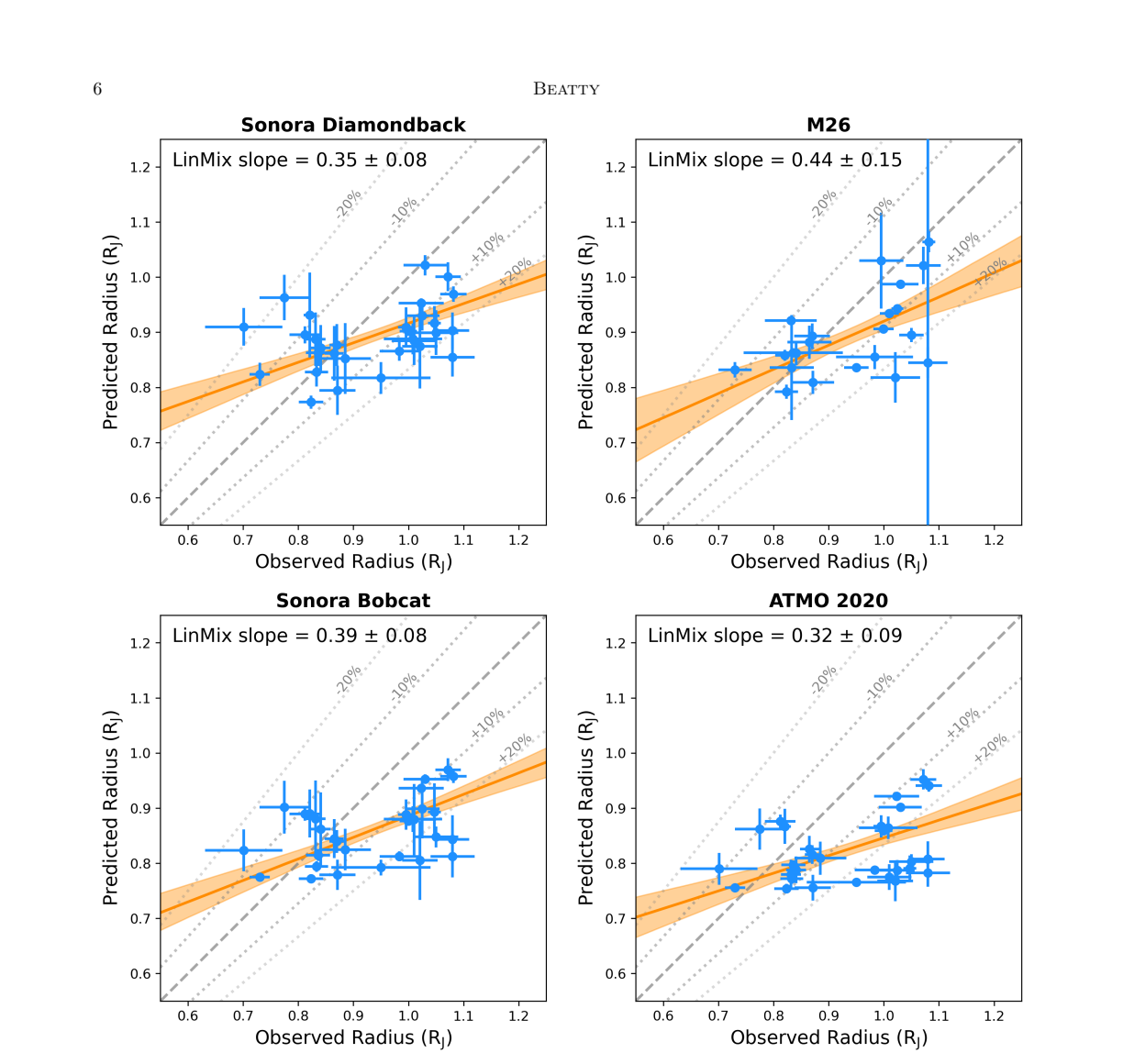
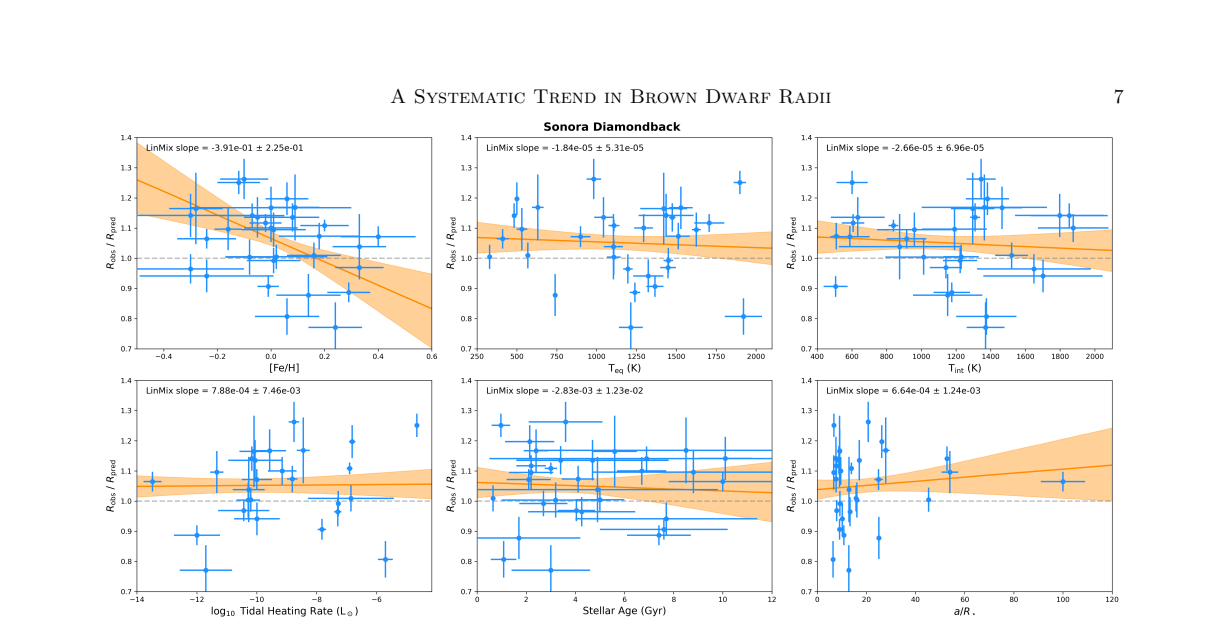
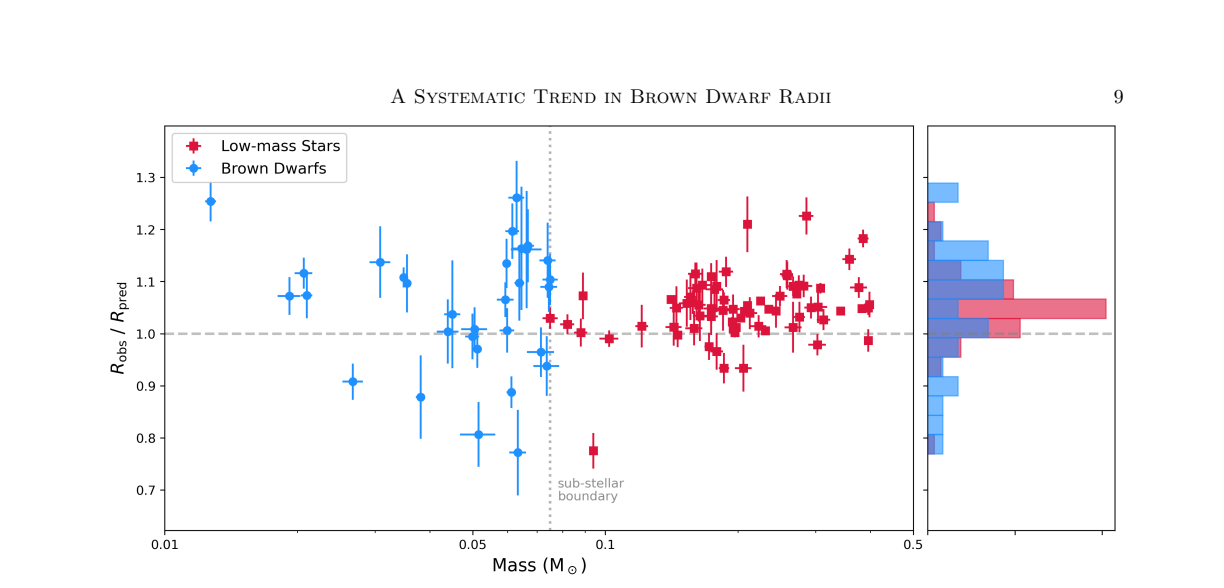
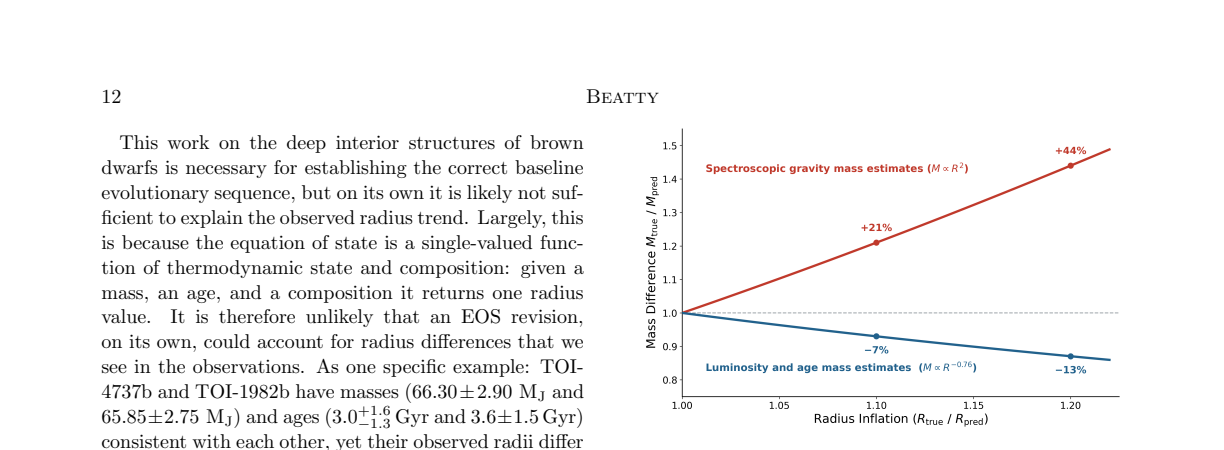
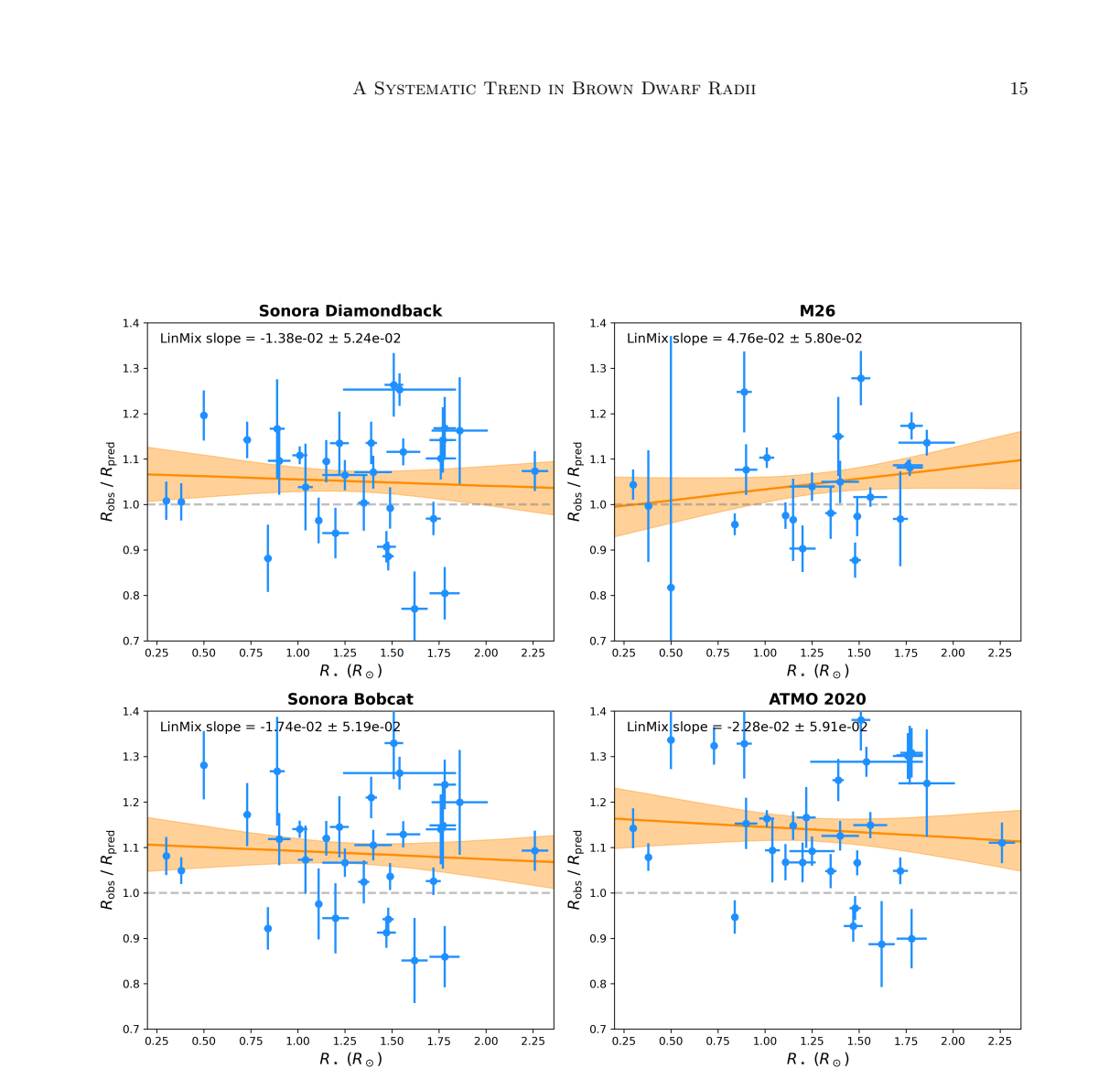
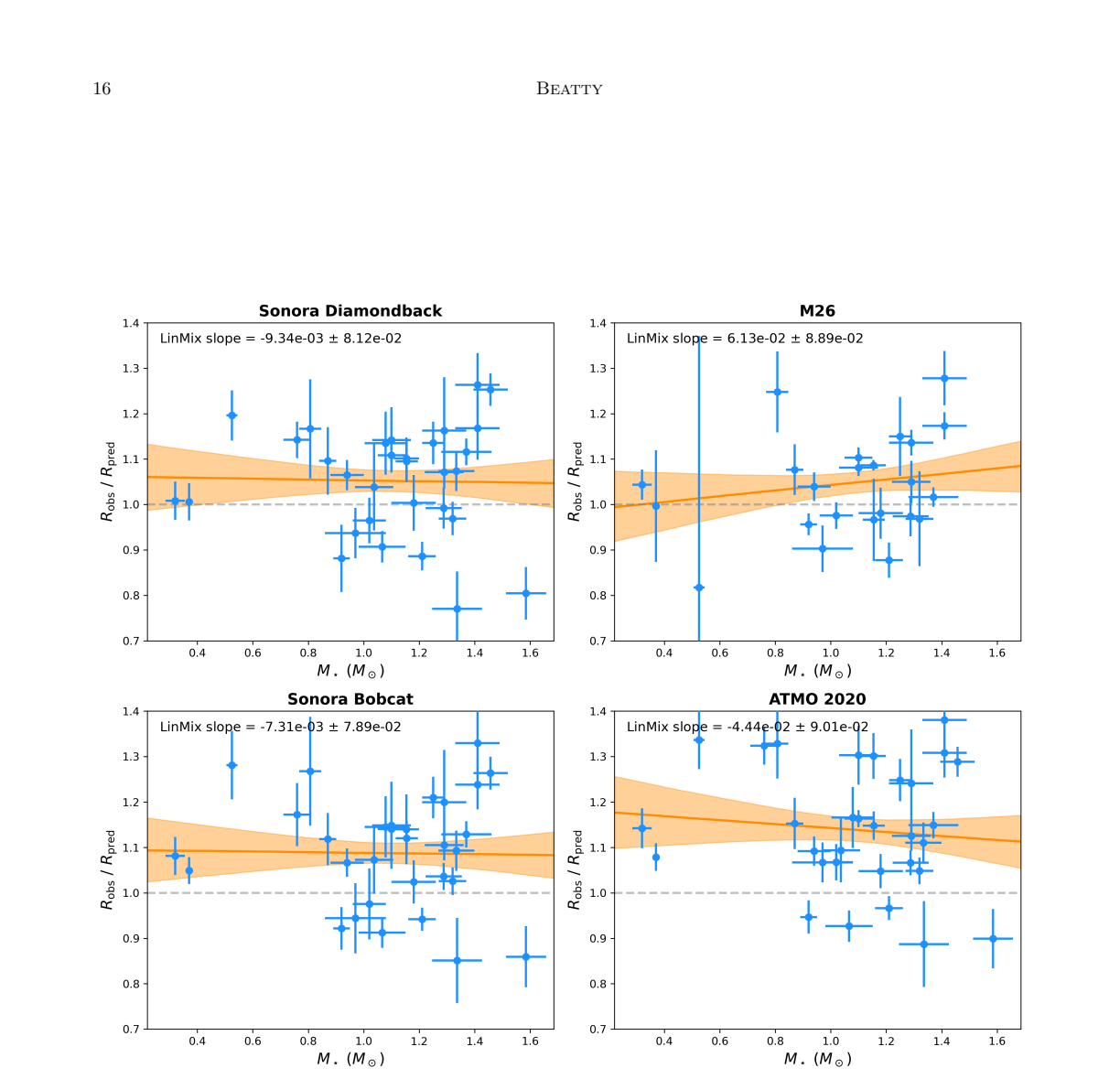
We compared the observed masses and radii of 31 field-age, weakly irradiated transiting brown dwarfs to the Sonora Diamondback, Sonora Bobcat, and ATMO 2020 grids, and a subset of 23 of them to the irradiated models of Mukherjee et al. (2026). In every comparison we find a radius-dependent trend, with fits of $R_{\rm pred}$ versus $R_{\rm obs}$ yielding slopes of 0.3−0.4, shallower than the one-to-one relation at 3.7−8σ. The mean inflation is 5−14% depending on the grid, reaching ∼ 20% among the largest objects. We also measure an intrinsic dispersion of 8−12%, two to three times the measurement uncertainty. While the mean inflation offset varies by a factor of three among grids, this dispersion does not, indicating that it is a property of the population and not the models. We find no correlation with mass, equilibrium temperature, orbital separation, tidal heating rate, or age, and only a marginal (1.7σ) trend with host-star metallicity. Most notable is the absence of any trend with irradiation, which argues against hot Jupiter-like stellar heating as the primary cause. We instead suggest that brown dwarfs span a wider range of atmospheric boundary conditions than current grids represent. The brown dwarf radius inflation is comparable to that in fully convective M dwarfs, and it is likely the transiting counterpart to the luminosity discrepancies seen in dynamical-mass benchmarks. If the trend extends below the deuterium-burning limit, it would bias directly imaged planet mass estimates, overestimating luminosity-age masses by several to ten percent and requiring spectroscopic-gravity masses to be revised upward by ∼ 20−45%.
from the abstract
Pith says
Machine review · deepseek-v4-flash · 1 Aug 2026 · of version 1 of the paper; version 2 is newer · what was read was not recorded · not checked by a person
It can be wrong. Challenge this review or reply to it.
Holds up, with conditions. The radius-dependent trend versus all four grids is a genuine new result and worth refereeing, but the 8–12% 'intrinsic dispersion' is contaminated by the same trend and needs a detrended reanalysis before it can be interpreted. This line is wrong
2 major objections · 7 minor
How often objections from reviews like this one are right: not yet measured
Not checked: figures, code, what the references say.
The paper says, at Section 3.2, Eq. (1)
The review did not quote this passage.
Pith says: Objection 1 of 2 · major
Equation (1) models r_i = R_obs,i/R_pred,i as a Gaussian with a single mean μ and an added intrinsic variance, with no dependence on R_obs,i. But Section 3 and Figure 3 establish that R_pred versus R_obs has slope ~0.3–0.4, which implies r_i increases systematically with R_obs (r = R_obs/(m R_obs + c) with m<1).
more of objection 1
A constant-mean fit therefore absorbs the trend into the fitted σ_int. The reported 8–12% dispersion is thus not a scatter around the fitted radius trend; it is largely the trend's own amplitude. The cross-grid similarity of σ_int is also expected when the slopes are similar and does not by itself indicate a grid-independent population property. To support the claim that most of the observed scatter is physical, the author should fit a trend term (e.g., r_i = a + b R_obs,i + ε_i) and estimate σ_int on the residuals, or include a trend term in the likelihood. The conclusion in Sec
The paper says, at Section 2.2; Table 2
The review did not quote this passage.
Pith says: Objection 2 of 2 · major
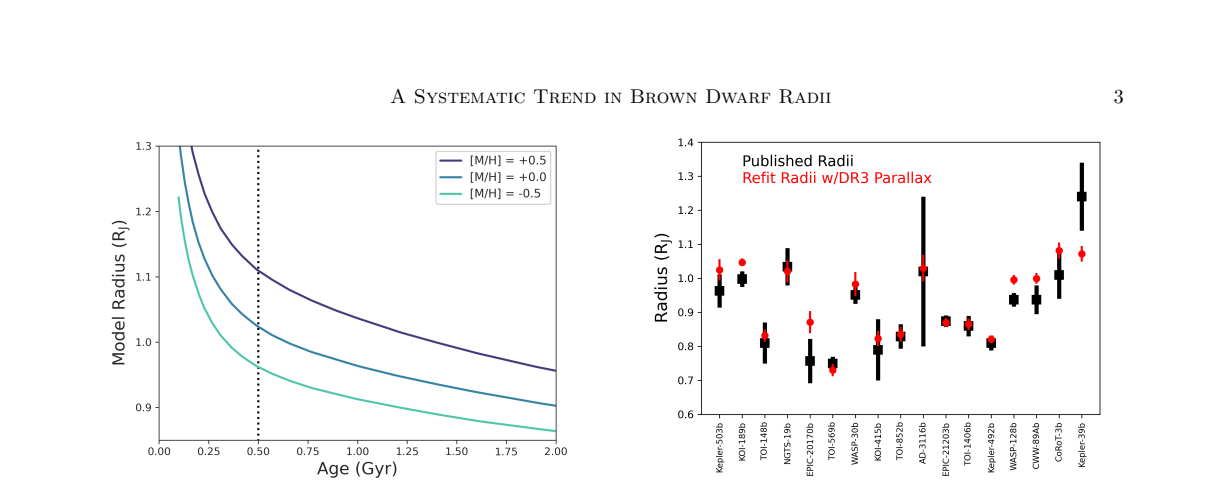
The predicted radii are computed assuming the brown dwarfs' ages and bulk metallicities equal those of their host stars. The paper notes the risk (migration-induced tidal-heating age reset; super-stellar metallicities for low-mass brown dwarfs) but does not test it. Because R_pred depends strongly on age (dlnR/dlnt ≈ 0.2, Section 4.3) and metallicity (Figure 1), an age offset of ~1 Gyr at 5 Gyr changes R_pred by several percent, comparable to the mean inflation and to the per-object uncertainty.
more of objection 2
A systematic correlation between the age or metallicity mismatch and R_obs could alter the measured slope and either create or hide part of the dispersion. I request a sensitivity test, e.g., marginalizing over a plausible brown-dwarf age offset, or recomputing slopes and σ_int with [Fe/H] offsets for the ~16% of the sample below 30 M_J. The central claim would be much stronger if the trend survi
7 minor objections
The paper says, at Section 2, paragraph 2
Pith says: minor objection 1 of 7
The phrase "2 to both focus" appears to have a missing word or formatting artifact; please rephrase.
The paper says, at Title and Figure 1
Pith says: minor objection 2 of 7
The title and Figure 1 caption use "T rend" and "Sonora-Diamondback" while the text uses "Sonora Diamondback"; unify for clarity.
show 5 more
The paper says, at Table 2 and Section 3
Pith says: minor objection 3 of 7
TOI-2119b has an M26 predicted radius of 1.321 ± 0.894, far more uncertain than any other entry. State the effect of removing this object on the M26 slope (0.44 ± 0.15) and on the cross-grid consistency claim.
The paper says, at Section 3
Pith says: minor objection 4 of 7
The M26 comparison uses 23 objects while the field-grid slopes use all 31. Since the slopes are said to be consistent across grids, it would be cleaner to also report the field-grid slopes on the common 23-object subset.
The paper says, at Section 4.4, Eq. (2)
Pith says: minor objection 5 of 7
The notation ΔR_p in Eq. (2) is introduced as a "fractional radius difference" but could be defined explicitly (e.g., ΔR_p = R_true/R_model) to avoid confusion with an absolute radius difference.
The paper says, at Section 3.1
Pith says: minor objection 6 of 7
The absence of a trend with irradiation is a central argument, but the Teq < 2000 K cutoff limits the dynamic range. A sentence quantifying the 2σ upper limit on the irradiation slope would make the null result more informative.
The paper says, at Data availability
Pith says: minor objection 7 of 7
The Zenodo link should include a versioned DOI and a short description of the machine-readable columns, especially for the T_int values used in Figures 4, 9, 10, and 11.
What would settle it
Re-estimate σ_int using Equation (1) but with r_i replaced by residuals from the best-fit linear trend r_i = a + b (R_obs,i − mean) for each grid, or equivalently fit the R_pred–R_obs relation with an intrinsic scatter term and compare σ_int to zero. If the detrended σ_int drops to ≤3–5% or is consistent with zero at <3σ, the paper's claim of 8–12% intrinsic dispersion is not supported. This requires only the existing Table 2 data and the same linmix/likelihood code.
from the skeptic's reading
How the review went
4 readings by deepseek-v4-flash · 1 Aug 2026
- Reader holds up, with conditions
- Skeptic disagrees
- Editor wrote the verdict above
- Referee major revision: 2 major objections, 7 minor
Not run on this paper: the simulated authors' defence.
Pith did not check this review's objections against the paper.
The review in full
The review in brief, machine-written
Worth a serious referee, but the headline number most likely to get quoted is the one that needs fixing. The paper's real contribution is population-level: four independent grids fail in the same radius-dependent way, with fitted slopes of R_pred versus R_obs of 0.3–0.4 and inflation growing to ~20% for the largest objects. That trend is robust across grids and based on a carefully assembled sample of 31 transiting brown dwarfs, with a sensible Gaia DR3 re-derivation of host-star radii. The linmix fitting with uncertainties on both axes is appropriate, and the significance estimates are internally consistent. The circularity concern is not warranted: R_pred comes from mass, age, and metallicity using external grids, with no radius-dependent term fitted from the residuals.
The first soft spot is internal to the statistics. The intrinsic dispersion in Section 3.2 is estimated from Equation (1), which models ri = R_obs/R_pred as a Gaussian with a single mean. But the paper just showed that ri grows systematically with R_obs, so the constant-mean model is misspecified and the trend is absorbed into sigma_int. The reported 8–12% intrinsic dispersion is probably largely the amplitude of the trend itself, not a separate population property. The claim that it is grid-independent and physical is unsupported until the trend is removed, e.g., by fitting ri = a + b R_obs + epsilon_i and estimating sigma_int on epsilon_i. This is fixable and should be fixed.
Second, the age and metallicity assumption. The paper explicitly assumes BD ages and metallicities equal host-star values, and acknowledges the risks of tidal-heating resets and super-stellar metallicities in low-mass BDs. Given the strong age sensitivity of R_pred at field ages (dlnR/dlnt ~ 0.2), a subset of younger-than-host BDs could mimic both the mean inflation and the scatter. The paper does not marginalize over this; a sensitivity test with free BD age/metallicity would make the trend much more convincing. Third, heterogeneous literature parameters are a limitation, but the paper is upfront about it and calls for a uniform reanalysis.
The no-irradiation conclusion is weaker than advertised because the sample is cut at Teq < 2000 K, but within that range the lack of a trend is a fair result.
This paper deserves a serious referee. The trend is likely real and important for substellar models and directly imaged planets, but the intrinsic-dispersion interpretation needs to be redone before acceptance.
The strongest objection
Section 3 establishes that R_pred vs R_obs has slope 0.3–0.4, so the ratio r_i = R_obs,i/R_pred,i increases systematically with R_obs. Section 3.2 then estimates the intrinsic dispersion using Equation (1), which models r_i as a Gaussian with a single mean μ and an added intrinsic variance σ_int^2, with no trend term. Because μ is constant, the systematic variation of r_i with R_obs is absorbed into σ_int. The reported 8–12% σ_int is therefore not a scatter around the fitted radius trend but largely the amplitude of the trend itself. This also explains why σ_int is similar across grids: the slopes are similar, so the trend-induced scatter is similar. The conclusion that the scatter is 'a property of the population and not the models' (Section 3.2) is unsupported by the analysis as presented. A correct estimate must first remove the trend (e.g., fit r_i = a + b R_obs,i + ε_i and estimate σ_int on ε_i) or fit R_pred vs R_obs with an intrinsic-scatter term. This is an internal statistical issue, independent of external assumptions about BD ages and metallicities.
The paper's headline includes both a shallow R_pred–R_obs slope and an intrinsic dispersion of 8–12%. The slope is a direct regression result; the dispersion is the basis for the claim that object-to-object scatter is physical. Equation (1) is the entire evidence for that dispersion, and it is misspecified: it assumes a constant mean even though the same paper demonstrates a radius-dependent mean. This is not a subtle systematic—it is a structural mismatch between the two statistical analyses. If σ_int is recomputed after detrending and vanishes, the paper loses its 'property of the population' interpretation, even if the slope remains. I therefore regard this as more load-bearing than the reader's age/metallicity concern, which is an external assumption that the paper explicitly acknowledges and that can be mitigated by sensitivity tests. The detrending issue is internal and can be settled immediately with existing data. That said, the presence of this flaw does not by itself refute the slope claim; it requires the authors to revise the dispersion analysis. Hence the verdict remains CONDITIONAL—the paper is not ready as is, but the concern is addressable. The age/metallicity assumption remains a secondary caveat. The proposed concrete test is computational and decisive.
The referee's report
If the slope result is correct, this is a significant population-level constraint on substellar evolutionary models: four independent grids fail in the same radius-dependent way, and the absence of an irradiation trend argues against hot-Jupiter-like heating as the primary mechanism. The comparison is not circular: R_pred is constructed from mass, age, and metallicity without using R_obs. Strengths include the comparison across four grids, the Gaia-based radius re-derivation for a large subset, explicit treatment of asymmetric age uncertainties, and honest discussion of limitations such as heterogeneous literature values and the assumed age/metallicity transfer. The paper also makes concrete, falsifiable predictions for direct-imaging mass biases and for JWST secondary-eclipse tests. However, the intrinsic-dispersion estimate is statistically conflated with the very trend the paper measures, and the age/metallicity transfer assumption is load-bearing and untested. Both issues are fixable with a reanalysis, so I recommend major revision rather than rejection.
Pith's reading of the paper (a machine's summary, not the authors')
This paper tries to establish that the observed radii of field-age, weakly irradiated transiting brown dwarfs deviate from all four major evolutionary model grids in a coherent, radius-dependent way: the larger the brown dwarf, the more its measured radius exceeds the predicted value, by 5–14% on average and up to ~20% for the largest objects. It also claims that the object-to-object scatter about this trend is mostly intrinsic—8–12%—rather than measurement noise, and that this scatter is consistent across grids even though the mean offset varies. Because the deviation does not correlate with irradiation, orbital separation, mass, or age, the paper argues against hot-Jupiter-like stellar heating and instead proposes that current models under-represent the range of atmospheric boundary conditions that control how fast brown dwarfs lose interior heat. A sympathetic reader would care because this is the first population-level test of substellar cooling models using directly measured masses and radii, and it connects to known inflation problems in M dwarfs and to possible mass biases for directly imaged planets.
What carries the argument. The central comparison is R_pred versus R_obs for a carefully selected sample, fit with linmix, a regression that accounts for uncertainties in both axes, with pivots at the error-weighted means. The fractional residual R_obs/R_pred is then tested for trends against six system parameters, and a joint-Gaussian likelihood with an intrinsic-dispersion term separates physical scatter from measurement error. The interpretation hinges on the cooling-age logic: at fixed mass, a brown dwarf's radius is set by how fast it radiates interior entropy, so any boundary-condition change that throttles the emergent flux slows cooling and leaves the object larger at a given age.
Core claim. On the paper's own terms: comparing the measured radii of 31 transiting brown dwarfs (23 for the irradiated grid) against the Sonora Diamondback, Sonora Bobcat, ATMO 2020, and Mukherjee et al. (2026) predictions, every grid shows the same signature—a fit of predicted versus observed radius with slope 0.3–0.4, shallower than unity at 3.7–8σ. The mean radius excess is 5–14% depending on the grid, rising to ~20% for the largest radii, and the residual scatter contains an intrinsic dispersion of 8–12%, detected at 8–14σ. No significant trend appears with mass, equilibrium temperature, orbital separation, tidal heating rate, or age; only a 1.7σ metallicity hint. The paper concludes the inflation
The premise it rests on. The analysis assumes each brown dwarf's age and metallicity equal its host star's; if a subset of brown dwarfs are younger (e.g., via tidal-heating reset) or more metal-rich than their hosts, the predicted radii move in exactly the direction needed to create the apparent inflation and scatter.
If the paper is right (Pith's inferences, not the authors')
All four grids consistently underpredict the radii of the largest field-age transiting brown dwarfs, so the discrepancy is not an artifact of one model.
The 8–12% intrinsic dispersion means current grids cannot reproduce the spread of radii at fixed mass, age, and metallicity; future models should be evaluated against this dispersion.
The lack of an irradiation trend rules out stellar heating as the dominant inflation mechanism, redirecting theory toward atmospheric boundary conditions and flux throttling.
The amplitude of inflation matches M-dwarf radius inflation, suggesting a common missing ingredient in models of fully convective low-mass objects.
If the trend continues below the deuterium-burning limit, luminosity-age masses of directly imaged planets would be overestimated by several-to-ten percent, while spectroscopic-gravity masses would need upward revision by ~20–45%.
A uniform reanalysis of all known transiting brown dwarfs with a single pipeline—especially one that lets each brown dwarf's age and metallicity float rather than assuming they match the host star—would separate a real boundary-condition effect from a host-star transfer artifact.
The marginal metallicity trend could be sharpened with homogeneous stellar metallicities; if it holds, it would point to metal-dependent cloud or opacity physics in the atmospheres.
JWST secondary-eclipse spectroscopy of a matched pair of inflated and non-inflated brown dwarfs could test the flux-throttling picture directly: inflated objects should show muted molecular features, lower brightness temperatures, or cloud signatures.
If the same flux-throttling mechanism operates in hot Jupiters or directly imaged planets, radius-dependent model biases of this kind could also affect transiting giant-planet radius comparisons, though the paper does not make that claim.
Check this review
Pith stored no record of this review's passes and took no fingerprint of it. Reviews made by code from 13 Nov 2026 on carry both.
How often reviews like this one are right
Reviews like this one: written by deepseek-v4-flash, where what was read was not recorded.
How often objections from reviews like this one are right: not yet measured
Reviews by people
This review was written by a machine. No person has reviewed this paper on Pith yet. A scientist listed on Pith can review it for a fee, and their review is published here whatever it concludes.
The paper
Abstract
Transiting brown dwarfs provide a direct empirical test of substellar evolutionary models, and with more than 50 now known we can carry out this test at the population level. We compared the observed masses and radii of 31 field-age, weakly irradiated transiting brown dwarfs to the Sonora Diamondback, Sonora Bobcat, and ATMO 2020 grids, and a subset of 23 of them to the irradiated models of Mukherjee et al. (2026). In every comparison we find a radius-dependent trend, with fits of $R_{\rm pred}$ versus $R_{\rm obs}$ yielding slopes of 0.3−0.4, shallower than the one-to-one relation at 3.7−8σ. The mean inflation is 5−14% depending on the grid, reaching ∼ 20% among the largest objects. We also measure an intrinsic dispersion of 8−12%, two to three times the measurement uncertainty. While the mean inflation offset varies by a factor of three among grids, this dispersion does not, indicating that it is a property of the population and not the models. We find no correlation with mass, equilibrium temperature, orbital separation, tidal heating rate, or age, and only a marginal (1.7σ) trend with host-star metallicity. Most notable is the absence of any trend with irradiation, which argues against hot Jupiter-like stellar heating as the primary cause. We instead suggest that brown dwarfs span a wider range of atmospheric boundary conditions than current grids represent. The brown dwarf radius inflation is comparable to that in fully convective M dwarfs, and it is likely the transiting counterpart to the luminosity discrepancies seen in dynamical-mass benchmarks. If the trend extends below the deuterium-burning limit, it would bias directly imaged planet mass estimates, overestimating luminosity-age masses by several to ten percent and requiring spectroscopic-gravity masses to be revised upward by ∼ 20−45%.
The paper's own sentences, arranged, kept beside the review and separate from it. Each label is drawn from a closed vocabulary; the number beside it is the probability the classifier gave that label. No sentence in this record was written by a model.
abstract compiled · 2026-09-23
The authors' main claim, as the classifier picked it out 0.50
“We instead suggest that brown dwarfs span a wider range of atmospheric boundary conditions than current grids represent.”
How the main claim is stated: hedged possibility 0.90
What the abstract itself states, as probabilities: claims first 0.05 · states limitation 0.55 · human participants 0.01 · controlled comparison 0.25 · randomized assignment 0.01 · states quantitative result 0.99 · compares with prior results 0.90 · mentions code or data availability 0.02
The abstract, sentence by sentence
This table labels the abstract only (arXiv listing abstract v2). The number is the probability the classifier gave the label.
| Sentence | Role | The authors' own work | States the main conclusion | Strength |
|---|---|---|---|---|
| Transiting brown dwarfs provide a direct empirical test of substellar evolutionary models, and with more than 50 now known we can carry out this test at the population level. | background 0.99 | 0.10 | 0.03 | asserted 1.00 |
| We compared the observed masses and radii of 31 field-age, weakly irradiated transiting brown dwarfs to the Sonora Diamondback, Sonora Bobcat, and ATMO 2020 grids, and a subset of 23 of them to the irradiated models of Mukherjee et al. (2026). | method 0.92 | 0.95 | 0.03 | asserted 0.98 |
| In every comparison we find a radius-dependent trend, with fits of $R_{\rm pred}$ versus $R_{\rm obs}$ yielding slopes of $0.3{-}0.4$, shallower than the one-to-one relation at $3.7{-}8\sigma$. | result 1.00 | 0.96 | 0.54 | asserted 1.00 |
| The mean inflation is $5{-}14\%$ depending on the grid, reaching $\sim20\%$ among the largest objects. | result 1.00 | 0.95 | 0.16 | asserted 1.00 |
| We also measure an intrinsic dispersion of $8{-}12\%$, two to three times the measurement uncertainty. | result 1.00 | 0.97 | 0.07 | asserted 1.00 |
| While the mean inflation offset varies by a factor of three among grids, this dispersion does not, indicating that it is a property of the population and not the models. | interpretation 0.61 | 0.93 | 0.16 | asserted 0.95 |
| We find no correlation with mass, equilibrium temperature, orbital separation, tidal heating rate, or age, and only a marginal ($1.7\sigma$) trend with host-star metallicity. | result 1.00 | 0.97 | 0.08 | asserted 1.00 |
| Most notable is the absence of any trend with irradiation, which argues against hot Jupiter-like stellar heating as the primary cause. | interpretation 0.80 | 0.84 | 0.16 | asserted 0.62 |
| We instead suggest that brown dwarfs span a wider range of atmospheric boundary conditions than current grids represent. | interpretation 1.00 | 0.45 | 0.38 | hedged possibility 0.90 |
| The brown dwarf radius inflation is comparable to that in fully convective M dwarfs, and it is likely the transiting counterpart to the luminosity discrepancies seen in dynamical-mass benchmarks. | interpretation 0.98 | 0.61 | 0.28 | hedged possibility 0.89 |
| If the trend extends below the deuterium-burning limit, it would bias directly imaged planet mass estimates, overestimating luminosity-age masses by several to ten percent and requiring spectroscopic-gravity masses to be revised upward by $\sim20{-}45\%$. | interpretation 0.98 | 0.25 | 0.09 | hedged possibility 0.89 |
What kind of paper the classifier reports this is: empirical study 1.00 · evidence from analysis of existing data 0.99
What was examined, and what was not
Sources read
- arXiv listing abstract v2
Not examined
- full text
- figures and tables
- references and citing sentences
- relations to other papers
Levels run
- P abstract
Not run
- S sections
- T body sentences
- C citations
- R cross-paper relations
How the labels were made
Compiled by classifier-1.13.0 via TypeSafe API, question bank abstract-p1-20260923, 2026-09-23: 1 request, 8,619 input tokens.
Every quoted sentence on this record is the authors'. Every label is from Pith's closed vocabulary, with the probability shown beside it. This record as JSON
Figures (11)
Showing 7 of the paper's 11 figures. Figures are the authors', reproduced from the paper.
Cited by 1 Pith paper
Reviewed papers on Pith that cite this one. The full citation record
Challenges and discussion
Disagree with the review, or know something it missed? Leave a comment, or challenge this review formally: a challenge becomes a permanent entry in this paper's record, and its decision is published here.
Come back by email
A short list of the week's newly reviewed papers. Nothing is sent until you confirm from your inbox, and every email has a link that stops it. No account.
No comments yet.
Sign in to comment