REVIEW 4 major objections 3 minor 88 references
World Action Planner claims that letting a vision-language model propose and refine actions inside an action-conditioned world model beats end-to-end imitation policies on compositional, novel-layout, and zero-shot manipulation tasks.
Reviewed by Pith at T0; open to challenge. T0 means a machine referee read the full paper against a public rubric. the ladder, T0–T4 →
T0 review · deepseek-v4-flash
2026-08-01 04:54 UTC pith:HYVZR6BG
load-bearing objection Genuinely new integration of VLM reasoning with a pose-image world model; strong simulation results, but the known-inaccurate pose conditioning under contact is never stress-tested. the 4 major comments →
World Action Planner: Generalizable Decision-Making with Action-Conditioned World Models
The pith
A machine-rendered reading of the paper's core claim, the machinery that carries it, and where it could break.
Core claim
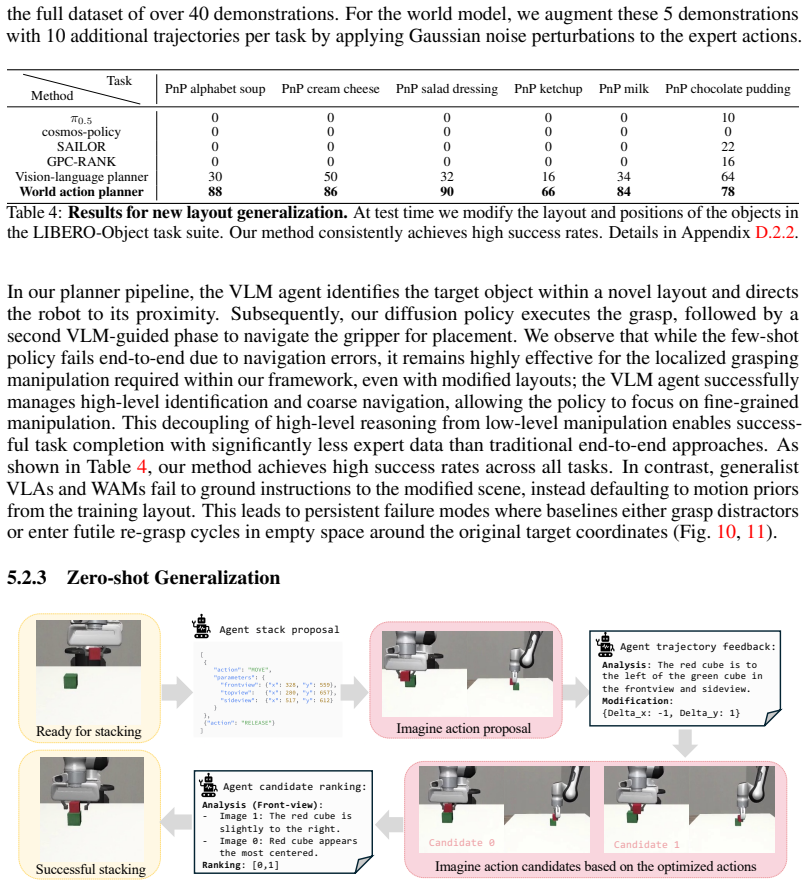
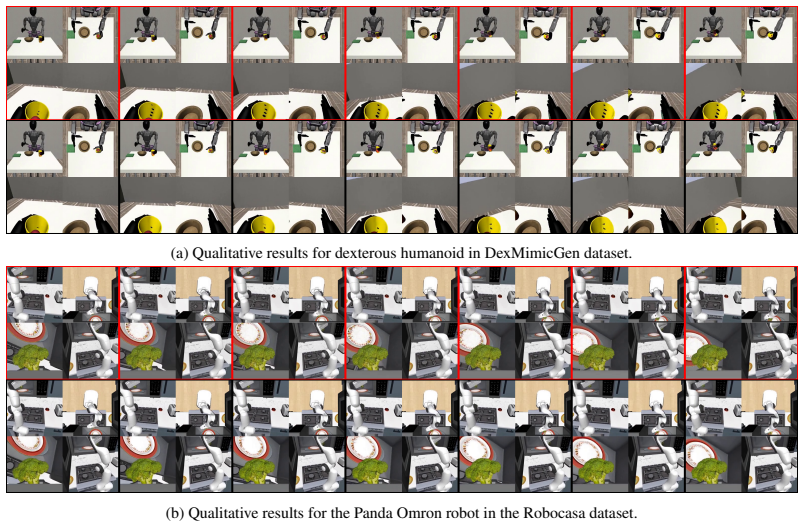
The paper claims that a robot can solve novel manipulation problems by reasoning over imagined futures rather than regurgitating training motions. Its core discovery is that an action-conditioned world model, conditioned not on low-dimensional action vectors but on pose skeleton images computed from forward dynamics of the proposed actions, produces rollouts that a vision-language model can inspect, critique, and rank. On four compositional long-horizon tasks composed from seen primitives, the planner achieves 72-78% success where end-to-end baselines score near zero; on six tasks with shifted object layouts it achieves 66-90% using only five demonstrations per task; and on two zero-shot man
What carries the argument
The central object is the pose-image conditioned world model: a multi-view video diffusion model that takes as conditioning clean pose skeleton images of the robot, rendered by executing the proposed actions through forward dynamics, and predicts future video frames. The pose skeletons are computed from the robot's own kinematics, not learned from pixels, so the model can imagine the physical consequences of arbitrary, even out-of-distribution, actions. This imagined rollout is then fed back to a VLM agent in three ways: to propose initial primitive moves, to provide high-level corrective feedback on safety and clearance via 'global optimization', and to rank a grid of candidate actions via
Load-bearing premise
The whole pipeline depends on the world model's imagined rollouts being faithful enough to real physics—especially contact events—that a VLM's feedback and ranking over imagined futures selects actions that also succeed in the real environment; the paper itself notes that forward-dynamics-computed pose images misrepresent contact (e.g., a gripper shown as closed while actually holding an object), which could make imagined outcomes misleading exactly in the fine-grained graspi
What would settle it
Run the planner on a set of contact-rich manipulation tasks (inserting, pressing, stacking with tight tolerances) while logging both the world model's imagined future frames and the true environment rollouts. If the VLM's chosen candidate correlates no better than chance with ground-truth success, or if replacing the learned world model with ground-truth simulator rollouts dramatically improves success while the learned model does not, then the claim's load-bearing premise—faithful imagination—is refuted.
If this is right
- End-to-end policies that memorize training motions will continue to fail when scenes or task compositions change; a planning loop that reasons over imagined consequences is a viable alternative for out-of-distribution manipulation.
- The VLM does not need to output precise coordinates; it only needs to rank candidate outcomes, a capability that combines with the world model to provide metric grounding.
- Policy learning becomes far more sample-efficient: with a good world model and VLM planner, a handful of demonstrations per task suffices, because the policy only handles local, in-distribution atomic skills.
- Model-based exploration across tasks amortizes data collection: a shared dynamics model makes each new task's reward function cheap to learn, whereas imitation learning must re-learn a distinct policy per task.
Where Pith is reading between the lines
- The 'policies as tools' framing suggests a modular robot-learning stack where local policies handle in-distribution atomic skills and the VLM-plus-world-model planner orchestrates them; this could combine the robustness of specialized policies with the flexibility of planning.
- The pose-image conditioning trick is transferable: any controlled generative video model could be steered by rendering the agent's articulated state as a skeleton or keypoint overlay, without retraining the conditioning mechanism.
- A natural stress test follows from the paper's own caveat: tasks with heavy contact forces (deformable objects, tight fits, regrasping under load) are where the forward-dynamics pose approximation should break down most; measuring planning success across a contact-richness axis would reveal the boundary of the claim.
- The theoretical separation suggests that scaling the VLM's ability to judge task success (as a reward/evaluator model) may be a more efficient investment than scaling demonstration data or policy networks.
Editorial analysis
A structured set of objections, weighed in public.
Referee Report
Summary. The paper proposes World Action Planner (WAP), a robot planning system that combines a Vision-Language Model (VLM) agent with a pose-image-conditioned video diffusion world model. The VLM proposes primitive actions, which are refined through (i) global optimization based on VLM feedback on imagined rollouts, and (ii) local grid search with VLM candidate ranking, optionally including imagined rollouts of a learned policy. The authors report large success-rate gains over end-to-end imitation baselines (π0.5, cosmos-policy) and over prior world-model-based policy-enhancement methods on LIBERO compositional tasks, LIBERO layout-shifted tasks, and Robosuite zero-shot tasks. The paper also provides theoretical results claiming model-based planning outperforms imitation learning in multi-task generalization in tabular and linear-function-approximation settings.
Significance. If the empirical claims hold, WAP would be a meaningful step toward test-time planning with world models and VLM reasoning, especially for compositional and layout-shifted manipulation where end-to-end policies fail. Strengths include the comparatively extensive world-model evaluation across four simulation suites and multiple embodiments, the ablations isolating global optimization, local search, and policy-rollout imagination, and a best-of-N comparison that uses ground-truth rewards as an upper bound. The theoretical appendix is detailed and builds on standard reward-free exploration and imitation-learning lower-bound techniques. However, as detailed below, several load-bearing issues remain: the physically inaccurate pose conditioning is not stress-tested, the theoretical comparison is asymmetric in information, the empirical headline lacks statistical support, and the 'zero-shot' claim is weakened by task-specific world-model fine-tuning.
major comments (4)
- [C.1.1, Fig. 6, Alg. 1] The paper explicitly acknowledges that forward-dynamics pose skeletons are inaccurate under contact: the gripper is rendered closed while an object between the jaws keeps it open, and reaction forces are unknown a priori. Since the planning loop in Alg. 1 uses only the world model's imagined rollouts for VLM feedback and ranking, and since the largest gains are in contact-rich tasks (Tables 4, 5, 9), the absence of any ablation using ground-truth or contact-aware poses leaves the physical-grounding mechanism unverified. Please add an oracle experiment with simulator ground-truth joint poses (or contact-aware forward simulation) to demonstrate that the performance does not rely on systematically wrong imagined outcomes.
- [B.2.1, Theorems 1-3] The theoretical comparison is not apples-to-apples. In the protocol, the imitation learning agent receives only expert action labels and never observes rewards, while the model-based agent collects rewards during exploration and, in the tabular theorem, is given the reward functions for all contexts. The Ω(|C|/K) lower bound for imitation learning therefore may reflect an information-structure advantage rather than an intrinsic superiority of model-based planning. Please either provide the IL agent with the same reward information, or explicitly reframe the results as a comparison between 'IL without rewards' and 'MB with rewards/known rewards.' This is important because contribution (ii) is stated as a general separation.
- [Tables 3-5 and §5.2] Success rates are reported as single 50-trial counts with no error bars, no multiple seeds, and no statistical tests. The abstract's 'significantly outperforming' is therefore not statistically supported, especially for the smaller gaps in Table 5 (PickPlaceCan 80 vs 58). Please provide multiple seeds or confidence intervals, state the number of runs, and use a significance test where appropriate. Also, the baseline protocol varies across experiments: in §5.2.1 baselines are fine-tuned by the authors, while in §5.2.2 official checkpoints are used; details for adapting SAILOR and GPC-RANK are sparse.
- [§5.2.3 and D.2.3] The label 'zero-shot generalization' is overstated. Although no expert demonstrations are used, the world model is fine-tuned on 50 task-specific exploratory trajectories for PickPlaceCan and StackCube. This is not zero-shot with respect to the target task. Please either rename the setting (e.g., 'demonstration-free' or 'no-policy planning') or include a truly zero-shot evaluation in which the world model is not fine-tuned on the target task, to support the abstract's claim of 'zero-shot generalization scenarios.'
minor comments (3)
- [Throughout] Typos and spacing issues: 'a action-conditioned', 'W AMs', 'receices', 'sufficies', 'the the' in places. A careful proofread is needed.
- [Table 1] The presentation of PSNR/LPIPS pairs is dense; a separate table or clearer column separation would improve readability. It is also worth stating explicitly which metrics are higher-better versus lower-better in the caption.
- [Appendix B] Some notation is introduced inconsistently (e.g., 'E[h...]' in a few displayed equations). These do not affect the logic but should be cleaned for publication.
Circularity Check
No significant circularity: the planner's reported success rates are measured by external simulators, and the world-model/planning claims do not reduce to fitted constants or self-citations.
full rationale
The paper's central claim is empirical: WAP outperforms π0.5, cosmos-policy, SAILOR, GPC-RANK, and a vision-language planner on LIBERO and Robosuite tasks, with success rates evaluated by the simulators (Tables 3–5). Those numbers are not derived from the paper's equations or from fitted parameters renamed as predictions; the world model is independently evaluated with PSNR/LPIPS against held-out trajectories (Table 1), and the planner is ablated against environment-grounded best-of-N sampling (Tables 10–11). The theoretical results (Theorems 1–3) are standard sample-complexity separations with proofs in Appendix B that do not assume the empirical conclusion. The authors cite their own prior work ([45], [56], [83]) for primitive-action prompting, a baseline protocol, and a global-local search heuristic, but these are design borrowings, not load-bearing justifications of the performance claims; no uniqueness theorem or fitted ansatz is imported from self-citations. The acknowledged limitation in C.1.1 and Fig. 6 — pose skeletons are inaccurate under contact because forward dynamics omit reaction forces — is a genuine correctness risk for the claimed mechanism, not a circularity: it concerns whether imagined rollouts are physically faithful, not whether the output reduces to the input by construction. The VLM both proposes and ranks candidates, which can bias selection, but the final metric is simulator success, so this is a robustness concern rather than a definitional equivalence. Overall, the derivation chain is self-contained against external benchmarks; any circularity burden is limited to minor, non-load-bearing self-citations, hence score 1.
Axiom & Free-Parameter Ledger
free parameters (4)
- global optimization modification scale =
0.06
- grid search scale delta =
0.02 (StackCube), 0.05 (other tasks)
- exploratory action noise std =
sigma = 0.08 and 0.16 (40/40/20 split)
- demonstration budgets =
30 per task (policy), 100 per task (world model); 5 per task for new-layout policy
axioms (6)
- domain assumption Known rewards r_c for each context (Theorem 1)
- domain assumption Shared universal dynamics P across tasks
- domain assumption Linear reward representation E[r_c(s,a)] = phi(s,a)^T Theta psi(c) with known task features psi(c)
- standard math Exploratory assumption kappa > 0 in linear MDPs
- ad hoc to paper Forward-dynamics pose skeletons are adequate conditioning despite contact inaccuracy
- domain assumption VLM can propose, critique, and rank actions from images reliably enough
read the original abstract
Building generalizable agents for diverse applications remains a fundamental challenge. While imitation learning-based policies succeed in specific training environments, they often fail to generalize to novel scenes and tasks. In this work, we propose World Action Planner, a robot planning system that leverages the reasoning capabilities of Vision-Language Models (VLMs) and the physical grounding of a multi-task pose-image conditioned world model. Our system enables an agent to propose initial action plans and iteratively refine them via optimization and search, reasoning over imagined world model rollouts. We demonstrate that our approach achieves superior performance across compositional tasks, new layouts, and zero-shot generalization scenarios, significantly outperforming state-of-the-art end-to-end policy models such as VLAs and WAMs. Project website at worldactionplanner.github.io
Figures






Reference graph
Works this paper leans on
-
[1]
Abbasi-Yadkori, D
Y . Abbasi-Yadkori, D. Pál, and C. Szepesvári. Improved algorithms for linear stochastic bandits. Advances in neural information processing systems, 24, 2011. 21, 26
2011
-
[2]
N. Agarwal, A. Ali, M. Bala, Y . Balaji, E. Barker, T. Cai, P. Chattopadhyay, Y . Chen, Y . Cui, Y . Ding, et al. Cosmos world foundation model platform for physical ai.arXiv preprint arXiv:2501.03575, 2025. 2, 16
Pith/arXiv arXiv 2025
-
[3]
A. Ali, J. Bai, M. Bala, Y . Balaji, A. Blakeman, T. Cai, J. Cao, T. Cao, E. Cha, Y .-W. Chao, et al. World simulation with video foundation models for physical ai.arXiv preprint arXiv:2511.00062, 2025. 2, 16
Pith/arXiv arXiv 2025
-
[4]
Alonso, A
E. Alonso, A. Jelley, V . Micheli, A. Kanervisto, A. Storkey, T. Pearce, and F. Fleuret. Diffusion for world modeling: Visual details matter in atari.Advances in Neural Information Processing Systems, 37:58757–58791, 2024. 16
2024
-
[5]
M. Assran, A. Bardes, D. Fan, Q. Garrido, R. Howes, M. Muckley, A. Rizvi, C. Roberts, K. Sinha, A. Zholus, et al. V-jepa 2: Self-supervised video models enable understanding, prediction and planning.arXiv preprint arXiv:2506.09985, 2025. 5, 16
Pith/arXiv arXiv 2025
-
[6]
J. Bjorck, F. Castañeda, N. Cherniadev, X. Da, R. Ding, L. Fan, Y . Fang, D. Fox, F. Hu, S. Huang, et al. Gr00t n1: An open foundation model for generalist humanoid robots.arXiv preprint arXiv:2503.14734, 2025. 6
Pith/arXiv arXiv 2025
- [7]
-
[8]
Bruce, M
J. Bruce, M. D. Dennis, A. Edwards, J. Parker-Holder, Y . Shi, E. Hughes, M. Lai, A. Mavalankar, R. Steigerwald, C. Apps, et al. Genie: Generative interactive environments. InForty-first International Conference on Machine Learning, 2024. 16
2024
-
[9]
B. Chen, T. Zhang, H. Geng, K. Song, C. Zhang, P. Li, W. T. Freeman, J. Malik, P. Abbeel, R. Tedrake, et al. Large video planner enables generalizable robot control.arXiv preprint arXiv:2512.15840, 2025. 3, 16, 17
Pith/arXiv arXiv 2025
-
[10]
C. Chi, Z. Xu, S. Feng, E. Cousineau, Y . Du, B. Burchfiel, R. Tedrake, and S. Song. Diffusion policy: Visuomotor policy learning via action diffusion.The International Journal of Robotics Research, 44(10-11):1684–1704, 2025. 4, 16, 28, 30 10
2025
-
[11]
Y . Du, M. Yang, P. Florence, F. Xia, A. Wahid, B. Ichter, P. Sermanet, T. Yu, P. Abbeel, J. B. Tenenbaum, et al. Video language planning.arXiv preprint arXiv:2310.10625, 2023. 3, 16
Pith/arXiv arXiv 2023
-
[12]
J. Duan, W. Yuan, W. Pumacay, Y . R. Wang, K. Ehsani, D. Fox, and R. Krishna. Manipulate- anything: Automating real-world robots using vision-language models.arXiv preprint arXiv:2406.18915, 2024. 16
Pith/arXiv arXiv 2024
-
[13]
Ghosh, J
D. Ghosh, J. Rahme, A. Kumar, A. Zhang, R. P. Adams, and S. Levine. Why generalization in rl is difficult: Epistemic pomdps and implicit partial observability.Advances in neural information processing systems, 34:25502–25515, 2021. 17
2021
-
[14]
Y . Guo, L. X. Shi, J. Chen, and C. Finn. Ctrl-world: A controllable generative world model for robot manipulation.arXiv preprint arXiv:2510.10125, 2025. 2, 3, 6, 16, 29
Pith/arXiv arXiv 2025
-
[15]
D. Hafner, T. Lillicrap, J. Ba, and M. Norouzi. Dream to control: Learning behaviors by latent imagination.arXiv preprint arXiv:1912.01603, 2019. 3, 16
Pith/arXiv arXiv 1912
-
[16]
D. Hafner, T. Lillicrap, M. Norouzi, and J. Ba. Mastering atari with discrete world models. arXiv preprint arXiv:2010.02193, 2020. 16
Pith/arXiv arXiv 2010
-
[17]
D. Hafner, J. Pasukonis, J. Ba, and T. Lillicrap. Mastering diverse domains through world models.arXiv preprint arXiv:2301.04104, 2023. 16
Pith/arXiv arXiv 2023
-
[18]
A. Hallak, D. Di Castro, and S. Mannor. Contextual markov decision processes.arXiv preprint arXiv:1502.02259, 2015. 5, 17
Pith/arXiv arXiv 2015
-
[19]
N. Hansen, H. Su, and X. Wang. Td-mpc2: Scalable, robust world models for continuous control.arXiv preprint arXiv:2310.16828, 2023. 3, 6, 16
Pith/arXiv arXiv 2023
-
[20]
N. Hansen, X. Wang, and H. Su. Temporal difference learning for model predictive control. arXiv preprint arXiv:2203.04955, 2022. 16
Pith/arXiv arXiv 2022
-
[21]
X. He, H. Yu, S. Peng, D. Tan, Z. Shen, H. Bao, and X. Zhou. Matchanything: Universal cross-modality image matching with large-scale pre-training.arXiv preprint arXiv:2501.07556,
-
[22]
Hore and D
A. Hore and D. Ziou. Image quality metrics: Psnr vs. ssim. In2010 20th international conference on pattern recognition, pages 2366–2369. IEEE, 2010. 6
2010
-
[23]
J. Hu, X. Chen, C. Jin, L. Li, and L. Wang. Near-optimal representation learning for linear bandits and linear rl. InInternational Conference on Machine Learning, pages 4349–4358. PMLR, 2021. 17
2021
-
[24]
P. Hu, Y . Chen, and L. Huang. Nearly minimax optimal reinforcement learning with linear function approximation. InInternational Conference on Machine Learning, pages 8971–9019. PMLR, 2022. 18
2022
-
[25]
Y . Hu, F. Lin, T. Zhang, L. Yi, and Y . Gao. Look before you leap: Unveiling the power of gpt-4v in robotic vision-language planning.arXiv preprint arXiv:2311.17842, 2023. 2, 16
Pith/arXiv arXiv 2023
-
[26]
W. Huang, C. Wang, R. Zhang, Y . Li, J. Wu, and L. Fei-Fei. V oxposer: Composable 3d value maps for robotic manipulation with language models.arXiv preprint arXiv:2307.05973, 2023. 2, 16
Pith/arXiv arXiv 2023
-
[27]
P. Intelligence, K. Black, N. Brown, J. Darpinian, K. Dhabalia, D. Driess, A. Esmail, M. Equi, C. Finn, N. Fusai, et al. π0.5: a vision-language-action model with open-world generalization. arXiv preprint arXiv:2504.16054, 2025. 1, 3, 4, 7, 16, 17
Pith/arXiv arXiv 2025
-
[28]
A. Jaech, A. Kalai, A. Lerer, A. Richardson, A. El-Kishky, A. Low, A. Helyar, A. Madry, A. Beutel, A. Carney, et al. Openai o1 system card.arXiv preprint arXiv:2412.16720, 2024. 36
Pith/arXiv arXiv 2024
-
[29]
A. K. Jain, V . Mohta, S. Kim, A. Bhardwaj, J. Ren, Y . Feng, S. Choudhury, and G. Swamy. A smooth sea never made a skilled sailor: Robust imitation via learning to search.arXiv preprint arXiv:2506.05294, 2025. 3, 6, 7, 9, 16, 29, 32, 33, 34 11
arXiv 2025
-
[30]
J. Jang, S. Ye, Z. Lin, J. Xiang, J. Bjorck, Y . Fang, F. Hu, S. Huang, K. Kundalia, Y .-C. Lin, et al. Dreamgen: Unlocking generalization in robot learning through video world models.arXiv preprint arXiv:2505.12705, 2025. 16
Pith/arXiv arXiv 2025
-
[31]
E. Y .-T. Jia, W. Yuan, T. Shi, V . Guizilini, J. Mao, and Y . Wang. Dreamplan: Efficient reinforcement fine-tuning of vision-language planners via video world models.arXiv preprint arXiv:2603.16860, 2026. 2, 3, 16
arXiv 2026
-
[32]
Jiang, Y
Z. Jiang, Y . Xie, K. Lin, Z. Xu, W. Wan, A. Mandlekar, L. J. Fan, and Y . Zhu. Dexmimicgen: Automated data generation for bimanual dexterous manipulation via imitation learning. In 2025 IEEE International Conference on Robotics and Automation (ICRA), pages 16923–16930. IEEE, 2025. 6
2025
-
[33]
C. Jin, A. Krishnamurthy, M. Simchowitz, and T. Yu. Reward-free exploration for reinforcement learning. InInternational Conference on Machine Learning, pages 4870–4879. PMLR, 2020. 18, 19
2020
-
[34]
C. Jin, Z. Yang, Z. Wang, and M. I. Jordan. Provably efficient reinforcement learning with linear function approximation.Mathematics of Operations Research, 48(3):1496–1521, 2023. 5, 20, 21, 26, 27
2023
-
[35]
M. J. Kim, Y . Gao, T.-Y . Lin, Y .-C. Lin, Y . Ge, G. Lam, P. Liang, S. Song, M.-Y . Liu, C. Finn, et al. Cosmos policy: Fine-tuning video models for visuomotor control and planning.arXiv preprint arXiv:2601.16163, 2026. 3, 7, 16, 30
Pith/arXiv arXiv 2026
-
[36]
M. J. Kim, K. Pertsch, S. Karamcheti, T. Xiao, A. Balakrishna, S. Nair, R. Rafailov, E. Foster, G. Lam, P. Sanketi, et al. Openvla: An open-source vision-language-action model.arXiv preprint arXiv:2406.09246, 2024. 3, 16, 30, 31
Pith/arXiv arXiv 2024
-
[37]
F. Kong, X. Zhang, B. Wang, and S. Li. Improved regret bounds for linear adversarial mdps via linear optimization.arXiv preprint arXiv:2302.06834, 2023. 5, 21
Pith/arXiv arXiv 2023
-
[38]
J. Kwon, Y . Efroni, C. Caramanis, and S. Mannor. Reward-mixing mdps with few latent contexts are learnable. InInternational Conference on Machine Learning, pages 18057–18082. PMLR,
-
[39]
G. Li, Y . Wei, Y . Chi, Y . Gu, and Y . Chen. Sample complexity of asynchronous q-learning: Sharper analysis and variance reduction.Advances in neural information processing systems, 33:7031–7043, 2020. 5, 21
2020
-
[40]
L. Li, Q. Zhang, Y . Luo, S. Yang, R. Wang, F. Han, M. Yu, Z. Gao, N. Xue, X. Zhu, et al. Causal world modeling for robot control.arXiv preprint arXiv:2601.21998, 2026. 3, 16
Pith/arXiv arXiv 2026
-
[41]
Z. Li, H. Liu, D. Zhou, and T. Ma. Chain of thought empowers transformers to solve inherently serial problems. InThe Twelfth International Conference on Learning Representations, 2024. 36
2024
-
[42]
Y . Lipman, R. T. Chen, H. Ben-Hamu, M. Nickel, and M. Le. Flow matching for generative modeling.arXiv preprint arXiv:2210.02747, 2022. 3
Pith/arXiv arXiv 2022
-
[43]
B. Liu, Y . Zhu, C. Gao, Y . Feng, Q. Liu, Y . Zhu, and P. Stone. Libero: Benchmarking knowledge transfer for lifelong robot learning.Advances in Neural Information Processing Systems, 36:44776–44791, 2023. 6, 7
2023
-
[44]
F. Liu, K. Fang, P. Abbeel, and S. Levine. Moka: Open-world robotic manipulation through mark-based visual prompting.arXiv preprint arXiv:2403.03174, 2024. 2, 3, 16
Pith/arXiv arXiv 2024
-
[45]
H. Liu, S. Yao, H. Chen, J. Gao, J. Mao, J.-B. Huang, and Y . Du. Simpact: Simulation-enabled action planning using vision-language models.arXiv preprint arXiv:2512.05955, 2025. 3
arXiv 2025
-
[46]
S. Liu, L. Wu, B. Li, H. Tan, H. Chen, Z. Wang, K. Xu, H. Su, and J. Zhu. Rdt-1b: a diffusion foundation model for bimanual manipulation.arXiv preprint arXiv:2410.07864, 2024. 6
Pith/arXiv arXiv 2024
-
[47]
Lozano-Perez
T. Lozano-Perez. Robot programming.Proceedings of the IEEE, 71(7):821–841, 2005. 2 12
2005
-
[48]
R. Lu, G. Huang, and S. S. Du. On the power of multitask representation learning in linear mdp. arXiv preprint arXiv:2106.08053, 2021. 17
Pith/arXiv arXiv 2021
-
[49]
Malik, Y
D. Malik, Y . Li, and P. Ravikumar. When is generalizable reinforcement learning tractable? Advances in Neural Information Processing Systems, 34:8032–8045, 2021. 6, 17
2021
-
[50]
A. Mandlekar, S. Nasiriany, B. Wen, I. Akinola, Y . Narang, L. Fan, Y . Zhu, and D. Fox. Mimicgen: A data generation system for scalable robot learning using human demonstrations. arXiv preprint arXiv:2310.17596, 2023. 6
Pith/arXiv arXiv 2023
-
[51]
S. Nasiriany, A. Maddukuri, L. Zhang, A. Parikh, A. Lo, A. Joshi, A. Mandlekar, and Y . Zhu. Robocasa: Large-scale simulation of everyday tasks for generalist robots.arXiv preprint arXiv:2406.02523, 2024. 6
Pith/arXiv arXiv 2024
-
[52]
S. Nasiriany, F. Xia, W. Yu, T. Xiao, J. Liang, I. Dasgupta, A. Xie, D. Driess, A. Wahid, Z. Xu, et al. Pivot: Iterative visual prompting elicits actionable knowledge for vlms.arXiv preprint arXiv:2402.07872, 2024. 16
Pith/arXiv arXiv 2024
-
[53]
M. Oquab, T. Darcet, T. Moutakanni, H. V o, M. Szafraniec, V . Khalidov, P. Fernandez, D. Haziza, F. Massa, A. El-Nouby, et al. Dinov2: Learning robust visual features without supervision. arXiv preprint arXiv:2304.07193, 2023. 5
Pith/arXiv arXiv 2023
-
[54]
Peebles and S
W. Peebles and S. Xie. Scalable diffusion models with transformers. InProceedings of the IEEE/CVF international conference on computer vision, pages 4195–4205, 2023. 6
2023
-
[55]
Pichai, D
S. Pichai, D. Hassabis, and K. Kavukcuoglu. A new era of intelligence with gemini 3.Google Blog, November, 18, 2025. 7
2025
-
[56]
H. Qi, H. Yin, Y . Du, and H. Yang. Strengthening generative robot policies through predictive world modeling.arXiv e-prints, pages arXiv–2502, 2025. 3, 7, 9, 32, 33, 34
2025
-
[57]
J. Quevedo, A. K. Sharma, Y . Sun, V . Suryavanshi, P. Liang, and S. Yang. Worldgym: World model as an environment for policy evaluation.arXiv preprint arXiv:2506.00613, 2025. 2, 3, 6, 16
arXiv 2025
-
[58]
Radford, J
A. Radford, J. W. Kim, C. Hallacy, A. Ramesh, G. Goh, S. Agarwal, G. Sastry, A. Askell, P. Mishkin, J. Clark, et al. Learning transferable visual models from natural language supervision. InInternational conference on machine learning, pages 8748–8763. PmLR, 2021. 5
2021
-
[59]
Rajaraman, Y
N. Rajaraman, Y . Han, L. Yang, J. Liu, J. Jiao, and K. Ramchandran. On the value of interaction and function approximation in imitation learning.Advances in Neural Information Processing Systems, 34:1325–1336, 2021. 6, 17, 25
2021
-
[60]
Rajaraman, L
N. Rajaraman, L. Yang, J. Jiao, and K. Ramchandran. Toward the fundamental limits of imitation learning.Advances in Neural Information Processing Systems, 33:2914–2924, 2020. 17, 19, 20
2020
-
[61]
V . Sanh, L. Debut, J. Chaumond, and T. Wolf. Distilbert, a distilled version of bert: smaller, faster, cheaper and lighter.arXiv preprint arXiv:1910.01108, 2019. 30
Pith/arXiv arXiv 1910
-
[62]
A. K. Sharma, Y . Sun, N. Lu, Y . Zhang, J. Liu, and S. Yang. World-gymnast: Training robots with reinforcement learning in a world model.arXiv preprint arXiv:2602.02454, 2026. 16
arXiv 2026
-
[63]
K. Song, B. Chen, M. Simchowitz, Y . Du, R. Tedrake, and V . Sitzmann. History-guided video diffusion.arXiv preprint arXiv:2502.06764, 2025. 3, 28
Pith/arXiv arXiv 2025
-
[64]
W. Sun, N. Jiang, A. Krishnamurthy, A. Agarwal, and J. Langford. Model-based rl in contextual decision processes: Pac bounds and exponential improvements over model-free approaches. In Conference on learning theory, pages 2898–2933. PMLR, 2019. 5, 17
2019
-
[65]
Z. Tan, S. Liu, X. Yang, Q. Xue, and X. Wang. Ominicontrol: Minimal and universal control for diffusion transformer. InProceedings of the IEEE/CVF International Conference on Computer Vision, pages 14940–14950, 2025. 3 13
2025
-
[66]
G. R. Team, K. Choromanski, C. Devin, Y . Du, D. Dwibedi, R. Gao, A. Jindal, T. Kipf, S. Kirmani, I. Leal, et al. Evaluating gemini robotics policies in a veo world simulator.arXiv preprint arXiv:2512.10675, 2025. 2, 16
arXiv 2025
-
[67]
R. A. Team. Causal video models are data-efficient robot policy learners.Rhoda AI Blog, 2026. 3
2026
-
[68]
A. J. Wagenmaker, Y . Chen, M. Simchowitz, S. Du, and K. Jamieson. Reward-free rl is no harder than reward-aware rl in linear markov decision processes. InInternational Conference on Machine Learning, pages 22430–22456. PMLR, 2022. 21
2022
-
[69]
T. Wan, A. Wang, B. Ai, B. Wen, C. Mao, C.-W. Xie, D. Chen, F. Yu, H. Zhao, J. Yang, et al. Wan: Open and advanced large-scale video generative models.arXiv preprint arXiv:2503.20314,
-
[70]
Y . Wang, C. Wen, H. Guo, S. Peng, M. Qin, H. Bao, X. Zhou, and R. Hu. Precise action-to- video generation through visual action prompts. InProceedings of the IEEE/CVF International Conference on Computer Vision, pages 12713–12724, 2025. 2, 16
2025
-
[71]
M. Weltevrede, C. Horsch, M. T. Spaan, and W. Böhmer. Exploration implies data augmentation: Reachability and generalisation in contextual mdps.arXiv preprint arXiv:2410.03565, 2024. 17
Pith/arXiv arXiv 2024
-
[72]
T. Wiedemer, Y . Li, P. Vicol, S. S. Gu, N. Matarese, K. Swersky, B. Kim, P. Jaini, and R. Geirhos. Video models are zero-shot learners and reasoners.arXiv preprint arXiv:2509.20328, 2025. 28
Pith/arXiv arXiv 2025
-
[73]
Williams, A
G. Williams, A. Aldrich, and E. A. Theodorou. Model predictive path integral control: From theory to parallel computation.Journal of Guidance, Control, and Dynamics, 40(2):344–357,
-
[74]
J. Wu, S. Yin, N. Feng, X. He, D. Li, J. Hao, and M. Long. ivideogpt: Interactive videogpts are scalable world models.Advances in Neural Information Processing Systems, 37:68082–68119,
-
[75]
S. Yang, Y . Du, K. Ghasemipour, J. Tompson, L. Kaelbling, D. Schuurmans, and P. Abbeel. Learning interactive real-world simulators.arXiv preprint arXiv:2310.06114, 2023. 2
Pith/arXiv arXiv 2023
-
[76]
Z. Yang, J. Teng, W. Zheng, M. Ding, S. Huang, J. Xu, Y . Yang, W. Hong, X. Zhang, G. Feng, et al. Cogvideox: Text-to-video diffusion models with an expert transformer.arXiv preprint arXiv:2408.06072, 2024. 2
Pith/arXiv arXiv 2024
-
[77]
H. Ye, X. Chen, L. Wang, and S. S. Du. On the power of pre-training for generalization in rl: provable benefits and hardness. InInternational Conference on Machine Learning, pages 39770–39800. PMLR, 2023. 17
2023
-
[78]
S. Ye, Y . Ge, K. Zheng, S. Gao, S. Yu, G. Kurian, S. Indupuru, Y . L. Tan, C. Zhu, J. Xiang, et al. World action models are zero-shot policies.arXiv preprint arXiv:2602.15922, 2026. 1, 3, 4, 16
Pith/arXiv arXiv 2026
-
[79]
K. Young, A. Ramesh, L. Kirsch, and J. Schmidhuber. The benefits of model-based generaliza- tion in reinforcement learning.arXiv preprint arXiv:2211.02222, 2022. 17
Pith/arXiv arXiv 2022
-
[80]
M. Yuksekgonul, F. Bianchi, J. Boen, S. Liu, Z. Huang, C. Guestrin, and J. Zou. Textgrad: Automatic" differentiation" via text.arXiv preprint arXiv:2406.07496, 2024. 4
Pith/arXiv arXiv 2024
discussion (0)
Sign in with ORCID, Apple, or X to comment. Anyone can read and Pith papers without signing in.