REVIEW 3 major objections 5 minor 33 references
Supervising latent states as reasoning processes, not visual feature copies, lets multimodal models think without external CoT or help images.
Reviewed by Pith at T0; open to challenge. T0 means a machine referee read the full paper against a public rubric. the ladder, T0–T4 →
T0 review · grok-4.5
2026-07-31 16:10 UTC pith:GSFKSCQR
load-bearing objection Solid empirical recipe: on-policy top-k KL plus latent cosine from a privileged multimodal-CoT teacher beats several visual-latent baselines on a 7B backbone; the “process-level internalization” story is stronger than the isolation experiments fully support. the 3 major comments →
OPLD: On-Policy Latent Distillation for Multimodal Reasoning
The pith
A machine-rendered reading of the paper's core claim, the machinery that carries it, and where it could break.
Core claim
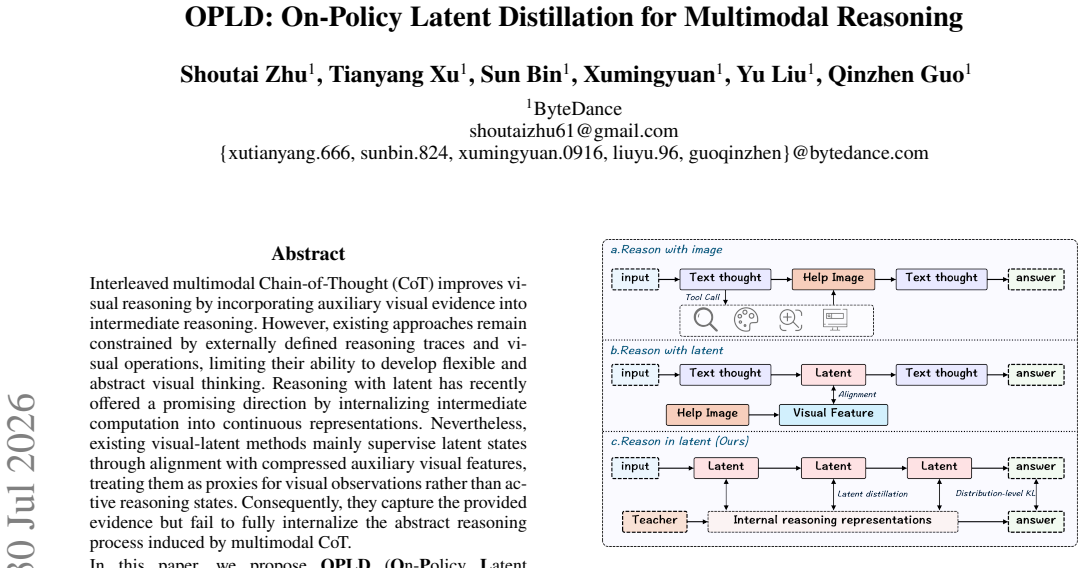
The paper claims that on-policy distillation of a privileged multimodal-CoT teacher’s token distributions and latent trajectories transfers abstract reasoning into a CoT-free student’s continuous latent slots, so the student can reason without auxiliary images or explicit rationales and outperforms feature-alignment latent methods on multiple multimodal benchmarks.
What carries the argument
On-Policy Latent Distillation (OPLD): after teacher and student warmups, the student generates an on-policy answer and latent trajectory; the frozen CoT-augmented teacher supplies top-k forward KL on that trajectory plus slot-wise cosine alignment of the K recursive latent codes.
Load-bearing premise
Matching latent slots by recursive depth with cosine loss is assumed to transfer the teacher’s abstract reasoning process, even though equal depth need not mean the same semantic stage and the two models warm up independently.
What would settle it
If ablating the latent-cosine term (keeping only token-level KL) or intervening at test time by zeroing, noising, or shuffling the student’s latent trajectory left benchmark gains essentially unchanged, the claim that process-level latent supervision internalizes multimodal CoT would fail.
If this is right
- Multimodal models can drop explicit visual tools, crops, and text CoT at inference while retaining much of the accuracy those traces provide in training.
- Latent reasoning design should prioritize process-level teacher signals over forcing latents to reconstruct auxiliary visual embeddings.
- On-policy student rollouts plus teacher scoring on the student’s own trajectory give stabler transfer than offline or larger-teacher token distillation alone.
- A compact encoder–decoder latent bottleneck is a practical interface for calibrating student imagination to a privileged teacher space.
Where Pith is reading between the lines
- If slot-wise depth alignment is only a weak temporal bias, learned mappers or optimal-transport matching between teacher and student latents could raise how much of the privileged gap is recovered.
- The same on-policy latent-distillation pattern may transfer to pure-language continuous-thought models whenever a privileged discrete CoT teacher is available.
- Gains concentrated on fine-grained and high-resolution perception suggest the latent chain mainly organizes evidence integration rather than long symbolic deduction.
Editorial analysis
A structured set of objections, weighed in public.
Referee Report
Summary. The paper proposes OPLD, a three-stage teacher–student framework that transfers reasoning induced by privileged interleaved multimodal CoT into a CoT-free student’s recursive latent slots. A CoT-augmented teacher and a CoT-free student are warmed up separately; then the frozen teacher supervises student on-policy rollouts via top-k forward KL on answer tokens (Eqs. 16–19) and slot-wise cosine alignment of latent trajectories (Eq. 15), combined as L_OPLD (Eq. 20). At inference the student uses only the original image–question input and K recursive Enc–Dec latent steps. On Qwen2.5-VL-7B with a cleaned Zebra-CoT∪Visual-CoT set (217K), OPLD reports large gains over the backbone and SFT on V* and HRBench, outperforms several published visual-latent methods on most reported metrics (Table 1), and is supported by training-strategy, latent-design, and test-time latent-intervention ablations (Fig. 4, Tables 2, 5–7).
Significance. If the results hold under fairer isolation of the claimed mechanism, the work is a solid systems contribution to multimodal latent reasoning: it shows that privileged multimodal CoT can be internalized into fixed-step continuous latents so that inference needs neither textual CoT nor auxiliary images/tools, while remaining competitive with thinking-with-images agents on perception-heavy benchmarks. Strengths include a clear three-stage recipe, careful leakage filtering of teacher help images, systematic ablations (strategy, K, Enc–Dec vs raw hidden, loss terms), and latent interventions (noise/zero/shuffle) that functionally link the trajectory to answers. The framing that process-level latent supervision is a more effective paradigm than feature-level visual alignment would be high-impact if isolated; even as an empirical distillation recipe the gains on V* Attribute and HRBench FSP are practically relevant.
major comments (3)
- [Abstract; Method Stage 3, Eqs. 15–20; Table 2; Supplementary limitations] Abstract/Introduction/Conclusion claim that OPLD supervises latents at the “reasoning-process level” and is more effective than “conventional feature-level alignment.” Stage 3 defines zT_1:K = f_lat_ϕ(xT) with xT = (I, Q, R, Ihelp) (Eqs. 2, 14–15), so L_lat pulls student latents toward states computed under privileged evidence the student never sees. The supplement (“Interpretation and limitation of slot-wise alignment”) already states that equal recursive depth is only a temporal inductive bias, not semantic stage correspondence, and that independent full-parameter warmups can drift coordinates. Table 2 shows cosine is necessary (top-k KL only collapses on HRBench), but there is no same-backbone, same-data control that aligns the same K Enc–Dec slots to compressed Ihelp / key visual features—the paradigm OPLD claims to beat. Without that isolation (or substantially softer claims), Table
- [Table 1; Abstract; Main Results] SOTA wording is stronger than Table 1 supports. Among visual-latent methods OPLD is often best, but HyLaR exceeds OPLD on HR-4K overall (75.00 vs 73.75), HR-4K FSP (93.75 vs 90.00), HR-8K FSP (88.25 vs 87.75), and V* Spatial (85.53 vs 81.58); several thinking-with-images agents also lead on individual cells. Please restrict “state-of-the-art on multiple benchmarks” to the metrics/settings where OPLD is actually first, and mark visual-latent vs agent comparisons consistently.
- [Fig. 4; Table 5; §Effect of Training Strategy] Fig. 4 / Table 5: standard OPD from a Qwen2.5-VL-32B teacher with the same forward-KL objective yields a large average drop (−3.30), including severe MME-RW-Lite degradation. This is used to argue that token-level distillation without latent alignment is insufficient, but the 32B teacher is a different model family scale and is not described as using the same latent protocol or multimodal-CoT teacher view as OPLD’s 7B teacher. Either match the teacher setup (same 7B CoT teacher, text-only OPD) or qualify that the failure mode may mix capacity/distribution shift with missing L_lat, so it does not cleanly isolate the necessity of latent trajectory alignment.
minor comments (5)
- [Method, Eqs. 11–17] Notation drift: student/teacher parameters are θ/ϕ in Eqs. 11–17 but the text sometimes refers to “frozen teacher” without restating that Enc/Dec are included; a single parameter table in the main text (beyond Supp. Table 4) would help.
- [Experimental Setup; Table 2] K=8, D=2048, λ_lat=0.05, top-k=128 are fixed with limited sensitivity beyond K∈{0,4,8} and a few loss variants; a short sweep or stability note for λ_lat and k would strengthen reproducibility claims.
- [Supplementary Case Studies] Case studies (Figs. 6–12) are useful, but several show the warmed-up teacher wrong and OPLD student correct; the prose explanation (soft KL + scoring on student prefixes) belongs in a short main-text paragraph so readers do not infer hard-label imitation.
- [Title block; Abstract; Table 1] Minor writing issues: spacing in “Interleavedmultimodal”, “On-PolicyLatent”, author line “Xumingyuan1”, and inconsistent benchmark names (SeedBench2-Plus vs Seed2+).
- [Related Work] Related Work is thorough; briefly situate OPLD against pure text latent CoT (e.g., Coconut-style) versus visual-latent feature alignment in one comparative sentence for non-MLLM readers.
Circularity Check
No significant circularity: empirical distillation evaluated on external benchmarks, not a by-construction derivation.
full rationale
OPLD is a systems/training paper. Its load-bearing claim is empirical: a CoT-free student trained with on-policy top-k forward KL plus slot-wise latent cosine to a frozen privileged multimodal-CoT teacher (Eqs. 13–20, Stage 3) improves external multimodal benchmarks (Table 1: V*, HRBench, MMStar, etc.) over baselines and prior visual-latent methods. That chain does not reduce the reported scores to the training objective by definition. Privileged teacher inputs xT=(I,Q,C) and student inputs xS=(I,Q) are a standard asymmetric distillation setup; L_lat and L_text are optimization losses, not the evaluation metrics. Warmup CE on y* and held-out LMMS-Eval greedy scores are independent of claiming that cosine equality is itself the scientific result. The supplement’s caveat that equal recursive depth is only a temporal inductive bias weakens the semantic interpretation of “process-level” transfer, but that is an assumption/correctness issue, not circularity (no fitted parameter renamed as prediction; no self-citation uniqueness theorem forcing the method; no X defined as Y). No steps match the enumerated circular patterns.
Axiom & Free-Parameter Ledger
free parameters (5)
- K (latent slots) =
8
- D (latent dimension) =
2048
- λ_lat (latent cosine weight) =
0.05
- top-k for forward KL =
128
- distillation learning rate / schedule =
1e-6, 1 epoch
axioms (5)
- domain assumption Privileged interleaved multimodal CoT induces latent trajectories that encode transferable abstract reasoning rather than only shortcut visual features (after leakage filtering).
- ad hoc to paper Aligning student latents slot-wise by recursive depth to teacher latents transfers process-level reasoning despite possible semantic misalignment and warmup drift.
- domain assumption On-policy student rollouts scored by a frozen teacher under mixed views (teacher sees x_T but conditions on student z^S and ŷ) yield stable, non-degenerate distillation targets.
- ad hoc to paper GPT-5.4-based removal of answer-leaking auxiliary images yields a cleaner reasoning supervision set without systematically discarding hard genuine reasoning cases.
- domain assumption Answer-only CE warmups establish compatible latent protocols so subsequent trajectory alignment is meaningful.
invented entities (2)
-
OPLD on-policy latent distillation objective (L_text + λ_lat L_lat) with teacher scoring on student latents
no independent evidence
-
Enc–Dec projected latent reasoning slots with recursive continuous feedback in the MLLM chat template
no independent evidence
read the original abstract
Interleaved multimodal Chain-of-Thought (CoT) improves visual reasoning by incorporating auxiliary visual evidence into intermediate reasoning. However, existing approaches remain constrained by externally defined reasoning traces and visual operations, limiting their ability to develop flexible and abstract visual thinking. Reasoning with latent has recently offered a promising direction by internalizing intermediate computation into continuous representations. Nevertheless, existing visual-latent methods mainly supervise latent states through alignment with compressed auxiliary visual features, treating them as proxies for visual observations rather than active reasoning states. Consequently, they capture the provided evidence but fail to fully internalize the abstract reasoning process induced by multimodal CoT. In this paper, we propose OPLD (On-Policy Latent Distillation), a simple framework that transfers the reasoning capability induced by privileged multimodal CoT into latent reasoning representations. Extensive experiments on diverse multimodal benchmarks demonstrate that OPLD consistently outperforms existing latent reasoning methods and achieves state-of-the-art performance on multiple benchmarks. The results suggest that supervising latent representations at the reasoning-process level provides a more effective paradigm for multimodal latent reasoning than conventional feature-level alignment.
Figures



Reference graph
Works this paper leans on
-
[1]
Advances in Neural Information Processing Systems , volume =
Chain-of-Thought Prompting Elicits Reasoning in Large Language Models , author =. Advances in Neural Information Processing Systems , volume =
-
[2]
Advances in Neural Information Processing Systems , volume =
Large Language Models are Zero-Shot Reasoners , author =. Advances in Neural Information Processing Systems , volume =
-
[3]
arXiv preprint arXiv:2302.00923 , year =
Multimodal Chain-of-Thought Reasoning in Language Models , author =. arXiv preprint arXiv:2302.00923 , year =. 2302.00923 , archivePrefix =
-
[4]
arXiv preprint arXiv:2505.14362 , year =
DeepEyes: Incentivizing ``Thinking with Images'' via Reinforcement Learning , author =. arXiv preprint arXiv:2505.14362 , year =. 2505.14362 , archivePrefix =
-
[5]
arXiv preprint arXiv:2505.15436 , year =
Chain-of-Focus: Adaptive Visual Search and Zooming for Multimodal Reasoning via RL , author =. arXiv preprint arXiv:2505.15436 , year =. 2505.15436 , archivePrefix =
-
[6]
Proceedings of the IEEE/CVF International Conference on Computer Vision , year =
Bootstrapping Grounded Chain-of-Thought in Multimodal LLMs for Data-Efficient Model Adaptation , author =. Proceedings of the IEEE/CVF International Conference on Computer Vision , year =
-
[8]
Proceedings of the IEEE/CVF Conference on Computer Vision and Pattern Recognition , year =
Monet: Reasoning in Latent Visual Space Beyond Images and Language , author =. Proceedings of the IEEE/CVF Conference on Computer Vision and Pattern Recognition , year =. 2511.21395 , archivePrefix =
-
[9]
arXiv preprint arXiv:2412.06769 , year =
Training Large Language Models to Reason in a Continuous Latent Space , author =. arXiv preprint arXiv:2412.06769 , year =. 2412.06769 , archivePrefix =
-
[10]
arXiv preprint arXiv:2602.04476 , year =
Vision-aligned Latent Reasoning for Multi-modal Large Language Model , author =. arXiv preprint arXiv:2602.04476 , year =. 2602.04476 , archivePrefix =
-
[11]
Proceedings of the AAAI Conference on Artificial Intelligence , volume =
Visual Chain-of-Thought Prompting for Knowledge-Based Visual Reasoning , author =. Proceedings of the AAAI Conference on Artificial Intelligence , volume =. 2024 , doi =
2024
-
[12]
arXiv preprint arXiv:2403.16999 , year =
Visual CoT: Unleashing Chain-of-Thought Reasoning in Multi-Modal Language Models , author =. arXiv preprint arXiv:2403.16999 , year =. 2403.16999 , archivePrefix =
-
[13]
arXiv preprint arXiv:2405.13872 , year =
Image-of-Thought Prompting for Visual Reasoning Refinement in Multimodal Large Language Models , author =. arXiv preprint arXiv:2405.13872 , year =. 2405.13872 , archivePrefix =
-
[14]
arXiv preprint arXiv:2503.12799 , year =
Grounded Chain-of-Thought for Multimodal Large Language Models , author =. arXiv preprint arXiv:2503.12799 , year =. 2503.12799 , archivePrefix =
-
[15]
Proceedings of the IEEE/CVF Conference on Computer Vision and Pattern Recognition , year =
Argus: Vision-Centric Reasoning with Grounded Chain-of-Thought , author =. Proceedings of the IEEE/CVF Conference on Computer Vision and Pattern Recognition , year =. 2505.23766 , archivePrefix =
-
[16]
arXiv preprint arXiv:2506.11991 , year =
VGR: Visual Grounded Reasoning , author =. arXiv preprint arXiv:2506.11991 , year =. 2506.11991 , archivePrefix =
-
[17]
Advances in Neural Information Processing Systems , year =
VLM-R ^3 : Region Recognition, Reasoning, and Refinement for Enhanced Multimodal Chain-of-Thought , author =. Advances in Neural Information Processing Systems , year =. 2505.16192 , archivePrefix =
-
[18]
arXiv preprint arXiv:2606.08464 , year =
TVI-CoT: Text-Visual Interleaved Chain-of-Thought Reasoning for Multimodal Understanding , author =. arXiv preprint arXiv:2606.08464 , year =. 2606.08464 , archivePrefix =
-
[19]
Proceedings of the AAAI Conference on Artificial Intelligence , volume =
Let's Think with Images Efficiently! An Interleaved-Modal Chain-of-Thought Reasoning Framework with Dynamic and Precise Visual Thoughts , author =. Proceedings of the AAAI Conference on Artificial Intelligence , volume =. 2026 , doi =
2026
-
[20]
Proceedings of the 42nd International Conference on Machine Learning , series =
Imagine While Reasoning in Space: Multimodal Visualization-of-Thought , author =. Proceedings of the 42nd International Conference on Machine Learning , series =
-
[21]
arXiv preprint arXiv:2505.22525 , year =
Thinking with Generated Images , author =. arXiv preprint arXiv:2505.22525 , year =. 2505.22525 , archivePrefix =
-
[22]
arXiv preprint arXiv:2606.16783 , year =
Gen-VCoT: Generative Visual Chain-of-Thought Reasoning via Diffusion-Based RGB Intermediate Representations , author =. arXiv preprint arXiv:2606.16783 , year =. 2606.16783 , archivePrefix =
-
[23]
Proceedings of the IEEE/CVF Conference on Computer Vision and Pattern Recognition , pages =
CoT-VLA: Visual Chain-of-Thought Reasoning for Vision-Language-Action Models , author =. Proceedings of the IEEE/CVF Conference on Computer Vision and Pattern Recognition , pages =
-
[24]
arXiv preprint arXiv:2603.01893 , year =
Generative Visual Chain-of-Thought for Image Editing , author =. arXiv preprint arXiv:2603.01893 , year =. 2603.01893 , archivePrefix =
-
[25]
arXiv preprint arXiv:2509.24251 , year=
Latent visual reasoning , author=. arXiv preprint arXiv:2509.24251 , year=
-
[26]
arXiv preprint arXiv:2506.17218 , year =
Machine Mental Imagery: Empower Multimodal Reasoning with Latent Visual Tokens , author =. arXiv preprint arXiv:2506.17218 , year =. 2506.17218 , archivePrefix =
-
[27]
arXiv preprint arXiv:2512.16584 , year =
Sketch-in-Latents: Eliciting Unified Reasoning in MLLMs , author =. arXiv preprint arXiv:2512.16584 , year =. 2512.16584 , archivePrefix =
-
[28]
arXiv preprint arXiv:2601.06803 , year =
Forest Before Trees: Latent Superposition for Efficient Visual Reasoning , author =. arXiv preprint arXiv:2601.06803 , year =. 2601.06803 , archivePrefix =
-
[29]
Findings of the Association for Computational Linguistics: NAACL 2025 , pages=
Lmms-eval: Reality check on the evaluation of large multimodal models , author=. Findings of the Association for Computational Linguistics: NAACL 2025 , pages=
2025
-
[30]
arXiv preprint arXiv:2507.16746 , year=
Zebra-cot: A dataset for interleaved vision language reasoning , author=. arXiv preprint arXiv:2507.16746 , year=
-
[31]
Advances in Neural Information Processing Systems , volume=
Visual cot: Advancing multi-modal language models with a comprehensive dataset and benchmark for chain-of-thought reasoning , author=. Advances in Neural Information Processing Systems , volume=
-
[32]
arXiv preprint arXiv:2604.20328 , year =
Hybrid Latent Reasoning with Decoupled Policy Optimization , author =. arXiv preprint arXiv:2604.20328 , year =. 2604.20328 , archivePrefix =
-
[33]
arXiv preprint arXiv:2602.22766 , year =
Imagination Helps Visual Reasoning, But Not Yet in Latent Space , author =. arXiv preprint arXiv:2602.22766 , year =. 2602.22766 , archivePrefix =
-
[34]
arXiv preprint arXiv:2605.02735 , year =
Visual Latents Know More Than They Say: Unsilencing Latent Reasoning in MLLMs , author =. arXiv preprint arXiv:2605.02735 , year =. 2605.02735 , archivePrefix =
discussion (0)
Sign in with ORCID, Apple, or X to comment. Anyone can read and Pith papers without signing in.