REVIEW 4 major objections 6 minor 35 references
Decoupling monocular 3D Gaussian geometry from post-hoc object semantics yields a searchable map at roughly one-tenth the memory.
Reviewed by Pith at T0; open to challenge. T0 means a machine referee read the full paper against a public rubric. the ladder, T0–T4 →
T0 review · grok-4.5
2026-07-31 11:51 UTC pith:PT2TUZ3F
load-bearing objection Solid systems paper: real memory win from object-level embeddings, careful SCD math, but the competitive mIoU is conditioned on near-oracle 2D masks. the 4 major comments →
MonoVoc: Decoupling Geometry and Semantics for Lightweight Monocular Open-Vocabulary 3D Gaussians
The pith
A machine-rendered reading of the paper's core claim, the machinery that carries it, and where it could break.
Core claim
A training-free monocular pipeline that first reconstructs a geometry-only 3D Gaussian map and then assigns compact object-level open-vocabulary semantics in post-processing produces a searchable semantic Gaussian map with roughly an order-of-magnitude lower memory than dense per-Gaussian baselines, while preserving strong rendering fidelity and competitive rendered segmentation accuracy on Replica.
What carries the argument
Semantic Color Deblending (SCD): the per-Gaussian weighted average that inverts alpha compositing to recover a semantic color from all pixels a Gaussian influences, followed by CMC palette quantization in Lab space and one shared language embedding per object color.
Load-bearing premise
The method assumes that 2D segmentation masks supply clean, well-separated object colors that remain reliable object identifiers even after alpha-blend overlap mixes evidence across neighboring Gaussians.
What would settle it
On the same Replica monocular sequences, replace clean segmentations with boundary-mixed or label-noisy masks and check whether rendered mIoU and text-retrieval Top-1 collapse relative to the clean-input numbers the paper reports.
If this is right
- Everyday monocular video can yield a fully searchable object-level 3D Gaussian map without multiview capture or per-scene semantic training.
- Storing one embedding per object instead of per Gaussian makes open-vocabulary 3D retrieval and QA practical under tight memory budgets.
- Geometry, object identity, and language meaning can be swapped independently, so better SLAM, segmenters, or embedders plug in without re-optimizing the map.
- Rendered segmentation quality can stay competitive with denser, optimization-heavy monocular baselines while using far fewer Gaussians.
Where Pith is reading between the lines
- If segmentation quality is the dominant failure mode, the same deblending-plus-quantization stack becomes a diagnostic for how much 2D mask noise a monocular Gaussian map can tolerate before 3D object IDs break.
- Object-level rather than per-Gaussian embeddings suggest a natural path to editable scene graphs: relabel or merge objects by editing the palette and embedding table without touching geometry.
- The explicit overlap-bias formula invites a sparse global refinement pass only near high-Gij boundaries, which could tighten the method without abandoning the lightweight design.
Editorial analysis
A structured set of objections, weighed in public.
Referee Report
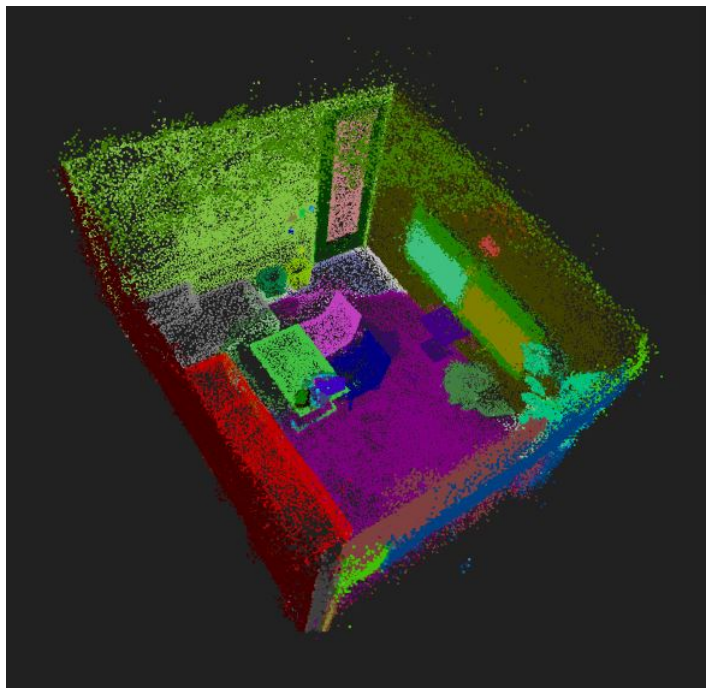
Summary. MonoVoc proposes a training-free monocular pipeline that decouples 3D Gaussian geometry from open-vocabulary semantics. Geometry is obtained from HI-SLAM2 on monocular RGB; semantics are attached post hoc via Semantic Color Deblending (SCD), a per-Gaussian weighted-average inverse of alpha compositing (Eqs. 1, 11; Theorems 1–4), CMC palette quantization in Lab space (Eq. 2), and one language embedding per discrete object color rather than per Gaussian. On Replica, the method reports strong rendering metrics (PSNR/LPIPS best among compared methods), competitive rendered mIoU (91.22% vs SceneSplat 91.89%), 80% Top-1 retrieval with Perception Encoder soft masks on 15 queries, and substantially lower map size/memory (140K Gaussians, 14 MB vs 90–149 MB). The central claim is that this modular object-level design yields a searchable monocular semantic Gaussian map with order-of-magnitude memory savings without scene-specific semantic training.
Significance. If the joint claim holds under realistic monocular inputs, the work is practically significant: it targets a real deployment bottleneck (dense per-Gaussian language features and multiview/optimization-heavy pipelines) with a simple, modular design. Strengths that deserve credit include (i) a careful derivation of SCD with exact recovery under one-hot visibility and an explicit overlap-bias formula (Theorems 1–4, Appendix A), (ii) a clear efficiency win from object-level rather than per-Gaussian embeddings (Table 4), and (iii) competitive rendering fidelity without entangling semantics in the SLAM loop (Table 1). The contribution is more systems/engineering than a new learning principle, but a lightweight monocular open-vocab 3DGS map is a useful target for AR/robotics if validated beyond oracle 2D masks.
major comments (4)
- [§4.1–4.2, Appendix C] §4.1–4.2 and Appendix C: Experiments feed Replica ground-truth semantic segmentations as 2D supervision. The abstract and introduction claim a practical solution “directly from everyday monocular video,” yet Appendix C shows that boundary noise, mixed-boundary colors, and repeated label errors propagate through SCD (Eq. 11 / Theorem 4) into wrong 3D assignments and lower mIoU. The load-bearing premise—that discrete segmentation colors are reliable object IDs under alpha-blend overlap—is therefore only tested under near-oracle masks. A major revision should report end-to-end results with automatic segmenters (e.g., SAM or comparable open-vocab 2D masks) on the same scenes, or clearly reframe claims as conditional on high-quality 2D masks and quantify the mIoU/retrieval drop under realistic noise levels already studied in Appendix C.
- [Table 1, Table 3, §4.4] Table 1 and Table 3: Empirical support for “competitive open-vocabulary understanding” is narrow. Rendered mIoU is slightly below SceneSplat; language evaluation uses only 15 text queries with reported standard deviations that look like repeated runs over the same small set rather than a held-out query suite or multiple scenes with many objects. For a journal claim of searchable open-vocab maps and QA, expand retrieval/QA evaluation (more queries, negative queries, multi-object referring expressions) and report per-scene breakdowns. Without this, the semantic half of the central claim rests mainly on GT-mask mIoU and a small retrieval table.
- [Table 4, §4.5] Table 4 and §4.5: Memory reduction (14 MB vs 90–149 MB) is real under the object-level design and is a genuine strength. However, the efficiency comparison is only partly fair: SceneSplat’s runtime excludes 3D map generation (footnote), ObjectGS couples reconstruction and semantics differently, and MonoVoc’s Gaussian count is largely inherited from HI-SLAM2’s Replica configuration rather than shown to be a consequence of SCD alone. Please (i) report a matched comparison of semantic storage overhead holding geometry fixed, (ii) include full end-to-end baselines where possible, and (iii) separate “fewer Gaussians from the SLAM backend” from “object-level embeddings reduce feature memory.” The order-of-magnitude memory claim should be attributed primarily to the embedding design, which the paper already motivates well.
- [§3.3, Theorem 4, Limitations] §3.3 Theorem 4 and Limitations: SCD is an efficient diagonal/per-Gaussian approximation to the coupled inverse (Appendix A, Theorem A.19). The paper is honest that overlap bias mixes colors via Gij and that quantization is needed to snap back to the palette. What is missing for the central accuracy claim is a quantitative bound or ablation of residual error after CMC snapping on real multi-object overlap (not only metric choice in Table 2). Please add an ablation of deblending vs. no deblending vs. a sparse global/refinement baseline on boundary regions, and report how often quantization chooses the wrong palette entry when Gij is large. This directly tests whether the surrogate inverse is adequate for the reported mIoU.
minor comments (6)
- [Title, Tables 1–4] Throughout: naming is inconsistent (MonoVoc / MonoV oc / MonoV oc). Standardize to one spelling in title, headers, and tables.
- [§3.2] §3.2 Eq. (3)–(5): “semantic color si (not RGB value rather a learnable parameter)” is confusing in a training-free method where si is recovered, not learned. Clarify that si is an assigned semantic RGB/palette identifier, not a trained feature.
- [Table 2, §4.3] Table 2: “10,566,418,000 total pixels” over 2000 images is hard to parse; give per-image resolution and how multi-scene aggregation was done. Also clarify whether mismatch is computed after the same point-splat rendering (size 0.05) used elsewhere, which can itself introduce discretization error.
- [Figure 1, §3.1] Figure 1 and §3.1: state explicitly which 2D segmenter and which embedding backend are the default for main tables; modularity is fine but main results need a fixed configuration.
- [§2] Related work: briefly contrast storage/query cost with LangSplatV2 / OpenGaussian in a small table or paragraph so multiview vs monocular tradeoffs are quantitative, not only qualitative.
- [Abstract, §4.5] Minor prose: “order-of-magnitude reduction” is supported for memory vs the two baselines; avoid implying the same factor for runtime (81 min is between the two reported times).
Circularity Check
No significant circularity: SCD is a self-contained inverse of alpha compositing; efficiency and metrics are design choices and external benchmarks, not predictions forced by fitted inputs.
full rationale
The paper’s load-bearing technical chain is (1) fixed geometry from external HI-SLAM2, (2) Semantic Color Deblending as the closed-form per-Gaussian weighted least-squares inverse of the known alpha-compositing weights (Eqs. 6–11, Theorems 1–4), (3) CMC palette snap to discrete 2D segmentation colors, and (4) one language embedding per object color. Theorems 1–4 derive nonnegativity/partition-of-unity, the unique WLS minimizer, exact recovery under one-hot visibility, and explicit overlap bias; these are algebraic consequences of the forward renderer, not definitions of success in terms of the target metrics. Memory reduction (14 MB vs 90–149 MB) follows by construction from storing one embedding per object rather than dense per-Gaussian features—an architectural choice, not a fitted parameter renamed as a prediction. Rendering fidelity, mIoU, and retrieval are measured against external Replica benchmarks and external baselines (ObjectGS, SceneSplat); no parameter is fit on a subset and then “predicted” on a tautologically related quantity. Citations (HI-SLAM2, CLIP, Perception Encoder, color-difference formulas) are to third-party systems or standards, not author-overlapping uniqueness theorems that forbid alternatives. Dependence on clean 2D masks is a validity/assumption risk (Appendix C), not circular derivation. Score 0; steps empty.
Axiom & Free-Parameter Ledger
free parameters (4)
- CMC lightness/chroma weights (l=2.0, c=1.0) =
l=2.0, c=1.0
- Deblending/quantization engineering knobs =
as listed in §4.1
- Number of Gaussians / HI-SLAM2 Replica configuration =
~140K Gaussians/scene
- Embedding backend and masking (CLIP vs Perception Encoder; hard vs soft) =
PE + soft mask best (80% Top-1)
axioms (5)
- standard math Alpha-compositing weights are independent of semantic colors and form a convex mixture (partition of unity), so background-subtracted rendering is linear in si.
- domain assumption HI-SLAM2 monocular reconstruction supplies sufficiently accurate fixed Gaussian geometry, opacity, and depth order for post-hoc semantic assignment without joint optimization.
- domain assumption 2D segmentation maps provide a discrete, consistent object-color palette that identifies objects across frames well enough for deblending evidence accumulation.
- ad hoc to paper Per-Gaussian weighted least-squares (diagonal/decoupled inverse) plus nearest-palette snap is an adequate surrogate for the full coupled inverse over overlapping Gaussians.
- domain assumption One language embedding per object color, from representative masked keyframes, suffices for open-vocabulary retrieval/QA without dense per-Gaussian features.
invented entities (2)
-
Semantic Color Deblending (SCD) estimator
no independent evidence
-
Object-level semantic-color embedding database linked to Gaussian sets
no independent evidence
read the original abstract
Open vocabulary 3D scene understanding is essential for next-generation interactive systems, empowering users to intuitively query and navigate reconstructed environments using natural language. However, current 3D Gaussian frameworks are often bottlenecked by restrictive multiview capture requirements, costly scene-specific optimization, and the massive memory overhead of storing dense language features. We present a novel, training-free pipeline that fundamentally reimagines this paradigm by explicitly decoupling 3D geometric reconstruction from semantic integration. Given a standard monocular video sequence as input, our method efficiently outputs a compact, highly interpretable, and fully searchable object-level semantic Gaussian map. Rather than entangling heavy language embeddings within the mapping loop, we extract geometry independently and ground semantics through a lightweight, modular post-processing framework. Extensive evaluations on the Replica dataset demonstrate that this decoupled architecture preserves strong rendering fidelity and competitive segmentation accuracy. Crucially, by replacing dense per-Gaussian storage with modular, object-level semantic embeddings, our approach delivers an order-of-magnitude reduction in memory usage compared to SOTA baselines. This provides a highly efficient, scalable, and practical solution for open-vocabulary 3D retrieval and question answering directly from everyday monocular video.
Figures


Reference graph
Works this paper leans on
-
[1]
Daniel Bolya, Po-Yao Huang, Peize Sun, Jang Hyun Cho, Andrea Madotto, Chen Wei, Tengyu Ma, Jiale Zhi, Jathushan Rajasegaran, Hanoona Rasheed, Junke Wang, Marco Monteiro, Hu Xu, Shiyu Dong, Nikhila Ravi, Daniel Li, Piotr Dollár, and Christoph Feichtenhofer. Perception encoder: The best visual embeddings are not at the output of the network.arXiv:2504.13181, 2025
Pith/arXiv arXiv 2025
-
[2]
Emerging properties in self-supervised vision transformers
Mathilde Caron, Hugo Touvron, Ishan Misra, Hervé Jégou, Julien Mairal, Piotr Bojanowski, and Armand Joulin. Emerging properties in self-supervised vision transformers. InProceedings of the IEEE/CVF International Conference on Computer Vision (ICCV), pages 9650–9660, October 2021
2021
-
[3]
Slgaussian: Fast language gaussian splatting in sparse views
Kangjie Chen, BingQuan Dai, Minghan Qin, Dongbin Zhang, Peihao Li, Yingshuang Zou, and Haoqian Wang. Slgaussian: Fast language gaussian splatting in sparse views. InProceedings of the 33rd ACM International Conference on Multimedia, pages 3047–3056, 2025
2025
-
[4]
Colorimetry – part 4: CIE 1976 L*a*b* colour space
CIE. Colorimetry – part 4: CIE 1976 L*a*b* colour space. CIE Standard S 014-4/E:2007, 2007
1976
-
[5]
Frank J. J. Clarke, Roderick McDonald, and Bryan Rigg. Modification to the JPC79 colour– difference formula.Journal of the Society of Dyers and Colourists, 100(4):128–132, 1984. doi: 10.1111/j.1478-4408.1984.tb00969.x
arXiv 1984
-
[6]
Guihua Cui, Ming Ronnier Luo, Bryan Rigg, Gerhard Roesler, and Klaus Witt. Uniform colour spaces based on the din99 colour-difference formula.Color Research & Application, 27(4): 282–290, 2002. doi: 10.1002/col.10066
-
[7]
Mark Everingham, Luc Van Gool, Christopher K. I. Williams, John Winn, and Andrew Zisser- man. The PASCAL visual object classes (VOC) challenge.International Journal of Computer Vision, 88(2):303–338, 2010. doi: 10.1007/s11263-009-0275-4
-
[8]
Image quality metrics: PSNR vs
Alain Hore and Djemel Ziou. Image quality metrics: PSNR vs. SSIM.Proceedings of the 20th International Conference on Pattern Recognition (ICPR), pages 2366–2369, 2010. doi: 10.1109/ICPR.2010.579
-
[9]
ARKitSceneRefer: Text- based localization of small objects in diverse real-world 3d indoor scenes
Shunya Kato, Shuhei Kurita, Chenhui Chu, and Sadao Kurohashi. ARKitSceneRefer: Text- based localization of small objects in diverse real-world 3d indoor scenes. InFindings of the Association for Computational Linguistics: EMNLP 2023, pages 784–799. Association for Computational Linguistics, 2023. doi: 10.18653/v1/2023.findings-emnlp.56
-
[10]
Splatam: Splat, track & map 3d gaussians for dense rgb-d slam
Nikhil Keetha, Jay Karhade, Krishna Murthy Jatavallabhula, Gengshan Yang, Sebastian Scherer, Deva Ramanan, and Jonathon Luiten. Splatam: Splat, track & map 3d gaussians for dense rgb-d slam. InProceedings of the IEEE/CVF Conference on Computer Vision and Pattern Recognition, 2024
2024
-
[11]
Bernhard Kerbl, Georgios Kopanas, Thomas Leimkühler, and George Drettakis. 3d gaussian splatting for real-time radiance field rendering.ACM Transactions on Graphics, 42(4), 2023. doi: 10.1145/3592433
doi:10.1145/3592433 2023
-
[12]
Lerf: Language embedded radiance fields
Justin Kerr, Chung Min Kim, Ken Goldberg, Angjoo Kanazawa, and Matthew Tancik. Lerf: Language embedded radiance fields. InProceedings of the IEEE/CVF international conference on computer vision, pages 19729–19739, 2023
2023
-
[13]
Berg, Wan-Yen Lo, Piotr Dollár, and Ross Girshick
Alexander Kirillov, Eric Mintun, Nikhila Ravi, Hanzi Mao, Chloe Rolland, Laura Gustafson, Tete Xiao, Spencer Whitehead, Alexander C. Berg, Wan-Yen Lo, Piotr Dollár, and Ross Girshick. Segment anything. InProceedings of the IEEE/CVF International Conference on Computer Vision, pages 4015–4026, 2023
2023
-
[14]
Weinberger, Serge Belongie, Vladlen Koltun, and René Ranftl
Boyi Li, Kilian Q. Weinberger, Serge Belongie, Vladlen Koltun, and René Ranftl. Language- driven semantic segmentation. InInternational Conference on Learning Representations, 2022. 10
2022
-
[15]
Changjun Li, Zhiqiang Li, Zhifeng Wang, Yang Xu, Ming Ronnier Luo, Guihua Cui, Manuel Melgosa, Michael H. Brill, and Michael R. Pointer. Comprehensive color solutions: Cam16, cat16, and cam16-ucs.Color Research & Application, 42(6):703–718, 2017. doi: 10.1002/col. 22131
work page doi:10.1002/col 2017
-
[16]
Hao Li, Roy Qin, Zhengyu Zou, Diqi He, Bohan Li, Bingquan Dai, Dingewn Zhang, and Junwei Han. Langsurf: Language-embedded surface gaussians for 3d scene understanding.arXiv preprint arXiv:2412.17635, 2024. URLhttps://arxiv.org/abs/2412.17635
arXiv 2024
-
[17]
Langsplatv2: High-dimensional 3D language Gaussian splatting with 450+ FPS
Wanhua Li, Yujie Zhao, Minghan Qin, Yang Liu, Yuanhao Cai, Chuang Gan, and Hanspeter Pfister. Langsplatv2: High-dimensional 3D language Gaussian splatting with 450+ FPS. In Advances in Neural Information Processing Systems (NeurIPS), 2025. URL https://arxiv. org/abs/2507.07136
arXiv 2025
-
[18]
4D langsplat: 4D language Gaussian splatting via multimodal large language models
Wanhua Li, Renping Zhou, Jiawei Zhou, Yingwei Song, Johannes Herter, Minghan Qin, Gao Huang, and Hanspeter Pfister. 4D langsplat: 4D language Gaussian splatting via multimodal large language models. InProceedings of the IEEE/CVF Conference on Computer Vision and Pattern Recognition (CVPR), pages 22001–22011, June 2025
2025
-
[19]
Oswald, and Danda Pani Paudel
Yue Li, Qi Ma, Runyi Yang, Huapeng Li, Mengjiao Ma, Bin Ren, Nikola Popovic, Nicu Sebe, Ender Konukoglu, Theo Gevers, Luc Van Gool, Martin R. Oswald, and Danda Pani Paudel. Scenesplat: Gaussian splatting-based scene understanding with vision-language pretraining. In Proceedings of the IEEE/CVF International Conference on Computer Vision (ICCV), pages 4961...
2025
-
[20]
Open-vocabulary semantic segmentation with mask-adapted clip
Feng Liang, Bichen Wu, Xiaoliang Dai, Kunpeng Li, Yinan Zhao, Hang Zhang, Peizhao Zhang, Peter Vajda, and Diana Marculescu. Open-vocabulary semantic segmentation with mask-adapted clip. InProceedings of the IEEE/CVF Conference on Computer Vision and Pattern Recognition, pages 7061–7070, 2023
2023
-
[21]
Ming Ronnier Luo, Guihua Cui, and Bryan Rigg. The development of the cie 2000 colour- difference formula: Ciede2000.Color Research & Application, 26(5):340–350, 2001. doi: 10.1002/col.1049
doi:10.1002/col.1049 2000
-
[22]
Hidenobu Matsuki, Riku Murai, Paul H. J. Kelly, and Andrew J. Davison. Gaussian splatting slam. InProceedings of the IEEE/CVF Conference on Computer Vision and Pattern Recognition, 2024
2024
-
[23]
R. McDonald and K. J. Smith. Cie94—a new colour-difference formula.Journal of the Society of Dyers and Colourists, 111(12):376–379, 1995. doi: 10.1111/j.1478-4408.1995.tb01688.x
arXiv 1995
-
[24]
Srinivasan, Matthew Tancik, Jonathan T
Ben Mildenhall, Pratul P. Srinivasan, Matthew Tancik, Jonathan T. Barron, Ravi Ramamoorthi, and Ren Ng. Nerf: Representing scenes as neural radiance fields for view synthesis. InEuropean Conference on Computer Vision, pages 405–421. Springer, 2020
2020
-
[25]
Learning transferable visual models from natural language supervision
Alec Radford, Jong Wook Kim, Chris Hallacy, Aditya Ramesh, Gabriel Goh, Sandhini Agar- wal, Girish Sastry, Amanda Askell, Pamela Mishkin, Jack Clark, Gretchen Krueger, and Ilya Sutskever. Learning transferable visual models from natural language supervision. In Marina Meila and Tong Zhang, editors,Proceedings of the 38th International Conference on Machin...
2021
-
[26]
Julian Straub, Thomas Whelan, Lingni Ma, Yufan Chen, Erik Wijmans, Simon Green, Jakob J. Engel, Raul Mur-Artal, Carl Ren, Shobhit Verma, Anton Clarkson, Mingfei Yan, Brian Budge, Yajie Yan, Xiaqing Pan, June Yon, Yuyang Zou, Kimberly Leon, Nigel Carter, Jesus Briales, Tyler Gillingham, Elias Mueggler, Luis Pesqueira, Manolis Savva, Dhruv Batra, Hauke M. S...
Pith/arXiv arXiv 1906
-
[27]
Slag: Scalable language-augmented gaussian splatting.IEEE Robotics and Automation Letters, 2025
Laszlo Szilagyi, Francis Engelmann, and Jeannette Bohg. Slag: Scalable language-augmented gaussian splatting.IEEE Robotics and Automation Letters, 2025. 11
2025
-
[28]
Osama Tasneem and Roel Pieters. Human–robot collaborative visual inspection with large language models.Robotics and Computer-Integrated Manufacturing, 98:103154, 2026. doi: 10.1016/j.rcim.2025.103154
arXiv 2026
-
[29]
Zhou Wang, Alan C. Bovik, Hamid R. Sheikh, and Eero P. Simoncelli. Image quality assessment: From error visibility to structural similarity.IEEE Transactions on Image Processing, 13(4): 600–612, 2004. doi: 10.1109/TIP.2003.819861
arXiv 2004
-
[30]
Hierarchical open-vocabulary 3d scene graphs for language-grounded robot navigation
Abdelrhman Werby, Chenguang Huang, Martin Büchner, Abhinav Valada, and Wolfram Burgard. Hierarchical open-vocabulary 3d scene graphs for language-grounded robot navigation. In Robotics: Science and Systems (RSS), 2024
2024
-
[31]
Opengaussian: Towards point- level 3D Gaussian-based open vocabulary understanding
Yanmin Wu, Jiarui Meng, Haijie Li, Chenming Wu, Yahao Shi, Xinhua Cheng, Chen Zhao, Haocheng Feng, Errui Ding, Jingdong Wang, and Jian Zhang. Opengaussian: Towards point- level 3D Gaussian-based open vocabulary understanding. InAdvances in Neural Information Processing Systems, volume 37, pages 19114–19138. Curran Associates, Inc., 2024. doi: 10.52202/079017-0604
-
[32]
Osprey: Pixel understanding with visual instruction tuning
Yuqian Yuan, Wentong Li, Jian Liu, Dongqi Tang, Xinjie Luo, Chi Qin, Lei Zhang, and Jianke Zhu. Osprey: Pixel understanding with visual instruction tuning. InProceedings of the IEEE/CVF Conference on Computer Vision and Pattern Recognition, 2024
2024
-
[33]
Efros, Eli Shechtman, and Oliver Wang
Richard Zhang, Phillip Isola, Alexei A. Efros, Eli Shechtman, and Oliver Wang. The unrea- sonable effectiveness of deep features as a perceptual metric. InProceedings of the IEEE Conference on Computer Vision and Pattern Recognition (CVPR), pages 586–595, 2018. doi: 10.1109/CVPR.2018.00068
arXiv 2018
-
[34]
HI-SLAM2: Geometry-aware gaussian SLAM for fast monocular scene reconstruction
Wei Zhang, Qing Cheng, David Skuddis, Niclas Zeller, Daniel Cremers, and Norbert Haala. HI-SLAM2: Geometry-aware gaussian SLAM for fast monocular scene reconstruction. IEEE Transactions on Robotics, 41:6478–6493, October 2025. doi: 10.1109/TRO.2025. 3626627. URL https://doi.org/10.1109/TRO.2025.3626627. Originally available as arXiv:2411.17982
arXiv 2025
-
[35]
Objectgs: Object-aware scene reconstruction and scene understanding via Gaussian splatting
Ruijie Zhu, Mulin Yu, Linning Xu, Lihan Jiang, Yixuan Li, Tianzhu Zhang, Jiangmiao Pang, and Bo Dai. Objectgs: Object-aware scene reconstruction and scene understanding via Gaussian splatting. InProceedings of the IEEE/CVF International Conference on Computer Vision (ICCV), pages 8350–8360, October 2025. 12 A Additional deblending proofs This appendix giv...
2025
discussion (0)
Sign in with ORCID, Apple, or X to comment. Anyone can read and Pith papers without signing in.