REVIEW 3 major objections 6 minor 299 references
On the same graph, node-label supervision reliably helps link prediction on homophilic graphs, but link supervision helps node classification only in a structure-dominant regime—and only under a leakage-free protocol.
Reviewed by Pith at T0; open to challenge. T0 means a machine referee read the full paper against a public rubric. the ladder, T0–T4 →
T0 review · grok-4.5
2026-07-31 04:37 UTC pith:5NPM77HF
load-bearing objection Clean same-graph NC–LP protocol with a real directional finding; soft spot is the collection-relative “structure-dominant” label, not the asymmetry itself. the 3 major comments →
Same Graph Cross-Task Transfer in GNNs: Protocols and Predictors
The pith
A machine-rendered reading of the paper's core claim, the machinery that carries it, and where it could break.
Core claim
Under a standardized leakage-free same-graph protocol, NC→LP transfer is consistently beneficial on homophilic graphs across GCN, GraphSAGE, and GPS, whereas LP→NC is unreliable under naive representation reuse and becomes reliably positive mainly in a structure-dominant regime where link prediction is highly learnable but node classification remains unsaturated. Coupled training (multi-view and joint) is generally more stable than post-hoc reuse, and the CoTask Score summarizes when one shared encoder serves both tasks without net loss.
What carries the argument
Leakage-free evaluation protocol: fixed NC node splits and LP edge splits, a single observed adjacency built only from training positive edges for all message passing, and fixed LP negatives reused across methods. CoTask Score (CTS) averages percent gains on NC accuracy and LP AUC over a fixed GCN reference to score joint utility.
Load-bearing premise
The “structure-dominant” regime is defined relative to ranking within this fixed collection of eleven datasets; if the pool or backbone ranking changes, which graphs count as structure-dominant—and thus where reverse transfer is called reliable—can shift.
What would settle it
Rerun the same protocol on a larger, independently chosen set of graphs with the same three backbones: if NC→LP gains no longer track homophily, or if LP→NC gains appear strongly outside the high-LP / low-NC-headroom quadrant (or vanish inside it), the directional regime claims fail.
If this is right
- Default to NC→LP reuse on high-homophily graphs; treat LP→NC as optional structural pretraining only when LP is easy and NC is unsaturated.
- Prefer multi-view or joint training over embedding replacement when a single encoder must serve both tasks, to reduce negative transfer.
- Report CTS alongside per-task metrics so shared-encoder choices are judged by net NC+LP utility, not one task alone.
- Use edge/node homophily (and baseline task learnability) as cheap pre-checks before committing to a transfer direction or mechanism.
- Future multi-objective graph benchmarks should adopt fixed splits, observed graphs, and negatives so cross-task claims are comparable.
Where Pith is reading between the lines
- The same protocol could be reused as a stress test for whether newer long-range or state-space graph models preserve the NC→LP / LP→NC asymmetry or erase it.
- If structure-dominant reverse transfer is real, cheap unsupervised link objectives may substitute for scarce node labels precisely on graphs where connectivity is informative but labels are not aligned with edges.
- Collection-relative regime labels suggest publishing absolute baseline LP/NC scores with every claim, so later work can re-bin regimes without re-running the original suite.
- Negative transfer under ET-Replace implies frozen LP embeddings often destroy class-separating geometry; adaptive gating of transferred features may be a practical next control knob.
Editorial analysis
A structured set of objections, weighed in public.
Referee Report
Summary. The paper formalizes same-graph cross-task transfer between node classification (NC) and link prediction (LP), and introduces a leakage-free evaluation protocol that fixes node/edge splits, restricts message passing to A_obs built only from training positives, and reuses fixed LP negatives across methods. Under this protocol it evaluates five lightweight transfer regimes (WS, ET-Rep, ET-Concat, MV, Joint) on three backbones (GCN, GraphSAGE, GPS) over 11 datasets spanning homophilic, heterophilic, and mixed regimes, in both transductive and (partially) inductive settings. The central empirical claim is a directional, regime-dependent asymmetry: NC→LP is consistently beneficial on homophilic graphs and correlates with homophily, whereas LP→NC is fragile under naive representation reuse and is reliably positive mainly in a structure-dominant regime (high LP learnability, unsaturated NC). The authors further define CoTask Score (CTS) to summarize joint NC+LP utility for shared-encoder deployments and argue that simple diagnostics (especially homophily) can guide mechanism choice and avoid negative transfer.
Significance. If the findings hold, the work supplies a practical and overdue evaluation standard for multi-objective GNN pipelines that currently mix incompatible splits, observed graphs, and negative-sampling rules. The directional asymmetry and the homophily–NC→LP correlation are actionable for practitioners choosing whether and how to reuse supervision, and CTS is a simple, reproducible multi-objective summary. Strengths that raise confidence include: explicit leakage sanity checks; consistency across three architecturally distinct backbones; supporting inductive tables; a second hyperparameter configuration (A.6); two extra homophilic Amazon graphs (A.7); and geometric evidence via cosine-similarity gaps (Table 11, Fig. 2). Code and fixed-split reproducibility are promised. The contribution is primarily empirical and protocol-level rather than architectural, which is appropriate given the stated goal.
major comments (3)
- [Section 5, Datasets; also Abstract and §5.1] Section 5 (Datasets): the operational definition of the structure-dominant regime—baseline LP AUC in the upper half and baseline NC accuracy in the lower half of this fixed 11-dataset collection under a given backbone—is collection-relative. The claim that LP→NC is “reliably positive mainly” in that regime (Abstract, §5.1, Conclusion) therefore depends on membership of USA/EUROPE/BRAZIL within this pool. Please either (i) state an a priori, collection-independent criterion (e.g., absolute LP AUC and NC headroom thresholds, or a leave-one-dataset-out membership check), or (ii) rephrase the claim as an empirical concentration on these three graphs and report sensitivity of membership and of the LP→NC conclusion when the pool or backbone ranking changes. Without that, the regime language overclaims relative to the evidence.
- [Appendix A.4, Tables 9–10; §5.1] Tables 9–10 (Appendix A.4): inductive results for MV and Joint are reported only under GCN, while GraphSAGE and GPS stop at WS/ET. The paper’s robustness claim for coupled objectives (MV/Joint as the “safest” choices in §5.1–5.2) is therefore only partially stress-tested under distribution shift to unseen nodes. Either complete MV/Joint for the other backbones in the inductive setting, or clearly scope the inductive conclusions to WS/ET and avoid generalizing the coupling recommendation from inductive GCN alone.
- [Section 3.1 Eq. (1); Table 5; Table 8] Section 3.1, Eq. (1) and Table 5: CTS is anchored to a fixed GCN reference g for all backbones. This is fine for within-GCN comparison, but when GraphSAGE/GPS rows are scored against a GCN base, large positive CTS on heterophilic graphs can reflect backbone superiority rather than transfer benefit (e.g., GraphSAGE/GPS Base CTS already large on TEXAS/WISCONSIN). Please either (i) also report backbone-local CTS anchored to each backbone’s own single-task base, or (ii) separate “transfer gain CTS” from “backbone CTS” in Table 5/8 so joint-utility claims about transfer mechanisms are not confounded by encoder choice.
minor comments (6)
- [Appendix A.1] Appendix A.1, Eq. (2): λ_x is initialized from a homophily/CC formula before validation search. You correctly note that final λ_x is validation-selected and that asymmetry appears in non-MV methods; still, state explicitly in the main text (not only appendix) that MV results are not driven by this schedule, and report the selected λ_x values per dataset.
- [Table 3 caption] Table 3 caption says gains are “relative to the corresponding LP single-task base model”; it should say NC single-task base. Same check for related captions.
- [Table 1; Section 5] Table 1: USA/EUROPE/BRAZIL list “–” for features; clarify in text whether one-hot or structural features are used and whether that interacts with ET-Rep/Concat.
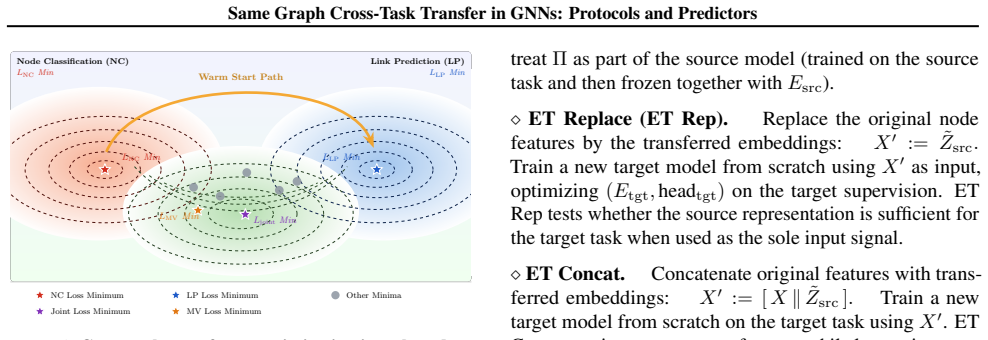
- [Figure 1; §4] Figure 1 is conceptually helpful but the “Warm Start Path” and multiple minima are schematic only; a short caption caveat that this is intuition, not a computed loss landscape, would avoid over-reading.
- [Appendix A.2] Typos/style: “Formal defintions” (A.2); “defintions”; occasional missing spaces before citations; arXiv ID formatting in the header is fine for preprint but journal version should drop the duplicate abstract block artifacts if any remain.
- [Section 2] Related Work: a brief pointer to recent multi-task GNN recommendation / joint NC–LP production systems would better situate the deployment motivation already stated in the introduction.
Circularity Check
No load-bearing circular derivation; only mild post-hoc labeling of the structure-dominant regime from the same collection’s baseline ranks.
specific steps
-
other
[Section 5, Datasets (structure-dominant definition)]
"under a fixed backbone and protocol, a dataset is structure-dominant if its baseline LP AUC ranks in the upper half of the benchmark while its baseline NC accuracy ranks in the lower half. ... Empirically, USA, EUROPE, and BRAZIL satisfy this criterion across all three backbones under our protocol"
Regime membership is fixed from the same 11-dataset collection’s baseline rank halves, then the narrative claim that LP→NC is “reliably positive mainly” in that regime is read off the same collection. This is mild post-hoc labeling, not identity-by-construction: transfer gains are still independently measured relative to NC bases, and the definition uses baselines rather than the LP→NC outcomes themselves. It does not force the directional asymmetry or the homophily–NC→LP correlations.
full rationale
The paper’s central claims are empirical comparisons under a fixed leakage-free protocol: bidirectional transfer gains versus single-task bases (Tables 2–3, 9–10), homophily–gain correlations (Tables 4, 7), CTS as an explicit relative summary (Eq. 1), and geometric cosine-gap evidence (Table 11). None of these reduce by construction to their inputs. CTS and S_val are openly normalized reporting/selection metrics, not disguised first-principles predictions. The sole mild concern is that “structure-dominant” is defined from within-collection baseline LP/NC rank halves and then used to locate where LP→NC gains concentrate; that is post-hoc regime naming on the same benchmark pool, not a fitted parameter renamed as a prediction, and membership is fixed from baselines rather than from the transfer outcomes themselves. No self-citation uniqueness chain, ansatz smuggling, or self-definitional identity between claimed outputs and defining inputs appears. Score 1 reflects that minor labeling issue only.
Axiom & Free-Parameter Ledger
free parameters (6)
- NC label split ratios 60%/20%/20% =
60/20/20
- LP positive edge split ratios 80%/10%/10% =
80/10/10
- LP negative sampling ratio 1:1 with fixed seed policy =
|E-_s|=|E+_s|
- Joint task weight λ and MV alignment weight λ_x =
λ∈{0.0..1.0} grid; λ_x∈[0.2,1.6]
- CTS reference model g = standard GCN under protocol =
GCN single-task reference
- Default encoder hyperparameters (depth, width, dropout, lr, patience) =
e.g. 2-layer, hid 64, dropout 0.5, lr 0.01, patience 50
axioms (6)
- ad hoc to paper Message-passing embeddings for all tasks/methods must be computed only on A_obs := Adj(V, E+_tr), excluding val/test LP positives.
- ad hoc to paper LP evaluation uses fixed negative sets E-_s generated once and reused across methods and runs.
- domain assumption Homophily (edge/node) is a meaningful diagnostic of label-connectivity alignment for predicting NC→LP transfer.
- ad hoc to paper A dataset is structure-dominant if baseline LP AUC ranks upper half and baseline NC accuracy ranks lower half of the fixed 11-dataset collection under a given backbone/protocol.
- domain assumption GCN, GraphSAGE, and GPS are representative enough that directional findings are not backbone artifacts within message-passing and graph-transformer families.
- domain assumption Standard supervised losses (cross-entropy NC; BCE LP) and MLP pairwise decoder over [zu∥zv∥|zu−zv|∥zu⊙zv] adequately probe representation transfer.
invented entities (3)
-
CoTask Score (CTS)
no independent evidence
-
Structure-dominant regime (operational half-rank definition)
no independent evidence
-
Leakage-free same-graph NC–LP evaluation protocol
independent evidence
read the original abstract
Many real-world graphs support multiple predictive tasks over the same underlying structure, creating an opportunity to reuse supervision across node classification (NC) and link prediction (LP). However, existing evaluations often rely on incompatible splits, observed-graph assumptions, and negative sampling rules, making conclusions about same-graph cross-task transfer unreliable. We formalize same-graph NC-LP transfer and propose a leakage-free protocol that fixes node and edge splits, uses a shared message-passing graph that excludes evaluated edges, and employs fixed negatives for LP. Across three backbones (GCN, GraphSAGE, GPS), we find that transfer is strongly directional and predictable: NC $\to$ LP is consistently beneficial on homophilic graphs, while LP $\to$ NC is fragile and can even degrade accuracy under naive representation reuse. LP $\to$ NC becomes reliably positive mainly in a structure-dominant regime where LP is easy but NC is unsaturated, suggesting that LP acts as structural pretraining. Finally, we introduce the CoTask Score (CTS) to summarize joint NC+LP utility when a shared encoder must serve both tasks, and show that simple dataset statistics, especially homophily, can guide mechanism choice and help avoid negative transfer.
Figures

Reference graph
Works this paper leans on
-
[1]
AAAI , volume=
Hypergraph Neural Architecture Search , author=. AAAI , volume=
-
[2]
arXiv preprint arXiv:2409.02901 , year=
Topological Methods in Machine Learning: A Tutorial for Practitioners , author=. arXiv preprint arXiv:2409.02901 , year=
-
[3]
2008 , publisher=
Introduction to information retrieval , author=. 2008 , publisher=
2008
-
[4]
The Web Conference , pages=
Graph contrastive learning with adaptive augmentation , author=. The Web Conference , pages=
-
[5]
NeurIPS , year=
From canonical correlation analysis to self-supervised graph neural networks , author=. NeurIPS , year=
-
[6]
Physica A: Statistical Mechanics and its Applications , volume =
Costa, Luciano da Fontoura , title =. Physica A: Statistical Mechanics and its Applications , volume =. 2022 , doi =
2022
-
[7]
TMLR , year=
Single-Pass Contrastive Learning Can Work for Both Homophilic and Heterophilic Graph , author=. TMLR , year=
-
[8]
NeurIPS , volume=
Decoupled self-supervised learning for graphs , author=. NeurIPS , volume=
-
[9]
Proceedings of the 31st ACM International Conference on Information & Knowledge Management , pages=
Towards self-supervised learning on graphs with heterophily , author=. Proceedings of the 31st ACM International Conference on Information & Knowledge Management , pages=
-
[10]
arXiv preprint arXiv:2212.04604 , year=
Localized Contrastive Learning on Graphs , author=. arXiv preprint arXiv:2212.04604 , year=
-
[11]
International Conference on Learning Representations , year=
Large-scale representation learning on graphs via bootstrapping , author=. International Conference on Learning Representations , year=
-
[12]
NeurIPS , volume=
Simple and asymmetric graph contrastive learning without augmentations , author=. NeurIPS , volume=
-
[13]
IEEE Transactions on Knowledge and Data Engineering , year=
Make Heterophilic Graphs Better Fit GNN: A Graph Rewiring Approach , author=. IEEE Transactions on Knowledge and Data Engineering , year=
-
[14]
AAAI , volume=
Beyond smoothing: Unsupervised graph representation learning with edge heterophily discriminating , author=. AAAI , volume=
-
[15]
IEEE Data Engineering Bulletin , year=
Heterophily and graph neural networks: Past, present and future , author=. IEEE Data Engineering Bulletin , year=
-
[16]
NeurIPS , volume=
From trainable negative depth to edge heterophily in graphs , author=. NeurIPS , volume=
-
[17]
Learning on Graphs Conference , pages=
Edge directionality improves learning on heterophilic graphs , author=. Learning on Graphs Conference , pages=. 2024 , organization=
2024
-
[18]
NeurIPS , volume=
Demystifying structural disparity in graph neural networks: Can one size fit all? , author=. NeurIPS , volume=
-
[19]
ACM Transactions on Intelligent Systems and Technology (TIST) , volume=
Graph neural networks: Taxonomy, advances, and trends , author=. ACM Transactions on Intelligent Systems and Technology (TIST) , volume=. 2022 , publisher=
2022
-
[20]
NeurIPS , volume=
Diverse message passing for attribute with heterophily , author=. NeurIPS , volume=
-
[21]
NeurIPS , volume=
Bernnet: Learning arbitrary graph spectral filters via bernstein approximation , author=. NeurIPS , volume=
-
[22]
Proceedings of the 28th ACM SIGKDD Conference on Knowledge Discovery and Data Mining , pages=
Ud-gnn: Uncertainty-aware debiased training on semi-homophilous graphs , author=. Proceedings of the 28th ACM SIGKDD Conference on Knowledge Discovery and Data Mining , pages=
-
[23]
Proceedings of the ACM Web Conference 2022 , pages=
Gbk-gnn: Gated bi-kernel graph neural networks for modeling both homophily and heterophily , author=. Proceedings of the ACM Web Conference 2022 , pages=
2022
-
[24]
2022 IEEE International Conference on Data Mining (ICDM) , pages=
Hp-gmn: Graph memory networks for heterophilous graphs , author=. 2022 IEEE International Conference on Data Mining (ICDM) , pages=. 2022 , organization=
2022
-
[25]
, author=
Visualizing data using t-SNE. , author=. JMLR , volume=
-
[26]
Forty-first International Conference on Machine Learning , year=
Position: Graph Foundation Models Are Already Here , author=. Forty-first International Conference on Machine Learning , year=
-
[27]
Liu, Juncheng and Hooi, Bryan and Kawaguchi, Kenji and Xiao, Xiaokui , journal=
-
[28]
IEEE Transactions on Pattern Analysis and Machine Intelligence , year=
A survey of vectorization methods in topological data analysis , author=. IEEE Transactions on Pattern Analysis and Machine Intelligence , year=
-
[29]
Proceedings of the 32nd ACM International Conference on Information and Knowledge Management , pages=
MUSE: Multi-View Contrastive Learning for Heterophilic Graphs , author=. Proceedings of the 32nd ACM International Conference on Information and Knowledge Management , pages=
-
[30]
The Eighth International Conference on Learning Representations (ICLR 2020), Addis Ababa , year=
Measuring and improving the use of graph information in graph neural network , author=. The Eighth International Conference on Learning Representations (ICLR 2020), Addis Ababa , year=
2020
-
[31]
arXiv preprint arXiv:2006.07988 , year=
Adaptive universal generalized pagerank graph neural network , author=. arXiv preprint arXiv:2006.07988 , year=
Pith/arXiv arXiv 2006
-
[32]
AAAI , volume=
Beyond low-frequency information in graph convolutional networks , author=. AAAI , volume=
-
[33]
NeurIPS , volume=
Inductive representation learning on large graphs , author=. NeurIPS , volume=
-
[34]
KDD , pages=
Structural deep network embedding , author=. KDD , pages=
-
[35]
Proceedings of the 24th international conference on world wide web , pages=
Line: Large-scale information network embedding , author=. Proceedings of the 24th international conference on world wide web , pages=
-
[36]
Less is More: SlimG for Accurate, Robust, and Interpretable Graph Mining , author=
-
[37]
arXiv preprint arXiv:2109.05641 , year=
Is heterophily a real nightmare for graph neural networks to do node classification? , author=. arXiv preprint arXiv:2109.05641 , year=
-
[38]
Revisiting heterophily for graph neural networks , author=
-
[39]
When do graph neural networks help with node classification: Investigating the homophily principle on node distinguishability , author=
-
[40]
Deep Gaussian Embedding of Graphs: Unsupervised Inductive Learning via Ranking , author=
-
[41]
Beyond homophily in graph neural networks: Current limitations and effective designs , author=
-
[42]
2023 , organization=
On over-squashing in message passing neural networks: The impact of width, depth, and topology , author=. 2023 , organization=
2023
-
[43]
What graph neural networks cannot learn: depth vs width , author=
-
[44]
Uncertainty in Artificial Intelligence , pages=
Studying the Effect of GNN Spatial Convolutions On The Embedding Space’s Geometry , author=. Uncertainty in Artificial Intelligence , pages=. 2023 , organization=
2023
-
[45]
IEEE Transactions on Neural Networks and Learning Systems , volume=
A comprehensive survey on graph neural networks , author=. IEEE Transactions on Neural Networks and Learning Systems , volume=. 2020 , publisher=
2020
-
[46]
How hard is to distinguish graphs with graph neural networks? , author=
-
[47]
arXiv preprint arXiv:2003.04078 , year=
A survey on the expressive power of graph neural networks , author=. arXiv preprint arXiv:2003.04078 , year=
Pith/arXiv arXiv 2003
-
[48]
Approximate graph propagation , author=
-
[49]
Am-gcn: Adaptive multi-channel graph convolutional networks , author=
-
[50]
Diffusion improves graph learning , author=
-
[51]
Hu, Weihua and others , year=
-
[52]
KDD , pages=
node2vec: Scalable feature learning for networks , author=. KDD , pages=
-
[53]
Cao, Shaosheng and Lu, Wei and Xu, Qiongkai , title =. Proceedings of the 24th ACM International on Conference on Information and Knowledge Management , pages =. 2015 , isbn =. doi:10.1145/2806416.2806512 , abstract =
arXiv 2015
-
[54]
Deepwalk: Online learning of social representations , author=
-
[55]
IEEE Transactions on Signal Processing , volume=
Cayleynets: Graph convolutional neural networks with complex rational spectral filters , author=. IEEE Transactions on Signal Processing , volume=. 2018 , publisher=
2018
-
[56]
arXiv preprint arXiv:2007.16002 , year=
Graph convolutional networks using heat kernel for semi-supervised learning , author=. arXiv preprint arXiv:2007.16002 , year=
Pith/arXiv arXiv 2007
-
[57]
Proceedings of the 19th
Diffusion kernels on graphs and other discrete structures , author=. Proceedings of the 19th
-
[58]
ICLR , year=
Predict then Propagate: Graph Neural Networks meet Personalized PageRank , author=. ICLR , year=
-
[59]
, author=
The PageRank citation ranking: Bringing order to the web. , author=. 1999 , institution=
1999
-
[60]
AAAI , volume=
Deeper insights into graph convolutional networks for semi-supervised learning , author=. AAAI , volume=
-
[61]
arXiv preprint arXiv:1412.6550 , year=
Fitnets: Hints for thin deep nets , author=. arXiv preprint arXiv:1412.6550 , year=
-
[62]
arXiv preprint arXiv:1503.02531 , year=
Distilling the knowledge in a neural network , author=. arXiv preprint arXiv:1503.02531 , year=
-
[63]
Li, Xue and Cheng, Yuanzhi , title =. 2022 , issue_date =. doi:10.1016/j.knosys.2022.109919 , journal =
arXiv 2022
-
[64]
The Eleventh
ContraNorm: A Contrastive Learning Perspective on Oversmoothing and Beyond , author=. The Eleventh. 2023 , url=
2023
-
[65]
arXiv preprint arXiv:2012.15024 , year=
Adaptive Graph Diffusion Networks , author=. arXiv preprint arXiv:2012.15024 , year=
Pith/arXiv arXiv 2012
-
[66]
arXiv preprint arXiv:2210.14709 , year=
Learning on Large-scale Text-attributed Graphs via Variational Inference , author=. arXiv preprint arXiv:2210.14709 , year=
-
[67]
arXiv preprint arXiv:2304.10668 , year=
Train Your Own GNN Teacher: Graph-Aware Distillation on Textual Graphs , author=. arXiv preprint arXiv:2304.10668 , year=
-
[68]
arXiv preprint arXiv:2204.01855 , year=
A survey on graph representation learning methods , author=. arXiv preprint arXiv:2204.01855 , year=
-
[69]
2016 , note =
Benchmark Data Sets for Graph Kernels , author =. 2016 , note =
2016
-
[70]
Journal of Symbolic Computation , volume=
A persistence landscapes toolbox for topological statistics , author=. Journal of Symbolic Computation , volume=. 2017 , publisher=
2017
-
[71]
how graph neural networks go beyond weisfeiler-lehman?
A new perspective on" how graph neural networks go beyond weisfeiler-lehman?" , author=
-
[72]
AAAI , volume=
Weisfeiler and leman go neural: Higher-order graph neural networks , author=. AAAI , volume=
-
[73]
Graph Neural Networks Exponentially Lose Expressive Power for Node Classification , author=
-
[74]
Information Sciences , volume=
IEA-GNN: Anchor-aware graph neural network fused with information entropy for node classification and link prediction , author=. Information Sciences , volume=. 2023 , publisher=
2023
-
[75]
How Powerful are Graph Neural Networks? , author=
-
[76]
ICLR , year=
Wasserstein Embedding for Graph Learning , author=. ICLR , year=
-
[77]
Foundations of Computational Mathematics , pages=
Homological algebra for persistence modules , author=. Foundations of Computational Mathematics , pages=. 2021 , publisher=
2021
-
[78]
Graph Neural Networks: Foundations, Frontiers, and Applications , pages=
Graph neural networks: Adversarial robustness , author=. Graph Neural Networks: Foundations, Frontiers, and Applications , pages=. 2022 , publisher=
2022
-
[79]
International Journal of Bifurcation and Chaos , volume=
Centrality estimation in large networks , author=. International Journal of Bifurcation and Chaos , volume=. 2007 , publisher=
2007
-
[80]
Journal of mathematical sociology , volume=
A faster algorithm for betweenness centrality , author=. Journal of mathematical sociology , volume=. 2001 , publisher=
2001
discussion (0)
Sign in with ORCID, Apple, or X to comment. Anyone can read and Pith papers without signing in.