REVIEW 2 major objections 5 minor 101 references
Any lifted-product quantum code can be enlarged along a group extension while keeping its local Tanner structure, transferring logicals and surgery gadgets by chain maps.
Reviewed by Pith at T0; open to challenge. T0 means a machine referee read the full paper against a public rubric. the ladder, T0–T4 →
T0 review · grok-4.5
2026-07-31 01:55 UTC pith:2ZOAQSDQ
load-bearing objection Solid algebraic lift for general LP codes with real finite-code wins and transferable surgery; surgery distance and thermo claims stay numerical/exploratory as the authors mostly admit. the 2 major comments →
Lifting Lifted Product Codes
The pith
A machine-rendered reading of the paper's core claim, the machinery that carries it, and where it could break.
Core claim
Every lifted-product code over the group algebra of G admits a systematic |K|-lift along any short exact sequence 1→K→H→G→1: lift the classical factors by choosing preimages of supported group elements, form the balanced product over H, and obtain a Tanner graph that is a graph lift of the base. The quotient map induces chain, cochain, and transfer maps that relate homology, code parameters (with odd-index bounds), and logical-operation gadgets across the family.
What carries the argument
Group-extension lift of LP codes: entrywise lift of the two classical boundary maps along a section of π:H→G, followed by the balanced product over F₂[H]; the induced transfer maps then carry logical classes and surgery chain maps from the projected code to the cover.
Load-bearing premise
The claim that lifted surgery uses less space rests on randomly padding the ancilla until a finite randomized distance search stops finding light logicals; there is no proof that the padded ancilla is smaller than a direct build or that true surgery distance is preserved.
What would settle it
For a fixed base–lift pair and target logical set, construct both the lifted-surgery ancilla (after the paper’s random boost) and a direct high-rate or graph-surgery ancilla under the same weight/degree caps; if mixed-integer or exhaustive distance computation shows the lifted merged code still has a dressed data logical lighter than the data distance, or if its total qubit-plus-check count is not smaller, the overhead claim fails for that instance.
If this is right
- Code search can start from a strong small LP or BB or CC seed and explore only odd-index group extensions, shrinking the search space while inheriting parameter lower bounds.
- Surgery gadgets designed on a cheap projected code can be composed with transfer maps and reused on larger covers, cutting ancilla qubits in the demonstrated gross-code and BB examples.
- Lifted clustered-cyclic codes that keep k fixed under odd lifts retain the same parallel-product-surgery addressability as the base CC code.
- Sequences of lifts supply candidate thermodynamic families for abstract qLDPC codes; finite-size crossings of coherent information become a practical diagnostic for which branches share asymptotic noise thresholds.
Where Pith is reading between the lines
- Even-index lifts break the clean injectivity of transfer maps on logicals, so a full logical-basis dictionary for even covers is still missing and would immediately tighten distance bounds.
- The same transfer-map pattern should let other base-code gadgets (fold-transversal gates, homomorphic CNOTs, code switching) be pulled to covers once explicit logical bases are known.
- Selecting a unique thermodynamic branch will likely need finite-radius growth or expansion statistics beyond the radius-one Tanner neighborhood the lift already preserves.
Editorial analysis
A structured set of objections, weighed in public.
Referee Report
Summary. The paper gives a systematic algebraic construction that lifts any lifted-product (LP) code over F2[G] along a group extension 1→K→H→G→1 by lifting the classical boundary maps entrywise and taking the balanced product over F2[H]. The resulting Tanner graph is a |K|-lift of the base; projection induces chain/cochain and transfer maps that relate logical operators, parameter bounds (especially for odd |K|), and surgery gadgets. Applications include concrete LP instances with improved parameters (e.g. [[216,12,14]] and [[128,16,12]] versus prior BB lifts; several improved CC lifts), transfer of code-surgery ancillas with numerically lower space overhead, conditions under which lifted CC codes retain parallel product surgery, and an exploratory use of lifts as candidate thermodynamic families via coherent-information crossings under bit-flip noise.
Significance. If the construction holds as stated, this is a useful and timely contribution to qLDPC code design. It generalizes BB-preserving covering constructions to arbitrary LP codes (including non-abelian base groups), supplies standard but carefully worked-out homology transfer maps with odd-index injectivity and parameter bounds, and turns those maps into practical tools for code search and gadget transfer. The improved finite-size parameters are concrete and partly MIP-verified; the CC metacheck control when k is preserved (Prop. 8 / Cor. 9) is a clean algebraic observation. The thermodynamic-family discussion is appropriately cautious and still valuable as a first systematic ansatz for algebraically defined codes without a Euclidean lattice. Strengths include appendix proofs of the core propositions, explicit boundary maps for several codes, and reproducible numerical protocols (GAP search, QDistRnd/MIP distance, MCMC coherent information).
major comments (2)
- [Sec. IV A, Appendix B, Tables IV–V, Fig. 3] Sec. IV A and Appendix B: the claim that lifted code surgery can be “implemented with lower space overhead” rests on composing transfer maps with a projected ancilla, then randomly adding qubits/checks until QDistRnd (10k–40k samples) finds no dressed data logical below target d, under weight/degree caps. There is no theorem that the boosted ancilla is smaller than a direct construction or that the phenomenological surgery distance is preserved—only numerical screening on selected logical sets (gross-code graph surgery; one high-rate BB example). The abstract and Sec. IV should state this limitation explicitly and frame the overhead reduction as empirical on the reported instances, not as a general guarantee.
- [Sec. V, Fig. 5, abstract] Sec. V / abstract: the thermodynamic-family proposal is already caveated in the text (“additional conditions are needed”), but the abstract’s phrasing that coherent information “exhibits finite-size crossings” for “selected lifts” can be read as stronger than the data support. Fig. 5(b) shows that not all lifts of the same base share a crossing; the paper should keep the abstract aligned with the body and avoid suggesting that local Tanner structure plus a covering relation alone selects a unique family.
minor comments (5)
- [Sec. III, Table II] Table II and the note added: the concurrent appearance of [[128,16,12]] in Ref. [46] should be cited more prominently in the main comparison, not only in the note added.
- [Sec. II B, Prop. 2] Proposition 2: the cochain maps are stated to be “not the canonical pullback”; a one-sentence clarification of how they differ from the dual of the chain map would help readers who expect the standard dual diagram.
- [Example 3, Table VI] Example 3 / Table VI: non-abelian presentations and the precise choice of lifts hij(g) are only sketched; pointing to the data-availability statement or giving one fully expanded boundary map would aid reproducibility.
- [Fig. 1, Sec. IV heading] Fig. 1 caption and several places: “T anner” / spacing glitches and minor typos (e.g. “forliftedclustered”, “OPERA TION”) should be cleaned in copy-editing.
- [Sec. II C, Cor. 6] Corollary 6: the bound d' ≤ t d is for a lifted logical of weight t times a base logical; it is worth one sentence noting that other (non-lifted) logicals could in principle be lighter, so the search still needs an independent distance estimate.
Circularity Check
No significant circularity: algebraic lift, homology maps, and reported code/surgery results are constructions, theorems, or search/MCMC outputs, not inputs renamed as predictions.
full rationale
The central derivation defines LP lifts from a group extension 1→K→H→G→1 by entrywise lifting of classical boundary maps and balanced product over F2[H] (Sec. II A; Prop. 1), then proves projection induces chain/cochain and transfer maps (Prop. 2) and, for odd |K|, injectivity of transfer on homology with the standard bounds k'≥k and d'≤t d (Prop. 4–6, Cor. 6) from p̂∘τ̂=tI=I over F2. These are self-contained algebraic consequences of the construction, not fits or self-definitional loops. Improved [[n,k,d]] instances (Tables II–III) are discrete search outputs under an explicit criterion (kd²/n or distance), not tautologies of fitted continuous parameters. Lifted surgery composes known surgery maps with transfer maps and then heuristically boosts ancillae until randomized distance screening passes (Sec. IV A; App. B); the paper does not claim a theorem that overhead is always smaller or that phenomenological distance is proved—only numerical comparison—so there is no “prediction forced by construction.” PPS inheritance for lifted CC codes (Prop. 8–9) is conditional on odd lift index and unchanged k. Coherent-information crossings (Sec. V) are MCMC estimates of an independently defined quantity, and the text explicitly reports lift branches that do not share a common crossing. Self-citations to prior BB/CC/surgery literature supply context and baselines; none is a load-bearing uniqueness theorem that forces the present claims. No step reduces a claimed first-principles prediction to its own fitted or definitional input.
Axiom & Free-Parameter Ledger
free parameters (3)
- Kernel-label assignments γ_ij(g) on non-forest protograph edges =
Discrete search over Γ_gf; winners reported per (K,H)
- QDistRnd sampling budgets and surgery expansion caps =
N_dist~2000; surgery 10k+30k; deg/wt≤9 in high-rate demo
- MCMC disorder/replica schedule for coherent information =
1000 disorders; 60 replicas; 1e5 measure sweeps
axioms (6)
- domain assumption LP codes are balanced products of length-one chain complexes of free modules over F2[G] with the stated left/right module conventions when G is non-abelian.
- standard math A surjective graph map that is bijective on incident edges at every vertex is a graph lift; Tanner-graph local structure is the relevant locality for qLDPC lifts.
- domain assumption Code surgery is correctly modeled by a mapping cone of a chain map from ancilla to data; phenomenological distance tracks dressed data logicals in the merged code.
- domain assumption For CC codes, ker ∂2 = row(ω_G I_a ⊗ I_b) and logicals admit the clustered diag(ω_G) form, so PPS addressability is read off binary Ha,Hb.
- domain assumption Preservation of coherent information is necessary and sufficient for exact correctability of the encoded reference entanglement under the noise channel considered.
- ad hoc to paper Selected finite lifts of a base LP code are a reasonable first ansatz for a thermodynamic family even without a Euclidean lattice.
invented entities (2)
-
Lifted code surgery (composite τ∘Γ surgery maps)
independent evidence
-
Lift branch as thermodynamic family for algebraic qLDPC codes
no independent evidence
read the original abstract
Lifted product (LP) codes form an important class of quantum error correcting codes with favorable code parameters. We introduce a systematic construction of LP code families based on group extensions and graph lifts. The construction increases the code size while preserving the local structure of the Tanner graph, and relates code parameters, logical operators, and fault-tolerant logical-operation gadgets within the families through chain and cochain maps. As a first application, we obtain LP codes with better code parameters than previously reported ones. We then demonstrate that code-surgery gadgets can be transferred across the selected finite lifts through chain maps and, in several cases, implemented with lower space overhead. We also develop parallel product surgery for lifted clustered cyclic codes. Finally, we propose lifting as a systematic first step toward defining thermodynamic families for algebraically defined qLDPC codes without an underlying Euclidean lattice. For several base codes and selected lifts, coherent information exhibits finite-size crossings, while our results also indicate that additional conditions are needed to determine a unique family.
Figures



Reference graph
Works this paper leans on
-
[1]
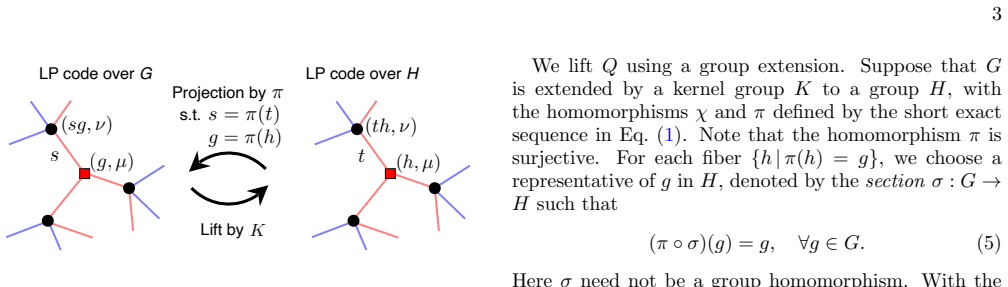
Proof.(1).We first construct the graph projectionpin- duced by the group homomorphismπ
Proof of Proposition 1 We complete the proof of Proposition 1. Proof.(1).We first construct the graph projectionpin- duced by the group homomorphismπ. LetT(Q) denote the Tanner graph of codeQ. A vertex ofT( eQ) is labeled by a pair (h, µ), whereh∈Handµlabels a basis element of the corresponding chain module; for example for anX- check vertex, a basis elem...
-
[2]
Since all maps areF 2-linear, it suffices to consider a basis vector
Proof of Proposition 2 Proof.We first verify the chain-map identities. Since all maps areF 2-linear, it suffices to consider a basis vector. We first consider basis vectors inQ 2: eA i h⊗e B j ∈Q 2, h∈H,(A8) wheree A i (eB j ) is a basis ofA 1 (B1). We also denote the basis forA 0 (B0) asf A i (f B j ). By the definition of∂ 2, ∂2 eA i h⊗e B j = X k f A k...
-
[3]
Low rate surgery In the ordinary low-rate (graph) surgery, the initial ancilla graph is constructed by the standard gauging and perfect-matching procedure [25]. Our heuristic approach, namelylifted graph surgery, uses this established protocol: we initialize an ancillary code for the base code, and takes the composite map with the transfer map. After init...
-
[4]
[24]; see Appendix E of its Supple- mental Material
High rate surgery The algorithm is based on the randomized construc- tion described in Ref. [24]; see Appendix E of its Supple- mental Material. In direct code surgery, the ancilla code and the associated chain maps are constructed directly for the lifted data code. In lifted code surgery, the an- cilla code is first constructed for the base code, and its...
-
[5]
Most of the subroutines are discussed in the main text
Code search We perform the numerical simulations for the code search using the programming languageGAP. Most of the subroutines are discussed in the main text. We discuss a technique to reduce the search space below. The com- plete procedure is summarized in Algorithm 1. As explained in Sec. II, a lift is specified by assign- ing an element ofKto every su...
-
[6]
We provide the bound- ary maps for simple cyclic groups where the ring admits a compact polynomial representation
Boundary map of LP codes Here we provide the boundary maps for selected lifted codes, summarized in Table VII. We provide the bound- ary maps for simple cyclic groups where the ring admits a compact polynomial representation. For other codes, the boundary map representation using theGAPrepre- sentation will be disclosed in a GitHub repository
-
[7]
The canonical logical operators in the gross code We first give explicit representatives of logical opera- tors in the gross codeJ144,12,12K. Let us first define the polynomials f= 1 +x+x 2 +x 3 +x 6 +x 7 +x 8 +x 9 +xy 3 +x 5y3 +x 7y3 +x 11y3 (C12) g=x+x 2y+y 2 +xy 2 +x 2y3 +y 4 (C13) h= 1 +y+xy+y 2 +y 3 +xy 3,(C14) and a set of monomials A={1, y, x2y, x2...
-
[8]
A. R. Calderbank and P. W. Shor, Good quantum error-correcting codes exist, Physical Review A54, 1098 (1996), arXiv:quant-ph/9512032
Pith/arXiv arXiv 1996
-
[9]
A. M. Steane, Multiple-particle interference and quan- tum error correction, Proceedings of the Royal Society of London A452, 2551 (1996), arXiv:quant-ph/9601029
Pith/arXiv arXiv 1996
-
[10]
N. P. Breuckmann and J. N. Eberhardt, Quantum low- density parity-check codes, PRX Quantum2, 040101 (2021)
2021
-
[11]
Panteleev and G
P. Panteleev and G. Kalachev, Degenerate quantum ldpc codes with good finite length performance, Quantum5, 585 (2021)
2021
-
[12]
Panteleev and G
P. Panteleev and G. Kalachev, Quantum ldpc codes with almost linear minimum distance, IEEE Transactions on Information Theory68, 213 (2022)
2022
-
[13]
Panteleev and G
P. Panteleev and G. Kalachev, Asymptotically good quantum and locally testable classical ldpc codes (2021)
2021
-
[14]
Q. Xu, J. P. Bonilla Ataides, C. A. Pattison, N. Raveen- dran, D. Bluvstein, J. Wurtz, B. Vasi´ c, M. D. Lukin, L. Jiang, and H. Zhou, Constant-overhead fault-tolerant quantum computation with reconfigurable atom arrays, Nature Physics20, 1084 (2024)
2024
-
[15]
M. Cain, Q. Xu, R. King, L. R. B. Picard, H. Levine, M. Endres, J. Preskill, H.-Y. Huang, and D. Bluvstein, 23 Shor’s algorithm is possible with as few as 10,000 recon- figurable atomic qubits (2026), arXiv:2603.28627 [quant- ph]
Pith/arXiv arXiv 2026
-
[16]
Bravyi, A
S. Bravyi, A. W. Cross, J. M. Gambetta, D. Maslov, P. Rall, and T. J. Yoder, High-threshold and low- overhead fault-tolerant quantum memory, Nature627, 778 (2024)
2024
-
[17]
Liang, K
Z. Liang, K. Liu, H. Song, and Y.-A. Chen, Generalized toric codes on twisted tori for quantum error correction, PRX Quantum6, 020357 (2025)
2025
-
[18]
T. R. Scruby, T. Hillmann, and J. Roffe, High-threshold, low-overhead and single-shot decodable fault-tolerant quantum memory, PRX Quantum7, 020310 (2026)
2026
-
[19]
R. Wang, H.-K. Lin, and L. P. Pryadko, Abelian and non-abelian quantum two-block codes (2023), arXiv:2305.06890 [quant-ph]
Pith/arXiv arXiv 2023
-
[20]
Lin and L
H.-K. Lin and L. P. Pryadko, Quantum two-block group algebra codes, Phys. Rev. A109, 022407 (2024)
2024
-
[21]
A. A. Kovalev and L. P. Pryadko, Quantum kronecker sum-product low-density parity-check codes with finite rate, Phys. Rev. A88, 012311 (2013)
2013
-
[22]
R. M. Tanner, A recursive approach to low complexity codes, IEEE Transactions on Information Theory27, 533 (1981)
1981
-
[23]
J.-P. Tillich and G. Zemor, Quantum ldpc codes with positive rate and minimum distance proportional to the square root of the blocklength, IEEE Transactions on Information Theory60, 1193 (2014), arXiv:0903.0566 [quant-ph]
Pith/arXiv arXiv 2014
-
[24]
Guemard, Lifts of quantum css codes (2024), arXiv:2404.16736 [quant-ph]
V. Guemard, Lifts of quantum css codes (2024), arXiv:2404.16736 [quant-ph]
Pith/arXiv arXiv 2024
-
[25]
Guemard, Lifting a css code via its handlebody real- ization (2025), arXiv:2505.14327 [quant-ph]
V. Guemard, Lifting a css code via its handlebody real- ization (2025), arXiv:2505.14327 [quant-ph]
Pith/arXiv arXiv 2025
-
[26]
B. C. B. Symons, A. Rajput, and D. E. Browne, Se- quences of bivariate bicycle codes from covering graphs (2025), arXiv:2511.13560 [quant-ph]
Pith/arXiv arXiv 2025
-
[27]
B. Gu, A. Z. Liu, A. O. Quintavalle, Q. Xu, J. Eisert, and J. Roffe, Qgpu: Parallel logic in quantum ldpc codes (2026), arXiv:2603.05398 [quant-ph]
arXiv 2026
-
[28]
D. Horsman, A. G. Fowler, S. Devitt, and R. Van Meter, Surface code quantum computing by lattice surgery, New Journal of Physics14, 123011 (2012), arXiv:1111.4022 [quant-ph]
Pith/arXiv arXiv 2012
-
[29]
A. Cowtan and S. Burton, Css code surgery as a universal construction, Quantum8, 1344 (2024), arXiv:2301.13738 [quant-ph]
Pith/arXiv arXiv 2024
-
[30]
Cowtan, Ssip: automated surgery with quantum ldpc codes (2024), arXiv:2407.09423 [quant-ph]
A. Cowtan, Ssip: automated surgery with quantum ldpc codes (2024), arXiv:2407.09423 [quant-ph]
Pith/arXiv arXiv 2024
- [31]
-
[32]
D. J. Williamson and T. J. Yoder, Low-overhead fault- tolerant quantum computation by gauging logical opera- tors, Nature Physics22, 598 (2026)
2026
-
[33]
A. W. Cross, Z. He, P. J. Rall, and T. J. Yoder, Improved qldpc surgery: Logical measurements and bridging codes (2025), arXiv:2407.18393 [quant-ph]
arXiv 2025
-
[34]
A. C. Yuan, A. Cowtan, Z. He, T.-C. Lin, and D. J. Williamson, Parsimonious quantum low-density parity- check code surgery (2026), arXiv:2603.05082 [quant-ph]
arXiv 2026
-
[35]
Z. He, A. Cowtan, D. J. Williamson, and T. J. Yoder, Extractors: Qldpc architectures for efficient pauli-based computation (2025), arXiv:2503.10390 [quant-ph]
arXiv 2025
-
[36]
Zhang and Y
G. Zhang and Y. Li, Time-efficient logical operations on quantum low-density parity check codes, Phys. Rev. Lett. 134, 070602 (2025)
2025
- [37]
-
[38]
Cowtan, Z
A. Cowtan, Z. He, D. J. Williamson, and T. J. Yoder, Parallel logical measurements via quantum code surgery, PRX Quantum7, 020325 (2026)
2026
-
[39]
L. Z. Cohen, I. H. Kim, S. D. Bartlett, and B. J. Brown, Low-overhead fault-tolerant quan- tum computing using long-range connectiv- ity, Science Advances8, eabn1717 (2022), https://www.science.org/doi/pdf/10.1126/sciadv.abn1717
-
[40]
B. Ide, M. G. Gowda, P. J. Nadkarni, and G. Dauphi- nais, Fault-tolerant logical measurements via homological measurement, Phys. Rev. X15, 021088 (2025)
2025
-
[41]
J. Y. Lee, Y.-Z. You, and C. Xu, Symmetry protected topological phases under decoherence, Quantum9, 1607 (2025)
2025
-
[42]
J. Y. Lee, C.-M. Jian, and C. Xu, Quantum criticality under decoherence or weak measurement, PRX Quantum 4, 030317 (2023)
2023
-
[43]
R. Fan, Y. Bao, E. Altman, and A. Vishwanath, Diag- nostics of mixed-state topological order and breakdown of quantum memory, PRX Quantum5, 020343 (2024)
2024
-
[44]
J. Y. Lee, Exact calculations of coherent information for toric codes under decoherence: Identifying the fun- damental error threshold, Phys. Rev. Lett.134, 250601 (2025)
2025
-
[45]
Niwa and J
R. Niwa and J. Y. Lee, Coherent information for calderbank-shor-steane codes under decoherence, Phys. Rev. A111, 032402 (2025)
2025
-
[46]
Colmenarez, Z.-M
L. Colmenarez, Z.-M. Huang, S. Diehl, and M. M¨ uller, Accurate optimal quantum error correction thresholds from coherent information, Phys. Rev. Res.6, L042014 (2024)
2024
-
[47]
Huang, L
Z.-M. Huang, L. Colmenarez, M. M¨ uller, and S. Diehl, Coherent information as a mixed-state topological order parameter of fermions, Phys. Rev. Res.7, 043009 (2025)
2025
-
[48]
A. Vijay and J. Y. Lee, Information critical phases under decoherence (2025), arXiv:2512.22121 [quant-ph]
arXiv 2025
-
[49]
T.-H. Yang, B. Shi, and J. Y. Lee, Topological mixed states: Phases of matter from axiomatic approaches, Phys. Rev. X (2026)
2026
-
[50]
Schumacher and M
B. Schumacher and M. A. Nielsen, Quantum data pro- cessing and error correction, Phys. Rev. A54, 2629 (1996)
1996
-
[51]
Horodecki, J
M. Horodecki, J. Oppenheim, and A. Winter, Quan- tum state merging and negative information, Commu- nications in Mathematical Physics269, 107 (2006)
2006
-
[52]
V. Gu´ emard and G. Z´ emor, Moderate-length lifted quan- tum tanner codes (2025), arXiv:2502.20297 [quant-ph]
arXiv 2025
-
[53]
A. Aydin, I. Tamo, and A. Barg, Breaking the bi- cycle frame: Coset-based quantum ldpc codes (2026), arXiv:2606.17268 [quant-ph]
Pith/arXiv arXiv 2026
-
[54]
This distinction matters when multiple edges connect the same pair of vertices
More precisely, the neighborhood ofvshould refer to the set ofedgesincident tov, not the set of vertices in general. This distinction matters when multiple edges connect the same pair of vertices. For Tanner graphs considered here, which are simple undirected graphs, the two descriptions are equivalent. We use the vertex-based definition in the main text ...
-
[55]
N. P. Breuckmann and J. N. Eberhardt, Balanced prod- uct quantum codes, IEEE Transactions on Information 24 Theory67, 6653 (2021)
2021
-
[56]
T. J. Yoder, E. Schoute, P. Rall, E. Pritchett, J. M. Gam- betta, A. W. Cross, M. Carroll, and M. E. Beverland, Tour de gross: A modular quantum computer based on bivariate bicycle codes (2025), arXiv:2506.03094 [quant- ph]
Pith/arXiv arXiv 2025
-
[57]
Hatcher,Algebraic topology(Cambridge University Press, 2002)
A. Hatcher,Algebraic topology(Cambridge University Press, 2002)
2002
-
[58]
L. P. Pryadko, V. A. Shabashov, and V. K. Kozin, Qdis- trnd: A gap package for computing the distance of quan- tum error-correcting codes, Journal of Open Source Soft- ware7, 4120 (2022). [52]GAP – Groups, Algorithms, and Programming, Version 4.13.1, The GAP Group (2024)
2022
-
[59]
Zhang, Y.-C
J. Zhang, Y.-C. Wu, and G.-P. Guo, Facilitating practical fault-tolerant quantum computing based on color codes, Phys. Rev. Res.6, 033086 (2024)
2024
-
[60]
In fact, this corresponds to theXmetachecks in the single-shot QEC literature
-
[61]
Onsager, Crystal statistics
L. Onsager, Crystal statistics. i. a two-dimensional model with an order-disorder transition, Phys. Rev.65, 117 (1944)
1944
-
[62]
R. J. Baxter, Exactly solved models in statistical me- chanics, inIntegrable Systems in Statistical Mechanics (WORLD SCIENTIFIC, 1985) pp. 5–63
1985
-
[63]
M. A. Nielsen and I. L. Chuang,Quantum computation and quantum information(Cambridge university press, 2010)
2010
-
[64]
Metropolis, A
N. Metropolis, A. W. Rosenbluth, M. N. Rosenbluth, A. H. Teller, and E. Teller, Equation of state calculations by fast computing machines, The Journal of Chemical Physics21, 1087 (1953)
1953
-
[65]
W. K. Hastings, Monte carlo sampling methods using markov chains and their applications, Biometrika57, 97 (1970)
1970
-
[66]
K. Hukushima and K. Nemoto, Exchange monte carlo method and application to spin glass simulations, Jour- nal of the Physical Society of Japan65, 1604 (1996), https://doi.org/10.1143/JPSJ.65.1604
-
[67]
W. D. Vousden, W. M. Farr, and I. Mandel, Dynamic temperature selection for parallel tempering in markov chain monte carlo simulations, Monthly Notices of the Royal Astronomical Society455, 1919 (2015)
1919
-
[68]
Haah, Commuting pauli hamiltonians as maps between free modules, Communications in Mathematical Physics 324, 351 (2013)
J. Haah, Commuting pauli hamiltonians as maps between free modules, Communications in Mathematical Physics 324, 351 (2013)
2013
-
[69]
K. Chen, Y. Liu, Y. Zhang, Z. Liang, Y.-A. Chen, K. Liu, and H. Song, Anyon theory and topological frustration of high-efficiency quantum low-density parity-check codes, Phys. Rev. Lett.135, 076603 (2025)
2025
-
[70]
J. Haah, Classification of translation invariant topolog- ical pauli stabilizer codes for prime dimensional qudits on two-dimensional lattices, Journal of Mathematical Physics62, 012201 (2021)
2021
-
[71]
Bombin, G
H. Bombin, G. Duclos-Cianci, and D. Poulin, Univer- sal topological phase of two-dimensional stabilizer codes, New Journal of Physics14, 073048 (2012)
2012
-
[72]
Haah, Algebraic methods for quantum codes on lattices, Revista Colombiana de Matem´ aticas50, 299 (2017)
J. Haah, Algebraic methods for quantum codes on lattices, Revista Colombiana de Matem´ aticas50, 299 (2017)
2017
-
[73]
Bomb ´ ın, Structure of 2d topological stabilizer codes, Communications in Mathematical Physics327, 387 (2014)
H. Bomb ´ ın, Structure of 2d topological stabilizer codes, Communications in Mathematical Physics327, 387 (2014)
2014
-
[74]
M. Freedman and M. B. Hastings, Building man- ifolds from quantum codes (2021), arXiv:2012.02249 [math.DG]
Pith/arXiv arXiv 2021
-
[75]
N. P. Breuckmann and S. Burton, Fold-transversal clif- ford gates for quantum codes, Quantum8, 1372 (2024)
2024
-
[76]
Sayginel, S
H. Sayginel, S. Koutsioumpas, M. Webster, A. Rajput, and D. E. Browne, Fault-tolerant logical clifford gates from code automorphisms, PRX Quantum6, 030343 (2025)
2025
-
[77]
N. Berthusen, M. J. Gullans, Y. Hong, M. Mudassar, and S. J. S. Tan, Automorphism gadgets in homological product codes (2025), arXiv:2508.04794 [quant-ph]
Pith/arXiv arXiv 2025
-
[78]
N. P. Breuckmann, M. Davydova, J. N. Eberhardt, and N. Tantivasadakarn, Cups and gates i: Cohomology in- variants and logical quantum operations, Communica- tions in Mathematical Physics407, 10.1007/s00220-026- 05570-z (2026)
-
[79]
Menon, J
V. Menon, J. P. Bonilla Ataides, R. Mehta, A. Gu, D. B. Tan, and M. D. Lukin, Magic tricycles: Efficient magic- state generation with finite block-length quantum ldpc codes, Phys. Rev. X16, 021014 (2026)
2026
-
[80]
C. Li, J. Preskill, and Q. Xu, Transversal dimension jump for product qldpc codes (2026), arXiv:2510.07269 [quant- ph]
arXiv 2026
discussion (0)
Sign in with ORCID, Apple, or X to comment. Anyone can read and Pith papers without signing in.