REVIEW 2 major objections 5 minor 65 references
A structure-preserving neural network, LLPNN, learns latent Lie–Poisson dynamics from observable data and reconstructs unobservable momentum trajectories via a conserved Noether invariant.
Reviewed by Pith at T0; open to challenge. T0 means a machine referee read the full paper against a public rubric. the ladder, T0–T4 →
T0 review · deepseek-v4-flash
2026-08-03 16:50 UTC pith:PYTX54BZ
load-bearing objection Clever Noether-based latent reconstruction and clean experiments, but the central identifiability claim is unproven and false for some linear Hamiltonians—overbroad as stated. the 2 major comments →
Latent Lie-Poisson Neural Networks (LLPNNs): Discovering the motion of Lie-Poisson systems through observable data and latent dynamics
The pith
A machine-rendered reading of the paper's core claim, the machinery that carries it, and where it could break.
Core claim
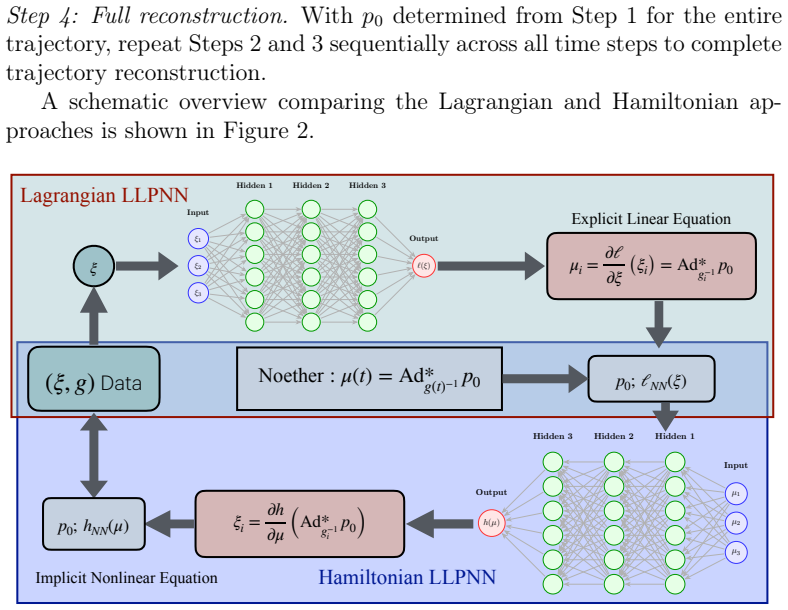
Central claim: if the observed configuration g(t) evolves on a known Lie group G and the reduced Hamiltonian h(μ) is time-independent, then the unobservable momentum μ(t) is exactly Ad*_{g(t)} p0 for a constant, per-trajectory spatial momentum p0. This identity turns the learning problem into one of fitting h(μ) (or a pseudo-Lagrangian on active velocities) and a constant vector p0 per trajectory from data; once p0 is found from a short fitting window, both observable and latent trajectories are reconstructed by coadjoint updates and Magnus-based group dynamics. The framework therefore works for degenerate Hamiltonians, where the observable variables need not admit an autonomous evolution eq
What carries the argument
The central object is the coadjoint reconstruction identity μ(t)=Ad*_{g(t)} p0, a direct consequence of Noether's theorem for time-independent, left-invariant Lie–Poisson systems. It provides an exact bridge from the observed configuration g(t) to the unobservable momentum μ(t). Combined with a Hamiltonian decoder h(μ) or a pseudo-Lagrangian encoder ℓ(ξ_act), it yields residual equations for the next step that are solved with a second-order Magnus expansion and Newton–Raphson root-finding. Because each latent update is a coadjoint action, the flow remains on coadjoint orbits and preserves all Casimirs to machine precision.
Load-bearing premise
The entire latent reconstruction rests on the assumption that the system has a known, time-independent Lie-group symmetry, so Noether's theorem yields a constant spatial momentum p0 for each trajectory; if the symmetry is broken or the group is unknown, the mapping μ(t)=Ad*_{g(t)} p0 collapses and the method cannot be formulated.
What would settle it
Train the method on a Hamiltonian system with a known Lie-group symmetry but with a small symmetry-breaking potential added. If reconstruction error grows systematically with the symmetry-breaking magnitude and p0 drifts, the Noether-based identity is falsified. More directly, construct an observation operator that hides the active momentum component: if p0 cannot be recovered from the short fitting window even with clean data, the latent reconstruction fails in a way the paper leaves open.
If this is right
- Long-term prediction of symmetry-reduced Hamiltonian systems becomes possible from observable data alone, with machine-precision Casimir conservation built into the architecture.
- Degenerate Hamiltonian systems, including optimal control problems with unobservable co-states, become learnable even when no Euler–Poincaré or Lagrangian formulation exists.
- The learned Hamiltonian closely matches the true Hamiltonian (absolute errors around 1e-4 in the tested region), suggesting the method recovers the physical or control Hamiltonian, not merely trajectory fits.
- The framework handles both regular systems and systems with passive coordinates, with active and passive variables split from data by identifying constant velocity components.
- Reconstruction is robust to moderate observational noise (η=0.005), with degraded but still accurate long-term predictions in the tested examples.
Where Pith is reading between the lines
- A direct consequence of the paper's identity is that, for any time-independent Lie–Poisson system with known symmetry, the latent momentum is identifiable up to an overall scale from configuration data alone—if p0 is recoverable from a short window. This suggests a general observability criterion could be developed for Lie–Poisson systems.
- The framework could be extended to inverse optimal control: by learning the Hamiltonian from observed agent trajectories, one might recover the underlying cost or coordination structure without ever measuring co-states.
- The paper itself flags that the known-symmetry assumption is restrictive (Limitation 1, Section 5) and that p0 identifiability under general observation operators remains open (Section 6). A natural next step is to characterize when the short fitting window is sufficient.
- Since the reconstruction identity depends on g(t) but not directly on ξ(t), replacing velocity observations with finite differences of g might make the method applicable to position-only data; this is an editorial inference, not a claim of the paper.
Editorial analysis
A structured set of objections, weighed in public.
Referee Report
Summary. The paper introduces Latent Lie–Poisson Neural Networks (LLPNNs), a geometric deep-learning method for systems whose state is a Lie–Poisson momentum μ(t) that is not directly observed. Available data are Lie-group configurations g(t) and reduced velocities ξ(t). The central identity is Noether's theorem: for a left-invariant Hamiltonian, the spatial momentum p0 is constant per trajectory and μ(t)=Ad^*_{g(t)} p0. The paper develops two training variants: a Hamiltonian decoder that learns h(μ)≈h_NN(μ) and fits p0 per trajectory via the nonlinear loss (23); and a pseudo-Lagrangian encoder that learns ℓ(ξ_act) and fits p0 from a linear system (32). Reconstruction propagates μ by coadjoint actions and g by a second-order Magnus update, so Casimirs are preserved exactly. The method is demonstrated on a non-quadratic rigid body (SO(3)), Kirchhoff's underwater vehicle (SE(3)), and a degenerate three-vehicle optimal-control Hamiltonian (SE(2)^3), reporting long-horizon MAE and conservation errors below baselines (Neural ODE, DeepONet, LPNet).
Significance. If the identifiability issues are resolved, the paper makes a useful contribution: it provides a principled way to infer latent momentum variables from observable data by leveraging the Noether constant, and it handles degenerate Hamiltonians for which an Euler–Poincaré formulation does not exist. The construction is elegant and the numerical evidence is encouraging; Casimir conservation is exact by construction rather than by penalty. The code is publicly available, which supports reproducibility. However, the central claim of latent reconstruction is not universally valid without an observability condition on p0, and the paper's own Section 6 acknowledges the gap. The recommendations below therefore ask for a sharpened statement of scope and either a proof or explicit assumption of identifiability.
major comments (2)
- [Section 3.1.1 / 6 (Eqs. (10), (21)–(23))] The reconstruction of μ(t) is predicated on identifiability of p0 from a short window of (g,ξ), but no sufficient condition is given. This is not a technicality: there are Hamiltonians satisfying all stated assumptions for which p0 is completely unobservable. For SE(2)^N with Ψ=0 in Eq. (65), h(μ)=Σ_k μ_{k1}. Then ξ_k=(1,0,0) for every μ, so g(t)=g0 exp(t ξ) and the entire observed trajectory is independent of μ. The LLPNN loss (23) vanishes identically for any p0, and the learned latent trajectory is arbitrary. This is a linear, time-independent Hamiltonian inside the paper's scope. The paper should either formulate and prove observability conditions on (h, observation map), or explicitly restrict the central claims to systems for which p0 is identifiable. As written, the abstract and Section 2.3 overstate the generality.
- [Remark 2.1 / Section 4] The momentum scale ambiguity in Remark 2.1 means that μ is only reconstructed up to a positive constant c; the reported latent trajectories are rescaled post hoc using an initial test window or Hessian trace. Consequently, the method does not identify the physical scale of the momentum/co-state from observable data. This is a second fundamental identifiability gap that should be stated in the abstract and conclusions. The quantitative latent momentum errors reported in Figures 4, 9, and 13 are scale-adjusted, and the text should make this explicit rather than presenting them as direct estimates of μ.
minor comments (5)
- [Section 3.6] The LPNet baseline is trained on latent trajectories produced by the learned LLPNN Hamiltonian, as the paper states. This comparison should be presented as a sanity check, not as evidence that LPNet would fail if given true latent data. Please add a clear caveat in the results section and avoid drawing strong conclusions from this baseline.
- [Equations (26)–(27)] Notation is inconsistent: h is used both for the Hamiltonian and for the time step in (27). Use Δt or τ for the time step and make the Magnus residual equation dimensionally explicit.
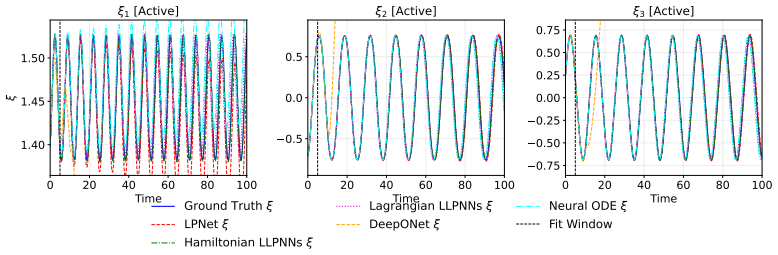
- [Figure captions (Figures 3, 4, 12, 13)] The 'Fit Window' is not quantitatively specified in the captions. Please state N_fit and the noise level for each figure, and define the legend entries consistently across panels.
- [Section 4.2] Training and test initial momenta are drawn from different distributions (N(0,I3) vs. N(0,0.25I3)). The paper does not discuss why this distribution shift was chosen or its effect on generalization. Please comment on this choice in the text.
- [References] Reference [23] contains a typo in the author name ('Vakhtangee'); the name should be corrected. Please also check reference formatting throughout.
Circularity Check
Core derivation is independent supervised Lie–Poisson learning; only the post-hoc momentum-scale calibration is a fitted (not predicted) quantity, and the paper's own observability limitation is a correctness caveat, not circularity.
specific steps
-
fitted input called prediction
[Remark 2.1 (Momentum Gauge Ambiguity and Scaling); cf. Figures 4/9/13 'Scaled Momentum Components']
"Because ch(µ/c) generates identical velocity fields ξ, the absolute scale of µ cannot be uniquely determined from velocity observations alone. To evaluate learned latent states against physical ground-truth trajectories, predicted momenta are rescaled post-hoc using the Hessian trace ratio at the origin or a scale factor estimated from an initial test window."
The latent-momentum reconstruction μ(t)=Ad*_{g(t)} p0 inherits the gauge freedom of Eq. (10): any rescaling of p0 (equivalently of h) yields exactly the same observable velocity data. The paper therefore cannot identify the absolute magnitude of μ from observable data alone, and it supplies the missing scale post-hoc using ground-truth information or the test window. The reported 'Scaled Momentum Components' thus compare ground truth against a curve whose absolute scale was fitted/calibrated to the target, so the magnitude part of the latent 'reconstruction' is fitted rather than predicted. This is a disclosed, partial circularity; the future velocity predictions and the shape of μ(t) remain genuinely out-of-sample.
full rationale
I walked the derivation chain: Eq. (10) (Noether coadjoint reconstruction) is standard textbook mechanics; the passive/active split and ansatz (20) are stated modeling assumptions, not definitions of the target quantities. Training minimizes (23) jointly over h_NN and per-trajectory p0_j, which is supervised fitting, and test-time p0 is fitted to a short initial window (Eqs. 24, 33) before forecasting the remaining trajectory — ordinary initial-condition fitting, not a circular prediction. The self-citations [27]–[29] are used for baseline LPNets and for the SE(2)^N optimal-control model, but the load-bearing reconstruction formula is not imported from those papers as an unverified uniqueness result. The only concrete circular element is Remark 2.1: because the absolute scale of μ is unidentifiable from ξ, the paper rescales predicted momenta post-hoc using the Hessian trace ratio or a test-window scale factor, so the reported momentum magnitude is fitted, not predicted. Section 6 explicitly says observability of p0 remains an open question; that is a genuine identifiability limitation and a correctness risk, but it is not a circular derivation. Overall the central velocity-prediction claim is self-contained and out-of-sample, so the circularity score is low.
Axiom & Free-Parameter Ledger
free parameters (4)
- Noether constant p0^j per training trajectory =
M trajectories × dim(g*) (e.g., 3 for SO(3), 6 for SE(3), 9 for SE(2)^3)
- Neural network weights W for h_NN or ℓ_NN =
~2K parameters per network (3 hidden layers × 32 units)
- Warm-start matrices B and K =
K × K symmetric matrices
- Post-hoc momentum scale factor =
estimated per trajectory from initial test window or Hessian trace ratio
axioms (4)
- domain assumption The system has a known Lie group symmetry G and its Lie–Poisson bracket Λ(µ) is known a priori; the Hamiltonian h(µ) is unknown but time-independent.
- standard math Conserved spatial momentum p0 exists and is constant per trajectory (Noether's theorem)
- domain assumption Observed data comprise both group elements g(t) and velocities ξ(t), with enough information to determine p0 from a short fitting window
- domain assumption Active/passive decomposition of coordinates is identifiable from data (Definition 3.1) and passive velocities are constant; active velocity–momentum map is locally invertible for the Lagrangian LLPNN (Eq. 29)
read the original abstract
Structure-preserving neural networks are essential for the long-term prediction of Hamiltonian systems from data. Many important Hamiltonian systems in mechanics and control admit symmetry reduction to Lie--Poisson systems, including rigid bodies, underwater vehicles, fluids, plasmas, and optimal control problems. A fundamental challenge in learning such systems is that their dynamics evolve in momentum variables that are typically unobservable, while available data consist only of observable quantities such as configurations and velocities. In optimal control applications, the situation is further complicated because the latent variables contain unobservable co-states and the Hamiltonian may be degenerate, preventing the existence of a corresponding Lagrangian and rendering the encoder-decoder approaches inapplicable. We introduce Latent Lie--Poisson Neural Networks (LLPNNs), a structure-preserving framework for learning Lie--Poisson dynamics directly from observable data. The proposed approach exploits three geometric ingredients: (i) learning either a Hamiltonian decoder or a pseudo-Lagrangian encoder on the active variables, (ii) constructing latent trajectories through a universal Noether invariant arising from Lie--Poisson symmetry reduction, and (iii) reconstructing observable and latent dynamics through Lie--Poisson flows combined with Magnus-based Lie-group updates. The resulting method preserves the geometric structure and is applicable to both regular and degenerate Hamiltonian systems. We demonstrate the method on three examples: a generalized rigid body on SO(3), Kirchhoff's underwater vehicle on SE(3), and an optimal-control problem for interacting vehicles on $SE(2)^N$. Numerical experiments show excellent long-term predictive accuracy, strong robustness to noise, and competitive performance using only modest datasets and lightweight neural-network architectures.
Figures



Reference graph
Works this paper leans on
-
[1]
Maziar Raissi, Paris Perdikaris, and George E Karniadakis. Physics- informed neural networks: A deep learning framework for solving for- ward and inverse problems involving nonlinear partial differential equa- tions.Journal of Computational physics, 378:686–707, 2019
2019
-
[2]
Physics-informed machine learning.Nature Reviews Physics, 3(6):422–440, 2021
George Em Karniadakis, Ioannis G Kevrekidis, Lu Lu, Paris Perdikaris, Sifan Wang, and Liu Yang. Physics-informed machine learning.Nature Reviews Physics, 3(6):422–440, 2021. 55
2021
-
[3]
Salvatore Cuomo, Vincenzo Schiano Di Cola, Fabio Giampaolo, Gian- luigi Rozza, Maizar Raissi, and Francesco Piccialli. Scientific machine learning through physics-informed neural networks: Where we are and what’s next.arXiv preprint arXiv:2201.05624, 2022
Pith/arXiv arXiv 2022
-
[4]
Neural ordinary differential equations.arXiv preprint arXiv:1806.07366, 2018
Ricky TQ Chen, Yulia Rubanova, Jesse Bettencourt, and David Duvenaud. Neural ordinary differential equations.arXiv preprint arXiv:1806.07366, 2018
Pith/arXiv arXiv 2018
-
[5]
Learning nonlinear operators via deeponet based on the universal approximation theorem of operators.Nature machine intelli- gence, 3(3):218–229, 2021
Lu Lu, Pengzhan Jin, Guofei Pang, Zhongqiang Zhang, and George Em Karniadakis. Learning nonlinear operators via deeponet based on the universal approximation theorem of operators.Nature machine intelli- gence, 3(3):218–229, 2021
2021
-
[6]
Hamiltonian neural networks.Advances in neural information processing systems, 32, 2019
Samuel Greydanus, Misko Dzamba, and Jason Yosinski. Hamiltonian neural networks.Advances in neural information processing systems, 32, 2019
2019
-
[7]
Adaptable Hamiltonian neural networks.Physical Review Research, 3(2):023156, 2021
Chen-Di Han, Bryan Glaz, Mulugeta Haile, and Ying-Cheng Lai. Adaptable Hamiltonian neural networks.Physical Review Research, 3(2):023156, 2021
2021
-
[8]
Symplectic learning for Hamiltonian neural networks.arXiv preprint arXiv:2106.11753, 2021
Marco David and Florian Méhats. Symplectic learning for Hamiltonian neural networks.arXiv preprint arXiv:2106.11753, 2021
Pith/arXiv arXiv 2021
-
[9]
Lagrangian neural networks.arXiv preprint arXiv:2003.04630, 2020
Miles Cranmer, Sam Greydanus, Stephan Hoyer, Peter Battaglia, David Spergel, and Shirley Ho. Lagrangian neural networks.arXiv preprint arXiv:2003.04630, 2020
Pith/arXiv arXiv 2003
-
[10]
Direct Poisson neural networks: Learning non-symplectic mechanical systems
Martin Šípka, Michal Pavelka, Oğul Esen, and Miroslav Grmela. Direct Poisson neural networks: Learning non-symplectic mechanical systems. arXiv preprint arXiv:2305.05540, 2023
Pith/arXiv arXiv 2023
-
[11]
A global structure- preserving kernel method for the learning of poisson systems.Journal of Nonlinear Science, 35(4):79, 2025
Jianyu Hu, Juan-Pablo Ortega, and Daiying Yin. A global structure- preserving kernel method for the learning of poisson systems.Journal of Nonlinear Science, 35(4):79, 2025
2025
-
[12]
Discrete mechanics and varia- tional integrators.Acta numerica, 10:357–514, 2001
Jerrold E Marsden and Matthew West. Discrete mechanics and varia- tional integrators.Acta numerica, 10:357–514, 2001. 56
2001
-
[13]
General techniques for constructing variational integrators.Frontiers of Mathematics in China, 7:273–303, 2012
Melvin Leok and Tatiana Shingel. General techniques for constructing variational integrators.Frontiers of Mathematics in China, 7:273–303, 2012
2012
-
[14]
Spectral variational integrators.Nu- merische Mathematik, 130:681–740, 2015
James Hall and Melvin Leok. Spectral variational integrators.Nu- merische Mathematik, 130:681–740, 2015
2015
-
[15]
Springer Science & Business Media, 2013
Vladimir Igorevich Arnol’d.Mathematical Methods of Classical Mechan- ics, volume 60. Springer Science & Business Media, 2013
2013
-
[16]
Marsden and T
J.E. Marsden and T. Ratiu.Introduction to Mechanics and Symmetry: a basic exposition of classical mechanical systems, volume 17. Springer Science & Business Media, 2013
2013
-
[17]
Springer, 2025
Vakhtang Putkaradze.A Concise Introduction to Classical Mechanics. Springer, 2025
2025
-
[18]
Symplectic recurrent neural networks.International Conference on Learning Representations, 2020
Zhengdao Chen, Jianyu Zhang, Martin Arjovsky, and Léon Bottou. Symplectic recurrent neural networks.International Conference on Learning Representations, 2020
2020
-
[19]
Nonseparable symplectic neural networks.arXiv preprint arXiv:2010.12636, 2020
Shiying Xiong, Yunjin Tong, Xingzhe He, Shuqi Yang, Cheng Yang, and Bo Zhu. Nonseparable symplectic neural networks.arXiv preprint arXiv:2010.12636, 2020
Pith/arXiv arXiv 2010
-
[20]
Explicit symplectic approximation of nonseparable Hamil- tonians: Algorithm and long time performance.Physical Review E, 94(4):043303, 2016
Molei Tao. Explicit symplectic approximation of nonseparable Hamil- tonians: Algorithm and long time performance.Physical Review E, 94(4):043303, 2016
2016
-
[21]
Harsh Choudhary, Vyacheslav Kungurtsev, Chandan Gupta, Melvin Leok, and Georgios Korpas. Symplectic neural networks for learning generalized hamiltonians.arXiv preprint arXiv:2606.27029, 2026
Pith/arXiv arXiv 2026
-
[22]
Harsh Sharma, David A Najera-Flores, Michael D Todd, and Boris Kramer. Lagrangian operator inference enhanced with structure- preservingmachinelearningfornonintrusivemodelreductionofmechan- ical systems.Computer Methods in Applied Mechanics and Engineering, 423:116865, 2024
2024
-
[23]
ChristopherEldred, FrançoisGay-Balmaz, andVakhtangee. Variational neural networks for observable thermodynamics (v-nots).arXiv preprint arXiv:2509.09899, 2025. 57
arXiv 2025
-
[24]
SympNets: Intrinsic structure-preserving symplectic net- works for identifying Hamiltonian systems.Neural Networks, 132:166– 179, 2020
Pengzhan Jin, Zhen Zhang, Aiqing Zhu, Yifa Tang, and George Em Karniadakis. SympNets: Intrinsic structure-preserving symplectic net- works for identifying Hamiltonian systems.Neural Networks, 132:166– 179, 2020
2020
-
[25]
Data-driven prediction of general Hamil- tonian dynamics via learning exactly-symplectic maps
Renyi Chen and Molei Tao. Data-driven prediction of general Hamil- tonian dynamics via learning exactly-symplectic maps. InInternational Conference on Machine Learning, pages 1717–1727. PMLR, 2021
2021
-
[26]
Fast neural Poincaré maps for toroidal magnetic fields.Plasma Physics and Controlled Fu- sion, 63(2):024001, 2020
Joshua William Burby, Qi Tang, and R Maulik. Fast neural Poincaré maps for toroidal magnetic fields.Plasma Physics and Controlled Fu- sion, 63(2):024001, 2020
2020
-
[27]
Lie–Poisson Neural Networks (LPNets): Data-Based Com- puting of Hamiltonian Systems with Symmetries.Neural Networks, 173:106162, 2024
Christopher Eldred, François Gay-Balmaz, Sofiia Huraka, and Vakhtang Putkaradze. Lie–Poisson Neural Networks (LPNets): Data-Based Com- puting of Hamiltonian Systems with Symmetries.Neural Networks, 173:106162, 2024
2024
-
[28]
Clpnets: Coupledlie–poissonneuralnetworksformulti-parthamiltonian systems with symmetries.Neural Networks, 189:107441, 2025
Christopher Eldred, François Gay-Balmaz, and Vakhtang Putkaradze. Clpnets: Coupledlie–poissonneuralnetworksformulti-parthamiltonian systems with symmetries.Neural Networks, 189:107441, 2025
2025
-
[29]
Sofiia Huraka and Vakhtang Putkaradze. Structure-preserving learning and prediction in optimal control of collective motion.arXiv preprint arXiv:2601.06770, 2026
arXiv 2026
-
[30]
Springer, 01 2013
Enzo Tonti.The Mathematical Structure of Classical and Relativistic Physics: A General Classification Diagram. Springer, 01 2013
2013
-
[31]
Learning Poisson systems and trajectories of autonomous sys- tems via Poisson neural networks.IEEE Transactions on Neural Net- works and Learning Systems, 2022
Pengzhan Jin, Zhen Zhang, Ioannis G Kevrekidis, and George Em Kar- niadakis. Learning Poisson systems and trajectories of autonomous sys- tems via Poisson neural networks.IEEE Transactions on Neural Net- works and Learning Systems, 2022
2022
-
[32]
StatisticalmechanicsofArakawa’s discretizations.Journal of Computational Physics, 227(2):1286–1305, 2007
SvetlanaDubinkinaandJasonFrank. StatisticalmechanicsofArakawa’s discretizations.Journal of Computational Physics, 227(2):1286–1305, 2007
2007
-
[33]
De- signing Poisson integrators through machine learning.arXiv preprint arXiv:2403.20139, 2024
Miguel Vaquero, David Martín de Diego, and Jorge Cortés. De- signing Poisson integrators through machine learning.arXiv preprint arXiv:2403.20139, 2024. 58
Pith/arXiv arXiv 2024
-
[34]
Symmetry preservation in hamiltonian systems: Simulation and learning.Journal of Nonlinear Science, 34(6):115, 2024
Miguel Vaquero, Jorge Cortés, and David Martín de Diego. Symmetry preservation in hamiltonian systems: Simulation and learning.Journal of Nonlinear Science, 34(6):115, 2024
2024
-
[35]
Locally-symplectic neural networks for learning volume- preserving dynamics.Journal of Computational Physics, 476:111911, 2023
J¯ anis Baj¯ ars. Locally-symplectic neural networks for learning volume- preserving dynamics.Journal of Computational Physics, 476:111911, 2023
2023
-
[36]
Learning to predict 3d rotational dynamics from images of a rigid body with unknown mass distribution.Aerospace, 10(11):921, 2023
Justice J Mason, Christine Allen-Blanchette, Nicholas Zolman, Eliz- abeth Davison, and Naomi Ehrich Leonard. Learning to predict 3d rotational dynamics from images of a rigid body with unknown mass distribution.Aerospace, 10(11):921, 2023
2023
-
[37]
Optimal control problem via neural networks.Neural Computing and Applications, 23(7):2093–2100, 2013
Sohrab Effati and Morteza Pakdaman. Optimal control problem via neural networks.Neural Computing and Applications, 23(7):2093–2100, 2013
2093
-
[38]
Springer Science & Business Media, 2013
R Gamkrelidze.Principles of Optimal Control theory, volume 7. Springer Science & Business Media, 2013
2013
-
[39]
Optimal control via neural networks: A convex approach.arXiv preprint arXiv:1805.11835, 2018
Yize Chen, Yuanyuan Shi, and Baosen Zhang. Optimal control via neural networks: A convex approach.arXiv preprint arXiv:1805.11835, 2018
Pith/arXiv arXiv 2018
-
[40]
Intelligent opti- mal control of robotic manipulators using neural networks.Automatica, 36(9):1355–1364, 2000
Young H Kim, Frank L Lewis, and Darren M Dawson. Intelligent opti- mal control of robotic manipulators using neural networks.Automatica, 36(9):1355–1364, 2000
2000
-
[41]
Real-time optimal control via deep neural networks: Study on landing problems.Journal of Guidance, Control, and Dynamics, 41(5):1122–1135, 2018
Carlos Sánchez-Sánchez and Dario Izzo. Real-time optimal control via deep neural networks: Study on landing problems.Journal of Guidance, Control, and Dynamics, 41(5):1122–1135, 2018
2018
-
[42]
When optimal control meets neural network: A comprehensive survey.Archives of Computational Methods in Engineering, pages 1–56, 2026
Xinwei Wang, Yuqi Dou, Xueling Yi, Yepeng Zhang, Xin Li, Bai Li, Haijun Peng, Lei Wang, and Kok Lay Teo. When optimal control meets neural network: A comprehensive survey.Archives of Computational Methods in Engineering, pages 1–56, 2026
2026
-
[43]
D. D. Holm.Geometric Mechanics: Rotating, translating, and rolling. Geometric Mechanics. Imperial College Press, 2011. 59
2011
-
[44]
Optimal Control and Poisson reduction
Perinkulam S Krishnaprasad. Optimal Control and Poisson reduction. Institute for Systems Research Technical Reports, 1993
1993
-
[45]
Bloch.Nonholonomic Mechanics and Control, volume 24
A.M. Bloch.Nonholonomic Mechanics and Control, volume 24. Springer, New York, 2003
2003
-
[46]
Extremal collective behavior
Eric W Justh and PS Krishnaprasad. Extremal collective behavior. In 49th IEEE Conference on Decision and Control (CDC), pages 5432–
-
[47]
Optimality, reduction and collec- tive motion.Proceedings of the Royal Society A: Mathematical, Physical and Engineering Sciences, 471(2177):20140606, 2015
Eric W Justh and PS Krishnaprasad. Optimality, reduction and collec- tive motion.Proceedings of the Royal Society A: Mathematical, Physical and Engineering Sciences, 471(2177):20140606, 2015
2015
-
[48]
Symmetry reduced dynamics of charged molecularstrands.Archive for rational mechanics and analysis, 197:811– 902, 2010
David CP Ellis, François Gay-Balmaz, Darryl D Holm, Vakhtang Putkaradze, and Tudor S Ratiu. Symmetry reduced dynamics of charged molecularstrands.Archive for rational mechanics and analysis, 197:811– 902, 2010
2010
-
[49]
On cayley-transform methods for the discretization of lie- group equations.Foundations of Computational Mathematics, 1(2):129– 160, 2001
Arieh Iserles. On cayley-transform methods for the discretization of lie- group equations.Foundations of Computational Mathematics, 1(2):129– 160, 2001
2001
-
[50]
Cambridge University Press, 2022
Steven L Brunton and J Nathan Kutz.Data-driven science and engi- neering: Machine learning, dynamical systems, and control. Cambridge University Press, 2022
2022
-
[51]
Springer, 2006
Jorge Nocedal and Stephen J Wright.Numerical optimization. Springer, 2006
2006
-
[52]
Universal ap- proximation of an unknown mapping and its derivatives using multilayer feedforward networks.Neural networks, 3(5):551–560, 1990
Kurt Hornik, Maxwell Stinchcombe, and Halbert White. Universal ap- proximation of an unknown mapping and its derivatives using multilayer feedforward networks.Neural networks, 3(5):551–560, 1990
1990
-
[53]
CUP Archive, 1964
Edmund Taylor Whittaker.A treatise on the analytical dynamics of particles and rigid bodies. CUP Archive, 1964
1964
-
[54]
Springer Science & Business Media, 2013
Derek F Lawden.Elliptic functions and applications. Springer Science & Business Media, 2013
2013
-
[55]
Stability of a bottom-heavy underwater vehicle
Naomi Ehrich Leonard. Stability of a bottom-heavy underwater vehicle. Automatica, 33(3):331–346, 1997. 60
1997
-
[56]
Stability and drift of underwater vehicle dynamics: mechanical systems with rigid motion symmetry.Physica D: Nonlinear Phenomena, 105(1-3):130–162, 1997
Naomi Ehrich Leonard and Jerrold E Marsden. Stability and drift of underwater vehicle dynamics: mechanical systems with rigid motion symmetry.Physica D: Nonlinear Phenomena, 105(1-3):130–162, 1997
1997
-
[57]
Dynamics of the Kirchhoff equations i: Coincident centers of gravity and buoyancy
Philip Holmes, Jeffrey Jenkins, and Naomi Ehrich Leonard. Dynamics of the Kirchhoff equations i: Coincident centers of gravity and buoyancy. Physica D: Nonlinear Phenomena, 118(3-4):311–342, 1998
1998
-
[58]
The Euler– Poincaré equations and semidirect products with applications to contin- uum theories.Advances in Mathematics, 137(1):1–81, 1998
Darryl D Holm, Jerrold E Marsden, and Tudor S Ratiu. The Euler– Poincaré equations and semidirect products with applications to contin- uum theories.Advances in Mathematics, 137(1):1–81, 1998
1998
-
[59]
Oxford University Press, 2009
Darryl D Holm, Tanya Schmah, and Cristina Stoica.Geometric Me- chanics and Symmetry: from finite to infinite dimensions, volume 12. Oxford University Press, 2009
2009
-
[60]
Springer Science & Business Media, 2013
Jerrold E Marsden and Tudor S Ratiu.Introduction to mechanics and symmetry: a basic exposition of classical mechanical systems, volume 17. Springer Science & Business Media, 2013
2013
-
[61]
Optimal control problems with symmetry breaking cost functions
Anthony M Bloch, Leonardo J Colombo, Rohit Gupta, and Tomoki Oh- sawa. Optimal control problems with symmetry breaking cost functions. SIAM Journal on Applied Algebra and Geometry, 1(1):626–646, 2017
2017
-
[62]
Structure- preserving learning of nonholonomic dynamics.arXiv preprint arXiv:2603.27580, 2026
Thomas Beckers, Anthony Bloch, and Leonardo Colombo. Structure- preserving learning of nonholonomic dynamics.arXiv preprint arXiv:2603.27580, 2026. Appendix A. Lie Groups and their actions Appendix A.1. General definitions In this short exposition, we closely follow the notation and definitions of [16]. A Lie group is a groupGthat is also a smooth manifol...
arXiv 2026
-
[63]
There exists an identity elemente∈Gsuch thateg=ge=gfor any g∈G,
-
[64]
For anyg, h∈G, the product satisfiesgh∈G, 61
-
[65]
As shown below, the tangent space at the identity is naturally endowed with a commutator bracket
For anyg∈G, there exists an inverse elementg −1 ∈Gsuch that gg −1 =g −1g=e. As shown below, the tangent space at the identity is naturally endowed with a commutator bracket. To define this bracket, we first introduce the relevant group actions. Adjoint Group Actions.Suppose we have smooth curvesg(s)∈Gandh(t)∈ Gpassing through the identityeat parameter zer...
discussion (0)
Sign in with ORCID, Apple, or X to comment. Anyone can read and Pith papers without signing in.