REVIEW 4 major objections 5 minor 39 references
Simulating quantum circuits as SQL can win on memory for over half of generated circuits, and simple models predict the faster engine up to 95% accuracy.
Reviewed by Pith at T0; open to challenge. T0 means a machine referee read the full paper against a public rubric. the ladder, T0–T4 →
2026-08-03 13:02 UTC pith:RN3U2ACN
load-bearing objection A genuinely useful benchmark for SQL-based quantum simulation, but the missing SQL correctness check guts the empirical claims until fixed. the 4 major comments →
InferQ: A Database-Oriented Benchmark for Quantum Circuits Simulation
The pith
A machine-rendered reading of the paper's core claim, the machinery that carries it, and where it could break.
Core claim
The central claim is that a broad, compositionally generated family of quantum circuits can be expressed as a relational workload—specifically a chain of common table expressions implementing tensor contractions as joins and aggregates—and that this representation is not only executable but systematically useful. Relational engines achieve lower peak memory than a widely used quantum simulator on more than half of the generated circuits, and they can complete sparse 40–45 qubit circuits out of core when exact in-memory state-vector simulation is impossible. The paper further claims that the extracted features make backend choice predictable: a lightweight tree-based router attains 95.3% accu
What carries the argument
The load-bearing mechanism is a template-based, history-dependent circuit generator: it samples a sequence of quantum algorithm primitives (state preparation, Hamiltonian simulation, QFT, QPE, Grover iterations, and similar) with feasibility masking and synergy reweighting, then instantiates and composes the subcircuits. Around it sits the SQL compilation chain, which converts tensor contractions into a CTE chain of join-and-aggregate queries, and a four-part feature extractor (static, graph, SQL, and dynamic) that maps each circuit to a vector used for routing and prediction. The Markov transition model provides scale and diversity; the CTE chain exposes simulation to database query optimiz
Load-bearing premise
The whole evaluation rests on the assumption that the generated SQL actually computes the same state vector as the quantum circuit; the paper delegates this to an external implementation and leaves correctness checks to future work.
What would settle it
Run the emitted SQL for a stratified sample of InferQ circuits, including dense ones, and compare the final state vector against the exact statevector result from a standard quantum simulator; any significant mismatch would mean the runtime and memory measurements are for a different computation.
If this is right
- Database query optimizers can be studied and improved on reproducible quantum-simulation workloads, including index selection, join ordering, and materialization choices.
- Out-of-core relational execution extends exact simulation to sparse circuits with 40–45 qubits, beyond the reach of dense in-memory state-vector simulators.
- A lightweight learned router can replace hand-assigned engine choices, with claimed accuracies up to 95.3% for runtime and 97.4% for memory.
- Dynamic properties like Shannon entropy and sparsity can be estimated without full simulation using static, graph, and SQL features (a tree regressor reaches R-squared about 0.89 for entropy).
- Forcing CTE materialization can roughly halve runtime on dense circuits under tight memory limits, pointing to a concrete optimizer lever.
Where Pith is reading between the lines
- (Beyond the paper) The reported memory advantage is likely concentrated in the sparse portion of the generated corpus, since the released distribution is heavily sparse; extending the same win to general dense workloads would need explicit evidence.
- (Beyond the paper) The benchmark's most direct payoff for database research is as a controlled query-optimizer testbed: template-based generation lets one vary sparsity, interaction graph, and contraction order independently.
- (Beyond the paper) The learned router should be tested on externally sourced benchmark circuits to see whether the 95% accuracy transfers; the paper provides ingestion support but does not evaluate routing transfer.
- (Beyond the paper) A correctness audit of the emitted SQL is a precondition for trusting every runtime and memory number; without it, the experiments may be timing a different computation.
Editorial analysis
A structured set of objections, weighed in public.
Referee Report
Summary. InferQ is a benchmark that generates quantum circuits by composing subcircuits from hand-defined templates via a history-dependent Markov process, emits each circuit as an RDBMS-ready SQL workload (a CTE chain of join-and-aggregate tensor contractions), extracts static, graph, SQL, and dynamic features, and releases 202,975 circuits with a web viewer. The experiments compare PostgreSQL, SQLite, DuckDB, and Umbra against Qiskit Aer on 162 and 7,705 circuits, reporting that RDBMSs, mainly SQLite, achieve lower peak memory on about half or more of the circuits, and that lightweight classifiers trained on InferQ features achieve up to 95.3% runtime-routing and 97.4% memory-routing accuracy. The paper also reports out-of-core execution for 40–45-qubit sparse circuits under a 16 GB memory limit and learned estimators for entropy/sparsity.
Significance. If the emitted SQL truly reproduces the circuit statevector, InferQ fills a real gap: it provides a reproducible, scalable, SQL-native workload generator for database-oriented quantum simulation research, with a large public dataset, seeded generation, feature schema, and cross-engine comparisons. The explicit ablation study and the out-of-core experiments are useful and would enable follow-up work on query optimization and learned routing. These strengths are real and should be credited. However, the benchmark's central empirical claims are conditional on two issues: SQL correctness is assumed rather than verified, and the headline routing accuracies rely on dynamic features that are only available after simulation, so the stated 'data-centric simulator selection' use case is overstated. The 'general, compositional circuit' claim is also broader than the released corpus supports. These are fixable but load-bearing.
major comments (4)
- [§3.5, Outlook, §6] SQL equivalence is assumed, not verified. Section 3.5 states 'we construct an equivalent SQL query using the implementation in [13]' and the Outlook explicitly lists 'correctness checks' as future work. No comparison of the SQL result against a reference simulator appears in Section 6. If the CTE join/aggregate chain or the einsum-to-SQL translation contains any bug (qubit ordering, phase, dropped amplitudes), every runtime and peak-memory measurement, and every routing label and dynamic feature derived from the SQL output, describes a computation different from the intended circuit. Please add an automated equivalence check (e.g., compare the SQL result with Qiskit Aer's statevector on a stratified sample covering all templates), report the pass rate, and rerun the affected experiments if any discrepancy is found; expose this check as part of the benchmark pipeline.
- [§4.4, Table 8, Table 10] The headline routing accuracies use dynamic features — statevector_saved_shannon_entropy and statevector_saved_sparsity — that are only computable after the simulation has been run. A pre-execution 'simulator selection' system cannot use them. Table 10 quantifies the gap: full-feature XGBoost attains 0.95 runtime / 0.98 memory accuracy, while Static+Graph+SQL (the features available before simulation) attains 0.93 / 0.97. The abstract's 'using InferQ features ... accurately predict when SQL execution is preferable' obscures this dependence. Please either reframe the routing results as post-hoc workload characterization, or report a deployable pre-execution pipeline (static/graph/SQL features only, or dynamic features predicted by the §6.4 estimators) as the headline, clearly separating the two settings.
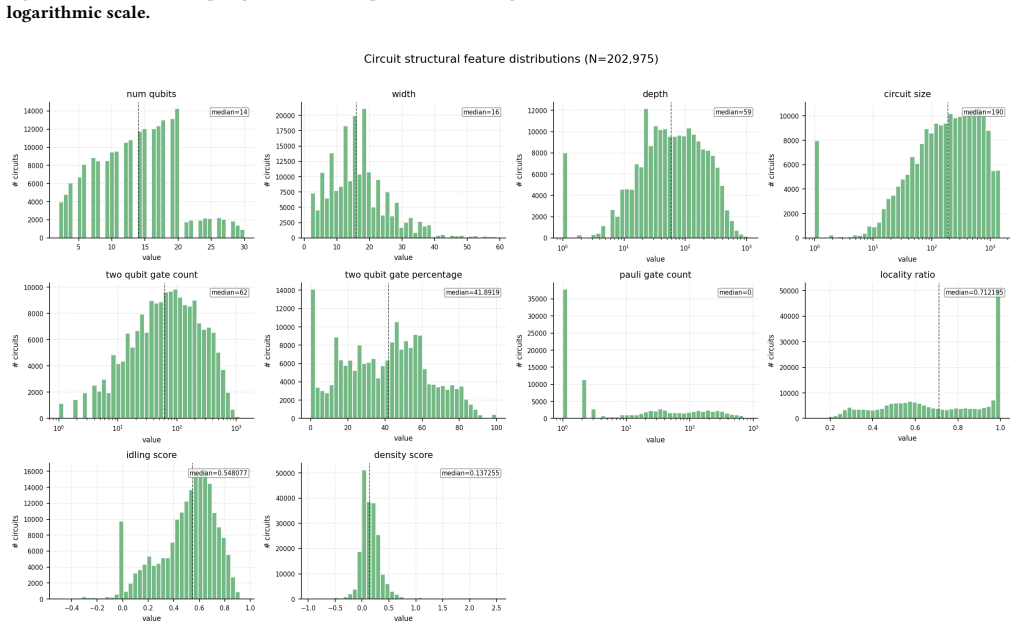
- [§3.2, Figure 15, Appendix I.1] The claim of 'general, compositional circuits' is not yet supported. Generation is restricted to a fixed hand-defined template set, and the released 202k corpus is heavily skewed toward sparse output states (Figure 15); the out-of-core family in Appendix I.1 is explicitly constructed to preserve 2^h support with CNOT-only expansion. Since the memory-win results are driven by sparse states, the >50% peak-memory claim should be stratified by output density and by template family, and the paper should state the coverage limitations. Adding dense-circuit templates or treating external-suite circuits (§E) as a separate, additional stratum would make the 'general' claim testable.
- [§6.1, Table 19, Appendix F] The peak-memory comparison underpinning the central claim is not fully specified. It is not stated whether 'peak memory' for each RDBMS is process RSS, container cgroup peak, or a DBMS-reported memory counter, nor how the comparison handles SQLite's file-backed temporary storage in the tuned profiles (Appendix G, Table 18). Appendix F reports median peak RSS of 203 MB for SQLite and 206 MB for Aer, but Figures 1 and 7 do not reference the measurement method. Please state the exact memory metric and measurement tool for each engine, and confirm that the same definition is used throughout.
minor comments (5)
- [Eq. (9), Section 4.4] The entropy definition uses (p_i + ε) log2(p_i + ε), but ε and τ are never given values, and the normalization effect of the smoothing is not discussed. Specify defaults and state how the entropy is affected by the ε term.
- [Figure 7] The figure legend is hard to parse: 'ducksql', 'psql', and the four Qiskit Aer methods are not clearly mapped to the bars, and the win percentages are not tied to a table in the main text. Consider a grouped bar chart with a separate table.
- [Section 6.2 and Section 5] The paper refers to 7,705 circuits for routing training and 202,975 in the released dataset. Clarify whether the 7,705 circuits are a subset of the 202,975, and why routing is evaluated only on the smaller set.
- [Appendix I.2] For DuckDB and SQLite, spill is measured with proc_io_write_bytes, an OS-level proxy that may include non-spill I/O. This is acknowledged, but the potential bias should be quantified or discussed in the main out-of-core analysis.
- [Appendix H] The sentence 'each circuit is compiled into a single SQL statement of the form WITH ... SELECT' is central to the workload definition but appears only in an appendix. Move a concise version to Section 3.5.
Circularity Check
SQL-equivalence premise is delegated to co-authored [13] and correctness is deferred to future work, making the RDBMS memory/routing measurements conditional on an unverified self-cited artifact; no prediction reduces to a fit.
specific steps
-
self citation load bearing
[Section 3.5 (SQL query generation); Outlook; Sections 6.2 and Appendix G]
"Once a circuit is generated, we construct an equivalent SQL query using the implementation in [13]. We extended their package by making it a dependency to InferQ. The package uses the einstein summation (einsum) representation of a quantum circuit with tensor algebra. It then converts tensor contractions into relational joins as proposed by Blacher et al. [6]. ... As future work, we plan to further optimize RDBMS-based simulation ... InferQ can also be extended from circuit generation to end-to-end validation for quantum algorithm design, covering correctness checks, iterative test–debug cycle"
The benchmark's central value proposition is that each emitted SQL workload 'expresses the simulation task.' Section 3.5 asserts equivalence only by invoking the implementation in [13], whose authors include Rihan Hai, a co-author of this paper. The Outlook explicitly defers 'correctness checks' to future work, and no statevector-versus-SQL comparison is reported anywhere in Section 6. Therefore the headline empirical results (RDBMS peak-memory wins on >50% of circuits, routing accuracies up to 95.3%/97.4%, out-of-core completions) are measured over SQL artifacts whose correctness is imported from the authors' own prior work and never independently established. This makes the central premise load-bearing self-citation rather than a demonstrated, self-contained derivation.
full rationale
The paper's empirical claims are genuine measurements on generated workloads, not derivations from its own equations. I find no place where an equation is defined in terms of its target or where a fitted parameter is simply renamed as a prediction. The principal load-bearing weakness is the SQL-equivalence assumption: Section 3.5 delegates query generation to [13] (a PVLDB paper co-authored by Rihan Hai), and the Outlook explicitly lists 'correctness checks' as future work. Without a comparison of the emitted SQL's result against Qiskit Aer's statevector, all runtime, memory, spill, and routing measurements may describe a computation different from the intended circuit. This is a self-citation load-bearing gap rather than a by-construction reduction, so it warrants score 4 rather than 6+: the benchmark's experimental content and ML routing evaluations are independent artifacts that would stand or fall on the unverified SQL equivalence. I also weighed the routing models' use of dynamic features (Shannon entropy, sparsity, von Neumann entropy) computed from the saved statevector. These features are post-hoc and the advertised accuracies include them, but the paper uses a proper held-out test split and reports ablations (Static+Graph+SQL without dynamic features still reach 0.93 runtime / 0.97 memory accuracy; SQL-only features reach 0.92 runtime / 0.84 memory accuracy), so the classifier does not reduce to a fit by construction. That issue is a deployment caveat, not a circular derivation.
Axiom & Free-Parameter Ledger
free parameters (3)
- Synergy rule weights β =
β=2 in Example 3.1; others user-configurable, not systematically set
- Entropy smoothing ε and sparsity threshold τ =
not numerically specified in the paper
- DBMS tuning profiles (Table 18) =
e.g., PostgreSQL work_mem 55–256 MB, DuckDB memory_limit 7.4–10.8 GB, SQLite cache 64–128 MB
axioms (4)
- domain assumption The Qymera einsum-to-SQL compiler produces a correct and equivalent simulation of the quantum circuit.
- domain assumption Qiskit Aer's per-circuit best method, with GPU acceleration disabled, is a fair conventional-simulator baseline for runtime and peak memory.
- domain assumption The template library and synergy rules generate circuits representative of 'general, compositional' quantum algorithms.
- ad hoc to paper Equation (9) with (p_i + ε) log(p_i + ε) is a valid Shannon-entropy estimate.
read the original abstract
Recent work suggests that relational database management systems (RDBMSs) can execute quantum circuit simulation by compiling the simulation into SQL workloads (primarily join-and-aggregate tensor contractions). While early results are promising, they largely focus on a narrow set of highly structured circuits and offer limited support for systematic database research, such as query optimization, physical design, and engine-level evaluation across a broad range of circuits. We present InferQ, a database-oriented benchmark for quantum circuit simulation. InferQ generates general, compositional circuits by assembling subcircuits from a set of circuit templates, emits each simulation task as an RDBMS-ready SQL workload, and extracts circuit and query features (static, graph, SQL, and dynamic) for workload characterization. InferQ also releases a large dataset of 202,975 circuits online, with a web-based viewer to support searching, filtering, and downloading circuits and feature records. In experiments across RDBMS engines (PostgreSQL, SQLite, DuckDB, and Umbra) and the widely used Qiskit Aer simulator, we find that RDBMSs achieve better peak memory usage than Qiskit Aer on more than 50% of the circuits generated by InferQ. Moreover, using InferQ features, lightweight machine learning models (linear and tree-based models) can accurately predict when SQL execution is preferable (with accuracy up to 95.3% for runtime and 97.4% for memory), enabling data-centric simulator selection and opening the door to principled optimization of SQL-based quantum circuit simulation.
Figures




Reference graph
Works this paper leans on
-
[1]
Scott Aaronson and Daniel Gottesman. 2004. Improved simulation of stabilizer circuits.Physical Review A70, 5 (Nov. 2004). doi: 10.1103/physreva.70.052328
-
[2]
Daniel S Abrams and Seth Lloyd. 1999. Quantum algorithm providing exponential speed increase for finding eigenvalues and eigenvectors.Physical Review Letters 83, 24 (1999), 5162
1999
-
[3]
Andrew Adams, Karima Ma, Luke Anderson, Riyadh Baghdadi, Tzu-Mao Li, Michaël Gharbi, Benoit Steiner, Steven Johnson, Kayvon Fatahalian, Frédo Du- rand, et al . 2019. Learning to optimize halide with tree search and random programs.ACM Transactions on Graphics (TOG)38, 4 (2019), 1–12
2019
-
[4]
Medina Bandic, Carmen G. Almudever, and Sebastian Feld. 2023. Interaction graph-based characterization of quantum benchmarks for improving quantum circuit mapping techniques.Quantum Machine Intelligence5, 2 (Oct. 2023). doi:10.1007/s42484-023-00124-1
-
[5]
Medina Bandic, Pablo le Henaff, Anabel Ovide, Pau Escofet, Sahar Ben Rached, Santiago Rodrigo, Hans van Someren, Sergi Abadal, Eduard Alarcon, Carmen G. Almudever, and Sebastian Feld. 2024. Profiling quantum circuits for their efficient execution on single- and multi-core architectures. arXiv:2407.12640 [quant-ph] https://arxiv.org/abs/2407.12640
Pith/arXiv arXiv 2024
-
[6]
Mark Blacher, Julien Klaus, Christoph Staudt, Sören Laue, Viktor Leis, and Joachim Giesen. 2023. Efficient and Portable Einstein Summation in SQL.Pro- ceedings of the ACM on Management of Data (PACMMOD)1, 2, Article 121 (jun 2023), 19 pages
2023
-
[7]
Matthias Boehm, Matteo Interlandi, and Chris Jermaine. 2023. Optimizing Tensor Computations: From Applications to Compilation and Runtime Techniques. In Companion of the 2023 International Conference on Management of Data (SIGMOD). 53–59
2023
-
[8]
Gilles Brassard, Peter Høyer, Michele Mosca, and Alain Tapp. 2002. Quantum amplitude amplification and estimation.Contemp. Math.305 (2002), 53–74
2002
-
[9]
Lingjiao Chen, Arun Kumar, Jeffrey Naughton, and Jignesh M Patel. 2017. To- wards Linear Algebra over Normalized Data.Proceedings of the VLDB Endowment 10, 11 (2017)
2017
-
[10]
Tianqi Chen, Thierry Moreau, Ziheng Jiang, Lianmin Zheng, Eddie Yan, Haichen Shen, Meghan Cowan, Leyuan Wang, Yuwei Hu, Luis Ceze, et al. 2018. TVM: An Automated End-to-End Optimizing Compiler for Deep Learning. In13th USENIX Symposium on Operating Systems Design and Implementation (OSDI). 578–594
2018
-
[11]
Edward Farhi, Jeffrey Goldstone, and Sam Gutmann. 2014. A Quantum Approxi- mate Optimization Algorithm.https://arxiv.org/abs/1411.4028
Pith/arXiv arXiv 2014
-
[12]
András Gilyén, Yuan Su, Guang Hao Low, and Nathan Wiebe. 2019. Quantum sin- gular value transformation and beyond: exponential improvements for quantum matrix arithmetics. InProceedings of the 51st annual ACM SIGACT symposium on theory of computing. 193–204
2019
-
[13]
Rihan Hai, Shih-Han Hung, Tim Coopmans, Tim Littau, and Floris Geerts. 2025. Quantum Data Management in the NISQ Era.PVLDB18, 6 (2025), 1720–1729
2025
-
[14]
Rihan Hai, Shih-Han Hung, Tim Coopmans, Tim Littau, and Floris Geerts. 2025. Quantum Data Management in the NISQ Era: Extended Version. https://ar xiv.org/abs/2409.14111
Pith/arXiv arXiv 2025
-
[15]
Aram W Harrow, Avinatan Hassidim, and Seth Lloyd. 2009. Quantum Algorithm for Linear Systems of Equations.Physical Review Letters103, 15 (2009), 150502
2009
-
[16]
Roman Heinrich et al. 2025. How Good are Learned Cost Models, Really? Insights from Query Optimization Tasks.SIGMOD3, 3 (2025), 172:1–172:27. doi: 10.114 5/3725309
2025
-
[17]
Javier Martín Hernández and Piet Van Mieghem. 2015. Classification of graph metrics.https://api.semanticscholar.org/CorpusID:37136216
2015
-
[18]
IBM Quantum. 2025. Qiskit: Open-Source Quantum Computing Software.https: //www.ibm.com/quantum/qiskit. Official IBM Quantum page for Qiskit, the world’s most popular software stack for quantum computing and algorithms research
2025
-
[19]
Ngo, Xuanlong Nguyen, Dan Olteanu, and Maximilian Schleich
Mahmoud Abo Khamis, Hung Q. Ngo, Xuanlong Nguyen, Dan Olteanu, and Maximilian Schleich. 2020. Learning Models Over Relational Data Using Sparse Tensors and Functional Dependencies.ACM Transactions on Database Systems (TODS)45, 2 (2020)
2020
-
[20]
Viktor Leis, Andrey Gubichev, Atanas Mirchev, Peter Boncz, Alfons Kemper, and Thomas Neumann. 2015. How good are query optimizers, really?Proceedings of the VLDB Endowment9, 3 (2015), 204–215
2015
-
[21]
Ang Li, Samuel Stein, Sriram Krishnamoorthy, and James Ang. 2022. QASM- Bench: A Low-level QASM Benchmark Suite for NISQ Evaluation and Simulation. arXiv:2005.13018 [quant-ph]https://arxiv.org/abs/2005.13018
Pith/arXiv arXiv 2022
-
[22]
Tim Littau and Rihan Hai. 2025. Qymera: Simulating Quantum Circuits using RDBMS. InCompanion of the 2025 International Conference on Management of Data (SIGMOD/PODS ’25). ACM, 179–182. doi:10.1145/3722212.3725126
arXiv 2025
-
[23]
Shangyu Luo, Dimitrije Jankov, Binhang Yuan, and Chris Jermaine. 2021. Auto- matic optimization of matrix implementations for distributed machine learning and linear algebra. InProceedings of the 2021 International Conference on Man- agement of Data (SIGMOD). 1222–1234
2021
-
[24]
Nantia Makrynioti and Vasilis Vassalos. 2019. Declarative Data Analytics: A Survey.IEEE Transactions on Knowledge and Data Engineering (TKDE)33, 6 (2019), 2392–2411
2019
-
[25]
Markov and Yaoyun Shi
Igor L. Markov and Yaoyun Shi. 2008. Simulating Quantum Computation by Contracting Tensor Networks.SIAM J. Comput.38, 3 (2008), 963–981
2008
-
[26]
John M Martyn, Zane M Rossi, Andrew K Tan, and Isaac L Chuang. 2021. Grand unification of quantum algorithms.PRX quantum2, 4 (2021), 040203
2021
-
[27]
2010.Quantum Computation and Quan- tum Information
Michael A Nielsen and Isaac L Chuang. 2010.Quantum Computation and Quan- tum Information. Cambridge university press
2010
-
[28]
Matteo Paganelli, Paolo Sottovia, Kwanghyun Park, Matteo Interlandi, and Francesco Guerra. 2023. Pushing ML Predictions into DBMSs.IEEE Transactions on Knowledge and Data Engineering (TKDE)35, 10 (2023), 10295–10308
2023
-
[29]
Qiskit Development Team. 2025. Qiskit Aer Documentation. https://qisk it.github.io/qiskit-aer/. Online documentation for Qiskit Aer, the high- performance quantum circuit simulator with realistic noise models in the Qiskit ecosystem
2025
-
[30]
Qiskit Development Team. 2025. Running with multiple-GPUs and/or multiple nodes. https://qiskit.github.io/qiskit-aer/howtos/running_gpu.htm l. Qiskit Aer documentation on distributed GPU and multi-node execution with cache blocking options
2025
-
[31]
Nils Quetschlich, Lukas Burgholzer, and Robert Wille. 2023. MQT Bench: Bench- marking Software and Design Automation Tools for Quantum Computing.Quan- tum7 (July 2023), 1062. doi:10.22331/q-2023-07-20-1062
-
[32]
Wenbo Sun, Qiming Guo, Wenlu Wang, and Rihan Hai. 2025. TranSQL+: Serving Large Language Models with SQL on Low-Resource Hardware.SIGMOD3, 6, Article 371 (Dec. 2025), 27 pages
2025
-
[33]
Smith, Joshua Viszlai, Xin-Chuan Wu, Nikos Hardavellas, Margaret R
Teague Tomesh, Pranav Gokhale, Victory Omole, Gokul Subramanian Ravi, Kaitlin N. Smith, Joshua Viszlai, Xin-Chuan Wu, Nikos Hardavellas, Margaret R. Martonosi, and Frederic T. Chong. 2022. SupermarQ: A Scalable Quantum Benchmark Suite. arXiv:2202.11045 [quant-ph] https://arxiv.org/abs/22 02.11045
Pith/arXiv arXiv 2022
-
[34]
Ashish Vaswani, Noam Shazeer, Niki Parmar, Jakob Uszkoreit, Llion Jones, Aidan N Gomez, Łukasz Kaiser, and Illia Polosukhin. 2017. Attention is all you need.Advances in neural information processing systems30 (2017)
2017
-
[35]
Yisu Remy Wang, Shana Hutchison, Jonathan Leang, Bill Howe, and Dan Suciu
-
[36]
Jiani Yang, Sai Wu, Dongxiang Zhang, Jian Dai, Feifei Li, and Gang Chen. 2023. Rethinking Learned Cost Models: Why Start from Scratch?Proc. ACM Manag. Data1, 4 (2023), 255:1–255:27. doi:10.1145/3626769
-
[37]
Binhang Yuan, Dimitrije Jankov, Jia Zou, Yuxin Tang, Daniel Bourgeois, and Chris Jermaine. 2021. Tensor relational algebra for distributed machine learning system design.Proceedings of the VLDB Endowment14, 8 (2021)
2021
-
[38]
generators
Xuanhe Zhou, Chengliang Chai, Guoliang Li, and Ji Sun. 2020. Database Meets Artificial Intelligence: A Survey.IEEE Transactions on Knowledge and Data Engineering (TKDE)(2020). InferQ: A Database-Oriented Benchmark for Quantum Circuits Simulation Appendices Table 12 provides a compact roadmap of the appendix material. Table 12: Appendix roadmap. Appendix M...
2020
-
[2020]
SPORES: sum-product optimization via relational equality saturation for large scale linear algebra.Proceedings of the VLDB Endowment13, 12 (2020), 1919–1932
2020
This paper was first reviewed by deepseek-v4-flash on August 3, 2026.
discussion (0)
Sign in with ORCID, Apple, or X to comment. Anyone can read and Pith papers without signing in.