REVIEW 4 major objections 4 minor 66 references
Resolution of Infrared Entanglement Divergences via the Extended Uncertainty Principle
T0 review · 4 major / 4 minor · reviewed 2026-08-15 · deepseek-v4-flash
Pith's one-line read The Extended Uncertainty Principle turns the infrared entanglement divergence into a finite, geometry-determined value.
desk verdict The single-oscillator EUP solution is solid and the variance-saturation idea is genuinely interesting, but the many-body proof only bounds a Gaussian surrogate, not the true EUP ground state, so the central claim remains conditional. read the letter →
The pith
A machine-rendered reading of the paper's core claim, the machinery that carries it, and where it could break.
The reading
What carries the argument
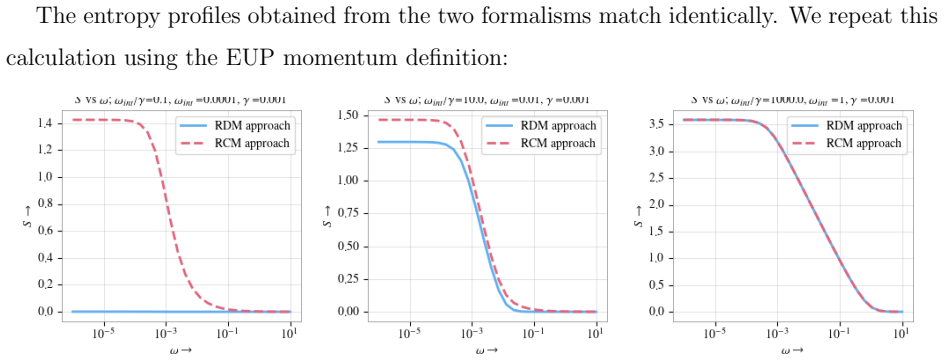
The load-bearing object is the EUP-deformed momentum operator $\hat{p}=(1+\gamma\hat{x}^{2})\hat{\pi}-i\hbar\gamma\hat{x}$, whose Schrodinger equation maps exactly to an associated Legendre equation; the resulting states are labelled by $l$ with $l(l+1)=(M\omega/\hbar\gamma)^{2}$, and through the variance formula $\langle\hat{x}^{2}\rangle=1/[\gamma(2l+1)]$ they encode the geometric saturation that blocks the IR divergence. For the many-body problem the operative machinery is the Moment-Matched Gaussian Reference State: a Gaussian chosen to share the exact EUP position variance (and, in the deep asymptotic regime $\kappa=M\omega_{\rm int}/(\hbar\gamma)\gg1$, the exact momentum variance as well), because the true EUP states' power-law tails make direct energy evaluation unstable. The Maximum Entropy Principle then makes the Gaussian state's finite entropy an upper bound on the true entropy, while the symplectic-eigenvalue formalism of covariance matrices converts this bound into explicit entanglement entropy and entanglement spectrum results.
What would settle it
Numerically diagonalize the exact coupled-oscillator ground state in the EUP framework without the Gaussian replacement, hold $\gamma$ fixed, and take $\omega\to0$ at small $\kappa=M\omega_{\rm int}/(\hbar\gamma)$; the central claim fails if the exact entanglement entropy or symplectic eigenvalue grows without bound rather than saturating.
Extended reading notes
Core claim
Within the EUP, with $[\hat{x},\hat{p}]=i\hbar(1+\gamma\hat{x}^{2})$ and $\gamma$ set by the background curvature, the exact ground state of a harmonic oscillator develops a heavy power-law tail and a position variance $\langle\hat{x}^{2}\rangle=1/[\gamma(2l+1)]$, where $l(l+1)=(M\omega/\hbar\gamma)^{2}$; in the free limit $\omega\to0$ this variance saturates to $1/\gamma$ (equation 14). The paper extends this single-particle saturation to entanglement: a Moment-Matched Gaussian Reference State built from the EUP variances, together with the maximum entropy principle, provides a rigorous upper bound on the von Neumann entropy of the true state, and the reduced covariance matrix yields the entropy and the symplectic eigenvalue $\nu$. As $\omega\to0$, $\nu$ saturates, so the entanglement entropy approaches a finite plateau instead of diverging. The entanglement spectrum, obtained from the eigenvalues $p_n$ of the reduced density matrix, becomes a discrete, evenly spaced ladder with a non-vanishing modular gap, capping the local entanglement temperature. In the continuum scalar-field limit the saturated entropy grows only as $\ln(\ln(16\kappa/\gamma))$, with $\kappa=M\omega_{\rm int}/\hbar$, showing that the geometric deformation supplies an intrinsic soft infrared cutoff.
Load-bearing premise
The many-body proof stands on replacing the exact non-Gaussian EUP state with a Gaussian reference state whose momentum variance matches the exact one only in the deep asymptotic regime $\kappa\gg1$; the paper leaves the ultra-small $\kappa$ regime untreated, so a failure of saturation there would not be captured by the argument.
Editorial extensions
If this is right
- In the strictly massless limit, the entanglement entropy saturates to a finite value for two coupled oscillators, a one-dimensional harmonic chain, and a massless scalar field.
- The entanglement spectrum remains discrete and evenly spaced with a non-vanishing modular gap, so the effective entanglement temperature of the vacuum is capped.
- The crossover from standard divergent behavior to the saturated regime occurs near the frequency scale $\omega\sim\hbar\gamma/M$, with $M\omega/(\hbar\gamma)$ as the governing parameter.
- Even in the absence of a potential, the EUP free-particle and free-field spectra are discrete, and a massless scalar field acquires a zero-point gap $\zeta_0=\sqrt{\gamma}$.
- The continuum saturated entropy depends on $\ln(\ln(16\kappa/\gamma))$, providing a geometry-determined soft cutoff that is independent of external boundary conditions.
Reading between the lines
- If $\gamma$ is tied to the background Ricci scalar, this mechanism turns the infrared cutoff of field theory into a dynamical geometric quantity; a testable consequence is that the entropy plateau and correlation length in curved-space vacuum states would shift with the local curvature.
- The maximum-entropy argument implies a purely information-theoretic bound: among all states compatible with the EUP variances, the Gaussian reference state carries the largest entanglement entropy, so the saturation reported here is an upper bound that non-Gaussian EUP states cannot exceed.
- The discrete EUP mode ladder suggests an effective lattice description with spacing set by $\gamma^{-1/2}$; in higher-dimensional field theories the same spectral-gap mechanism could make area-law entanglement acquire curvature-dependent corrections.
- An engineered analog experiment, such as a trapped-ion or circuit chain with position-dependent couplings mimicking $1+\gamma x^2$, should display a plateau in the entanglement entropy as the on-site frequency goes to zero.
Signed reviews
Editorial analysis
A structured set of objections, weighed in public.
Referee Report
Summary. The paper claims that the Extended Uncertainty Principle (EUP), through the modified algebra [x,p]=iℏ(1+γx²), resolves the infrared divergence of entanglement entropy for coupled harmonic oscillators, one-dimensional harmonic chains, and massless scalar fields. The single-oscillator section gives an exact solution whose position variance saturates at ⟨x²⟩→1/γ as ω→0 (Eq. (14)), and the γ→0 limit correctly reproduces the standard Gaussian oscillator. The many-body sections replace the standard Gaussian spread parameters by the EUP-saturated values β±→β±,EUP (Eq. (32)) inside standard Gaussian covariance-matrix entropy formulas, invoke the Maximum Entropy Principle, and conclude that the true entanglement entropy is finite. The entanglement spectrum is claimed to remain discrete and evenly gapped in the massless limit.
Significance. The single-particle EUP oscillator result is a solid, explicit calculation: the variance saturation and the smooth γ→0 limit are genuine and nontrivial, and the paper deserves credit for presenting closed-form wavefunctions and normalization factors for a non-Gaussian exactly solvable model. The many-body claim, if rigorously established, would be significant because it would replace an artificial IR cutoff by a geometric scale. However, the proof of the central claim currently rests on an unverified covariance-matching assumption, and the paper's own Appendix C.1 documents a momentum mismatch that is not controlled in the center-of-mass mode in the IR limit. The evidence actually establishes saturation of the Gaussian Reference State entropy, not of the true EUP ground-state entropy; the proof gap is load-bearing for the paper's main conclusion.
major comments (4)
- [§IV, Eq. (32) and §VII] The Maximum Entropy Principle bound S(ρ_GRS) ≥ S(ρ_true) requires the Gaussian Reference State and the true state to share the same covariance matrix. Here the GRS covariance is assigned by hand through β±→β±,EUP, but the physical Hamiltonian H does not decouple in normal-mode coordinates (Eq. (30), ΔH≠0), and the exact ground state of H is never constructed. The true normal-mode position and momentum variances are never computed. Consequently, the statement in §VII that the finiteness of the true entanglement entropy is 'mathematically prove[n]' is not supported by the calculation; the calculation proves finiteness of S(ρ_GRS).
- [Appendix C.1, Eq. (C1)–(C4)] Even granting that the true covariance equals the single-oscillator EUP values, the MEP bound requires matching momentum variances. Appendix C.1 shows that the GRS momentum variance differs from the exact EUP momentum variance unless l−≫1. In the IR limit ω→0, the center-of-mass mode has l+→0, so the mismatch in that mode is O(1) and is not controlled by the large-κ regime κ∈[10²,10⁴] on which the numerics focus. Thus the proof's core requirement fails precisely in the mode responsible for the IR divergence.
- [§IV, Appendix B.1 and Appendix C.2, Fig. 11] The product-state analysis in Appendix C.2 and Fig. 11 concerns a state that is an exact eigenstate of the decoupled Hamiltonian H′, not of the physical Hamiltonian H; Appendix B.1 itself shows that this state has an anomalously large energy variance σ_H ≫ ⟨H⟩. Therefore the numerical observation that the product state's entropy is bounded by the GRS entropy does not bound the entropy of the true ground state of H. The comparison in Fig. 11 is between two approximate states, and the MEP argument does not close the gap to the physical ground state.
- [§V and §VI; §VI, Eq. (50)] The chain and scalar-field sections inherit the same covariance-matching assumption after substituting EUP single-particle variances into the standard Gaussian formulas. The paper explicitly omits the κ≪1 regime, where the symplectic-eigenvalue constraint ν≥1/2 is violated by the naive RCM replacement, but the IR center-of-mass issue noted above is not an omitted parameter regime; it is the l+→0 limit of the mode that drives the divergence. The scalar-field mode expansion additionally asserts completeness of the EUP free-particle modes without proof, which is needed for the discrete expansion in Eq. (51).
minor comments (4)
- [Eqs. (43), (44), (50), (53)] Several displayed equations contain stray commas or doubled punctuation: Eq. (43) ends with ',.', Eq. (44) has a trailing comma, Eq. (50) ends with ',,' and Eq. (53) contains an extra comma. These should be cleaned up.
- [Appendix A.1, Eq. (A1)] The normalization constant in Eq. (A1) is introduced as a conjecture and verified numerically up to n=50; for a paper whose later claims rely on normalized states, this should be stated as a conjecture in the main text or replaced by a proof.
- [§III.C.3 and §VI, Eq. (50)] The free-particle energy spectrum is given as E_n=ℏ²γ n²/(2M) in §III.C.3, while the scalar-field section uses λ_n²=γ(n+1)² with n starting at 0. The indexing shift and the factor-of-two difference should be harmonized and explicitly explained.
- [Fig. 5 and Fig. 7] The figures use natural units (M=ℏ=1), but the captions do not state this; adding the parameter values and unit convention to each caption would improve reproducibility.
Circularity Check
No significant circularity: the many-body saturation is an explicitly constructed covariance input, and the flagged MEP gap is a support issue rather than an equivalence.
full rationale
The single-particle result (Eq. 14) is derived by exactly solving the EUP-deformed oscillator (Eqs. 4-13), with the flat-space limit γ→0 recovering the standard SHO as an external check; no parameter is fitted to the target entropy. The many-body Gaussian Reference State is introduced transparently: Eq. (32) says 'we manually upgrade the spread parameters to their exact EUP-modified counterparts,' so the saturation of S(ρ_G) follows from the already-derived single-particle variance, not from a hidden fit. The paper also discloses the key limitation in Sec. IV A: 'the GRS ... cannot simultaneously accommodate the exact EUP momentum variance,' with App. C1 showing the momentum mismatch disappears only for l− ≫ 1. Consequently the Maximum Entropy bound S(ρ_G) ≥ S(ρ_true) is conditional on an unproved covariance match, and the Sec. VII statement that the finiteness of the true entropy is mathematically proven is overstrong; this is a missing-premise/correctness defect, not a circular reduction. App. C2's statement that the product state shares the GRS covariance is likewise unsupported once momentum variances are included. The only self-citation (Ref. [36] for the EUP algebra) supplies a model input rather than a conclusion drawn from the present results. No equation in the paper is defined in terms of a later predicted quantity.
Assumptions & free parameters
free parameters (1)
- gamma (curvature scale) =
not fitted; assumed small and positive
assumptions (5)
- domain assumption EUP commutation relation [x,p] = i hbar (1 + gamma x^2) with gamma > 0 small
- ad hoc to paper Minimal Hermitian momentum representation p = (1 + gamma x^2) pi - i hbar gamma x, with no additional position-dependent potential h(x)
- ad hoc to paper The EUP free-particle modes phi_n form a complete orthonormal basis on the infinite line
- domain assumption Standard Gaussian covariance-matrix entropy formulas and the Maximum Entropy Principle apply to EUP-deformed systems
- domain assumption Equal-time field commutator [Phi(x,t), Pi(y,t)] = i delta(x-y) is preserved under the EUP field quantization
Cite this review
Pith. "Pith review of Resolution of Infrared Entanglement Divergences via the Extended Uncertainty Principle." pith.science (2026). https://pith.science/paper/6JGXRCIF
@misc{pith2026260729427,
  author       = {Pith},
  title        = {Pith review of: Resolution of Infrared Entanglement Divergences via the Extended Uncertainty Principle},
  year         = {2026},
  howpublished = {\url{https://pith.science/paper/6JGXRCIF}},
  note         = {Machine review of arXiv:2607.29427}
}
read the original abstract
The entanglement entropy of quantum systems typically exhibits both ultraviolet and infrared (IR) divergences. In the low-frequency limit, the IR divergence is intimately tied to the unbounded spatial delocalization of zero-modes, a pathological feature common to both coupled harmonic oscillators and massless scalar fields. In this work, we demonstrate that this infinite growth is naturally resolved by invoking the Extended Uncertainty Principle (EUP), which introduces large-length-scale geometric corrections to the canonical commutation relations. By exactly solving the simple harmonic oscillator under the EUP framework, we establish the existence of an intrinsic geometric confinement that enforces a strict upper bound on the position variance, limits spatial delocalization, and introduces an intrinsic localization length scale related to the background Ricci scalar. We extend this regularizing mechanism to many-body systems by evaluating the entanglement entropy and entanglement spectrum of a one-dimensional harmonic chain and a massless scalar field. We show that the EUP-induced spatial bounds prevent the accumulation of low-lying long-wavelength modes, keeping the entanglement spectrum discrete and evenly gapped even in the strictly massless limit. This non-vanishing modular gap effectively caps the local entanglement temperature of the vacuum. Consequently, the entanglement entropy saturates to a finite value, providing a robust, geometric resolution to the zero-mode IR divergence problem in quantum field theory.
Figures


Figures from the paper (8 more)



Reference graph
Works this paper leans on
-
[1]
Mathematically, this corresponds tolϵ→1 and ϵ→0
The Standard Flat-Space Limit (γ→0) In the strict standard limit where the background curvature vanishes (γ→0), the ge- ometric deformation is entirely removed. Mathematically, this corresponds tolϵ→1 and ϵ→0. In this limit, the quadratic correction term in the energy spectrum vanishes identi- cally, and the conventional, equally-spaced SHO spectrum is im...
-
[2]
HUP Regime: The Weak-Deformation Limit (Mω/ℏγ≫1) In this regime, the system is dominated by the external harmonic potential, but the macroscopic spacetime geometry introduces a small, non-vanishing perturbative correction (γ >0). Substitutingl∼ϵ −1 =Mω/ℏγinto the exact spectrum yields the standard SHO spectrum alongside a leading-order quadratic geometric...
-
[3]
Dirichlet Boundary Conditions Imposing Dirichlet boundary conditionsψ(±R) = 0 over a domainx∈[−R,R] discretizes the parameterm. In the continuum limit (R→∞), the wave functions simplify to the compact parity-separated form: ψn(x) = γ1/4√ 2p π(1 +γx 2) cos narctan √γx ,ifnis odd, iγ1/4√ 2p π(1 +γx 2) sin narctan √γx ,ifnis even, (23) wheren∈N...
-
[4]
Neumann Boundary Conditions Imposing Neumann boundary conditionsψ ′(±R) = 0 is of primary interest for the scalar field theory quantization. As detailed in Appendix (A 3), the eigenvalue condition yields m→n∈NasR→∞, giving the normalized eigenfunctions: ψn(x) = γ1/4√ 2p π(1 +γx 2) cos narctan √γx ,ifnis odd, iγ1/4√ 2p π(1 +γx 2) sin narctan ...
-
[5]
Energy Spectrum and Geometric Localization Settingω= 0 in the EUP wave equation removes the external harmonic potential. How- ever, the exact spatial wave functions and energy spectrum exhibit several distinct features that differ qualitatively from standard non-relativistic quantum mechanics. As detailed above (and derived explicitly in Appendix (A 3)), ...
-
[6]
+ 1 2Mω 2 int(ˆx1−ˆx2)2.(28) In the standard HUP treatment, one performs a coordinate rotation in configuration space, transforming to normal-mode coordinates in which the Hamiltonian completely decouples. However, the non-linearities introduced by the EUP-modified momentum operator reintro- duce cross-couplings among the coordinates upon such a transform...
work page 2025
-
[7]
Normalization constant for arbitrary state The calculation of the normalization constant for an arbitrary state involves evaluating analytical integrals of hypergeometric functions. However, for the special case whereland γare real, positive quantities, a distinct pattern emerges upon examining the first few eigenstates. Based on this structure, we conjec...
-
[8]
Ground-State Variances The normalized ground-state wave function of the EUP-deformed harmonic oscillator is given by: ψ(x) = γ π 1/4 Γ(l+ 2) Γ(l+ 3/2) 1/2 1 (1 +γx 2)1+l/2.(A2) Since, the wave function is symmetric under parity (x→−x), the first moment vanishes identically,⟨ˆx⟩= 0. Consequently, the spatial variance is determined entirely by the second mo...
Show all 66 references
-
[9]
nπarctan √γx 2 arctan √γR # ,ifnis odd, iγ1/4 q arctan √γR (1 +γx 2) sin
Free-Particle Limit(ω→0)Under the EUP Evaluating the free-particle limit (ω→0) of the EUP-deformed oscillator provides the continuous spectrum regime under modified spatial kinematics. Unlike standard quantum mechanics — where free particles correspond to unconstrained plane w...
-
[10]
Energy Variance of the Product State Ansatz We explicitly demonstrate why the exact eigenstates of the decoupled HamiltonianH ′ fail as a reliable approximation for the physical HamiltonianH. Let|Ψ prod⟩denote the trial product state, defined as an exact eigenstate of the unpe...
-
[11]
Momentum Variances of the Gaussian Reference State Consider a single-variable Gaussian state with an EUP-enforced position variance: ψ(x) = β π 1/4 exp −βx2 2 ,(B11) whereβ= γ 2(2l+ 1). In the standard HUP framework, the corresponding momentum variance is given by: ⟨ˆp2⟩HUP, G...
-
[12]
RCM Entanglement vs. RDM Entanglement As noted in the main text, the RDM formalism applied to the GRS yields the standard HUP momentum variance because the Gaussian ansatz cannot simultaneously encode the exact EUP momentum variance. In this subsection, we analyze the physical...
-
[13]
Evaluating its entanglement entropy serves as a test of the Maximum Entropy Prin- ciple
Entanglement Analysis for the Product State Although the energy-based limitations of the product state were demonstrated in Ap- pendix (B), its resulting covariance matrix yields exact EUP spatial and momentum vari- ances. Evaluating its entanglement entropy serves as a test o...
-
[14]
Derivation of Scaled and Rotated Hermite Polynomial Identities Starting from the generating function of Hermite polynomials: ∞X m=0 ∞X n=0 Hm x+y√ 2 Hn x−y√ 2 tmsn m!n! = exp 2(x+y)t√ 2 + 2(x−y)s√ 2 −t 2−s 2 = exp 2x(t+s)√ 2 − (t+s) 2 2 + 2y(t−s)√ 2 − (t−s) 2 2 . (C14) The rig...
-
[15]
In this section, we derive the continuous field limit and obtain an explicit analytical expression for the von Neumann entropy at ω= 0
Continuum limit of 1-D Harmonic Chain Taking the continuum limit of the one-dimensional harmonic chain provides analytical insights into the system’s entanglement entropy. In this section, we derive the continuous field limit and obtain an explicit analytical expression for th...
-
[16]
(1 +γx 2)2∂ ˆΦ ∂x # dx.(E8) Recalling the definition of the modified spatial differential operator ˆDx 2 , expanding the derivative term yields d dx
Entanglement Entropy in the Large-νLimit The von Neumann entanglement entropy for a single bosonic mode is uniquely determined by its symplectic eigenvalueν. In physical regimes characterized by strong squeezing or IR zero-mode contributions—such as the continuum massless limi...
-
[17]
Bombelli, R
L. Bombelli, R. K. Koul, J. Lee, and R. D. Sorkin, Phys. Rev. D34, 373 (1986)
1986
- [18]
-
[19]
J. I. Latorre and A. Riera, Journal of Physics A Mathematical General42, 504002 (2009), arXiv:0906.1499 [cond-mat.stat-mech]
2009 arXiv
-
[20]
Horodecki, P
R. Horodecki, P. Horodecki, M. Horodecki, and K. Horodecki, Rev. Mod. Phys.81, 865 (2009). 50
2009
-
[21]
S. Das, S. Shankaranarayanan, and S. Sur, (2008), arXiv:0806.0402 [gr-qc]
2008 arXiv
-
[22]
Eisert, M
J. Eisert, M. Cramer, and M. B. Plenio, Rev. Mod. Phys.82, 277 (2010)
2010
-
[23]
V. R. Vieira, Journal of Physics: Conference Series213, 012005 (2010)
2010
-
[24]
S. N. Solodukhin, Living Rev. Rel.14, 8 (2011), arXiv:1104.3712 [hep-th]
2011 arXiv
-
[25]
Sachdev, in25th Solvay Conference on Physics: The Theory of the Quantum World(2012) arXiv:1203.4565 [hep-th]
S. Sachdev, in25th Solvay Conference on Physics: The Theory of the Quantum World(2012) arXiv:1203.4565 [hep-th]
2012 arXiv
-
[26]
Savary and L
L. Savary and L. Balents, Reports on Progress in Physics80, 016502 (2016)
2016
-
[27]
Mallayya, R
K. Mallayya, R. Tibrewala, S. Shankaranarayanan, and T. Padmanabhan, Phys. Rev. D90, 044058 (2014)
2014
-
[28]
S. M. Chandran and S. Shankaranarayanan, Physical Review D99(2019), 10.1103/Phys- RevD.99.045010, arXiv:1810.03888 [quant-ph]
2019 arXiv
-
[29]
S. M. Chandran and S. Shankaranarayanan, Physical Review D102, 125025 (2020), arXiv:2010.03418 [gr-qc]
2020 arXiv
-
[30]
P. Jain, S. M. Chandran, and S. Shankaranarayanan, Phys. Rev. D103, 125008 (2021), arXiv:2103.01772 [hep-th]
2021 arXiv
-
[31]
Casini and M
H. Casini and M. Huerta, J. Stat. Mech.0512, P12012 (2005), arXiv:cond-mat/0511014
2005 arXiv
-
[32]
Casini and M
H. Casini and M. Huerta, J. Phys. A42, 504007 (2009), arXiv:0905.2562 [hep-th]
2009 arXiv
-
[33]
Calabrese and J
P. Calabrese and J. Cardy, Journal of Physics A: Mathematical and Theoretical42, 504005 (2009)
2009
-
[34]
Bianchini and O
D. Bianchini and O. A. Castro-Alvaredo, Nucl. Phys. B913, 879 (2016), arXiv:1607.05656 [hep-th]
2016 arXiv
-
[35]
P. W. Anderson, Phys. Rev. Lett.18, 1049 (1967)
1967
-
[36]
Zanardi and N
P. Zanardi and N. Paunkovi´ c, Phys. Rev. E74, 031123 (2006)
2006
-
[37]
Zhou and J
H.-Q. Zhou and J. P. Barjaktareviˇ c, Journal of Physics A: Mathematical and Theoretical41, 412001 (2008)
2008
-
[38]
S. S. Kumar and S. Shankaranarayanan, Sci. Rep.7, 15774 (2017), arXiv:1606.05472 [cond- mat.stat-mech]
2017 arXiv
-
[39]
Nenmeli and S
V. Nenmeli and S. Shankaranarayanan, arxiv (2022), arXiv:2212.07174 [quant-ph]
2022 arXiv
- [40]
- [41]
-
[42]
M. P. Dabrowski and F. Wagner, Eur. Phys. J. C80, 676 (2020), arXiv:2006.02188 [gr-qc]. 51
2020 arXiv
-
[43]
Singh and D
R. Singh and D. Kothawala, Phys. Rev. D105, L101501 (2022), arXiv:2110.15951 [gr-qc]
2022 arXiv
-
[44]
K. S. Gupta, T. Juri´ c, A. Samsarov, and I. Smoli´ c, JHEP10, 170 (2019), arXiv:1908.07402 [hep-th]
2019 arXiv
-
[46]
Kempf, G
A. Kempf, G. Mangano, and R. B. Mann, Phys. Rev. D52, 1108 (1995), arXiv:hep- th/9412167
1995
-
[47]
Nenmeli, S
V. Nenmeli, S. Shankaranarayanan, V. Todorinov, and S. Das, Phys. Lett. B821, 136621 (2021), arXiv:2106.04141 [gr-qc]
2021 arXiv
-
[48]
Kempf, Phys
A. Kempf, Phys. Rev. D54, 5174 (1996), [Erratum: Phys.Rev.D 55, 1114 (1997)], arXiv:hep- th/9602119
1996
- [49]
- [50]
-
[51]
Petruzziello and F
L. Petruzziello and F. Wagner, Phys. Rev. D103, 104061 (2021), arXiv:2101.05552 [gr-qc]
2021 arXiv
-
[52]
Gattu and S
M. Gattu and S. Shankaranarayanan, Gen. Rel. Grav.56, 102 (2024), arXiv:2204.01780 [gr- qc]
2024 arXiv
-
[53]
M. G. Genoni, M. G. A. Paris, and K. Banaszek, Phys. Rev. A78, 060303 (2008), arXiv:0805.1645 [quant-ph]
2008 arXiv
-
[54]
Adesso,Entanglement of Gaussian states, Other thesis (2007), arXiv:quant-ph/0702069
G. Adesso,Entanglement of Gaussian states, Other thesis (2007), arXiv:quant-ph/0702069
2007 arXiv
-
[55]
Adesso, S
G. Adesso, S. Ragy, and A. R. Lee, Open Syst. Info. Dyn.21, 1440001 (2014), arXiv:1401.4679 [quant-ph]
2014 arXiv
-
[56]
L. Lami, A. Serafini, and G. Adesso, New J. Phys.20, 023030 (2018), arXiv:1612.05215 [quant-ph]
2018 arXiv
-
[57]
F. W. J. Olver, D. W. Lozier, R. F. Boisvert, and C. W. Clark,NIST Handbook of Mathe- matical Functions(2010)
2010
-
[58]
NIST Digital Library of Mathematical Functions,
DLMF, “NIST Digital Library of Mathematical Functions,”https://dlmf.nist.gov/14.3, Release 1.2.4 of 2025-03-15, f. W. J. Olver, A. B. Olde Daalhuis, D. W. Lozier, B. I. Schneider, R. F. Boisvert, C. W. Clark, B. R. Miller, B. V. Saunders, H. S. Cohl, and M. A. McClain, eds
2025
-
[59]
J. L. L´ opez and N. M. Temme, Advances in Computational Mathematics39, 349 (2013)
2013
-
[60]
Hamil, B
B. Hamil, B. C. L¨ utf¨ uo˘ glu, and A. Hocine, Mod. Phys. Lett. A38, 2350079 (2023). 52
2023
-
[61]
De Palma and D
G. De Palma and D. Trevisan, J. Math. Phys.65, 062201 (2024), arXiv:2105.05627 [quant-ph]
2024 arXiv
-
[62]
How compactness curbs entanglement growth in bosonic systems,
S. Aimet, P. Schmoll, J. Eisert, J. Schmiedmayer, and S. Sotiriadis, “How compactness curbs entanglement growth in bosonic systems,” (2026), arXiv:2603.16775 [quant-ph]
2026
-
[63]
Li and F
H. Li and F. Haldane, Phys. Rev. Lett.101, 010504 (2008), arXiv:0805.0332 [cond-mat.mes- hall]
2008 arXiv
-
[64]
Chandran, V
A. Chandran, V. Khemani, and S. L. Sondhi, Phys. Rev. Lett.113, 060501 (2014), arXiv:1311.2946 [cond-mat.str-el]
2014 arXiv
-
[65]
N. D. Birrell and P. C. W. Davies,Quantum Fields in Curved Space, Cambridge Monographs on Mathematical Physics (Cambridge University Press, Cambridge, UK, 1982)
1982
-
[66]
L. E. Parker and D. Toms,Quantum Field Theory in Curved Spacetime: Quantized Field and Gravity, Cambridge Monographs on Mathematical Physics (Cambridge University Press, 2009)
2009
-
[67]
Padmanabhan,Quantum Field Theory
T. Padmanabhan,Quantum Field Theory. The Why, What and How, Graduate Texts in Physics (Springer, 2016). 53
2016
Reviewed August 15, 2026 · model on record in the stance chip above.
Discussion (0). Continue with ORCID to comment.