REVIEW 39 references
A benchmark comparing five memory strategies for conversational agents on three public datasets finds dense vector retrieval alone maintains long-range recall, at roughly 25 times the token cost of recency windows.
Reviewed by Pith at T0; open to challenge. T0 means a machine referee read the full paper against a public rubric. the ladder, T0–T4 →
T0 review · deepseek-v4-flash
2026-08-04 01:47 UTC pith:Y3I7JR3B
AgentMemBench: A Systematic Benchmark for Evaluating Long-Term Memory Management Strategies in Conversational AI Agents
The pith
A machine-rendered reading of the paper's core claim, the machinery that carries it, and where it could break.
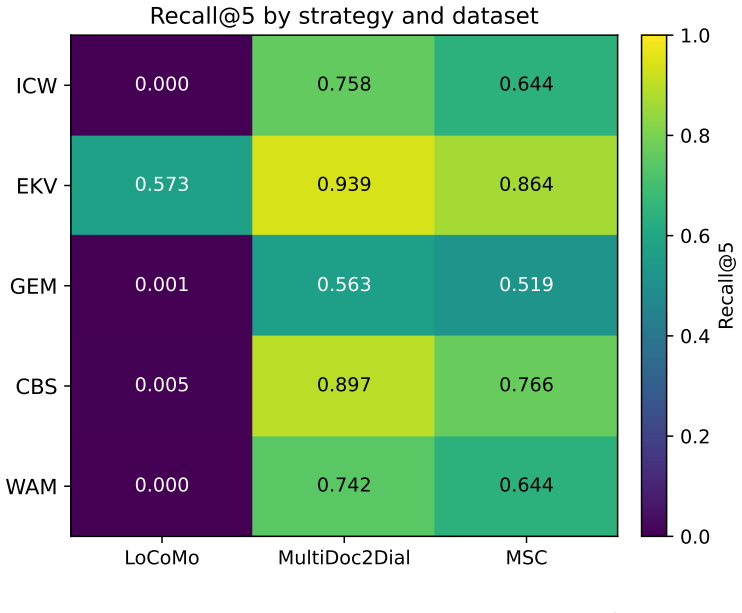
The headline finding is stark on the hardest dataset, LoCoMo, where questions refer many sessions back. The window, graph, summary, and web strategies retrieve the needed turn almost never (Recall@5 <= 0.005), while the vector-search store retrieves it 57% of the time. Across all datasets, vector search is best on every quality score but uses about 5,100 tokens of memory context versus about 300 for the window, a roughly 25x cost difference. Summaries are the runner-up on retrieval because a summary keeps the session's provenance, but summaries also collapse on long-range recall.
These are empirical comparisons, not proofs. The benchmark's own labels are partly constructed: for the MSC dataset, gold sessions are assigned by a token-overlap heuristic, and MultiDoc2Dial dialogues are split into pseudo-sessions. Answer quality is bounded by a single 7B generator that also acts as the faithfulness judge. So the qualitative lesson — dense retrieval is the only tested mechanism that scales across many sessions — is plausible, but the exact numbers should be read with those caveats.
Core claim
The paper's load-bearing assertion is that on long-horizon recall (LoCoMo), 'every strategy except EKV essentially fails: ICW = 0.000, WAM = 0.000, GEM = 0.001, CBS = 0.005 Recall@5, while EKV alone reaches 0.573' and that macro-averaged EKV 'dominates on every quality axis' (Recall@5 0.792, MRR 0.677, nDCG 0.690, F1 0.156, Faithfulness 0.354). If correct, dense external vector storage is the only memory mechanism among those tested that reliably surfaces far-back turns, and it does so at a roughly 25x token-footprint premium (~5,100 vs ~300 tokens).
Load-bearing premise
The validity of the recall metrics depends on the gold-session annotations being true relevance labels. LoCoMo provides public gold turns, but for MSC the paper states gold sessions are 'assigned by the documented token-overlap heuristic' and for MultiDoc2Dial dialogues are segmented into pseudo-sessions 'grounded on a shared reference document' (Section 4.1). If those labels correlate mechanically with lexical or semantic overlap, then the Recall@k advantage of dense retrieval may partly reflect the annotation heuristic rather than genuine memory quality, and the 'EKV dominates' claim would be an artifact of label construction.
Editorial analysis
A structured set of objections, weighed in public.
Axiom & Free-Parameter Ledger
free parameters (6)
- ICW default window w =
16 turns
- EKV top-k k =
5
- CBS compression interval s =
8 turns
- WAM window w, web results kw, overlap threshold tau =
w=8, kw=3, tau=0.15
- GEM 2-hop neighbourhood expansion =
2-hop
- MADS thresholds =
Q_rel>0.30; C>5 & T_avg>200; C>20; E_density<1.0 & C>3
axioms (8)
- domain assumption Gold-session annotations are valid proxies for the memory evidence a correct answer requires.
- domain assumption Qwen2.5-7B-Instruct (4-bit) self-judge faithfulness scores are comparable across strategies.
- domain assumption BAAI/bge-small-en-v1.5 cosine similarity is a sufficient relevance model for memory retrieval.
- domain assumption SpaCy en_core_web_sm NER and relation templates instantiate graph-based episodic memory fairly.
- domain assumption A single 4-bit 7B generator is a fair generator for all strategies.
- domain assumption The synthetic web-search function approximates web-augmented memory for this benchmark.
- ad hoc to paper MSC gold sessions are recoverable by the token-overlap heuristic.
- ad hoc to paper MultiDoc2Dial dialogues can be segmented into pseudo-sessions that preserve the original grounding structure.
read the original abstract
Long-term memory remains a critical bottleneck for conversational AI agents, whose finite context windows cannot support coherent recall across thousands of turns. We present AgentMemBench, a unified, reproducible benchmark evaluating five memory management strategies under identical conditions: in-context windowing (ICW), external key-value store (EKV), graph-based episodic memory (GEM), compression-based summarisation (CBS), and web-augmented memory (WAM). All are assessed across three public datasets covering long-term multi-session dialogue (LoCoMo), task-oriented document grounding (MultiDoc2Dial), and persona-grounded multi-session chat (MSC), using Recall@k, MRR, nDCG@k, Answer F1, an LLM-judge Faithfulness score, Memory Footprint, and Latency over 491 annotated question turns. Generation and judging both use Qwen2.5-7B-Instruct (4-bit), with greedy decoding for determinism. Our results show that (1) EKV dominates on every quality axis (macro Recall@5 0.792, MRR 0.677, F1 0.156, Faithfulness 0.354); (2) long-range recall is decisive: on LoCoMo, where the gold turn lies many sessions back, ICW, WAM, GEM, and CBS retrieve almost nothing (Recall@5 <= 0.005) while EKV alone reaches 0.573, showing that recency windows, summaries, and entity graphs collapse at long horizons and only dense retrieval scales; (3) CBS is the runner-up on retrieval (0.556); (4) WAM equals ICW on in-corpus recall by construction, since external results carry no in-corpus provenance; and (5) EKV's recall advantage carries a footprint cost (~5,100 vs ~300 tokens for ICW/WAM), an explicit accuracy-efficiency trade-off. We additionally evaluate two published memory systems (MemGPT/Letta, HippoRAG) against the same harness, and release all code, environment, and result artefacts for full reproducibility.
Figures


Reference graph
Works this paper leans on
-
[1]
Zane Durante, Bhidipti Sarkar, Rohan Kong, Amirhossein Habibian, Soroush Ebrahimi, Sanjay Garg, Gaurav Bhatt, Fereshteh Sadeghi, Ehsan Biber, Silvio Savarese, Qitao Gao, and Hung Q. Vo. Agent AI: Surveying the horizons of multimodal interaction.arXiv preprint arXiv:2401.03568, 2024
Pith/arXiv arXiv 2024
-
[2]
Joon Sung Park, Joseph C. O’Brien, Carrie J. Cai, Meredith Ringel Morris, Percy Liang, and Michael S. Bernstein. Generative agents: Interactive simulacra of human behavior. arXiv preprint arXiv:2304.03442, 2023
Pith/arXiv arXiv 2023
-
[3]
Goldfish: Multi-turn chatbot with long-term memory.arXiv preprint arXiv:2202.06060, 2022
Jing Xu, Arthur Szlam, and Jason Weston. Goldfish: Multi-turn chatbot with long-term memory.arXiv preprint arXiv:2202.06060, 2022
Pith/arXiv arXiv 2022
-
[4]
Evaluating very long-term conversational memory of llm agents.arXiv preprint arXiv:2402.17753, 2024
Adyasha Maharana, Dong-Ho Lee, Sergey Tulyakov, Mohit Bansal, Francesco Barbieri, and Yuwei Luo. Evaluating very long-term conversational memory of llm agents.arXiv preprint arXiv:2402.17753, 2024
Pith/arXiv arXiv 2024
-
[5]
Peters, and Arman Cohan
Iz Beltagy, Matthew E. Peters, and Arman Cohan. Longformer: The long-document trans- former. 2020
2020
-
[6]
Mem0: The memory layer for personalized ai.arXiv preprint arXiv:2504.19413, 2024
Mem0 Team. Mem0: The memory layer for personalized ai.arXiv preprint arXiv:2504.19413, 2024
Pith/arXiv arXiv 2024
-
[7]
Chenxu Hu, Jie Fu, Chenzhuang Du, Simian Luo, Junbo Zhao, and Hang Zhao. ChatDB: Augmenting LLMs with databases as their symbolic memory.arXiv preprint arXiv:2306.03901, 2023
Pith/arXiv arXiv 2023
-
[8]
Darren Edge, Ha Trinh, Newman Cheng, Joshua Bradley, Alex Chao, Apurva Mody, Steven Truitt, and Jonathan Larson. From local to global: A graph RAG approach to query-focused summarisation.arXiv preprint arXiv:2404.16130, 2024
Pith/arXiv arXiv 2024
-
[9]
DialoglM: Pre- trained model for long dialogue comprehension and summarization
Ming Zhong, Yang Liu, Yichong Xu, Chenguang Zhu, and Michael Zeng. DialoglM: Pre- trained model for long dialogue comprehension and summarization. InProceedings of AAAI, 2022
2022
-
[10]
Ziegler, Nisan Stiennon, Ryan Lowe, Jan Leike, and Paul Christiano
Jeff Wu, Long Ouyang, Daniel M. Ziegler, Nisan Stiennon, Ryan Lowe, Jan Leike, and Paul Christiano. Recursively summarizing books with human feedback. 2021
2021
-
[11]
Model context protocol: Connecting AI assistants to external tools and data sources.https://modelcontextprotocol.io, 2024
Anthropic. Model context protocol: Connecting AI assistants to external tools and data sources.https://modelcontextprotocol.io, 2024. Open standard for LLM-to-tool inte- gration
2024
-
[12]
LangChain: Building applications with LLMs through composability
Harrison Chase. LangChain: Building applications with LLMs through composability. https://github.com/langchain-ai/langchain, 2023
2023
-
[13]
Yaxiong Wu, Tao Liang, Jiaying Xie, Yongsheng Ma, Hai Wang, Jingchao Wang, Yujia Ye, Jianan Zhang, and Yong Wang. From human memory to AI memory: A survey on memory mechanisms in the era of LLMs.arXiv preprint arXiv:2504.15965, 2025. 19
Pith/arXiv arXiv 2025
-
[14]
Yiming Du, Wenyu Huang, Danna Zheng, Zhaowei Wang, Sebastien Montella, Mirella Lapata, Kam-Fai Wong, and Jeff Z. Pan. Rethinking memory in AI: Taxonomy, operations, topics, and future directions.arXiv preprint arXiv:2505.00675, 2025
arXiv 2025
-
[15]
Di Wu, Hongwei Wang, Wenhao Peng, Jian Deng, Wenhan Che, et al. Long- MemEval: Benchmarking chat assistants on long-term interactive memory.arXiv preprint arXiv:2410.10813, 2024
Pith/arXiv arXiv 2024
-
[16]
Yuanzhe Hu, Yu Wang, and Julian McAuley. MemoryAgentBench: Evaluating memory in LLM agents via incremental multi-turn interactions.arXiv preprint arXiv:2507.05257, 2025
Pith/arXiv arXiv 2025
-
[17]
A survey on large language model based autonomous agents.Frontiers of Computer Science, 18(6), 2024
Lei Wang, Chen Ma, Xueyang Feng, Zeyu Zhang, Hao Yang, Jingsen Zhang, Zhiyuan Chen, Jiakai Tang, Xu Chen, Yankai Lin, Wayne Xin Zhao, Zhewei Wei, and Ji-Rong Wen. A survey on large language model based autonomous agents.Frontiers of Computer Science, 18(6), 2024
2024
-
[18]
Episodic and semantic memory
Endel Tulving. Episodic and semantic memory. In Endel Tulving and Wayne Donaldson, editors,Organization of Memory, pages 381–403. Academic Press, 1972
1972
-
[19]
Smith, and Mike Lewis
Ofir Press, Noah A. Smith, and Mike Lewis. Train short, test long: Attention with linear biases enables input length extrapolation. 2022
2022
-
[20]
Liu, Kevin Lin, John Hewitt, Ashwin Paranjape, Michele Bevilacqua, Fabio Petroni, and Percy Liang
Nelson F. Liu, Kevin Lin, John Hewitt, Ashwin Paranjape, Michele Bevilacqua, Fabio Petroni, and Percy Liang. Lost in the middle: How language models use long contexts. In Transactions of the Association for Computational Linguistics, volume 12, pages 157–173, 2023
2023
-
[21]
Retrieval-augmented generation for knowledge-intensive NLP tasks
Patrick Lewis, Ethan Perez, Aleksandra Piktus, Fabio Petroni, Vladimir Karpukhin, Naman Goyal, Heinrich K¨ uttler, Mike Lewis, Wen-tau Yih, Tim Rockt¨ aschel, Sebastian Riedel, and Douwe Kiela. Retrieval-augmented generation for knowledge-intensive NLP tasks. In Advances in Neural Information Processing Systems, volume 33, pages 9459–9474, 2020
2020
-
[22]
Billion-scale similarity search with GPUs
Jeff Johnson, Matthijs Douze, and Herv´ e J´ egou. Billion-scale similarity search with GPUs. volume 7, pages 535–547, 2019
2019
-
[23]
Wanjun Zhong, Lianghong Guo, Qiqi Gao, He Ye, and Yanlin Wang. MemoryBank: En- hancing large language models with long-term memory.arXiv preprint arXiv:2305.10250, 2023
Pith/arXiv arXiv 2023
-
[24]
Kuang-Huei Lee, Xinyun Chen, Hiroki Furuta, John Canny, and Ian Fischer. ReadAgent: A system for long-context memory with language models.arXiv preprint arXiv:2402.09727, 2024
Pith/arXiv arXiv 2024
-
[25]
Long time no see! open-domain conversation with long-term personas
Xinchao Xu, Zhibin Gou, Wenquan Wu, Zheng-Yu Niu, Hua Wu, Haifeng Wang, and Shihang Wang. Long time no see! open-domain conversation with long-term personas. In Findings of ACL, pages 2540–2551, 2022
2022
-
[26]
Prompted LLMs as chatbot modules for long open-domain conversation
Gibbeum Lee, Volker Hartmann, Jongho Park, Dimitris Papailiopoulos, and Kangwook Lee. Prompted LLMs as chatbot modules for long open-domain conversation. InFindings of ACL, 2023
2023
-
[27]
Feishu Luo et al. From storage to experience: A survey on the evolution of LLM agent memory mechanisms.arXiv preprint arXiv:2510.18012, 2025. Survey of agent memory mechanism evolution. 20
arXiv 2025
-
[28]
Yushi Bai, Xin Lv, Jiajie Zhang, Hongchang Lyu, Jiankai Tang, Zhidian Huang, Zhengx- iao Du, Xiao Liu, Aohan Zeng, Lei Hou, Yuxiao Dong, Jie Tang, and Juanzi Li. Long- Bench: A bilingual, multitask benchmark for long context understanding.arXiv preprint arXiv:2308.14508, 2023
Pith/arXiv arXiv 2023
-
[29]
Patil, Kevin Lin, Sarah Wooders, and Joseph E
Charles Packer, Vivian Fang, Shishir G. Patil, Kevin Lin, Sarah Wooders, and Joseph E. Gonzalez. MemGPT: Towards LLMs as operating systems.arXiv preprint arXiv:2310.08560, 2023
Pith/arXiv arXiv 2023
-
[30]
A-MEM: Agentic memory for LLM agents.arXiv preprint arXiv:2502.12110, 2024
Wujiang Xu, Zujie Liang, Kai Mei, Hang Gao, Juntao Tan, and Yongfeng Zhang. A-MEM: Agentic memory for LLM agents.arXiv preprint arXiv:2502.12110, 2024
Pith/arXiv arXiv 2024
-
[31]
Bernal Jim´ enez Guti´ errez, Yiheng Zhu, Yu Shen, Meng Jiang, and Jiawei Han. HippoRAG: Neurobiologically inspired long-term memory for large language models.arXiv preprint arXiv:2405.14831, 2024
Pith/arXiv arXiv 2024
-
[32]
From RAG to memory: Non-parametric continual learning for large language models
Bernal Jim´ enez Guti´ errez, Yiheng Shu, Weijian Qi, Sizhe Zhou, and Yu Su. From RAG to memory: Non-parametric continual learning for large language models. InProceedings of the 42nd International Conference on Machine Learning (ICML), pages 21497–21515, 2025
2025
-
[33]
Le, Yiwen Song, Yanfei Chen, Hamid Palangi, George Lee, Anand Rajan Iyer, Tianlong Chen, Huan Liu, Chen-Yu Lee, and Tomas Pfister
Zhen Tan, Jun Yan, I-Hung Hsu, Rujun Han, Zifeng Wang, Long T. Le, Yiwen Song, Yanfei Chen, Hamid Palangi, George Lee, Anand Rajan Iyer, Tianlong Chen, Huan Liu, Chen-Yu Lee, and Tomas Pfister. In prospect and retrospect: Reflective memory management for long-term personalized dialogue agents. InProceedings of the 63rd Annual Meeting of the Association fo...
2025
-
[34]
MemOS: A memory OS for AI system.arXiv preprint arXiv:2507.03724, 2025
Zhiyu Li, Shichao Song, Chenyang Xi, Hanyu Wang, Chen Tang, Simin Niu, Ding Chen, Jiawei Yang, Feiyu Xiong, et al. MemOS: A memory OS for AI system.arXiv preprint arXiv:2507.03724, 2025
Pith/arXiv arXiv 2025
-
[35]
Ross Mitchell
Mohammad Tavakoli, Alireza Salemi, Carrie Ye, Mohamed Abdalla, Hamed Zamani, and J. Ross Mitchell. Beyond a million tokens: Benchmarking and enhancing long-term mem- ory in LLMs. InProceedings of the International Conference on Learning Representations (ICLR), 2026
2026
-
[36]
Robert Friel and Mala Sanchez. RAGBench: Explainable benchmark for retrieval- augmented generation systems.arXiv preprint arXiv:2407.11005, 2024
Pith/arXiv arXiv 2024
-
[37]
MultiDoc2Dial: Modelling dialogues grounded in multiple documents
Song Feng, Siva Sankalp Patel, Hui Wan, and Sachindra Jain. MultiDoc2Dial: Modelling dialogues grounded in multiple documents. InProceedings of EMNLP, pages 6162–6176, 2021
2021
-
[38]
Beyond goldfish memory: Long-term open- domain conversation
Jing Xu, Arthur Szlam, and Jason Weston. Beyond goldfish memory: Long-term open- domain conversation. InProceedings of the 60th Annual Meeting of the Association for Computational Linguistics (ACL), pages 5180–5197, 2022
2022
-
[39]
Wolpert and William G
David H. Wolpert and William G. Macready. No free lunch theorems for optimization. IEEE Transactions on Evolutionary Computation, 1(1):67–82, 1997. 21
1997
discussion (0)
Sign in with ORCID, Apple, or X to comment. Anyone can read and Pith papers without signing in.