REVIEW 3 major objections 5 minor 68 references
A kernel-entropy guidance signal, linearized into logit space, shifts the fidelity-diversity frontier of text diffusion models and lifts LLaDA-8B pass@32 on HumanEval and MBPP by 8-15 absolute points.
Reviewed by Pith at T0; open to challenge. T0 means a machine referee read the full paper against a public rubric. the ladder, T0–T4 →
T0 review · deepseek-v4-flash
2026-08-04 01:42 UTC pith:DJWNRZI3
load-bearing objection SAKE is a clever training-free diversity guidance with sound core math and promising gains, but the derivation doesn't match the actual masked-diffusion implementation, leaving a load-bearing gap that needs an ablation. the 3 major comments →
Exploring More to Solve More: Boosting Diversity in Text Diffusion Models via Entropy-Based Guidance
The pith
A machine-rendered reading of the paper's core claim, the machinery that carries it, and where it could break.
The key object is a similarity matrix (kernel Gram matrix) over the sentence's token embeddings, blended with a positional kernel, from which the authors compute the order-2 Renyi entropy - a measure of how spread out the tokens are as a whole. Maximizing this entropy produces a repulsive force between similar tokens, and because the force is a weighted sum of embedding differences, multiplying it by the vocabulary embedding matrix turns it directly into a per-word logit adjustment. The result is an adaptive modulator: in repetitive contexts it flattens the distribution to force exploration; when the sentence is already varied the force nearly vanishes and the model's own confidence dominates.
The paper reports Pareto-frontier improvements on synthetic Gaussian mixing, story continuation, and brainstorm tasks, plus higher pass rates on HumanEval, MBPP, and GSM8K with LLaDA-8B. Caveats: the guidance strength is tuned per benchmark by grid search, the headline numbers come without confidence intervals, the claimed linear-time cost is actually quadratic in sequence length when the Gram matrix is computed, and the semantic-geometry assumption behind the kernel is asserted rather than validated.
Core claim
The load-bearing assertion is that a training-free, entropy-based logit guidance improves the fidelity-diversity trade-off of discrete text diffusion and, in particular, that 'applying SAKE to LLaDA-8B-base yields significant performance gains, improving HumanEval pass@32 (41.1->55.8), MBPP pass@32 (48.2->56.1), and GSM8K self-consistency (71.5->75.1)' (Sec. 1). The theoretical core is Eq. 18: psi_div = (2E/sigma^2) * sum_{j!=i} kappa_attn(i,j)^2 * kappa(h_i,h_j)^2 * (h_i - h_j), the linearized gradient of the order-2 Renyi entropy of the kernel Gram matrix. If the paper is correct, DLM inference can be steered toward semantically structured exploration with ~7% throughput cost and no retraining.
Load-bearing premise
The premise that hidden-state Euclidean geometry carries semantic meaning, asserted in Sec. 4.3.2: 'These assumptions hold in modern LLMs (like LLaDA) because LayerNorm/RMSNorm constrains embeddings.' The whole guidance signal (Eq. 18) is a first-order Taylor linearization of a repulsive energy in that geometry, so if embedding distances are not faithful semantic similarities - or if masked-position hidden states are geometrically degenerate - SAKE becomes uncalibrated repulsive jitter and the pass@32 gains in Sec. 5.3 become task-specific accidents. The paper offers no probe, ablation, or baseline isolating the semantic-kernel assumption from the raw repulsion. A second, structurally distinct dependency: the causal chain in Sec. 5.3 from intra-sequence kernel entropy to across-sample pass@k diversity is asserted via the CoT-diversity argument, never derived.
Editorial analysis
A structured set of objections, weighed in public.
Referee Report
Summary. The paper introduces Semantic-Aware Kernel Entropy (SAKE), a training-free guidance method for discrete text diffusion models. SAKE adjusts the sampling logits by adding a signal derived from the gradient of the order-2 Rényi entropy of a kernel Gram matrix built on token representations and relative positions. The authors provide a formal analysis of guidance entropy dynamics (Prop. 4.1) and derive the SAKE signal (Prop. 4.3). They evaluate the method on synthetic tasks, Pareto-frontier benchmarks, and code/math reasoning tasks with LLaDA-8B, reporting improved diversity-fidelity trade-offs and higher pass@32 / self-consistency scores compared to temperature scaling and D-CFG.
Significance. If the mechanism is validated, SAKE would be a lightweight, training-free way to improve multi-sample performance of discrete diffusion language models, with only an estimated 7% throughput reduction (Table 3). The theoretical derivations are transparent and the fixed-temperature comparisons in Table 9 show consistent pass@32 gains (e.g., HumanEval 0.41→0.56 at T=0.2). The idea of using kernel Rényi entropy as a guidance signal is novel and could inspire further work. However, the current manuscript does not adequately validate the core geometry assumption or the step from intra-sequence diversity to across-sample pass@k gains, so the significance is conditional.
major comments (3)
- [Sec. 4.3.2 / Algorithm 1] The derivation of SAKE in Prop. 4.3 and Eq. 18 assumes that h_i are the token embeddings of the current tokens at each position, so that the gradient ∇_{h_i}D̃κ can be projected onto the vocabulary embedding matrix E via Eq. 14. However, Algorithm 1 line 3 sets H_t = f_θ(x_{t−1}), i.e., the model's hidden states for the input sequence. In LLaDA-style masked diffusion, most positions of x_{t−1} are [MASK] tokens for most of the reverse process. The hidden states at mask positions are contextualized representations of the mask, not the embeddings of the candidate tokens y. The paper's justification in Sec. 4.3.2 ('LayerNorm/RMSNorm constrains embeddings') does not establish that these hidden states lie in the same semantic geometry as the vocabulary embedding matrix E. This is a load-bearing gap: without alignment, the repulsive term in Eq. 18 may be uncalibrated geometric jitter rather th
- [Sec. 5.3] The paper claims that SAKE improves multi-sample reasoning performance (pass@32, self-consistency) by increasing 'diversity-guided chains of thought.' However, the SAKE objective (Eq. 16) maximizes kernel entropy within a single generated sequence, repelling tokens from one another in that sequence. The reported pass@32 metric measures diversity across multiple independently sampled outputs. The causal link between intra-sequence kernel entropy and across-sample output diversity is asserted but never derived or empirically tested. Please provide evidence that SAKE actually increases inter-sample diversity (e.g., measure distinct correct solutions, self-consistency agreement, or pairwise embedding distances across samples) beyond the reported pass@k improvements. Without this, the mechanism behind the downstream gains is unspecified.
- [Sec. 5.2 / Sec. 5.3] The paper does not include any ablation that isolates the semantic kernel from a raw positional or purely repulsive baseline. Since SAKE combines a semantic RBF kernel with a positional attention kernel, the observed gains could in principle come from a generic repulsion that jitters the distribution, rather than from semantic awareness. Please add a baseline that uses the same algorithm with (a) only the attention kernel (or a uniform kernel), and (b) random/synthetic 'semantic' distances, to confirm that the semantic kernel is load-bearing for the reported Pareto frontiers and pass@32 improvements.
minor comments (5)
- [Appendix A] The proposition numbering is inconsistent: the main text refers to Prop. 4.1 and Prop. 4.3, while the appendix labels them A.1 and A.2. Please unify.
- [Eq. 13] The inner product notation ⟨·,·⟩ is introduced without definition; specify the Euclidean inner product in the embedding space.
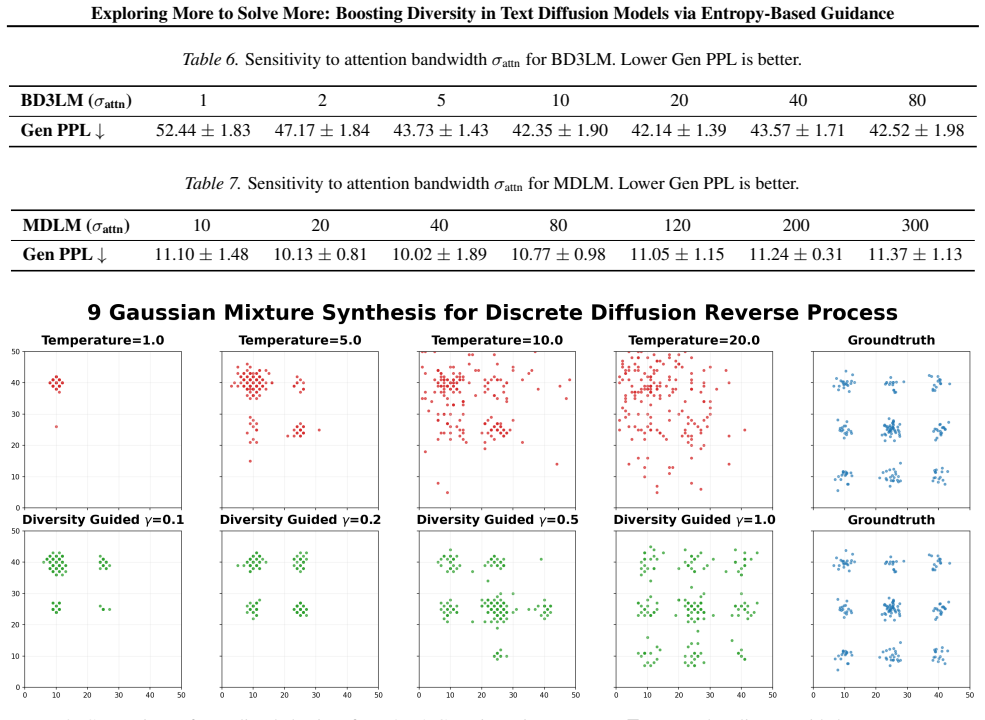
- [Figures 1 and 4] Figure 1 caption says '8-Gaussian-mixture' while Figure 4 caption says '9-Gaussian-mixture'; the figures appear nearly identical. Please clarify and correct the inconsistency.
- [Sec. 4.3.2] The phrase 'a single backward pass of a continuous diversity function' is misleading: Algorithm 1 computes the gradient analytically from hidden states, not via automatic differentiation. Suggest rewording to 'a single forward pass followed by a closed-form gradient evaluation.'
- [Sec. 5.4] Table 3 reports throughput for prompt lengths up to 1024, but the main benchmark results in Sec. 5.3 likely use shorter prompts; please state the computational cost for the actual benchmark settings, not only the synthetic throughput experiment.
Circularity Check
No significant circularity: SAKE's guidance signal is derived in-paper from Renyi entropy of a Gram matrix, and the reported gains are measured on held-out benchmarks, not forced by construction.
full rationale
The derivation chain is self-contained and does not reduce to its inputs. Proposition 4.1 derives the entropy-gradient identity (Eq. 7-8) from the definition of the tilted distribution P_gamma using the covariance identity, with no assumption that the guidance target holds; the proof is given in Appendix A. Proposition 4.3 derives the repulsive-gradient signal (Eq. 17 -> 18) by calculus from the order-2 Renyi entropy of the kernel Gram matrix (Eq. 15), and the density-matrix validity (Hermitian, PSD, unit trace) is proven in the appendix via the Schur product theorem, not imported from a citation. The empirical headline claims (HumanEval pass@32 41.1->55.8, MBPP 48.2->56.1, GSM8K 71.5->75.1) are measured on external benchmarks and are not guaranteed by the construction: Pass@1 slightly decreases (32.9->32.0) and D-CFG fails to improve pass@32, showing the gains are not a forced property of the decoding procedure. The paper's own limitation section explicitly concedes that the relationship between gamma and the decoded distribution is underdeveloped, which is inconsistent with a claim whose conclusion is baked into its premise. The main vulnerability, stated by the paper rather than hidden ('These assumptions hold in modern LLMs (like LLaDA) because LayerNorm/RMSNorm constrains embeddings,' Sec. 4.3.2), is the semantic-geometry assumption on hidden states; this is an explicit, testable premise about model internals, not a circular embedding of the conclusion, though the [MASK]-token mismatch in Algorithm 1 is a genuine correctness risk. The heavy same-group citation presence (Jalali et al. 2025a; Zhang et al. 2024/2025, etc.) is contextual related-work attribution, and the proofs do not rely on it; the kernel-repulsion objective resembles the authors' prior RKE/SPARKE line (Jalali et al. 2025a), which is a novelty-attribute concern rather than a circular reduction, since the paper derives Eq. 18 internally. Tuning gamma and sigma by grid search on the evaluation benchmarks is a potential overfitting concern for the raw numbers, but it is not a fitted parameter being renamed as a prediction, and the reported trade-off (Pass@32 up, Pass@1 down) remains an empirical, falsifiable outcome. No step can be exhibited where a prediction reduces by the paper's own equations or by self-citation to its own inputs.
Axiom & Free-Parameter Ledger
free parameters (5)
- gamma (guidance scale) =
Grid-searched per benchmark (e.g., gamma=0.7 in Table 1; Gaussian sweep gamma in [0.01, 2.0])
- sigma (semantic kernel bandwidth) =
sigma=20 (MDLM), sigma=80 (BD3LM), selected from swept ranges
- sigma_attn (attention/positional kernel bandwidth) =
sigma_attn=20-40 (MDLM), 10-80 (BD3LM) from sweeps
- top-p trust-region threshold =
0.95, selected via a HumanEval sweep (Table 8)
- sampling temperature T =
0.2-0.7 explored; Table 2 headlined at T=0.2
axioms (6)
- standard math Gaussian RBF Gram matrices are PSD and the Hadamard (Schur) product of PSD matrices is PSD.
- domain assumption The diversity potential is smooth and token embeddings are bounded, so the first-order Taylor linearization (Eq. 13) is faithful.
- domain assumption Euclidean distance between token/hidden-state embeddings measures semantic (dis)similarity, so RBF entropy of the sequence is a semantic diversity measure.
- domain assumption Maximizing within-sequence kernel entropy transfers to across-sample diversity that improves pass@k and self-consistency.
- domain assumption All useful guidance can be expressed as logit-space tilting P_gamma proportional to P_base * exp(gamma * psi) (Eq. 6).
- domain assumption A top-p filter on the base logits confines the unbounded linearized signal to a plausible-token region.
read the original abstract
Although diffusion models have revolutionized continuous domains like image synthesis through high quality generations and controllable guidance mechanisms, bringing this controllability to the discrete, sequential nature of text remains an open challenge. Meanwhile, current sampling strategies and guidance methods adjust token likelihoods without capturing the broader semantic landscape, leading to a suboptimal balance between fidelity and diversity. In this work, we introduce a novel training-free Semantic-Aware Kernel Entropy (SAKE) guidance method. Our method computes the order-2 R\'enyi entropy over a kernel Gram matrix that captures both cross-token semantic interactions and relative token positions. By linearizing this objective in the embedding space, we derive a tractable guidance signal that dynamically adjusts the sampling distribution, flattening it to encourage exploration during redundancy and sharpening it for fidelity when diverse. Empirical experiments demonstrate that our approach achieves a superior Pareto frontier between fidelity and diversity, and improves multi-sample performance on reasoning-intensive tasks, such as code and mathematics generation, compared to temperature scaling and discrete guidance baselines.
Figures


Reference graph
Works this paper leans on
-
[1]
arXiv preprint arXiv:2412.10193 , year=
Simple guidance mechanisms for discrete diffusion models , author=. arXiv preprint arXiv:2412.10193 , year=
-
[2]
Advances in Neural Information Processing Systems , volume=
Concrete score matching: Generalized score matching for discrete data , author=. Advances in Neural Information Processing Systems , volume=
-
[3]
arXiv preprint arXiv:2310.16834 , year=
Discrete diffusion modeling by estimating the ratios of the data distribution , author=. arXiv preprint arXiv:2310.16834 , year=
-
[4]
Advances in neural information processing systems , volume=
Diffusion models beat gans on image synthesis , author=. Advances in neural information processing systems , volume=
-
[5]
arXiv preprint arXiv:2207.12598 , year=
Classifier-free diffusion guidance , author=. arXiv preprint arXiv:2207.12598 , year=
-
[6]
Advances in Neural Information Processing Systems , volume=
An information-theoretic evaluation of generative models in learning multi-modal distributions , author=. Advances in Neural Information Processing Systems , volume=
-
[8]
Advances in neural information processing systems , volume=
Denoising diffusion probabilistic models , author=. Advances in neural information processing systems , volume=
-
[9]
Advances in neural information processing systems , volume=
Generative modeling by estimating gradients of the data distribution , author=. Advances in neural information processing systems , volume=
-
[10]
arXiv preprint arXiv:2011.13456 , year=
Score-based generative modeling through stochastic differential equations , author=. arXiv preprint arXiv:2011.13456 , year=
Pith/arXiv arXiv 2011
-
[11]
International conference on machine learning , pages=
Deep unsupervised learning using nonequilibrium thermodynamics , author=. International conference on machine learning , pages=. 2015 , organization=
2015
-
[12]
Advances in neural information processing systems , volume=
Elucidating the design space of diffusion-based generative models , author=. Advances in neural information processing systems , volume=
-
[13]
Proceedings of the 40th International Conference on Machine Learning , pages=
Consistency models , author=. Proceedings of the 40th International Conference on Machine Learning , pages=
-
[14]
arXiv preprint arXiv:2210.02747 , year=
Flow matching for generative modeling , author=. arXiv preprint arXiv:2210.02747 , year=
-
[15]
arXiv preprint arXiv:2010.02502 , year=
Denoising diffusion implicit models , author=. arXiv preprint arXiv:2010.02502 , year=
Pith/arXiv arXiv 2010
-
[16]
Advances in neural information processing systems , volume=
Diffusion-lm improves controllable text generation , author=. Advances in neural information processing systems , volume=
-
[17]
arXiv preprint arXiv:2212.10325 , year=
Seqdiffuseq: Text diffusion with encoder-decoder transformers , author=. arXiv preprint arXiv:2212.10325 , year=
-
[18]
Advances in neural information processing systems , volume=
Structured denoising diffusion models in discrete state-spaces , author=. Advances in neural information processing systems , volume=
-
[19]
Advances in Neural Information Processing Systems , volume=
Simple and effective masked diffusion language models , author=. Advances in Neural Information Processing Systems , volume=
-
[20]
arXiv preprint arXiv:2406.03736 , year=
Your absorbing discrete diffusion secretly models the conditional distributions of clean data , author=. arXiv preprint arXiv:2406.03736 , year=
-
[21]
arXiv preprint arXiv:2502.09992 , year=
Large language diffusion models , author=. arXiv preprint arXiv:2502.09992 , year=
-
[22]
arXiv preprint arXiv:2508.15487 , year=
Dream 7b: Diffusion large language models , author=. arXiv preprint arXiv:2508.15487 , year=
-
[23]
arXiv preprint arXiv:2203.11171 , year=
Self-consistency improves chain of thought reasoning in language models , author=. arXiv preprint arXiv:2203.11171 , year=
-
[24]
Advances in neural information processing systems , volume=
Tree of thoughts: Deliberate problem solving with large language models , author=. Advances in neural information processing systems , volume=
-
[25]
International conference on machine learning , pages=
Reliable fidelity and diversity metrics for generative models , author=. International conference on machine learning , pages=. 2020 , organization=
2020
-
[26]
Proceedings of the 2016 conference of the North American chapter of the association for computational linguistics: human language technologies , pages=
A diversity-promoting objective function for neural conversation models , author=. Proceedings of the 2016 conference of the North American chapter of the association for computational linguistics: human language technologies , pages=
2016
-
[27]
arXiv preprint arXiv:2505.09388 , year=
Qwen3 technical report , author=. arXiv preprint arXiv:2505.09388 , year=
-
[28]
Advances in Neural Information Processing Systems , year=
SPARKE: Scalable Prompt-Aware Diversity and Novelty Guidance in Diffusion Models via RKE Score , author=. Advances in Neural Information Processing Systems , year=
-
[29]
High-Resolution Image Synthesis with Latent Diffusion Models , booktitle =
Robin Rombach and Andreas Blattmann and Dominik Lorenz and Patrick Esser and Bj. High-Resolution Image Synthesis with Latent Diffusion Models , booktitle =. 2022 , pages =
2022
-
[30]
Journal of Machine Learning Research , volume=
Cascaded diffusion models for high fidelity image generation , author=. Journal of Machine Learning Research , volume=
-
[31]
arXiv preprint arXiv:2211.13221 , year=
Latent video diffusion models for high-fidelity long video generation , author=. arXiv preprint arXiv:2211.13221 , year=
-
[32]
arXiv preprint arXiv:2311.15127 , year=
Stable video diffusion: Scaling latent video diffusion models to large datasets , author=. arXiv preprint arXiv:2311.15127 , year=
-
[33]
Proceedings of the IEEE/CVF conference on computer vision and pattern recognition , pages=
Align your latents: High-resolution video synthesis with latent diffusion models , author=. Proceedings of the IEEE/CVF conference on computer vision and pattern recognition , pages=
-
[34]
arXiv preprint arXiv:2112.10741 , year =
Alex Nichol and Prafulla Dhariwal and Aditya Ramesh and Pranav Shyam and Pamela Mishkin and Bob McGrew and Ilya Sutskever and Mark Chen , title =. arXiv preprint arXiv:2112.10741 , year =
-
[35]
Proceedings of the IEEE/CVF Conference on Computer Vision and Pattern Recognition , pages=
Universal guidance for diffusion models , author=. Proceedings of the IEEE/CVF Conference on Computer Vision and Pattern Recognition , pages=
-
[36]
Jaakkola , booktitle=
Gabriele Corso and Yilun Xu and Valentin De Bortoli and Regina Barzilay and Tommi S. Jaakkola , booktitle=
-
[37]
European Conference on Computer Vision , pages=
Improving geo-diversity of generated images with contextualized vendi score guidance , author=. European Conference on Computer Vision , pages=. 2024 , organization=
2024
-
[38]
arXiv preprint arXiv:2502.08512 , year=
Measuring Diversity in Synthetic Datasets , author=. arXiv preprint arXiv:2502.08512 , year=
-
[39]
Advances in neural information processing systems , volume=
Assessing generative models via precision and recall , author=. Advances in neural information processing systems , volume=
-
[40]
arXiv preprint arXiv:2210.02410 , year =
Dan Friedman and Adji Bousso Dieng , title =. arXiv preprint arXiv:2210.02410 , year =
-
[41]
Weber , title=
Seyedmorteza Sadat and Jakob Buhmann and Derek Bradley and Otmar Hilliges and Romann M. Weber , title=. The Twelfth International Conference on Learning Representations , year=
-
[42]
2025 , eprint=
Shielded Diffusion: Generating Novel and Diverse Images using Sparse Repellency , author=. 2025 , eprint=
2025
-
[43]
arXiv preprint arXiv:1610.02424 , year=
Diverse beam search: Decoding diverse solutions from neural sequence models , author=. arXiv preprint arXiv:1610.02424 , year=
-
[44]
arXiv preprint arXiv:1904.09751 , year=
The curious case of neural text degeneration , author=. arXiv preprint arXiv:1904.09751 , year=
Pith/arXiv arXiv 1904
-
[45]
arXiv preprint arXiv:2407.01082 , year=
Turning up the heat: Min-p sampling for creative and coherent llm outputs , author=. arXiv preprint arXiv:2407.01082 , year=
-
[46]
arXiv preprint arXiv:2412.19437 , year=
Deepseek-v3 technical report , author=. arXiv preprint arXiv:2412.19437 , year=
-
[47]
Advances in neural information processing systems , volume=
Language models are few-shot learners , author=. Advances in neural information processing systems , volume=
-
[48]
2025 , eprint=
Block Diffusion: Interpolating Between Autoregressive and Diffusion Language Models , author=. 2025 , eprint=
2025
-
[49]
The Thirty-ninth Annual Conference on Neural Information Processing Systems , year =
When Kernels Multiply, Clusters Unify: Fusing Embeddings with the Kronecker Product , author =. The Thirty-ninth Annual Conference on Neural Information Processing Systems , year =
-
[50]
IEEE International Symposium on Information Theory (ISIT) , year =
The Maximum von Neumann Entropy Principle: Theory and Applications in Machine Learning , author =. IEEE International Symposium on Information Theory (ISIT) , year =
-
[51]
International Conference on Machine Learning , year=
KODA: Contrastive Representation Comparison and Alignment for Vision-Language Foundation Models , author=. International Conference on Machine Learning , year=
-
[52]
Conditional Vendi Score: Prompt-Aware Diversity Evaluation for Generative
Mohammad Jalali and Azim Ospanov and Amin Gohari and Farzan Farnia , booktitle=. Conditional Vendi Score: Prompt-Aware Diversity Evaluation for Generative. 2026 , url=
2026
-
[53]
Advances in Neural Information Processing Systems , volume=
Towards a scalable reference-free evaluation of generative models , author=. Advances in Neural Information Processing Systems , volume=
-
[54]
International Conference on Machine Learning , pages=
Towards an Explainable Comparison and Alignment of Feature Embeddings , author=. International Conference on Machine Learning , pages=. 2025 , organization=
2025
-
[55]
International Conference on Machine Learning , pages=
Kernel-based Unsupervised Embedding Alignment for Enhanced Visual Representation in Vision-language Models , author=. International Conference on Machine Learning , pages=. 2025 , organization=
2025
-
[56]
Proceedings of The 28th International Conference on Artificial Intelligence and Statistics , pages =
A Multi-Armed Bandit Approach to Online Selection and Evaluation of Generative Models , author =. Proceedings of The 28th International Conference on Artificial Intelligence and Statistics , pages =. 2025 , volume =
2025
-
[57]
Proceedings of the 26th International Conference on Machine Learning (ICML) , year=
PAK-UCB Contextual Bandit: An Online Learning Approach to Prompt-Aware Selection of Generative Models and LLMs , author=. Proceedings of the 26th International Conference on Machine Learning (ICML) , year=
-
[58]
Be More Diverse than the Most Diverse: Optimal Mixtures of Generative Models via Mixture-
Parham Rezaei and Farzan Farnia and Cheuk Ting Li , booktitle=. Be More Diverse than the Most Diverse: Optimal Mixtures of Generative Models via Mixture-. 2025 , url=
2025
-
[59]
Proceedings of the IEEE/CVF International Conference on Computer Vision Workshops , pages=
On the distributed evaluation of generative models , author=. Proceedings of the IEEE/CVF International Conference on Computer Vision Workshops , pages=
-
[60]
The 41st Conference on Uncertainty in Artificial Intelligence , year=
Do Vendi Scores Converge with Finite Samples? Truncated Vendi Score for Finite-Sample Convergence Guarantees , author=. The 41st Conference on Uncertainty in Artificial Intelligence , year=
-
[61]
Proceedings of the IEEE/CVF International Conference on Computer Vision (ICCV) , month =
Ospanov, Azim and Jalali, Mohammad and Farnia, Farzan , title =. Proceedings of the IEEE/CVF International Conference on Computer Vision (ICCV) , month =. 2025 , pages =
2025
-
[62]
Proceedings of the 41st International Conference on Machine Learning , pages =
An Interpretable Evaluation of Entropy-based Novelty of Generative Models , author =. Proceedings of the 41st International Conference on Machine Learning , pages =. 2024 , volume =
2024
-
[63]
Unveiling Differences in Generative Models: A Scalable Differential Clustering Approach , author=
-
[64]
arXiv preprint arXiv:2505.18901 , year=
PromptWise: Online Learning for Cost-Aware Prompt Assignment in Generative Models , author=. arXiv preprint arXiv:2505.18901 , year=
-
[65]
Forty-third International Conference on Machine Learning , year=
MMD Guidance: Training-Free Distribution Adaptation for Diffusion Models via Maximum Mean Discrepancy Guidance , author=. Forty-third International Conference on Machine Learning , year=
-
[66]
Mixture-Greedy for Online Generative Model Selection: Is
Bahar Dibaei Nia and Farzan Farnia , booktitle=. Mixture-Greedy for Online Generative Model Selection: Is. 2026 , url=
2026
-
[67]
2026 , url=
Donya Jafari and Farzan Farnia , booktitle=. 2026 , url=
2026
-
[68]
ICML 2026 Workshop on Combining Theory and Benchmarks: Towards A Virtuous Cycle to Understand and Guarantee Foundation Model Performance , year=
PromptSplit: Revealing Prompt-Level Disagreement in Generative Models , author=. ICML 2026 Workshop on Combining Theory and Benchmarks: Towards A Virtuous Cycle to Understand and Guarantee Foundation Model Performance , year=
2026
-
[69]
Advances in Neural Information Processing Systems , volume=
Exposing flaws of generative model evaluation metrics and their unfair treatment of diffusion models , author=. Advances in Neural Information Processing Systems , volume=
discussion (0)
Sign in with ORCID, Apple, or X to comment. Anyone can read and Pith papers without signing in.