REVIEW 4 major objections 5 minor 39 references
Rethinking Total Absorption Gamma Spectroscopy Deconvolution: Supervised Machine Learning vs Response-Matrix Methods
T0 review · 4 major / 5 minor · reviewed 2026-08-04 · deepseek-v4-flash
Pith's one-line read In a simulated TAGS decay with a high level density, supervised machine learning recovers individual β-feeding intensities about ten times more accurately than response-matrix unfolding—provided the training and test conditions match.
desk verdict The paper's order-of-magnitude ML superiority claim is an in-distribution artifact, and the authors' own caveats concede the point — but the benchmark itself is new and worth a referee's time. read the letter →
The pith
A machine-rendered reading of the paper's core claim, the machinery that carries it, and where it could break.
The reading
What carries the argument
The central object is the response-matrix inverse problem d = N R f, in which the measured TAS spectrum is a Poisson-noised superposition of per-level response functions; because adjacent level responses are nearly degenerate, direct inversion of R is unstable. The argument turns on the distinction between two optimization targets: response-matrix methods (differential evolution, expectation-maximization/Richardson–Lucy, and non-negative least squares) minimize the residual between measured and reconstructed spectra, while supervised machine-learning estimators (one-dimensional convolutional networks and gradient-boosted trees) minimize a loss (L1 or L2) directly on the feeding vector. This
What would settle it
Train the CNN and GBDT models exactly as described, then generate a validation set with a response matrix perturbed by a few percent (e.g., recomputed with a different detector geometry or physics list) or with feedings drawn from a different prior, and compare L2 errors. If the supervised models' advantage over NNLS/DIFEVO/BAYES collapses under either change, the order-of-magnitude claim is an artifact of matching training and test conditions rather than a general property of the methods.
Extended reading notes
Core claim
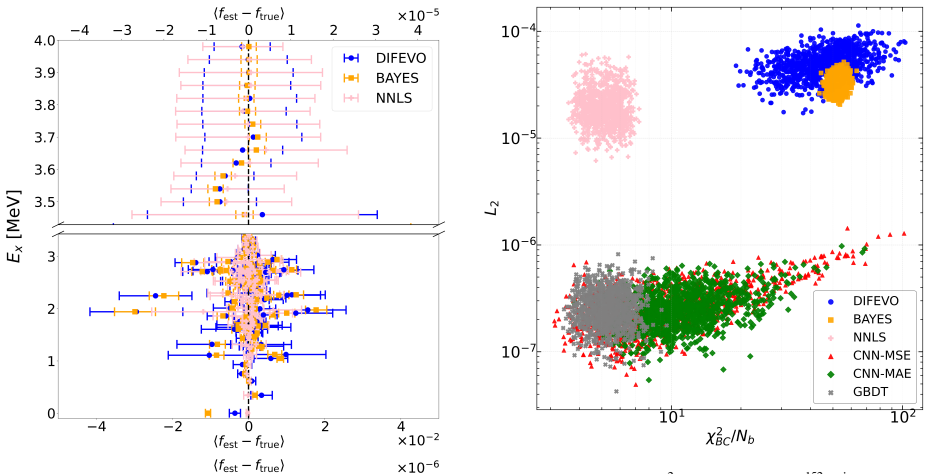
The central claim, in the authors' terms, is that 'a good spectral fit does not guarantee an accurate feeding reconstruction.' Response-matrix algorithms optimize the fit to the measured spectrum and therefore develop oscillatory biases in the feeding distribution that grow with statistics, whereas supervised machine-learning estimators are trained to minimize the error on the feeding vector itself and are statistically compatible with one another and consistently superior on the test set: on the L2 metric, all three supervised methods outperform the response-matrix methods by more than an order of magnitude, with individual feeding uncertainties reduced by up to an order of magnitude. The p
Load-bearing premise
The evaluation is in-distribution: the 1000-case validation set is generated with the same detector response matrix, the same ±10% perturbation around the same nominal feeding vector, and the same Poisson sampling used to train the models, so the claimed ML superiority assumes that this simulated setup transfers to real TAGS data with response-model errors, background, contaminants, and different feeding priors.
Editorial extensions
If this is right
- If the simulated results transfer to experiment, TAGS analyses of complex decays can push per-level feeding uncertainties down by about an order of magnitude at high statistics.
- The hybrid workflow—response-matrix initial estimate, then supervised ML refinement—becomes the paper's practical recommendation for handling real data.
- The decoupling result implies that reporting only reconstructed-spectrum χ² is insufficient; feeding-level accuracy must be assessed directly, and the authors plan a systematic uncertainty evaluation next.
- For experiments with 10^7–10^8 counts, supervised ML gains roughly two orders of magnitude in feeding accuracy over the low-statistics regime, while response-matrix methods stall.
- Supervised ML requires a representative training set and prior knowledge of the solution; without those, the response-matrix methods remain the fallback.
Reading between the lines
- Because the validation set is generated in-distribution (same response matrix, same ±10% prior, same Poisson sampling as training), the reported order-of-magnitude advantage is best read as an interpolation result; a validation set built with an independently perturbed response matrix would test whether the advantage survives response-model mismatch, which is the likely real-world failure mode.
- The same optimization-target insight should generalize to other ill-posed spectroscopy inverses: any deconvolution benchmark that scores only spectral goodness-of-fit can reward methods that fit noise, so ML-trained-on-truth may appear superior partly because it is scored on its own loss.
- The hybrid workflow suggests an iterative closed loop the paper does not explore: use the ML refinement as a new reference, generate a fresh training set around it, and retrain; convergence of this loop would be a testable extension.
- The authors' choice to train with ±10% perturbations around a single nominal feeding vector means the models never see qualitatively different feeding patterns; a test with a different decay or a different nominal vector would reveal how much of the learned mapping is decay-specific.
Editorial analysis
A structured set of objections, weighed in public.
Referee Report
Summary. The paper presents a systematic comparison of supervised machine-learning estimators (CNN-MSE, CNN-MAE, GBDT) against conventional response-matrix unfolding methods (DIFEVO, BAYES, NNLS) for the TAGS deconvolution problem. The authors use a realistic GEANT4-based response matrix for a synthetic benchmark, 152Tb†/152Gd†, generate two million training samples by perturbing a reference feeding vector by ±10% and applying Poisson statistics, and evaluate on one thousand independently generated but identically distributed validation samples. They report that the supervised ML methods achieve substantially lower L2 error on feeding-vector reconstruction, reduce per-feeding uncertainties by about an order of magnitude, and behave differently from RM methods as counting statistics vary. The paper proposes a hybrid workflow in which an RM method provides an initial feeding estimate that is then refined by a supervised ML model. The central quantitative claim is stated in Sec. 4: on the L2 metric, all three ML methods outperform the RM methods by more than one order of magnitude.
Significance. If the claimed superiority held outside the specific simulation setup, the paper would be a useful step toward applying supervised ML to TAGS, a problem where conventional unfolding is known to be ill-conditioned. The paper's strengths include the use of a realistic detector response, a large training set, a validation set that is independent of training, and the simultaneous reporting of spectral-fit (χ2_BC/Nb) and feeding-reconstruction (L2) metrics. The authors also clearly separate the optimization targets of the two method families, which is an important conceptual point. However, the evidence presented is confined to an in-distribution evaluation: the validation data are generated by the same procedure as the training data, and the primary metric L2 is the training objective for CNN-MSE and GBDT. The paper itself acknowledges that supervised ML requires good prior knowledge of the solution and defers systematic uncertainty, background, contaminants, and pileup to future work. Therefore, the practical significance is currently conditional on the transfer of the in-simulation ranking to real TAGS data, which is not demonstrated. The proposed hybrid strategy is plausible but unt
major comments (4)
- [Sec. 2, Eq. (3); Sec. 4] The headline 'more than one order of magnitude' L2 advantage is largely forced by the evaluation design. The validation set is generated with the same procedure as the training set (same response matrix R, same ±10% flat perturbation around the same f_ref, same Poisson sampling; Sec. 2, 'ensuring consistency between training and evaluation conditions'), and the L2 metric of Eq. (3) is exactly the training loss for CNN-MSE and GBDT. RM methods minimize spectral residuals, not L2, so their poorer L2 is expected. To make the central claim load-bearing, the paper needs a domain-shift test: evaluate on spectra produced with a perturbed response matrix (e.g., energy-scale or efficiency changes), with a different reference feeding vector or wider perturbation range, and with added background/contaminants, and report both L2 and χ2_BC/Nb. Without such a test, the conclusions in Sec. 4 should be
- [Sec. 3.2] The low-statistics comparison mixes training-distribution mismatch with algorithmic capability. The supervised models were trained exclusively at N=10^8; for N=10^4–10^7 the validation spectra are rescaled to 10^8 counts before being fed to the ML models, while the RM methods are applied at the original statistics. This means the ML inputs at low statistics have noise levels far outside the training distribution, and no noise augmentation or retraining at each N is described. Consequently, the conclusion that 'only the supervised ML approaches are able to translate the reduction of statistical fluctuations into a more accurate reconstruction' is not a fair head-to-head comparison. Please clarify the exact preprocessing for RM methods and retrain or noise-train the ML models at each statistics level, or reinterpret the result as a sensitivity analysis rather than a comparative claim.
- [Sec. 3.1; Sec. 4 (last paragraph)] The claim that ML reduces 'the uncertainty on individual feeding values by up to an order of magnitude' overstates what is quantified. The reported standard deviations are only the Monte Carlo dispersion over validation samples; systematic uncertainties from response-model errors, missing transitions, continuum-model assumptions, and background are not evaluated. The paper itself defers 'a systematic evaluation of the uncertainties' to future work. Please rephrase the uncertainty claim to refer to the in-simulation statistical dispersion, and add a caveat that the absolute uncertainties in a real TAGS analysis will include response-model systematics that are not present in this benchmark.
- [Sec. 4] The central practical recommendation—use an RM estimate as the training prior for a supervised ML model—is not tested. If the initial RM estimate is inaccurate, the training distribution will be offset from the test distribution, potentially erasing the ML advantage. At minimum, the paper should include a proof-of-principle experiment: train a model on spectra generated around an RM estimate (rather than around f_ref) and evaluate on the true validation distribution. Without this, the hybrid strategy remains a conjecture.
minor comments (5)
- [General] The phrase 'continium' in the Table 1 caption should be 'continuum'. Also, the author affiliation contains 'Fonseca-V argas' with an extra space.
- [Sec. 2] Please specify the training/validation split more precisely: how many of the two million samples are used for training versus validation, and whether any early stopping or hyperparameter selection was performed on the validation set.
- [Fig. 5 and Sec. 3.1] The axis label in Fig. 5 is 'χ2_BC–L2' but the text discusses χ2_BC/Nb; the figure should be labeled consistently with the metric actually shown.
- [References] Several reference names are garbled, e.g., 'T y oshida' and 'V etterling'; please proofread the bibliography against the original sources.
- [Sec. 2, Eq. (4)] The definition of the DIFEVO loss omits the factorial term from the Poisson log-likelihood; this is fine as a constant, but the text should state that the constant has been dropped.
Circularity Check
No significant circularity; the comparison is a transparent, held-out benchmark rather than a self-referential derivation.
full rationale
The paper reports an empirical benchmark between supervised ML estimators and response-matrix unfolding methods, not a derivation from first principles. Its central claim—that ML methods trained to map spectra directly onto feeding vectors achieve lower L2 on a held-out validation set than RM methods that optimize spectral discrepancy—is supported by a standard train/validation split: the 1000 validation pairs were not used in training. The fact that Eq. 3 is both the training loss for CNN-MSE and GBDT and the evaluation metric does not constitute circularity; the paper explicitly acknowledges this by design, stating that supervised ML methods 'by construction, minimize the error on the feeding vector directly, and it is precisely this difference in optimization target that drives their superior performance.' This is a transparent explanation of mechanism, not a hidden reduction. CNN-MAE, which is trained with L1 loss, also achieves low L2 values, showing the result is not a simple tautology of training on the same metric. The in-distribution nature of the validation data and the untested hybrid workflow are genuine external-validity limitations, and the authors explicitly defer such generality to future work ('Establishing the generality of the trends reported here across decays of different level densities and cascade complexities is left for future work'), but these are limitations, not circular steps. Self-citations to Refs. [1,12] are used to construct the benchmark decay scheme (statistical-model branching ratios), but no load-bearing conclusion is imported from them. No step in the analysis reduces to its own inputs by definition or by fitted-parameter renaming.
Assumptions & free parameters
free parameters (8)
- Feeding perturbation interval (±10% of nominal) =
±10%
- Continuum onset energy =
2.9 MeV
- Continuum bin width =
40 keV
- Nominal continuum feeding where ENSDF has no info =
0.1%
- Training sample size =
2,000,000
- Training/validation total statistics =
10^8 decays
- CNN architecture hyperparameters
- GBDT hyperparameters
assumptions (5)
- domain assumption The GEANT4 model of the Lucrecia detector (Physics List Option 4, Radioactive Decay module) accurately represents the response of the real detector.
- domain assumption The statistical-model prescription of Ref. [12] correctly describes the de-excitation branching ratios of the continuum levels.
- domain assumption The ENSDF decay scheme for 152Tb, plus the added continuum, is a realistic and representative case for high-level-density TAGS decays.
- ad hoc to paper Validation samples drawn from the same generative procedure as training samples (same R, same ±10% perturbations, same Poisson noise) are representative of the conditions where the trained model will be used.
- standard math Poisson statistics adequately describe the counting fluctuations in a TAGS measurement.
invented entities (1)
-
152Tb† / 152Gd† synthetic decay benchmark
Cite this review
Pith. "Pith review of Rethinking Total Absorption Gamma Spectroscopy Deconvolution: Supervised Machine Learning vs Response-Matrix Methods." pith.science (2026). https://pith.science/paper/3YY5JUBW
@misc{pith2026260800090,
  author       = {Pith},
  title        = {Pith review of: Rethinking Total Absorption Gamma Spectroscopy Deconvolution: Supervised Machine Learning vs Response-Matrix Methods},
  year         = {2026},
  howpublished = {\url{https://pith.science/paper/3YY5JUBW}},
  note         = {Machine review of arXiv:2608.00090}
}
abstract
The extraction of $\beta$-feeding distributions in Total Absorption $\gamma$-ray Spectroscopy constitutes a challenging inverse problem, particularly in nuclei with complex decay schemes involving a large number of excited states. In such cases, the measured spectrum arises from the superposition of many detector response functions, making the determination of the individual feedings intrinsically ill-posed and highly sensitive to the methodology employed. In this work, we present a systematic comparison between supervised Machine-Learning techniques and Response-Matrix methods using realistic Monte Carlo simulations of an experimental Total Absorption Spectrometer. Supervised Machine-Learning approaches construct a non-parametric estimator that infers level feedings from the measured spectrum after a training stage, whereas Response-Matrix methods determine the feeding distribution by directly minimizing the difference between measured and reconstructed spectra. Our results show that supervised Machine-Learning techniques achieve superior accuracy in the reconstruction of individual feeding intensities, whereas Response-Matrix methods provide robust and physically consistent initial solutions. These findings support a hybrid strategy in which a Response-Matrix method is first used to obtain an initial feeding estimate, which is then refined using a supervised Machine-Learning approach to achieve improved overall accuracy.
Figures


Figures from the paper (3 more)


Reference graph
Works this paper leans on
-
[1]
J. Tain, D. Cano-Ott, Algorithms for the analysis of β-decay total absorption spec- tra, Nuclear Instruments and Methods in Physics Research Section A: Accelerators, Spectrometers, Detectors and Associated Equip- ment 571 (3) (2007) 728–738. doi:https: //doi.org/10.1016/j.nima.2006.10.098. URL https://www.sciencedirect.com/ science/article/pii/S0168900206018985
-
[2]
W. H. Press, S. A. Teukolsky, W. T. V etterling, B. P . Flannery, Numerical Recipes in FORTRAN: The Art of Scientific Computing, 2nd Edition, Cambridge University Press, Cambridge, 1992
1992
-
[3]
A. P . Dempster, N. M. Laird, D. B. Rubin, Maximum likelihood from incomplete data via the em algorithm , Journal of the Royal Statistical Society: Series B (Methodolog- ical) 39 (1) (1977) 1–22. arXiv:https: //rss.onlinelibrary.wiley.com/doi/pdf/ 10.1111/j.2517-6161.1977.tb01600.x, doi:https://doi.org/10.1111/j. 2517-6161.1977.tb01600.x. URL https://rss....
arXiv 1977
-
[4]
L. A. Shepp, Y . V ardi, Maximum likelihood recon- struction for emission tomography, IEEE Transac- tions on Medical Imaging 1 (2) (1982) 113–122. doi:10.1109/TMI.1982.4307558
arXiv 1982
-
[5]
W. H. Richardson, Bayesian-based it- erative method of image restoration ∗, J. Opt. Soc. Am. 62 (1) (1972) 55–59. doi:10.1364/JOSA.62.000055. URL https://opg.optica.org/abstract. cfm?URI=josa-62-1-55
-
[6]
L. B. Lucy, An iterative technique for the rectifica- tion of observed distributions, Astrophysical Jour- nal 79 (1974) 745. doi:10.1086/111605
doi:10.1086/111605 1974
-
[7]
G. D’Agostini, A multidimensional unfolding method based on bayes’ theorem , Nuclear In- struments and Methods in Physics Research Section A: Accelerators, Spectrometers, Detec- tors and Associated Equipment 362 (2) (1995) 487–498. doi:https://doi.org/10.1016/ 0168-9002(95)00274-X . URL https://www.sciencedirect.com/ science/article/pii/016890029500274X
arXiv 1995
- [8]
Show all 39 references
-
[9]
Tikochinsky, N
Y . Tikochinsky, N. Z. Tishby, R. D. Levine, Con- sistent inference of probabilities for reproducible experiments, Phys. Rev. Lett. 52 (1984) 1357–
1984
-
[10]
D. M. Titterington, General structure of regular- ization procedures in image reconstruction, As- tronomy and Astrophysics 144 (1985) 381
1985
-
[11]
L. Meng, D. Ramsden, An inter-comparison of three spectral-deconvolution algorithms for gamma-ray spectroscopy, IEEE Transactions on Nuclear Science 47 (4) (2000) 1329–1336. doi: 10.1109/23.872973
2000 doi
-
[12]
J. Tain, D. Cano-Ott, The influence of the unknown de-excitation pattern in the analy- sis of β-decay total absorption spectra , Nu- clear Instruments and Methods in Physics 12 Research Section A: Accelerators, Spec- trometers, Detectors and Associated Equip- ment 571 (3) (2007...
2007 doi
-
[13]
C. Duke, P . Hansen, O. Nielsen, G. Rudstam, Strength-function phenomena in electron-capture beta decay , Nuclear Physics A 151 (3) (1970) 609–633. doi:https://doi.org/10.1016/ 0375-9474(70)90400-8 . URL https://www.sciencedirect.com/ science/article/pii/0375947470904008
1970
-
[14]
Rubio, W
B. Rubio, W. Gelletly, A. Algora, E. Nacher, J. L. Tain, Beta decay studies with total absorp- tion spectroscopy and the lucrecia spectrometer at isolde* , Journal of Physics G: Nuclear and Particle Physics 44 (8) (2017) 084004. doi:10.1088/1361-6471/aa797f. URL https://doi.or...
2017 doi
-
[15]
Hardy, L
J. Hardy, L. Carraz, B. Jonson, P . Hansen, The es- sential decay of pandemonium: A demonstration of errors in complex beta-decay schemes , Physics Letters B 71 (2) (1977) 307–310. doi:https:// doi.org/10.1016/0370-2693(77)90223-4 . URL https://www.sciencedirect.com/ science/a...
1977
-
[16]
Dembski, M
C. Dembski, M. Kuchera, S. Liddick, R. Ramanu- jan, A. Spyrou, Two-dimensional total absorption spectroscopy with conditional generative ad- versarial networks , Nuclear Instruments and Methods in Physics Research Section A: Accel- erators, Spectrometers, Detectors and Associa...
2024
-
[17]
Storn, K
R. Storn, K. Price, Differential evolution – a simple and e fficient heuristic for global opti- mization over continuous spaces , Journal of Global Optimization 11 (4) (1997) 341–359. doi:10.1023/A:1008202821328. URL https://doi.org/10.1023/A: 1008202821328
1997 doi
-
[18]
C. L. Lawson, R. J. Hanson, Solving Least Squares Problems , Society for In- dustrial and Applied Mathematics, 1995. arXiv:https://epubs.siam.org/ doi/pdf/10.1137/1.9781611971217, doi:10.1137/1.9781611971217. URL https://epubs.siam.org/doi/abs/ 10.1137/1.9781611971217
1995 doi
-
[19]
C. M. Bishop, H. Bishop, Deep Learn- ing, 1st Edition, Springer, Cham, 2024. doi:10.1007/978-3-031-45468-4 . URL https://doi.org/10.1007/ 978-3-031-45468-4
2024 doi
-
[20]
Coadou, Boosted Decision Trees , WORLD SCIENTIFIC, 2022, p
Y . Coadou, Boosted Decision Trees , WORLD SCIENTIFIC, 2022, p. 958. doi:10.1142/9789811234033_0002. URL http://dx.doi.org/10.1142/ 9789811234033_0002
2022 doi
-
[21]
Algora, J
A. Algora, J. L. Taín, A. B. Perez, B. Ru- bio, J. Agramunt, L. Caballero, E. Nácher, A. Krasznahorkay, M. D. Hunyadi, J. Gulyás, A. Vitéz, J. Äystö, H. Penttilä, S. Rinta-Antila, I. Moore, T. Eronen, A. Jokinen, A. Niemi- nen, J. Hakala, P . Karvonen, A. Kankainen, U. Hager, ...
2007
-
[22]
C. M. Bishop, Pattern Recognition and Machine Learning (Information Science and Statistics), 1st Edition, Springer, 2007
2007
-
[23]
K. P . Murphy, Machine learning : a probabilistic perspective, MIT Press, Cambridge, Mass. [u.a.], 2013
2013
-
[24]
Abadi, A
M. Abadi, A. Agarwal, P . Barham, E. Brevdo, Z. Chen, C. Citro, G. S. Corrado, A. Davis, J. Dean, M. Devin, S. Ghemawat, I. Good- fellow, A. Harp, G. Irving, M. Isard, Y . Jia, R. Jozefowicz, L. Kaiser, M. Kudlur, J. Leven- berg, D. Mané, R. Monga, S. Moore, D. Mur- ray, C. Ol...
2015
-
[25]
T. Chen, T. He, M. Benesty, V . Khotilovich, Y . Tang, H. Cho, K. Chen, R. Mitchell, I. Cano, T. Zhou, M. Li, J. Xie, M. Lin, Y . Geng, Y . Li, J. Y uan, D. Cortes, xgboost: Extreme Gradient Boosting, r package version 3.2.0.0 (2025). URL https://github.com/dmlc/xgboost
2025
-
[26]
Rokach, O
L. Rokach, O. Maimon, Decision Trees , Springer US, Boston, MA, 2005, pp. 165–
2005
-
[27]
Breiman, Random forests , Machine Learn- ing 45 (1) (2001) 5–32
L. Breiman, Random forests , Machine Learn- ing 45 (1) (2001) 5–32. doi:10.1023/A: 1010933404324. URL https://doi.org/10.1023/A: 1010933404324
2001 doi
-
[28]
A. N. Tikhonov, Solution of incorrectly formu- lated problems and the regularization method, Doklady Akademii Nauk SSSR 4 (1963) 1035– 1038
1963
-
[29]
Fortin, F.-M
F.-A. Fortin, F.-M. De Rainville, M.-A. Gardner, M. Parizeau, C. Gagné, DEAP: Evolutionary al- gorithms made easy, Journal of Machine Learning Research 13 (2012) 2171–2175
2012
-
[30]
Bourbeau, Z
J. Bourbeau, Z. Hampel-Arias, Pyunfold: A python package for iterative unfolding , The Journal of Open Source Software 3 (26) (2018)
2018
-
[31]
Virtanen, R
P . Virtanen, R. Gommers, T. E. Oliphant, M. Haberland, T. Reddy, D. Cournapeau, E. Burovski, P . Peterson, W. Weckesser, J. Bright, S. J. van der Walt, M. Brett, J. Wilson, K. J. Millman, N. Mayorov, A. R. J. Nelson, E. Jones, R. Kern, E. Larson, C. J. Carey, ˙I. Polat, Y . F...
2020
-
[32]
Bayes, An essay toward solving a problem in the doctrine of chances, Philosophical Transac- tions of the Royal Society of London (1764)
T. Bayes, An essay toward solving a problem in the doctrine of chances, Philosophical Transac- tions of the Royal Society of London (1764)
-
[33]
Allison, K
J. Allison, K. Amako, J. Apostolakis, P . Arce, M. Asai, T. Aso, E. Bagli, A. Bagulya, S. Baner- jee, G. Barrand, B. Beck, A. Bogdanov, D. Brandt, J. Brown, H. Burkhardt, P . Canal, D. Cano-Ott, S. Chauvie, K. Cho, G. Cirrone, G. Cooperman, M. Cortés-Giraldo, G. Cosmo, G. Cutt...
2016
-
[34]
R. Brun, F. Rademakers, ROOT: An object ori- ented data analysis framework, Nucl. Instrum. Meth. A 389 (1997) 81–86. doi:10.1016/ S0168-9002(97)00048-X
1997
-
[35]
Baker, R
S. Baker, R. Cousins, Clarification of the use of chi-square and likelihood functions in fits to histograms , Nuclear Instruments and Methods in Physics Research 221 (2) (1984) 437–442. doi:https://doi.org/10.1016/ 0167-5087(84)90016-4 . URL https://www.sciencedirect.com/ scienc...
1984
-
[36]
M. J. Martin, Nuclear data sheets for a = 152, Nu- clear Data Sheets 114 (2013) 1497–1847. 14
2013
-
[192]
URL https://doi.org/10.1007/ 0-387-25465-X_9
doi:10.1007/0-387-25465-X_9 . URL https://doi.org/10.1007/ 0-387-25465-X_9
-
[741]
URL https://doi.org/10.21105/joss
doi:10.21105/joss.00741. URL https://doi.org/10.21105/joss. 00741
-
[1360]
URL https://link.aps.org/doi/10.1103/ PhysRevLett.52.1357
doi:10.1103/PhysRevLett.52.1357. URL https://link.aps.org/doi/10.1103/ PhysRevLett.52.1357
Reviewed August 4, 2026 · model on record in the stance chip above.
Discussion (0). Continue with ORCID to comment.