REVIEW 2 major objections 4 minor 48 references
This paper reports the first direct observation of a topological photon pump: a transmon qubit coupled to a microwave cavity adds one photon to the cavity per drive cycle, at a rate fixed by the cycle period and insensitive to control-field
Reviewed by Pith at T0; open to challenge. T0 means a machine referee read the full paper against a public rubric. the ladder, T0–T4 →
A driven transmon-cavity system pumps photons into a microwave cavity at a topologically quantized rate, reaching ~7 photons with sub-Poissonian statistics.
T0 review reviewed 2026-08-04 challenge →
load-bearing objection First convincing quantum-regime topological photon pump, but the P/Pq≈1 headline rests on a numerically calibrated χ1 and fit error bars; still deserves refereeing. the 2 major comments →
Realization of a Quantum Topological Photon Pump
The pith
A machine-rendered reading of the paper's core claim, the machinery that carries it, and where it could break.
The reading
Core claim
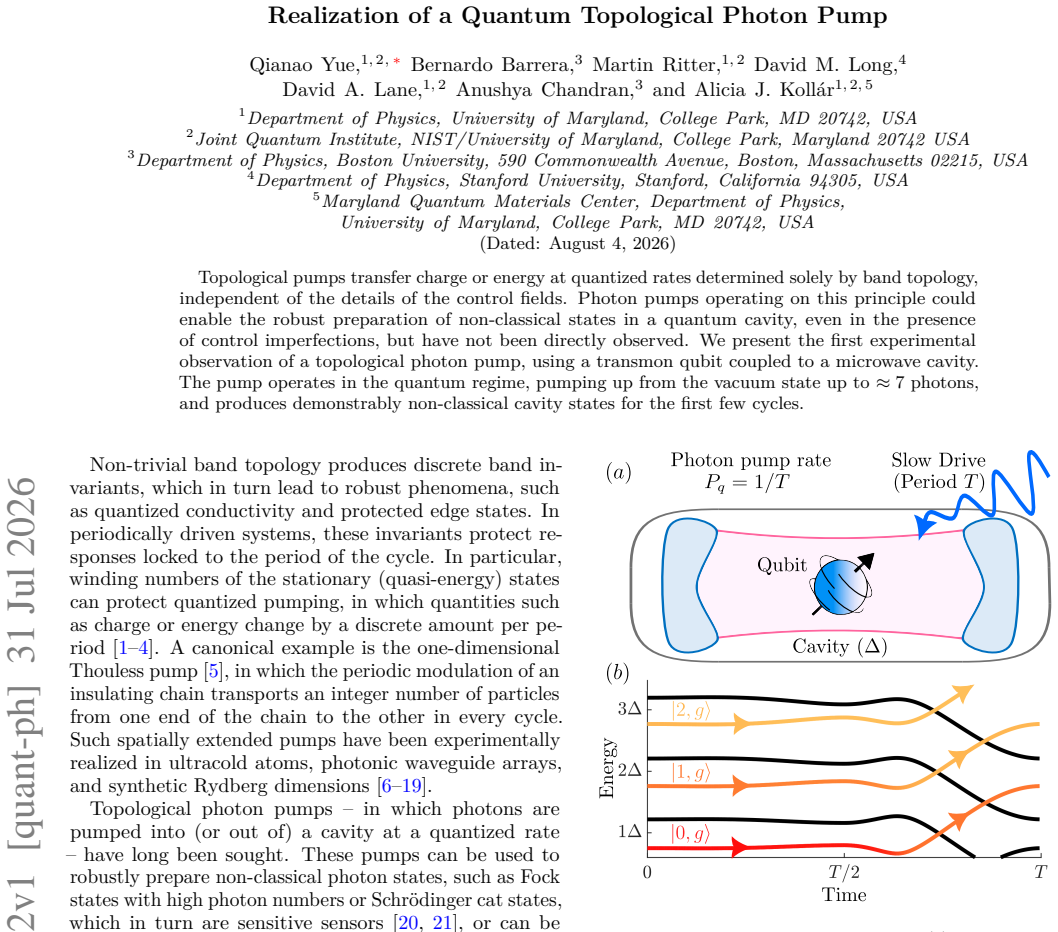
The central claim is that in a circuit-QED system described by H_pump(t)=Δ a†a + g(a†σ−+aσ+)+ (1/2) B(t)·σ, with B(t) tracing a semicircle in the (Bx,Bz) plane, the instantaneous spectrum of the coupled qubit-cavity system winds by exactly one photon rung per drive period in the regime κ≪ω<g≪Δ,B. Because of the spectral flow, the state |n,g⟩ adiabatically connects to |n+1,g⟩ over each cycle, so starting from vacuum the cavity gains one photon per cycle with quantized rate Pq=1/T. The paper reports the first experimental observation of this: photon numbers growing from vacuum to ≈7, an extracted P/Pq ≈ 1 independent of Δ and B in the topological regime, near-zero pumping in the trivial regime
What carries the argument
The central object is the spectral flow of the instantaneous eigenstates of the driven Jaynes-Cummings Hamiltonian. During the vertical portion of the drive, polariton number is conserved, protecting exact level crossings between pumping (|n,g⟩→|n+1,g⟩) and depumping (|n,e⟩→|n−1,e⟩) branches; during the semicircular portion, the qubit changes state while the photon number stays fixed. This one-rung-up-per-cycle winding is equivalent to a nonzero Chern number of the dressed Floquet states on the (θ1,θ2) torus, and it fixes the pump rate regardless of the details of B(t) so long as the vertical stroke is ungapped. An analytic phase diagram gives the boundary B_min(Δ)=(Δ²−g²)/Δ, resonance detun
Load-bearing premise
The absolute photon numbers and extracted pump rate assume the numerically computed single-photon AC Stark shift χ1 = −1.74 MHz and the measured cavity decay rate κ are correct; if either calibration is off, all quoted n and P/Pq values scale and the P≈Pq conclusion is weakened.
What would settle it
Measure the cavity photon number after m cycles with a technique independent of the qubit's dispersive shift—for example, direct heterodyne detection of the cavity field or Wigner tomography—at the same Δ=101 MHz, B=120 MHz, ω=5 MHz settings; if the inferred photon numbers and P/Pq differ from 1 beyond the error bars, the quantized-rate claim fails.
If this is right
- If the central claim is right, a single drive period transfers exactly one photon into the cavity from vacuum, so the pump can serve as a calibration-free photon source: the rate is set by the clock period T, not by pulse shapes.
- The same robustness means the pump can prepare approximate Fock states from vacuum; the observed sub-Poissonian statistics to ⟨n⟩≈3 are limited by cavity loss, and millisecond-lifetime cavities should reach much larger Fock states.
- Reversing the drive direction reverses the photon current, depumping the cavity; this gives an on-demand reset to vacuum that is independent of the initial cavity state.
- The pump remains quantized under deformations of the semicircular segment of the protocol, while transverse fields during the vertical stroke destroy pumping—identifying exactly which control imperfections matter.
- The pump fails in the small-detuning regime due to qubit backaction on the cavity photon number, so the large-Δ regime, not the previously proposed small-Δ regime, is the practical one for preparing non-classical states from vacuum.
Where Pith is reading between the lines
- A direct test of the protection mechanism: deliberately distort the semicircular segment by adding a random or offset shape while keeping the vertical stroke intact and check P/Pq remains 1; the paper's symmetry argument predicts stability, and its offset simulations predict degradation when the vertical stroke itself is offset.
- Because the quantized rate is a property of the spectral flow rather than of the specific transmon nonlinearity, the same protocol should transfer to other cavity-QED platforms (optical cavities coupled to atoms or Rydberg ensembles) whenever the effective field geometry can be engineered; the paper's outlook gestures this way but does not demonstrate it.
- The superposition statement in the outlook—qubit in |g⟩+|e⟩ producing superpositions of Fock states with very different photon numbers—suggests the pump could be used to synthesize approximate cat states; a concrete next experiment would be to initialize the qubit in an equal superposition and perform Wigner tomography after a few cycles.
- The paper's P/Pq fit assumes a simple exponential saturation n(mT)=(P/κ)(1−e^{−κmT}); at low ω the discrete photon-arrival timing causes deviations from this form. A more refined model that accounts for stroboscopic injection could yield an even cleaner quantization test and would be worth checking against the ω=1–10 MHz data.
Editorial analysis
A structured set of objections, weighed in public.
Referee Report
Summary. The manuscript reports a circuit-QED realization of a topological photon pump. A transmon qubit coupled to a microwave cavity is driven by a semicircular effective field B(t) synthesized from flux and microwave control. Starting from vacuum, the authors observe a linear-to-saturating increase of the qubit AC Stark shift with number of drive cycles, interpret this as n(mT) photons in the cavity, map a phase diagram in (B, Δ) whose resonance dips match an analytic formula, extract a pump rate P from a loss-model fit, and find P/Pq ≈ 1 in the topological regime. They also present photon-number-resolved spectroscopy showing sub-Poissonian states after the first few cycles, and a bidirectional drive experiment. Supplemental material derives the semiclassical Floquet quasi-energy spectrum, the phase boundaries, the Chern-number picture, and the maximum photon number.
Significance. If the calibration concern is resolved, these data constitute the first direct observation of a topological photon pump in the quantum regime and a meaningful step toward robust Fock-state preparation. The analytic phase diagram (Eq. S27), the Floquet/Chern classification in Sec. S2, and the extensive parameter sweeps are substantial contributions. The experiment is an external test of the authors' earlier theoretical proposal (Ref. 26), which counts as independent support rather than circularity. The main caveat is that the absolute photon-number scale, and hence the quantized-rate claim, rests on a numerically computed χ1 without independent experimental calibration.
major comments (2)
- [Sec. S5D / Fig. 3] The absolute scale of n(mT) is set by χ1 = −1.74 MHz, obtained from a QuTiP calculation with the Table S1 parameters, with no independent experimental calibration at the −140 MHz operating point. Since P is extracted by fitting Eq. S32 to the first five cycles, a multiplicative error in χ1 enters P/Pq almost directly. The error bars in Fig. 3 are only fit uncertainties. Please add an independent χ1 measurement (e.g., a displacement-induced shift) or propagate the uncertainty in g, α, Δ_qc and show that the resulting P/Pq interval contains unity. Without this, the headline 'P ≈ Pq' cannot be distinguished from a miscalibrated scale.
- [Fig. 4 / Abstract] The claim that the produced states are 'demonstrably non-classical' is supported visually by comparison with Fock and coherent distributions, but no quantitative nonclassicality witness is given. Reporting a Mandel Q parameter, g^(2)(0), Wigner negativity, or a Fock-state fidelity with uncertainty would make the claim precise. If a witness is not available, the wording should be weakened.
minor comments (4)
- [References [25] and [30]] References [25] and [30] are the same paper (Nathan, Martin, and Refael, Phys. Rev. B 99, 094311 (2019)). Consolidate to avoid duplicate citation.
- [Main text, 'P≈Pq everywhere else'] The sentence 'We observe P≈Pq everywhere else in the topological regime' is stronger than the data shown in Fig. 3, which covers three values of Δ and a limited window of B. Qualify the claim to 'for all measured configurations' or show the full dataset.
- [Fig. 4 axes] The upper and lower horizontal axes in Fig. 4 are not clearly distinguished in the figure as printed. A legend explaining the relationship between 'Frequency shift (χ1)' and 'exact qubit frequency shifts' would improve readability.
- [Sec. S5D] The sentence 'χ1 is smaller than the linewidth of the qubit' is ambiguous; the relevant linewidth is the measured spectroscopy linewidth, not the qubit decay rate. Please specify.
Circularity Check
No circular reduction found; P/Pq is a fitted observable, and the numeric χ1 calibration is a risk rather than a circular input.
full rationale
The core derivation is self-contained. The theory in Sec. S2 builds a semiclassical Floquet model for the qubit, solves the vertical-stroke quasi-energies exactly in Eq. (S13), and derives the phase boundaries (Eqs. (S20)-(S27)) and Chern-number classification without assuming the measured pump rate. The experimental claim P/Pq ≈ 1 is obtained by fitting the independently measured photon numbers to n(mT) = (P/κ)(1−e^{−κmT}) (Eq. S32), where P is a free fit parameter; comparing the fitted P to 1/T is a genuine empirical test, not an identity. Self-citations to Refs. [26,29,46] are to the prior proposal and device-characterization work; the load-bearing quantization logic does not rest on those citations alone. The one legitimate concern is the photon-number scale: Sec. S5D states that χ1 = −1.74 MHz is 'determined from numerical calculation with QuTip and the chip parameters in Table S1', and n(mT) is obtained as the measured Stark shift divided by χ1. A multiplicative error in χ1 would rescale all n(mT) and hence P/Pq. However, χ1 is not fitted to the P/Pq data, and no equation in the paper reduces P/Pq to χ1 by construction. This is a systematic calibration uncertainty (correctness risk), not a circular derivation step. Overall, the paper does not exhibit self-definitional, fitted-input-as-prediction, or self-citation-load-bearing circularity.
Axiom & Free-Parameter Ledger
free parameters (1)
- P (pump rate) =
P/Pq ≈ 1 in the topological regime; P ≈ 0 when B < Bmin(Δ)
axioms (5)
- domain assumption The driven system is described by the Jaynes-Cummings Hamiltonian Eq. S33 within the rotating-wave approximation and using only the two lowest transmon levels; counter-rotating terms and higher levels are neglected.
- domain assumption The hierarchy κ ≪ ω < g ≪ Δ, B (Eq. 3) ensures the system remains adiabatic in the instantaneous eigenstate and follows the spectral-flow path |n,g⟩ → |n+1,g⟩.
- domain assumption Along the vertical stroke of the protocol, polariton number is conserved in the Jaynes-Cummings model, making crossings between different polariton sectors exact; only the semicircular stroke is deformable without destroying the spectral flow.
- domain assumption The cavity can be approximated by a coherent-state field of magnitude Bcav = 2g√n in the semiclassical Floquet analysis (Eqs. S8-S13), with quantum corrections controlled by g/Δ ≪ 1.
- standard math Quantized energy transfer is determined by Floquet quasi-energy spectral flow or, equivalently, by the Chern number of the dressed adiabatic qubit state over the (θ1, θ2) torus.
Cite this review
Pith. "Pith review of Realization of a Quantum Topological Photon Pump." pith.science (2026). https://pith.science/paper/QJFCIIVO
@misc{pith2026260800162,
  author       = {Pith},
  title        = {Pith review of: Realization of a Quantum Topological Photon Pump},
  year         = {2026},
  howpublished = {\url{https://pith.science/paper/QJFCIIVO}},
  note         = {Machine review of arXiv:2608.00162}
}
read the original abstract
Topological pumps transfer charge or energy at quantized rates determined solely by band topology, independent of the details of the control fields. Photon pumps operating on this principle could enable the robust preparation of non-classical states in a quantum cavity, even in the presence of control imperfections, but have not been directly observed. We present the first experimental observation of a topological photon pump, using a transmon qubit coupled to a microwave cavity. The pump operates in the quantum regime, pumping up from the vacuum state up to $\approx 7$ photons, and produces demonstrably non-classical cavity states for the first few cycles.
Figures


Reference graph
Works this paper leans on
-
[1]
M. S. Rudner, N. H. Lindner, E. Berg, and M. Levin, Phys. Rev. X3, 031005 (2013)
2013
-
[2]
Nathan and M
F. Nathan and M. S. Rudner, New Journal of Physics17, 125014 (2015)
2015
-
[3]
H. C. Po, L. Fidkowski, T. Morimoto, A. C. Potter, and A. Vishwanath, Phys. Rev. X6, 041070 (2016)
2016
-
[4]
Roy and F
R. Roy and F. Harper, Phys. Rev. B96, 155118 (2017)
2017
-
[5]
D. J. Thouless, Phys. Rev. B27, 6083 (1983)
1983
-
[6]
Cheng, E
W. Cheng, E. Prodan, and C. Prodan, Phys. Rev. Lett. 125, 224301 (2020)
2020
-
[7]
Y. E. Kraus, Y. Lahini, Z. Ringel, M. Verbin, and O. Zil- berberg, Phys. Rev. Lett.109, 106402 (2012)
2012
-
[8]
Nakajima, T
S. Nakajima, T. Tomita, S. Taie, T. Ichinose, H. Ozawa, L. Wang, M. Troyer, and Y. Takahashi, Nature Physics 12, 296 (2016)
2016
-
[9]
Lohse, C
M. Lohse, C. Schweizer, H. M. Price, O. Zilberberg, and I. Bloch, Nature (London)553, 55 (2018)
2018
-
[10]
Lohse, C
M. Lohse, C. Schweizer, O. Zilberberg, M. Aidelsburger, and I. Bloch, Nature Physics12, 350 (2016)
2016
-
[11]
Cerjan, M
A. Cerjan, M. Wang, S. Huang, K. P. Chen, and M. C. Rechtsman, Light: Science & Applications9, 178 (2020)
2020
-
[12]
Jürgensen, S
M. Jürgensen, S. Mukherjee, and M. C. Rechtsman, Nature596, 63 (2021)
2021
-
[13]
Mostaan, F
N. Mostaan, F. Grusdt, and N. Goldman, Nature Com- munications13, 5997 (2022)
2022
-
[14]
I. H. Grinberg, M. Lin, C. Harris, W. A. Benalcazar, C. W. Peterson, T. L. Hughes, and G. Bahl, Nature Communications11, 974 (2020)
2020
-
[15]
Walter, Z
A.-S. Walter, Z. Zhu, M. Gächter, J. Minguzzi, S. Roschin- ski, K. Sandholzer, K. Viebahn, and T. Esslinger, Nature Physics19, 1471 (2023)
2023
-
[16]
Nakajima, N
S. Nakajima, N. Takei, K. Sakuma, Y. Kuno, P. Marra, and Y. Takahashi, Nature Physics17, 844 (2021)
2021
-
[17]
Jürgensen, S
M. Jürgensen, S. Mukherjee, C. Jörg, and M. C. Rechts- man, Nature Physics19, 420 (2023)
2023
-
[18]
Liu, Y.-R
Y. Liu, Y.-R. Zhang, Y.-H. Shi, T. Liu, C. Lu, Y.-Y. Wang, H. Li, T.-M. Li, C.-L. Deng, S.-Y. Zhou,et al., Nature Communications16, 108 (2025)
2025
-
[19]
Wintersperger, C
K. Wintersperger, C. Braun, F. N. Ünal, A. Eckardt, M. D. Liberto, N. Goldman, I. Bloch, and M. Aidelsburger, Nature Physics16, 1058 (2020)
2020
-
[20]
Giovannetti, S
V. Giovannetti, S. Lloyd, and L. Maccone, Nature Pho- tonics5, 222 (2011)
2011
-
[21]
X. Deng, S. Li, Z.-J. Chen, Z. Ni, Y. Cai, J. Mai, L. Zhang, P. Zheng, H. Yu, C.-L. Zou,et al., Nature Physics20, 1874 (2024)
2024
-
[22]
Joshi, K
A. Joshi, K. Noh, and Y. Y. Gao, Quantum Science & Technology6, 033001 (2021)
2021
-
[23]
Martin, G
I. Martin, G. Refael, and B. Halperin, Phys. Rev. X7, 041008 (2017)
2017
-
[24]
P. J. D. Crowley, I. Martin, and A. Chandran, Phys. Rev. B99, 064306 (2019)
2019
-
[26]
D. M. Long, P. J. D. Crowley, A. J. Kollár, and A. Chan- dran, Phys. Rev. Lett.128, 183602 (2022)
2022
-
[27]
Malz and A
D. Malz and A. Smith, Phys. Rev. Lett.126, 163602 (2021)
2021
-
[28]
Boyers, P
E. Boyers, P. J. D. Crowley, A. Chandran, and A. O. Sushkov, Phys. Rev. Lett.125, 160505 (2020)
2020
-
[29]
Ritter, D
M. Ritter, D. M. Long, Q. Yue, M. Amouzegar, A. Chan- dran, and A. J. Kollár, Phys. Rev. A112, 042605 (2025)
2025
-
[30]
Nathan, I
F. Nathan, I. Martin, and G. Refael, Phys. Rev. B99, 094311 (2019)
2019
-
[31]
Blais, A
A. Blais, A. L. Grimsmo, S. M. Girvin, and A. Wallraff, Reviews of Modern Physics93(2021)
2021
-
[32]
Krantz, M
P. Krantz, M. Kjaergaard, F. Yan, T. P. Orlando, S. Gus- tavsson, and W. D. Oliver, Applied Physics Reviews6, 021318 (2019)
2019
-
[33]
L. Yuan, M. Xiao, Q. Lin, and S. Fan, Phys. Rev. B97, 104105 (2018)
2018
-
[34]
Nathan, I
F. Nathan, I. Martin, and G. Refael, Phys. Rev. Res.4, 043060 (2022)
2022
-
[35]
Lantagne-Hurtubise, I
E. Lantagne-Hurtubise, I. Esin, G. Refael, and F. Nathan, Phys. Rev. B110, L100305 (2024)
2024
-
[36]
Luneau, C
J. Luneau, C. Dutreix, Q. Ficheux, P. Delplace, B. Douçot, B. Huard, and D. Carpentier, Phys. Rev. Res.4, 013169 (2022)
2022
-
[37]
D. M. Long, P. J. D. Crowley, and A. Chandran, Phys. Rev. Lett.126, 106805 (2021)
2021
-
[38]
Nathan, R
F. Nathan, R. Ge, S. Gazit, M. Rudner, and M. Kolo- drubetz, Phys. Rev. Lett.127, 166804 (2021)
2021
-
[39]
Schwennicke and J
K. Schwennicke and J. Yuen-Zhou, The Journal of Physi- cal Chemistry Letters13, 2434 (2022)
2022
-
[40]
Tominaga, S
Y. Tominaga, S. Shirai, Y. Hishida, H. Terai, and A. Noguchi, EPJ Quantum Technology12, 60 (2025)
2025
-
[41]
Ganjam, Y
S. Ganjam, Y. Wang, Y. Lu, A. Banerjee, C. U. Lei, L. Krayzman, K. Kisslinger, C. Zhou, R. Li, Y. Jia, M. Liu, L. Frunzio, and R. J. Schoelkopf, Nature Communications 15, 3687 (2024)
2024
-
[42]
Milul, B
O. Milul, B. Guttel, U. Goldblatt, S. Hazanov, L. M. Joshi, D. Chausovsky, N. Kahn, E. Çiftyürek, F. Lafont, and S. Rosenblum, PRX Quantum4, 030336 (2023)
2023
-
[43]
R. W. Heeres, P. Reinhold, N. Ofek, L. Frunzio, L. Jiang, M. H. Devoret, and R. J. Schoelkopf, Nature Communi- cations8, 94 (2017)
2017
-
[44]
Hofheinz, E
M. Hofheinz, E. M. Weig, M. Ansmann, R. C. Bialczak, E. Lucero, M. Neeley, A. D. O’Connell, H. Wang, J. M. Martinis, and A. N. Cleland, Nature454, 310 (2008)
2008
-
[45]
R. W. Heeres, B. Vlastakis, E. Holland, S. Krastanov, V. V. Albert, L. Frunzio, L. Jiang, and R. J. Schoelkopf, Phys. Rev. Lett.115, 137002 (2015)
2015
-
[46]
Ritter, D
M. Ritter, D. M. Long, Q. Yue, A. Chandran, and A. J. Kollár, Phys. Rev. X15, 031028 (2025)
2025
-
[47]
M. H. Kolodrubetz, F. Nathan, S. Gazit, T. Morimoto, and J. E. Moore, Phys. Rev. Lett.120, 150601 (2018). 7
2018
-
[48]
Vuina, D
D. Vuina, D. M. Long, P. J. D. Crowley, and A. Chandran, Phys. Rev. B108, 134303 (2023)
2023
-
[49]
Johansson, P
J. Johansson, P. Nation, and F. Nori, Computer Physics Communications184, 1234 (2013). 8 Supplemental Materials: Realization of a Quantum Topological Photon Pump Contents S1. Bidirectionality of the Photon Pump 9 S2. Theoretical Model for the Large-∆Pump 10 A. Semi-Classical Model 10 B. Phase Diagram 11 C. Chern Numbers 16 S3. Processes that degrade or de...
2013
This paper was first reviewed by deepseek-v4-flash on August 4, 2026.
discussion (0)
Sign in with ORCID, Apple, or X to comment. Anyone can read and Pith papers without signing in.