REVIEW 3 major objections 4 minor 107 references
The paper shows the full secular approximation forces steady-state work to zero while heat flows; coarse-graining over a minimal time window restores consistent thermodynamics and matches exact simulations.
Reviewed by Pith at T0; open to challenge. T0 means a machine referee read the full paper against a public rubric. the ladder, T0–T4 →
T0 review · deepseek-v4-flash
2026-08-04 00:57 UTC pith:LUWWAVJD
load-bearing objection Full-secular zero-work result is clean and the coarse-graining is a useful practical fix, but the method's thermodynamic consistency claim is conditional on a time-scale separation that the construction does not guarantee. the 3 major comments →
Dissipation in Periodically Driven Quantum Systems: Partial Secularization and Thermodynamic Consistency
The pith
A machine-rendered reading of the paper's core claim, the machinery that carries it, and where it could break.
Core claim
The central claim is that the full secular approximation in Floquet master equations forces the periodic steady state to be diagonal in the Floquet basis and to evolve along a unitary orbit, so the period-averaged mechanical power Tr[Ḣ_S ρ] vanishes identically, while the dissipator still sustains a nonzero heat current. The first law can then only be saved by postulating an extra non-conservative work contribution whose physical origin is obscure. The paper shows this deficiency is an artifact of over-secularization: the off-diagonal elements of the Kossakowski matrix couple populations and coherences, and those coherences are what carry mechanical work. Coarse-graining the Floquet–Redfield
What carries the argument
The central object is the Kossakowski matrix K_{αα′}(t) = γ(α,α′) e^{i(α′−α)t}, whose positive semidefiniteness is necessary and sufficient for the dissipative dynamics to be completely positive. In the Floquet–Redfield equation this matrix has non-positive off-diagonal oscillatory entries. Coarse-graining over Δt replaces each off-diagonal entry by sinc[(α−α′)Δt/2] times the rate, turning the matrix into a tunable frequency filter. The prescription is to take the smallest Δt for which the filtered matrix is positive semidefinite, yielding a GKSL generator that retains the coherence-carrying non-secular terms. Work is read from Tr[Ḣ_S ρ], while heat is derived by introducing counting fields
Load-bearing premise
The approach is valid only if there exists a coarse-graining window Δt that is much longer than the bath memory time and much shorter than the system's intrinsic evolution time (τ_B ≪ Δt ≪ τ_S), and the paper's own benchmarks show that accuracy degrades as the Rabi frequency approaches the filter cutoff.
What would settle it
Compute, for a driven two-level system with parameters where the Rabi frequency approaches 2π/Δt_min (e.g., increasing the driving strength g toward the validity boundary), the period-averaged mechanical work predicted by the coarse-grained master equation and compare it with a numerically exact non-Markovian simulation; the claim fails if the two disagree beyond the stated O(λ^4) corrections or if W_cycle + Q_cycle ≠ 0. A complementary test: use a bath with memory time τ_B comparable to Δt_min, violating the left inequality in τ_B ≪ Δt ≪ τ_S; then the coarse-grained master equation should vis
If this is right
- The full secular Floquet master equation should not be used to compute steady-state work or efficiency in driven-dissipative systems, because it yields identically zero drive power and requires an ad hoc non-conservative work term to balance the first law.
- The coarse-grained master equation with the minimal positivity-preserving Δt provides a completely positive GKSL generator whose period-averaged work is nonzero and whose heat currents, defined by full counting statistics, satisfy the first and second laws.
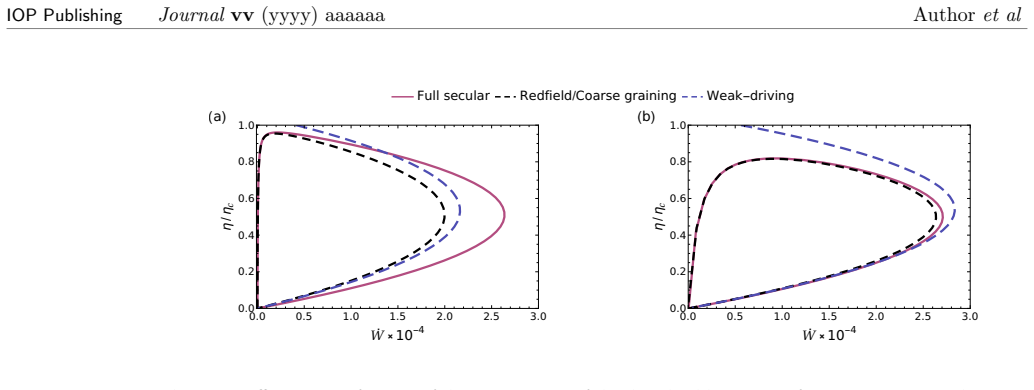
- In the driven two-level system, the minimal coarse-graining time is approximately half the driving period; in the three-level maser it is zero, so the Floquet–Redfield equation is already completely positive there, and both benchmarks match exact simulations.
- The non-secular terms that couple populations and coherences materially change heat-engine performance: power-efficiency curves of the three-level maser differ from full-secular predictions near resonance and at moderate driving strengths.
- Comparing Δt_min with the system timescale τ_S gives a practical criterion for when Markovian master equations are reliable and when non-Markovian simulations become necessary.
Where Pith is reading between the lines
- The minimal-window criterion doubles as a model-independent validity test: if the required Δt is not much smaller than the system's intrinsic evolution time, no Markovian GKSL master equation can be trusted for thermodynamics, and non-Markovian methods are mandatory.
- Because the paper identifies steady-state coherences as the carriers of work, existing efficiency and power calculations for driven quantum engines that use secular master equations and impose the first law by hand should be re-examined; they will generically misestimate power, especially near resonance.
- The coherence-interference terms in the three-level maser heat currents produce signatures with no classical rate-model counterpart, such as heat currents depending on Re(ρ12); measuring output power and heat as functions of drive strength near resonance could distinguish this formalism from both secular and semiclassical predictions.
- The sinc-filter interpretation suggests a possible extension: adapt Δt dynamically by monitoring positivity of the coarse-grained Kossakowski matrix, potentially extending Markovian descriptions to borderline parameter regimes, though this goes beyond the paper's fixed-Δt analysis.
Editorial analysis
A structured set of objections, weighed in public.
Referee Report
Summary. The manuscript analyzes Markovian master equations for periodically driven open quantum systems. Starting from the Floquet–Redfield equation, the authors prove that under the full secular approximation the steady-state cycle-averaged mechanical power vanishes identically, W_cycle = 0 (Eq. (24)), and argue that this is generically unphysical because exact dynamics and weak-driving master equations give nonzero work. To repair this while retaining complete positivity, they propose a coarse-graining procedure: averaging the Floquet–Redfield equation over a time interval Δt, and choosing the smallest Δt for which the coarse-grained Kossakowski matrix K′(Δt) in Eq. (34) becomes positive semidefinite. The resulting master equation (31) is of GKSL form. Heat currents are defined via a full-counting-statistics calculation, Eq. (36), leading to claimed first- and second-law consistency. The method is benchmarked against numerically exact PT-TEMPO simulations in two examples: a driven two-level system coupled to one bath and a three-level maser coupled to hot and cold baths.
Significance. The paper contains a clean, explicit derivation of an important limitation of the full secular approximation for driven-dissipative thermodynamics (W_cycle = 0), and it offers a constructive, physically interpretable recipe for partial secularization. The positivity criterion based on the minimal coarse-graining window is simple and potentially useful, and the use of numerically exact non-Markovian simulations as external benchmarks is a real strength. There are no fitted parameters targeting the claimed results. However, the central positive claim—that the coarse-grained master equation retains enough coherence to give the correct work while being completely positive—is established only in a parameter window; the manuscript itself documents degradation outside that window. Several supporting statements (e.g., the numerical verification of Eq. (42)) are asserted but not shown.
major comments (3)
- [§4, Eq. (28) and §6.1] The prescription Δt = Δt_min defined by positivity of K′ does not, by itself, guarantee the upper bound Δt_min ≪ τ_S in Eq. (28). In the driven two-level system, Fig. 2 gives ω_max ≈ 2Ω, so Δt_min ≈ π/Ω, while τ_S = 2π/Ω_R. When Ω_R approaches 2Ω (strong driving or near-resonant detuning), the sinc filter suppresses not only bath-induced fast oscillations but also the Rabi coherence dynamics that sustain nonzero work. The paper acknowledges this in §6.1 ('in the limit of very strong coupling, the coarse-graining approach with Δt_min filters all off-diagonal oscillations, recovering the full secular ME') and in Fig. 5 (right), where Δt > τ_S fails to capture work. This means the advertised advantage over the full secular approximation is conditional on an unproven separation Δt_min ≪ τ_S. A quantitative sufficient condition, or an explicit statement that the method is limited to regimes s
- [§6, Eq. (42)] The approximation of retaining only Re[Γ] in the dissipative part and Im[Γ] in the Lamb-shift part is used in both examples and underlies the positivity analysis and the heat-current expression Eq. (36). The text states 'We have verified numerically in the examples that it has a negligible impact on the results predicted by the master equation,' but no comparison is shown. Since the Born–Markov justification given in the text (smoothness of the spectral response) is not universally valid, the supporting numerical verification should be displayed or at least quantified. As it stands, this is a missing piece of evidence for a load-bearing approximation.
- [§5 and Appendix B] The first-law agreement W_cycle + Q_cycle ≈ 0 shown in Fig. 5 (right) is an internal consistency check: both quantities are computed from the same coarse-grained master equation, with work obtained from coherences and heat from the counting-field expression using the same generator. The exact PT-TEMPO benchmark is used for populations and coherences (Fig. 4), but the heat currents in Fig. 5 (left) are compared only between the different Markovian master equations, not against the exact simulation. Consequently, thermodynamic consistency with the exact non-Markovian dynamics is not directly demonstrated for heat. This should be stated explicitly, or an exact heat-current comparison should be added.
minor comments (4)
- [General] The manuscript contains several typos and placeholders: 'Authoret al' in the header, 'Kossakovski' vs 'Kossakowski', 'mentinoed' in §6.2, and the Data availability section still containing 'Sample text inserted for demonstration.' These should be corrected before publication.
- [Fig. 2 caption] The caption defines ω_max = 2π/Δt_min, while the text says the cutoff corresponds to the first zero of the sinc function. The relationship between these two definitions should be clarified, since the first zero of sinc[(α−α′)Δt/2] occurs at |α−α′| = 2π/Δt, not at 2π/Δt_min unless an additional factor is explained.
- [Eq. (25) and Appendix B] In Eq. (25), the prefactor (ω+qΩ)/ω assumes ω ≠ 0. The zero Bohr-frequency transitions (ω = 0) are included in some dissipators (e.g., A_{0,±1} = σ_z in the two-level example). The text should state how zero-frequency transitions are handled in the heat-current expression, or why they do not contribute in the cases shown.
- [Appendix A] The proof of diagonal steady states assumes a non-degenerate Hamiltonian, but the full secular Floquet master equation can have quasienergy degeneracies or near-degeneracies. A sentence clarifying how degeneracies affect the conclusion would be useful, especially because the paper emphasizes near-degeneracies in the introduction.
Circularity Check
No significant circularity: positivity fixing of Δt and external exact benchmarks make the central derivation self-contained.
full rationale
The central negative result (zero steady-state work under full secularization) is a direct mathematical consequence of the full-secular master equation's diagonal steady state, not an input assumption. The coarse-graining interval is fixed a priori by requiring positive semi-definiteness of the Kossakowski matrix, not fitted to the currents that are later compared. Work and heat are evaluated from independent expressions (work from Tr[Ĥ_Sρ], heat from full counting statistics), and the first-law check is a numerical consistency test with residuals O(λ^4), not an identity imposed by construction. The two examples are benchmarked against PT-TEMPO exact non-Markovian simulations, providing an external reference. The few self-citations ([42], [67], [98]) are supporting literature for counting statistics, coherence terms, and quantum enhancements; none is load-bearing for the main derivation. The acknowledged validity bound Eq. (28), and the noted degradation when Ω_R approaches the 2Ω filter cutoff, are limitations of the method rather than circular steps.
Axiom & Free-Parameter Ledger
axioms (6)
- standard math Floquet theorem decomposition U_S(t)=P(t) exp(-i H_F t)
- domain assumption Born-Markov approximation and bath correlation decay
- domain assumption Full counting statistics heat current formula
- domain assumption PT-TEMPO exact simulation is numerically exact and non-Markovian
- domain assumption Bath spectral density Ohmic with exponential cutoff
- ad hoc to paper Approximation Eq. (42) separating real/imag parts of rates
read the original abstract
Periodically driven open quantum systems are central to quantum thermodynamics and quantum control. These systems are typically described using Floquet-Born-Markov master equations, derived with the use of a full secular approximation, and whose thermodynamic implications are often overlooked. In this context, we show that such a strong secular approximation may lead to unphysical predictions for steady state energy currents. We then demonstrate that a coarse-grained formulation of the master equation can regularize these issues while yielding completely positive dynamics and consistent energy currents. The coarse-graining time has a clear physical interpretation, as it defines the temporal resolution at which a Markovian master equation can describe the evolution of the periodically driven system. We show the consistency and validity of our approach by comparing to an exact non-Markovian simulation in paradigmatic examples: a driven two-level system and a three-level maser coupled to hot and cold thermal reservoirs. Our work provides a practical framework for correctly applying the secular approximation in periodically driven-dissipative systems and for assessing the accuracy of master equations of the GKSL form.
Figures



Reference graph
Works this paper leans on
-
[1]
Martins W S, Carollo F, Li W, Brandner K and Lesanovsky I 2023Physical Review A108 L050201 ISSN 2469-9926, 2469-9934 URL https://link.aps.org/doi/10.1103/PhysRevA.108.L050201
-
[2]
Ramsay A J 2010Semiconductor Science and Technology25103001 ISSN 0268-1242, 1361-6641 URL https://iopscience.iop.org/article/10.1088/0268-1242/25/10/103001
-
[3]
Kavokin A (ed) 2017Microcavitiessecond edition ed (Series on semiconductor science and technologyno 16) (Oxford ; New York, NY: Oxford University Press) ISBN 978-0-19-878299-5
-
[4]
Weimer H, M¨ uller M, Lesanovsky I, Zoller P and B¨ uchler H P 2010Nature Physics6 382–388 ISSN 1745-2481 publisher: Nature Publishing Group URL https://www.nature.com/articles/nphys1614 30 IOP PublishingJournalvv(yyyy) aaaaaa Authoret al
-
[5]
Berloff N G, Silva M, Kalinin K, Askitopoulos A, T¨ opfer J D, Cilibrizzi P, Langbein W and Lagoudakis P G 2017Nature Materials161120–1126 ISSN 1476-4660 number: 11 Publisher: Nature Publishing Group URLhttp://www.nature.com/articles/nmat4971
-
[6]
Aedo I and Lamata L 2018Physical Review A97042317 publisher: American Physical Society URLhttps://link.aps.org/doi/10.1103/PhysRevA.97.042317
-
[7]
Cabot A, Carollo F and Lesanovsky I 2024Physical Review Letters132050801 ISSN 0031-9007, 1079-7114 URLhttps://link.aps.org/doi/10.1103/PhysRevLett.132.050801
-
[8]
Pavlov V P, Porras D and Ivanov P A 2023Physica Scripta98095103 ISSN 0031-8949, 1402-4896 URLhttps://iopscience.iop.org/article/10.1088/1402-4896/ace99f
-
[9]
Breuer H P and Petruccione F 2002The theory of open quantum systems(Oxford ; New York: Oxford University Press) ISBN 978-0-19-852063-4 oCLC: ocm49872077
-
[10]
Trushechkin A S and Volovich I V 2016EPL (Europhysics Letters)11330005 ISSN 0295-5075, 1286-4854 arXiv:1509.05754 [quant-ph] URLhttp://arxiv.org/abs/1509.05754
-
[11]
Gonz´ alez J O, Correa L A, Nocerino G, Palao J P, Alonso D and Adesso G 2017Open Systems & Information Dynamics241740010 ISSN 1230-1612, 1793-7191 URL https://www.worldscientific.com/doi/abs/10.1142/S1230161217400108
-
[12]
Levy A and Kosloff R 2014Europhysics Letters10720004 URL https://doi.org/10.1209/0295-5075/107/20004
-
[13]
Barra F 2015Scientific reports514873
-
[14]
De Chiara G, Landi G, Hewgill A, Reid B, Ferraro A, Roncaglia A J and Antezza M 2018 New Journal of Physics20113024 ISSN 1367-2630 URL https://iopscience.iop.org/article/10.1088/1367-2630/aaecee
-
[15]
Farina D and Giovannetti V 2019Physical Review A100012107 ISSN 2469-9926, 2469-9934 URLhttps://link.aps.org/doi/10.1103/PhysRevA.100.012107
-
[16]
Cattaneo M, Giorgi G L, Maniscalco S and Zambrini R 2019New Journal of Physics21 113045 ISSN 1367-2630 URL https://iopscience.iop.org/article/10.1088/1367-2630/ab54ac
-
[17]
Kirˇ sanskas G, Francki´ e M and Wacker A 2018Physical Review B97035432 ISSN 2469-9950, 2469-9969 URLhttps://link.aps.org/doi/10.1103/PhysRevB.97.035432
-
[18]
McCauley G, Cruikshank B, Bondar D I and Jacobs K 2020npj Quantum Information6 1–14 ISSN 2056-6387 publisher: Nature Publishing Group URL https://www.nature.com/articles/s41534-020-00299-6
2056
-
[19]
Nathan F and Rudner M S 2020Physical Review B102115109 ISSN 2469-9950, 2469-9969 URLhttps://link.aps.org/doi/10.1103/PhysRevB.102.115109
-
[20]
Davidovic D 2020Quantum4326 ISSN 2521-327X arXiv:2003.09063 [quant-ph] URL http://arxiv.org/abs/2003.09063
Pith/arXiv arXiv 2003
-
[21]
D’Abbruzzo A, Cavina V and Giovannetti V 2023SciPost Physics15117 ISSN 2542-4653 URLhttps://scipost.org/10.21468/SciPostPhys.15.3.117
-
[22]
Fern´ andez De La Pradilla D, Moreno E and Feist J 2024Physical Review A109062225 ISSN 2469-9926, 2469-9934 URLhttps://link.aps.org/doi/10.1103/PhysRevA.109.062225
-
[23]
Potts P P, Kalaee A A S and Wacker A 2021New Journal of Physics23123013 ISSN 1367-2630 URLhttps://iopscience.iop.org/article/10.1088/1367-2630/ac3b2f
-
[24]
Boubakour M, Szikman T and Elouard C 2026arXiv preprint arXiv:2606.13504
-
[25]
Whitney R S 2008Journal of Physics A: Mathematical and Theoretical41175304
-
[26]
Shirley J H 1965Phys. Rev.138(4B) B979–B987 URL https://link.aps.org/doi/10.1103/PhysRev.138.B979 31 IOP PublishingJournalvv(yyyy) aaaaaa Authoret al
-
[27]
Grifoni M and H¨ anggi P 1998Physics Reports304229–354 ISSN 0370-1573 URL https://www.sciencedirect.com/science/article/pii/S0370157398000222
-
[28]
Kohler S, Dittrich T and H¨ anggi P 1997Physical Review E55300–313
-
[29]
Breuer H P, Huber W and Petruccione F 2000Phys. Rev. E61(5) 4883–4889 URL https://link.aps.org/doi/10.1103/PhysRevE.61.4883
-
[30]
Alicki R, Lidar D A and Zanardi P 2006Physical Review A73052311 ISSN 1050-2947, 1094-1622 URLhttps://link.aps.org/doi/10.1103/PhysRevA.73.052311
-
[31]
Hone D W, Ketzmerick R and Kohn W 2009Phys. Rev. E79(5) 051129 URL https://link.aps.org/doi/10.1103/PhysRevE.79.051129
-
[32]
Szczygielski K, Gelbwaser-Klimovsky D and Alicki R 2013Physical Review E—Statistical, Nonlinear, and Soft Matter Physics87012120
-
[33]
Szczygielski K 2014Journal of Mathematical Physics55083506 ISSN 0022-2488 URL https://doi.org/10.1063/1.4891401
-
[34]
Schnell A, Eckardt A and Denisov S 2020Physical Review B101100301 ISSN 2469-9950, 2469-9969 URLhttps://link.aps.org/doi/10.1103/PhysRevB.101.100301
-
[35]
Haddadfarshi F, Cui J and Mintert F 2015Phys. Rev. Lett.114(13) 130402 URL https://link.aps.org/doi/10.1103/PhysRevLett.114.130402
-
[36]
Restrepo S, Cerrillo J, Bastidas V M, Angelakis D G and Brandes T 2016Phys. Rev. Lett. 117(25) 250401 URLhttps://link.aps.org/doi/10.1103/PhysRevLett.117.250401
-
[37]
Nafari Qaleh Z and Rezakhani A T 2022Physical Review A105012208 ISSN 2469-9926, 2469-9934 URLhttps://link.aps.org/doi/10.1103/PhysRevA.105.012208
-
[38]
Tude L T, Murphy C N and Eastham P R 2024Physical Review Letters132266901
-
[39]
Kolisnyk D, Queißer F, Schaller G and Sch¨ utzhold R 2024Physical Review Applied21044050 ISSN 2331-7019 URLhttps://link.aps.org/doi/10.1103/PhysRevApplied.21.044050
-
[40]
Jeske J, Ing D, Plenio M B, Huelga S F and Cole J H 2015The Journal of Chemical Physics 142ISSN 0021-9606, 1089-7690 arXiv:1408.2726 [physics] URL http://arxiv.org/abs/1408.2726
-
[41]
Purkayastha A, Dhar A and Kulkarni M 2016Physical Review A93ISSN 2469-9926, 2469-9934 arXiv:1511.03778 [cond-mat] URLhttp://arxiv.org/abs/1511.03778
-
[42]
Murphy C N, Toledo Tude L and Eastham P R 2022Applied Sciences121620 ISSN 2076-3417 number: 3 Publisher: Multidisciplinary Digital Publishing Institute URL https://www.mdpi.com/2076-3417/12/3/1620
2076
-
[43]
Tello Breuer C S, Becker T and Eckardt A 2024Phys. Rev. B110(6) 064319 URL https://link.aps.org/doi/10.1103/PhysRevB.110.064319
-
[44]
Rivas A and Huelga S F 2012Open quantum systemsvol 10 (Springer)
-
[45]
Eastham P R, Kirton P, Cammack H M, Lovett B W and Keeling J 2016Physical Review A 94ISSN 2469-9926, 2469-9934 arXiv:1508.04744 [quant-ph] URL http://arxiv.org/abs/1508.04744
-
[46]
Hartmann R and Strunz W T 2020Physical Review A101ISSN 2469-9926, 2469-9934 arXiv:1906.02583 [quant-ph] URLhttp://arxiv.org/abs/1906.02583
Pith/arXiv arXiv 1906
-
[47]
Kosloff R 2013Entropy152100–2128
-
[48]
Gelbwaser-Klimovsky D, Alicki R and Kurizki G 2013Physical Review E—Statistical, Nonlinear, and Soft Matter Physics87012140
-
[49]
Restrepo S, Cerrillo J, Strasberg P and Schaller G 2018New Journal of Physics20053063 ISSN 1367-2630 URLhttps://iopscience.iop.org/article/10.1088/1367-2630/aac583 32 IOP PublishingJournalvv(yyyy) aaaaaa Authoret al
-
[50]
Klatzow J, Becker J N, Ledingham P M, Weinzetl C, Kaczmarek K T, Saunders D J, Nunn J, Walmsley I A, Uzdin R and Poem E 2019Physical Review Letters122110601 ISSN 0031-9007, 1079-7114 URLhttps://link.aps.org/doi/10.1103/PhysRevLett.122.110601
-
[51]
Szczygielski K, Gelbwaser-Klimovsky D and Alicki R 2013Physical Review E87012120 ISSN 1539-3755, 1550-2376 URLhttps://link.aps.org/doi/10.1103/PhysRevE.87.012120
-
[52]
Langemeyer M and Holthaus M 2014Physical Review E89012101
-
[53]
Gasparinetti S, Solinas P, Braggio A and Sassetti M 2014New Journal of Physics16115001 ISSN 1367-2630 URLhttp://arxiv.org/abs/1404.3507
-
[54]
Cuetara G B, Engel A and Esposito M 2015New Journal of Physics17055002 ISSN 1367-2630 URLhttps://iopscience.iop.org/article/10.1088/1367-2630/17/5/055002
-
[55]
Scovil H E D and Schulz-DuBois E O 1959Physical Review Letters2262–263 ISSN 0031-9007 URLhttps://link.aps.org/doi/10.1103/PhysRevLett.2.262
-
[56]
Trushechkin A 2021Physical Review A103062226 ISSN 2469-9926, 2469-9934 URL https://link.aps.org/doi/10.1103/PhysRevA.103.062226
-
[57]
Gorini V, Kossakowski A and Sudarshan E C G 1976Journal of Mathematical Physics17 821–825 ISSN 0022-2488 URLhttps://doi.org/10.1063/1.522979
-
[58]
Agredo J, Fagnola F and Poletti D 2022Open Systems & Information Dynamics292250005 ISSN 1230-1612, 1793-7191 arXiv:2503.23860 [quant-ph] URL http://arxiv.org/abs/2503.23860
-
[59]
Manzano G and L´ opez R 2023Physical Review Research5043041
-
[60]
Vorberg D, Wustmann W, Ketzmerick R and Eckardt A 2013Phys. Rev. Lett.111(24) 240405 URLhttps://link.aps.org/doi/10.1103/PhysRevLett.111.240405
-
[61]
Kohn W 2001Journal of Statistical Physics103417–423
-
[62]
Hotz R and Schaller G 2021Physical Review A104052219 ISSN 2469-9926, 2469-9934 URL https://link.aps.org/doi/10.1103/PhysRevA.104.052219
-
[63]
Geva E and Kosloff R 1994Phys. Rev. E49(5) 3903–3918 URL https://link.aps.org/doi/10.1103/PhysRevE.49.3903
-
[64]
Boukobza E and Tannor D J 2007Phys. Rev. Lett.98(24) 240601 URL https://link.aps.org/doi/10.1103/PhysRevLett.98.240601
-
[65]
Hofer P P, Souquet J R and Clerk A A 2016Phys. Rev. B93(4) 041418 URL https://link.aps.org/doi/10.1103/PhysRevB.93.041418
-
[66]
Mitchison M T, Huber M, Prior J, Woods M P and Plenio M B 2016Quantum Science and Technology1015001 ISSN 2058-9565 URL https://iopscience.iop.org/article/10.1088/2058-9565/1/1/015001
-
[67]
Almanza-Marrero J A and Manzano G 2025Quantum91878 ISSN 2521-327X URL https://doi.org/10.22331/q-2025-10-07-1878
-
[68]
Shirai T, Mori T and Miyashita S 2015Phys. Rev. E91(3) 030101 URL https://link.aps.org/doi/10.1103/PhysRevE.91.030101
-
[69]
Elouard C, Herrera-Mart ´ ı D, Esposito M and Auff` eves A 2020New Journal of Physics22 103039 ISSN 1367-2630 URL https://iopscience.iop.org/article/10.1088/1367-2630/abbd6e
-
[70]
Schaller G and Brandes T 2008Physical Review A78022106 ISSN 1050-2947, 1094-1622 URLhttps://link.aps.org/doi/10.1103/PhysRevA.78.022106
-
[71]
Majenz C, Albash T, Breuer H P and Lidar D A 2013Physical Review A88012103 ISSN 1050-2947, 1094-1622 URLhttps://link.aps.org/doi/10.1103/PhysRevA.88.012103 33 IOP PublishingJournalvv(yyyy) aaaaaa Authoret al
-
[72]
Esposito M, Harbola U and Mukamel S 2009Reviews of Modern Physics811665–1702 ISSN 0034-6861, 1539-0756 URLhttps://link.aps.org/doi/10.1103/RevModPhys.81.1665
-
[73]
Friedman H M, Agarwalla B K and Segal D 2018New Journal of Physics20083026 URL https://doi.org/10.1088/1367-2630/aad5fc
-
[74]
Kilgour M and Segal D 2018Physical Review E98ISSN 2470-0045, 2470-0053 arXiv:1804.10585 [cond-mat] URLhttp://arxiv.org/abs/1804.10585
-
[75]
Liu J and Segal D 2021Physical Review E103032138
-
[76]
Esposito M, Lindenberg K and Van den Broeck C 2010New Journal of Physics12013013
-
[77]
Manzano G, Horowitz J M and Parrondo J M 2018Physical Review X8031037
-
[78]
Geva E, Kosloff R and Skinner J L 1995The Journal of Chemical Physics1028541–8561 ISSN 0021-9606, 1089-7690 URLhttp://aip.scitation.org/doi/10.1063/1.468844
-
[79]
Juan-Delgado A and Chenu A 2021Physical Review A104022219 ISSN 2469-9926, 2469-9934 URLhttps://link.aps.org/doi/10.1103/PhysRevA.104.022219
-
[80]
Soret A and Esposito M 2025Physical Review A111062205 ISSN 2469-9926, 2469-9934 URLhttps://link.aps.org/doi/10.1103/PhysRevA.111.062205
discussion (0)
Sign in with ORCID, Apple, or X to comment. Anyone can read and Pith papers without signing in.