REVIEW 2 major objections 4 minor 47 references
Long-term LLM-agent memory fails through two systematic misalignments—time versus topic, and write-time salience versus future utility—and a coupled interaction-to-fact design fixes both, this paper argues.
Reviewed by Pith at T0; open to challenge. T0 means a machine referee read the full paper against a public rubric. the ladder, T0–T4 →
T0 review · deepseek-v4-flash
2026-08-04 21:48 UTC pith:ZLMA7ZE3
load-bearing objection Solid empirical systems paper with credible benchmark gains; the DUM diagnostic is the soft spot, but the main accuracy claim holds. the 2 major comments →
MemSIF: From Structured Interactions to Dual-Track Fact Memory for LLM Agents
The pith
A machine-rendered reading of the paper's core claim, the machinery that carries it, and where it could break.
Core claim
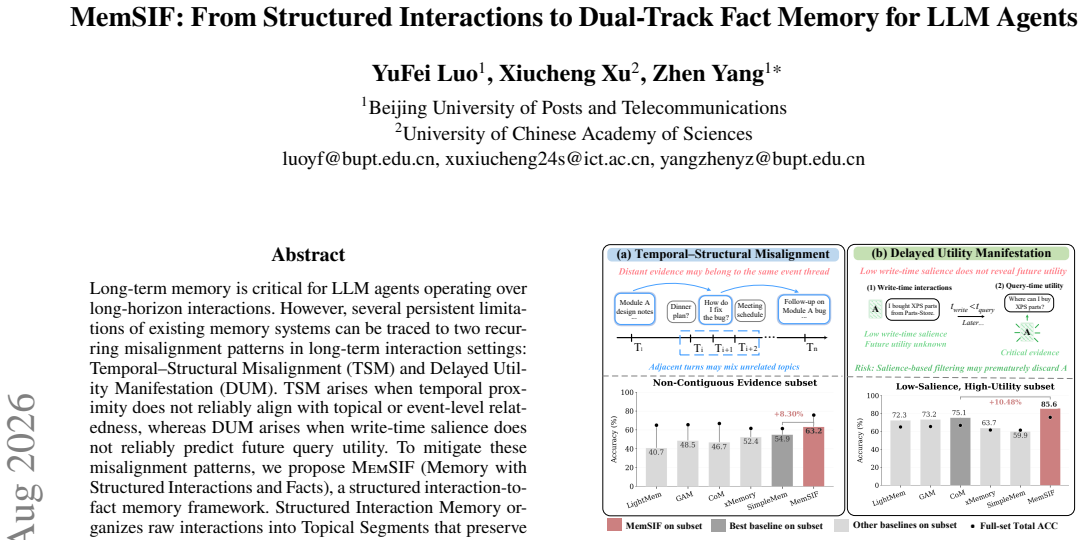
The paper's central claim is that two misalignment patterns—temporal proximity failing to match topical or event relatedness (TSM), and write-time salience failing to predict future query utility (DUM)—underlie many failures of LLM agent memory, and that both can be mitigated by coupling interaction organization with fact construction. MemSIF organizes raw interactions into Topical Segments for local coherence and Event Trajectories for cross-time continuity, then builds facts through two complementary tracks: CoreFact consolidates schema-guided facts whose value is clear at write time, while ActiveFact forms candidate facts from query-time evidence and promotes them to persistent entries on
What carries the argument
The load-bearing objects are two interaction structures and two fact tracks, joined by one shared matching function. Topical Segments are temporally contiguous, topic-coherent chunks of conversation, built with a double-threshold rule: merge when similarity is high, split when low, and let an LLM decide in between. Event Trajectories link non-contiguous segments that belong to the same evolving event. Both use φ(A,B) = α·s_sem(A,B) + (1−α)·J(K_A,K_B), blending normalized cosine similarity with Jaccard overlap of key entities. CoreFact memory writes schema-constrained facts (Identity, Event, Preference, Relation) at write time via add/update/merge/supersede operations. ActiveFact memory accum
Load-bearing premise
The diagnosis of delayed utility rests on a single AI model's opinions of what is salient and what is useful—collected in one call, with thresholds picked after looking at the data and no reported human check—so the 43.71% figure could measure the judge's bias rather than the conversations.
What would settle it
Have human annotators score the same LoCoMo evidence-query pairs for write-time salience and query-time utility. If human judges put the low-salience-but-critical rate far below the reported pair-level 41.55%, or if ActiveFact's advantage over the no-ActiveFact ablation vanishes on the human-labeled subset, the delayed-utility mechanism is falsified. A second check: rebuild the NCE subset with gold event annotations (or human topic segmentation) and test whether removing Event Trajectories still produces the predicted Temp-category drop.
If this is right
- A memory system no longer has to gamble at write time: information whose value is unclear stays recoverable in the raw interaction layer, and consolidation happens only after queries reveal that the evidence matters.
- The component that helps depends on the failure mode—Event Trajectories drive gains on temporal questions, Topical Segments on multi-hop questions, and ActiveFact on low-salience-but-critical questions—so a single mechanism is unlikely to cover both misalignments.
- Promoted ActiveFact entries pay for themselves: reusing a persistent fact avoids re-retrieving raw history, cutting tokens and runtime while raising accuracy.
- The benefit is largest under weaker backbones (8.79% gain with the 4B model on LoCoMo), suggesting structured memory partially compensates for limited reasoning capacity.
- The two diagnostic subsets (non-contiguous evidence and low-salience, high-utility) give future memory systems a method-independent way to test whether they actually fix TSM and DUM.
Where Pith is reading between the lines
- Editorial extension: the DUM result implies a general bound—any memory policy that commits to retention before queries arrive is capped by write-time information; the paper's own 43.71% LSHU rate suggests write-time-only policies will keep missing roughly this share of critical evidence on similar dialogues.
- Editorial extension: the double-threshold segmentation with LLM arbitration between thresholds is portable: any retrieval pipeline that currently uses fixed windows could swap in this boundary rule, since the paper's sensitivity analysis shows moderate robustness to the gap width.
- Editorial extension: a natural stress test is to rebuild the LSHU subset with different judges (human annotators, a different backbone) and check whether the 43.71% prevalence and ActiveFact's advantage survive; that would reveal whether DUM is a property of the conversations or of the GPT-4o labeler.
- Editorial extension: the promotion rule (source support AND query demand) is a conservative evidence-accumulation policy; varying the two thresholds in deployment would trade memory growth against recall of rare-but-critical details, a trade-off the paper does not quantify.
Editorial analysis
A structured set of objections, weighed in public.
Referee Report
Summary. The paper proposes MemSIF, a long-term memory architecture for LLM agents that couples Structured Interaction Memory (Topical Segments and Event Trajectories) with Dual-Track Fact Memory (CoreFact and ActiveFact) to address two claimed failure patterns: Temporal–Structural Misalignment (TSM) and Delayed Utility Manifestation (DUM). The method is evaluated on LoCoMo and LongMemEval-S with three main backbones (Qwen3-4B, Qwen3-32B, DeepSeek-v4-pro) and two additional 8B backbones, reporting the highest Total ACC in every dataset–backbone setting, with paired bootstrap confidence intervals excluding zero, a human-validated GPT-4o judge, component ablations, diagnostic-subset analyses, and an efficiency study. The appendix provides empirical diagnostics for TSM and DUM, reproductions of subset construction, sensitivity analyses, and prompt templates.
Significance. If the results hold, MemSIF is a strong and general architecture for long-term agent memory, with consistent gains across model families and scales. The paper is unusually thorough in its evaluation: a 93.0% agreement and κ=0.81 human-validated judge, paired bootstrap CIs in all six main settings, component ablations on both benchmarks, two reusable diagnostic subsets, and public code. The TSM/DUM framing is a useful organizing perspective even if the diagnostic operationalization needs refinement. The main empirical benchmark claim is well supported; the weaker link is the DUM label-based diagnostic, which does not affect the headline Total ACC results but does affect the mechanistic narrative.
major comments (2)
- [Appendix A.2/A.5] The DUM diagnostic is built entirely on GPT-4o salience/utility annotations S(e) and U(e,q), produced by a single call at temperature 0.1, with thresholds S≤2 and U=3 chosen after inspecting the data. No human validation or independent-model agreement is reported for these labels. This is load-bearing for the 43.71% LSHUR claim (Table 8), the LSHU subset (Eq. 6), and the LSHU-subset ablation evidence (Figure 4, Table 4) that ActiveFact mitigates DUM. Please add human validation on a stratified sample (as done for the answer judge) or an independent-model agreement, and report sensitivity to the S/U thresholds. The Total ACC claim is unaffected, but the DUM mechanism claim currently rests on unvalidated labels.
- [§4.1 / Appendix A.3] The diagnostic subsets are defined by thresholds selected from the empirical distributions: NCE uses TED≥0.3 at the observed valley, and LSHU uses S(e)≤2 with U(e,q)=3. This creates a risk that the subset-level conclusions (Figure 1, Figure 4, Table 4) are threshold artifacts. Report the NCE and LSHU ablations under neighboring thresholds (e.g., TED 0.25/0.35; S≤1 vs S≤2, U=3 vs U≥2) and show that the key patterns—e.g., ActiveFact removal causing the largest drop on LSHU—are stable. Without such robustness evidence, the TSM/DUM mitigation claims are not fully established.
minor comments (4)
- [Tables 1–3] Category-level results (S-hop, M-hop, Temp, Kno) are reported without confidence intervals, yet the text draws mechanistic conclusions from category patterns (e.g., 'largest gains on Temp', 'leads all categories'). Please either provide category-level CIs or soften these claims.
- [§D.2] The paired bootstrap is computed against the strongest baseline selected from the same data. This selection makes the reported CIs optimistic; a multiple-comparison caveat should be acknowledged, particularly for the smaller gains under DeepSeek-v4-pro where the lower bounds are close to zero.
- [§4.1 / Appendix C.2] Full-Context is truncated to ~32K tokens even for LongMemEval-S histories averaging 100K+ tokens. This limits its role as a long-context upper bound; the paper should state this explicitly when interpreting Full-Context results.
- [Figure 5] The bubble sizes and colors are not explicitly defined in the caption or text; please add a legend or explanation.
Circularity Check
No significant circularity: the headline benchmark results are external and the diagnostic subsets, though author-defined, are not constructed from MemSIF outputs.
full rationale
The central claim — highest Total ACC on LoCoMo and LongMemEval-S across five backbones — is established by comparisons against external benchmarks with fixed public test sets, multiple published baselines, a human-validated GPT-4o judge (93% agreement, κ=0.81), and paired-bootstrap confidence intervals excluding zero in all six main settings. No equation or method component is fitted to these test answers, and no reported prediction is equivalent by construction to an input. The TSM and DUM patterns are defined by the authors and operationalized through the NCE and LSHU diagnostic subsets, but those subsets are constructed from gold evidence positions and from GPT-4o salience/utility annotations that are independent of MemSIF and baseline outputs; evaluating MemSIF on them is a targeted mechanistic test, not a derivation of the headline results. The concern that the diagnostic subsets are self-referential because the authors define the patterns, design components to address them, and then evaluate on those subsets is a limitation of the explanatory narrative, not circularity in the derivation: the components could have failed on those subsets, and the main accuracy results stand independently. The only notable weakness is that the DUM labels come from a single GPT-4o call at temperature 0.1 with thresholds chosen after inspecting the data and without human validation; this affects the reliability of the diagnostic evidence, not the circularity of the argument. No load-bearing self-citation is present: references to CoM and GAM are baseline comparisons, not justifications of MemSIF's design, and no uniqueness theorem or ansatz is imported from the authors' prior work. Therefore no circular step meets the evidentiary standard required for this review.
Axiom & Free-Parameter Ledger
free parameters (6)
- matching weight alpha =
0.8
- Topical Segment thresholds tau_merge/tau_split =
0.60 / 0.325
- Event Trajectory Top-K =
3
- ActiveFact promotion thresholds theta_s/theta_q =
0.45 / 0.45
- CoreFact schema types =
Identity, Event, Preference, Relation
- Diagnostic thresholds TED, S, U =
0.3; <=2; =3
axioms (5)
- domain assumption GPT-4o salience and utility scores are valid operationalizations of write-time salience and future query utility.
- domain assumption LoCoMo and LongMemEval-S gold evidence annotations and question categories faithfully represent long-term memory needs.
- domain assumption The GPT-4o answer judge is a valid proxy for human correctness judgments.
- domain assumption Backbone LLM judgments for boundary decisions, trajectory compatibility, and fact extraction are reliable enough to construct the memory structures.
- standard math Standard embedding and retrieval machinery (Qwen3-Embedding-8B cosine similarity) behaves consistently across methods.
Cite this review
Pith. "Pith review of MemSIF: From Structured Interactions to Dual-Track Fact Memory for LLM Agents." pith.science (2026). https://pith.science/paper/ZLMA7ZE3
@misc{pith2026260801742,
  author       = {Pith},
  title        = {Pith review of: MemSIF: From Structured Interactions to Dual-Track Fact Memory for LLM Agents},
  year         = {2026},
  howpublished = {\url{https://pith.science/paper/ZLMA7ZE3}},
  note         = {Machine review of arXiv:2608.01742}
}
read the original abstract
Long-term memory is critical for LLM agents operating over long-horizon interactions. However, several persistent limitations of existing memory systems can be traced to two recurring misalignment patterns in long-term interaction settings: Temporal-Structural Misalignment (TSM) and Delayed Utility Manifestation (DUM). TSM arises when temporal proximity does not reliably align with topical or event-level relatedness, whereas DUM arises when write-time salience does not reliably predict future query utility. To mitigate these misalignment patterns, we propose MemSIF (Memory with Structured Interactions and Facts), a structured interaction-to-fact memory framework. Structured Interaction Memory organizes raw interactions into Topical Segments that preserve local topical coherence and Event Trajectories that maintain cross-time event continuity. Dual-Track Fact Memory uses two complementary tracks: CoreFact memory consolidates stable, schema-guided information at write time, whereas ActiveFact memory forms facts on demand and promotes those supported by multiple historical sources and recurring query demand for reuse. Experiments on LoCoMo and LongMemEval-S across five backbone LLMs show that MemSIF achieves the highest Total ACC in all settings, outperforming the strongest baseline by 2.29%-8.79% on LoCoMo and 2.87%-6.15% on LongMemEval-S. These results support the effectiveness of combining Structured Interaction Memory with Dual-Track Fact Memory to mitigate TSM and DUM. Code is available at https://github.com/luoyufeihaha/MemSIF.
Figures




Reference graph
Works this paper leans on
-
[1]
arXiv preprint arXiv:2511.16043 , year=
Agent0: Unleashing self-evolving agents from zero data via tool-integrated reasoning , author=. arXiv preprint arXiv:2511.16043 , year=
-
[2]
arXiv preprint arXiv:2505.01441 , year=
Agentic reasoning and tool integration for llms via reinforcement learning , author=. arXiv preprint arXiv:2505.01441 , year=
-
[3]
Findings of the Association for Computational Linguistics: EMNLP 2025 , pages=
Agent laboratory: Using llm agents as research assistants , author=. Findings of the Association for Computational Linguistics: EMNLP 2025 , pages=. 2025 , publisher=
2025
-
[4]
Proceedings of the 63rd Annual Meeting of the Association for Computational Linguistics (Volume 1: Long Papers) , pages=
Hiagent: Hierarchical working memory management for solving long-horizon agent tasks with large language model , author=. Proceedings of the 63rd Annual Meeting of the Association for Computational Linguistics (Volume 1: Long Papers) , pages=
-
[5]
Transactions of the association for computational linguistics , volume=
Lost in the middle: How language models use long contexts , author=. Transactions of the association for computational linguistics , volume=
-
[6]
arXiv preprint arXiv:2510.05381 , year=
Context length alone hurts LLM performance despite perfect retrieval , author=. arXiv preprint arXiv:2510.05381 , year=
-
[7]
long-context LLMs for persistent agents , author=
Beyond the context window: A cost-performance analysis of fact-based memory vs. long-context LLMs for persistent agents , author=. arXiv preprint arXiv:2603.04814 , year=
-
[8]
How memory management impacts llm agents: An empirical study of experience-following behavior , author=. Proceedings of the 64th Annual Meeting of the Association for Computational Linguistics (Volume 1: Long Papers) , pages=
-
[9]
arXiv preprint arXiv:2601.01885 , year=
Agentic memory: Learning unified long-term and short-term memory management for large language model agents , author=. arXiv preprint arXiv:2601.01885 , year=
-
[10]
IEEE Transactions on Pattern Analysis and Machine Intelligence , year=
Lifelong learning of large language model based agents: A roadmap , author=. IEEE Transactions on Pattern Analysis and Machine Intelligence , year=
-
[11]
ACM Transactions on Information Systems , volume=
A survey on the memory mechanism of large language model-based agents , author=. ACM Transactions on Information Systems , volume=. 2025 , publisher=
2025
-
[12]
Proceedings of the AAAI conference on artificial intelligence , volume=
Memorybank: Enhancing large language models with long-term memory , author=. Proceedings of the AAAI conference on artificial intelligence , volume=
-
[13]
Advances in neural information processing systems , volume=
Hipporag: Neurobiologically inspired long-term memory for large language models , author=. Advances in neural information processing systems , volume=
-
[14]
International Conference on Learning Representations , volume=
Raptor: Recursive abstractive processing for tree-organized retrieval , author=. International Conference on Learning Representations , volume=
-
[15]
arXiv preprint arXiv:2504.19413 , year=
Mem0: Building production-ready ai agents with scalable long-term memory , author=. arXiv preprint arXiv:2504.19413 , year=
-
[16]
Advances in Neural Information Processing Systems , volume=
A-mem: Agentic memory for llm agents , author=. Advances in Neural Information Processing Systems , volume=
-
[17]
arXiv preprint arXiv:2504.15965 , year=
From human memory to ai memory: A survey on memory mechanisms in the era of llms , author=. arXiv preprint arXiv:2504.15965 , year=
-
[18]
arXiv preprint arXiv:2509.23040 , year=
Look back to reason forward: Revisitable memory for long-context llm agents , author=. arXiv preprint arXiv:2509.23040 , year=
-
[19]
Proceedings of the AAAI Conference on Artificial Intelligence , volume=
Evolving generalist virtual agents with generative and associative memory , author=. Proceedings of the AAAI Conference on Artificial Intelligence , volume=
-
[20]
Proceedings of the 63rd Annual Meeting of the Association for Computational Linguistics (Volume 1: Long Papers) , pages=
In prospect and retrospect: Reflective memory management for long-term personalized dialogue agents , author=. Proceedings of the 63rd Annual Meeting of the Association for Computational Linguistics (Volume 1: Long Papers) , pages=
-
[21]
arXiv preprint arXiv:2602.02574 , year=
WritePolicyBench: Benchmarking Memory Write Policies under Byte Budgets , author=. arXiv preprint arXiv:2602.02574 , year=
-
[22]
arXiv preprint arXiv:2602.06052 , year=
Rethinking Memory Mechanisms of Foundation Agents in the Second Half: A Survey , author=. arXiv preprint arXiv:2602.06052 , year=
-
[23]
Proceedings of the 2025 Conference on Empirical Methods in Natural Language Processing , pages=
Memory os of ai agent , author=. Proceedings of the 2025 Conference on Empirical Methods in Natural Language Processing , pages=
2025
-
[24]
arXiv preprint arXiv:2510.18866 , year=
Lightmem: Lightweight and efficient memory-augmented generation , author=. arXiv preprint arXiv:2510.18866 , year=
-
[25]
arXiv preprint arXiv:2505.19549 , year=
From Single to Multi-Granularity: Toward Long-Term Memory Association and Selection of Conversational Agents , author=. arXiv preprint arXiv:2505.19549 , year=
-
[26]
arXiv preprint arXiv:2511.18423 , year=
General agentic memory via deep research , author=. arXiv preprint arXiv:2511.18423 , year=
-
[27]
Chain-of-memory: Lightweight memory construction with dynamic evolution for llm agents , author=. Proceedings of the 64th Annual Meeting of the Association for Computational Linguistics (Volume 1: Long Papers) , pages=
-
[28]
arXiv preprint arXiv:2602.02007 , year=
Beyond RAG for agent memory: Retrieval by decoupling and aggregation , author=. arXiv preprint arXiv:2602.02007 , year=
-
[29]
arXiv preprint arXiv:2601.02553 , year=
SimpleMem: Efficient Lifelong Memory for LLM Agents , author=. arXiv preprint arXiv:2601.02553 , year=
-
[30]
Proceedings of the 36th annual acm symposium on user interface software and technology , pages=
Generative agents: Interactive simulacra of human behavior , author=. Proceedings of the 36th annual acm symposium on user interface software and technology , pages=
-
[31]
MemGPT: towards LLMs as operating systems. , author=. arXiv preprint arXiv:2310.08560 , year=
-
[32]
arXiv preprint arXiv:2308.08239 , year=
Memochat: Tuning llms to use memos for consistent long-range open-domain conversation , author=. arXiv preprint arXiv:2308.08239 , year=
-
[33]
Advances in neural information processing systems , volume=
Reflexion: Language agents with verbal reinforcement learning , author=. Advances in neural information processing systems , volume=
-
[34]
Proceedings of the AAAI Conference on Artificial Intelligence , volume=
Expel: Llm agents are experiential learners , author=. Proceedings of the AAAI Conference on Artificial Intelligence , volume=
-
[35]
International Conference on Learning Representations , volume=
Human-inspired episodic memory for infinite context LLMs , author=. International Conference on Learning Representations , volume=
-
[36]
arXiv preprint arXiv:2409.05591 , volume=
Memorag: Moving towards next-gen rag via memory-inspired knowledge discovery , author=. arXiv preprint arXiv:2409.05591 , volume=
-
[37]
arXiv preprint arXiv:2305.14322 , year=
Ret-llm: Towards a general read-write memory for large language models , author=. arXiv preprint arXiv:2305.14322 , year=
-
[38]
Proceedings of the 62nd Annual Meeting of the Association for Computational Linguistics (Volume 1: Long Papers) , pages=
Evaluating very long-term conversational memory of llm agents , author=. Proceedings of the 62nd Annual Meeting of the Association for Computational Linguistics (Volume 1: Long Papers) , pages=
-
[39]
arXiv preprint arXiv:2410.10813 , year=
Longmemeval: Benchmarking chat assistants on long-term interactive memory , author=. arXiv preprint arXiv:2410.10813 , year=
-
[40]
arXiv preprint arXiv:2410.21276 , year=
Gpt-4o system card , author=. arXiv preprint arXiv:2410.21276 , year=
-
[41]
arXiv preprint arXiv:2505.09388 , year=
Qwen3 technical report , author=. arXiv preprint arXiv:2505.09388 , year=
-
[42]
arXiv preprint arXiv:2506.05176 , year=
Qwen3 embedding: Advancing text embedding and reranking through foundation models , author=. arXiv preprint arXiv:2506.05176 , year=
-
[43]
arXiv preprint arXiv:2606.19348 , year=
DeepSeek-V4: Towards Highly Efficient Million-Token Context Intelligence , author=. arXiv preprint arXiv:2606.19348 , year=
-
[44]
arXiv preprint arXiv:2407.21783 , year=
The llama 3 herd of models , author=. arXiv preprint arXiv:2407.21783 , year=
-
[45]
arXiv preprint arXiv:2601.06411 , year=
Structured Episodic Event Memory , author=. arXiv preprint arXiv:2601.06411 , year=
-
[46]
arXiv preprint arXiv:2604.12285 , year=
GAM: Hierarchical Graph-based Agentic Memory for LLM Agents , author=. arXiv preprint arXiv:2604.12285 , year=
-
[47]
arXiv preprint arXiv:2605.12061 , year=
SAGE: A Self-Evolving Agentic Graph-Memory Engine for Structure-Aware Associative Memory , author=. arXiv preprint arXiv:2605.12061 , year=
discussion (0)
Sign in with ORCID, Apple, or X to comment. Anyone can read and Pith papers without signing in.