REVIEW 5 minor 123 references
Necessary and sufficient conditions of nonlinear causality in viscous anisotropic hydrodynamics
T0 review · 0 major / 5 minor · reviewed 2026-08-15 · deepseek-v4-flash
Pith's one-line read The paper claims that the leading-order viscous anisotropic hydrodynamics (VAH) equations are causally valid exactly when three simple inequalities on the anisotropic transport coefficients hold, and it proves these inequalities are both…
desk verdict Clean, correct derivation of the first necessary-and-sufficient nonlinear causality conditions for leading-order VAH; genuinely useful, but scoped to the truncated system and slightly overclaimed on stability. read the letter →
The pith
A machine-rendered reading of the paper's core claim, the machinery that carries it, and where it could break.
The reading
What carries the argument
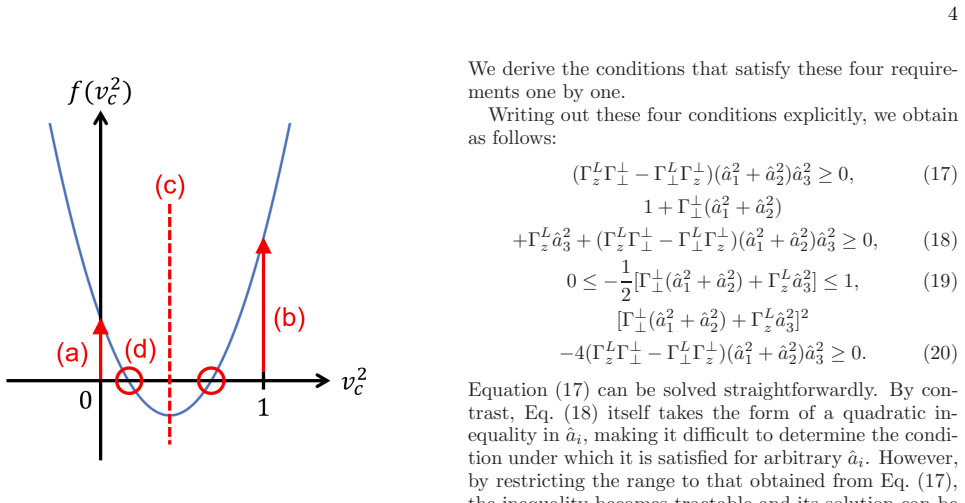
The load-bearing object is the characteristic equation of the quasilinear system, $\det(A^\alpha\xi_\alpha)=0$, reduced in the local rest frame to $$$v_c^{4}$+\big[\Gamma^\perp_\perp(\hat $a_1^{2}$+\hat $a_2^{2}$)+\Gamma^L_z\hat $a_3^{2}$\big]$v_c^{2}$+(\Gamma^L_z\Gamma^\perp_\perp-\Gamma^L_\perp\Gamma^\perp_z)(\hat $a_1^{2}$+\hat $a_2^{2}$)\hat $a_3^{2}$=0.$$ Because the equation is quadratic in $v_c^2$, causality for every direction is equivalent to four graphical conditions on the parabola $f(v_c^2)$: nonnegative at $0$ and $1$, axis within $[0,1]$, and nonnegative discriminant. Solving those four conditions successively yields the three inequalities of Eq. (21). The angle parametrization $\chi=\hat a_3^2$ turns the quartic into $v_c^4+[\Gamma^\perp_\perp(1-\chi)+\Gamma^L_z\chi]v_c^2+(\Gamma^L_z\Gamma^\perp_\perp-\Gamma^L_\perp\Gamma^\perp_z)\chi(1-\chi)=0$, exposing two independent sound modes in the decoupled limit and a smooth interpolation between fixed endpoint velocities when the coupling is active.
What would settle it
Include the next-to-leading-order correction $\delta\tilde f$ in the equations of motion, recompute the characteristic equation, and search for parameter values satisfying the three inequalities that yield any characteristic speed $|v_c|>1$; a single such root would show the conditions do not certify causality of the complete theory. Alternatively, solve the truncated VAH equations as a Riemann problem with parameters just outside the allowed ranges and observe a signal propagating outside the light cone.
Extended reading notes
Core claim
By writing the VAH equations of motion as a first-order quasilinear system $A^\alpha(\Psi)\partial_\alpha\Psi=F(\Psi)$ and computing the characteristic equation $\det(A^\alpha\xi_\alpha)=0$, the paper shows that all characteristic velocities lie between zero and the speed of light in every direction exactly when $$-1\le \frac{\bar\zeta^L_z}{E+P_L}\le0,\qquad -1\le \frac{\bar\zeta^\perp_\perp}{E+P_\perp}\le0,\qquad 0\le \frac{\bar\zeta^L_\perp}{E+P_\perp}\frac{\bar\zeta^\perp_z}{E+P_L}\le \frac{\bar\zeta^L_z}{E+P_L}\frac{\bar\zeta^\perp_\perp}{E+P_\perp}\le 1.$$ In the decoupled limit the system separates into two sound-like modes with squared speeds $v_\perp^2=-\Gamma^\perp_\perp(1-\chi)$ and $v_L^2=-\Gamma^L_z\chi$; the first two inequalities enforce causal boundary speeds, and the third extends the constraint to all mixing angles. The authors interpret the coupled system as two fluids exchanging pressure fluctuations, with $\Gamma^L_\perp\Gamma^\perp_z$ acting as a diffusion coupling.
Load-bearing premise
The proof treats the truncated equations as the whole theory, assuming the omitted small correction term carries no faster-than-light signals.
Editorial extensions
If this is right
- For any parameter set satisfying the three inequalities, numerical solutions of the VAH equations remain within the relativistic causal region, so the conditions can be checked locally during a simulation to certify each cell.
- Because the inequalities are necessary and sufficient, parameters outside the allowed range will produce at least one propagation direction with characteristic speed below zero or above the speed of light, marking the boundary of VAH's validity.
- The simple algebraic form makes it feasible to impose causality as a constraint in parameter estimation or model calibration of anisotropic transport coefficients.
- In the decoupled limit, the two eigenmodes provide a diagnostic: causality of the whole system collapses to causality of the longitudinal and transverse modes separately plus a coupling bound.
- The results set the stage for extending the analysis to the complete VAH theory including the next-to-leading-order correction $\delta\tilde f$, which the authors identify as the immediate next step.
Reading between the lines
- If the next-to-leading-order correction $\delta\tilde f$ is not negligible, the three inequalities are only a necessary condition for causality of the complete VAH theory; adding transverse shear and longitudinal diffusion modes could introduce additional characteristic speeds that the current conditions do not constrain.
- The inequality chain has a positivity-and-determinant structure, suggesting it may also imply linear stability of the anisotropic rest state, though that connection is not proven in the paper.
- One could test the conditions numerically by running shock-type problems with parameters straddling the boundary of the inequalities and looking for superluminal precursors or unstable growth.
- Because the conditions depend only on local ratios $\bar\zeta/(E+P)$, they can be mapped into spacetime for realistic heavy-ion collision simulations, potentially identifying when and where an anisotropic hydrodynamic description first becomes causally admissible.
Signed reviews
Editorial analysis
A structured set of objections, weighed in public.
Referee Report
Summary. The paper derives necessary and sufficient conditions for nonlinear causality in viscous anisotropic hydrodynamics (VAH), restricted to the leading-order truncation that neglects the next-to-leading-order correction δf. The equations of motion (5)-(9) are treated as a first-order quasilinear system, and characteristic analysis in the local rest frame reduces the characteristic determinant to the quartic (14), then to a quadratic in v_c^2. Requiring that for every propagation direction both roots lie in [0,1] yields the chain of inequalities (21) on the combinations ζ̄L_z/(E+P_L), ζ̄⊥⊥/(E+P_⊥), and the product (ζ̄L_⊥/(E+P_⊥))(ζ̄⊥_z/(E+P_L)). Section IV gives a physical interpretation in terms of two coupled modes, and Section V notes that incorporating NLO corrections is future work.
Significance. If correct, the result is practically valuable: it converts the causality requirement for the VAH equations into three simple inequalities that can be checked locally in simulations, analogous to the nonlinear causality constraints already used for conventional viscous hydrodynamics. The work goes beyond the earlier conformal first-order analysis of Ref. [74] by treating the second-order nonconformal anisotropic hydrodynamics. The derivation is verifiable, and I independently confirmed the reduction from Eq. (A6) to Eq. (14). The paper is honest about its scope, explicitly limiting the claim to the truncated system (5)-(9), and the final conditions are falsifiable: any simulation violating (21) will exhibit superluminal propagation. The main limitation, that the neglected δf and its associated π⊥, W⊥ modes could in principle introduce additional superluminal characteristic modes, is stated clearly in Sec. V, so the paper does not overclaim its scoped result.
minor comments (5)
- [Appendix A, Eq. (14)] The reduction from the 6x6 determinant (A6) to the characteristic equation (14) is stated rather than shown. I verified the expansion independently, but please include the intermediate calculation or provide it as supplementary material so that the central equation is fully reproducible.
- [Appendix B, step 5, Eq. (B24)] The derivation of condition (d) divides by (ΓL_z)^2 when writing the symmetry axis of k(t), so the case ΓL_z=0, which is allowed by the final inequality (21a), is not covered by the argument as written; the same concern applies to Γ⊥⊥=0. The final inequalities remain correct (they can be obtained by a separate direct check or by a continuity argument), but the proof should treat these boundary cases explicitly.
- [Eq. (13)] The denominator in the displayed formula for v_c^2 is typeset as a_3^3; it should read a_3^2.
- [Sec. V, first paragraph] The sentence beginning 'we derived the necessary and sufficient conditions' is grammatically incomplete, and the paragraph should explicitly restate that the conditions apply to the truncated system (5)-(9), in line with the qualification in the abstract and in the final paragraph of Section V.
- [Sec. II, after Eq. (4)] The ratios in Eq. (21) are meaningful only when E+P_L and E+P_⊥ are positive; the paper should state this standard assumption explicitly.
Circularity Check
No significant circularity: Eq. (21) is derived by self-contained characteristic-algebra from the truncated VAH equations of motion, with the NLO-neglect scope explicitly stated.
full rationale
The paper's central claim, Eq. (21), is a set of inequalities on the transport coefficients Γ = ζ̄/(E+P) obtained by requiring all roots of the characteristic equation (16) to lie in [0,1] for every propagation direction. The derivation is self-contained: the 8x8 quasilinear system (A1) is reduced in the local rest frame to the 6x6 determinant (A6), which yields the quartic (14), and Appendices B and C convert the four quadratic conditions (a)-(d) into the chain (21) by elementary algebra. No parameter is fitted to data and then renamed as a prediction; the transport coefficients are inputs, and the inequalities are constraints on them. The only self-citation-like element is footnote 1 and the contrast with Ref. [74], but the present derivation does not rely on that prior work for any load-bearing step; Ref. [86] is cited for the general nonlinear-causality framework, not for the VAH result. The paper also explicitly scopes its result: the equations (5)-(9) neglect the NLO correction δf and the associated π⊥ and W⊥z, and Sec. V states that incorporating δf is future work. That is a stated limitation of the physical system analyzed, not a circular step. Thus the claim is exactly a theorem about the truncated VAH system, derived from its own equations of motion, with no reduction to its own inputs.
Assumptions & free parameters
assumptions (4)
- standard math A quadratic with leading coefficient 1 has both roots in [0,1] if and only if f(0)>=0, f(1)>=0, vertex in [0,1], and discriminant >=0.
- domain assumption Subluminal characteristic velocities in the local rest frame are necessary and sufficient for nonlinear causality of the first-order quasilinear system.
- domain assumption Equations (5)-(9), obtained by neglecting the NLO correction delta f, correctly describe leading-order VAH dynamics.
- domain assumption The reduction from the 8x8 matrix (A1) to the 6x6 characteristic matrix (A6), using the local rest frame and constraints on u and z, preserves all physical characteristic speeds.
Cite this review
Pith. "Pith review of Necessary and sufficient conditions of nonlinear causality in viscous anisotropic hydrodynamics." pith.science (2026). https://pith.science/paper/AAPIMT7U
@misc{pith2026260801900,
  author       = {Pith},
  title        = {Pith review of: Necessary and sufficient conditions of nonlinear causality in viscous anisotropic hydrodynamics},
  year         = {2026},
  howpublished = {\url{https://pith.science/paper/AAPIMT7U}},
  note         = {Machine review of arXiv:2608.01900}
}
read the original abstract
We derive the necessary and sufficient conditions for nonlinear causality in viscous anisotropic hydrodynamics (VAH) within the approximation that neglects small correction terms. Relativistic hydrodynamics provides a successful description of the space-time evolution of the matter produced in relativistic heavy-ion collisions, yet the earliest stage at which a hydrodynamic description becomes valid remains an open question. VAH has been proposed as an extension of conventional viscous hydrodynamics (VH) that can accommodate the large pressure anisotropies of the early-time dynamics. However, in such far-from-equilibrium regimes, the nonlinear causality of the theory is not guaranteed. By analyzing the characteristic velocities of the VAH equations of motion, we derive a set of inequalities that ensures causal signal propagation in all directions. The resulting conditions take a remarkably simple form and admit a clear physical interpretation in terms of the characteristic modes of the anisotropic medium. These results establish the regime of validity of VAH and provide a foundation for its application to the early-time dynamics of relativistic heavy-ion collisions.
Figures
Reference graph
Works this paper leans on
- [74]
-
[1]
Preparation Since ˆai(= ai/ √ a2 1 + a2 2 + a2
-
[2]
(15) Dividing both sides of equation (14) by ( a2 1 + a2 2 + a2 3)2, v4 c + [Γ⊥ ⊥(ˆa2 1 + ˆa2
+ ΓL z a2 3]b2 + (ΓL z Γ⊥ ⊥ − ΓL ⊥Γ⊥ z )(a2 1 + a2 2)a2 3 = 0, (14) where we have defined the following notations: ΓL z = ¯ζL z E + PL , Γ⊥ ⊥ = ¯ζ⊥ ⊥ E + P⊥ , ΓL ⊥ = ¯ζL ⊥ E + P⊥ , Γ⊥ z = ¯ζ⊥ z E + PL . (15) Dividing both sides of equation (14) by ( a2 1 + a2 2 + a2 3)2, v4 c + [Γ⊥ ⊥(ˆa2 1 + ˆa2
-
[3]
(16) 2 It should be noted that each component of this matrix is Loren tz vector as shown in Appendix A
+ ΓL z ˆa2 3]v2 c + (ΓL z Γ⊥ ⊥ − ΓL ⊥Γ⊥ z )(ˆa2 1 + ˆa2 2)ˆa2 3 = 0. (16) 2 It should be noted that each component of this matrix is Loren tz vector as shown in Appendix A. 4 FIG. 1: Conditions under which the quadratic function f (v2 c ) = 0 in Eq. (16) has two solutions in the range 0 ≤ v2 c ≤ 1. The function f (v2 c ) is shown by the blue curve, while ...
-
[4]
+ ΓL z ˆa2 3] ≤ 1, (19) [Γ⊥ ⊥(ˆa2 1 + ˆa2
-
[5]
(20) Equation (17) can be solved straightforwardly
+ ΓL z ˆa2 3]2 −4(ΓL z Γ⊥ ⊥ − ΓL ⊥Γ⊥ z )(ˆa2 1 + ˆa2 2)ˆa2 3 ≥ 0. (20) Equation (17) can be solved straightforwardly. By con- trast, Eq. (18) itself takes the form of a quadratic in- equality in ˆai, making it difficult to determine the condi- tion under which it is satisfied for arbitrary ˆ ai. However, by restricting the range to that obtained from Eq. (17...
-
[6]
+ ΓL z ˆa2 3]v2 c + (ΓL z Γ⊥ ⊥ − ΓL ⊥Γ⊥ z )(ˆa2 1 + ˆa2 2)ˆa2
-
[7]
We derive the conditions that satisfy these four require- ments one by one
(B1) The necessary and sufficient condition for causality is equivalent to requiring that f (v2 c ) satisfy the following four conditions for any ˆai: (a) f (v2 c = 0) ≥ 0, (b) f (v2 c = 1) ≥ 0, (c) The symmetry axis of f (v2 c ) lies in 0 ≤ v2 c ≤ 1, (d) The discriminant of f (v2 c ) is D ≥ 0. We derive the conditions that satisfy these four require- ments...
Show all 123 references
-
[8]
is a component of a unit vector, we have ˆa2 1 + ˆa2 2 = 1 − ˆa2
-
[9]
Substituting this into Eq
(B2) Each component ˆai taking any value is equivalent to the square of the third component ˆ a2 3 taking any value in 0 ≤ ˆa2 3 ≤ 1. Substituting this into Eq. (B1), f (v2 c ) can be written as follows: 7 f (v2 c ) = ( v2 c )2 + [Γ⊥ ⊥(1 − ˆa2
-
[10]
+ ΓL z ˆa2 3]v2 c + (ΓL z Γ⊥ ⊥ − ΓL ⊥Γ⊥ z )(1 − ˆa2 3)ˆa2
-
[11]
(B3) Thus, f (v2 c ) depends only on v2 c and ˆa2
-
[12]
Therefore, it is necessary and sufficient for f (v2 c ) to satisfy the above conditions (a)–(d) for any ˆa2 3 such that 0 ≤ ˆa2 3 ≤ 1
-
[13]
Substituting v2 c = 0 into f (v2 c ), we obtain f (0) = (Γ L z Γ⊥ ⊥ − ΓL ⊥Γ⊥ z )(1 − ˆa2 3)ˆa2
Condition (a) First, we derive the condition under which Condition (a), namely f (v2 c = 0) ≥ 0, is satisfied. Substituting v2 c = 0 into f (v2 c ), we obtain f (0) = (Γ L z Γ⊥ ⊥ − ΓL ⊥Γ⊥ z )(1 − ˆa2 3)ˆa2
-
[14]
(B5) Therefore, the condition for satisfying (a) is as follows: ΓL ⊥Γ⊥ z ≤ ΓL z Γ⊥ ⊥
(B4) Since (1 − ˆa2 3)ˆa2 3 is positive, for f (v2 c = 0) ≥ 0 to hold for any ˆa2 3, it suffices that ΓL z Γ⊥ ⊥ − ΓL ⊥Γ⊥ z ≥ 0. (B5) Therefore, the condition for satisfying (a) is as follows: ΓL ⊥Γ⊥ z ≤ ΓL z Γ⊥ ⊥. (B6)
-
[15]
Substituting v2 c = 1 into f (v2 c ) and rearranging in terms of ˆa2 3, we obtain f (1) = −(ΓL z Γ⊥ ⊥ − ΓL ⊥Γ⊥ z )(ˆa2 3)2 + (ΓL z − Γ⊥ ⊥ + ΓL z Γ⊥ ⊥ − ΓL ⊥Γ⊥ z )ˆa2 3 + Γ⊥ ⊥ + 1
Condition (a)+(b) Next, we derive the condition under which Condition (b), namely f (v2 c = 1) ≥ 0, is satisfied together with Condition (a) obtained in the first step mentioned above. Substituting v2 c = 1 into f (v2 c ) and rearranging in terms of ˆa2 3, we obtain f (1) = −(ΓL...
-
[16]
Then, in order to satisfy f (v2 c = 1) ≥ 0, it suffices that g(ˆa2
is negative. Then, in order to satisfy f (v2 c = 1) ≥ 0, it suffices that g(ˆa2
-
[17]
Substituting ˆa2 3 = 0 into g(ˆa2 3), we obtain g(0) = Γ ⊥ ⊥ + 1
satisfy both of the following two conditions: (i): g(ˆa2 3 = 0) ≥ 0. Substituting ˆa2 3 = 0 into g(ˆa2 3), we obtain g(0) = Γ ⊥ ⊥ + 1. (B8) Then, the condition for g(ˆa2 3 = 0) ≥ 0 is given by −1 ≤ Γ⊥ ⊥. (B9) (ii): g(ˆa2 3 = 1) ≥ 0. Substituting ˆa2 3 = 1 into g(ˆa2 3), we obt...
-
[18]
The symmetry axis of f (v2 c ) is given by v2 c = − 1 2 [Γ⊥ ⊥(1 − ˆa2
Condition (a)+(b)+(c) Next, we derive the condition under which Condition (c), namely the symmetry axis of f (v2 c ) lies in 0 ≤ v2 c ≤ 1, is satisfied together with Conditions (a) and (b). The symmetry axis of f (v2 c ) is given by v2 c = − 1 2 [Γ⊥ ⊥(1 − ˆa2
-
[19]
(B12) Then, the condition for 0 ≤ v2 c ≤ 1 is 0 ≤ (Γ⊥ ⊥ − ΓL z )ˆa2 3 − Γ⊥ ⊥ ≤ 2
+ ΓL z ˆa2 3] = 1 2 [(Γ⊥ ⊥ − ΓL z )ˆa2 3 − Γ⊥ ⊥]. (B12) Then, the condition for 0 ≤ v2 c ≤ 1 is 0 ≤ (Γ⊥ ⊥ − ΓL z )ˆa2 3 − Γ⊥ ⊥ ≤ 2. (B13) Now, let the intermediate expression between two in- equalities be the linear function h(ˆa2 3). Then, the con- dition is divided into two ...
-
[20]
Therefore, the conditions are the following two inequalities: 0 ≤ −Γ⊥ ⊥, (B14) −ΓL z ≤ 2
takes the minimum value −Γ⊥ ⊥ at ˆa2 3 = 0, and the maximum value −ΓL z at ˆa2 3 = 1. Therefore, the conditions are the following two inequalities: 0 ≤ −Γ⊥ ⊥, (B14) −ΓL z ≤ 2. (B15) (ii): In the case Γ ⊥ ⊥ < ΓL z . 8 The linear function h(ˆa2
-
[21]
Therefore, the conditions are the following two inequalities: 0 ≤ −ΓL z , (B16) −Γ⊥ ⊥ ≤ 2
takes the minimum value −ΓL z at ˆa2 3 = 1, and the maximum value −Γ⊥ ⊥ at ˆa2 3 = 0. Therefore, the conditions are the following two inequalities: 0 ≤ −ΓL z , (B16) −Γ⊥ ⊥ ≤ 2. (B17) These conditions obtained in the separate cases can be combined into the following conditions:...
-
[22]
The discriminant of f (v2 c ) is given by D = [Γ ⊥ ⊥(1 − ˆa2
Condition (a)+(b)+(c)+(d) Finally, we derive the condition under which Condition (d), namely the discriminant of f (v2 c ) is D ≥ 0, is satisfied together with Conditions (a), (b) and (c). The discriminant of f (v2 c ) is given by D = [Γ ⊥ ⊥(1 − ˆa2
-
[23]
(B20) Here, let t = ˆa2 3/1 − ˆa2
+ ΓL z ˆa2 3]2 − 4(ΓL z Γ⊥ ⊥ − ΓL ⊥Γ⊥ z )(1 − ˆa2 3)ˆa2 3. (B20) Here, let t = ˆa2 3/1 − ˆa2
-
[24]
(B21) When ˆa2 3 takes any value in 0 ≤ ˆa2 3 ≤ 1, t takes any value in 0 ≤ t < +∞
Then, since ˆ a2 3 = t/1 + t and 1 − ˆa2 3 = 1/1 + t, discriminant is given by D = (Γ⊥ ⊥ + ΓL z t)2 − 4(ΓL z Γ⊥ ⊥ − ΓL ⊥Γ⊥ z )t (1 + t)2 = (ΓL z )2t2 + (4ΓL ⊥Γ⊥ z − 2ΓL z Γ⊥ ⊥)t + (Γ⊥ ⊥)2 (1 + t)2 . (B21) When ˆa2 3 takes any value in 0 ≤ ˆa2 3 ≤ 1, t takes any value in 0 ≤ t ...
-
[25]
(B28) These are the necessary and sufficient conditions for non- linear causality in V AH
Results Writing Γ explicitly, we finally obtain the following re- sults: −1 ≤ ¯ζL z E + PL ≤ 0, (B26) −1 ≤ ¯ζ⊥ ⊥ E + P⊥ ≤ 0, (B27) 0 ≤ ¯ζL ⊥ E + P⊥ ¯ζ⊥ z E + PL ≤ ¯ζL z E + PL ¯ζ⊥ ⊥ E + P⊥ ≤ 1. (B28) These are the necessary and sufficient conditions for non- linear causality in V...
-
[26]
+ ΓL z ˆa2 3, (C14) β = (Γ L z Γ⊥ ⊥ − ΓL ⊥Γ⊥ z )(ˆa2 1 + ˆa2 2)ˆa2
-
[27]
(C15) Substituting these into the above conditions, we obtain the following constraints: [Γ⊥ ⊥(ˆa2 1 + ˆa2
-
[28]
+ ΓL z ˆa2 3]2 − 4(ΓL z Γ⊥ ⊥ − ΓL ⊥Γ⊥ z )(ˆa2 1 + ˆa2 2)ˆa2 3 ≥ 0, (C16) Γ⊥ ⊥(ˆa2 1 + ˆa2
-
[29]
+ ΓL z ˆa2 3 ≤ 0, (C17) (ΓL z Γ⊥ ⊥ − ΓL ⊥Γ⊥ z )(ˆa2 1 + ˆa2 2)ˆa2 3 ≥ 0, (C18) Γ⊥ ⊥(ˆa2 1 + ˆa2
-
[30]
(C19) Equations (C16), (C17), (C18), and (C19) are identical to Eqs
+ ΓL z ˆa2 3 + (ΓL z Γ⊥ ⊥ − ΓL ⊥Γ⊥ z )(ˆa2 1 + ˆa2 2)ˆa2 3 ≥ −1. (C19) Equations (C16), (C17), (C18), and (C19) are identical to Eqs. (20), (19), (17), and (18), respectively. There- fore, we obtain the same conditions as in the graphical approach. Then, the subsequent discuss...
-
[31]
Arsene et al
I. Arsene et al. (BRAHMS), Quark gluon plasma and color glass condensate at RHIC? The Perspective from the BRAHMS experiment, Nucl. Phys. A 757, 1 (2005), arXiv:nucl-ex/0410020
2005 arXiv
-
[32]
B. B. Back et al. (PHOBOS), The PHOBOS perspective on discoveries at RHIC, Nucl. Phys. A 757, 28 (2005), arXiv:nucl-ex/0410022
2005 arXiv
-
[33]
Adams et al
J. Adams et al. (STAR), Experimental and theoretical challenges in the search for the quark gluon plasma: The STAR Collaboration’s critical assessment of the evidence from RHIC collisions, Nucl. Phys. A 757, 102 (2005), arXiv:nucl-ex/0501009
2005 arXiv
-
[34]
Adcox et al
K. Adcox et al. (PHENIX), Formation of dense partonic matter in relativistic nucleus-nucleus collisions at RHIC : Experimental evaluation by the PHENIX collaboration, Nucl. Phys. A 757, 184 (2005), arXiv:nucl-ex/0410003
2005 arXiv
-
[35]
Gyulassy, The QGP discovered at RHIC (2004) pp
M. Gyulassy, The QGP discovered at RHIC (2004) pp. 159–182, arXiv:nucl-th/0403032. 10
2004 arXiv
-
[36]
Muller and J
B. Muller and J. L. Nagle, Results from the relativis- tic heavy ion collider, Ann. Rev. Nucl. Part. Sci. 56, 93 (2006), arXiv:nucl-th/0602029
2006 arXiv
-
[37]
The Frontiers of Nuclear Science, A Long Range Plan (2008), arXiv:0809.3137 [nucl-ex]
2008 arXiv
-
[38]
Jacobs, D
P. Jacobs, D. Kharzeev, B. Muller, J. Nagle, K. Ra- jagopal, and S. Vigdor, Phases of QCD: Summary of the Rutgers long range plan town meeting, January 12-14, 2007 (2007), arXiv:0705.1930 [nucl-ex]
2007 arXiv
-
[39]
Acharya et al
S. Acharya et al. (ALICE), The ALICE experiment: a journey through QCD, Eur. Phys. J. C 84, 813 (2024), arXiv:2211.04384 [nucl-ex]
2024 arXiv
-
[40]
Adcox et al
K. Adcox et al. (PHENIX), Suppression of hadrons with large transverse momentum in central Au+Au collisions at √ sN N = 130-GeV, Phys. Rev. Lett. 88, 022301 (2002), arXiv:nucl-ex/0109003
2002 arXiv
-
[41]
Adams et al
J. Adams et al. (STAR), Evidence from d + Au measure- ments for final state suppression of high p(T) hadrons in Au+Au collisions at RHIC, Phys. Rev. Lett. 91, 072304 (2003), arXiv:nucl-ex/0306024
2003 arXiv
-
[42]
Chatrchyan et al
S. Chatrchyan et al. (CMS), Observation and studies of jet quenching in PbPb collisions at nucleon-nucleon center-of-mass energy = 2.76 TeV, Phys. Rev. C 84, 024906 (2011), arXiv:1102.1957 [nucl-ex]
2011 arXiv
-
[43]
Aad et al
G. Aad et al. (ATLAS), Observation of a Centrality- Dependent Dijet Asymmetry in Lead-Lead Collisions at √ sN N = 2.77 TeV with the ATLAS Detector at the LHC, Phys. Rev. Lett. 105, 252303 (2010), arXiv:1011.6182 [hep-ex]
2010 arXiv
-
[44]
Aamodt et al
K. Aamodt et al. (ALICE), Suppression of Charged Par- ticle Production at Large Transverse Momentum in Cen- tral Pb-Pb Collisions at √ sN N = 2.76 TeV, Phys. Lett. B 696, 30 (2011), arXiv:1012.1004 [nucl-ex]
2011 arXiv
-
[45]
Adam et al
J. Adam et al. (ALICE), Enhanced production of multi- strange hadrons in high-multiplicity proton-proton col- lisions, Nature Phys. 13, 535 (2017), arXiv:1606.07424 [nucl-ex]
2017 arXiv
-
[46]
Rafelski and B
J. Rafelski and B. Muller, Strangeness Production in the Quark - Gluon Plasma, Phys. Rev. Lett. 48, 1066 (1982), [Erratum: Phys.Rev.Lett. 56, 2334 (1986)]
1982
-
[47]
Heinz and R
U. Heinz and R. Snellings, Collective flow and viscosity in relativistic heavy-ion collisions, Ann. Rev. Nucl. Part . Sci. 63, 123 (2013), arXiv:1301.2826 [nucl-th]
2013 arXiv
-
[48]
C. Gale, S. Jeon, and B. Schenke, Hydrodynamic Mod- eling of Heavy-Ion Collisions, Int.J.Mod.Phys. A28, 1340011 (2013), arXiv:1301.5893 [nucl-th]
2013 arXiv
-
[49]
H. Song, Y. Zhou, and K. Gajdosova, Collective flow and hydrodynamics in large and small systems at the LHC, Nucl. Sci. Tech. 28, 99 (2017), arXiv:1703.00670 [nucl- th]
2017 arXiv
-
[50]
Song, Hydrodynamic modelling for relativistic heavy- ion collisions at RHIC and LHC, Pramana 84, 703 (2015), arXiv:1401.0079 [nucl-th]
H. Song, Hydrodynamic modelling for relativistic heavy- ion collisions at RHIC and LHC, Pramana 84, 703 (2015), arXiv:1401.0079 [nucl-th]
2015 arXiv
-
[51]
J. E. Bernhard, J. S. Moreland, and S. A. Bass, Bayesian estimation of the specific shear and bulk viscosity of quark–gluon plasma, Nature Phys. 15, 1113 (2019)
2019
-
[52]
Everett et al
D. Everett et al. (JETSCAPE), Phenomenological con- straints on the transport properties of QCD matter with data-driven model averaging, Phys. Rev. Lett. 126, 242301 (2021), arXiv:2010.03928 [hep-ph]
2021 arXiv
-
[53]
I. J. Abualrob et al. (ALICE), Evidence of nuclear geometry-driven anisotropic flow in OO and Ne −Ne col- lisions at √sNN = 5.36 TeV (2025), arXiv:2509.06428 [nucl-ex]
2025 arXiv
-
[54]
Aad et al
G. Aad et al. (ATLAS), Measurement of the azimuthal anisotropy of charged particles in sNN=5.36TeV O16+O16 and Ne20+Ne20 collisions with the ATLAS detector, Phys. Rev. C 113, 045205 (2026), arXiv:2509.05171 [nucl-ex]
2026 arXiv
-
[55]
Hayrapetyan et al
A. Hayrapetyan et al. (CMS), Observation of long- range collective flow in OO and NeNe collisions and implications for nuclear structure studies (2025), arXiv:2510.02580 [nucl-ex]
2025
-
[56]
Chatrchyan et al
S. Chatrchyan et al. (CMS), Observation of Long-Range Near-Side Angular Correlations in Proton-Lead Colli- sions at the LHC, Phys. Lett. B 718, 795 (2013), arXiv:1210.5482 [nucl-ex]
2013 arXiv
-
[57]
Aad et al
G. Aad et al. (ATLAS), Measurement of long-range pseudorapidity correlations and azimuthal harmonics in √ sN N = 5 .02 TeV proton-lead collisions with the ATLAS detector, Phys. Rev. C 90, 044906 (2014), arXiv:1409.1792 [hep-ex]
2014 arXiv
-
[58]
Abelev et al
B. Abelev et al. (ALICE), Long-range angular corre- lations on the near and away side in p-Pb collisions at √sN N = 5 .02 TeV, Phys. Lett. B 719, 29 (2013), arXiv:1212.2001 [nucl-ex]
2013 arXiv
-
[59]
B. B. Abelev et al. (ALICE), Long-range angular correla- tions of π, K and p in p-Pb collisions at √sNN = 5.02 TeV, Phys. Lett. B 726, 164 (2013), arXiv:1307.3237 [nucl-ex]
2013 arXiv
-
[60]
Khachatryan et al
V. Khachatryan et al. (CMS), Long-range two-particle correlations of strange hadrons with charged particles in pPb and PbPb collisions at LHC energies, Phys. Lett. B 742, 200 (2015), arXiv:1409.3392 [nucl-ex]
2015 arXiv
-
[61]
W. Zhao, Y. Zhou, H. Xu, W. Deng, and H. Song, Hy- drodynamic collectivity in proton–proton collisions at 13 TeV, Phys. Lett. B 780, 495 (2018), arXiv:1801.00271 [nucl-th]
2018 arXiv
-
[62]
R. D. Weller and P. Romatschke, One fluid to rule them all: viscous hydrodynamic description of event-by-event central p+p, p+Pb and Pb+Pb collisions at √ s = 5 .02 TeV, Phys. Lett. B 774, 351 (2017), arXiv:1701.07145 [nucl-th]
2017 arXiv
-
[63]
Bozek and W
P. Bozek and W. Broniowski, Collective dynamics in high-energy proton-nucleus collisions, Phys. Rev. C 88, 014903 (2013), arXiv:1304.3044 [nucl-th]
2013 arXiv
-
[64]
Acharya et al
S. Acharya et al. (ALICE), Observation of partonic flow in proton-proton and proton-nucleus collisions (2024), arXiv:2411.09323 [nucl-ex]
2024 arXiv
-
[65]
W. Zhao, C. M. Ko, Y.-X. Liu, G.-Y. Qin, and H. Song, Probing the Partonic Degrees of Freedom in High- Multiplicity p − P b collisions at √ sN N = 5.02 TeV, Phys. Rev. Lett. 125, 072301 (2020), arXiv:1911.00826 [nucl- th]
2020 arXiv
-
[66]
Y. Wang, W. Zhao, and H. Song, Exploring the par- tonic collectivity in small systems at the LHC (2023), arXiv:2401.00913 [nucl-th]
2023 arXiv
-
[67]
W. Zhao, Y. Zhou, K. Murase, and H. Song, Searching for small droplets of hydrodynamic fluid in proton–proton collisions at the LHC, Eur. Phys. J. C 80, 846 (2020), arXiv:2001.06742 [nucl-th]
2020 arXiv
-
[68]
Schenke, C
B. Schenke, C. Shen, and P. Tribedy, Hybrid Color Glass Condensate and hydrodynamic description of the Rela- tivistic Heavy Ion Collider small system scan, Phys. Lett. B 803, 135322 (2020), arXiv:1908.06212 [nucl-th]
2020 arXiv
-
[69]
S. Zhao, Y. Peng, U. W. Heinz, and H. Song, Ex- ploring the fluid behavior in p+p collisions at √ s = 13TeV with viscous anisotropic hydrodynamics (2025), arXiv:2509.03841 [nucl-th]. 11
2025
-
[70]
Kanakubo, Y
Y. Kanakubo, Y. Tachibana, and T. Hirano, Unified de- scription of hadron yield ratios from dynamical core- corona initialization, Phys. Rev. C 101, 024912 (2020), arXiv:1910.10556 [nucl-th]
2020 arXiv
-
[71]
Kanakubo, Y
Y. Kanakubo, Y. Tachibana, and T. Hirano, Interplay between core and corona components in high-energy nuclear collisions, Phys. Rev. C 105, 024905 (2022), arXiv:2108.07943 [nucl-th]
2022 arXiv
-
[72]
Ito and T
N. Ito and T. Hirano, Equilibrated fraction of QCD matter in high-energy oxygen–oxygen collisions, (2026), arXiv:2604.05307 [nucl-th]
2026 arXiv
-
[73]
Berges, M
J. Berges, M. P. Heller, A. Mazeliauskas, and R. Venu- gopalan, QCD thermalization: Ab initio approaches and interdisciplinary connections, Rev. Mod. Phys. 93, 035003 (2021), arXiv:2005.12299 [hep-th]
2021 arXiv
-
[75]
Fukushima, Evolution to the quark–gluon plasma, Rept
K. Fukushima, Evolution to the quark–gluon plasma, Rept. Prog. Phys. 80, 022301 (2017), arXiv:1603.02340 [nucl-th]
2017 arXiv
-
[76]
Romatschke, Relativistic Fluid Dynamics Far From Local Equilibrium, Phys
P. Romatschke, Relativistic Fluid Dynamics Far From Local Equilibrium, Phys. Rev. Lett. 120, 012301 (2018), arXiv:1704.08699 [hep-th]
2018 arXiv
-
[77]
Giacalone, A
G. Giacalone, A. Mazeliauskas, and S. Schlichting, Hy- drodynamic attractors, initial state energy and particle production in relativistic nuclear collisions, Phys. Rev. Lett. 123, 262301 (2019), arXiv:1908.02866 [hep-ph]
2019 arXiv
-
[78]
Jankowski and M
J. Jankowski and M. Spali´ nski, Hydrodynamic attractors in ultrarelativistic nuclear collisions, Prog. Part. Nucl . Phys. 132, 104048 (2023), arXiv:2303.09414 [nucl-th]
2023 arXiv
-
[79]
Rajagopal, B
K. Rajagopal, B. Scheihing-Hitschfeld, and R. Steinhorst, Adiabatic Hydrodynamization and the emergence of at- tractors: a unified description of hydrodynamization in kinetic theory, JHEP 04, 028, arXiv:2405.17545 [hep-ph]
-
[80]
Chen and S
S. Chen and S. Shi, Attractor of hydrodynamic attractors, Phys. Rev. D 113, L071501 (2026), arXiv:2509.08864 [nucl-th]
2026 arXiv
-
[81]
J. F. Grosse-Oetringhaus and U. A. Wiedemann, A Decade of Collectivity in Small Systems (2024), arXiv:2407.07484 [hep-ex]
2024 arXiv
-
[82]
Paech and S
K. Paech and S. Pratt, Origins of bulk viscosity in rel- ativistic heavy ion collisions, Phys. Rev. C 74, 014901 (2006), [Erratum: Phys.Rev.C 93, 059902 (2016)], arXiv:nucl-th/0604008
2006 arXiv
-
[83]
Kharzeev and K
D. Kharzeev and K. Tuchin, Bulk viscosity of QCD matter near the critical temperature, JHEP 09, 093, arXiv:0705.4280 [hep-ph]
-
[84]
Karsch, D
F. Karsch, D. Kharzeev, and K. Tuchin, Universal prop- erties of bulk viscosity near the QCD phase transition, Phys. Lett. B 663, 217 (2008), arXiv:0711.0914 [hep-ph]
2008 arXiv
-
[85]
Torrieri, B
G. Torrieri, B. Tomasik, and I. Mishustin, Bulk Viscos- ity driven clusterization of quark-gluon plasma and early freeze-out in relativistic heavy-ion collisions, Phys. Re v. C 77, 034903 (2008), arXiv:0707.4405 [nucl-th]
2008 arXiv
-
[86]
Torrieri and I
G. Torrieri and I. Mishustin, Instability of Boost- invariant hydrodynamics with a QCD inspired bulk vis- cosity, Phys. Rev. C 78, 021901 (2008), arXiv:0805.0442 [hep-ph]
2008 arXiv
-
[87]
Monnai and T
A. Monnai and T. Hirano, Effects of Bulk Viscos- ity at Freezeout, Phys. Rev. C 80, 054906 (2009), arXiv:0903.4436 [nucl-th]
2009 arXiv
-
[88]
Rajagopal and N
K. Rajagopal and N. Tripuraneni, Bulk Viscosity and Cavitation in Boost-Invariant Hydrodynamic Expansion, JHEP 03, 018, arXiv:0908.1785 [hep-ph]
-
[89]
Noronha-Hostler, G
J. Noronha-Hostler, G. S. Denicol, J. Noronha, R. P. G. Andrade, and F. Grassi, Bulk Viscosity Effects in Event- by-Event Relativistic Hydrodynamics, Phys. Rev. C 88, 044916 (2013), arXiv:1305.1981 [nucl-th]
2013 arXiv
-
[90]
Bazow, U
D. Bazow, U. W. Heinz, and M. Strickland, Second-order (2+1)-dimensional anisotropic hydrodynamics, Phys. Rev. C 90, 054910 (2014), arXiv:1311.6720 [nucl-th]
2014 arXiv
-
[91]
Bazow, U
D. Bazow, U. W. Heinz, and M. Martinez, Nonconfor- mal viscous anisotropic hydrodynamics, Phys. Rev. C 91, 064903 (2015), arXiv:1503.07443 [nucl-th]
2015 arXiv
-
[92]
Tinti, Anisotropic matching principle for the hydro- dynamic expansion, Phys
L. Tinti, Anisotropic matching principle for the hydro- dynamic expansion, Phys. Rev. C 94, 044902 (2016), arXiv:1506.07164 [hep-ph]
2016 arXiv
-
[93]
Molnar, H
E. Molnar, H. Niemi, and D. H. Rischke, Deriva- tion of anisotropic dissipative fluid dynamics from the Boltzmann equation, Phys. Rev. D 93, 114025 (2016), arXiv:1602.00573 [nucl-th]
2016 arXiv
-
[94]
P. M. Chesler, Colliding shock waves and hydrodynamics in small systems, Phys. Rev. Lett. 115, 241602 (2015), arXiv:1506.02209 [hep-th]
2015 arXiv
-
[95]
M. P. Heller and M. Spalinski, Hydrodynamics Beyond the Gradient Expansion: Resurgence and Resummation, Phys. Rev. Lett. 115, 072501 (2015), arXiv:1503.07514 [hep-th]
2015 arXiv
-
[96]
McNelis, D
M. McNelis, D. Bazow, and U. Heinz, (3+1)-dimensional anisotropic fluid dynamics with a lattice QCD equation of state, Phys. Rev. C 97, 054912 (2018), arXiv:1803.01810 [nucl-th]
2018 arXiv
-
[97]
Kurkela, A
A. Kurkela, A. Mazeliauskas, J.-F. Paquet, S. Schlicht- ing, and D. Teaney, Matching the Nonequilibrium Ini- tial Stage of Heavy Ion Collisions to Hydrodynamics with QCD Kinetic Theory, Phys. Rev. Lett. 122, 122302 (2019), arXiv:1805.01604 [hep-ph]
2019 arXiv
-
[98]
McNelis, D
M. McNelis, D. Bazow, and U. Heinz, Anisotropic fluid dynamical simulations of heavy-ion collisions, Comput. Phys. Commun. 267, 108077 (2021), arXiv:2101.02827 [nucl-th]
2021 arXiv
-
[99]
Alqahtani, M
M. Alqahtani, M. Nopoush, R. Ryblewski, and M. Strick- land, Anisotropic hydrodynamic modeling of 2.76 TeV Pb-Pb collisions, Phys. Rev. C 96, 044910 (2017), arXiv:1705.10191 [nucl-th]
2017 arXiv
-
[100]
Liyanage, ¨O
D. Liyanage, ¨O. S¨ urer, M. Plumlee, S. M. Wild, and U. Heinz, Bayesian calibration of viscous anisotropic hy- drodynamic simulations of heavy-ion collisions, Phys. Rev. C 108, 054905 (2023), arXiv:2302.14184 [nucl-th]
2023 arXiv
-
[101]
Strickland, J
M. Strickland, J. Noronha, and G. Denicol, Anisotropic nonequilibrium hydrodynamic attractor, Phys. Rev. D 97, 036020 (2018), arXiv:1709.06644 [nucl-th]
2018 arXiv
-
[102]
C. N. Cruz-Camacho, M. Martinez, and A. Behtash, Out- of-equilibrium Gubser flow attractors, Nucl. Phys. A 982, 204 (2019), arXiv:1807.08032 [hep-th]
2019 arXiv
-
[103]
Jaiswal, S
S. Jaiswal, S. Pal, C. Chattopadhyay, L. Du, and U. Heinz, Far-from-equilibrium Attractor in Non- conformal Plasmas, Acta Phys. Polon. Supp. 16, 1 (2023), arXiv:2208.00744 [nucl-th]
2023 arXiv
-
[104]
F. S. Bemfica, M. Martinez, and M. Shokri, Causal- ity and stability in first-order conformal anisotropic hydrodynamics, Phys. Rev. D 108, 056004 (2023), arXiv:2304.14563 [hep-th]
2023 arXiv
-
[105]
Israel, Nonstationary irreversible thermodynamics: A Causal relativistic theory, Annals Phys
W. Israel, Nonstationary irreversible thermodynamics: A Causal relativistic theory, Annals Phys. 100, 310 (1976). 12
1976
-
[106]
Israel and J
W. Israel and J. M. Stewart, Transient relativistic ther- modynamics and kinetic theory, Annals Phys. 118, 341 (1979)
1979
-
[107]
Muller, Zum Paradoxon der Warmeleitungstheorie, Z
I. Muller, Zum Paradoxon der Warmeleitungstheorie, Z. Phys. 198, 329 (1967)
1967
-
[108]
Baier, P
R. Baier, P. Romatschke, D. T. Son, A. O. Starinets, and M. A. Stephanov, Relativistic viscous hydrodynam- ics, conformal invariance, and holography, JHEP 04, 100, arXiv:0712.2451 [hep-th]
-
[109]
Monnai and T
A. Monnai and T. Hirano, Relativistic Dissipative Hy- drodynamic Equations at the Second Order for Multi- Component Systems with Multiple Conserved Currents, Nucl. Phys. A 847, 283 (2010), arXiv:1003.3087 [nucl-th]
2010 arXiv
-
[110]
G. S. Denicol, H. Niemi, E. Molnar, and D. H. Rischke, Derivation of transient relativistic fluid dynamics from the Boltzmann equation, Phys. Rev. D 85, 114047 (2012), [Erratum: Phys.Rev.D 91, 039902 (2015)], arXiv:1202.4551 [nucl-th]
2012 arXiv
-
[111]
W. A. Hiscock and L. Lindblom, Stability and causality in dissipative relativistic fluids, Annals Phys. 151, 466 (1983)
1983
-
[112]
T. S. Olson, STABILITY AND CAUSALITY IN THE ISRAEL-STEW ART ENERGY FRAME THEORY, An- nals Phys. 199, 18 (1990)
1990
-
[113]
G. S. Denicol, T. Kodama, T. Koide, and P. Mota, Sta- bility and Causality in relativistic dissipative hydrody- namics, J. Phys. G 35, 115102 (2008), arXiv:0807.3120 [hep-ph]
2008 arXiv
-
[114]
S. Pu, T. Koide, and D. H. Rischke, Does stability of relativistic dissipative fluid dynamics imply causality?, Phys. Rev. D 81, 114039 (2010), arXiv:0907.3906 [hep- ph]
2010 arXiv
-
[115]
Floerchinger and E
S. Floerchinger and E. Grossi, Causality of fluid dy- namics for high-energy nuclear collisions, JHEP 08, 186, arXiv:1711.06687 [nucl-th]
-
[116]
F. S. Bemfica, M. M. Disconzi, V. Hoang, J. Noronha, and M. Radosz, Nonlinear Constraints on Relativistic Fluids Far from Equilibrium, Phys. Rev. Lett. 126, 222301 (2021), arXiv:2005.11632 [hep-th]
2021 arXiv
-
[117]
Plumberg, D
C. Plumberg, D. Almaalol, T. Dore, J. Noronha, and J. Noronha-Hostler, Causality violations in realistic sim u- lations of heavy-ion collisions, Phys. Rev. C 105, L061901 (2022), arXiv:2103.15889 [nucl-th]
2022 arXiv
-
[118]
Chiu and C
C. Chiu and C. Shen, Exploring theoretical uncer- tainties in the hydrodynamic description of relativistic heavy-ion collisions, Phys. Rev. C 103, 064901 (2021), arXiv:2103.09848 [nucl-th]
2021 arXiv
-
[119]
T. N. da Silva, D. D. Chinellato, A. V. Giannini, M. N. Ferreira, G. S. Denicol, M. Hippert, M. Luzum, J. Noronha, and J. Takahashi (ExTrEMe), Prehydrody- namic evolution in large and small systems, Phys. Rev. C 107, 044901 (2023), arXiv:2211.10561 [nucl-th]
2023 arXiv
-
[120]
Krupczak et al
R. Krupczak et al. (ExTrEMe), Causality violations in simulations of large and small heavy-ion collisions, Phys. Rev. C 109, 034908 (2024), arXiv:2311.02210 [nucl-th]
2024 arXiv
-
[121]
T. S. Domingues, R. Krupczak, J. Noronha, T. N. da Silva, J.-F. Paquet, and M. Luzum, Effect of causality constraints on Bayesian analyses of heavy-ion collisions, Phys. Rev. C 110, 064904 (2024), arXiv:2409.17127 [nucl-th]
2024 arXiv
-
[122]
Hoshino and T
T. Hoshino and T. Hirano, Constraint on initial con- ditions of one-dimensional expanding fluids from non- linear causality, Phys. Rev. C 111, 014913 (2025), arXiv:2412.02405 [nucl-th]
2025 arXiv
-
[123]
Roy, Nonlinear analysis of causality for heat flow in heavy-ion collisions: Constraints from the equa- tion of state, Phys
V. Roy, Nonlinear analysis of causality for heat flow in heavy-ion collisions: Constraints from the equa- tion of state, Phys. Rev. C 113, 034913 (2026), arXiv:2508.03265 [nucl-th]
2026
Reviewed August 15, 2026 · model on record in the stance chip above.
Discussion (0). Continue with ORCID to comment.